Introduction
When diplomats at the Ninth Review Conference for the Treaty on the Non-Proliferation of Nuclear Weapons (NPT) failed to reach consensus on an Outcome Document in 2015, observers warned the collapse of the meeting would have ‘reverberations across the nuclear landscape’.Footnote 1 The ‘radicalization of the nuclear disarmament debate’ by a select set of non-nuclear weapons states was said to threaten the future of the non-proliferation regime.Footnote 2 However, months later, the United Nations established an Open-Ended Working Group on nuclear disarmament to develop recommendations for moving forward the regime. Recently, the adoption of a legal prohibition on nuclear weapons was celebrated by its proponents as strengthening the ailing disarmament norm. A similar pattern has occurred in international meetings on global climate change. A series of conferences fractured over final outcome statements and binding commitments in the 2000s, yet the Paris Conference in 2015 produced a landmark agreement for universal cooperation on goals of capping greenhouse gas emissions. President Trump’s announcement in 2017 that the United States would withdraw from the agreement suggested that the environmental policy norm was again under stress, but many other countries appeared to rally to the cause.
This article argues that critical characteristics of norm clusters may allow them to remain surprisingly resilient in the face of challenges. It speaks directly to the current debate in the critical constructivist literature regarding the impact of contestation on norm strength. Contestation, broadly defined as challenges towards the meaning (or meaning-in-use) of norms,Footnote 3 represents a common characteristic of norm clusters, but scholars are divided over whether disputes actually help or harm norms. Some political scientists lament that norm challenges may all too easily lead to ‘regress’, ‘erosion’, or ‘decay’.Footnote 4 Others argue that norms, once internalised, are enduring.Footnote 5 Newer scholarship has advanced more nuanced models of links between norm contestation and robustness.Footnote 6
This study examines the effects of contestation on individual norms that are embedded in larger norm clusters. We define norm clusters as collections of aligned, but distinct, norms or principles that relate to a common, overarching issue area; they address different aspects and contain specific normative obligations. Higher degrees of cohesion and institutionalisation and legalisation of the multiple norms in a cluster might mitigate the effects of contestatory challenges directed towards individual norms or the cluster as a whole. While constructivists argue that the most important dynamic to study is ‘robustness’ of individual norms, we contend that ‘resiliency’ of norm clusters offers a richer assessment of prospects for international cooperation and long-term impact on state behaviour. To advance this argument, this study explores the research question: Why do some norms endure regardless of contestation, while others do not?
Given the more static notion of robustness that dominates current debates about norm contestation, we turn to insights from regime theory for a new model of resiliency. We contend that synergistic linkages between norms in a cluster as well as higher levels of institutionaliation and legalisation, may promote resiliency. These qualities can help to buoy norms against possible weakening effects of contestation and insulate the norm core from validity challenges. We posit that when individual norms are linked to larger institutionalised complexes of norms, they are more likely to survive contestation than isolated norms that enjoy a low level of institutionalisation. Resiliency may help many norm clusters weather ‘storms’ of various types, including intentional actions by agents determined to bring down or change normative architectures, or other external shocks.
This article proceeds as follows: First, we survey the promise and limits of contemporary research on norm dynamics and contestation, and we advance a new model of the resiliency of norm clusters versus less institutionalised or connected norms. Next, we probe the plausibility of the model by examining contestatory discourses and practices related to the disarmament norm and the norm banning assassination of foreign adversaries.Footnote 7 In the former case, the norm in question shares close ties and synergistic linkages to other norm cores and is embedded in a highly institutionalised complex; in the latter, the norm is relatively isolated and does not constitute a central feature of a larger institutional structure. Preliminary results from the study appear to confirm our hypothesis of resiliency dynamics of norm clusters, including the significance of cohesiveness, level of institutionalisation, and legal foundations.
Constructivism, norm contestation, and robustness
This study builds on the constructivist research programme, including studies of dynamics of norm diffusion, compliance, and normative change.Footnote 8 In the 1980s and 1990s, scholarship began to identify the role of norms in international politics, charting their development, and demonstrating that norms did, in fact, have an independent impact on outcomes (that is, that they were not epiphenomenal to the power and interest of strong actors).Footnote 9 Providing what Martha Finnemore termed ‘shared expectations about appropriate behavior held by a community’, norms were perceived to not only regulate state behaviour, but also shape identities and interests as ‘socially constructed by knowledgeable practice’.Footnote 10 This scholarship also theorised how norms develop over time and constitute and affect state behaviour (for example, through naming, shaming, and blaming processes).Footnote 11 Studies typically examined the efforts of grassroots activists such as NGOs to raise moral consciousness in order to build societal pressure for norm-compliant behaviour.Footnote 12 In their seminal model, Martha Finnemore and Kathryn Sikkink depicted norm development as a three-stage norm life-cycle including emergence, broad acceptance (also referred to as a ‘norm cascade’), and internalisation. Once established, they argued, norms become both regulative and constitutive by shaping national interests and identity. They are expected to be robust, eliciting conformity in association with interests through cross-national moral consciousness-raising and institutionalisation and habitualisation. Once internalised ‘norms acquire a taken-for-granted quality and are no longer a matter of broad public debate’.Footnote 13
While early scholarship remained attached to a structural, norm-centered analysis, more recent studies shifted focus to agency input through practices of contestation. In doing so, scholars were able to explore norm change and the erosion of norm robustness in the face of determined actors or exigent circumstances. These newer works highlight the dynamics of norm evolution and devolution, emphasising that even seemingly internalised norms remain contested and subject to situational interpretation processes.Footnote 14 For example, Wayne Sandholtz and Kendall Stiles propose a cyclic model of normative change, where disagreements about ‘which norms apply and what the norms require or permit’ in a given situation cause dispute and eventually change a norm’s content, formality, specificity, or authoritativeness.Footnote 15 In their empirical analysis of norm dynamics within regimes on the control of weapons of mass destruction, Harald Müller and Carmen Wunderlich conclude that normative change may take different forms, from stable to dynamic, depending on the context and actor constellation.Footnote 16 All of these models theorise norm change resulting from contestatory social practices by which actors express dissatisfaction with (the interpretation of) norms.
In accord with Wiener, we understand contestation as ‘the range of social practices, which discursively express disapproval of norms’ that ‘may be performed either explicitly (by contention, objection, questioning, or deliberation) or implicitly (through neglect, negation, or disregard)’.Footnote 17 Disputes about normative meaning(s) might further be distinguished: first, actors might disagree about which norm(s) to apply in a given situation or, second, even object to their basic validity. Even if they agree on which norms should govern a given situation, they might have different understandings about how to apply the norm to a specific case as well as to the exact behavioural implications of the norm.Footnote 18 It is this third type of contestation (that is, conflicts that result from differing understandings of a norm’s meaning) that we are concerned with in this article. In addition, we recognise norm clusters bring to the fore a fourth type of contestation (that is, disputes about the relative weight of individual norms).Footnote 19
One feature of theories of norms that appears little changed in the literature over time is their focus on norm strength, or robustness.Footnote 20 While scholars still struggle over the challenge of how to conceptualise robustness independent of the effects of norms, generally speaking, norms are considered robust when they are regarded as legitimate, endorsed, ratified, and followed by a critical mass of players.Footnote 21 They are regularly cited in international discourse, included in policy statements as providing legitimacy for short-term and long-term responses to problems, and implemented into national law and regulations.Footnote 22 Nicole Deitelhoff and Lisbeth Zimmermann regard robustness as an extension of the validity and facticity of the norm in the face of challenges. They argue it is high ‘when a norm enjoys widespread discursive acceptance of its claims by norm addressees (validity) and when its claims generally guide the actions of addressees (facticity)’.Footnote 23
Robustness is thus viewed as relative norm strength and health in constitution in the face of challenges or perturbations that might otherwise upset a prevailing structure. Conversely, norms are considered less robust if there is limited international acceptance and support or compliance. For example, Christopher Kutz describes norm death as ‘a reversal of the entrepreneurial process: a process of waning, from fully decisive filtering and guidance to weighing to weak presence – potentially to total irrelevance and invisibility’.Footnote 24 Diana Panke and Ulrich Petersohn argue that non-compliance cascades or erosion processes can result from a mismatch of ‘preferences, beliefs or identities, on the one hand, and an international norm, on the other hand’.Footnote 25
Critical constructivists also disagree about implications of contestation and challenges for norm robustness. Some political scientists frame contestation as struggle that leads to the deterioration or ‘decay’ of norm frames.Footnote 26 For example, Ryder McKeown, argues contested norms ‘will always lose some salience just in virtue of being publicly challenged’.Footnote 27 Norm erosion may occur through challenge and a chain of defections, or through concerted actions of ‘norm revisionists’ that challenge a norm’s resonance and lead to ‘reverse cascade’.Footnote 28 With reference to the ‘death’ of the anti-mercenary norm in modern warfare, Panke and Petersohn argue violations of norms can start a non-compliance ‘cascade’ and the erosion of support.Footnote 29 Contemporary studies of norm ‘anti-preneurship’ and challenge strategies by coalitions of opponents also explore the role of agency in attempts to weaken global norms.Footnote 30 Taken together, these works imply that a strengthening of norms should be seen as progressive and the weakening of norms, regressive.Footnote 31
In contrast, others contend that challenges through contestation may positively impact norms, for example through triggering clarification and refinement processes, both on procedural and substantive grounds.Footnote 32 The ‘social activity’ of contestation, Wiener argues, is not only healthy, it is vital for the maintenance of normative architectures. In her understanding, contestation is ‘constitutive for social change, for it always involves a critical redress of the rules of the game’.Footnote 33 Thus, deliberation over norm meanings may be necessary to produce legitimacy insofar as contestatory discourses open the way for processes of understanding, of joint meaning creation, which will lend sociocultural legitimacy and power to norms.Footnote 34
Norm cluster resiliency
Advances in constructivist theory help to shape our understanding of the dynamic nature of norms, but existing measures of norm strength are problematic. They are also ontologically suspect, in that they imply that powerful norms may regulate state behaviour, while weak ones may not. This speaks to a broader controversy in the literature regarding the agent-structure problem in International Relations theory – whether norms were best conceived as part of ‘structure’ or resources for more effective ‘agency’ in international politics.Footnote 35 Our study is in keeping with a fragile consensus suggesting that they are both. Norms often are institutionalised into features of the international structure, but they are used in discursive and instrumental ways in pursuit of actors’ values and/or interests.
Conceptually, we distinguish between different structural layers that can generate various effects in conjunction with norm contestation. We shift from the focus of early work on structural norm-centered analysis towards agency input through the practice of contestation. Traditionally, scholars have emphasised the structuring role of norms. Other authors have supplemented the traditional focus on norms as structuring units of world politics by reference to an overarching ‘normative structure’ as the broadest layer in world politics.Footnote 36 We argue that norm clusters represent a third or intervening layer, located between the intersection of norms (lowest layer) and normative structures (broadest layer).Footnote 37
Drawing on this line of reasoning, we argue that norms embedded in such clusters may be more resilient towards challenges and thus prone to survive contestation without significant damage to their validity. Attention to the robustness of individual norms may be misdirected, particularly when they are embedded in more resilient normative clusters. It is not necessarily the most robust norms that shape international politics over the longer-term. Rather, the resiliency of normative structures represents a more accurate portrayal of norm health and includes features pertaining to the dynamic nature of norms. A model focused on resiliency also helps better to balance considerations of agency and structure. The cohesiveness and legalisation of norm clusters may mitigate the effects of contestation on norm strength, but they are not explicitly structural, nor are they agentic.
There are four elements to our model of norm resiliency: first, norms remain at the heart of the model. They reflect formalised statements of general principles that help to shape international relations. The core of norms can be found in the most distilled down essence of the principle at hand (for example, the protection of civilians in wartime, the rejection of torture, or the reduction of greenhouse gas to combat climate change). For Deitelhoff and Zimmermann, norm cores display levels of facticity and validity.Footnote 38 Second, international norm clusters are defined as similarly aligned, coupled norms or principles.Footnote 39 While they speak to a common issue area and might be conceptually interlinked, the individual norms in a cluster are distinct and contain specific normative obligations that usually, but not necessarily, coincide. They are typically present where there is some link between norms, as well as some form of institutional or legal endorsement of these ties, that is traceable in the form of discursive patterns in conference proceedings or rhetorical commitments to norms as a cluster. This may be a product of their development, such as the result of international summits devoted to finding ‘solutions’ to particular challenges, or norm clusters as integral components of international regimes. Norm clusters may be a more organic product of the similarity of normative principles, or the discursive establishment of links by civil society actors or policymakers. Norms may be linked strategically, as entrepreneurs frame them to build upon one another, thus drawing and redrawing boundaries in an effort to create more robust norm clusters. Observable strategies of cluster making may or may not correspond to the cluster designations that analysts make.
Third, our study argues that resiliency is a critical concept for understanding international norm clusters. Norm clusters may demonstrate varying degrees of resiliency. According to disciplines ranging from material science to psychology, ‘resiliency’ refers to the ability of systems to recover from or adjust to (external) challenges while retaining essential functions.Footnote 40 This study focuses on resiliency as a characteristic of norm clusters that may mitigate the scope, emphasis, and impact of contestation on individual norms while continuing to uphold their basic normative vision as ingrained in the norm core. In norm clusters, the institutional and legal dynamics of larger normative system and contestation about the relative weight of regime norms may mitigate the effects of applicatory contestation and insulate the individual norm cores from validity challenges. Resiliency represents the overall character of the normative system as a function of institutionalised synergistic issue linkages, and is a more dynamic characteristic of norm clusters. Sandholtz suggests that a nested approach may offer a more comprehensive way to understand norm influence, asserting, ‘a particular norm (e.g., do not torture prisoners of war) is embedded in a regime (Geneva law), which in turn, is embedded in a larger normative structure (humanitarian and human rights norms more broadly), which is further embedded in the system of international law.’ Sandholtz adds, ‘when a norm is part of a broader regime, it both supports other regime norms and is reinforced by them’.Footnote 41 It should also be noted that definitions of robustness used in regime theory and norm research sometimes do not fully articulate how stability might be a consequence of adaptive mechanisms provided for by the systems themselves.Footnote 42
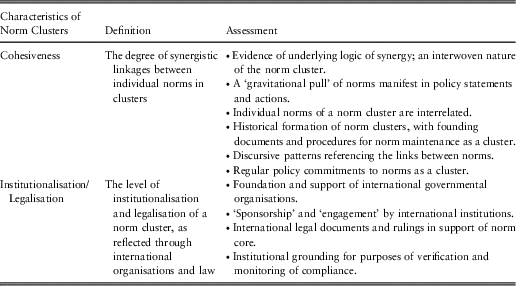
Fourth, our model contends that norm clusters are expected to be more or less resilient as a function of key characteristics (see Figure 1). Here, we draw on insights from both norm contestation theory and regime theory. For example, Müller proposes, ‘normative systems are often “integrated within hierarchies of increasing abstraction and comprehensiveness”’.Footnote 43 Such normative systems may comprise the broader normative context in which singular norms are situated and linked to each other.Footnote 44 Sakiko Fukuda-Parr and David Hulme further identify ‘supernorms’, or ‘carefully structured sets of interrelated norms that pursue a grand prescriptive goal’ and are ‘grouped into a unified and coherent framework’.Footnote 45 At its extreme, such a norm cluster may be cast into dense institutionalised structures in the form of international regimes.Footnote 46 Research on international regimes contends, ‘a rule is more likely to obligate if it is made within the framework of an organized normative hierarchy, than if it is merely an ad hoc agreement between parties in a state of nature’.Footnote 47
A resiliency model of norm clusters.

As illustrated in Table 1, two of the most important characteristics that provide norm clusters with adaptive mechanisms for dealing with challenges are: (1) the degree of cohesiveness and synergistic linkages between the individual norms (as a function of norm clusters); and (2) the level of institutionalisation and legalisation of a norm cluster. First, synergistic linkages in norm clusters can be developed to both tie together and balance the interests of different parties. This prospect is well supported by regime theories, which contend that the strength of a regime increases the closer the linkages between singular norms and principles.Footnote 48 The architects of norms (or entrepreneurs) strategically create ‘package deals’ by making concessions in one issue-area only in return for advantages in other areas. Cohesiveness may be best evidenced in the discourse during formation of norm architectures, which reveals common patterns and commitments in early stages of norm development. Norms that are established as a cluster or integrated network of principles are often defined in founding documents of organisations.Footnote 49
Key elements of the resiliency model.

Cohesiveness also can be seen in the synergistic linkage of normative themes (or what Margaret E. Keck and Sikkink call ‘issue linkages’.Footnote 50 This is the underlying logic that forms a ‘gravitational pull’ of norms together. Usually, norms are embedded or ‘nested’ together in larger complexes and institutional alignments, linked formally or informally through institutions and agreements and practices.Footnote 51 This gravitational pull reflects the synergy of beliefs and values between various norms within a cluster. This should be evident in discursive connections drawn between norms in conference proceedings as well as official government documents. The interwoven nature of the individual norms helps to ensure the upholding of the functionality of the norm cluster in light of challenges. As we elaborate in more detail below, within densely institutionalised norm clusters, challenges are processed in distinct ways. Those guided by legalised procedures help to insulate against actions of non-compliance and confine the limits of legitimate arguments. The impact of challenges is mitigated by institutions, rules, procedures, and decision-making processes that allow an evolution of perspectives rather than simple defeat or rejection of counterarguments.
Second, norm clusters that are grounded in larger international institutional and legal networks and have the foundation and support of international governmental organisations may be more resilient. Regime theorists suggest such embeddedness of singular institutions in larger normative frameworks under the heading of norm strength and institutionalisation, defining the latter as ‘an international process’ that ‘refers to the way in which norms emerge at the international level and become reflected in international law and organizations, with treaty signature and ratification by individual states seen as an important signal of institutionalization’.Footnote 52 Institutional foundations for the normative architecture are often established in the founding of the norm/s and through subsequent sponsorship and engagement by international institutions. In such settings, international institutions serve as important stewards of international norms in clusters, providing forums, ‘good offices’, and larger networks for support and achievement of international cooperation on major issues.Footnote 53 Besides serving as sites of contestation, they provide procedures of discourse and standardised practices that both enable contestation and yet help to constrain its potential impact on institutional agreements. In so doing, institutions help to fill the ‘legitimacy gap between fundamental norms and standardized procedures’ and promote stakeholder engagement. By providing fora for ‘a priori “regular contestation”’ they help to tame ‘the potentially conflictive outcome of political contestation’.Footnote 54 In addition, norms that are clearly connected to institutions for verification and monitoring purposes may also be more successful at identifying and overcoming challenges – at insulating the norm core against questions of validity or legitimacy.
Levels of international norm cluster resiliency also may be higher when norm clusters are grounded in international law. In some cases, this may be formaliaed and instituted in international legal rulings. In others, opinio juris denotes a subjective obligation, a sense on behalf of a state that it is bound to the law in question and that norms represent a de facto guide to state behaviour. Kenneth W. Abbott and Duncan Snidal argue that legal dimensions tend to depoliticise issues and offer a ‘general strengthening of the obligation of norms’.Footnote 55 Richard Price also examines the power of international and customary law that can be identified by analysing both state practices and opinio juris.Footnote 56 Norms that intersect with international legal structures, scholars contend, foster significant pressure for state compliance.Footnote 57 In sum, these characteristics of resiliency may help norm clusters weather problems or challenges over time.
Research design
This study explores the potential value of this model by examining its application in two case studies. The cases begin by tracing contestation of an individual norm. We then examine qualities of norm cluster resiliency (in case the norm is embedded in a broader normative structure), as a function of the level of cohesiveness of norms in the cluster as well as the level of institutionalisation and legal foundations. High resiliency should be evidenced in clusters with multiple norms that originate and develop in a cohesive manner, and that are embedded in or backed up by a dense institutional network and legal structures. High levels of cohesiveness are measureable in the formation of norm architectures, where discourse reveals normative linkages as well as common patterns and commitments in early stages of norm development.Footnote 58 This cohesiveness also can be seen in the synergistic linkages of normative themes in ongoing deliberations – as the underlying logic that forms a ‘gravitational pull’ of norms together. Meanwhile, lower levels of resiliency may be exhibited by more ‘singular’ norms, which have typically been developed independently by states, evolved in the course of state customary practice or through a bottom-up process of grassroots activism. These norms tend to be less anchored in international agreements or within international organisational homes, or to be as broad, universal, and endorsed by a range of states in the international system. In other words, these are norms where we assume lower levels of cohesiveness (or weaker links between singular norms and others in a cluster), institutionalisation, or foundation in international law. In such situations, this study posits, norms are less resilient and contestation may do them more harm.Footnote 59
We explore the utility of the model by employing the comparative case study method and process tracing. We compare a ‘most likely’ case focusing on the contested nuclear disarmament norm embedded within the nuclear non-proliferation regime with a ‘least likely’ case analysing challenges to the rather lone-standing anti-assassination norm. Specifically, we trace the processes of norm contestation, institutional deliberations, and outcomes.Footnote 60 Comparative case studies include contestatory discourses and practices for norm development. Criteria for case selection include variance in issue areas and the levels of norm resiliency. Due to space constraints, we limit our selection to two prohibitionary norms that vary on levels of norm embeddedness: the nuclear disarmament norm within the non-proliferation regime and the norm banning assassination of foreign adversaries. To support our claim, we expect to find that resiliency has an effect on the outcome of norm contestation, making it harder to weaken the norm.
Disarmament, contestation, and the resiliency of the non-proliferation regime
The norm of nuclear disarmament calls for the elimination of nuclear weapons under a system of strict monitoring and safeguards. It was developed in accordance with the broader non-proliferation norm of preventing the spread of nuclear weapons. In 1946, the United Nations (UN) General Assembly first established a Commission to confront problems related to the discovery of atomic energy. Early negotiations on nuclear disarmament occurred in the First Committee of the UN General Assembly, the UN Disarmament Commission, NATO, Euratom, and the International Atomic Energy Agency (IAEA). The nuclear non-proliferation regime, with the Treaty on Nuclear Non-Proliferation (NPT) at its center, emerged as a complex, or cluster, of interrelated norms. The NPT does not formally outlaw nuclear weapons, rather it represents a bargain among nuclear-weapons states (NWS) and non-nuclear-weapons states (NNWS) that rests on three normative ‘pillars’: (1) the obligation of NWS not to transfer nuclear weapon technologies to NNWS (Articles I and II); (2) the ‘inalienable right’ of all states parties to access the peaceful uses of nuclear energy (Article IV); and (3) the obligation on the part of all states parties to work towards nuclear disarmament (Article VI).Footnote 61 While endorsed by the UN and the NPT ratified by most governments, this normative architecture nevertheless became a fertile ground for contestation.Footnote 62
Contestation
The nuclear disarmament norm has faced waves of contestation and challenges over time. As early as the 1960s, many states participating in negotiations for the creation of the NPT resisted the idea of a commitment to nuclear disarmament and implications for state behaviour. For example, when Ireland first called for negotiation of a non-proliferation treaty that would question the justification of the possession of nuclear weapons by any country, the United States and other nuclear-weapons states pushed back.Footnote 63 A ten-nation UN Disarmament Committee was established in 1959, but deliberations immediately highlighted differences between states that supported a traditional prohibitionary norm frame and others that favoured a discriminatory architecture.Footnote 64 By the early 1960s, Western countries began to champion a discriminatory regime that allowed some states to retain nuclear weapons in exchange for controls on their further dissemination, promotion of peaceful nuclear energy development, inspections and safeguards, and a pledge to work toward disarmament. Many other governments protested this idea of an unequal emerging architecture. Yet, in 1970 the NPT entered into force as a compromise solution based on a three-pillared norm cluster.Footnote 65
Intense episodes of applicatory and justificatory contestation have also occurred during the NPT Review Conferences (RevCons) held every five years after the 1970 formal launch of the regime. States have questioned the hierarchy of the three different pillars as well as the meaning of individual norms in the system.Footnote 66 Disagreement on the disarmament norm prevented four of the nine NPT RevCons to end with final documents (in 1980, 1990, 2005, and 2015). Indeed, (particularly non-aligned) NNWS regularly criticise the nuclear weapon states for not living up to their disarmament commitments. While no member state would officially challenge the validity of the disarmament norm, disagreement reigns as to the substance and scope of the precise requirements following from Article VI.
In many ways, the Ninth NPT Review Conference in 2015 represented the culmination of these exchanges. Diplomats voiced new challenges to the disarmament norm, as well as debated the importance of strengthening non-proliferation efforts and how to respond to actual and suspected cases of non-compliance with the treaty. NNWS were especially committed to pushing more concrete, time-bound commitments on disarmament to help NWS meet Article VI pledges. Particularly pressing issues included the emerging discourse on the humanitarian impact of nuclear weapons and the prospect of negotiating a legally-binding instrument prohibiting nuclear weapons. Many NNWS supported the elimination of all nuclear weapons in an irreversible and verifiable manner, with the goal of establishing a ban by 2030.Footnote 67 Meanwhile, the five NWS and some allies opposed a legally binding instrument and instead recommended an incremental approach toward the aspirational objective.
An international agreement on the humanitarian impact of nuclear weapons has become a focal point of the disarmament debate in the past decade. The reluctance of NWS to commit to a binding, treaty-bound path towards nuclear disarmament had created considerable discontent and led to the establishment of a coalition among a majority of (NNWS) NPT members and a determined NGO community focusing on the humanitarian impact of nuclear weapons.Footnote 68 A series of conferences on this issue were held in 2013 and 2014, culminating in the adoption of the ‘Austria Pledge’ in December 2014, which essentially advanced a nuclear weapons ban treaty.Footnote 69 At the NPT RevCon this agreement caused considerable conflict and hardened the dividing lines between NNWS and NWS. The ‘radicalization’ of the disarmament debate was perceived of as directly challenging the fragile compromise of the non-proliferation regime.Footnote 70 Supporters of the humanitarian pledge and disarmament-friendly states doubled-down on their demands calling for a nuclear weapons ban treaty or a comprehensive nuclear weapons convention.Footnote 71 While discursively upholding the commitments enshrined in the contested norm, NNWS also highlighted a lack of implementation on part of the NWS. In fact, only five of the 22 items related to disarmament in the 2010 NPT Action Plan had generated any movement by states parties to the NPT.Footnote 72 Meanwhile, diplomats from France, the United Kingdom, and the United States reached the limits of their patience on the question, calling the proposed text on humanitarian consequences for the outcome document unacceptable and ‘unrealistic’.Footnote 73
The disarmament norm generated a high level of contestation at the 2015 RevCon and ultimately contributed to the collapse of consensus on an outcome document. Yet, in October 2016, the humanitarian movement scored a major victory when the UN First Committee decided to convene negotiations in 2017 on a ‘legally binding instrument to prohibit nuclear weapons, leading towards their total elimination’.Footnote 74 In a historic move, in July 2017, a majority of UN member states adopted the Treaty on the Prohibition of Nuclear Weapons against the declared intention of the NWS and their allies. Immediately after the vote, the United States, the United Kingdom and France jointly declared that they did ‘not intend to sign, ratify or ever become party’Footnote 75 to the Treaty. With ‘nuclear haves’ boycotting the new Treaty, contestation of the disarmament norm appears to continue.
Norm cluster resiliency
Cohesiveness
The disarmament norm is embedded in a highly cohesive non-proliferation regime complex supported by the NPT, which is considered fairly robust despite its discriminatory structure.Footnote 76 As noted above, at least three major norms make up this complex, including the obligation of NWS not to transfer nuclear weapon technologies to NNWS, peaceful nuclear energy cooperation, and the commitment by NWS to work towards nuclear disarmament. These norms are effectively bound by a central logic of restraint.Footnote 77 Yet, because the NPT discriminates between two classes of states and imposes different rights and obligations on them, its structure has fostered contestation.
Norm cohesiveness in the nuclear non-proliferation regime is a function of their historical development and synergistic linkages. That is, from the beginning, nuclear weapons states and non-nuclear weapons states participated in negotiations under the auspices of the UN with somewhat ideologically cohesive goals. Many agreed that nuclear weapons proliferation represented a multidimensional threat. UN negotiations to create the non-proliferation regime began in the late 1950s and included substantial institutional progress in the 1960s. The Commission on Disarmament became one of the first forums to address these issues, and the UN First Committee of the General Assembly offered a regular venue for interactions on questions of disarmament and no-proliferation. Negotiations in the First Committee helped to produce progress on questions of discrimination and verification, and the UN General Assembly acted in 1962 to effectively legitimise disarmament negotiations.
Norms in this cluster also exhibit a high level of synergy – substantive issue linkages where dimensions of the norms have clear connections and where compliance with one norm may impact on support for another. In many ways, the three main norms of the non-proliferation regime –non-proliferation, cooperation in the peaceful uses of nuclear technology, and disarmament – have been inextricably linked from their early formation. Considerations of any one of these norms have been interconnected with debates and discussions of the others, and this pattern has recurred throughout the history of negotiations of the NPT and subsequent RevCons and related initiatives in international diplomacy. The overall effects of this are that contestation appears to have less impact on the norm core due to the buoying and insulating effects of the cluster.
Institutionalisation and legalisation
The nuclear non-proliferation regime was established as a norm cluster by state governments working together through international institutions. The development of this institutionalised norm architecture was primarily orchestrated from the top down – beginning in the late 1950s and early 1960s with the UN serving as its symbolic foundation. Beyond hosting the negotiations for the original NPT, the IAEA as an affiliated agency also became the institutional home of monitoring, verification, and safeguards for the newly established system. The UN sponsored RevCons, as well as provided good offices for Preparatory Committee meetings in the years leading up to the RevCons. The First Committee and General Assembly became important venues for deliberations over nuclear weapons, even as a significant amount of validity and applicatory contestation occurred in early debates over the NPT. Diplomats pressed for a UN resolution in the 1960s geared primarily to the prevention of more dissemination of nuclear weapons, versus a plan to eliminate the stockpiles of weapons held by the superpowers, but delegates differed over implementation and interpretations of the new standards.
Disarmament and non-proliferation were also legalised. IAEA safeguards developed in the 1960s helped to establish powerful institutional foundations for cooperation and promote inspections and transparency of nuclear activities. The safeguard protocols were upgraded in the mid-1960s with the support of the UN, and NNWS suggested that all countries should subscribe to the IAEA inspections. The disarmament norm also established legal foundation in UN resolutions, the laws of war, judicial decisions, and supporting actions by non-governmental organisations. The UN General Assembly has issued resolutions declaring nuclear weapons to be a ‘direct violation of the Charter of the United Nations’ and ‘contrary to the rules of international law and to the laws of humanity’.Footnote 78 It has also characterised the use of nuclear weapons as a ‘crime against mankind and civilization’.Footnote 79 The legal stakes for nuclear weapons use were again raised by the 1996 ruling of the International Court of Justice, which argued that the use or threatened use of nuclear weapons was generally illegal.Footnote 80 Since July 2017, there is also an explicit treaty prohibiting development, manufacture, stockpiling, deployment, testing, transfer, use or threat of use of nuclear weapons.
In sum, the evidence suggests high levels of institutionalisation and legalisation of the disarmament norm. A number of institutions regularly debate and discuss nuclear disarmament, and the new nuclear weapons ban might even enhance these dynamics. Even if boycotted by the nuclear weapon states, the Treaty unambiguously outlaws nuclear weapons and as such strengthens the disarmament norm. It ‘fills a legal gap left by the NPT, which has allowed the five declared nuclear weapon powers to hang on to their nuclear weapons indefinitely’.Footnote 81 NWS may continue their rhetorical commitment to nuclear disarmament, and the existence of a legal ban might make it difficult for them to keep a low profile when it comes to complying with their Article VI obligations.
Outcome: Duration and resiliency
The resiliency of the disarmament norm cluster has clearly been bolstered by both synergistic linkages and institutionalisation. Together, these factors have contributed to the duration and resiliency of the norm. The disarmament norm and the larger non-proliferation norm cluster clearly faced a number of challenges over the decades. However, through years of negotiations delegates were able to effectively construct and uphold a consensus on a cohesive normative framework, supported by the grand bargain. Events of the 2015 NPT Review Conference and their aftermath reflected this longer-term trajectory. There was surprisingly little contestation over the non-proliferation norm beyond some specific questions of application and implementation, and for many countries discourse on peaceful uses focused primarily on applicatory contestation related to IAEA inspections and the Additional Protocol. At the time of writing, disarmament appears to remain a robust norm. The record shows that it has weathered substantial contestation, which has led to more specificity of the norm throughout the years.Footnote 82
Drone strikes and the norm against assassination
The development of the norm against assassination of foreign adversaries has a long and checkered history. What began as an emerging customary norm in bilateral relationships eventually became constitutive through endorsement by many countries. The norm was adopted as the preferred approach for governments to interact with one another in modern politics – it offered a measure of immunity for leaders, even when the countries themselves might be in conflict. At the same time, however, the norm against assassination of foreign adversaries has always seemed somewhat fragile. Not only have state leaders generally avoided direct debates about the ends and means of targeted killings, but some maintain the right to carry them out as an extension of sovereign self-defence. Major conflicts in the twentieth and early twenty-first centuries, including the war on terrorism, along with the advent of unmanned aerial vehicles (UAVs, or drones), highlight the push-and-pull of contestation of the norm against assassination.
Contestation
The historical development of the norm against assassination of foreign adversaries has been uneven. Political assassinations were almost routine in the ancient world of conquest and direct and indirect uses of power. This was a world in which the ‘killing of kings’ was considered fair game, and sometimes even preferable to all-out war between two countries.Footnote 83 Only with the establishment of the Westphalian system of sovereign states in the 1600s did the international community begin to imply that direct attacks against foreign heads of state should be discontinued in favour of new ordering principles of state sovereignty and balances of power that might grant more stability and order in Europe. Philosophers, prime ministers, and presidents argued that such actions were immoral and out of bounds for respectable players in global politics. Yet, tensions between these emerging norms continued as sovereign states demanded the right of self-defence. This was highlighted in cases during the Cold War, when intelligence agencies conducted covert operations, which included assassinations of foreign adversaries whom they believed were sympathetic to the adversary.Footnote 84
Targeted killing as a tool of statecraft has not engendered the creation of central international institutions or formal treaty that expressly bans such uses of force in all circumstances. Some have argued that targeted killings should be rejected as violating international standards of the laws of war for the protection of civilians from indiscriminate uses of military force, as well as the principle of sovereign self-defence.Footnote 85 Others have maintained that the prerogative of national security may lead governments to take actions they deem appropriate, even in extreme circumstances.Footnote 86
The invention of armed drones presents perhaps the most direct challenge to the nascent norm against assassination in the twenty-first century. Modern military drones were first developed by contractors in Israel and the United States as unmanned aircraft that could be flown remotely at high altitudes for prolonged periods of time. They can provide an ideal platform for reconnaissance operations and, with technology advancements, even airstrikes. Since 2001, the use of drones to launch missiles at adversaries has expanded dramatically, prompting important questions about the legitimacy of the norm against assassination. High-profile cases, such as the drone killings of US citizens (cleric Anwar al-Awlaki and his son) in the war on terror forced questions of application, not to mention justificatory standards.
US leaders have remained steadfast in their support of the use of drones for targeted killings. For example, in his 2002 National Security Strategy for the United States, President Bush argued the United States had the legal right to self-defence and even pre-emptive attacks against enemies plotting to kill Americans. The Bush administration authorised both the Pentagon and the Central Intelligence Agency to conduct a vigorous drone war in places like Afghanistan and the tribal regions of Pakistan. President Obama actually expanded the drone campaign in his first years in office against al-Qaeda and Taliban targets, and authorised operations in Somalia and Yemen. In 2013, President Obama publicly acknowledged the existence of the drone programme and laid out a set of standards that he argued would provide greater restrictions for use of targeted killings in the war on terror. He argued that the use of drones was justified in the war on terror as ‘lethal, targeted action against al Qaeda and its associated forces’. Drone strikes were legal ‘under domestic law and international law’, he claimed, given the state of war between the United States, al-Qaeda, the Taliban, and associated forces.Footnote 87
At the same time, these attacks have generated controversy in international institutions. Critics have charged that the United States and other countries using armed drones are carrying out extrajudicial killings, in violation of international law. One of the most controversial aspects of the drone war has been the use of so-called ‘signature strikes’ against suspected terrorists. President Obama also escalated the campaign of drone strikes against al-Qaeda and Taliban groups after he took office. In response, the UN has become a forum for contestation of these types of targeted killings. In 2013, the UN General Assembly Third Committee (Social, Humanitarian, and Cultural) began debating the legality and ethics of unmanned aerial vehicle attacks, with critics warning that they represented a dangerous new form of extra-judicial killing.Footnote 88 In 2014 the government of Pakistan sponsored a resolution in the UN Human Rights Council that questioned whether US drone strikes violate international human rights law. This resolution became a template for other actions to challenge Western countries’ use of drones. A series of critical forums were held in 2015, for example, under the auspices of the First Committee of the UN General Assembly, in which diplomats continued the debate over the political, legal, and ethical dimensions of armed drones. Diplomats and NGOs drew new attention to the potential implications of the proliferation of these weapons systems and urged the international community to establish new standards and even a form of UAV arms control.
Norm cluster resiliency
Cohesiveness
The norm against assassination of foreign adversaries is not cohesively grounded in a broader norm cluster of similar, widely accepted norms. One of the reasons for this is that it emerged as a customary norm that was not explicitly endorsed by international institutions. Its principled foundations grew out of the writings of important figures in the development of international diplomacy and law – Grotius, de Vattel, and Jefferson – reflecting optimistic and ambitious philosophical arguments that assassination was unethical or ‘unfair’. Rather than gaining endorsement as a central pillar of international institutions, though, the norm appeared to gain only tacit endorsements from great powers and international institutions.
At the same time, there appears to be a lack of synergy or cohesion between the anti-assassination norm and other principles. For example, one could argue that the links between sovereignty and the ban on assassination are fraught. The many rules and standards of the UN system operate on the assumption of state sovereignty: the UN espouses a generalised commitment to non-intervention and peaceful conflict resolution. Article II of the UN Charter grounds the United Nations in the ‘sovereign equality of all its Members’. UN Charter Article II (4) proscribes any use or even the threat of the use of force, and Article II (7) prohibits any form of external intervention in the domestic affairs of a state by any means. However, many argue that the norm against forcible intervention applies only to peacetime, and even then is fragile in its constitutive nature. The very nature of warfare in the twenty-first century pushes the boundaries of such principles. Even when countries are willing to use armed drones, they claim that such uses are discriminate. The era of ‘smart bombs’ and armed UAVs opened the possibility of attacks against foreign adversary command and control facilities (for both state and non-state actors), but governments that employed these systems could claim that the leaders were not personally targeted. No weapons system highlights the irony of the principles behind the assassination ban more so than drone warfare. Here, the US government has effectively attempted to legitimise its development and use of drones in the post-September 11 era by redefining its commitment to the norms of sovereignty and self-defence.Footnote 89
Drone warfare also challenges the norm of non-combatant immunity. This principle was an ancient and widely accepted rule of the law of armed conflict, which demands that states should not carry out indiscriminate uses of military force that threaten civilians. It was grounded in the Hague Conventions at the turn of the twentieth-century that prohibited attacks directed against undefended or unfortified towns and UN declarations.Footnote 90 In 1977, Article 48 of the Additional Protocol to the Geneva Conventions articulated a more detailed commitment by states to protect civilians by demanding states use discriminate, proportional military force. In the revolution in military affairs, states with these capabilities appear more willing to use force, while at the same time claiming that such uses are discriminate. They are more willing to pursue attacks that might lead to the death of adversarial leaders when targeting command and control facilities.Footnote 91 In sum, given the singular nature of the norm against assassination and the weak connections (and even contradictions) between it and other norms, this case appears to demonstrate a low level of synergy. Dimensions of some of the norms affected by the use of armed drone strikes (state sovereignty versus protection and defence in the war on terror) do not have strong connections, and as a result the assassination ban core may be less insulated from validity challenges. Further, compliance with one norm may negatively impact support for another – and acts of non-compliance can be justified with reference to other norms.
Institutionalisation and legalisation
The assassination ban is not heavily institutionalised. It emerged from individual state practices and gained endorsements from the international community over time. Western countries began to develop laws of war – standards of behaviour that called for restraints on the use of force in a number of categories in the nineteenth century. One of the first attempts at codification of new standards came in the US Army’s Lieber Code of 1863, which defined assassination as antithetical to the modern era (General Orders #100). States participating in the Hague Convention of 1907 took this a step further, establishing a customary prohibition on assassination as ‘treacherous killing’. The League of Nations 1937 Convention for the Prevention and Repression of Terrorism codified the illegality of the assassination of foreign leaders, their families, and other ‘protected persons’.Footnote 92 After 1945, the UN system also helped codify some standards,Footnote 93 culminating in 1973 in the passing of a Convention on the Prevention and Punishment of Crimes against Internationally Protected Persons, characterising assassination as a violation of international law. Assassination was defined as ‘the intentional killing of an internationally protected person’ using the definition of ‘protected person’ as outlined in Article I of the Convention.Footnote 94 Diplomats spoke to the dangers of political assassination as a lingering form of neocolonial exploitation, not to mention its potentially destabilising effects on social order.
Beyond conventions, however, there is no central institutional architecture overseeing the ban on assassination, nor is there a system for monitoring and sanctions. Limits on assassination remain self-imposed by states. The US renunciation of assassination in the Cold War is one example of a moral statement, calling the act a ‘violation of the traditional American way of life … [and] traditional American notions of fair play’.Footnote 95 Meanwhile, the self-defined nature of these constraints also has left a great deal of room open for interpretation – and idiosyncratic processes of internalisation or challenge. Cases in point are the attempts by the US government to legitimise its recent drone programme by redefining its commitment to the norms of sovereignty and self-defence.
While the international community may have embraced moral foundations of a ban on assassination, the legal foundations remain circumscribed. Even Grotius qualified his arguments by acknowledging that states had the right to declare war for the protection of sovereignty and that an attack on a leader was acceptable if no treachery was involved.Footnote 96 While international conventions call for the right to individual life and liberty, most emphasise protections from arbitrary or unjust attacks. Short of an absolute ban on the use of force for self-defence, for example, the European Convention for the Protection of Human Rights and Fundamental Freedoms establishes a proportionality test to determine the required conditions necessary to justify the state’s use of force.Footnote 97 As scholars Richard Murphy and John Radsan argue, targeted killing is often disputed from a legal perspective because ‘it does not fit comfortably into either of the two models that generally control the state’s use of deadly force: human rights law and international humanitarian law (IHL)’.Footnote 98 Existing legal regimes make the distinction that if there is a presence of an armed conflict, such actions may be taken. While threatening human life might violate the International Covenant on Civil and Political Rights, even the International Court of Justice allows that state sovereignty must take precedence in most cases. Ultimately, then, this issue comes back around to whether states have determined their uses of force are justified. And in the two cases where government court systems have publicly acknowledged using targeted killing, Israel and the United States, both have deemed actions consistent with the law.
Outcome: Inconsistency
The record of the international norm against assassination has been uneven, at best. As a basic moral principle, it has been championed by many different countries over time. Various international institutions have issued statements condemning attacks on civilians and non-combatants. However, this study suggests that the specific norm against assassination lacks fundamental cohesiveness and institutional grounding. While various states and international organisations have called for the end to targeted killings, there are no central institutions or organisations devoted to oversight or enforcement of the norm. The international community has largely depended upon the goodwill and voluntary restraint of countries that employ such means. The advent of armed drones has intensified contestation of the norm and has led to its loss of influence. There is little interest among Western powers for an international accord that might limit the use of drones. At the time of writing (2017), dozens of governments are developing armed drone programmes with the expressed intention to modernise their military capabilities and promote national security.
Findings
This study argues that resiliency of norm clusters may contribute to the stability and duration of norms. By contrasting the characteristics of norm clusters for two prohibitive norms, it suggests important differences in outcome when norms face contestation. The disarmament norm remains stable and durable in spite of contemporary challenges. It it is continuously endorsed and activated in discourse; with the NPT claiming nearly universal membership, the disarmament norm (as one of the three pillars of the NPT) is accepted by more than a critical mass of players. Even though NWS have been slow in their progress to implement concrete disarmament steps, they do not contest the general validity of the disarmament norm. In fact, their lack of commitment regularly evokes harsh criticism and has prompted initiatives to not only specify the commitments, but also to establish an emerging norm of NWS accountability for compliance with Article VI. Throughout the years, contestatory discourses have considerably increased the norm’s specificity. Lately, disarmament-friendly states and civil society actors even succeeded in establishing a legal prohibition on nuclear weapons. Because the disarmament norm is part of a dense, fairly cohesive and institutionalised norm cluster, we argue that it is quite resilient.
In contrast, the norm against assassination is relatively isolated and lacks support of a resilient norm cluster. Optimists maintain the norm as internalised and habitualised, yet there is ample evidence to suggest that it has lost legitimacy in contemporary global politics. The norm core of the legitimacy of the assassination ban appears to have been undermined by an absence of cohesiveness with related norms at the heart of a limited network and especially the absence of strong institutional and legal foundations. Technology advances are also at play here: an increasing number of states appear to be developing armed drone capabilities and using them in military hostilities to target terrorist group leaders. Violations of the norm appear to have been met with general indifference and no redress through formal political or legal institutions.
Comparisons across the two cases reveal interesting patterns of norm contestation. In the NPT formation case study, there was substantial validity and applicatory contestation over the disarmament norm. However, diplomats were able to effectively construct a consensus on a discriminatory normative framework, supported by a grand bargain – NWS would pledge to work toward disarmament while offering peaceful nuclear assistance to NNWS to promote economic development. The superpowers negotiated and implemented a series of arms control and arms reduction agreements in the spirit of disarmament, though debates remain regarding the exact meaning and application of the disarmament norm. Yet, its overall validity has never been seriously challenged. Through discursive encounters, states’ interpretations of the meaning of the norm has seen considerable convergence, which has resulted in a series of concrete, specific disarmament measures, culminating in a legal ban of nuclear weapons against the will of the NWS. Meanwhile, the ban on assassination has received far less direct debate and attention – in part because the assassination norm is not closely linked to other norms in a cluster. Beyond references to standards in international conventions, states continue to carry out targeted killings in the name of sovereign self-defence. Rather than directly confront the validity of the standard in some cases, state actions have simply disregarded such constraints. The critical difference between these norms appears to lie inter alia in characteristics of the norm cluster, referring to the degree of cohesiveness, institutionalisation, and legalisation.
A higher level of resiliency of the non-proliferation norm cluster seems to have allowed it to adapt to applicatory contestation of its individual norms and helped insulate the norm cores against validity claims. In contrast, the assassination norm is not cohesively linked to a larger norm cluster and not well institutionalised or legalised. As a result, the norm core appears neither buoyed against applicatory contestation, nor insulated from validity challenges. One factor illustrating the low level of cohesiveness in the case of the assassination norm was its conflicting relationship with the norm of sovereignty. In some ways, then, resiliency may be a better measure of legitimacy of the entire norm network than norm robustness.
Conclusion
This study reveals the degree to which resiliency of norm clusters aids in responding to contestatory discourses and behaviours. In the case of the disarmament norm, for example, contestation has added greater clarity of commitments and promotion of strategic arms reductions. Higher levels of resiliency may allow norm clusters to adapt to applicatory contestation and questions and help to insulate the norm core against validity claims.
This study distinguished conceptually between different structural layers that can generate various effects in conjunction with norm contestation. By adding a third, or intervening layer of norm clusters between the intersection of norms (lowest layer) and normative structures (broadest layer), we have shifted from the focus of early work on structural norm-centered analysis towards agency input through the practice of contestation. This study has shown that norms embedded in such clusters may be more resilient towards challenges. The disarmament norm has survived contestation without significant damage to its validity over time, whereas the norm against assassination appears diminished in the face of continual challenges. Thus, we conclude that attention to the robustness of individual norms may be misdirected, especially when they are embedded in more resilient normative clusters. We submit that the resiliency of normative structures represents a more accurate portrayal of norm health – and helps bridge questions of agency versus structure. The resiliency of norm clusters through cohesiveness and legalisation has been shown to mitigate the effects of applicatory contestation and insulate the individual norm cores from validity challenges.
This study also highlights the degree to which the nested nature of norm clusters may be a function of their construction or development over time. That is, the nuclear non-proliferation regime presents a particularly cohesive and institutionalised norm cluster that was carefully designed by state governments. The NPT at its centre binds a complex of interrelated and balanced norms. Even though states differ regarding the meaning and relative importance attributed to individual norms, such contestation does not touch the legitimacy of the norm cluster as a whole. Obviously, cohesive norm linkages can absorb discontent with (the implementation and meaning of) individual norms. Nuclear weapon states might disagree with non-nuclear weapon states regarding individual disarmament measures, but with their signature they have subordinated themselves to uphold the ‘grand bargain’ underlying the treaty regime. Thus, it is not possible to prevent of the further dissemination of nuclear (weapons) technology without paying tribute to the disarmament stipulations enshrined in Article VI. In many ways, then, the institutionalisation and legalisation of the disarmament norm and the non-proliferation regime represent the quintessential institutionalised norm. Conversely, the assassination norm appears to have percolated down from customary norms in bilateral relationships to broader acceptance. The constraint was not ordained by great powers as a fundamental ordering principle, nor were strong institutional frameworks created to support a multidimensional, highly cohesive norm cluster.
Finally, this study raises interesting questions for theories of norm contestation. Assertions that different types of contestation may have different effects appear upheld by this study: the resiliency of the norm cluster appears to be a powerful mitigating force. Studies of norm ‘death’ or regress appear to reach similar conclusions, though their attention to the qualities of the norm cluster is indirect. The resiliency model also provides foundation for further exploration of developments in other norm clusters, including international efforts to curb the illicit spread of small arms and light weapons, the anti-torture norm, the anti-whaling norm, the anti-mercenary norm, and the Responsibility to Protect. Of course, the relationship between contested norms, their robustness and norm cluster resiliency needs more qualification. For example, large-N studies could try to assess the resiliency of existing norm clusters. Cases in which a contested norm is embedded in a norm cluster with only low levels of cohesion between the individual norms and/or low levels of legalisation/institutionalisation also would be very interesting to further explore.
Acknowledgements
The authors gratefully acknowledge comments on this manuscript from Nicole Deitelhoff, Lisbeth Zimmermann, Wayne Sandholtz, and Adam Bower, as well as helpful guidance from anonymous reviewers of the RIS. We also appreciate the support of the University Research Centers (UNCE) – Peace Research Center Prague, Faculty of Social Sciences, Charles University.