INTRODUCTION
With Americanized English the common tongue for much of the industrialized world, knowing a second language might seem as useless as learning Morse code. However, executive recruiters and hiring personnel say North Americans who speak Spanish can do far more than chat up Latino receptionists. Bilingual skills help job seekers land work. They can lead to key assignments and pay raises. In some cases, they may even be a job requirement. –Dan Woog (Monster.com)
The quote above, from a popular employment website, exemplifies a framing of multilingualism as human capital. The author represents bilingualism in Spanish and English as an investment in knowledge and skills that can provide advantages and benefits on the labor market, reflecting a discourse of multilingualism as a form of economic advantage, a discourse that has become increasingly dominant in contemporary society (Heller & Duchêne Reference Heller, Duchêne, Heller and Duchêne2012). As Heller & Duchêne (Reference Heller, Duchêne and Coupland2016) note, although this discourse is common and potentially rhetorically effective, it does not necessarily reflect the economic realities of how linguistic repertoires are valued. It is thus worth examining in detail whether representations of multilingualism as human capital reflect economic realities, or whether such discourse might instead obscure a more complex situation.
In this article, I consider the case of Spanish-English bilingualism in the United States and whether, as is suggested by the quote above, it yields advantages on the labor market, what those advantages might be, and for whom they might accrue. First, I consider past research examining demand and returns for Spanish-English bilingualism on the US labor market. I argue that findings from existing literature cannot be readily explained merely by conceptualizing multilingualism as human capital. Rather, I suggest that it is also important to attend to the ideologies that underpin employers’ valuations of language skills. Specifically, I argue for a need to consider the ways raciolinguistic ideology (Flores & Rosa Reference Flores and Rosa2015; Rosa & Flores Reference Rosa and Flores2017) may assign value to linguistic repetoires not primarily on the basis of their communicative utility but rather with respect to the value associated with their racialized speakers. I then introduce the methods and findings of my own study, which is, to my knowledge, the first to use online job advertisements as a way of studying possible economic returns to Spanish-English bilingualism (although Kalist (Reference Kalist2005) and New American Economy (2017) use online job advertisements to examine demand for bilingualism). Finally, I interpret the findings through the lens of raciolinguistic ideology and suggest directions for future work.
LATINXS, SPANISH-ENGLISH BILINGUALISM, AND THE UNITED STATES LABOR MARKET
Underlying the framing of multilingualism as human capital is a view of language as commodity (Holborow Reference Holborow2015). In other words, the idea that learning additional languages is a way of increasing one's human capital presupposes a view of languages as comprising substances that are roughly interchangeable across individuals. It also assumes that workers’ linguistic repertoires can be and are objectively measured to determine their communicative utility or production value. Thus, a human capital perspective posits that the price of the individual's labor will be determined by what the labor market is willing to pay for their skills, taking into consideration market conditions, particularly the demand for and supply of said skills. Hence, this perspective would predict that the ability to speak a language that employers have a great need for would give an individual a labor market advantage, allowing them to accrue economic benefits such as greater earnings and more work choices or opportunities.
As I suggest in this work, however, the discourse of multilingualism as human capital considerably underestimates the complexities and contradictions that go into treating language as commodity and assigning it value. In particular, it does not consider how the processes of determining whether individuals possess linguistic skills and assigning those skills value rely on ideologies of language and take place within existing systems of unequal power (Park & Wee Reference Park and Wee2012). In this work, I focus on Spanish in the United States and suggest that accounting for the racialization of Latinxs and their linguistic repertoires is crucial for understanding the value assigned to Spanish-English bilingualism on the US labor market.
Two observations about the economic treatment of Spanish-English bilingualism require a more complex explanation than that offered by the common, if simplified, human capital perspective I outlined above. First, US employers’ demand for Spanish-English bilingualism is substantial, but, curiously, given the large bilingual Latinx population, some employers report a shortage of potential employees with the needed language skills. Second, although they have a lesser likelihood of being un- or underemployed than their monolingual counterparts, existing evidence suggests that bilingual workers tend not to receive wage premiums for their language skills. I now present an overview of the evidence supporting these observations and then attempt to explain them drawing on the concept of raciolinguistic ideology.
As I have already mentioned, US employers’ demand for Spanish-English bilingualism is substantial (New American Economy 2017). The need for workers who can provide services to clients or who can communicate with coworkers in both languages is especially clear in areas that have large Spanish-speaking populations such as in parts of New Mexico (Villa & Villa Reference Villa and Villa2005), California (Porras, Ee, & Gándara Reference Porras, Ee and Gándara2014), and Texas (Alarcón & Heyman Reference Alarcón and Heyman2013, Reference Alarcón and Heyman2014). For example, Villa & Villa surveyed 146 employers in southern New Mexico and found that the majority (52.06%) preferred that employees be bilingual and a smaller number (9.66%) required Spanish-English bilingualism. The authors also reported that the vast majority of employers (91.8%) did not report difficulty in finding bilingual workers.
A rather different assessment of the US supply of bilingualism can be found in a report by Forbes Insights (2011). It contains findings from a survey of executives at large US corporations. Respondents were asked about the potential value of multilingualism for executives in multinational corporations. The report states that the number of expatriate assignments for US managers or executives has increased and will continue to increase in the coming years. Survey respondents were in overwhelming agreement that ‘expatriate managers are more successful when they are bilingual’ (2011:6). Nonetheless, the report contains gloomy predictions about the prospects of US residents to fill these positions, suggesting that a perceived lack of multilingualism among US workers puts them ‘at a significant disadvantage on a globalized playing field’ (2011:8). Although the report does not focus on any particular language, the prevalence of Spanish suggests that it must be among the languages in highest demand by multinational corporations.
This perceived shortage of multilingual candidates seems difficult to reconcile with US history and demographics. Spanish speakers in many parts of the present-day US predate even the first English settlers at Jamestown (Macías Reference Macías2014). Today, migration to the US from Latin America provides a constant supply of Spanish speakers (Rumbaut & Massey Reference Rumbaut and Massey2013). According to data from the American Community Survey (ACS; US Census Bureau/American FactFinder 2014), an estimated thirty-eight million residents of the US reported using Spanish (or a Spanish Creole) at home in 2014, roughly thirteen percent of the population, more than half of whom also reported speaking English ‘very well’ (approximately twenty-two million). In order to perceive a shortage of multilingual workers, it appears that respondents to the Forbes Insights survey, consciously or not, largely exclude the bilingualism of US Latinxs as a viable source of the linguistic skills they desire. Forbes Insights’ respondents are not alone in perceiving a shortage of multilingualism; Fishman (Reference Fishman, Finegan and Rickford2004:124–25) asserts that US industries frequently turn ‘a deaf ear’ to the multilingualism of language minority groups in the US. I return to this issue below; next, I consider the apparent lack of wage returns for Spanish-English bilingualism.
Despite apparent demand for their linguistic skills across regions and industries, past research has found scant evidence that US Latinxs’ linguistic repertoires are rewarded by higher wages on the labor market. Several large-scale studies have attempted to infer the effect of Spanish-English bilingualism on workers’ earnings once a number of confounding variables are controlled for by conducting analyses of large datasets, like the American Community Survey (ACS) conducted by the US Census Bureau.
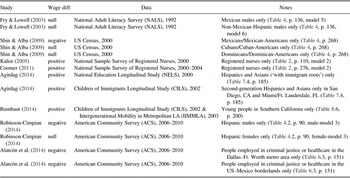
The studies in Table 1 attempt to infer the effect of bilingualism (in most cases, specifically Spanish-English bilingualism) on wages. They do so via regression analysis in which a variety of other factors that influence an individual's income level are taken into account, with the hope that what is left over in the association between income and bilingualism is a reasonable estimate of the wage returns to bilingualism. All of these studies control for other predictors of income that are also likely to be associated with bilingualism. Most control for at least four or five of the following: educational attainment, region, gender, occupation, race/ethnicity, and age (or work experience). For purposes of space, I attend only to associations between wages and bilingualism, meaning that the summary of each study in Table 1 only focuses on one or a few of the multiple analyses presented in some of these reports.
Summary of research on wage differentials between monolingual (English) and bilingual (mostly Spanish and English) workers.

In a few small-scale analyses, Spanish-English bilingualism is associated with positive gains over the earnings associated with English monolingualism. Two of these analyses (Kalist Reference Kalist2005; Coomer Reference Coomer2011) are restricted to the earnings of registered nurses; both analyze data from the same survey. Each finds that registered nurses who report being bilingual in Spanish and English earn more than their English monolingual counterparts.
In addition, both Agirdag (Reference Agirdag2014) and Rumbaut (Reference Rumbaut2014) find that bilingualism is associated with higher wages than English monolingualism for young people whose families are relatively recent arrivals to the US from Latin American or Asia (e.g. for the CILS data, the participants are all second generation). Importantly, these are the only two analyses that include languages other than Spanish, which is important given the very different socioeconomic outcomes that Asians and Latinxs experience on the US labor market, which both studies provide evidence of.
The remaining analyses, which tend to deal with more nationally representative samples, point toward no or a negative effect of Spanish-English bilingualism on an individual's earnings. While there appears to be consistent evidence suggesting that Spanish-English bilinguals are less likely to be un- or underemployed than their monolingual English-speaking counterparts (e.g. Agirdag Reference Agirdag2014; Robinson-Cimpian Reference Robinson-Cimpian2014), the analyses reviewed in Table 1 provide little evidence to suggest that bilingualism is associated with higher wages. Rather, Spanish-English bilinguals appear to be compensated at a rate that is the same or less than their monolingual English-speaking counterparts (with the apparent exception of registered nurses). Such findings are not easily explained by the human capital perspective I outlined above, since it would likely predict that an in-demand skill like Spanish-English bilingualism would allow workers to exchange their labor for higher wages than their monolingual counterparts. The human capital perspective offers no readily apparent explanation for why bilingualism would be associated with a wage penalty.
I argue that these observations about the treatment of Spanish-English bilingualism on the US labor market are better explained by considering how unequal power relations and ideology shape the way language is conceived, assessed, and valued by employers. In particular, I focus my attention on raciolinguistic ideology and how it might be related to the apparent value assigned to Spanish-English bilingualism by US employers. Flores & Rosa (Reference Flores and Rosa2015) describe raciolinguistic ideologies as systems of belief that naturalize connections between racialized speakers and linguistic forms. Thus, Flores & Rosa argue that racialized speakers’ linguistic practices are often ‘heard’ as deficient, especially from the perspective of racially and linguistically unmarked listeners (e.g. white monolingual speakers of ‘standard’ US English), not because they are communicatively inadequate, but rather because of the stigma attached to the racialized bodies that produce these forms. Hence, according to Flores & Rosa, in order to understand why a racialized group's language is stigmatized, it is more informative to examine the ideological processes by which deficiencies are constructed and reproduced rather than the linguistic practices themselves.
In this work, I take up Flores & Rosa's call for work on the ideological processes that undergird the way racialized language practices are received. I propose that raciolinguistic ideology may inform competing orientations to Spanish-English bilingualism on the US labor market. I argue that the demand for US employees who are Spanish proficient (usually in addition to English proficient) can be understood with appeal to two orientations to the utility of the language: Spanish as world language and Spanish as local language. These orientations are competing ideological conceptions intended to describe how US employers (and others) might imagine, represent, and assign value to Spanish. I argue that US employers and others orient to Spanish in competing ways that construct different imagined audiences and may presume differently racialized groups of Spanish users.
When Spanish is oriented to as world language, it is represented as having economic value because of its possible facilitation of international trade. Trade between the United States and Spanish-speaking countries is prevalent and has increased over the past few decades because of trade deals, especially the North American Free Trade Agreement (NAFTA; Villarreal & Fergusson Reference Villarreal and Fergusson2015). In 2015, Mexico was the United States’ third most important trading partner, behind China and Canada. Trade with Mexico totaled 531.1 billion US dollars and accounted for 14.2% of the US's total international trade (US Census Bureau 2015). An orientation to Spanish as world language appears to undergird the demand for multilingual executives documented in the Forbes Insights (2011) report.
In contrast, when Spanish is oriented to as local language, it is represented as having economic value because of its ability to facilitate communication between employers and the large population of US-based Spanish speakers. An orientation to Spanish as local language clearly undergirds the demand for Spanish-English bilingualism seen in studies by Villa & Villa (Reference Villa and Villa2005) and Alarcón & Heyman (Reference Alarcón and Heyman2013, Reference Callahan and Gándara2014). For example, Alarcón & Heyman (Reference Alarcón and Heyman2014) describe how employers in the janitorial, call center, and healthcare industries in El Paso, Texas seek out Spanish-speaking employees that can communicate with US Latinxs. In the healthcare and call center industries, Spanish is used mostly for communication with clients, while, in the janitorial sector, it is used for communication among coworkers.
The principal intended audiences of these two orientations to Spanish are clearly different: clients, personnel, or partners outside the US for Spanish as world language, and US-based Latinx clients or co-workers for Spanish as local language. Drawing on the framework of raciolinguistic ideology, I argue that the orientations may also imply differently racialized groups of Spanish speakers expected to carry out communicative labor for different audiences and at different levels of prestige.
As Flores & Rosa (Reference Flores and Rosa2015) argue, US Latinxs’ Spanish-English bilingualism is racialized and ‘heard’ as deficient in contrast to the unmarked speech of, for example, White monolingual speakers of ‘standard’ US English or Castilian Spanish speakers. Because their US Spanishes are deemed ‘nonstandard’, and because they are frequently denied access to bilingual education (Macías Reference Macías2014), it is unsurprising that bilingual Latinxs’ linguistic repertoires often differ from, for example, those of monolingual Spaniards or speakers who have acquired Spanish as a second language in formal settings.
Flores & Rosa (Reference Flores and Rosa2015) emphasize that raciolinguistic ideology allows listeners to ‘hear’ deficiency in difference. I suggest that US employers perceive Latinxs’ linguistic repertoires as deficient and thus unfit for particular contexts of use. Contra a human capital perspective, however, I suggest that this perception may have less to do with the communicative value of Latinxs’ linguistic repertoires and more to do with the speakers’ racialized positionalities.
This perspective, grounded in the concept of raciolinguistic ideology, offers one way of explaining the discrepancy between the Forbes Insights report's claims about a lack of multilingualism in the US and the huge population of US Latinxs who are bilingual in Spanish and English. In particular, multinational corporations conceive of Spanish as a tool for use in international trade but apparently tend not to consider US Latinxs to be an appropriate population from which to recruit such language skills. I suggest that the tendency to erase or ignore US Latinxs as a population from which to recruit bilingual employees for high prestige work may have less to do with any objective assessment of their linguistic skills and more to do with their lower status within US racial and socioeconomic hierarchies.
In contrast, when employers orient to Spanish as local language, it appears that they often do seek out bilingual Latinx employees. Nonetheless, in these cases, employers often do not view Latinxs’ linguistic repertoires as skills deserving of higher compensation. Alarcón & Heyman's (Reference Alarcón and Heyman2013) investigation of the call center industry in El Paso, Texas presents a case of US Latinxs’ bilingualism being seen as both desirable and deficient. As the authors point out, the choice to locate in El Paso, a city near the US border with Mexico, suggests that these call centers, which deal with clients across the US, seek to hire Spanish-speaking employees. Alarcón & Heyman report that in-bound call centers ‘historically’ offered increased compensation for bilingual agents of between $0.50 and $1.50 per hour but that such practices have changed, ‘and it is less and less common to receive this bonus’ (Reference Alarcón and Heyman2013:16). Furthermore, the authors report that some firms imposed Spanish language certification requirements, which some agents could not fulfill for a variety of reasons including prohibitive up-front costs or unfamiliarity with ‘standard’ Spanish. Agents whose language was not certified were deemed unqualified for the additional pay but, in some cases, were nonetheless asked to serve Spanish-speaking callers. These practices exemplify how US Latinxs’ bilingualism can be constructed as deficient even when they serve employers’ communicative needs.
The evidence reviewed above suggests problems with the assumptions inherent in the prevalent discourse of multilingualism as human capital. In particular, despite their need for Spanish-English bilingualism, US employers appear, in some cases, to disregard the existence of this skill among US Latinxs, and in other cases, not to offer expected wage premiums for in-demand language skills.
I suggest that these contradictions require greater attention to the ideological processes by which employers understand and assign value to US Latinxs’ linguistic repertoires. As of yet, there is limited research documenting employers’ views on employees’ or job candidates’ bilingual repertoires. In order to provide greater insight into how Spanish-English bilingualism is conceived of and valued on the US labor market, Alarcón, Di Paolo, Heyman, & Morales (Reference Alarcón, Di Paolo, Heyman and Morales2014:155) have called for more studies that consider ‘hiring, classification, compensation and promotion processes’. In the next section, I describe my own work that offers a look at one aspect of the hiring process.
PRESENT STUDY
In light of the need for more research that considers how employers conceive of and assign value to Spanish-English bilingualism, the present study explores one aspect of the hiring process—job advertisements—which provide some indication of the labor market demand for particular skills (Zagorsky Reference Zagorsky1998; Kalist Reference Kalist2005). In the case of Spanish-English bilingualism, job advertisements provide a way of exploring practices by which employers attempt to attract and hire Spanish-speaking employees. Since job advertisements contain written descriptions of job duties and desired qualifications, they also provide data that is qualitatively richer than that usually obtained by large-scale questionnaires.
Of course, in order to understand the findings of this study, it is important to consider the limitations of what job advertisements can indicate about the labor market (Kureková, Beblavý, & Thum-Thysen Reference Kureková, Beblavý and Thum-Thysen2015). The creation and posting of an online advertisement is merely one optional aspect of the hiring process, and there is no one-to-one correspondence between advertisements and hires. Advertised positions may never be filled, and filled positions may never be advertised. Advertisements may be reposted because the search has not yet been successful, or because modifications were made to the description. In some cases, a single advertisement may represent an effort to recruit multiple workers. There is no guarantee that the person hired for a position will in fact meet all of the qualifications specified in the advertisement. There is also no guarantee that all of the required qualifications will be listed in the advertisement. For example, an anonymous reviewer for this article pointed out that some employers may refrain from listing Spanish as a requirement in advertisements and may employ more covert ways of identifying potential Spanish speakers in order to avoid accusations of ‘discrimination’ against monolingual English speakers. Finally, there are numerous reasons why the pay advertised for these positions may not reflect the earnings of the person hired (e.g. salary negotiations, bonuses, overtime, and commissions).
Despite these limitations, like Kureková and colleagues (Reference Kureková, Beblavý and Thum-Thysen2015), I believe the study of job advertisements can provide a useful source of information about hiring processes. In particular, the job advertisements I have collected have permitted a mixed-method exploration of the following questions, intended to explore how Spanish-English bilingualism is conceived of and valued on the US labor market.
-
(i) What is the frequency and distribution (by state, by industry sector, by level of experience required, by educational level required) of online job advertisements for positions that require or prefer Spanish-English bilingualism?
-
(ii) What is the difference in advertised pay between positions requiring Spanish-English bilingualism and other observationally similar positions (in terms of industry sector, state, required educational level, and required experience) with no such language requirement?
-
(iii) Do job advertisements that require Spanish appear to be oriented toward Spanish as world language (e.g. for use in international trade or multiational corporations) or Spanish as local language (e.g. providing services to US Spanish speakers)? Is there a difference by level of advertised pay?
-
(iv) How are language requirements described in such advertisements? Is there a difference by level of advertised pay?
In the next section, I describe how data was collected and prepared for analysis. I then present quantitative and qualitative analyses of the data.
METHOD
In 2015, I collected job advertisements posted to a general-purpose employment website six times at two-month intervals. Each time, using a computer script, I retrieved approximately 2,500 of the most recently posted advertisements in each of the fifty-eight categories the website uses to separate jobs into different sectors. All subsequent cleaning and statistical analysis was performed using R (R Core Team 2016).
After the removal of exact duplicates, my initial dataset consisted of approximately 380,000 advertisements, both the text and the metadata for each. Metadata includes information that the person submitting the advertisement enters into the submission system, including, for example, job title, location, base pay, and required education. This information could also appear in the text of the advertisement, but, in the construction of most of the variables used in my quantitative analyses (described below), I considered only information entered as metadata. The only exception was the construction of variables related to language requirements, for which advertisement texts were automatically and manually analyzed as described below.
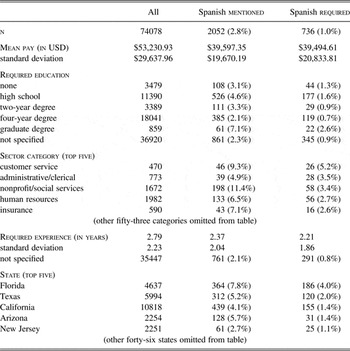
For numerous reasons, job advertisements, even those posted to the same online system, are not always consistent in the information they contain (Kureková et al. Reference Kureková, Beblavý and Thum-Thysen2015). As a result, there were large quantities of missing data in my original dataset, which I dealt with in the following manner. I restricted the dataset to only positions that were listed as full time, leaving approximately 320,000; about 83% of the data was retained. Approximately 75% did not advertise a pay range, which is consistent with other studies that explore wages in online job advertisements. For example, Marinescu & Wolthoff (Reference Marinescu and Wolthoff2015:8) report that only 20% of the advertisements in their sample of approximately 60,000 contain information about pay. I restricted the dataset to only those advertisements that included information about base pay, leaving approximately 78,000 advertisements. Finally, I discarded further data as described in the pay and state variable descriptions below, leaving a sample of 74,078 job advertisements, descriptive statistics for which can be found in Table 2.
Spanish-English bilingualism mentioned
I found all texts (including job titles) that contained the string ‘spanish’ (ignoring case). Although this string might refer to things other than language, through manual coding, I found the vast majority of instances were in reference to desired or required Spanish-English bilingualism. Since the texts were written in English, I assumed that English was an implicit requirement for each position.
Spanish-English bilingualism required. I examined each text that mentioned Spanish to determine if it listed Spanish-English bilingualism as a requirement of the job or simply as a desirable skill. In most cases, this was made abundantly clear in the advertisement (see Tables 5, 7, and 9 for examples), although I classified about 7% of the advertisements as unclear with respect to whether Spanish-English bilingualism was required or preferred.
Advertised pay
I converted all wage information included in advertisements’ metadata to estimated yearly totals by multiplyling hourly wages by 2,080 (forty hours per week * fifty-two weeks per year) and monthly wages by twelve. Pay was most commonly advertised in a range, and I used the lower end. In an attempt to eliminate apparent errors in listed pay, I discarded all data that advertised pay lower than $15,080 (US federal minimum wage, $7.25 * 2,080) or higher than $150,000 (an arbitrary limit established to deal with the frequency of apparent errors in advertisements with high wages).
As is typical of income-related variables, advertised pay was positively skewed, meaning there was a higher concentration of observations at the lower end of the scale and relatively few toward the upper end. Skewed data can affect the statistical power of inferential tests, so many researchers opt for transformations in these cases. The transformed variable, however, is no longer directly interpretable as dollars earned. In order to make my analysis as transparent as possible, I forego this transformation and instead use the skewed pay variable (see also Agirdag Reference Agirdag2014:167).
Required education
Many advertisements specified a minimum required level of education in the metadata. Educational level is related to earnings, and bilingualism has also been associated with greater educational attainment (Rumbaut Reference Rumbaut2014; Santibañez & Zárate Reference Santibañez and Zárate2014). As a result, I included a factor specifying required education in my analyses. The five levels for this factor were: ‘none’, ‘high school’, ‘two-year degree’, ‘four-year degree’, and ‘graduate degree’.
Sector category
When posting an advertisement to the website, users select a sector category from among fifty-eight possible choices (see Tables 2 and 3 for examples). Since both wages and requirements for Spanish-English bilingualism are likely affected by the type of work done or the industry the person works in, I included this category as a variable in my analyses.
Descriptive statistics for sample of job advertisements listing pay (before matching).

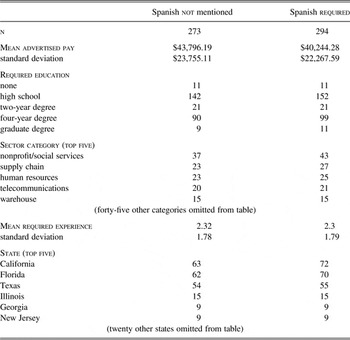
Descriptive statistics for matched sample of job advertisements.

Required experience
Many job advertisements specified required experience in the metadata. Greater experience is likely associated with greater earnings, and so I included a variable specifying the lowest number of years of experience required by the advertisement.
State
Almost all job advertisements included some information about the location of the position in the metadata. Spanish speakers are not evenly distributed across the US, and this may affect demand for Spanish-speaking workers. Furthermore, the average income varies by state in the United States, reflecting regional inequalities. Thus, I included this variable in my analyses. I discarded any position that was not located in the fifty US states or the District of Columbia.
There are undoubtedly nonuniform distributions of Spanish speakers and incomes even within a state (e.g. northern v. southern California or rural v. urban areas), but, without more specific information (e.g. zip code or county), it is difficult to construct a more fine-grained variable. Furthermore, such a variable would undoubtedly result in very few observations per cell, rendering subsequent procedures and analyses less reliable.
RESULTS
Descriptive statistics
As can be seen from the descriptive statistics in Table 2, Spanish-English bilingualism is a fairly common qualification in online job advertisements; approximately 2.8% of advertisements in my sample mention Spanish as a preferred or required qualification. Approximately one percent of the positions in my sample require Spanish-English bilingualism.
Requirements and preferences for Spanish-English bilingualism are not evenly distributed across levels of pay, required education, required experience, job sectors, or states. There are imbalances across each of these variables. On average, the pay is higher for advertisements that do not mention Spanish at all than for those that require Spanish. Among advertisements that call for low levels of education (e.g. a high school diploma) and high levels of education (i.e. a graduate degree), there is a greater frequency of requirements for Spanish-English bilingualism. Frequencies of requirements for Spanish-English bilingualism across different sectors of work range from 5.2% of the advertisements in the customer service sector to 0.0% in veterinary services. Required experience also tends to be lower for positions that require or mention Spanish than jobs that do not. Finally, frequencies for requirements for Spanish-English bilingualism vary across states, ranging from 4.0% of advertisements in Florida to 0.0% in fourteen states including Alaska, Hawaii, Idaho, Maine, Wyoming, and West Virgina. As would be expected, and was also found by Kalist (Reference Kalist2005), this frequency is positively correlated (r(49) = 0.57, p < 0.001) with the percentage of Spanish speakers in the state as estimated by the ACS (US Census Bureau/American FactFinder 2014).
Creating a matched sample
In order to address the imbalances in the data, I constructed a matched sample using requirement for Spanish-English bilingualism as the treatment variable (for an overview of matched-sampling procedures, see Rosenbaum Reference Rosenbaum2010). I selected four covariates: required education, required experience, sector category, and state, all discussed in the Methods section above. Each was found to be associated with advertised pay.
For two of the variables—required experience and required education—there was a substantial number of missing values (see Table 2). Only about 50% of advertisements specified required education in their metadata, similar to Marinescu & Wolthoff (Reference Marinescu and Wolthoff2015:8), who report that about 42% of advertisements in their sample contain this information. About 52% of advertisements specified required experience in their metadata, which is much higher than Marinescu and Woltoff, who report only 0.3% of advertisements in their sample containing this information. This discrepancy likely reflects differences in the data-entry forms used to submit advertisements.
I retained only complete cases, in other words, only cases that specified sector category, state, required education, and required experience in their metadata. I was left with a sample that contained a treatment set of 333 advertisements (i.e. 333 advertisements that required Spanish-English bilingualism). I performed exact 1:1 matching with replacement using the three categorical covariates—sector category, state, and required education—and then used nearest neighbor analysis with a caliper of 0.1 for the one continuous variable—required experience.
The procedures successfully matched 287 of the 333 advertisements in the treatment set to 266 advertisements in the control set (i.e. those that did not mention Spanish). Control items were assigned a weight that reflected how many treatment items they were matched to, and these weights were incorporated into my later model. Most control items were matched to only one treatment item, but several were matched to two or three.
At this stage, I also incorporated seven more pairs of observations derived from advertisements that listed an explicit pay differential for Spanish-English bilinguals, which I had set aside during my manual coding of Spanish-English bilingualism requirements. These were mostly call center positions (see Alarcón & Heyman Reference Alarcón and Heyman2013) or positions in social services in California (see Porras et al. Reference Porras, Ee and Gándara2014:246–47); in both cases, policies offering wage premiums to bilingual employees have been reported in the literature. I added two observations per advertisement in these cases—one treatment with the bilingual wage premium added and one control with the base salary listed.
In the end, these procedures produced a sample (n = 567) in which advertisements listing Spanish as a requirement were paired with other advertisements not mentioning Spanish, which had been posted in the same sector category, were located in the same state, required the same level of education, and required very similar levels of experience. Table 3 presents descriptive statistics for the matched sample. It is important to recall that the frequencies of categorical variables do not match exactly because in several cases two or three treatment items were matched to the same control item. In these cases, the control item is assigned a greater weight in the model so that balance between treatment and control sets is maintained.
Regression analysis
I created a regression model using the weighted matched sample. The dependent variable was minimum advertised pay. The predictors were state, sector category, required experience, required education, and requirement for Spanish-English bilingualism. A table reporting the whole model can be found in the appendix. The only predictor of interest in this work is the requirement for Spanish-English bilingualism (no language requirement is the reference level), and the model shows that advertised pay decreases when Spanish-English bilingualism is required (β = -$3,326.00, σ est = $1,224.58, t(486) = −2.72, p = 0.007, 95% CI [-$5,732.12, -$919.88]). Hence, the model estimates that positions that required Spanish-English bilingualism were associated with advertised annual pay between $919.88 and $5,732.12 lower than wages for observationally similar positions with no language requirement.
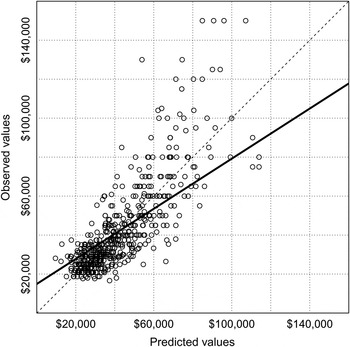
Since the matched sample is relatively small, and the pay variable is skewed, it is worth examining the model's performance in more detail. In Figure 1, predicted values of the dependent variable are plotted along the x-axis with corresponding observed values plotted along the y-axis. This provides a way of examining how accurately the model can predict advertised pay at different levels. As can be seen by starting from the left and moving right, the model performs best at lower ends of the pay scale with the points fairly tightly confined around the forty-five-degree diagonal (dashed) line until predictions of about $70,000 or more are made, at which point the model's accuracy becomes more erratic. This is an expected outcome of the relatively little data available for higher-paying positions.
Scatter plot showing predicted vs. observed values of dependent variable, advertised pay. Dashed line represents the model's target: exact correspondence between predicted and observed values. A regression line is presented in solid black.

Qualitative analysis
I also analyzed the texts of the job advertisements in the sample to understand the distribution of job duties and Spanish language skills required. I divided the positions that required Spanish into three groups based on income: I looked at the first quintile, the third quintile, and the fifth quintile of advertised pay (quintiles were based on the distribution of advertised pay for all jobs in the sample; see Table 2). Specifically, I explored how the advertisements orient to Spanish, especially as world language or local language. I also explored the Spanish language requirements the advertisements specified and how they described them. I first provide a summary of each level, followed by comparisons among them.
First quintile: $80,000–$150,000 per year (n = 14)
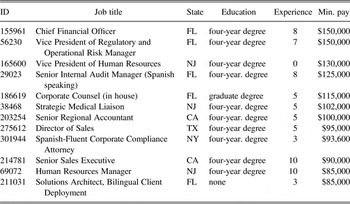
Among job advertisements that require Spanish, the few that listed pay in the first quintile (n = 14) consisted of a diverse group of senior managers or executives, like directors and vice presidents, as well as high-prestige professional positions, including attorneys and accountants. Table 4 presents twelve job titles along with other characteristics taken from advertisements in this quintile. Reflecting the lack of one-to-one correspondence between positions and advertisements I discussed above, the two advertisements in this group not shown in Table 4 are for the same or very similar positions as others already shown. The advertisements were apparently modified and reposted probably because the position had not yet been successfully filled. I retain such near duplicates in my data for the sake of methodological consistency (exact duplicates were automatically removed), because, it is often unclear whether two advertisements are truly for the exact same position.
Sample of advertised positions requiring Spanish in the first quintile (by pay).

Many of the positions appeared to imagine that Spanish would be used as a way of communicating with operations outside of the US. Six of the fourteen advertisements (42.9%) mentioned that the position would require the person filling it to have knowledge of Latin America or to communicate with people there. For example, one advertisement sought a senior internal audit manager who would be responsible for leading a team in ‘performing audits’ on the company's operations ‘in South and Central America’. Three other positions (21.4%) had a clear international orientation. One called for a senior regional accountant who was experienced in ‘international accounting’ and a second characterized the employer as ‘an international distribution company’. The third specified that applicants should be ‘willing and able to travel internationally extensively’.
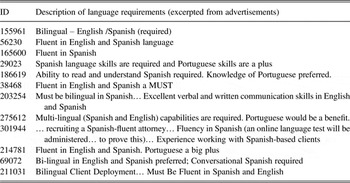
In describing the Spanish language competency needed for the position, seven of the advertisements (50.0%) specified that the applicant should be ‘fluent in [English and] Spanish’. Fewer advertisements, four of fourteen (28.6%), used the words bilingual or multilingual in describing the Spanish proficiency they expected. One advertisement specified only receptive skills, listing the following: ‘Ability to read and understand Spanish required’. Another stated that being ‘bilingual’ in English and Spanish was preferred but listed ‘Conversational Spanish’ as the requirement. Four of the advertisements (28.6%) explicitly require literacy (reading or writing) in Spanish. Table 5 presents excerpts describing language requirements from each of the advertisements presented in Table 4.
Spanish descriptions for first quintile sample (see Table 4).

Third quintile: $37,44 –$52,000 per year (n = 52)
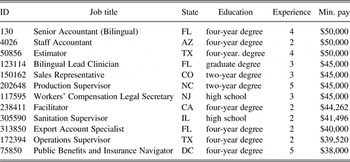
There were a fair number of postings requiring Spanish-English bilingualism and advertising wages in the third quintile (n = 52). Sixteen of the postings in this category (31.0%) advertised positions in nonprofit organizations or educational institutions. Nine more advertisements (17.3%) were for midlevel management positions. The remaining advertised positions include many different types, such as accountants (3, 5.8%), analysts (2, 3.8%), customer service or sales representatives (6, 11.5%), and legal secretaries (2, 3.8%). Table 6 presents a sample of job titles along with other characteristics taken from advertisements in this quintile.
Sample of advertised positions requiring Spanish in the third quintile (by pay).

Although some positions in this category do appear to orient toward overseeing operations in Latin America (e.g. the senior accountant position in Table 6 states that experience with Latin America ‘in a corporate setting is preferred’), most appear to be oriented toward providing services or working with Spanish speakers in the United States. Positions in the social services appear to require Spanish in order to serve low-income Spanish-speaking communities. For example, an advertisement for a community services specialist calls for candidates to be able to ‘provide bilingual services including translating and transcribing English to Spanish and Spanish to English, and completion of public assistance forms’. Midlevel management positions appear to require Spanish as a way of overseeing a locally employed Spanish-speaking work force. For example, an advertisement for a bilingual production supervisor in a food processing plant stipulates that candidates ‘must be able to communicate with crew in Spanish’.
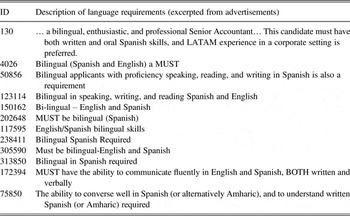
In describing the Spanish language competency sought for these positions, forty-two advertisements (80.1%) used the word bilingual. Most commonly, they simply presented Spanish competency in a list of required qualifications, stating something like ‘Bilingual Spanish Required’ or ‘Bilingual required; fluent in English and Spanish’. Many also included the word bilingual in the advertised job title (e.g. ‘Bilingual Office Manager’). Twelve of the advertisements (23.1%) explicitly mentioned Spanish literacy. Table 7 presents excerpts describing language requirements from each of the advertisements presented in Table 6.
Spanish descriptions for third quintile sample (see Table 6).

Fifth quintile: $15,080–$27,040 per year (n = 90)
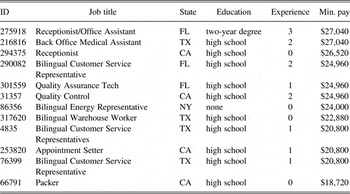
Many of the advertisements that required Spanish in my sample fall in the fifth quintile (n = 90), the one that advertised the lowest wages. Many of these positions involved front-line service and sales, positions that have substantial amounts of interaction with existing or potential customers. Twenty (22.2%) were for call center or telemarketing positions. Eleven (12.2%) involved sales or customer service in other settings, including retail or in-person sales appointments. Seventeen (19.0%) were for positions that involved office reception duties (e.g. greeting visitors and answering incoming calls). Not every position could be described as front-line service. There were several positions involving more manual labor, such as janitorial work (4, 4.4%), building maintenance (3, 3.3%), and warehouse work (4, 4.4%), or the operation of heavy machinery (3, 3.3%), such as delivery trucks or forklifts. Table 8 presents a sample of job titles along with other characteristics taken from advertisements in this quintile.
Sample of advertised positions requiring Spanish in the fifth quintile (by pay).

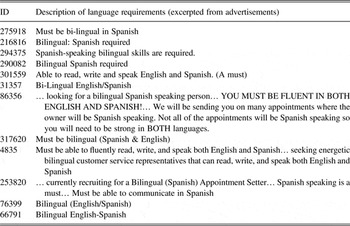
In describing the Spanish-language competency sought for these positions, seventy-one advertisements (79.0%) used the word bilingual. Many of the positions included bilingual in the advertised job title (e.g. ‘Bilingual Recruitment/Placement Specialist’). Many also included brief references to bilingualism in a list of requirements, for example, ‘Fully Bilingual (English/Spanish)’ or ‘BILINGUAL ENGLISH/SPANISH Required’. Others included a more elaborate description of required language abilities. An advertisement searching for a ‘Bilingual Front Desk Receptionist’ stated the following: ‘The ideal candidate will be fluent in Spanish, speak, read, write, translate… MUST Speak, Read and write Spanish and English Fluently. This includes grammar and writing skills’. Twenty-six (29.0%) of the advertisements in this category explicitly mentioned Spanish literacy. Table 9 presents excerpts describing language requirements from each of the advertisements presented in Table 8.
Spanish descriptions for fifth quintile sample (see Table 8).

Cross-quintile comparisons
The distribution of requirements for Spanish-English bilingualism, which is skewed toward lower paying jobs, reflects the tendency I have already reported for such positions to be associated with lower wages. My examination of the advertisements’ text provides some insight into the value assigned to Spanish-English bilingualism on the US labor market.
First, the orientation to Spanish as world language or local language appears to be stratified into different income levels. In particular, positions that orient to Spanish as world language are over-represented at the highest income level, while the much more frequent orientation to Spanish as local language dominates the lower income levels. In particular, positions advertising first quintile wages appear to see Spanish-English bilingualism as a tool for communicating with multinational corporate operations or potential clients outside of the US, particularly those in Latin America. Positions advertising third quintile wages often present Spanish as a tool either for overseeing a US-based Spanish-speaking workforce or serving US Spanish-speaking clients. Positions advertising fifth quintile wages often present Spanish as a tool for communicating with US-based Spanish-speaking consumers, clients, or co-workers.
A further intriguing observation of this analysis is that descriptions of the expected Spanish language proficiency appear to vary considerably by advertised pay particularly with respect to the words bilingual and fluent. Since the first quintile contained few observations, I compared jobs requiring Spanish that advertised pay in the first and second quintiles (the top 40%, n = 55) to jobs requiring Spanish that advertised pay in the fourth and fifth quintiles (the bottom 40%, n = 187) in order to test for statistical differences in the use of these terms across levels of pay. I found that the term bilingual is used less frequently for positions advertising higher pay than those advertising lower pay (45.5% v. 68.4% of advertisements, χ2 (1, N = 242) = 8.70, p = 0.003). Thus, the term bilingual is approximately 1.51 times (95% CI [1.11, 2.04]) more likely to appear in advertisements for jobs requiring Spanish that offer pay in the bottom two quintiles. For fluent, I observed more frequent use of the term in higher paying jobs, but the difference was not found to be significant (41.8% v. 27.8%, χ2 (1, N = 242) = 3.27, p = 0.07).
While there is clearly a great deal of imprecision in the use of the term bilingual, the tendency to apply it more frequently for lower valued forms of labor raises questions about its latent meanings. It is my impression that, in this context, bilingual suggests both greater competency than fluent as well as a more ‘nativelike’ authenticity in the language or even an ethnic or racial claim to it.Footnote 1
Furthermore, I found no apparent difference in the explicit mention of Spanish literacy across these three quintiles. This may suggest that positions requiring Spanish across income levels have similar need for Spanish literacy. Alternatively, it may suggest that many advertisements for positions that offer higher wages and require Spanish are written with the assumption that any qualified individual will be biliterate.
Taken together, my observations regarding descriptors of language competence and literacy provide no clear evidence that an objectively higher degree of linguistic skill is called for in higher-paying positions. Rather, the inverse may be true; lower-paying positions may call for an arguably greater degree of linguistic skill as suggested by the higher frequency of the word bilingual in lower-paying job advertisements.
DISCUSSION
The results of this study suggest that the question of whether Spanish-English bilingualism functions as human capital on the US labor market requires a complex explanation. This study provides further evidence that Spanish-English bilingualism is in demand among US employers. I found that Spanish-English bilingualism is listed somewhat commonly as a required or preferred qualification in online job advertisements. Spanish is mentioned in about 2.8% of all advertisements in my sample, and listed as a requirement in about 1.0% of them. Another recent study looked at the frequency with which Spanish was mentioned in online job advertisements and reported a considerably lower but still substantial figure: 1.64% of advertisements (New American Economy 2017). For contextualization, consider that graduate degrees are required for about 2.3% of positions for which required education was specified, meaning that the requirement for Spanish-English bilingualism in my sample is a little less than half as frequent as requirements for advanced degrees. Spanish is also by far the most prevalent human language mentioned in my collection of online job advertisements as well as in the data from the New American Economy (2017) report. For comparison, the string ‘japanese’ (ignoring case) occurs in 0.4% of advertisements; ‘chinese’, ‘cantonese’, or ‘mandarin’, collectively in 0.2%; and ‘french’, in 0.1%. Thus, Spanish-English bilingualism appears to provide individuals with more options on the labor market.
Those options are not the most desirable, however. Spanish is much more likely to be listed as a requirement in advertisements that offer lower wages and for positions that specify lower levels of education and experience. To some extent, the nonuniform distribution of Spanish language requirements can be explained by factors consistent with the view of multilingualism as human capital, such as where US Spanish speakers are located and the nature of the work Spanish-English bilinguals are called upon to do. Such an explanation might suggest that, where there is sufficient demand for Spanish-English bilingualism, it is rewarded on the labor market. I argue, however, that this explanation cannot adequately account for the present study's finding that positions for which Spanish-English bilingualism was required were associated with advertised annual pay that was an estimated $919.88 to $5,732.12 lower than the advertised pay for observationally similar positions without such a requirement (same state, sector category, and required educational level and similar required experience level). This study then contributes to a growing body of literature suggesting that, at least for certain groups, bilingualism is not rewarded by increased wages on the US labor market, and indeed may even be associated with wage penalties (e.g. Shin & Alba Reference Shin and Alba2009; Alarcón et al. Reference Alarcón, Di Paolo, Heyman and Morales2014; Robinson-Cimpian Reference Robinson-Cimpian2014). Viewing multilingualism as human capital provides no obvious explanation for these findings, which supports the contention that explanations that also attend to ideology and unequal power relations are crucial to understanding the economic value of language skills.
Past research on wage returns for Spanish-English bilingualism has been conducted using large surveys such as the American Community Survey. These studies draw on large representative datasets, exploring correlations between self-reported language abilities and wages. The negative correlations between wages and language abilities that have sometimes been reported in these studies raise a number of questions for the human capital perspective. There are numerous potential explanations for these findings, however. For example, since there is no indication of whether individuals classified as bilingual are expected to use Spanish on the job, it is unclear that their earnings have any direct relationship to their Spanish language skills. Wage penalties observed in these studies may be partially explained, for example, by linguistic discrimination against speakers of Spanish-accented English.
One of the primary contributions that this study offers is to provide insight into one of the possible mechanisms causing Spanish-English bilingualism to be negatively associated with earnings. In particular, my analysis suggests that the lower value assigned to labor that involves the use of Spanish (in addition to English) is often structured into the positions that are created to perform that labor. In other words, based on the results of this study and the theoretical framework I have presented above, I argue that, in imagining the type of labor that involves the use of Spanish as local language and planning out a position to cover the need for that labor, employers tend to imagine work and workers that are inherently less valuable, regardless of workers’ actual productivity or linguistic skill, since, at the point of producing an advertisement, these can only be anticipated. I argue that this tendency to value Spanish-English bilinguals’ labor less than their monolingual counterparts’ may reflect deficits that, drawing on raciolinguistic ideology, employers ‘hear’ or imagine in the language of US Latinxs (see Flores & Rosa Reference Flores and Rosa2015).
I hypothesize that it is the racialized linguistic repertoires of US Latinxs in particular that employers assign lower value to rather than the bilingualism of US Whites or other groups who have learned Spanish as an additional language or Spanish speakers who have grown up and been educated in Spanish-dominant countries such as Spain or Argentina and have learned English as an additional language. This interpretation is suggested by the greater frequency of the term bilingual among lower-paying positions as well as the tendency for these positions to orient to Spanish as local language. Positions that required Spanish and offered pay on the higher end tended to orient toward Spanish as world language to be used, for example, in international trade. Although further research is necessary to confirm these suggestions, it may be that advertisements for these lower- and higher-paying positions are written with the expectation that different groups of Spanish speakers will apply or ultimately be hired. While lower-paying positions that orient to Spanish as local language may be expected to attract US Latinxs, who are described using the word bilingual to signal their authentic, ethnic or racial connection to Spanish, I suspect that employers may be seeking or expecting to hire from a different population when advertising higher-paying positions, including people who have recently or will emigrate from Spanish-speaking countries or US-born individuals who have learned Spanish as a second language in formal educational settings. Future research could address these issues, for example, through interviews with those involved in the hiring process, including those who produce job advertisements.
The most fruitful economic advantages of Spanish-English bilingualism, therefore, may be reserved for speakers who are imagined to be able to use Spanish as world language, a criterion that may often exclude US Latinxs from consideration. I argue, however, that this exclusion would not be based on an objective determination that their linguistic skills are not strong enough to meet employers’ needs in these situations. This study found no evidence that advertisements for higher-paying positions, which more commonly oriented to Spanish as world language than those for lower-paying positions, used any explicit signals that greater Spanish competence was required. I observed no difference in explicit requirements for literacy skills (i.e. the ability to read and write in Spanish). I also observed that lower-paying positions were more likely to describe required linguistic skills using the word bilingual, a term I suggest denotes greater competence than those often found in the descriptions of linguistic skills for higher-paying positions (e.g. fluent) and which may also index a racial or ethnic connection to Spanish.
I argue that the economic value assigned to linguistic repertoires on the US labor market may not be determined primarily by objective assessment of linguistic skill but rather by race. In the Monster.com quote at the beginning of this article, it is the mostly White English monolingual readers who are promised economic rewards for their second language acquisition, while ‘Latino receptionists’ are presented in a low-prestige position with their bilingualism neither celebrated nor apparently valued as a skill that increases their human capital.
The discourse observed in the Monster.com article, however, is much more prevalent than a quotation from a single article might suggest. Indeed, among educators, the discourse of multilingualism as human capital is quite prevalent. For example, in a statement from 2011 expressing concern about dwindling funding for language learning in US higher education, the Modern Language Association (MLA) wrote that ‘knowledge of a second language serves students well in the interconnected world: a second language opens the door to job opportunities in the global economy’. Although the statement certainly has largely uncontroversial intentions or aims (at least among linguists and language educators), when its framing of multilingualism as human capital is viewed in light of findings about the rewards for Spanish-English bilingualism on the US labor market, it raises important questions for language education. For example, to what extent does discourse such as the MLA's contribute to the erasure of the experiences of US Latinxs? Are institutions and organizations like the MLA doing everything possible to ensure that US Latinxs are able to share in the promised rewards of multilingualism?
This work may suggest some possible avenues for working toward greater reward and recognition of US Latinxs’ bilingualism. First, greater effort may be called for from public institutions to credentialize Latinxs’ bilingualism so that it can be more effectively leveraged as a formal qualification in the same way that, for example, a Bachelor's degree might be leveraged. The Seal of Biliteracy is an example of such an effort (see Porras et al. Reference Porras, Ee and Gándara2014 or New American Economy 2017 for a discussion). Further investigation of this policy as well as other efforts should explore whether they provide meaningful ways for Latinxs or other groups to fully leverage the economic potential of their linguistic repertoires.
Second, public outreach to employers may be useful in trying to combat any misconceptions about US Latinxs’ bilingualism that may contribute to prejudices against them. Further investigation of employers’ views about US Latinxs’ bilingualism would likely be necessary before such interventions are possible. Research that explores what employers mean by terms like bilingual or whether they expect employees to be biliterate would also be fruitful.
APPENDIX: EFFECTS ON ADVERTISED WAGES FOR MATCHED SAMPLE