INTRODUCTION
Occurrence of sperm whales, Physeter macrocephalus Linnaeus, 1758, has been reported year-round in the Gulf of California (Gendron, Reference Gendron, Alvarez-Castañeda and Patton2000). Photo-identification studies have demonstrated their interannual site fidelity to the Gulf, including the Guaymas Basin (Jaquet et al., Reference Jaquet, Gendron and Coakes2003). A comparison of whale sightings and jumbo squid (Dosidicus gigas) fishery landings suggests that distribution of sperm whales in the Gulf is linked to abundance of squid, therefore it has been proposed that sperm whales congregate in areas of high abundance of jumbo squid in the Gulf of California to prey on them (Jaquet & Gendron, Reference Jaquet and Gendron2002; Jaquet et al., Reference Jaquet, Gendron and Coakes2003; Davis et al., Reference Davis, Jaquet, Gendron, Markaida, Bazzino and Gilly2007). However, sperm whale abundance has not been compared to in situ estimations of squid abundance.
Jumbo squid is an abundant resource in the Gulf of California and the fishery catch is from 80,000–120,000 tonnes captured at Guaymas Basin (Markaida & Sosa-Nishizaki, Reference Markaida and Sosa-Nishizaki2001; Martínez-Aguilar et al., Reference Martínez-Aguilar, Morales-Bojórquez, Díaz-Uribe, Suárez-Higuera and Hernández-Herrera2004). Markaida & Sosa-Nishizaki (Reference Markaida and Sosa-Nishizaki2003) describe jumbo squid, as an active migratory predator, feeding on myctophids, sardines and anchovies, crustaceans, and squid. Tagging studies at Guaymas Basin show that jumbo squid moves from the Baja Peninsula to Mexico's mainland coast (Markaida et al., Reference Markaida, Rosenthal and Gilly2005). This species typically occurs from surface waters to depths of 500 m, with pronounced diel vertical migrations bringing them closer to the surface at night (Gilly et al., Reference Gilly, Markaida, Baxter, Block, Boustany, Zeideberg, Reisenbichler, Robison, Bazzino and Salinas2006).
Recent studies describing acoustic backscattering properties of jumbo squid support the use of echo sounders to determine distribution and abundance of this species (Benoit-Bird et al., Reference Benoit-Bird, Gilly, Whitlow Au and Mate2008). The objective of our study was to use acoustic backscatter data to determine the relationship between distribution and diving behaviour of sperm whales and jumbo squid presence in the Guaymas Basin.
MATERIALS AND METHODS
The Guaymas Basin is located in the central Gulf of California, between the ports of Guaymas, Sonora and Santa Rosalía, Baja California Sur. Our study area is of approximately 3770 km2, which were covered from May to October 2006 (Figure 1).
Sperm whale distribution in the Guaymas Basin (study area inside the rectangle).

Visual survey for whales was conducted during daylight hours by four observers positioned in the ship's bridge, at an eye-height of about 5.5 m above the water surface, and equipped with 10 × 50 binoculars. After sperm whales were located, the vessel approached them and individuals were counted and assigned to a sex–age category (lactating calf, nursing mother, juvenile, adult female without a calf and adult male). Fluke photographs were taken with a digital camera (Nikon D100) with 300 mm zoom lens. Presence of photo-identified individuals was analysed to determine temporal residence and site fidelity.
A Furuno (GP1850WF) dual 50–200 kHz GPS-echo sounder was used to measure bathymetry as well as jumbo squid and sperm whale presence. The echo-sounder transducer was mounted over the side of the vessel in a rigid pole mount, 1 m beneath the water's surface. Detection of squid with the echo sounder was tested by observing acoustic backscatter next to five skiffs (24 feet length and 3 fishermen each) which were fishing for squid in the Guaymas Basin. Bottom depth at the fishing location was 144 m. A scattering layer was detected with the echo sounder at 50 kHz, between 20 and 100 m water depth. The layer was approximately 1 km long and the highest backscatter density occurred at a depth of 90 m. With their skiffs located right on top of the scattering layer, fishermen were successfully catching jumbo squid using jigs at the end of 100 m long hand lines. Mantle length of captured squid varied from 0.50–1.20 m. Although no quantitative calibration was made between acoustic backscatter and squid biomass, abundant capture of squid in the area of high backscatter validates our use of presence and intensity of acoustic scattering layers as proxies for squid presence and relative abundance.
Sperm whale diving records were obtained by positioning the vessel in the location where an individual had just submerged to start a dive and following the large acoustic scattering object detected in the echo sounder display. The echo sounder screen presents the elapsed time of feature detection and the depth of the backscatter, thermocline and other water column and bottom features, in this way we were able to follow the dive of a specific whale, its depth and the depth of the scattering layer (Figure 1). This method has been previously used to describe diving patterns in killer whales (Nøttestad & Similä, Reference Nøttestad and Similä2001). During each diving event monitored through the echo sounder we recorded the GPS position, depth of the scattering layers, portions of the diving track and rate of descent. Whenever sperm whale tracks were lost due to changes in direction of the whale, rough weather or a blind spot, an effort was made to relocate the whale when it surfaced. The identity of the relocated whale was verified by fluke marks or body characteristics and, if possible, the whale was followed to the next dive.
Surface swimming speed was collected by accompanying the whales and recording their movements, speed was determined with the GPS; connected to a PC where data were stored.
Squid caught by sperm whales had mantle lengths of approximately 1.20–1.40 m (estimated by comparing the squid length against the sperm whale body length or mouth length, depending on the sex and category of the individual.
RESULTS
Forty-three sperm whale groups, with a total of 813 sperm whales, were encountered in five cruises of 6 days each (30 days) at Guaymas Basin. We covered a distance of 800 km, thus, there were 1.02 individuals per km. Sperm whale groups were mainly concentrated over the continental slope of Guaymas Basin at an average bottom depth of 659 m (SD = 319, range: 300–1800 m; Figure 1). Thirty-two of these groups were distributed in waters between 500 and 850 m depth, over the continental slope. Five groups occurred over bottom depths of 200–400 m, over the margin of the continental slope and the continental platform; and six groups over the abyssal area at more than 1000 m deep.
We observed sperm whales diving into the scattering layers on 42 (97.6%) of the 43 encounters and assumed that they were foraging on the organisms causing the acoustic backscatter (Figure 2). On 10 occasions (24% of the foraging encounters) we observed sperm whales surfacing after a dive with jumbo squid in their mouths. These observations occurred in areas where scattering layers were found at depths between 160 and 400 m. On two occasions we observed squids escape from the sperm whale's mouth and on one occasion the squid was recaptured and eaten. On one occasion (2.4% of the foraging encounters) we observed a whale surfacing from a depth of 400 m with a large unidentified fish in its jaws. We were not able to confirm that the other 76% of these foraging encounters resulted in an effective capture of prey.
Dive of a sperm whale to reach the acoustic backscatter (oblique line in the 50 kHz screen, upper middle left) detected at 260 m, as observed in the echo sounder screen. In the upper area of the screen, under the latitude–longitude position, are a bicoloured bar (white and grey) each colour represents one minute, thus the total amount of time in the split screen is about 20 minutes. This sperm whale took five minutes to reach the scattering layer at a speed of 0.9 m/s (J.P. Gallo-Reynoso. 23 June 2006).

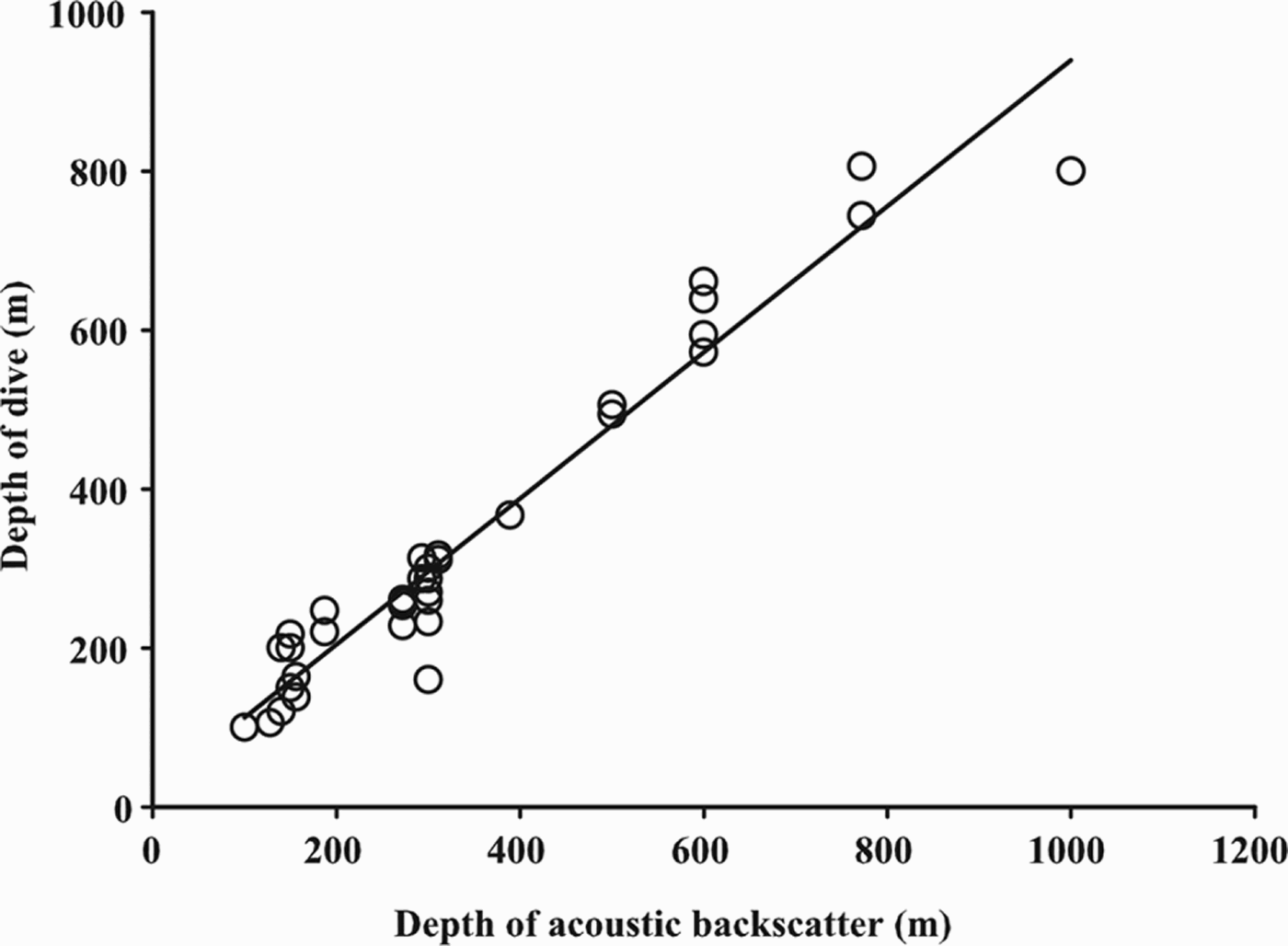
Diving whales tracked with the echo sounder reached a mean maximum dive depth of 342±196.4 m (N = 36, range: 100–806 m). Foraging dives most frequently reached depths in the 200–300 m range (N = 15 dives, 48.4% of total), followed by the 600–800 m (9 dives, 29%) and 100–200 m (7 dives, 22.6%) ranges. Significant correlation was observed between maximum depth of dive and depth of scattering layers (r2 = 0.944, P = 0.000, N = 36) (Figure 3). We observed other deep dives in one group, in which whales descended almost vertically and, after emerging, swam fast on the surface (8.9 km/h±0.373, range: 8.3–9.6, N = 13). These dives had a mean depth of 445±246.3 m (N = 9, range: 153–847 m) and only occurred when the whales did not reach a scattering layer. In contrast, when the sperm whales reached scattering layers, their horizontal movements on the surface were slow (mean 2.4 km/h±0.144, range: 2.2–2.7, N = 12). There is a statistically significant difference between these swimming speeds (t-test, t = −56.197, df = 23, P=<0.001) meaning that swimming speed at surface is somehow linked to the presence of a backscattering layer.
Depth of dives of sperm whales in respect to depth at which the acoustic backscatter (AB) was detected (regression equation: DAB = 20.2255 + 0.9190DD), r2 = 0.944, P = 0.000, N = 36. DAB, depth of AB; DD, depth of dive.

Eleven complete foraging dives were measured, they had a mean duration of 22.9±12.7 minutes (range: 3–50 minutes). Mean surface time was 6±2.6 minutes (N = 26, range: 3–13 minutes). From the diving data, we calculated the speed of movement of the individuals as an average of 0.57 m/s, including the descent (0.96 m/s), bottom movements (0.33 m/s) and ascent (0.47 m/s). Sperm whales spent almost 75% of their time diving and 25% of their time at the surface.
DISCUSSION
Davis et al. (Reference Davis, Jaquet, Gendron, Markaida, Bazzino and Gilly2007) studied the diving behaviour of sperm whales in the Gulf of California by attaching satellite-linked dive recorders to five individuals. They found that 91% of the deep dives ranged from 100–500 m (average 418±216.0 m) and lasted 15 to 35 minutes (average 27±9.1 minutes; Davis et al., Reference Davis, Jaquet, Gendron, Markaida, Bazzino and Gilly2007). All of our observations corresponded to deep dives and the foraging depth (average 342±196.4 m) and duration (average 22.9±12.7 minutes) are similar to those reported by Davis et al. (Reference Davis, Jaquet, Gendron, Markaida, Bazzino and Gilly2007). Mean surface time was 6±2.6 minutes, somehow different to what Watwood et al. (Reference Watwood, Miller, Johnson, Madsen and Tyack2006) found in three different areas, the Atlantic Ocean, the Gulf of Mexico and the Ligurian Sea in which an average dive cycle consisted of a 45 minute (±6.3) dive with a 9 minute (±3.0) surface interval. Nevertheless, in our study sperm whales spent 75% of their time diving and 25% of their time at the surface, similar to observations from Watwood et al. (Reference Watwood, Miller, Johnson, Madsen and Tyack2006), in which sperm whales tagged with diving recorders spent on average more than 72% of their time in foraging dive cycles.
Significant difference found in swimming speed at the surface when whales reached scattering layers during a dive (slower) versus dives when no scattering layer was reached (faster) indicates that sperm whales spend more time, most likely foraging, in areas of increased acoustic backscatter. Our results differ from the observations of Whitehead (Reference Whitehead1996) who reported no variation in sperm whale swimming speed as a function of feeding success (indicated by defaecation rate). Moreover, our observations of sperm whale movements on the surface were similar to results from Watwood et al. (Reference Watwood, Miller, Johnson, Madsen and Tyack2006) in which whales maintained their time in the foraging phase by decreasing transit time for deeper foraging dives.
Although we did not conduct squid abundance estimations, the presence of a scattering layer (measured at 50 kHz band) in the area of successful squid fishing and several observations of squid carried to the surface after sperm whales dove to the scattering layer support the use of scattering layers as an indicator of squid presence (Figure 4). Moreover, recent in situ measurements of jumbo squid acoustic target strength, which included an echo sounder with similar frequencies (38–200 kHz) by Benoit-Bird et al. (Reference Benoit-Bird, Gilly, Whitlow Au and Mate2008) to those we used for our observations (50–200 kHz), support the use of acoustic scattering stock assessment studies.
Female sperm whale with a jumbo squid in its mouth (J. Égido. 25 October, 2006).

Results from a study of jumbo squids instrumented with pop-up archival transmitting tags in the Gulf of California indicate that they spent about 75% of the time in the 200–400 m depth-range (Davis et al., Reference Davis, Jaquet, Gendron, Markaida, Bazzino and Gilly2007), showing a mean dive-depth preference similar to the average depth we observed for sperm whale foraging dives (342±63 m) and to the average depth we detected for scattering layers (312±223 m, range: 100–1000 m). Moreover, squids tagged with pop up satellite tags by Gilly et al. (Reference Gilly, Markaida, Baxter, Block, Boustany, Zeideberg, Reisenbichler, Robison, Bazzino and Salinas2006) presented shallow dives at night (bimodal distribution: 73±31 m and 198±113 m) and deep dives (253±64 m) during daytime, a similar distribution to that of sperm whales preying on jumbo squid that we found.
Our observations of sperm whale diving and foraging behaviour, together with in situ acoustic detection of jumbo squid backscatter, show a strong correlation between sperm whale distribution and presence of its prey in the Gulf of California and allow the use of the squid backscatter to assess the stocks and availability to other predatory species of the Gulf of California. This is an indicator that the Guaymas Basin is an important feeding area for sperm whales inside the Gulf of California.
ACKNOWLEDGEMENTS
We thank J. Castillo, N. Ramos and O. Rangel for their help. We thank the crew of ‘Más Bravo’. We thank MIRT–CIAD–UCSC and WWF Programa Golfo de California for funding this project. This study was carried out with permit: SGPA/DGVS/ 14132 SEMARNAT (México). Finally, we thank J. Ortega and two anonymous referees for comments that significantly improved the manuscript.