Introduction
“Emotional memory” is a shorthand phrase to refer to a memory for an event that elicits emotional reactions. These events and reactions can vary. The events may be rewarding or aversive; they may vary in intensity and time-course. These features can influence the nature of the emotional reactions. For instance, reactions to a public or personal event that unfolds over minutes or hours may include physiological responses, changes in cognitive processes, the conscious feeling of a change in affective state, and the labeling of that feeling. Reactions to an item that is presented briefly within the context of a laboratory experiment are likely to include fleeting physiological and cognitive responses, but the participant may not be aware of them.
The effects of these emotional reactions on memory are complex, yet they are often distilled to three tenets. First, the experience of emotion enhances memory. Second, when emotion does not enhance memory, this is usually because of the impairing effects of high levels of arousal. Third, when emotion facilitates an early stage of processing, this conveys benefits at a later stage. These views are pervasive because there is evidence, and often a long history, in their support. But as this review highlights, there are boundary conditions whose existence can shed light on the multifaceted nature of the effects of emotion on memory.
Emotional Enhancement of Memory: Underlying Mechanisms and Limitations
It is commonly believed that an emotional event will be remembered better than an event lacking emotion (reviewed by Buchanan, Reference Buchanan2007 and Hamann, Reference Hamann2001). William James (Reference James1890) described the effect of an emotional event as “a scar upon the cerebral tissues” (p. 670), and the term “flashbulb memories” was used to describe the purportedly permanent representation created for an exceptionally emotional event (Brown & Kulik, Reference Brown and Kulik1977). Several studies have shown that emotional public events are remembered better than everyday events with a similar retention interval (e.g., Conway et al., Reference Conway, Anderson, Larsen, Donnely, McDaniel, McClelland and Logie1994; Paradis, Solomon, Florer, & Thompson, Reference Paradis, Solomon, Florer and Thompson2004), and laboratory studies have shown emotional enhancement in memory for words (e.g., Kleinsmith & Kaplan, Reference Kleinsmith and Kaplan1963; Sharot & Phelps, Reference Sharot and Phelps2004), images (e.g., Bradley, Greenwald, Petry, & Lang, Reference Bradley, Greenwald, Petry and Lang1992), narratives (e.g., Cahill & McGaugh, Reference Cahill and McGaugh1995), and personal events (e.g., D'Argembeau, Comblain, & Van der Linden, Reference D'Argembeau, Comblain and Van der Linden2003).
In explaining flashbulb memories, Brown and Kulik proposed the role of a special emotional memory mechanism based on Robert Livingston's “Now Print” theory (Reference Livingston1967). This theory (1967) suggests that when the brain recognizes an event as both novel and significant, the limbic system releases a command that permanently “prints” all recent brain events, leading to facilitated retrieval of all event details at a later time. Select aspects of this theory have been supported. There is increased limbic activity, and a strengthened relation between the amygdala and other medial temporal lobe and cortical regions during emotional relative to neutral event encoding (reviewed by LaBar & Cabeza, Reference LaBar and Cabeza2006). Item-by-item fluctuations in connectivity relate to the durability of an emotional memory (Ritchey, Dolcos, & Cabeza, Reference Ritchey, Dolcos and Cabeza2008), with items associated with greater connectivity remembered over longer delays. State-based differences in connectivity also may influence how well emotional events are retained; for instance, functional coupling between the amygdala and medial prefrontal cortex during rest may relate to the ability to retain emotionally positive memories, at least among older adults (Sakaki, Nga, & Mather, Reference Sakaki, Nga and Mather2013). Thus, there is evidence that amygdala engagement—through its interactions with other regions—can lead to a strong, long-lasting memory.
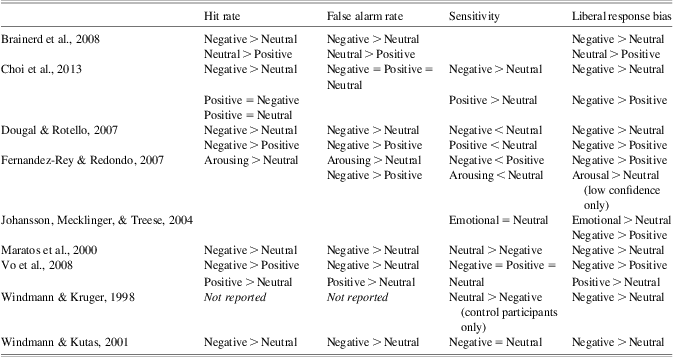
Critical aspects of the “Now Print” theory, however, have not been supported. Amygdala activation does not preserve memory for all attended event details, and amygdala engagement during an emotional event does not circumvent the medial temporal lobe processes that typically enable memory consolidation (Kensinger, Reference Kensinger2009). Thus, there is no “special” memory mechanism in the strongest sense (see McCloskey, Wible, & Cohen, Reference McCloskey, Wible and Cohen1988; Weaver, Reference Weaver1993). Moreover, even though people retain high confidence in “flashbulb” memories (e.g., Talarico & Rubin, Reference Talarico and Rubin2003, Reference Talarico and Rubin2007), their accuracy decreases over time (e.g., Christianson, Reference Christianson1989, Reference Christianson1992; Rubin & Kozin, Reference Rubin and Kozin1984). This disconnect between accuracy and confidence is consistent with research showing that emotion enhances the sense of recollection experienced during memory retrieval (reviewed by Phelps & Sharot, Reference Phelps and Sharot2008) and may lead to a shift in participants’ response biases: Emotional words (new and old) are more likely to receive an “old” response than neutral words (see Table 1). Although emotion can sometimes enhance the accuracy of a memory representation (e.g., Choi, Kensinger, & Rajaram, Reference Choi, Kensinger and Rajaram2013; Kensinger, Garoff-Eaton, & Schacter, Reference Kensinger, Garoff-Eaton and Schacter2007), or at least the accuracy with which some details of an event are remembered (see next section), emotion may change the qualitative characteristics of how an event is remembered even when it does not affect the likelihood that the event is remembered.
Effect of emotion on discrimination and response bias in tests of memory recognition

Note. Table 1 focuses on standard recognition assessments and does not include studies designed to intentionally elicit false memories. Additionally, only studies that specifically report some measure of response bias are included.
The mixed effects of emotion on memory accuracy may be explained by the frequent presence of two confounds that can exaggerate or mask the enhancing effects of emotion on memory. First, emotional stimuli are often more interrelated than neutral stimuli. This semantic relatedness can have an additive effect with arousal on memory (Buchanan, Etzel, Adolphs, & Tranel, Reference Buchanan, Etzel, Adolphs and Tranel2006) and in some cases may entirely explain the mnemonic benefit attributed to emotion (e.g., Maratos & Rugg, Reference Maratos and Rugg2001; Talmi, Luk, McGarry, & Moscovitch, Reference Talmi, Luk, McGarry and Moscovitch2007; Talmi, Schimmack, Paterson, & Moscovitch, Reference Talmi, Schimmack, Paterson and Moscovitch2007). This interrelatedness can also lead to enhanced conceptual priming and an increased sense of familiarity for both old and new emotional stimuli, leading to increased false memories as well as true memories (see Brainerd, Stein, Silveira, Rohenkohl, & Reyna, Reference Brainerd, Stein, Silveira, Rohenkohl and Reyna2008). When interrelatedness is controlled, emotion may not enhance false memory (e.g., Choi et al., Reference Choi, Kensinger and Rajaram2013). Second, the distinctiveness of an emotional stimulus among neutral items has been shown to contribute to the enhanced memory for the emotional items. Emotional stimuli typically benefit from presentation in mixed lists (containing both emotional and neutral items) but not in pure lists (Schmidt, Reference Schmidt2012b; Talmi, Luk, et al., Reference Talmi, Luk, McGarry and Moscovitch2007). Controlling for distinctiveness may eliminate many of the benefits of emotion on memory, although some benefits—such as enhanced memory for taboo words—may remain, suggesting that they benefit from emotion-specific processes (reviewed by Schmidt, Reference Schmidt2012a).
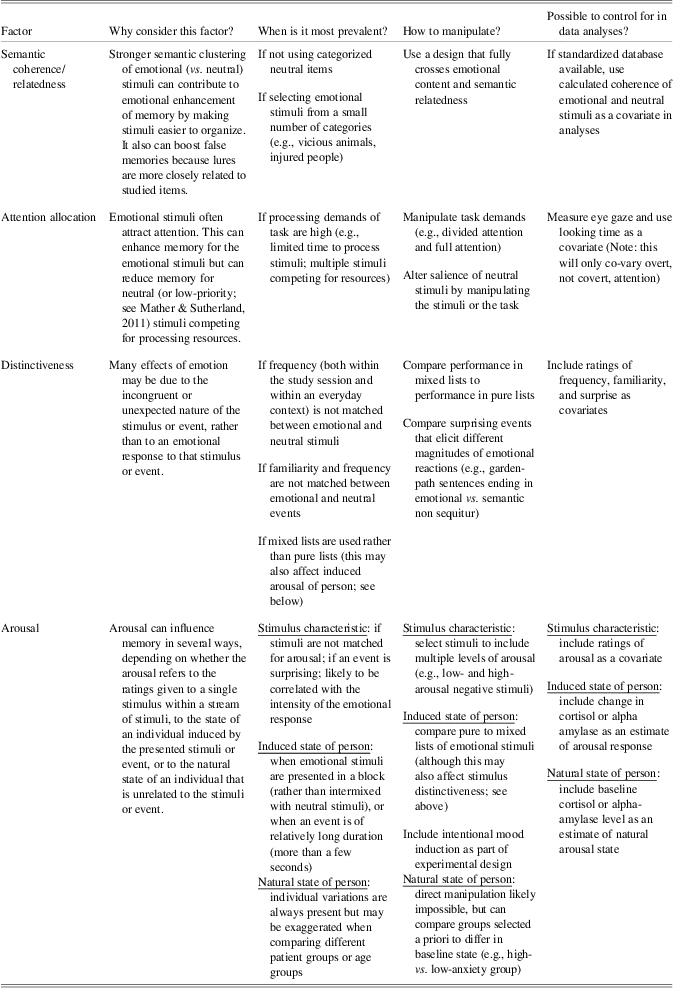
The current state of the emotional memory literature suggests that the presence of emotion often contributes to a more durable memory representation. However, this enhancement is not always present, and when it is, it may reflect the contribution of confounding processes not directly linked to the emotionality of the memoranda. By designing studies to directly control for and manipulate these parameters (see Table 2 for examples), researchers can better understand the underlying cognitive and neural mechanisms directly impacted by emotion. Such an understanding may be essential to research examining memory impairments and preservations in special populations. If emotional enhancement is held as a certainty in the memory literature, the field risks disregarding important research that does not show the effect.
Factors to consider when designing a study to assess emotional memory
Note. This table does not present an exhaustive list. Depending on the goals of the experiment, other factors to consider may include: valence of the stimuli (how positive or negative), discrete emotions elicited by the stimuli, mood of the participant, stimulus complexity, event rehearsal
Arousal and Memory: Beyond Yerkes-Dodson (Reference Yerkes and Dodson1908) and Easterbrook (Reference Easterbrook1959)
A second claim is that, when emotion does not enhance memory, this can be understood by the magnitude of physiological arousal elicited. Yerkes and Dodson (Reference Yerkes and Dodson1908) proposed that for complex tasks, performance increases with physiological or mental arousal up to a point, at which the effect of arousal becomes detrimental. This has been supported by animal and human studies on the effects of glucocorticoids and/or stress on memory, such that moderate levels during learning enhance subsequent memory, while lower or higher doses either show an impairing effect (e.g., Lupien et al., Reference Lupien, Gaudreau, Tchiteya, Maheu, Sharma, Nair and Meaney1997) or no effect on memory (e.g., Roozendaal, Williams, & McGaugh, Reference Roozendaal, Williams and McGaugh1999).
A closely related explanation for why emotion does not always enhance memory is that increased arousal leads to a restriction of observed cues (Easterbrook, Reference Easterbrook1959). This narrowing of attention enables memory for salient details to be enhanced, at the cost of memory for less salient details. At high arousal, however, this restriction of cue usage is thought to preclude processing of information crucial to event memory, such as the physical characteristics of a perpetrator (e.g., Christianson, Reference Christianson1992; Loftus, Loftus, & Messo, Reference Loftus, Loftus and Messo1987).
While these hypotheses have been supported by prior literature, effects may be relevant under narrower circumstances than typically assumed. The Yerkes-Dodson law was based on a study requiring mice to discriminate between two boxes while receiving shocks of various strength, and their claim of a U-shaped curve applied only to complex tasks. In their “easy” condition, there was a linear relation between shock strength and learning success. Moreover, in reanalyzing their data, Baumler and Lienert (Reference Baumler and Lienert1993) found that the dependent variable critically matters; although defining the learning criterion as “hits” yields an inverted U-shaped curve for complex tasks, defining the criterion as errors results in a linear arousal-performance relation for complex tasks and no relation for the easy task (Baumler & Lienert, Reference Baumler and Lienert1993; Hanoch & Vitouch, Reference Hanoch and Vitouch2004). Thus, the U-shaped curve may exist only for complex tasks, and only when data are scored in a particular way. Similarly, the Easterbrook (Reference Easterbrook1959) hypothesis was originally based upon tasks investigating drive, motivational concentration, perception, and motor skill, and focused on cue usage during encoding-stage processes. It has since been applied more broadly to a variety of long-term memory studies and has not been reconciled with evidence that arousal often influences post-encoding processes rather than attention narrowing during encoding (e.g., Riggs, McQuiggan, Farb, Anderson, & Ryan, Reference Riggs, McQuiggan, Farb, Anderson and Ryan2011; Mickley Steinmetz & Kensinger, Reference Mickley Steinmetz and Kensinger2013). Whereas the Yerkes-Dodson law and Easterbrook's attention-narrowing account are valid explanations for arousal-enhanced memory (or the lack thereof) in some cases, the effects of arousal on memory may also depend on other factors.
One such factor is the content of the memoranda: Although stress often enhances emotional memory (e.g., Cahill, Gorski, & Le, Reference Cahill, Gorski and Le2003) it typically impairs (Payne et al., Reference Payne, Jackson, Hoscheidt, Ryan, Jacobs and Nadel2007), or has no effect on (Buchanan & Lovallo, Reference Buchanan and Lovallo2001) memory for neutral information. The effects of arousal on memory for neutral stimuli may further depend on their salience (Mather & Sutherland, Reference Mather and Sutherland2011). Arousal may enhance memory for goal-relevant, salient neutral stimuli while having no effect on, or even impairing, memory for other neutral stimuli (e.g., Sutherland & Mather, Reference Sutherland and Mather2012).
Even among emotional information, the effects of arousal may differ depending upon the valence of the stimuli (i.e., whether they are positive or negative). For example, free recall of negatively arousing, but not positively arousing words, is enhanced by pre-learning stress (Schwabe, Bohringer, Chatterjee, & Schachinger, Reference Schwabe, Bohringer, Chatterjee and Schachinger2008). Further evidence for complex interactions between arousal and valence has been shown using fMRI: High (compared to low) arousal is associated with increased amygdala connectivity to the inferior frontal gyrus and middle occipital gyrus while encoding negative stimuli, and decreased amygdala connectivity to these regions while encoding positive stimuli (Mickley Steinmetz, Addis, & Kensinger, Reference Mickley Steinmetz, Addis and Kensinger2010).
Another factor is the relation between the arousal experienced and the memory task. Arousal can be relevant to the task, as in the original Yerkes-Dodson experiment, or irrelevant to the task, as often occurs in studies of mood induction. Research has suggested that when the arousal is task-relevant, such as when the content of the to-be-remembered information is arousing, memory for those arousal-inducing, salient details often comes at the cost of memory for other information (the emotion-induced memory trade-off; reviewed by Reisberg & Heuer, Reference Reisberg and Heuer2004). When arousal is task-irrelevant, the effects may be more variable. Libkuman, Nichols-Whitehead, Griffith and Thomas (Reference Libkuman, Nichols-Whitehead, Griffith and Thomas1999) found that sustained physiological arousal—induced by stationary running or biking—had little impact on memory for details of scenes. Sutherland and Mather (Reference Sutherland and Mather2012), however, showed that brief presentation of negative arousing sounds increased short-term memory for high-salience letters but had no benefit on memory for low-salience letters.
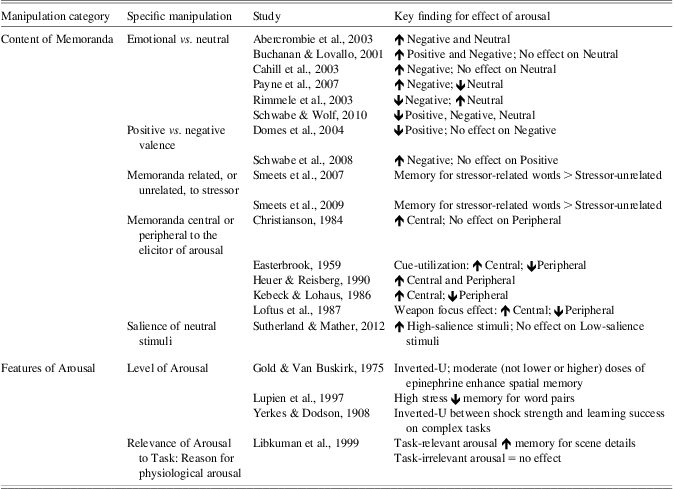
These studies demonstrate that when arousal does not enhance memory, this could be due not only to dose, but also to task complexity, the way performance is measured, the content of the memoranda, and the relevance of the arousal to the task. Considering only one of these factors often leads to mixed findings (see Table 3), emphasizing the need to assess multiple factors, and their potential interactions.
Representative examples of the mixed behavioral patterns revealed by studies examining how stimulus content or features of the arousal response influence the effect of arousal on memory
Facilitated Processing of Emotional Information Does Not Guarantee Memory Accuracy
The third claim we address is that the facilitated processing of emotional information precipitates facilitated retention of that information. There is no doubt that emotional information benefits from prioritized processing. We rapidly orient our attention to emotional stimuli (e.g., Öhman, Flykt, & Esteves, Reference Öhman, Flykt and Esteves2001), and we process emotional information faster and more fluently than non-emotional information (Kityama, Reference Kityama1990), even in the absence of full attention (Kensinger & Corkin, Reference Kensinger and Corkin2004; Talmi, Schimmack, et al., Reference Talmi, Schimmack, Paterson and Moscovitch2007; Talmi, Anderson, Riggs, Caplan, & Moscovitch, Reference Talmi, Anderson, Riggs, Caplan and Moscovitch2008). This prioritized processing can be related to memory benefits, both because attended stimuli are often well-remembered (reviewed by Chun & Turk-Browne, Reference Chun and Turk-Browne2007) and because the amygdala engagement triggered by emotional arousal facilitates both perceptual (e.g., Vuilleumier, Armony, Driver, & Dolan, Reference Vuilleumier, Armony, Driver and Dolan2001; Vuilleumier, Richardson, Armony, Driver, & Dolan, Reference Vuilleumier, Richardson, Armony, Driver and Dolan2004) and mnemonic processes (reviewed by LaBar & Cabeza, Reference LaBar and Cabeza2006). However, the assumptions that facilitated processing always produces enhanced memory, and that the cause of the memory enhancement is facilitated processing, are not always correct.
One demonstration of a disconnect between the effects of emotion on short-term processing and long-term retention comes from studies of working memory. Working memory efficiency can be slowed when emotional stimuli are held in mind (Kensinger & Corkin, Reference Kensinger and Corkin2003), likely because emotional reactions distract from the memory maintenance task. Emotional information may disrupt inter-item binding in working memory (e.g., remembering the relative locations of high and low arousal pictures; Mather et al., Reference Mather, Mitchell, Raye, Novak, Green and Johnson2006) and may also disrupt dorsolateral prefrontal processes related to holding information in mind during delayed-response working memory tasks (e.g., Dolcos & McCarthy, Reference Dolcos and McCarthy2006; Dolcos, Diaz-Granados, Wang, & McCarthy, Reference Dolcos, Diaz-Granados, Wang and McCarthy2008). Yet these same stimuli that impede working memory performance can be remembered well over the long-term (Kensinger & Corkin, Reference Kensinger and Corkin2003), revealing a distinction between the impairing effect of emotion on short-term processing and the beneficial effect on long-term retention. In these instances, the intrusive processing of the emotional content may lead to a more durable memory representation.
Emotion can also have the opposite direction of effect, benefiting short-term processing but impeding long-term retention. For instance, in Murray and Kensinger (Reference Murray and Kensinger2012), participants were faster to form a mental image combining one emotional and one neutral item into a pair, rather than two non-emotional items. However, that facilitated imagery did not lead to facilitated later memory: Individuals remembered the emotional pairs less well than the non-emotional pairs. In this case, the fluent processing of the emotional items may circumvent the effortful, deep processing that would translate into later memory benefits. The fluent processing may even bias individuals to believe that they have spent enough time learning information, when in fact additional effort would benefit the creation of a durable memory representation. For instance, Zimmerman and Kelley (Reference Zimmerman and Kelley2010) demonstrated that participants were overconfident when estimating which negative word pairs they would later remember. Likely because of the fluency with which individuals processed the negative pairs, they were misled to believe they had encoded them strongly and would retain them well.
Facilitated processing of emotional cues at retrieval may also mislead individuals, but at this stage of memory, it may cause them to endorse previously unstudied emotional items as “old” (Dougal & Rotello, Reference Dougal and Rotello2007; Fernandez-Rey & Redondo, Reference Fernandez-Rey and Redondo2007; Maratos, Allan, & Rugg, Reference Maratos, Allan and Rugg2000). As discussed earlier, sometimes this bias may result from the increased familiarity that stems from the inherent semantic interrelatedness of emotional items. Other times it may result because emotion facilitates the processing of retrieval cues. People may misattribute that ease-of-processing for a sense of familiarity that the information was previously encountered (e.g., Windmann & Kutas, Reference Windmann and Kutas2001).
These pieces of counter-evidence emphasize that facilitated processing of emotional information at one stage of processing does not guarantee similar facilitation at another stage. These results highlight the need to avoid the inference that if emotion has not enhanced memory retrieval, it has not facilitated earlier stages of processing. As we have reviewed, retrieval deficits can be indicative of facilitated processing at encoding that reduces post-encoding elaboration or time-on-task. More generally, these complexities provide an important reminder that memory retrieval provides only a limited window into the set of processes used to form and maintain a memory.
Implications and Applications
Although there is support for these three hypotheses, delineating their limiting parameters is important both for basic and clinical research. First, clinical alterations in the effects of emotion on memory may reflect a re-setting of the boundaries for the effect rather than a generalized change in its presence or absence. For instance, patients with Alzheimer's disease often show little-to-no enhancement of emotional memory within a laboratory setting. Yet when memory for a real-life experience is assessed, the patients often are more likely to remember the occurrence of that event compared to a more mundane event (Waring & Kensinger, Reference Waring and Kensinger2009). Future research could test how the factors that set the boundary in healthy populations—including semantic relatedness, valence, arousal, and personal involvement—are modified in clinical populations.
Second, a move away from a dose-response (quantity-based) explanation for the effects of arousal may enable a focus on the quality of the arousal response. “Arousal” can incorporate multiple phenomena—mental feelings of excitation or agitation, short-lived physiological changes, and specific responses of the hypothalamic-pituitary-adrenal system. These facets of arousal may have distinct effects on memory. Thus, when trying to understand how arousal affects memory—either in healthy populations or in individuals with affective disorders—it is critical to operationalize “arousal” and to tease apart the influences of these various aspects of arousal.
Third, by realizing the complex relations between the effects of emotion on different stages of processing, we may come closer to a holistic explanation for the effects of emotion on memory in different populations. For instance, we have shown that, unlike young adults, older adults are not faster at binding emotional pairs than neutral ones. Yet when memory is tested, older adults show a mnemonic advantage for the emotional integrations (Murray & Kensinger, in press). These results can only be explained by realizing that facilitation in one aspect of processing can be disconnected from benefits in another.
As these examples highlight, although there is support for the hypotheses reviewed here, there is danger in accepting them as rules-of-thumb and much to be gained by taking the boundary conditions seriously.
Acknowledgments
Preparation of this manuscript was supported by grant MH080833 from the National Institute of Health (to E.A.K.). The authors thank Angela Gutchess and Jessica Payne for helpful conversations related to the content of this review. The authors have no conflicts of interest.