Implications
The profitability of the fur animal production depends on market price of the pelts and the production costs. An important factor determining the production cost is the reproductive performance of breeding females. Pelt size in minks has increased considerably during the last decade. However, there are signs that selection for large body size has a negative impact on litter size and also for survival of kits. Therefore, it is important to know genetic parameters between animal size and fertility traits in order to assign proper selection weights for the traits in the breeding program and to ensure good reproductive result and in that way profitable fur production in the future.
Introduction
The most common animal in fur production in the world is mink (Neovison vison). The main breeding goals in Finnish mink breeding have been improved fur quality, and increase in body size and litter size (LS). Pelt size is the major characteristic determining auction price. During the past years in Finland as well as in other countries, the average number of kits per female has slightly decreased, although the breeding goal is to increase it (Hansen and Berg, Reference Hansen and Berg2007 and Reference Hansen and Berg2008; Hansen, Reference Hansen2009). In contrast, mink pelt size has increased considerably during the last decade. Increase in body size may have reduced the LS (Hansen and Berg, Reference Hansen and Berg2007 and Reference Hansen and Berg2008; Hansen, Reference Hansen2009), but other fertility traits may have been influenced as well.
There is strong evidence that fertility and animal size (AS) are genetically correlated. Lagerkvist et al. (Reference Lagerkvist, Johansson and Lundeheim1993 and Reference Lagerkvist, Johansson and Lundeheim1994), Rozempolska-Rucińska (Reference Rozempolska-Rucińska2004), Koivula et al. (Reference Koivula, Strandén and Mäntysaari2008) found an antagonistic genetic relationship between fertility and AS in mink. Negative genetic correlation between LS and AS has also been recognized in blue fox (Alopex lagopus, Peura et al., Reference Peura, Strandén and Mäntysaari2004 and Reference Peura, Strandén and Smeds2007). Mink production is strongly affected by changes in reproduction traits due to their importance in the breeding program and characteristic of mink reproduction; artificial insemination is not used in mink, their LSs are quite small and minks are seasonal, photosensitive breeders.
The mink-breeding season in the northern hemisphere lasts from late February until the end of March. Ovulation is induced by the presence of males or attempted or successful copulation, and a maturation age is about 8 to 12 months (Larivière, Reference Larivière1999; Ferguson and Larivière, Reference Ferguson and Larivière2002). Minks have also delayed implantation, which is an evolutionary strategy to ensure that postnatal development can be completed under more favorable environmental conditions (Lopes et al., Reference Lopes, Desmarais and Murphy2004). Because minks are photosensitive breeders with induced ovulation, it is possible to manipulate the timing of reproductive cycles by altering photoperiod (Fredberg et al., Reference Fredberg, Berg and Hansen2006) and also by date of first exposure to males. Timing of reproduction may have impact on prolificacy (Socha and Markiewicz, Reference Socha and Markiewicz2002). Date of first mating affects rate of remating, gestation length, pregnancy rate and LS (Elofson et al., Reference Elofson, Lagerkvist, Gustafsson and Einarsson1989). In other species, maturation age can also affect prolificacy (Peura et al., Reference Peura, Strandén and Smeds2004), and the same might be observed in minks as well.
In blue fox, Peura et al. (Reference Peura, Strandén and Smeds2004) concluded that too early or too late estrus is associated with smaller LS. In pig and dairy cattle, the selection goal is to achieve shorter farrowing or calving interval and, thus, increase in economic benefit. When the artificial insemination is used, age at first insemination (AFI) indicates maturation age. In pigs and dairy cattle, heritability of AFI varies from 0.11 to 0.32 months (Hanenberg et al., Reference Hanenberg, Knol and Merks2001; Muir et al., Reference Muir, Fatehi and Schaeffer2004), but in blue fox, AFI variation is between 0.15 and 0.18 months (Peura et al., Reference Peura, Strandén and Mäntysaari2004 and Reference Peura, Strandén and Smeds2007). In mink, however, heritability estimates for maturation age are not found in literature. Because date of first exposure to male can induce ovulation in mink (Fredberg et al., Reference Fredberg, Berg and Hansen2006), age at first mating (AFM) can be considered as an indicator of maturation age in yearling females.
Koivula et al. (Reference Koivula, Strandén and Mäntysaari2008) showed that LS at first parity has negative genetic correlation with AS as well as with all other grading traits. Therefore, it is important to know genetic parameters between AS and fertility traits in order to assign proper selection weights for the traits in the breeding program. In this study, we estimated genetic and phenotypic parameters between the first three LSs, AFM and AS. In addition, we examined genetic trends in traits studied.
Material and methods
Mink data were obtained from the Finnish Fur Breeders’ Association. The data had information from 2.8 million animals. Data for variance component estimation were sampled from the full data. Sampling was by farm. The complete pedigree contained about 3.5 million animals from 138 farms. The pedigree had many disconnected subpopulations, so it had to be pruned to have only informative animals. This was carried out using Relax2 (Strandén and Vuori, Reference Strandén and Vuori2006). In the end, the sample had observations from nine farms having 82 945 animals born in years 1990 to 2004. The pedigree file contained 103 489 animals.
Four fertility traits and AS were analyzed simultaneously with a multi-trait animal model. The fertility traits studied were the first three parity LSi (i = 1, 2, 3) and age of female at AFM. LSs were observed at 2 weeks from whelping. In order to include records from the second and the third LS, female was required to have the first LS record as well. AFM was defined as number of days between birthdate and first recorded mating. AS is subjectively graded by farmers. Farmers grade young animals mainly in October on the scale from 1 to 5, where Class 1 represents the poorest (the smallest animals) and 5 the best class (the largest animals). Minks are usually graded before pelting in order to select suitable animals for breeding. Thus, grading traits are commonly used for indirect selection of pelt characters in mink.
Restricted maximum likelihood (REML) estimates of (co)variance components were calculated with the DMU program (Madsen and Jensen, Reference Madsen and Jensen2000). The multi-trait animal model was

where y is a vector of observations, b is a vector of fixed effects, and c, a and e are vectors of random effects for common litter, animal and residual, respectively, and matrices X, W and Z are corresponding incidence matrices. The random common litter effect accounts for common litter environment of fullsibs born in the same litter. Random effects were assumed to be independent and normally distributed: a∼N (0, G0 ⊗ A), c∼N (0, C0 ⊗ I), e∼N (0, R0 ⊗ I).
Fixed effects for the traits were studied with general linear model by excluding random effects other than the residual (SAS, 2004). Only statistically significant (P < 0.05) effects were included in the REML animal model (Table 1). Fixed effects for LS1 were farm-year, time of birth within year for the animal (three classes: 99 to 119, 120 to 140 and 141 to 160 days from the beginning of the year), and number of matings (three classes: 1, 2 or >2 mating/season); for LS2 and LS3, fixed effects were farm-year and number of matings. For AFM and AS, the fixed effects in the model were farm-year, time of birth for animal and age of dam (three classes: 1-, 2-, >3-years old). Moreover, sex of animal was included for AS (three classes: male, female and unknown).
Fixed effects for the first three parity litter sizes, maturation age and animal size analyzed with Proc GLM in Statistical Analysis System

LS = litter size; AFM = age at first mating; AS = animal size; ns = not significant; nt = not tested.
*P < 0.05; ***P < 0.001.
Heritability (h 2) and proportion of common litter variance (c 2) for the traits were calculated as h 2 = σ 2a/(σ 2a + σ 2c + σ 2e), and c 2 = σ 2c/(σ 2a + σ 2c + σ 2e), where σ 2a, σ 2c and σ 2e are additive genetic, common litter and residual variances for the traits, respectively.
In addition to genetic correlations, genetic trends for the studied traits were assessed by examining standardized estimated breeding values (EBVs). EBVs were calculated with MiX99 (Strandén and Lidauer, Reference Strandén and Lidauer1999), and using the full data set. The model was the same as in the variance component analysis except that the variances were the obtained REML estimates. EBVs were standardized such that animals born in 2000 had a mean of 100 and standard deviation of 10.
Results and discussion
Mean and variation
Table 1 has statistical significance of fixed effects. Means and standard deviations in the LS traits, AFM and AS are given in Table 2. Number of observations was largest for AS and smallest for LS3 (Table 3). However, all trait pairs had at least 4632 observations. Average LS for the first three litters did not differ much, and also the standard deviations were similar. Coefficient of variation (CV) was considerable in the LS traits (Table 1). In general, prolificacy of young females is close to that of older females as the 1-year-old females tend to have on average 0.5 kit less than 2-year-old females. This is different from blue fox where yearling females produce about 2.5 kits less than 2- or 3-year-old females (Peura et al., Reference Peura, Strandén and Smeds2004). Average AFM was 311.14 days, which is about 10.4 months. Standard deviation and, consequently, the CV, were very low due to the nature of the trait. The mating season is short because of photoperiodic activation of estrus. Average grading score for AS should be ca. 3 in each farm-year. However, slightly higher scores are common, and mean AS in our data was 3.69.
Number of observations, mean, standard deviation and coefficient of variation for the first three parity litter sizes, age at first mating and animal size in Finnish mink

CV = coefficient of variation; LS = litter size; AFM = age at first mating; AS = animal size.
1Number of kits 2 weeks after whelping in the first parity.
2Number of kits 2 weeks after whelping in the second parity.
3Number of kits 2 weeks after whelping in the third parity.
4AFM as days between birthdate and first recorded mating.
5Size points.
Data included 82 945 animals born in years 1990 to 2004.
Number of animals in the multi-trait analyses for the first three litter sizes, age at first mating, and animal size in Finnish mink

LS = litter size; AFM = age at first mating; AS = animal size.
1Number of kits 2 weeks after whelping in the first parity.
2Number of kits 2 weeks after whelping in the second parity.
3Number of kits 2 weeks after whelping in the third parity.
4AFM as days between birthdate and first recorded mating.
5Size points.
Heritability estimates and litter variation
Heritabilities and litter variance proportions (±s.e.) for the studied traits are in Table 4. Heritability estimates for the LS1, LS2 and LS3 were 0.13, 0.15 and 0.15, respectively. In other studies, estimates for LS in mink have usually ranged from 0.13 to 0.20 (Berg, Reference Berg1993), but also lower estimates have been obtained. With different data, Koivula et al. (Reference Koivula, Strandén and Mäntysaari2008) estimated heritability of LS1 in mink to be 0.11. Lagerkvist et al. (Reference Lagerkvist, Johansson and Lundeheim1994) estimated heritability of total number of kits born to be 0.09 for mink, and Rozempolska-Rucińska (Reference Rozempolska-Rucińska2004) reported heritability of 0.02 for the number of kits born. In blue fox, estimates for heritability of LS have varied from 0.03 to 0.17 (Kenttämies, Reference Kenttämies1996; Peura et al., Reference Peura, Strandén and Mäntysaari2004 and Reference Peura, Strandén and Smeds2007; Wierzbicki and Jagusiak, Reference Wierzbicki and Jagusiak2006). For raccoon dogs (Nyctereutees procynoides), heritability of 0.08 was reported for LS (Ślaska, Reference Ślaska2002). Thus, heritability estimates presented in this study are within the range reported by other authors. The variation due to common litter effect was a bit higher for LS1 than for LS2 and LS3, but, in general, common litter effect seems to be quite low representing on average only 1% of the total variance (Table 4).
Estimates of phenotypic variance (σ2p), proportion of litter variance (c 2) and heritability (h 2) with standard errors for the first three litter sizes, age at first mating and animal size in Finnish mink

LS = litter size; AFM = age at first mating; AS = animal size.
1Number of kits 2 weeks after whelping in the first parity.
2Number of kits 2 weeks after whelping in the second parity.
3Number of kits 2 weeks after whelping in the third parity.
4AFM as days between birthdate and first recorded mating.
5Size points.
Estimates of (co)variance components were calculated with Data Migrator Utility software (Madsen and Jensen, Reference Madsen and Jensen2000).
Heritability of AFM was estimated to be 0.10, which is very similar to heritability estimates of other fertility traits. This suggests that it would be possible to change maturation age by selection. In the literature, heritability of age at maturity or its selection potential has not been studied in mink. In other animals, maturation age has been studied more. Hanenberg et al. (Reference Hanenberg, Knol and Merks2001) reported heritability estimate of 0.32 for gilts, Muir et al. (2004) 0.45 for heifers and Kause et al. (Reference Kause, Ritola, Paananen, Mäntysaari and Eskelinen2003) 0.12 to 0.56 for rainbow trout. Peura et al. (Reference Peura, Strandén and Mäntysaari2004 and Reference Peura, Strandén and Smeds2007) estimated heritability of 0.15 to 0.18 for age AFI in blue fox. However, the maturation age is physiologically very different trait in different species. In pigs and cattle, the breeding is triggered by the body weight, but in photoperiodic breeders, the AFM mirrors more the activation of hormonal action. Moreover, ovulation in mink is induced by the presence of males, or attempted or successful copulation (Larivière, Reference Larivière1999; Ferguson and Larivière, Reference Ferguson and Larivière2002).
The proportion of litter effect for the AFM was much higher than heritability (common litter effect = 0.44 v. heritability = 0.11). Thus, birth environment of female influences age at the first mating day. This influence indicates that dams’ nursing ability, competition between kits within litter, the location of the litter in the shed and maybe litter mates already in the dam’s uterus have large effects on maturation age. Thus, some competition effects (Muir and Schinckel, Reference Muir and Schinckel2002) may be present. However, strong maternal effects in mink have also been observed on timing of reproduction and pregnancy length. Fredberg et al. (Reference Fredberg, Berg and Hansen2006) found that late time of birth will prolong duration of pregnancy through maternal effects.
Heritability estimate for AS was 0.18 in this study. This is slightly lower than the heritability of 0.23 estimated by Koivula et al. (Reference Koivula, Strandén and Mäntysaari2008). There exists large variation in heritability estimates for body size in mink (reviewed by Berg, Reference Berg1993). In studies based on subjective grading, heritability for body size has varied from 0 to 0.51, with an average about 0.20 (Kenttämies and Vilva, Reference Kenttämies and Vilva1988; Berg, Reference Berg1993; Socha, Reference Socha2004). The highest heritabilities (range from 0.20 to 0.77) have been estimated for measurable size traits such as body weight (BW) and body length (Berg, Reference Berg1993; Lagerkvist et al., Reference Lagerkvist, Johansson and Lundeheim1994; Lohi, Reference Lohi2002; Socha, Reference Socha2004). In blue fox, heritability estimates for grading size have ranged from 0.16 to 0.29 (Peura et al., Reference Peura, Strandén and Mäntysaari2005 and Reference Peura, Strandén and Mäntysaari2007; Wierzbicki, Reference Wierzbicki2004). Visual scoring of body size may be affected by the fatness of the animal, which may also cause differences in heritability estimates.
Genetic correlations
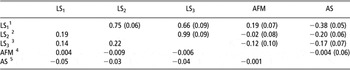
Genetic correlations and their standard errors for the traits are in the Table 5. The genetic correlations between LS1 and LS2, between LS1 and LS3 and between LS2 and LS3 were 0.75, 0.66 and 0.99, respectively. The genetic correlations between LS1, LS2 and LS3 differed statistically from zero (P < 0.01). Although these correlations are very high, it seems that at least LS1 is partly different trait from the other LS traits. This is also supported by the variance component estimates. Heritabilities and litter effects were different for LS1 and LS2 or LS3.
Estimated genetic correlations and their standard errors (above diagonal) and phenotypic correlations (below diagonal) between the first three parity litter sizes, age at first mating and animal size in Finnish mink

LS = litter size; AFM = age at first mating; AS = animal size.
1Number of kits 2 weeks after whelping in the first parity.
2Number of kits 2 weeks after whelping in the second parity.
3Number of kits 2 weeks after whelping in the third parity.
4AFM as days between birthdate and the first recorded mating.
5Size points.
Estimates of (co)variance components were calculated with Data Migrator Utility software (Madsen and Jensen, Reference Madsen and Jensen2000).
Genetic correlations between AS and the LS traits were clearly unfavorable indicating that larger animals have lower fertility (smaller litters). In other studies, it has also been observed that increase in AS may cause decrease in LS due to unfavorable genetic correlation. Lagerkvist et al. (Reference Lagerkvist, Johansson and Lundeheim1993 and Reference Lagerkvist, Johansson and Lundeheim1994) and Rozempolska-Rucińska (Reference Rozempolska-Rucińska2004) found an antagonistic genetic relationship between fertility and AS in mink. Koivula et al. (Reference Koivula, Strandén and Mäntysaari2008) found negative genetic correlation between LS and grading traits in mink. An unfavorable genetic correlation has also been found between female’s autumn BW and LS and also between BW and percentage of survived kits in the litter of following breeding season (Hansen and Berg, Reference Hansen and Berg2007). Similarly, in blue fox, Peura et al. (Reference Peura, Strandén and Mäntysaari2004 and Reference Peura, Strandén and Smeds2007) observed an unfavorable genetic correlation between AS and LS. Thus, if selection focuses on increasing AS, the genetic level of the LS will eventually decrease due to unfavorable correlation. However, the phenotypic impact may be small and slow to appear, because the heritability of LS is quite low. Consequently, LS has not yet decreased noticeably in Finnish mink farms.
There was a weak negative genetic correlation between AFM and AS, but it was not significantly different from zero. It seems that in mink, selection based on grading size does not affect AFM like in the blue fox. Peura et al. (Reference Peura, Strandén and Smeds2004) found a moderate negative genetic correlation (−0.20) between AFI and grading size in blue fox, indicating that selection for grading size increases growth rate, whereas genetic correlation decreases maturation age.
Selection for early or late maturation may have large impact on prolificacy, and thus, economic benefit. Study by Socha and Markiewicz (Reference Socha and Markiewicz2002) indicated that the highest number of kits and number of weaned kits are born for females that give birth early in spring. Moreover, Fredberg et al. (Reference Fredberg, Rasmussen, Berg and Sandbøl2001) concluded that female’s AFM affect birth time of kits and perhaps indirectly also LS. In blue fox, Peura et al. (Reference Peura, Strandén and Smeds2004) concluded that too early or too late estrus is associated with smaller LS. Thus, maturation age can affect prolificacy. In this study, we estimated a moderate positive genetic correlation between AFM and LS1 (0.19). The positive effects of a later mating age on LS may be related both to increased number of eggs ovulated and lower mortality of fertilized eggs before implantation (Elofson et al., Reference Elofson, Lagerkvist, Gustafsson and Einarsson1989). Interestingly, the genetic correlations between AFM and LS2 and LS3 were negative (−0.02 and −0.12, respectively). However, these were not statistically different from zero. The negative correlations may be attributable to earlier timing of heat in older females than yearlings and the fact that LS in different parities are not the same trait. In conclusion from correlations between LS and AFM, the early maturing minks have fewer kits than the later maturing females, but this interaction is observed only in the first litter. In the later parities, maturation age has no longer effect on LS, or if correlation exists, it might be favorable. Combined with the information of heritability and correlation estimates for first three LSs, relationships between AFM and LS traits indicate that LS1 and the later LSs are partly different traits.
Genetic trends
The genetic trends on LS traits were nearly same for all litters (Figure 1). Generally, the trends were small from 1990 to 2002, but after that the LS improved more than half of the standard deviation. The phenotypic trend of LS slightly increased, and the mean of LS1 increased approximately 0.6 kits from 1990 to 2004. Thus, it seems that in spite of negative genetic correlation between AS and LS, there has been genetic improvement in LS.
Genetic trends for the number of kits 2 weeks after whelping in the first (LS1), second (LS2) and third (LS3) parity presented with standardized breeding value estimates by birth year in Finnish mink.

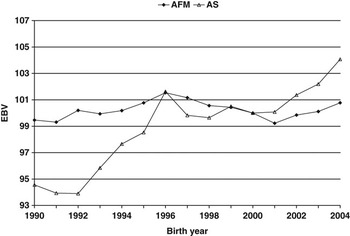
The genetic trend for AFM was almost plateau during the study period (Figure 2). Only minor fluctuations were observed in genetic trend of standardized EBVs of AFM. Breeding values are not currently estimated for AFM in the Finnish mink-breeding scheme. However, it might be useful to include AFM in the multi-trait breeding value evaluation. This would improve the accuracy of breeding value estimation, because the animals that do not have record on LS1 still have record on AFM. The genetic trend for AS was clear for increased size, although there was short slowdown from 1996 to 1998 (Figure 2, see also Koivula et al., Reference Koivula, Strandén and Mäntysaari2008). This increase in AS was also clear in the phenotypic trend, which indicated that body size has increased in mink (Figure 3).
Genetic trends for age at first mating (AFM; in days between birthdate and first recorded mating) and animal size (AS; in size points) presented with standardized breeding value estimates by birth year in Finnish mink.

Phenotypic trend in animal size (AS; in size points) by birth year in Finnish mink.

Conclusions
Heritability estimates of the LS traits and AFM were quite low. Litter effect was negligible for the LS traits, but for AFM, litter effect was high, indicating strong maternal effects. Heritability of AS was higher than estimates obtained for the fertility traits. Clear negative genetic correlation was found between AS and the LS traits. This indicates that it would be reasonable to take into account genetic correlations between the traits by using a multi-trait model in breeding value evaluations. AFM had a small positive genetic correlation with the first LS. However, genetic correlations of AFM with AS and later LS were close to zero. AFM could still be included into the multi-trait breeding value evaluation to support selection of economically important traits. Including AFM to the breeding value estimation would improve the accuracy of breeding value estimation, because females that do not have record on first LS still have record on AFM.
Acknowledgements
We thank Kerstin Smeds from the Finnish Fur Breeders’ Association for valuable comments to the manuscript.