




No CrossRef data available.
Changing ecological determinants of conduct problems from early adolescence to early adulthood
Published online by Cambridge University Press: 01 December 2004
Abstract
Changes in conduct problems from middle school through early adulthood were examined in a sample of 1191 African American and White males and females. Predictors were selected from a number of ecological contexts to examine the relative contribution of family, peer, school, and neighborhood factors to conduct problems during the 7th, 8th, and 11th grade and across transitions in middle school, into high school, and into young adulthood. Almost all contexts made a unique contribution to conduct problems except for the neighborhood setting. The variables that had the most regular influences during each of these periods were Family Consistent Control, Family Discipline Harshness, and Negative Peers. Positive family and positive peer variables had less consistent relations to outcomes. School variables were more influential in middle school than later. Few gender or race differences were found in the patterning of predictors across time. Studies using only one or two settings as predictors of conduct problems, may provide a misleading picture of their impact by excluding other contextual influences.The authors acknowledge the Russell Sage Foundation, the National Institute of Child Health and Human Development, the National Institute of Mental Health, and the following individuals (listed alphabetically) for support during the preparation of this article: Elaine Belansky, Todd Bartko, Heather Bouchey, Nick Butler, Celina Chatman, Diane Early, Kari Fraser, Leslie Gutman, Katie Jodl, Ariel Kalil, Linda Kuhn, Sarah Lord, Karen McCarthy, Oksana Malanchuk, Alice Michael, Melanie Overby, Robert Roeser, Sherri Steele, Erika Taylor, Janice Templeton, Cindy Winston, and Carol Wong.
Information
- Type
- Research Article
- Information
- Copyright
- © 2004 Cambridge University Press
Developmental psychopathology is concerned with the continuities and discontinuities of mental health through the life span. Although conduct problems have shown major stabilities across developmental periods (Robins, 1966), there is evidence of discontinuities as well (Moffitt, Caspi, Harrington, & Milne, 2002; Sampson & Laub, 1993). There are developmental changes where youth with high levels of early conduct problems have lower levels in adulthood and, conversely, where youth with low levels of early externalizing behavior become delinquent (Maughan & Rutter, 1998). Moreover, the degree of continuity may vary, depending on the group studied. For example, Broidy et al. (2003) found continuities for boys, but not for girls, in an analysis of data from six sites.
Whereas continuities in mental health status are generally attributed to the stability of individual biological and behavioral factors, discontinuities are more often explained by changes in experiential factors. The study of life span psychology is based on the premise that the important determinants of behavior are contextual factors (Baltes, 1979). From this perspective there is a strong belief that previous levels of competence or incompetence may have small relevance in the face of changing circumstance. Both continuities and discontinuities in individual behavior can be explained by social happenstance (Bandura, 1982; Lewis, 1997). Conversely, there are many examples of individual discontinuities, for example, the hormonal changes associated with adolescence (Rieder & Coupey, 1999), and environmental continuities, for example, high correlations between environmental risk scores measured in early childhood and adolescence (Sameroff, Seifer, Baldwin, & Baldwin, 1993). Contemporary views of development emphasize the interplay of individual and contextual characteristics over time, but the relative influence of these factors may vary during different developmental periods and for different groups of individuals.
In general, families, communities, cultures, and societies are relatively stable from birth to maturity. Despite recent increases in family dissolution, contact with biological parents and parenting practices of both fathers and mothers are relatively constant. Community variables related to resources and quality of schools are also stable, with families consistently living in either more or less affluent surroundings. But within these settings there are age-graded or developmental changes. Transitions to middle school (Eccles & Midgley, 1989) and high school (Felner, Primavera, & Cauce, 1981; Reyes, Gillock, & Kobus, 1994) would be points in development when there are major contextual changes in socializers, peer groups, and expectations (Ruble & Seidman, 1996). Yet during both of these school transitions the individual is still strongly embedded in the family of origin for financial and social support. Normatively, youth still live at home and spend large amounts of time in family activities. Parenting practices are also subject to life course change. As children reach adolescence, parents report more autonomy-giving and less restrictiveness in accord with the greater maturity of their offspring (Smetana, Crean, & Daddis, 2002).
The transition to early adulthood is an even larger contextual shift when individuals generally move out of the family residence and become increasingly self-supporting (Arnett, 2000; Sherrod, 1996). Engagement with the world of work or higher education increases the separation from the family of origin as individuals become part of new social institutions. During such transitions there are important discontinuities (Schulenberg, Bryant, & O'Malley, 2004) where individuals can show increases in competence (Aseltine & Gore, 1993) or decreases (Bardone, Moffitt, Caspi, Dickson, & Silva, 1996). These discontinuities are associated with changes in individuals' experience in the many social settings in which they participate (Schulenberg, Maggs, & Hurrelmann, 1997).
Determinants of conduct problems are of concern because of their central role in mental health diagnoses of conduct disorder and antisocial behavior and judicial judgments of delinquency and criminality. With large proportions of youth engaged in violence and being incarcerated, there are major social and economic costs to conduct disorder. It is one of the most prevalent disorders in childhood (Lewinsohn, Hops, Roberts, Seeley, & Andrews, 1993), and this high rate continues into adulthood (Moran, 1999; Turner & Gil, 2002). The Centers for Disease Control and Prevention (2000) reported 36% of high school students had been in a physical fight in the preceding year and 17% had carried a weapon during the preceding 30 days. In the year 2000 alone, 1.7 million youth were arrested (Children's Defense Fund, 2002). To reduce such problems more generally, a clear picture of their determinants is necessary.
The current study is a longitudinal investigation of conduct problems in a sample of youth followed from middle school into early adulthood. By examining the quality of the family, school, peer group, and neighborhood during this time period we are able to examine changes in conduct problems across the transitions into middle school, high school, and early adulthood. Although these social settings have been examined in many studies, few have compared their influences simultaneously. In this report, the primary questions are whether the relative importance of these contexts remains constant across these three transitions or whether there is a shift in their influence at different periods of life. Using a social ecological model (Bronfenbrenner, 1979), we are able to broaden our understanding of the changing impact of a variety of settings on the development of conduct problems.
Families
The view that the route to delinquency emanates from inadequate parenting has a long tradition (Glueck & Glueck, 1950). Inadequate supervision and discipline reflect poor quality socialization that leads to delinquency (Gottfredson & Hirschi, 1990). Inadequate emotional ties to parents represent another route to conduct problems. Families that foster positive social bonds increase attachment to parents and decrease attachment to deviant peers (Hirschi, 1969).
Conceptualizations of parenting have oscillated over time from two-dimensional circumplex models where families were classified in terms of emotional climate and control (Schaefer, 1959) to typologies where specific combinations of these factors are considered to have qualitatively different effects on children (Baumrind, 1991) and back again to dimensional ones where parenting behaviors are found to have additive influences (Barber, 1997; Herman, Dornbusch, Herron, & Herting, 1997). Among the dimensions of parenting found to be relevant for child mental health have been warmth, control, effectiveness, consistency, neglect, and harshness of discipline. Although multiple dimensions of parenting have been shown to affect externalizing behavior (Galambos, Barker, & Almeida, 2003), many studies have focused on single dimensions in isolation, especially harsh parenting (Ackerman, Brown, & Izard, 2003; Bennett, Bendersky, & Lewis, 2002). Darling and Steinberg (1993) presented a hierarchical model of parenting style where the control dimension had to be interpreted in the context of the warmth and concern dimension.
The effect of coercive and harsh parenting on preschool and elementary school-age antisocial behavior was made particularly salient in the work of Patterson and his associates (Patterson, DeBaryshe, & Ramsey, 1989; Patterson, Reid, & Dishion, 1992). Harsh parenting was found to predict externalizing problems for children at age 4 (Bennett et al., 2002) and those who would continue to have high levels of externalizing behavior from first to third grade (Ackerman et al., 2003). Deater–Deckard, Dodge, Bates, and Pettit (1996) placed punishment in a cultural context when they reported that the relation held up for European Americans, but it was not found for African American children during elementary school. African American and lower income youths were found to be more approving of spanking as a method of discipline and those who experienced more physical punishment short of abuse were more approving (Deater–Deckard, Lansford, Dodge, Pettit, & Bates, 2003). Parental monitoring and supervision have also been found to play a role in elementary school antisocial behavior (Dishion, Patterson, Stoolmiller, & Skinner, 1991). Loeber and Farrington (2000) included poor supervision, communication, and parent–child relations in their list of parental contributions to child delinquency.
The effects of parenting practices on conduct problems continue into adolescence, but there has been a proliferation of parenting constructs differentiating the control aspects childrearing. Unilateral parental decision making and harsh punishment have been found to make independent contributions to increases in externalizing behavior (Lansford, Criss, Pettit, Dodge, & Bates, 2003). Parental knowledge, defined as parent awareness of the whereabouts and activities of their adolescents, was reciprocally correlated with delinquent behavior. Between the ages of 14 and 18, parents with more knowledge had youth who decreased in delinquency and youth with greater delinquency had parents who decreased in their knowledge (Laird, Pettit, Bates, & Dodge, 2003). Moreover, the effects of parental control may be different when behavioral control (e.g., rule enforcement) and psychological control (e.g., disparagement) are considered separately. Galambos et al. (2003) found that between 12 and 15 years of age, behavioral control was related to decreases in externalizing problems, whereas psychological control was related to increases.
Peers
Friends have an important impact on adolescent emotional functioning within the school and neighborhood setting. Peer rejection has been an important area of research and has been offered as one explanation for antisocial behavior (Haselager, Van Lieshout, Riksen–Walraven, Cillessen, & Hartup, 2002; Hektner, August, & Realmuto, 2000; Petras, Schaeffer, Ialongo, Hubbard, Muthen, Lambert, Poduska, & Kellam, 2004). However, the delinquent values of the peer group have also been considered to play an important role in the development of antisocial behavior. Patterson et al. (1989) proposed that antisocial peers have an amplifying effect on antisocial behavior. Others have found consistent relations between association with deviant peers and higher levels of conduct problems during adolescence (Elliott & Menard, 1996; Keenan, Loeber, Zhang, Stouthamer–Loeber, & van Kammen, 1995).
Although most research in this domain has focused on the negative influence of peers on adolescents (Simons, Wu, Conger, & Lorenz, 1994), friendships may also exert positive effects (Brown, Lohr, & McClenahan, 1986). Both prosocial and antisocial aspects of friends have an impact on adolescent behavior (Brendgen, Vitaro, & Bukowski, 2000), but it is not clear whether this is a linear relation or whether the two ends of the dimension have independent effects. The common explanation for the influence of nondelinquent peers is that they do not have antisocial values and behaviors. However, nondelinquent peers may also have prosocial values for academic achievement and community involvement that offer an alternative life path to developing youth (Furstenberg, Cook, Eccles, Elder, & Sameroff, 1999).
Schools
School is another ecological context that has an important impact on conduct problems and where there is interdependence between the two. Most researchers have focused on the school difficulties of antisocial children (Dishion, French, & Patterson, 1995). There is a clear association between school failure and delinquency (Bachman, Wallace, O'Malley, Johnston, Kurth, & Neighbors, 1991; Huizinga & Jakob–Chien, 1998). Adolescents with conduct disorder often experience limited educational attainment, are more likely to be retained in grades, have lower levels of achievement, and end school prematurely. They are characterized by teachers as uninterested in school, unenthusiastic toward academic pursuits, and careless in their work (Kazdin, 1995). On the positive side, feelings of academic competence, valuing of school, and higher grades have been found to predict diminished emotional distress over time (Eccles, Lord, & Roeser, 1994).
Another literature has emphasized the effects of school characteristics on youth problems. Students' valuation of school is determined in large part by the characteristics of the institution. Disenfranchisement from the school context produces a perception that students are not receiving emotional support from caring adults (Gottfredson & Hirschi, 1990). Kazdin (1995) synthesized work from a number of investigators (e.g., Loeber, 1990; Mrazek & Haggerty, 1994) to identify the school factors facilitating the development of antisocial behavior. His list included little emphasis on schoolwork, little time spent on lessons, infrequent use of praise and appreciation of schoolwork, little emphasis on individual responsibility of the students, poor working conditions for students, unavailability of the teacher to deal with children's problems, and low teacher expectancies.
Other investigators have suggested that more positive school experiences and a decreased incidence of school failure are associated with the degree to which students feel involved in the educational process and feel that their learning is linked to their effort, as opposed to their traits. Status-oriented schools, where students more often feel detached from the educational process and evaluated according to their performance rather than their effort, and ascribed characteristics, such as race and gender, contrast with mastery-oriented schools that focus on individual learning processes and effort (Maehr & Midgley, 1991; Roeser, Eccles, & Sameroff, 1998). Similarly, Fiqueira–McDonough (1986) found that minor delinquency occurred more often in an environment dominated by competitive academic achievement, routine handling of discipline, and unpredictable supervision. Such environments were also more conservative and unlikely to have a gender-egalitarian orientation.
Neighborhoods
The community context has been posited to have direct and indirect effects on antisocial behavior. Moreover, as children age, some suggest there is a shift from indirect effects during early school age to direct effects during adolescence (Aber, 1994; Fraser, 1996; Leventhal & Brooks–Gunn, 2000). The earlier indirect effects are through family variables where availability or lack of social resources and supports promote or undermine parenting. The later direct effects are through lack of resources for the adolescent and young adult and the greater prevalence of antisocial peer groups as well as exposure to violence. Neighborhood disorganization provides greater access to delinquent groups that may lead youth to believe that antisocial behavior is acceptable (Sampson, Raudenbush, & Earls, 1997). Others have suggested that neighborhood effects operate though the increased poverty found in disorganized neighborhoods (Loeber et al., 1993). The route through poverty is further complicated because it is not clear whether it is neighborhood level or family level poverty that is the more important influence (Kupersmidt, Griesler, DeRosier, Patterson, & Davis, 1995). Sampson, Raudenbush, and Earls (1997) have placed these conditions within a psychological framework, finding that disorganization in high poverty neighborhoods operates through a reduced sense of shared efficacy among the area's inhabitants. Ingoldsby and Shaw (2002), after reviewing a large number of studies, suggested that middle childhood may represent a critical developmental period during which children are at heightened risk for neighborhood-based effects on antisocial behavior problems.
Comparing Ecological Context Influences
Since Bronfenbrenner (1979) broadened elements to be considered in a social ecology of development, there has been concern about the multiple influences of social settings and their interactions. In the delinquency domain most efforts have been directed at examining the relations between parents and peers (Elliott, Huizinga, & Ageton, 1985; Farrington, 1986). The most common view is that inept parenting causes an adolescent to affiliate with deviant peers; as a consequence of these associations, he or she acquires attitudes favorable to delinquent behavior (Sutherland, Cressey, & Luckenbill, 1992). Elliott and colleagues (1985) pointed to deviant peers as the primary cause of delinquency but also to quality of parenting as exerting an indirect effect by increasing the connection with deviant peers (although the family effects often disappear after controlling for peer effects). Galambos, Barker, and Almeida (2003) argued that in seeking interactions between contexts a differentiated model of process within each context is necessary. Comparing the effects of different parenting aspects on externalizing behavior, they found that firm behavior control but not parental support was an important counterweight to the influence of deviant peers.
School and peer influences are also intertwined. Decisions to try hard in school or skip school are susceptible to peer influences that can contribute to educational consequences such as increased truancy and poor commitment to schoolwork among members of particular peer groups (Berndt & Keefe, 1995; Brown, 1990). Even effects of racial and gender discrimination on problem behavior can result from interactions between teacher and peer behavior (Wong, Eccles, & Sameroff, 2003).
Ingoldsby and Shaw (2002) pointed out that the relative impact of parenting, neighborhood, and peer behavior may vary in different environments or at different points of development. Using a middle-school sample, Gutman, Sameroff, and Eccles (2002) found interactions between a combination of peer, school, neighborhood, and demographic variables and a number of parenting variables in predicting academic competence. The efforts that have been made to examine these multiple contexts during elementary school found moderating effects of parenting and neighborhood factors on early adolescent externalizing problems (Pettit, Bates, Dodge, & Meece, 1999). The sequencing of effects from these contexts was placed in a comprehensive transactional model for understanding the development of chronic conduct problems by Dodge and Pettit (2003) where individual differences affect parenting, which affects school and peer involvement. Cook, Herman, Phillips, and Settersten (2002) compared summary scores of seventh grade peer, school, family, and neighborhood quality for predicting general competence at eighth grade, testing both direct and interactive effects. They found additive effects among the contexts, but there were no interactive effects. Each setting made an independent contribution. In this report, we explore the influence of these multiple contexts on the development of conduct problems during adolescence and early adulthood and contrast the social impact of the family, peer group, school, and neighborhood.
Research Questions
Transitions in life offer opportunities to improve or worsen competence. Of special concern are changes in conduct problems related to the transition to middle school, high school, and early adulthood. Our questions relate to explanations of contemporary functioning and to the predictors of change from one developmental phase to the next. During these periods, we expect that youth change in their involvement in the family, peer group, school, and neighborhood. However, to what extent do the relative influences of these contexts on concurrent behavior change from one period to another? Also, to what extent do the relative influences change in the prediction of antisocial behavior in the next developmental period? We will examine the concurrent relations between contexts and behavior at the beginning of middle school (T1), the end of middle school (T2), and during high school (T3). We will then examine the predictive power of ecological variables from each period on conduct problems during the next period focusing on three transitions: the middle school transition from the beginning to the end of middle school (T1–T2), the high school transition from the end of middle school to high school (T2–T3), and the adult transition from high school to early adulthood (T3–T4).
Methods
Participants
The data reported here come from a study of primarily middle-class youth in Prince George's County Maryland, which is adjacent to and east of Washington, DC: the Maryland Adolescent Development in Context (MADIC) Study (Jodl, Michael, Malanchuk, Eccles, & Sameroff, 2001). The MADIC participants are a subsample of the Study of Adolescents in Multiple Contexts (SAMC; Cook et al., 2002). In the SAMC, the researchers invited all 1990, 1991, and 1992 seventh-grade students in the county school district to participate in their study. They administered questionnaires in school to students whose parents gave their consent at the beginning of seventh grade and at the end of the adolescents' eighth grade. These questionnaires were used to assess adolescents' perceptions of their families, their friends, and their own beliefs, feelings, and behaviors.
Of the approximately 5000 students in the second SAMC cohort (1991), 1482 adolescents and their families also participated in the interviews and self-reports required for the MADIC Study. These families were selected initially using a stratified sampling procedure designed to yield proportional representation of families from each of the 23 middle schools being studied; participation was voluntary at all waves. T1 MADIC data were collected from families when adolescents were at the beginning of the seventh grade (1991). The target youth and primary caregiver were interviewed at home and completed a self-administered questionnaire. T2 MADIC data were collected the summer following the adolescents' completion of eighth grade (1993). Because T1 data was collected at the beginning of the seventh grade and many of the questions, particularly the school scales, referred to their sixth-grade experience, we are using the T1–T2 time period to represent the transition to middle school.
The T3 data were collected after the 11th grade (1996), and the T4 data were collected approximately 1 year after the majority of adolescents graduated from high school (1998). Parents were not included in the T4 assessment. Except for the T1 and T2 SAMC measures of school climate and conduct problems, all of the data reported here are from the MADIC Study. In this report, we refer only to data from the 1181 Blacks and Whites who participated in at least two out of the four data waves. The small number of Latino (18), Asian (28), mixed-race (91), and “other” race (16) participants were excluded from these analyses. The 105 African Americans and 43 European Americans who participated in only one wave of data collection were also excluded.
Sixty-six percent of the remaining 1181 participants included in this report were African American and 50% were female. The African and European American households were characterized by wide and similar ranges of income, occupational, and educational statuses for the duration of the study. When enrolled in the study in 1991, the racial gap in earnings for this sample was much lower than the national average. The median income was between $40,000 and $45,000 for Blacks and between $50,000 and $55,000 for Whites, with Blacks earning 81% of what Whites earned (compared to a national figure of 60% in 1990). Thirteen percent of Blacks and 15% of Whites earned more than $75,000, and only 12% of Blacks and 5% of Whites earned less than $20,000. The primary caregivers' average level of education was also similar across the two ethnic groups: at T1, 95% of Blacks and 97% of Whites had received a high school degree, and 53% of both Blacks and Whites had obtained some kind of college degree. This comparable sociodemographic background of Black and White residents offers a unique opportunity to study normative developmental experiences of Black and White adolescents across the full socioeconomic spectrum.
Procedures
At T1, residents from the local area were recruited as interviewers and trained in a 3-day workshop. The racial composition of the mostly female interviewers roughly matched that of the county at large (60% African American, 38% European American, 2% Hispanic). Interviewers were paid per interview. As often as possible, race of interviewer was matched to race of primary caregiver. To ensure that interviewers were following the interview protocol accurately, approximately 15% of families were randomly selected and recontacted by the study staff to verify that the interview had taken place and the interviewer had followed the guidelines for conducting the interviews. These verification calls revealed no problems with the interview staff. Similar procedures were used to obtain interviewers for subsequent waves.
At the beginning of the study, the interviewer phoned the household and asked to speak with the parent identified by the school, generally the mother. After describing the study and obtaining his or her agreement to participate, the interviewer asked this adult, “Out of the people living in this household, what is the name of the person who has the most responsibility for and knows the most about (the target adolescent)?” The person named in response to this question was identified as the primary caregiver (7% were fathers, grandparents, and other relatives).
For T1, T2, and T3, following the initial phone contact, the remainder of the interviewing process took place in the home of the family. The primary caregiver and the target adolescent completed two questionnaires: one a face to face structured interview and the other a self-administered questionnaire. The primary caregiver was interviewed first and the adolescent second. Each face to face interview took 1 hr, and each self-administered booklet took 30 min to complete. T4 data were collected from a self-administered questionnaire that was mailed to all the target youth (primary caregivers were excluded from T4). Telephone follow-ups were used to gather information from those youth who failed to return their questionnaires. The target adolescent and primary caregiver were each given $15 for their participation at each assessment.
In these analyses, because of the lack of parent information at T4, we will maintain consistency by using only youth data from the four waves. Moreover, only the young adult outcome data will be used from T4 because the major changes in social context across the young adult transition precluded parallel measures of the social settings.
Attrition and missing data
Of the 1181 adolescents at T1, 943 (80%), 948 (80%), and 769 (65%) participated at T2, T3, and T4, respectively. Participants who had valid scores for all scales were included in the cross-sectional and longitudinal analyses of the original data. Chi-square, t-test, and logistic regression analyses were performed to test for significant differences between participants who were used in the analyses and those who were not.
In general, missing data appear to be missing at random (MAR; Little & Rubin, 1987). That is, participants with missing data differ from those without missing data, but these differences are rarely predictable from variables used in this report and are predictable from other variables in our data set. Using the Nagelkerke measure of the proportion of variance accounted for, the regression models account for between 8 and 20% of the variance in “missingness.” Although the specific variables that predict missingness vary across the different models implicated by our study variables, low levels of youth achievement tend to predict missingness in models associated with T1 and T2, whereas parent's report of poor neighborhood quality tends to predict missingness in models associated with T3 and T4.
We used similar analyses to examine differences between our sample of 1181 who participated in at least two waves of data collection and the 148 Blacks and Whites who dropped out of the study after T1. The only variable that uniquely predicted sample attrition was an academic achievement composite based on the math subtest of the Maryland Functional Achievement Test and school reported seventh-grade grade point average; lower levels of youth achievement predicted greater attrition.
We used two strategies in our analyses: one using the original data and another using an imputed set of data with all missing measures added to obtain a larger sample size. The original data set had a sufficient number of cases to test our hypotheses, but the imputed set permitted us to use a larger sample and to have more power in our analyses of subgroup differences. Data imputation methodology has undergone major advances from early techniques of listwise deletion, which tended to produce biased results from the reduced sample size, to substituting means, which tended to produce artificial stability of relations. Recent advances in data imputation have produced methodologies that utilize all available information to fill in missing data, in addition to adding a random component to offset artificial stability (Schafer & Graham, 2002). Failing to include this uncertainty can result in underestimating variability in the data, producing less accurate parameter estimates and underestimated standard errors (Sinharay, Stern, & Russell, 2001). Although these advanced methodologies are not yet common in the developmental literature, we felt that they would be very appropriate for the current data set.
We examined each of our ecological models using both original and imputed data. Because the multiple imputation procedure adds a random element to each value, statisticians recommend calculating a number of sets of imputed data to check for consistency. Five sets of imputed data were generated for all participants with at least two waves of complete data (N = 1181) using the sequential regression imputation method described by Raghunathan, Lepkowski, Van Hoewyk, and Solenberger (2001; cf. Allison, 2002; Schafer & Graham, 2002). The five sets of regression parameter estimates associated with each model were then combined using the SAS “MIANALYIS” procedure. We found only a few substantive differences among the many comparisons in the analyses using the original versus imputed data, and these differences will be noted where applicable.
Measures
The measures used in this article were derived primarily from youth self-reports and are described below. Scale construction was guided by theoretical concerns, factor analyses, and item analyses. Means, standard deviations, and Cronbach's alpha reliability estimates for all of the original variables are presented in Table 1. Scale selection for T1, T2, and T3 was guided by our desire to measure the same constructs at each wave and to include variables from the neighborhood, school, peer, and family levels of the ecological model. Because target youth were no longer in school, and many no longer living at home, there were few parallel scales in the T4 data. Only the T4 conduct problems measure is included in the transition to early adulthood analyses. Complete descriptions of all items and scales can be found at the following Web site: http://www.rcgd.isr.umich.edu/pgc.
Mean (M), standard deviations (SD), and reliability coefficients (α) for 7th grade (T1), 8th grade (T2), 11th grade (T3), and young adult (T4) scales

Conduct problem outcome
The primary conduct problem outcome variable used in this study was a combination of anger, physically aggressive behavior, and delinquency. Most literature in this area refers to antisocial behavior, and to a smaller extent, conduct disorder. We are using conduct problems as our outcome rather than an official diagnosis in our relatively low risk sample of primarily middle class families. A diagnosis of antisocial personality would have required criteria that were not assessed in our study. These unmeasured criteria include indicators of impulsivity, irresponsibility, and lack of remorse, in addition to a diagnosis of conduct disorder and being 18 years of age.
The same three self-report items related to participants' anger, adapted from the Symptoms Checklist 90—Revised (Derogatis, 1983; Derogatis, Rickels, & Rock, 1976), were used at each of the four waves of data collection: during the last month, including today, how often have you (a) felt so angry that you wanted to smash or break something? (b) felt that you couldn't control your temper? and (c) felt so upset that you wanted to hit or hurt someone? Adolescents responded to each item using the following Likert-type scale: 1 = almost never, 2 = once in a while, 3 = sometimes, 4 = often, and 5 = almost always.
Aggression, rule violation, and delinquency items included six aggressive behavior items that were based on the work of Elliott and colleagues (Elliott, Huizinga, & Menard, 1989) and included in both the SAMC (Cook et al., 2002) and the MADIC study: in the past year, how often have you (a) hit someone for what they said/did? (b) lied to your parents? (c) stolen from a store? (d) been involved in a gang fight? (e) damaged public or private property for fun? and (f) stolen a motor vehicle? (1 = never, 2 = once or twice, 3 = three or four times, 4 = five to nine times, 5 = 10 or more times). The response scales were modified slightly when the items were carried over into MADICS for Waves 4 and 5 (e.g., 5 = 20 or more times).
Family
Consistent Control
Our measure of family control at each time was a composite created from 21 (T1) and 19 (T2 and T3) items taken from scales used to measure the amount of decision-making autonomy parents granted youths, parent consistency in enforcing rules, and the extent to which parents monitored youth activities. Higher scores reflect greater family control. Autonomy items, which were reversed prior to scaling, were both content general (e.g., in general, how do you and your parents currently arrive at decisions?) and content specific (e.g., in your family, how do you make most of the decisions about which friends you can spend time with?) and were scored on the following 5-point Likert-type scale: 1 = my parents decide by themselves, 2 = my parents decide after discussing it with me, 3 = we decide after discussing it together, 4 = I decide after discussing it with my parents, and 5 = I decide all by myself (cf. Epstein & McPartland, 1977). Consistency items (e.g., how often do your parents only keep rules when it suits them? How often do your parents punish you for doing something 1 day, but forget about it the next?), which were also reversed prior to scaling, were measured on 5-point Likert-type scales anchored by almost never (1) and almost always (5). Monitoring items varied somewhat across waves. T1 items (e.g., how often do your parents know if you are home by the time you are supposed to be?—anchored by “almost never” and “almost always”) tended to refer more to parents' general monitoring levels than the items used at T2 and T3 (e.g., how often do your parents TRY to find out where you go at night? How often do your parents REALLY know where you go at night?—anchored by “never” and “always”) which focused more specifically on the distinction between parents monitoring efforts and successes.
Positive Climate
Our measures of family affective climate were composites created from 16 (T1 and T3) and 20 (T2) items taken from scales used to measure the quality of affective relationships, communication, and shared activities among family members. Some items differed in their anchor content and value ranges so items were standardized (and reversed, where necessary) before calculating scale scores; higher scores reflect a more positive affective climate. Affective relationship items included “How close do you feel to your parent?” (1 = not very close to 4 = extremely close 4) and “How often can your family members talk to each other about the sadness they feel?” (1 = almost never to 5 = almost always). Communication items included “Your parent and you talk about how things are going in your life” and “You talk with your parent about how things are going with your friends,” which were scored using the following scale: 1 = almost never, 2 = less than once a month, 3 = one to three times a month, 4 = about once a week, 5 = a few times a week, and 6 = almost every day. Shared activity items included “How often do you work on something together around the house (with your immediate family)?” and “Your parent(s) spend enough time with you” (anchored by 1 = almost never and 5 = almost always).
Discipline Harshness
Our measure of Family Discipline Harshness was a composite created from 20 (T1), 26 (T2), and 19 (T3) items taken from scales used to measure parents' self-centeredness, rule enforcement style, and use of physical punishment. Items were standardized (and reversed, where necessary) before calculating scale scores so that items with different value ranges could be placed on similar scales; higher scores reflect a harsher discipline style. Self-centered parenting items included “My parents want me to follow their directions even if I disagree with their reasons” and “Your (PARENT) doesn't like it when you question (his/her) decisions and rules” (anchored by 1 = almost never and 5 = almost always). Rule enforcement style items included “During the past month, how often did your parent yell at you?” and “During the past month, how often did your parent criticize you or your ideas?” (1 = never, 2 = once or twice, 3 = three or four times, 4 = a couple of times a week, 5 = almost every day). Physical punishment items included “When you break one of your parents' important rules, how often do they physically punish you?” (1 = almost never to 5 = almost always) and “During the last month, how often did your parent(s) hit, push, grab, or shove you?” (1 = never, 2 = once or twice, 3 = three or four times, 4 = a couple of times a week, 5 = almost every day).
Peers
Positive Peers
Positive Peer characteristics were measured using 6- (T2 and T3) and 7-item (T1) scales that included items like “How many of the friends you spend most of your time with … think it is important to work hard on schoolwork? [or] … like to discuss schoolwork/intellectual things with you?” (1 = none of them, 2 = a few of them, 3 = about half of them, 4 = most of them, 5 = all of them).
Negative Peers
Negative Peer characteristics were measured using 9- (T1), 8- (T2), and 5-item (T3) scales that included items such as “How many of the friends you spend most of your time with … cheat on school tests? [or] … put pressure on you to use drugs?” (1 = none of them, 2 = a few of them, 3 = about half of them, 4 = most of them, 5 = all of them). The items used in both the Positive and Negative Peer Characteristics scales were taken from Eccles' Michigan Study of Adolescent Life Transitions (Eccles, Midgley, Wigfield, Buchanan, Reuman, Flanagan, & Mac Iver, 1993).
School
School scales centered on two aspects of the youth's experience: the quality of the affective climate and respect for individual differences in race and competence. Our scales were derived from school context measures used by Maehr and Midgley (1991), Midgley et al. (2000), and Roeser et al. (1998).
Positive Climate
Positive affective climate is a general measure of the overall milieu at school and was measured using 9- (T1), 8- (T2), and 7-item (T3) scales that included items like, “At the school I go to now, the staff cares about students as individuals” (1 = strongly agree, 2 = agree, 3 = neither agree nor disagree, 4 = disagree, 5 = strongly disagree) and “Think about this past school year. In your eighth-grade school, how often was there racial tension between school staff members and students of different racial backgrounds?” (anchored by 1 = almost never and 5 = almost always).
Respect for Differences
Status-oriented schools tend to treat students better or worse depending on their academic ability, sex, or race. Respect for Differences is a more specific measure of the extent to which adolescents felt like they were being treated fairly and respected more for the quality of their school involvement than for their abilities and was measured using 10- (T1) and 5-item (T2 and T3) scales that included items like “In this school, how many teachers show equal respect for students, regardless of color?” (anchored by 1 = none, 3 = about half, and 5 = all) and “In your eighth-grade school, how true is it that teachers treat students who get good grades better than other students” (1 = not at all true at your school, 2 = a little true, 3 = somewhat true, 4 = quite true, 5 = very, very true). All items for the T1 version of this scale were collected at the beginning of seventh grade as part of Cook et al. (2002) SAMC. Comparable T3 and T4 scales were included in the MADIC data.
Neighborhood quality
Our measure of neighborhood quality consisted of a single 6-item scale administered only at T1. Scores on this variable at T2 and T3 were used only for families that lived in the same house as reported in T1. The scale included collective efficacy (Sampson et al., 1997) items like “You can count on people in your neighborhood to help you if you need it” and attachment items like “You want to get away from this neighborhood as soon as you can” (anchored by 1 = strongly agree and 5 = strongly disagree). If the family was in the same residence at T2 and T3, the T1 data were used. If the family moved at either T2 or T3, this variable was missing.
Results
The first task was to examine the intercorrelations among our social context variables and conduct problem outcomes. All eight context variables were found to be significantly related to conduct problems (see Table 2). The three family, two peer, two school, and one neighborhood variables at each age were individually related to contemporary conduct problems at each of the school-age assessments, TI, T2, and T3. We found similar results when the correlations between the context variables at each wave were correlated with conduct problems at the next wave of data, but to a smaller degree. All T1 variables were significantly correlated with T2 conduct problems, all T2 context variables were significantly correlated with T3 conduct problems, and all T3 context variables were significantly correlated with T4 conduct problems.
Cross-sectional and longitudinal correlations between contextual predictors and conduct problem outcome

The next task was to determine the relative importance of these context variables in predicting conduct problems. Hierarchical linear regression analyses were performed to examine the contribution of family, peer, school, and neighborhood variables within each period and across each transition. Three cross-sectional regressions were done using T1, T2, and then T3 data. This was followed by three longitudinal regressions using T1 context data to predict T2 conduct problems for the middle-school transition, T2 data to predict T3 conduct problems for the high-school transition, and T3 data to predict T4 conduct problems for the young adult transition.
In each of the longitudinal regression analyses, prior conduct problems was entered first, as a covariate, so that we could determine the amount of variance in conduct problems change that was explained by the context variables. Gender and race were also entered as covariates in all six of these regression analyses. We included measures of parental income, education, and occupational status in preliminary models but dropped them from the analyses reported here because they explained no statistically significant amounts of unique variance in any of the final regression models.
Cross-sectional analyses
In the cross-sectional analyses (see Table 3), relatively large amounts of variance in conduct problems were explained by the context variables (R2 = 34, 37, and 36% for T1, T2, and T3, respectively). At all three waves family, school, and peer, but not neighborhood variables had significant betas. Although the neighborhood variable had significant zero-order correlations with the conduct problem outcomes, it did not contribute unique variance to the outcome when the other context variables were considered.
Beta weights from final equations for cross-sectional and longitudinal regression analyses for whole sample with context variables as predictors and conduct problems as the outcome

Similar patterns of relations were found within each of the three time periods with a few differences. In the family domain, all three variables were consistent contributors, except for Family Positive Climate that was not at T1. Negative Peers was significant for all waves, but Positive Peers had a unique influence only at T3, during high school. Respect for Differences was significant T1, borderline at T2, and not at T3, whereas positive school climate was significant only at T2.
Transition analyses
Regression analyses were performed to examine the relative predictive ability of the setting variables from one time period on the next. The longitudinal transition analyses produced results similar to the cross-sectional regressions (see Table 3), but with smaller percentages of variance explained once prior conduct problems were taken into account (R2 = 12% for the T1–T2 transition, 5% for the T2–T3 transition, and 9% for the T3–T4 transition). Again, all the settings except for the neighborhood predicted change in conduct problems across each of the three transitions.
Among the family setting variables, T1 Positive Climate predicted T2 conduct problems, prior Consistent Control predicted T2 and T4 conduct problems, and prior Discipline Harshness predicted T2 and T3 conduct problems, and was borderline significant predicting T4. The effect of Family Positive Climate was an anomaly because the positive beta coefficient implied that more family warmth was associated with more conduct problems. Because it had been negatively related in the correlation table (see Table 2) and had negative beta weights in the cross-sectional regressions, we assumed that this was a suppression effect in relation to the more influential harsh discipline variable. To test this, we redid the longitudinal regression analyses using only the Family Positive Climate variable as a single predictor. Indeed, Family Positive Climate now had negative beta weights in predicting conduct problems during all three transitions. We checked to see if Positive Climate interacted with either Discipline Harshness or Consistent Control in predicting later conduct problems, but we found no interpretable relations.
In the peer domain there was a parallel anomalous effect of positive peers. The effect of Negative Peers was significant for the T1–T2 transition, and was borderline for the T2–T3 and T3–T4 transitions. Positive Peers was a significant contributor only to the T3–T4 transition.
From the school variables, only Respect for Differences was significantly related to changes in conduct problems and only for the T1–T2 transition. Less differential treatment was associated with fewer conduct problems. School variables did not make a reliable contribution to the transition to young adulthood.
A major aspect of the transition to adulthood is the transition to independent living. A question of interest to us was whether there would be a different pattern of T3 high-school setting variables on T4 young adulthood conduct problems for those still living at home compared to those who were living away. These comparisons can be seen in Table 4. Interestingly, T3 family variables were more related to conduct problems for those no longer living at home, where peer variables were more related to conduct problems for those still at home.
Beta weights from final regression equations for T3–T4 longitudinal analyses for individuals living at home or away with high-school context variables as predictors and young adult conduct problems as the outcome

Gender and race analyses
Race had a significant beta in only one of the six cross-sectional and longitudinal regression analyses (T1 cross-sectional), where being African American was associated with higher levels of conduct problems. For gender there were significant betas only in T2 cross-sectional analysis and the T1–T2 longitudinal analysis, males having more conduct problems than females.
To determine if there was a difference in the patterning of ecological influences for different genders or races, we ran four separate cross-sectional and longitudinal regressions for Black and White, male and female subgroups (see Tables 5 and 6). We looked for patterns in the results where there were consistent differences based on gender or race within a single analysis or where a subgroup was consistently different in several analyses. We will not discuss here occasions when one of the four groups was different in only one analysis because of the possibility of a random finding among the many comparisons.
Beta weights from final regression equations for cross-sectional analyses of race by gender subsamples with context variables as predictors and conduct problems as the outcome

Beta weights from final regression equations for longitudinal analyses of race by gender subsamples with context variables as predictors and conduct problems as the outcome

Cross-sectional regression analyses
In the whole sample analyses among the family variables, Consistent Control and Discipline Harshness were significant at all three time periods, and Positive Climate was significant at T2 and T3 (see Table 5). In the race/gender analyses the same results were found for all subgroups except for T3 where the three family variables were significant for Black males and females only. It must be noted that the magnitude of the betas were similar in the White subsamples but not significant owing to the smaller size of these two groups. Because Deater–Deckard et al. (1996) had reported stronger effects of harsh punishment on Whites than African American school-age children we redid our whole sample analyses including a race by Discipline Harshness interaction term. The interaction was not significant in any of our analyses.
Negative Peers had been significant at all time periods in the whole sample analyses but Positive Peers only at T3. These patterns were reflected in the subgroup analyses, with the exceptions that Negative Peers was not a reliable contributor for females at T2 and Positive Peers only significant for White females at T2 and T3. The school and neighborhood variables showed the same pattern in the subgroups as in the whole sample analysis.
Longitudinal regression analyses
For the four subgroups the amount of explained variance (R2) in conduct problems change across each transition ranged from 6 to 14% in the T1–T2 transition, 5 to 10% in the T2–T3 transition, and 6 to 13% in the T3–T4 transition (see Table 6). No subgroup had either the highest or lowest R2 consistently across the three transitions.
Among the family variables, where Discipline Harshness was significant or borderline in the whole sample analyses for all transitions, it had inconsistent effects in the subgroup analyses. It predicted conduct problems for Black females in the T1–T2 transition, Black and White males in the T2–T3 transition, and Black males in the T3–T4 transition. The other family variables had no consistent effects in the subgroups analyses.
Neither of the peer variables made significant contributions in the longitudinal regressions. Respect for Differences was significant for all subgroups in the T1–T2 transition as it had been in the whole sample analysis. There were no neighborhood effects.
Discussion
The social ecology of development contributes to the mental health of youth during middle school, high school, and young adulthood. Much prior research has centered on the relation between single settings and conduct problems. Because the family, peer group, school, and neighborhood have all been shown to predict antisocial behavior, studies that focus on one or another of these exaggerate the importance of the targeted independent variable. By including most of the individual's social contexts in the same study, we found that almost all are influential during each developmental period and each makes a unique contribution to an individual's conduct problems. The one exception in our data was our neighborhood variable. Although it was correlated with conduct problems when taken alone, it did not contribute to the explanation of individual differences when the other setting variables were included in the predictive equations.
Our sample is unique in that we are able to disentangle the effects of race and socioeconomic status that are confounded in much of the literature. By comparing African American and European American families from a full range of socioeconomic backgrounds, we can determine if developmental differences are more related to race than contextual factors.
Our major research question was whether the pattern of relations between the settings of the social ecology and conduct problems changed across developmental periods. We addressed this question using two strategies—a cross-sectional one in which we examined contemporary relations between independent and dependent variables, and a longitudinal one in which we examined the relation between prior context variables and later conduct problems while controlling for prior level of conduct problems. We had comparable measures of family, peer, school, and neighborhood variables for the first three waves of data collected during the 7th, 8th, and 11th grade. We did not have analogous context information at the last, age 19–20, assessment when the participants were no longer in school, and many were living away from their parents. As a consequence, we were not able to do a cross-sectional analysis of contextual effects on young adult behavior. We were able to use the conduct problems score from the last assessment as a longitudinal outcome for analyses of the young adult transition.
Social ecology of conduct problems
Our major conclusion is that there are many routes to conduct problems. The three cross-sectional regression analyses revealed contributors from each ecological setting at 7th grade, 8th grade, and 11th grade. The variables that had the most consistent influences during each of these periods were Consistent Control, Discipline Harshness, and Negative Peers. Positive family and positive peer variables had less consistent relations to outcomes. Family Positive Climate was a reliable predictor in the 8th and 11th grade and Positive Peers only during high school.
An important result is that having negative peers is not the opposite of having positive peers. This is in accord with previous findings (Brendgen et al., 2000; Brown et al., 1986) that both prosocial and antisocial aspects of friends have an impact. The prosocial values of nondelinquent peers may offer an alternative life path (Furstenberg et al., 1999), but in our data the independent effect does not appear until high school. During middle school the peer variable appears to be a single dimension, and it is not until later that there are nonlinear relations between the negative and positive poles.
The Respect for Differences school variable was uniquely related to conduct problems at the two middle school assessments but not during high school. Perhaps middle school is a period when emerging aspects of self-identity are being established so that differential treatment is highly salient (Roeser et al., 1998), whereas in high school one's sense of competence around these issues has become more stable so that how the school treats you is less influential than the way you experience the emotional climate.
Negative influences from family and peer groups could possibly dominate during middle school, and perhaps earlier, but become somewhat balanced by positive influences as the child passes into later adolescence and high school. Another possibility is that if the outcome was more positive, like well-being, we would find stronger relations to the positive context variables. With our focus on a more antisocial outcome, there were more consistent relations to the more negative aspects of the social ecology including harsh punishment, association with negative peers, and a school with differential respect for sex-, race-, and ability-based groups.
The power of family harshness and control, although significant at each age, seemed to diminish with time where the influence of the peer variables remained constant (negative peers) or increased (positive peers). This finding is consistent with the idea that family variables may set the stage for youth involvement with prosocial and antisocial peers, but then the peer variables come to dominate. Family conflict would put youth on the path to negative peers and family warmth to positive peers.
Many studies of delinquency focus on neighborhood disorganization as an explanation, but Sampson et al. (1997) posited that collective efficacy was an important mediating variable. We measured neighborhood perceptions in this study and found no unique contribution to our outcomes. It is possible that our sample of families was too affluent for these variables to be predictive. Neighborhood disorganization would characterize very few of the census tracts where they lived. Perhaps if we had used a population skewed toward impoverishment we would have found greater neighborhood influences, but if we had studied such a sample we would have lost our ability to disentangle race and social class influences.
Transitions
The problem with cross-sectional research is that it is not clear whether the concurrent predictors of conduct problems would also predict change in behavior from one developmental period to the next. We were concerned with three transitions: into middle school, into high school, and into young adulthood. We examined the prediction question by using longitudinal data in our analyses, seeking to determine the contributors to later conduct problems taking into account current conduct problems. In such analyses, much smaller amounts of additional variance are explained once prior conduct problems are taken into account. However, we did find significant family, peer, and school predictors of change, especially family consistency of control and harshness of discipline, negative peers earlier and positive peers later, and school respect for differences. As in the cross-sectional analyses, we were able to show that during each developmental period future conduct problems were multiply determined.
We tried to identify variables that were unique to a specific transition. Our question was whether the factors that predicted middle school, high school, and young adult transitions were different. In general, the answer seems to be no. Negative Peers was significant for T1–T2 and borderline for T2–T3 and T3–T4 transitions. Among the family variables Consistent Control was significant for the T1–T2 and the T3–T4 transitions, and Discipline Harshness was significant for the T1–T2, T2–T3, and borderline for the T3–T4 transition. Laird et al. (2003) found similar results where parent knowledge about their adolescent's whereabouts and activities, components of our Consistent Control measure, predicted both concurrent and future delinquent behavior.
The two variables that did show differential effects were school Respect for Differences and Positive Peers. Respect for differences was only significant in the T1–T2 analysis and Positive Peers only for T3–T4, the transition to young adulthood. When we unpacked the T3–T4 transition into subgroups either living at home or away, the Positive Peer variable was only significant for those still at home. The transition out of the home may provide these young adults with the opportunity to be influenced by new circumstances such that prior association with positive or negative peers had minimal long-term effects on conduct problems. The effects of school climate and educational philosophy appear to diminish as the participants aged. In the cross-sectional analyses, they only made contributions at T1 and T2 during middle school, and only for the T1–T2 transition analysis.
These longitudinal analyses support our conclusion from the cross-sectional data that positive influences make a more independent contribution to the conduct problem outcome as the youth get older and move into adulthood. Because of the high stability in behavior and context across time, it is often difficult to find enough change to explain. In our case, we were able to predict significant amounts of variance in the positive and negative changes in conduct problems using social factors from a number of contextual settings.
Race and gender
Although problem behavior is seen as a characteristic of males, there was a gender effect only in the two whole sample regressions with eighth-grade conduct as an outcome, which were the T1–T2 longitudinal analyses and the T2 cross-sectional analysis. When Brendgen et al. (2000) compared school-age boys' and girls' patterns of intercorrelations between positive and negative peer characteristics and delinquent behavior, they were similar. There was also a similarity in the patterning of peer and family variables for predicting conduct problems. Ackerman et al. (2003), studying harsh discipline and externalizing behavior in children from age 7 to 9, and Compton, Snyder, Schrepferman, Bank, and Shortt, (2003), measuring family coercion at age 10 and antisocial behavior at age 20, both reported that there were similar relations for both boys and girls.
In our subgroup longitudinal analyses of the effects of harsh discipline in our somewhat older middle-school through young adult sample, there were some small gender differences. Both African and European American males showed stronger effects in the T2–T3 and T3–T4 transitions.
Another question we had was whether the patterns of relations between ecological predictors and conduct problems would vary by race. In our predominantly middle-class sample, race was associated with the outcome only in one of the six regression analyses. There has been data (Deater–Deckard et al., 1996) showing that harsh punishment had different effects on African and European American children's problem behavior. We did not find this difference. There was no significant interaction between race and harshness in any of our regressions. However, there are many differences between the two studies. Deater–Deckard et al. (1996) used mothers' reports of discipline during kindergarten through third grade. We used youth reports of discipline during middle and high school. The two samples were comparable in social class, but whereas our sample is 66% Black, Deater–Deckard et al.'s was 17%. In addition, their outcome was based on teacher, peer, and parent reports, whereas ours was a self-report. Clearly, further investigation of this issue needs to explore racial/ethnic differences across the whole school-age span using both self and other reports of context and outcome variables.
Limitations
There are several methodological and analytic strategies that would increase the impact of studies such as ours. Among these are the use of multiple informants, other measures of context, a sample at higher risk for conduct problems, and analysis of mediator and moderator effects among predictors and outcomes. Our analyses were based exclusively on youth reports to maintain consistency across the four data points, particularly because the young adult assessment involved only a single informant. Clearly, the use of multiple informants would have given greater reliability to our assessments of predictors and outcomes (Patterson et al., 1989). In ongoing analyses focused on the middle-school and high-school waves, we are engaged in examining the different predictive efficiency of separate and combined reports of primary caregiver and target youth. Although most studies, especially of younger children, do make more use of mother reports, there may be an equal necessity of obtaining father reports or at least specific youth perceptions of mother and father behavior. Chang, Schwartz, Dodge, and McBride–Chang (2003) reported that harsh punishment had different effects if it came from the father or the mother, and Deater–Deckard and Dodge (1997) found that when the parent and child were of the same gender the effects were stronger.
The major import of this study was the finding that many social contexts influenced conduct problems. However, we were selective in the choice of variables within contexts for both practical and theoretical reasons. It may be that other context variables would have more powerful or clearer connections to conduct problems. Within the family domain, marital conflict has been found to be an important predictor (Criss, Pettit, Bates, Dodge, & Lapp, 2002). Within the peer domain, many studies have found rejection to have powerful consequences (Haselager et al., 2002; Hektner et al., 2000; Petras et al., 2004). Our school variables were concerned with the students' perception of the emotional climate and educational philosophy, but youth experiences of discrimination from both students and teachers (Wong et al., 2003) may have a connection with our outcome. Census tract data and measures of neighborhood disorganization would augment our more subjective neighborhood perception measure, but may not add predictive efficiency because of our finding that SES was not a contributor to conduct problems in this relatively low risk sample.
In our study, we focused on the developmental predictors of a normative range of interpersonal aggression and delinquent acts and, especially, whether the pattern of predictors changed over time. If one wanted to study the etiology of mental health diagnoses of conduct disorder and antisocial behavior or judicial judgments of delinquency and criminality, one would want a sample where there would be a large enough group of diagnosed problem individuals. In these cases, one would seek high-risk samples, primarily from lower SES backgrounds, living in areas with high rates of crime. From the perspective of developmental psychopathology, there is utility in studying representative samples to identify contributors to the extremes of behavioral dimensions such as aggression. But there is also utility in studying extreme cases to discover factors that may be important in a more normative sample. Studies of differences between life-course persistent and adolescent-limited antisocial behavior would be an example of such analyses (Moffitt, 1993; Moffitt et al., 2002).
We have highlighted the pattern of ecological contextual influences on conduct problems from middle school to young adulthood, but did not report on interactions among contextual variables nor between settings and problem behavior, even though they are difficult to detect in community samples (McClelland & Judd, 1993). Obviously, it would be important to know if variables within or across settings would offset or exacerbate each other. These are important questions that we are concerned with in ongoing analyses of these data. Using the seventh-grade data from the PGC study, Gutman et al. (2002) found interactions between a measure of socioeconomic risk and two parenting variables. Parent discipline and nondemocratic decision making were protective factors for school competence for high risk youth.
Other investigators have found moderator interactions among variables in the same setting, for example, Deater–Deckard and Dodge (1997) reported that parent warmth interacted with harshness; and in different settings, for example, Galambos et al. (2003) found parent firm control interacted with deviant peer effects. The most empirical complexity, but theoretical coherence, is captured in Dodge and Pettit's (2003) transaction model involving the interplay of individual and setting variables across childhood. In this report we have dealt with a unidirectional model from context variables to individual, with occasional controls for prior individual behavior. We have not focused at all on the reciprocal or linear effects of youth characteristics on contextual factors, an important part of any comprehensive developmental model of conduct and antisocial problems.
Given these caveats and needed extensions of our analyses that need to temper our results, we are led to conclude from the analyses reported here that research in the area of conduct problems must include attention to the multiple contexts in which development occurs. Dodge and Pettit (2003) emphasize that conduct problems are multidetermined and that no single variable will fully or adequately explain the developmental outcome. They framed this conclusion in terms of equifinality (Cicchetti, 1993), where roads beginning in disparate parts of the social ecology all lead to the same problematic outcome. Finally, we note that our data have implications for society's effort to reduce conduct problems. Because no single influence fully explains problem behavior, by extension, no single intervention will be able to eliminate conduct disorder.
References
REFERENCES
Aber, J. L.
(1994).
Poverty, violence, and child development: Untangling family and
community-level effects. In
C. A. Nelson (Ed.),
Threats to optimal development: Integrating biological,
psychological, and social risk factors, The Minnesota Symposia on Child
Psychology
(Vol. 27, pp.
229–272).
Hillsdale, NJ:
Erlbaum.
Ackerman, B. P.,
Brown, E., &
Izard, C. E.
(2003).
Continuity and change in levels of externalizing behavior in school
of children from economically disadvantaged families.
Child Development.
74,
694–709.Google Scholar
Allison, P. D.
(2002).
Missing data.
Thousand Oaks, CA:
Sage.
Arnett, J. J.
(2000).
Emerging adulthood: A theory of development from late teen through
the twenties.
American Psychologist
55,
469–480.Google Scholar
Aseltine, R. H., &
Gore, S.
(1993).
Mental health and social adaptation following the transition from
high school.
Journal of Research on Adolescence
3,
247–270.Google Scholar
Bachman, J. G.,
Wallace, J. M., Jr.,
O'Malley, P. M.,
Johnston, L. D.,
Kurth, C. L., &
Neighbors, H. W.
(1991).
Racial/ethnic differences in smoking, drinking, and illicit
drug use among American high school seniors, 1976–1989.
American Journal of Public Health
81,
372–377.Google Scholar
Baltes, P. B.
(1979).
Life-span developmental psychology: Some converging observations
on history and theory. In
P. B. Baltes, &
O. G. Brim, Jr. (Eds.),
Life-span development and behavior
(Vol. 2).
New York:
Academic Press.
Bandura, A.
(1982).
The psychology of chance encounters and life paths.
American Psychologist
37,
747–755.Google Scholar
Barber, B.
(1997).
Adolescent socialization in context—The role of connection,
regulation, and autonomy in the family.
Journal of Adolescent Research
12,
5–11.Google Scholar
Bardone, A. M.,
Moffitt, T. E.,
Caspi, A.,
Dickson, N., &
Silva, P. A.
(1996).
Adult mental health and social outcomes of adolescent girls with
depression and conduct disorder.
Development and Psychopathology
8,
811–829.Google Scholar
Baumrind, D.
(1991).
The influence of parenting style on adolescent competence and
substance use.
Journal of Early Adolescence
11,
56–95.Google Scholar
Bennett, D. S.,
Bendersky, M., &
Lewis, M.
(2002).
Children's intellectual and emotional–behavioral
adjustment at 4 years as a function of cocaine exposure, maternal
characteristics, and environmental risk.
Developmental Psychology
38,
648–658.Google Scholar
Berndt, T. J., &
Keefe, K.
(1995).
Friends' influence on adolescents' adjustment to school.
Child Development
66,
1312–1329.Google Scholar
Brendgen, M.,
Vitaro, F., &
Bukowski
(2000).
Deviant friends and early adolescents' emotional and
behavioral adjustment.
Journal of Research on Adolescence
10,
173–189.Google Scholar
Broidy, L. M.,
Nagin, D. S.,
Tremblay, R. E.,
Bates, J. E.,
Brame, B.,
Dodge, K. A.,
Fergusson, D.,
Horwood, J. L.,
Loeber, R.,
Laird, R.,
Lyman, D. R.,
Moffitt, T. E.,
Pettit, G. S., &
Vitaro, F.
(2003).
Developmental trajectories of childhood disruptive behaviors and
adolescent delinquency: A six-site, cross-national study.
Developmental Psychology
39,
222–245.Google Scholar
Bronfenbrenner, U.
(1979).
The ecology of human development.
Cambridge:
Harvard University Press.
Brown, B. B.
(1990).
Peer groups and peer cultures. In
S. S. Feldman &
G. R. Elliott (Eds.),
At the threshold: The developing adolescent (pp.
171–198).
Cambridge, MA:
Harvard University Press.
Brown, B. B.,
Lohr, M. J., &
McClenahan, E. L.
(1986).
Early adolescents' perceptions of peer pressure.
Journal of Early Adolescence
6,
139–154.Google Scholar
Centers for Disease Control and Prevention
(2000).
Youth Risk Behavior Surveillance–United States, 1999.
Morbidity & Mortality Weekly Report June
9;49(SS-5):
1–96.Google Scholar
Chang, L.,
Schwartz, D.,
Dodge, K. A.,
McBride–Chang, C.
(2003).
Harsh parenting in relation to child emotion regulation and
aggression.
Journal of Family Psychology
17,
598–606.Google Scholar
Children's Defense Fund.
(2002).
The state of children in America's union: A 2002 action guide
to leave no child behind.
Washington, DC:
Children's Defense Fund.
Cicchetti, D.
(1993).
Developmental psychopathology: Reactions, reflections, projections.
Developmental Review
13,
471–502.Google Scholar
Compton, K.,
Snyder, J.,
Schrepferman, L.,
Bank, L., &
Shortt, J. W.
(2003).
The contribution of parents and siblings to antisocial and
depressive behavior in adolescents: A double jeopardy coercion
model.
Development and Psychopathology
15,
163–182Google Scholar
Cook, T. D.,
Herman, M. R.,
Phillips, M., &
Settersten, R. A., Jr.
(2002).
Some ways in which neighborhoods, nuclear families, friendship
groups, and schools jointly affect changes in early adolescent
development.
Child Development
73,
1283–1309.Google Scholar
Criss, M. M.,
Pettit, G. S.,
Bates, J. E.,
Dodge, K. A.,
Lapp, A. L.
(2002).
Family adversity, positive peer relationships, and children's
externalizing behavior: A longitudinal perspective on risk and
resilience.
Child Development
73,
1220–1237Google Scholar
Darling, N., &
Steinberg, L.
(1993).
Parenting style as context: An integrative model.
Psychological Bulletin,
113,
487–496.Google Scholar
Deater–Deckard, K., &
Dodge, K. A.
(1997).
Externalizing behavior problems and discipline revisited: Nonlinear
effects and variation by culture, context, and gender.
Psychological Inquiry
8,
161–175.Google Scholar
Deater–Deckard, K.,
Dodge, K. A.,
Bates, J. E., &
Pettit, G. S.
(1996).
Physical discipline among African-American and European-American
mothers: Links to children's externalizing behaviors.
Developmental Psychology
32,
1065–1072.Google Scholar
Deater–Deckard, K.,
Lansford, J. E.,
Dodge, K. A.,
Pettit, G. S.,
Bates, J. E.
(2003).
The development of attitudes about physical punishment: An 8-year
longitudinal study.
Journal of Family Psychology
17,
351–360.Google Scholar
Derogatis, L. R.
(1983).
The SCL-90: Administration, scoring, and procedures manual II
(2nd ed.).
Towson, MD:
Clinical Psychometric Research.
Derogatis, L.R.,
Rickels, K., &
Rock, A.F.
(1976).
The SCL-90 and the MMPI: A step in the validation of a new
self-report scale.
British Journal of Psychiatry
128,
280–289.Google Scholar
Dishion, T. J.,
French, D. C., &
Patterson, J. R.
(1995).
The development and ecology of antisocial behavior. In
D. Cicchetti &
D. J. Cohen (Eds.),
Development and Psychopathology: Vol. 2. Risk, disorder, and
adaptation (pp.
421–471).
New York:
Wiley.
Dishion, T. J.,
Patterson, J. R.,
Stoolmiller, M., &
Skinner, M. L.
(1991).
Family, school, and behavioral antecedents to early adolescent
involvement with antisocial peers.
Developmental Psychology
27,
172–180.Google Scholar
Dodge, K. A., &
Pettit, G. S.
(2003).
A biopsychosocial model of the development of chronic conduct
problems in adolescence.
Developmental Psychology
39,
349–371.Google Scholar
Eccles, J. S.,
Lord, S. E., &
Roeser, R. W.
(1994).
Round holes, square pegs, rocky roads, and sore feet: A discussion
of stage/environment fit theory applied to families and
school. In
D. Cicchetti &
S. L. Toth (Eds.),
Rochester Symposium on Developmental Psychopathology: Vol. VII.
Adolescence: Opportunities and challenges.
Rochester, NY:
University of Rochester Press.
Eccles, J. S., &
Midgley, C.
(1989).
Stage/environment fit: Developmentally appropriate classrooms
for young adolescents. In
R. E. Ames &
C. Ames (Eds.),
Research on motivation in education
(Vol. 3, pp.
139–186).
New York:
Academic Press.
Eccles, J. S.,
Midgley, C.,
Wigfield, A.,
Buchanan, C. M.,
Reuman, D.,
Flanagan, C., &
Mac Iver, D.
(1993).
Development during adolescence: The impact of stage-environment fit
on young adolescents' experiences in schools and in families.
American Psychologist
48,
90–101.Google Scholar
Elliott, D. S.,
Huizinga, D., &
Ageton, S. S.
(1985).
Explaining delinquent behavior and drug use.
Beverly Hills, CA:
Sage.
Elliott, D. S.,
Huizinga, D., &
Menard, S.
(1989).
Multiple problem youth: Delinquency, substance use, and mental
health problems.
New York:
Springer–Verlag.
Elliott, D. S., &
Menard, S.
(1996).
Delinquent friends and delinquent behavior: Temporal and
developmental patterns. In
J. D. Hawkins (Ed.),
Delinquent behavior and crime: Current theories (pp.
28–67).
New York:
Cambridge University Press.
Epstein, J. L., &
McPartland, J. M.
(1977).
The Quality of School Life Scale and administrative and technical
manual.
Boston:
Houghton Mifflin.
Farrington, D. P.
(1986).
Age and crime. In
M. Tonry &
N. Morris (Eds.)
Crime and Justice: An Annual Review of Research
(Vol. 7, pp.
189–250).
Chicago:
University of Chicago Press.
Felner, R. D.,
Primavera, J., &
Cauce, A. M.
(1981).
The impact of school transitions: A focus for preventive effort.
American Journal of School Psychology
9,
449–459.Google Scholar
Fiqueira–McDonough, J
(1986).
School context, gender, and delinquency.
Journal of Youth & Adolescence
15,
79–98.Google Scholar
Fraser, M. W.
(1996).
Aggressive behavior in childhood and early adolescence: An
ecological–developmental perspective on youth violence.
Social Work
41,
347–361.Google Scholar
Furstenberg, F. F., Jr.,
Cook, T. D.,
Eccles, J.,
Elder, G. H., Jr., &
Sameroff, A.
(1999).
Managing to make it: Urban families and adolescent success.
Chicago:
University of Chicago Press.
Galambos, N. L.,
Barker, E. T., &
Almeida, D. M.
(2003).
Parents do matter: Trajectories of change in externalizing
and internalizing problems in early adolescence.
Child Development
74,
578–594.Google Scholar
Glueck, S., &
Glueck, E.
(1950).
Unraveling juvenile delinquency.
New York:
Commonwealth Fund.
Gottfredson, M., &
Hirschi, T.
(1990).
A general theory of crime.
Stanford, CA:
Stanford University Press.
Gutman, L. M.,
Sameroff, A. J., &
Eccles, J. S.
(2002).
The Academic achievement of African-American students during early
adolescence: An examination of multiple risk, promotive, and protective
factors.
American Journal of Community Psychology
30,
367–399.Google Scholar
Haselager, G. J. T.,
Van Lieshout, C. F. M.,
Riksen–Walraven, J. M. A.,
Cillessen, A. H. N., &
Hartup, W. W.
(2002).
Heterogeneity among peer-rejected boys across middle childhood:
Developmental pathways of social behavior.
Developmental Psychology
38,
446–456.Google Scholar
Hektner, J. M.,
August, G. J., &
Realmuto, G. M.
(2000).
Patterns and temporal changes in peer affiliation among aggressive
and nonaggressive children participating in a summer school
program.
Journal of Clinical Child Psychology
29,
603–614.Google Scholar
Herman, M. R.,
Dornbusch, S. M.,
Herron, M. C., &
Herting, J. R.
(1997).
The influence of family regulation, connection, and psychological
autonomy on six measures of adolescent functioning.
Journal of Adolescent Research
12,
34–67.Google Scholar
Hirschi, T.
(1969).
Causes of delinquency.
Berkeley, CA:
University of California Press.
Huizinga, D., &
Jakob–Chien, C.
(1998).
The contemporaneous co-occurrence of serious and violent juvenile
offending and other problem behaviors. In
R. Loeber &
D. P. Farrington (Eds.),
Serious & violent juvenile offenders: Risk factors and
successful interventions (pp.
47–67).
Thousand Oaks, CA:
Sage.
Ingoldsby, E. M., &
Shaw, D. S.
(2002).
Neighborhood contextual factors and early-starting antisocial
pathways.
Clinical Child and Family Psychology Review,
5,
21–55.Google Scholar
Jodl, K. M.,
Michael, A.,
Malanchuk, O.,
Eccles, J. S., &
Sameroff, A.
(2001).
Parents' roles in shaping early adolescents' occupational
aspirations.
Child Development
72,
1247–1265.Google Scholar
Kazdin, A. E.
(1995).
Conduct disorders in childhood and adolescence
(2nd ed.).
Thousand Oaks, CA:
Sage.
Keenan, K.,
Loeber, R.,
Zhang, Q.,
Stouthamer–Loeber, M., &
van Kammen, W. B.
(1995).
The influence of deviant peers on the development of boys'
disruptive and delinquent behavior: A temporal analysis.
Development and Psychopathology
7,
715–726.Google Scholar
Kupersmidt, J. B.,
Griesler, P. C.,
DeRosier, M. E.,
Patterson, C. J., &
Davis, P. W.
(1995).
Childhood aggression and peer relations in the context of family and
neighborhood factors.
Child Development,
66,
360–375.Google Scholar
Laird, R. D.,
Pettit, G. S.,
Bates, J. E., &
Dodge, K. A.
(2003).
Parents' monitoring—Relevant knowledge and
adolescents' delinquent behavior: Evidence of correlated
developmental changes and reciprocal influences.
Child Development
74,
752–768.Google Scholar
Lansford, J. E.,
Criss, M. M.,
Pettit, G. S.,
Dodge, K. A., &
Bates, J. E.
(2003).
Friendship quality, peer group affiliation, and peer antisocial
behavior as moderators of the link between negative parenting and
adolescent externalizing behavior.
Journal of Research on Adolescence
13,
161–184.Google Scholar
Leventhal, T., &
Brooks–Gunn, J.
(2000).
The neighborhoods they live in: The effects of neighborhood residence
on child and adolescent outcomes.
Psychological Bulletin,
126,
309–337.Google Scholar
Lewinsohn, P. M.,
Hops, H.,
Roberts, R. E.,
Seeley, J. R., &
Andrews, J. A.
(1993).
Adolescent psychopathology: I. Prevalence and incidence of
depression and other DSM-III-R disorders in high school
students.
Journal of Abnormal Psychology
102,
133–144.Google Scholar
Lewis, M.
(1997).
Altering fate: Why the past does not predict the future.
New York:
Guilford Press.
Little, R. J. A., &
Rubin, D. B.
(1987).
Statistical analysis with missing data.
New York:
Wiley.
Loeber, R.
(1990).
Development and risk factors of juvenile antisocial behavior and
delinquency.
Clinical Psychology Review
10,
1–41.Google Scholar
Loeber, R., &
Farrington, D. P.
(2000).
Young children who commit crime: Epidemiology, developmental
origins, risk factors, early interventions, and policy
implications.
Development and Psychopathology
12,
737–762.Google Scholar
Loeber, R.,
Wung, P.,
Keenan, K.,
Giroux, B.,
Stouthamer–Loeber, M., &
vanKammen, W. B.
(1993).
Developmental pathways in disruptive child behavior.
Development and Psychopathology
5,
101–132.Google Scholar
Maehr, M. L., &
Midgley, C.
(1991).
Enhancing student motivation: A schoolwide approach. Special Issue:
Current issues and new directions in motivational theory and research.
Educational Psychologist,
26,
399–427.Google Scholar
Maughan, B., &
Rutter, M.
(1998).
Continuities and discontinuities in antisocial behavior from
childhood to adult life. In
T. H. Ollendick &
R. J. Prinz (Eds.),
Advances in clinical child psychology
(Vol. 20, pp.
1–47).
New York:
Plenum Press.
McClelland, G. H., &
Judd, C. M.
(1993).
Statistical difficulties of detecting interactions and moderator
effects.
Psychological Bulletin
114,
376–390.Google Scholar
Midgley, C.,
Maehr, M. L.,
Hicks, L.,
Roeser, R. W.,
Urdan, T. U.,
Kaplan, A.,
Kumar, R.,
Middleton, M. J.,
Nelson, J.,
Roeser, R., &
Urdan, T.
(2000).
Patterns of Adaptive Learning Survey (PALS) manual.
Ann Arbor, MI:
University of Michigan.
Moffitt, T. E.
(1993).
Adolescence-limited and life-course-persistent antisocial behavior:
A developmental taxonomy.
Psychological Review,
100,
6.Google Scholar
Moffitt, T. E.,
Caspi, A.,
Harrington, H., &
Milne, B. J.
(2002).
Males on the life-course-persistent and adolescence-limited
antisocial pathways: Follow-up at age 26 years.
Development and Psychopathology
14,
179–207.Google Scholar
Moran, P.
(1999).
The epidemiology of antisocial personality disorder.
Social Psychiatry and Psychiatric Epidemiology
34,
231–242.Google Scholar
Mrazek, P. J., &
Haggerty, R. J.
(1994).
Reducing risks for mental disorders: Frontiers for preventive
intervention research.
Washington, DC:
National Academy Press.
Patterson, G. R.,
DeBaryshe, B. D., &
Ramsey, E.
(1989).
A developmental perspective on antisocial behavior.
American Psychologist
44,
329–335.Google Scholar
Patterson, G. R.,
Reid, J. B., &
Dishion, T. J.
(1992).
Antisocial boys.
Eugene, OR:
Castalia.
Petras, H.,
Schaeffer, C,
Ialongo, N.,
Hubbard, S,
Muthen, B.,
Lambert, S.,
Poduska, J., &
Kellam, S.
(2004).
When the course of aggressive behavior in childhood does not
predict antisocial outcomes in adolescence and young adult: An
examination of potential explanatory variables.
Development and Psychopathology
16,
919–941.Google Scholar
Pettit, S.,
Bates, J. E.,
Dodge, K. A., &
Meece, D. W.
(1999).
The impact of after-school peer contact on early adolescent
externalizing problems is moderated by parental monitoring, perceived
neighborhood safety, and prior adjustment.
Child Development
70,
768–778.Google Scholar
Raghunathan, T. E.,
Lepkowski, J. M.,
Van Hoewyk, J., &
Solenberger, P.
(2001).
A multivariate technique for multiply imputing missing values using
a sequence of regression models.
Survey Methodology
27,
85–95.Google Scholar
Reyes, O.,
Gillock, K., &
Kobus, K.
(1994).
School adjustment during the senior high school transition for
urban minority adolescents.
American Journal of Community Psychology
22,
341–370.Google Scholar
Rieder, J., &
Coupey, S. M.
(1999).
Update on pubertal development.
Current Opinion in Obstetrics & Gynecology
11,
457–62.Google Scholar
Robins, L. N.
(1966).
Deviant children grown up: A sociological and psychiatric study of
sociopathic personality.
Baltimore, MD:
Williams & Wilkins.
Roeser, R. W.,
Eccles, J. S., &
Sameroff, A. J.
(1998).
Academic and emotional functioning in early adolescence:
Longitudinal relations, patterns, and prediction by experience in
middle school.
Development & Psychopathology
10,
321–352.Google Scholar
Ruble, D. N., &
Seidman, E.
(1996).
Social transition: Windows into social psychological
transactions. In
E. T. Higgins &
A. W. Kruglanski (Eds.),
Social psychology: Handbook of basic principles (pp.
830–856).
New York:
Guilford Press.
Sameroff, A. J.,
Seifer, R.,
Baldwin, A. L., &
Baldwin, C. A.
(1993).
Stability of intelligence from preschool to adolescence: The
influence of social and family risk factors.
Child Development
64,
80–97.Google Scholar
Sampson, R. J., &
Laub, J. H.
(1993).
Crime in the making: Pathways and turning points through life.
Cambridge, MA:
Harvard University Press.
Sampson, R. J.,
Raudenbush, S. W., &
Earls, F.
(1997).
Neighborhoods and violent crime: A multilevel study of collective
efficacy.
Science
277,
918–924.Google Scholar
Schaefer, E. S.
(1959).
A circumplex model for maternal behavior.
Journal of Abnormal and Social Psychology
59,
226–235.Google Scholar
Schafer, J. L., &
Graham, J. W.
(2002).
Missing data: Our view of the state of the art.
Psychological Methods
7,
147–177.Google Scholar
Schulenberg, J.,
Bryant, A. L., &
O'Malley, P. M.
(2004).
Taking hold of some kind of life: How developmental tasks relate to
trajectories of well-being during the transition to adulthood.
Development and Psychopathology
16,
1119–1140.Google Scholar
Schulenberg, J.,
Maggs, J., &
Hurrelmann, K. (Eds.).
(1997).
Health risks and developmental transitions during adolescence.
New York:
Cambridge University Press.
Sherrod, L.
(1996).
Leaving home: The role of individual and familial factors. In
J. A. Graber &
J. Semon (Eds.),
Leaving home: Understanding the transition to adulthood. New
directions for child development, No. 71 (pp.
111–119).
San Francisco, CA:
Jossey–Bass.
Simons, R. L.,
Wu, C.,
Conger, R. D., &
Lorenz, F. O.
(1994).
Two routes to delinquent behavior: Differences between early and
late starters in the impact of parenting and deviant peers.
Criminology
32,
247–275.Google Scholar
Sinharay, S.,
Stern, H. S., &
Russell, D.
(2001).
The use of multiple imputation for the analysis of missing data.
Psychological Methods
6,
317–329.Google Scholar
Smetana, J. G.,
Crean, H. F., &
Daddis, C.
(2002).
Family processes and problem behaviors in middle-class African
American adolescents.
Journal of Research on Adolescence
12,
275–304.Google Scholar
Sutherland, E. H.,
Cressey, D. R., &
Luckenbill, D. F.
(1992).
Principles of criminology
(11th ed.).
Lanham, MD:
Rowman & Littlefield.
Turner, R. J., &
Gil, A. G.
(2002).
Psychiatric and substance disorders in South Florida:
Racial/ethnic and gender contrasts in a young adult cohort.
Archives of General Psychiatry
59,
43–50.Google Scholar
Wong, C. A.,
Eccles, J. S., &
Sameroff, A.
(2003).
The influence of ethnic discrimination and ethnic identification on
African-American adolescents' school and socioemotional
adjustment.
Journal of Personality
72,
1197–1232.Google Scholar
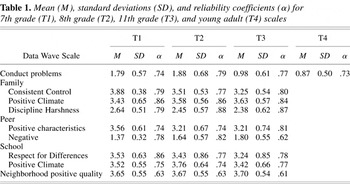
Mean (M), standard deviations (SD), and reliability coefficients (α) for 7th grade (T1), 8th grade (T2), 11th grade (T3), and young adult (T4) scales
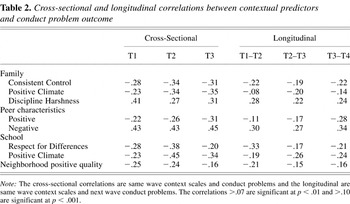
Cross-sectional and longitudinal correlations between contextual predictors and conduct problem outcome
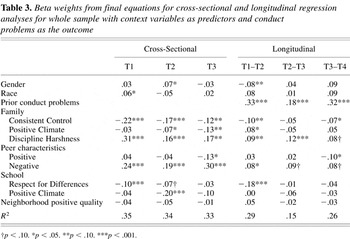
Beta weights from final equations for cross-sectional and longitudinal regression analyses for whole sample with context variables as predictors and conduct problems as the outcome
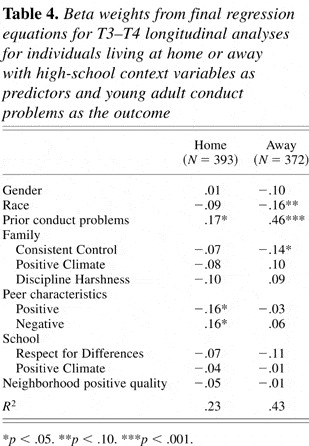
Beta weights from final regression equations for T3–T4 longitudinal analyses for individuals living at home or away with high-school context variables as predictors and young adult conduct problems as the outcome
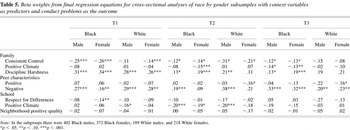
Beta weights from final regression equations for cross-sectional analyses of race by gender subsamples with context variables as predictors and conduct problems as the outcome
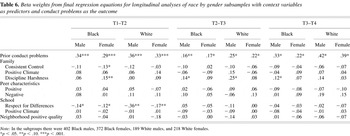
Beta weights from final regression equations for longitudinal analyses of race by gender subsamples with context variables as predictors and conduct problems as the outcome
 You have
Access
- 48
- Cited by