

INTRODUCTION
The Chinese Loess Plateau (CLP) hosts a vast expanse (~300,000 km2) of thick eolian dust deposits that provide a globally outstanding terrestrial archive of Late Cenozoic climatic and environmental changes (Liu, Reference Liu1985; An, Reference An2014). These eolian deposits can be divided into two parts: the well-known Quaternary loess-paleosol sequence and the underlying Miocene-Pliocene Red Clay sequence. While the climatic history recorded by Quaternary loess-paleosol sequences is relatively well constrained, the climatic significance of Red Clay sequences is far from established (An, Reference An2014; Ao et al., Reference Ao, Roberts, Dekkers, Liu, Rohling, Shi and An2016; Nie et al., Reference Nie, Song and King2016). Existing Miocene-Pliocene paleoclimate records from the semi-arid CLP (An et al., Reference An, Kutzbach, Prell and Porter2001, Reference An, Huang, Liu, Guo, Clemens, Li and Prell2005; Nie et al., Reference Nie, Stevens, Song, King, Zhang, Ji, Gong and Cares2014; Ao et al., Reference Ao, Roberts, Dekkers, Liu, Rohling, Shi and An2016), arid western China (Miao et al., Reference Miao, Herrmann, Wu, Yan and Yang2012), and humid South China (Clift et al., Reference Clift, Wan and Blusztajn2014) provide contrasting information on climate variability over this time interval.
Formation of fine magnetic grains (from <30 nm up to ~1000 nm) in the Chinese loess-paleosol and Red Clay deposits, including superparamagnetic (SP), stable single domain (SD), and small pseudo-single-domain (PSD) particles, is closely linked to in situ pedogenic weathering modulated by climate and can be quantified using magnetic techniques (Zhou et al., Reference Zhou, Oldfield, Wintle, Robinson and Wang1990; An et al., Reference An, Kukla, Porter and Xiao1991; Verosub et al., Reference Verosub, Fine, Singer and Tenpas1993; Evans and Heller, Reference Evans and Heller1994; Heller and Evans, Reference Heller and Evans1995; An et al., Reference An, Kutzbach, Prell and Porter2001; Liu et al., Reference Liu, Rolph, An and Hesse2003, Reference Liu, Jackson, Banerjee, Maher, Deng, Pan and Zhu2004; Bloemendal and Liu, Reference Bloemendal and Liu2005; Nie et al., Reference Nie, King, Jackson, Fang and Song2008; Ao et al., Reference Ao, Roberts, Dekkers, Liu, Rohling, Shi and An2016). Therefore, magnetic parameters are widely used to investigate pedogenic weathering, monsoon evolution, aridification history, and global climate change recorded in Quaternary loess-paleosol sequences (Kukla et al., Reference Kukla, Heller, Ming, Chun, Sheng and Sheng1988; An et al., Reference An, Kukla, Porter and Xiao1991; Verosub et al., Reference Verosub, Fine, Singer and Tenpas1993; Florindo et al., Reference Florindo, Zhu, Guo, Yue, Pan and Speranza1999; Evans and Heller, Reference Evans and Heller2001; Deng et al., Reference Deng, Vidic, Verosub, Singer, Liu, Shaw and Zhu2005, Reference Deng, Shaw, Liu, Pan and Zhu2006; Liu et al., Reference Liu, Deng, Torrent and Zhu2007, Reference Liu, Roberts, Larrasoaña, Banerjee, Guyodo, Tauxe and Oldfield2012, Reference Liu, Liu, Torrent, Barron and Hu2013, Reference Liu, Jin, Hu, Jiang, Ge and Roberts2015). However, considerably less environmental magnetic research has focused on the underlying Miocene-Pliocene Red Clay sequences (Nie et al., Reference Nie, Song and King2016). Here, we investigate late Miocene-early Pliocene climate change in East Asia; new mineral magnetic records of a Red Clay succession from Shilou (36°55’ N, 110°56’ E) on the eastern CLP form the basis for our paleoclimatic interpretations.
GENERAL SETTING
The Asian monsoon, which is the most dynamic component of the global monsoon system, is characterized by seasonal reversal of winter and summer monsoons (Webster, Reference Webster1994; Wang et al., Reference Wang, Clemens, Beaufort, Braconnot, Ganssen, Jian, Kershaw and Sarnthein2005; An et al., Reference An, Wu, Li, Sun, Liu, Zhou and Cai2015). The Asian Winter Monsoon (AWM) transports cold and dry air from high-latitude Eurasia toward South China, while the Asian Summer Monsoon (ASM) transports heat and moisture from the equatorial oceans to North China (Wang et al., Reference Wang, Clemens, Beaufort, Braconnot, Ganssen, Jian, Kershaw and Sarnthein2005; An et al., Reference An, Wu, Li, Sun, Liu, Zhou and Cai2015).
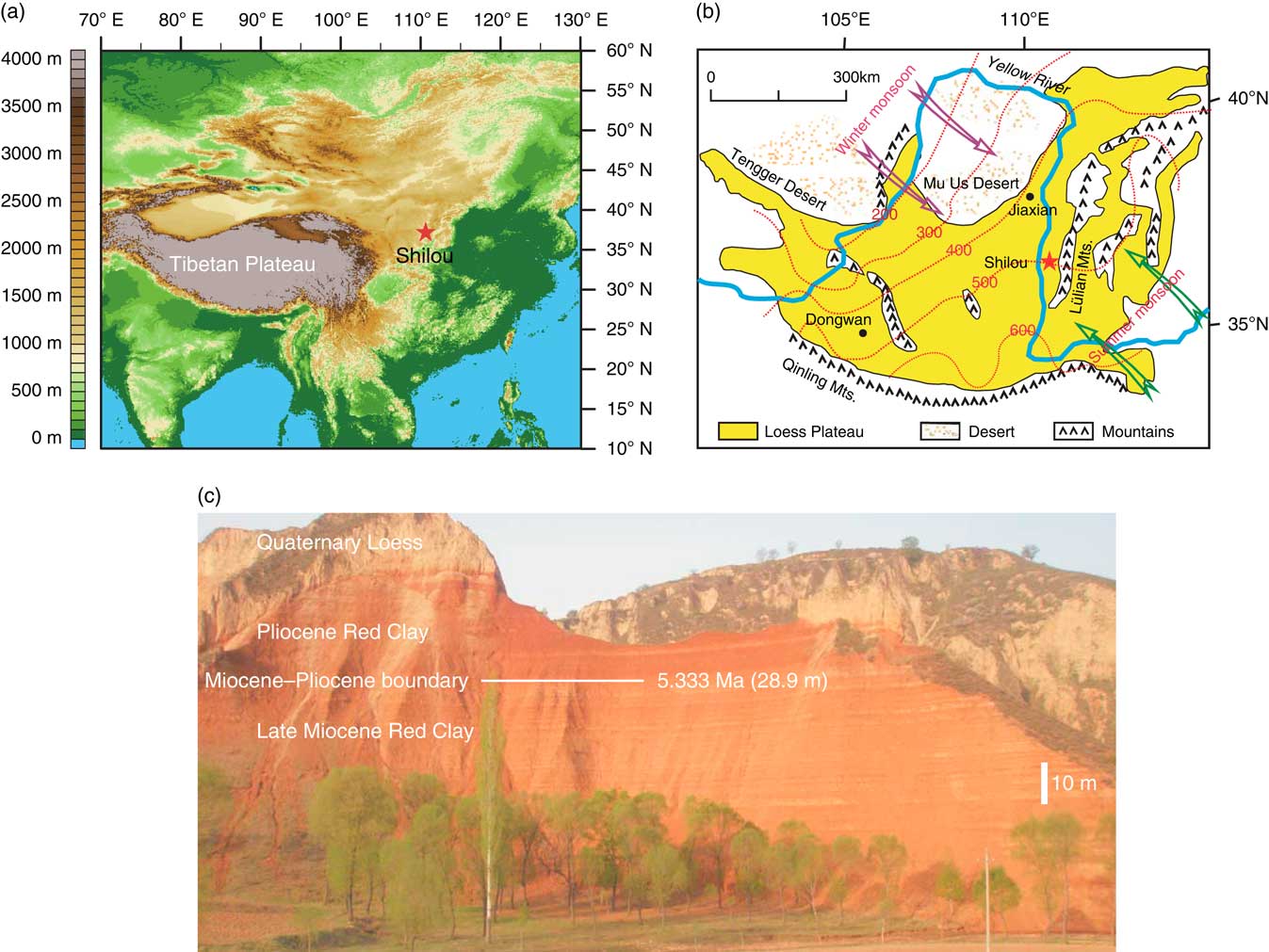
The Shilou Red Clay section lies between the Lüliang Mountains and the Yellow River on the eastern CLP, at the northern margin of ASM influence (Fig. 1). The climate and environment of the Shilou area are dominated by a seasonal reversal of AWM and ASM circulations. This region today has a mean annual temperature of ~9°C and mean annual precipitation of ~500 mm, with over 60% of the precipitation falling in the summer. The Shilou Red Clay sequence has a thickness of up to ~90 m and ranges in age from ~8.2 to 2.6 Ma (Ao et al., Reference Ao, Roberts, Dekkers, Liu, Rohling, Shi and An2016). In general, the horizontally stratified Shilou Red Clay consists of reddish soils that are intercalated with carbonate nodules (Fig. 1c). It has a redder color and has experienced stronger pedogenesis than the overlying Quaternary loess-paleosol sequence (Fig. 1c).
(color online) Schematic map of the site location and geological setting. (a) Map of Asian topography. (b) Map of the Chinese Loess Plateau with location of the studied Shilou red clay section. The Yellow River is the major river system in North China. The dashed red lines denote contours of mean annual precipitation (mm) on the Chinese Loess Plateau. (c) Field photograph of the Shilou-A red clay section. The upper part (Pliocene) has a distinctly redder color than the lower part (Late Miocene), which is consistent with enhanced pedogenesis and increased summer monsoon precipitation across the Miocene-Pliocene boundary.
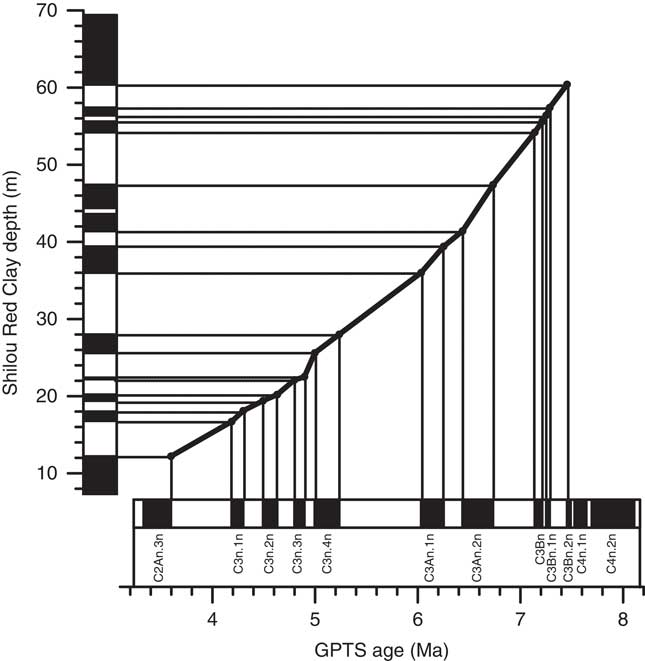
This study focuses on the ~70-m-thick Shilou Red Clay section studied by Xu et al. (Reference Xu, Yue, Li, Sun, Sun, Zhang, Ma and Wang2009) (here named the Shilou-A section), which is located ~1 km east of our recently investigated section with ~90-m-thick Shilou Red Clay (here referred to as the Shilou-B section; Ao et al., Reference Ao, Roberts, Dekkers, Liu, Rohling, Shi and An2016). Two previous correlations of the Shilou-A magnetostratigraphy to the geomagnetic polarity timescale (GPTS) suggest contrasting ages of ~11–2.6 Ma (from polarity subchron C5n.2n to C2An.1n; Xu et al., Reference Xu, Yue, Li, Sun, Sun, Zhang, Ma and Wang2009) and ~5.2–2.6 Ma (from C3n.4n to C2An.1n; Anwar et al., Reference Anwar, Kravchinsky and Zhang2015) for the ~70-m-thick Shilou Red Clay sequence. However, these magnetostratigraphic interpretations both involve ambiguous polarity divisions, which result in poor and equivocal correlations to the GPTS. Furthermore, these age assignments (~11–2.6 Ma or ~5.2–2.6 Ma) are inconsistent with the generally accepted age from ~8–7 Ma to 2.6 Ma for the Red Clay sequences on the central and eastern CLP (Sun et al., Reference Sun, An, Shaw, Bloemendal and Sun1998; Ding et al., Reference Ding, Xiong, Sun, Yang, Gu and Liu1999; Qiang et al., Reference Qiang, Li, Powell and Zheng2001). In addition, the age assignment of ~5.2–2.6 Ma (Anwar et al., Reference Anwar, Kravchinsky and Zhang2015) is not supported by the presence of the late Miocene micromammal Meriones sp. in the lower Shilou-A section at 46.6 m (Xu et al., Reference Xu, Yue, Li, Sun, Sun, Zhang, Ma and Wang2012). Our recent magnetostratigraphy from the 90-m-thick Shilou-B section (Ao et al., Reference Ao, Roberts, Dekkers, Liu, Rohling, Shi and An2016), with a much higher resolution and significantly improved definition of respective polarity zones, enables unequivocal magnetostratigraphic correlation (C4r.1r–C2An.1n, ~8.2–2.6 Ma) to the GPTS. This results in a revised correlation of the ~70-m-thick Shilou-A magnetostratigraphy to the GPTS from C4n.2n to C2An.1n (~8–2.6 Ma). Thus, a chronology from 3.6 to 7.5 Ma (12.2–60.4 m) for the late Miocene-early Pliocene Shilou Red Clay within the ~70-m-thick Shilou-A succession is established based on our updated magnetostratigraphic correlation (Ao et al., Reference Ao, Roberts, Dekkers, Liu, Rohling, Shi and An2016). The chronology was constructed via linear interpolation using geomagnetic polarity reversals for age control, assuming constant long-term sedimentation rates between reversals (Fig. 2).
Age-depth model for the 12.2–60.4 m interval of the Shilou-A red clay succession established from the updated magnetostratigraphic correlation (Ao et al., Reference Ao, Roberts, Dekkers, Liu, Rohling, Shi and An2016) to the geomagnetic polarity timescale (GPTS; Hilgen et al., Reference Hilgen, Lourens and van Dam2012).
SAMPLING AND METHODS
After removal of the weathered outcrop surface, 703 fresh samples were collected from the whole (~70-m-thick) Shilou-A Red Clay succession at 10 cm stratigraphic intervals (equivalent to a time spacing of ~8 ka). A total of 473 samples from the 12.2–60.4 m interval (3.6 to 7.5 Ma) were selected for the present study. Samples were powdered and then packed into non-magnetic cubic boxes for low-frequency magnetic susceptibility (χlf) measurements in the laboratory. χlf was measured with a Bartington Instruments MS2 magnetic susceptibility meter at 470 Hz. An anhysteretic remanent magnetization (ARM) was imparted using a peak alternating field (AF) of 100 mT and a 0.05 mT direct current (DC) bias field, and was measured using a 2-G Enterprises superconducting rock magnetometer (model 755R) housed in a magnetically shielded room. ARM is expressed in terms of the ARM susceptibility (χARM), which was obtained by dividing ARM intensity by the DC field strength.
Temperature-dependent susceptibility (χ-T) curves were measured in an argon atmosphere (with an argon flow rate of 100 mL/min) from room temperature to 700°C and back to room temperature using a MFK1-FA susceptometer equipped with a CS-3 high-temperature furnace (AGICO, Brno, Czech Republic). A χ run with an empty furnace tube was measured to determine the temperature-dependent background before measuring the sediment samples. The susceptibility of each sediment sample was obtained by subtracting the measured furnace tube background χ using the CUREVAL 5.0 program (AGICO, Brno, Czech Republic). Isothermal remnant magnetization (IRM) acquisition curves were measured at 30 field steps up to a maximum field of 2 T. Samples were magnetized with an ASC IM-10-30 pulse magnetizer, and IRMs were measured with an AGICO JR-6A spinner magnetometer. First-order reversal curve (FORC) measurements (Roberts et al., Reference Roberts, Pike and Verosub2000, Reference Roberts, Heslop, Zhao and Pike2014) were made using the variable resolution FORC protocol (Zhao et al., Reference Zhao, Heslop and Roberts2015) with a Princeton Measurements Corporation (Model 3900) vibrating sample magnetometer (VSM). For each sample, 80 FORCs were measured at fields up to 300 mT with an averaging time of 200 ms. Data were processed using the software of Zhao et al. (Reference Zhao, Heslop and Roberts2015) with a smoothing factor of 3.
RESULTS
Heating and cooling χ-T curves are nearly reversible (Fig. 3), which indicates that little magnetic mineral transformation occurred during thermal treatment (Ao et al., Reference Ao, Dekkers, Deng and Zhu2009). All of the heating curves are characterized by a major inflection at ~580°C, which corresponds to the Curie temperature of magnetite and is consistent with the ubiquitous presence of magnetite in Red Clay (Liu et al., Reference Liu, Rolph, An and Hesse2003; Xu et al., Reference Xu, Yue, Li, Sun, Sun, Zhang, Ma and Wang2009; Ao et al., Reference Ao, Roberts, Dekkers, Liu, Rohling, Shi and An2016). A steady increase in χ from room temperature to ~200–300°C indicates the gradual unblocking of fine (SP/SD) magnetite particles (Liu et al., Reference Liu, Deng, Yu, Torrent, Jackson, Banerjee and Zhu2005, Reference Liu, Torrent, Morrás, Ao, Jiang and Su2010; Deng, Reference Deng2008). There was no magnetic mineral transformation during heating, so the slight drop in χ to ~400°C is possibly due to changes in crystallinity, grain size, or morphology of magnetic particles (Dunlop and Özdemir, Reference Dunlop and Özdemir1997; Ao et al., Reference Ao, An, Dekkers, Wei, Pei, Zhao, Zhao, Xiao, Qiang, Wu and Chang2012).
(color online) χ-T curves for selected samples from the Shilou-A red clay sequence. The red and blue lines represent heating and cooling curves, respectively.

The measured IRM acquisition curves are characterized by a major increase below 300 mT (Fig. 4), which supports the interpretation of a dominant contribution from magnetite. The slight increase between 300 and 2000 mT is consistent with the presence of hematite. On a mass-specific basis, hematite has a much weaker magnetization than magnetite (Dunlop and Özdemir, Reference Dunlop and Özdemir1997), thus large hematite concentrations are necessary to contribute substantially to IRM when magnetite is also present.
IRM acquisition curves for selected samples from the Shilou-A red clay sequence (the same samples as in Fig. 3). The dashed vertical lines at 300 mT are shown to aid distinction between low-and high-coercivity portions of the IRM acquisition curves.

All FORC diagrams have closed contours with maximum contour density at a Bc value of ~10 mT (Fig. 5), which indicates a substantial presence of SD magnetite (Roberts et al., Reference Roberts, Pike and Verosub2000, Reference Roberts, Heslop, Zhao and Pike2014; Egli et al., Reference Egli, Chen, Winklhofer, Kodama and Horng2010). The outer contours are generally divergent along the Bu axis, which points to a small PSD component (Roberts et al., Reference Roberts, Pike and Verosub2000, Reference Roberts, Heslop, Zhao and Pike2014; Muxworthy and Dunlop, Reference Muxworthy and Dunlop2002).
(color online) First-order reversal curve (FORC) diagrams for selected samples from the Shilou-A red clay sequence (the same samples as in Fig. 3 and 4). The FORC diagrams are scaled to their respective maximum contour density.

Magnetic parameters (e.g., χARM and χlf) and their ratios are sensitive indicators of changes in magnetic mineralogy and are useful for establishing high-resolution paleoclimatic records because such parameters can be good proxies for important paleoenvironmental and paleoclimatic processes (Evans and Heller, Reference Evans and Heller2003; Liu et al., Reference Liu, Roberts, Larrasoaña, Banerjee, Guyodo, Tauxe and Oldfield2012, Reference Liu, Jin, Hu, Jiang, Ge and Roberts2015). For the Shilou-A Red Clay sequence, χARM and χlf have consistent variations, which are characterized by a prominent shift to higher values across the Miocene-Pliocene boundary (MPB, 5.333 Ma; Fig. 6a and b). Such a shift across the MPB is better characterized in the adjacent χARM/χlf record (Fig. 6c): χARM/χlf increases significantly from ~4.1 at ~5.6 Ma to ~7.0 at ~5 Ma. Overall, χARM/χlf ranges from 3.3 to 6.2 (average 5.2) during the late Miocene (7.5–5.333 Ma) and from 4.7 to 7.0 (average 5.8) during the early Pliocene (5.333–3.6 Ma; Fig. 6c). Such a χARM/χlf shift is also observed in our recently investigated Shilou-B section across the MPB (Ao et al., Reference Ao, Roberts, Dekkers, Liu, Rohling, Shi and An2016; Fig. 6d). The two χARM/χlf records have generally consistent variability, particularly over longer periods. Minor differences between them are probably related to different sampling intervals (10 cm sampling interval in the ~70-m-thick Shilou-A succession, versus a 2-cm sampling interval in the ~90-m-thick Shilou-B succession) and minor differences in sedimentary continuity and/or short-term magnetostratigraphic age model issues.
(color online) Changes in East Asian terrestrial climate and sea surface temperature (SST) across the Miocene-Pliocene boundary (MPB). (a–c) χlf, χARM, and χARM/χlf records from the Shilou-A red clay section. (d–e) χARM/χlf and χfd% records from the Shilou-B red clay section (calculated from the raw data reported by Ao et al. (Reference Ao, Roberts, Dekkers, Liu, Rohling, Shi and An2016)). The red curves (c–e) were obtained by exponential smoothing of the raw data. (f and g) Cold-aridiphilous (CA) and thermo-humidiphilous (TH) terrestrial mollusk changes in the Dongwan red clay sequence (both from Li et al. (Reference Li, Rousseau, Wu, Hao and Pei2008)). (h–j) TEX86-based SST records from Ocean Drilling Program (ODP) sites 1143 (South China Sea), 806 (tropical western Pacific Ocean), and 1085 (mid-latitude South Atlantic Ocean; Rommerskirchen et al., Reference Rommerskirchen, Condon, Mollenhauer, Dupont and Schefuss2011; Zhang et al., Reference Zhang, Pagani and Liu2014). See text for discussion.

DISCUSSION
Like the overlying Quaternary loess-paleosol sequence, the magnetic properties of the Red Clay sequence are dominated by fine-grained pedogenic magnetite populations that range from SP/SD to small PSD sizes, as suggested by the aforementioned rock magnetic results and previous studies (Nie et al., Reference Nie, King and Fang2007, Reference Nie, King, Jackson, Fang and Song2008, Reference Nie, Song, King, Zhang and Fang2013; Ao et al., Reference Ao, Roberts, Dekkers, Liu, Rohling, Shi and An2016). The SP grains, which have high χlf values but no stable magnetic remanence, formed during early pedogenesis. Some SP grains could have grown to SD and even to small PSD sizes, which have high χARM but low χlf with increased pedogenesis (Evans and Heller, Reference Evans and Heller2003; Hu et al., Reference Hu, Liu, Torrent, Barrón and Jin2013; Nie et al., Reference Nie, Song, King, Zhang and Fang2013, Reference Nie, Stevens, Song, King, Zhang, Ji, Gong and Cares2014). Thus, χARM/χlf, which reflects the relative amount of SD and small PSD magnetite grains compared to SP grains, allows a more detailed view of pedogenic variations in Red Clay than either χlf or χARM (Geiss and Zanner, Reference Geiss and Zanner2006; Nie et al., Reference Nie, Song, King, Zhang and Fang2013, Reference Nie, Stevens, Song, King, Zhang, Ji, Gong and Cares2014). This approach is supported by χARM/χlf variations of Quaternary loess-paleosol sequences, with distinctly high values in pedogenic paleosol layers and low values in loess layers (Nie et al., Reference Nie, Song, King, Zhang and Fang2013). Hematite has much lower magnetization and magnetic susceptibility than magnetite; therefore, the contribution of hematite to χARM/χlf variations is not significant when magnetite is also present.
The notable χlf and χARM increases across the MPB in the Shilou Red Clay indicate increases in pedogenic SP and SD to small PSD magnetite grains, respectively. An increased amount of SP magnetite grains is supported by a notable increase in the frequency-dependent magnetic susceptibility percentage (χfd%, defined as (χlf - χhf) / χlf × 100%, where χhf is the high-frequency magnetic susceptibility) in the Shilou-B Red Clay section across the MPB (Ao et al, Reference Ao, Roberts, Dekkers, Liu, Rohling, Shi and An2016; Fig. 6e). The prominent χARM/χlf increase across the MPB further indicates an increasing percentage of SD and small PSD magnetite grains relative to SP grains. Thus, consistent positive shifts of χlf, χARM, χARM/χlf, and χfd% indicate enhanced pedogenesis across the MPB on the CLP, which accelerated both formation of SP grains and transformation of SP grains to SD and small PSD grains. Relatively more SD and small PSD grains formed during this type of pedogenic enhancement, which resulted in increased χARM/χlf across the MPB. It is unlikely that the increased PSD magnetite fraction resulted from increased detrital input, because parallel grain size records from the Shilou-A Red Clay do not indicate coarser sediments and increased detrital input across the MPB (Xu et al., Reference Xu, Yue, Li, Sun, Sun, Zhang, Ma and Wang2012). In addition, the early Pliocene Shilou Red Clay interval is redder than the underlying late Miocene interval (Fig. 1c), and has more Fe-Mn (hydr)oxide mottles, nodules, concretions, and coatings in soil profiles, which are all consistent with enhanced pedogenesis across the MPB (Yang and Ding, Reference Yang and Ding2003; Roberts, Reference Roberts2015; Ao et al., Reference Ao, Roberts, Dekkers, Liu, Rohling, Shi and An2016).
Precipitation and temperature exert a primary control on pedogenic weathering (White and Blum, Reference White and Blum1995; White et al., Reference White, Blum, Bullen, Vivit, Schulz and Fitzpatrick1999; Wei et al., Reference Wei, Li, Liu, Shao and Liang2006; Clift et al., Reference Clift, Hodges, Heslop, Hannigan, Van Long and Calves2008). Increased precipitation can accelerate pedogenic weathering reactions by enhancing unsaturated soil hydrology, increasing the wetness of reactive mineral surfaces, activating stagnant porewaters that are immobile in drier soils, and decreasing soil solution concentrations and pH (White and Blum, Reference White and Blum1995). Higher temperatures can also enhance the pedogenic weathering rate because of the thermodynamic dependence of weathering reactions (White et al., Reference White, Blum, Bullen, Vivit, Schulz and Fitzpatrick1999). Therefore, enhanced pedogenesis across the MPB, as suggested by the Shilou Red Clay mineral magnetic record (Fig. 6a–e), is likely indicative of a climatic shift to more humid and/or warmer conditions.
A temperature increase on the CLP would be less likely and is inconsistent with observations of Antarctic glaciation and global cooling across the MPB (Zachos et al., Reference Zachos, Pagani, Sloan, Thomas and Billups2001; Rommerskirchen et al., Reference Rommerskirchen, Condon, Mollenhauer, Dupont and Schefuss2011; LaRiviere et al., Reference LaRiviere, Ravelo, Crimmins, Dekens, Ford, Lyle and Wara2012; Zhang et al., Reference Zhang, Pagani and Liu2014). Within a context of Antarctic glaciation (Zachos et al., Reference Zachos, Pagani, Sloan, Thomas and Billups2001), TEX86 (tetraether index of 86 carbon atoms, cf. Schouten et al. [Reference Schouten, Hopmans, Schefuss and Damste2002]) temperature proxy data suggest that sea surface temperature (SST) in the South China Sea (Ocean Drilling Program (ODP) Site 1143) and the tropical western Pacific Ocean (ODP Site 806) decreased by ~2°C across the MPB (Zhang et al., Reference Zhang, Pagani and Liu2014), while SST in the mid-latitude South Atlantic Ocean (ODP Site 1085) decreased by up to ~8°C (Rommerskirchen et al., Reference Rommerskirchen, Condon, Mollenhauer, Dupont and Schefuss2011; Fig. 6h–j). In addition to these SST drops, decreased bottom-water temperatures have also been documented across the MPB in the Pacific and Atlantic Oceans (LaRiviere et al., Reference LaRiviere, Ravelo, Crimmins, Dekens, Ford, Lyle and Wara2012). Furthermore, a temperature decline is supported by increased percentages of Pinus and Picea pollen in Red Clay successions across the MPB (Ma et al., Reference Ma, Wu, Fang, Li, An and Wang2005). These observations indicate that the CLP was unlikely to have shifted to warmer conditions across the MPB when global climate cooled, although the possibility of regional and/or season-specific East Asian continental warming cannot be entirely excluded at present. Future independent Asian continental temperature reconstructions are crucial to test these scenarios in more detail. According to presently available evidence, we primarily relate increased pedogenesis on the CLP across the MPB to increased soil moisture availability, rather than to temperature changes.
Increased moisture availability on the CLP from the late Miocene to early Pliocene is consistent with other indications of ASM intensification. Examples include decreased eolian detrital fluxes on the CLP (Sun and An, Reference Sun and An2002) and into the North Pacific Ocean (Rea et al., Reference Rea, Snoeckx and Joseph1998), globally increased chemical weathering intensity (Filippelli, Reference Filippelli1997), reorganization of the western Himalayan river system (Clift and Blusztajn, Reference Clift and Blusztajn2005), increased flux of clastic material to the South China Sea (Clift et al., Reference Clift, Wan and Blusztajn2014), decreased hematite/goethite ratios at ODP Site 1148 from the South China Sea (Clift, Reference Clift2006), a positive shift of soil carbonate δ13C from the Siwalik Basin, and positive shifts of hydrogen (δD) and carbon (δ13C) isotope ratios of leaf wax C31 n-alkane and increased abundance of the planktonic foraminifer Globorotalia bulloides and the radiolarian Actinomma in the Arabian Sea (Quade et al., Reference Quade, Cerling and Bowman1989; Sanyal et al., Reference Sanyal, Bhattacharya, Kumar, Ghosh and Sangode2004; Huang et al., Reference Huang, Clemens, Liu, Wang and Prell2007), which are indicative of an intensified ASM. The MPB also coincides with an increase in humidity over the Mediterranean region (Eronen et al., Reference Eronen, Ataabadi, Micheels, Karme, Bernor and Fortelius2009) and with increased moisture availability in tropical America, as indicated by a positive shift of black carbon δ13C in the northeastern equatorial Pacific Ocean (Kim et al., Reference Kim, Lee, Hyeong and Yoo2016). The percentage of terrestrial mollusks on the CLP that prefer cold or dry environments decreases across the MPB (Fig. 6f), while the percentage of terrestrial mollusks that prefer humid or warm environments increases (Fig. 6g), which is interpreted to indicate increased ASM precipitation and/or temperature across the MPB (Li et al., Reference Li, Rousseau, Wu, Hao and Pei2008, Reference Li, Wu, Rousseau, Dong, Zhang and Pei2014). Based on the aforementioned evidence, we infer that the mollusk record is more likely indicative of increased precipitation. Overall, the combined records suggest that the cooler early Pliocene had higher ASM precipitation than the warmer late Miocene (Fig. 6). This implies that increased precipitation was not always coupled with increased temperature during the late Miocene and Pliocene, in contrast to the relationship that has been inferred for the Quaternary (Lu et al., Reference Lu, Yi, Liu, Mason, Jiang, Cheng, Stevens, Xu, Zhang, Jin, Zhang, Guo, Wang and Otto-Bliesner2013; Yang et al., Reference Yang, Ding, Li, Wang, Jiang and Huang2015). In addition, global cooling across the MPB may have faciliated increased moisture availability on the CLP by weakening soil water evaporation.
CONCLUSIONS
We provide a detailed new mineral magnetic record from the Shilou Red Clay sequence on the eastern CLP. The magnetic minerology of the sequence is dominated by pedogenic SP, SD, and small PSD magnetite grains. Our new mineral magnetic record suggests that both pedogenic formation of SP grains and transformation of SP grains to SD and to small PSD grains accelerated across the MPB. These are indicative of enhanced pedogenesis, which is consistent with a marked lithological color shift to redder strata across the MPB. We relate the enhanced pedogenesis to increased ASM precipitation on the CLP across the MPB. Our study suggests a notable climate shift toward more humid conditions on the CLP across the MPB, within a context of global cooling, and contributes to better understanding of late Miocene-early Pliocene Asian continental climate variability.
Acknowledgments
We thank Dennis Kent for suggestions that improved the paper, Leping Yue for providing the samples used in this study, and the editors and anonymous reviewers for constructive comments that improved the paper. This work was supported by the National Basic Research Program of China (grant 2013CB956402), the National Natural Science Foundation of China (grants 41290253, 41420104008, 41174057, 41290250, and 41290253), the Key Research Program of Frontier Sciences, the Chinese Academy of Sciences (grants QYZDB-SSW-DQC021, QYZDY-SSW-DQC001, and ZDBS-SSW-DQC001), Australian Research Council grant DP120103952 to APR, and Australian Laureate Fellowship grant FL120100050 to EJR.



