The “rational design of institutions” literature has provided significant insight into such varied institutions as trade agreements and environmental treaties but has been less focused on institutions in the security realm. Military alliances are certainly a well-researched phenomenon in international relations, but despite the huge amount of work on alliances, scholars actually know relatively little about their design. Even a cursory glance at alliances reveals that there is significant variation in their provisions. Alliances vary not only with respect to their military obligations but also in the extent to which they impose limitations on when primary obligations apply, tie military cooperation to cooperation in other issue areas, and in the degree of institutionalization they require. What explains this variation in the design of military alliances?
This article seeks to provide an explanation for the design choices made by alliance members. I argue that states are motivated, at least in part, by the desire to construct as reliable alliances as possible and choose certain treaty designs over others depending on how they assess the risk for opportunism in the alliance and how sensitive they are to opportunism. When potential partners have shown themselves to be unreliable allies in the past and thus concerns about their future reliability linger, they and their prospective allies may be willing to incur the costs of negotiating and implementing more intricate and costly alliance designs in the hope of increasing the alliance's reliability. However, whether such reliability-enhancing provisions are put in place also depends on how vulnerable the allies are to opportunism and their relative bargaining power. If one or both alliance members have reputations for unreliability this should lead to the adoption of reliability-enhancing provisions in symmetric alliances, where members of similar power level depend on each other to provide for increased security and their relatively even bargaining power allows a concerned state to influence alliance design. In asymmetric alliances, major powers might not find reliability-enhancing provisions necessary and minor powers, who may worry about the reliability of their partners, might be unable to force more costly alliance designs given their limited bargaining power.
Building on the existing alliance and treaty design literatures, I formulate hypotheses regarding the effect of allies' reputations for unreliability on the design of symmetric and asymmetric alliances. I test these hypotheses using data on bilateral defense, offense, and neutrality pacts between 1919 and 2001. The analysis generally provides support for the hypotheses. While a history of alliance violation leads to the formulation of more precise and limited obligations in asymmetric alliances, asymmetric alliances where one or both leaders have previously violated an alliance commitment are no more likely to opt for costly reliability-enhancing features such as issue linkage or military institutionalization than asymmetric alliances where neither member has a history of alliance violation. Symmetric alliances where one or both members have a reputation for unreliability are more likely to include issue-linkage provisions and deeper levels of military institutionalization but are not necessarily more likely to specify limitations on when the alliance obligations apply.
This article brings together three strands of international relations scholarship—the alliance literature, the “rational design of institutions” literature, and work on reputations—and makes contributions to each. The literature on military alliances is extensive and scholars know a great deal about the effect of alliances on the conflict behavior of states. What scholars know less about, however, is why alliances vary in their design features. This article seeks to move the alliance literature forward by pointing to some of the variation in alliance design and attempting to provide an explanation for it. Studying the institutional design of alliances is valuable not only because it enhances our knowledge of alliances more generally but also because a good grasp of alliance design should provide the basis for a better understanding of the effect of these design features on state behavior.
The theoretical argument used in this study to explain variation in alliance design is based on the “rational design of institutions” literature and to the extent that the hypotheses derived from this argument hold up in the empirical test, this provides support for the notion that international institutions are the product of rational design choices by leaders attempting to address cooperation problems. The desire to tackle cooperation problems such as enforcement concerns has been shown to influence the design of a number of trade and environmental institutions but work on security institutions, which are traditionally considered hard cases for cooperation, has been more sparse. This article shows that the “rational design of institutions” approach can contribute to our understanding of security institutions as well.
The literature on reputation has recently experienced a boost with a number of studies showing that actors who are considered unreliable are less likely to find cooperative partners. Tomz finds this to be the case for sovereign lending, and studies by Gibler and Crescenzi, Kathman, Kleinberg, and Wood demonstrate that reputations for reliability affect the ability of a state to attract new allies.Footnote 1 Here I seek to build on this literature by examining whether reputation affects not only the likelihood of cooperation but also its terms. As Miller and Leveck and Narang point out, if we do not take into consideration the effect that reputation can have on alliance design, we may be underestimating the significance of reputation in international cooperation.Footnote 2
The article proceeds in five parts. The first section provides an overview of the literature on the design of military alliances and introduces the idea that reputational considerations may be an important factor in alliance design. The second section lays out the theoretical argument for how we should expect reputations for unreliability to affect alliance design in symmetric and asymmetric alliances. The third section describes the research design and the fourth section discusses the results of the empirical analyses. Finally, I conclude with a brief summary and avenues for future research.
Variation in Alliance Design, Alliance Goals, and Reputational Considerations
Military alliances are an important feature of international politics and international relations research has treated them as such. Countless studies have examined the effect of alliances on the conflict behavior of states, the expansion of war, and the likelihood of victory.Footnote 3 This literature has become increasingly refined over time. It has moved beyond the notion that alliances are a homogenous bunch and produced important insights by differentiating among different kinds of pacts.Footnote 4 Some studies also have gone further in exploring the institutional design of alliances. Leeds and Anac and Wallace, for example, examine the effect of military institutionalization on a state's choice to honor its alliance commitment in times of war and on military strategy.Footnote 5 While the insights that have been produced are significant, they also pertain mainly to the effect of alliances. Alliances have been treated predominantly as an independent variable rather than a dependent variable.
Exceptions to this tendency exist of course. There are a number of studies that try to explain alliance formation.Footnote 6 However, unlike the work on alliances as an independent variable, this research has been less willing to differentiate among different kinds of alliances and has not sought to explain why states choose certain alliance designs over others.Footnote 7
Work by Lake and Weber has gone in the direction of explaining differences in the design of security institutions.Footnote 8 Building on contracting theory, these scholars provide insight into why and under which conditions states choose to organize their security relations in different ways, such as through empires or confederations rather than alliances. Unfortunately, their work does not consider the significant amount of variation that we observe in the design of alliances themselves.
The work of Leeds, Ritter, Mitchell, and Long and Leeds and Mattes provides a descriptive account of the significant design differences across alliances.Footnote 9 For example, some alliances are blanket promises that apply under a wide range of circumstances, while others carefully limit the conditions under which members are required to fulfill their obligations. Some alliances focus exclusively on military cooperation, while others set up nonmilitary cooperation as well. Alliances also vary significantly in their level of institutionalization. Some alliances simply state the military obligations that the allies agree to, while others commit members to joint planning, establish permanent organizations, or mandate the integration or subordination of forces.
Recognition of the diversity in alliance contracts raises the question of why and when we observe one treaty design rather than another. Given the costs of negotiating and implementing design features such as military bases and joint defense plans, it is unlikely that the variation in alliance design is random. Instead, we should examine the goals states pursue when concluding alliances and explain how different design features can help achieve these goals.
Scholars have identified a number of motivations for alliance formation. For instance, Schroeder and Weitsman point out that alliances are sometimes concluded with the intent to influence and restrain the partner to prevent conflict between the signatories.Footnote 10 Similarly, Gibler argues that alliances can function as conflict management devices by helping members resolve underlying differences, such as competing territorial claims.Footnote 11 In a somewhat different vein, Powers suggests that alliance provisions are frequently embedded within regional economic agreements, and Leeds and Mattes show that, especially in recent times, alliance obligations tend to be part of broader cooperative agreements between states.Footnote 12
Although alliances can fulfill many roles for signatories, they are usually motivated at least in part, and often to a large extent, by concerns about a perceived international threat. When states conclude military alliances, they often do so with two interrelated goals in mind: signaling and commitment.Footnote 13 Allies want to signal to potential adversaries that they intend to cooperate militarily should conflict arise. This signal is supposed to deter potential aggressors from attacking a member state or, in the case of an offense pact, it is calculated to convince opponents to give in to demands. Should deterrence or compellence fail, the alliance is meant to increase the ability of the states to fight a common enemy. Coordination of military strategies allows allies to be more effective in conflict and reach a more beneficial outcome. Alliances also increase efficiency by sharing the burden of fighting during wartime and allowing states to cut defense spending in times of peace.
The ability to achieve these goals and benefit from an alliance depends on whether the members can be expected to uphold their commitments.Footnote 14 The notion that cooperative endeavors fail when one or more partners renege on the agreement and that the consequences of opportunism are undesirable is of course not unique to military alliances but, in the case of alliances, concerns about reliability might weigh more heavily. As countless scholars have argued, the stakes in the high-politics area of international security are greater than in matters of low politics such as trade or environmental protection.Footnote 15 In peacetime, the loss of an ally could instigate an attack by an opportunistic adversary that was previously deterred by the alliance. Abandonment by an ally might also mean that a state needs to revise its defense plans and possibly withdraw resources from social spending and invest in the acquisition of weapons and the recruitment of soldiers. In wartime, abandonment by an ally might be associated with even grimmer consequences: defeat.Footnote 16
In addition to higher stakes, military cooperation is also characterized by greater uncertainty. In trade agreements, for example, partners can observe each other's cooperative behavior from the moment the agreement enters into force (for example, by observing tariffs or quotas) and uncertainty about compliance can be more easily allayed over time. On the other hand, alliances do not necessarily require continuous incremental cooperation.Footnote 17 Thus, it is more difficult to determine whether one's partner is committed to the alliance. States might realize a lack of commitment only when the partner suddenly terminates the alliance or does not follow through on its obligations in war.
Given the significant uncertainty regarding the ally's level of commitment and the potentially disastrous consequences of being abandoned, states have an incentive to pay careful attention to whether a potential ally can be trusted. One important source of information on a potential ally's reliability is its past behavior. Past behavior informs a country's reputation that is then used by others as the basis for predictions about the country's future actions.Footnote 18
A number of international relations scholars express skepticism regarding reputation arguments in general and alliance reputation arguments in particular.Footnote 19 In order for reputation to affect future cooperation, actors need to know how others behaved in the past and they need to believe that past actions are predictive of future behavior. The first condition is satisfied in the case of military alliances. Abandonment by an ally during peacetime and especially during wartime is a high-profile event and is likely to be observed and remembered by others. Significantly more questionable is the notion that actors can make inferences regarding future behavior based on observing historical actions. In order for past behavior to be informative about potential future behavior, the past situation needs to be comparable to a situation that might arise in the future. This, however, is a strong assumption, especially with respect to alliances. As Morrow points out, the military and domestic costs of upholding alliance commitments may be higher in one situation than another and the value of the alliance may vary significantly depending on the partner and time.Footnote 20 This means that there may be little information to be gained by looking at a state's past behavior; meaningful reputations should not form.Footnote 21
While skepticism about reputation arguments is warranted, it seems that we should also not entirely dismiss the notion that observations regarding the past behavior of potential partners enter a state's decision calculus. Leaders certainly recognize that predictions based on past behavior are “cloudy,”Footnote 22 but they might still use reputation as a decision-making heuristic, especially when uncertainty is high. As Guzman points out, if states knew everything about each other, including discount factors and how much each state values an agreement, they would not need to base their decisions to cooperate on reputation but because these things are usually uncertain, reputation becomes an important heuristic.Footnote 23 We should expect that in the case of alliances, where uncertainty is high given the inherent difficulties of observing an ally's level of commitment, reputation should play a particularly important role.
Recent research suggests that leaders indeed take past alliance behavior into account when deciding on alliance partners. Gibler shows that leaders who have previously violated their alliance commitments are less likely to attract new allies, while leaders who have honored their alliances are more likely to be sought out as allies.Footnote 24 A similar result emerges in the work of Crescenzi and colleagues: states consider potential partners' past alliance behavior and the relevance of this behavior.Footnote 25 If a state previously violated (honored) an alliance with a partner that bears similarities to the state seeking the alliance, the alliance-seeking state will be less (more) likely to choose that state as an ally.
These studies suggest that reputation matters for alliance choices but they have limited themselves to one aspect of the effect of reputation. However, as Miller and LeVeck and Narang point out, reputation should not only affect a country's attractiveness as an ally; it should also have implications for the terms of the alliance.Footnote 26
It is unlikely that a leader who has violated an alliance will never be able to attract new allies. When threat is significant and/or other potential partners are not available, leaders might choose to form alliances even with those that have shown themselves not to be terribly reliable. As suggested earlier, leaders realize that past behavior is not a perfect predictor of future behavior and this makes them willing to ally even with countries that previously abandoned their partners. Under these conditions, however, we should expect leaders to try to ensure that their new alliance is more reliable than previous alliances of this partner.Footnote 27 I draw on the “rational design of institutions” literature to identify provisions that might increase alliance reliability.
Reliability Concerns, (A)symmetry, and Hypotheses About Alliance Design
The “rational design of institutions” literature suggests a number of ways states may address concerns about the reliability of their partners or the enforceability of agreements more generally.Footnote 28 While some of these suggestions (such as delegation to international courts) may not be applicable to military alliances, there are three design features that stand out as solutions for reliability concerns in alliances: greater precision in the formulation of terms, provisions for issue linkage, and deeper levels of military institutionalization.
One way to increase the likelihood that an agreement will be reliable is by precisely defining the conditions under which the core obligations need to be fulfilled.Footnote 29 In an uncertain international environment, blanket commitments can prove problematic because unexpected changes may occur that diminish the ability and willingness of signatories to stick to the agreement. In fact, research regarding alliance reliability suggests that a key reason for violation are changes that take place after the conclusion of the alliance agreement that suddenly render the alliance undesirable.Footnote 30 For instance, a change in power may alter a signatory's cost-benefit calculus and lead it to abandon its partner. If signatories are concerned about whether their partner will be reliable in a changing environment, especially if their partner has previously violated an alliance commitment, they can opt for precise language that specifies the particular conditions under which the alliance is invoked. By doing so, leaders from the outset limit the applicability of the agreement to situations in which all actors expect to be able and willing to follow their obligations.Footnote 31 Limiting alliance obligations in this way increases the likelihood that an alliance will withstand changing international circumstances.Footnote 32
Another potentially effective tool to increase the reliability of a commitment is by linking it to cooperation in other issue areas. This raises the value of the agreement, because it promises gains in other areas as well, and increases the costs of defection, as beneficial cooperation on linked issues would cease as a result. Because of the benefits of issue linkage, Koremenos and colleagues suggest that the issue scope of an institution should increase with the severity of the enforcement problem.Footnote 33
In this context, it is interesting to note that some alliances combine military obligations with commitments to cooperate on other issues, such as economic matters. Alliances, for instance, may specify trade concession such as the granting of most-favored-nation (MFN) status or providing economic aid. While economic cooperation can certainly be deepened in other ways than within the alliance context, the fact that these concessions are granted as part of the alliance explicitly ties these benefits to alliance cooperation. This kind of issue linkage can hold great benefits for member states and thus increase the value of the alliance beyond a simple military agreement. If violation of the alliance also puts at risk other beneficial forms of cooperation between the states, because these opportunities are explicitly tied to the military alliance, members should have a greater interest in upholding the alliance.Footnote 34
In addition to specifying precise conditions for when alliance obligations are invoked and incorporating cooperation on nonmilitary matters, reliability can also be increased by greater institutionalization. As Koremenos and colleagues suggest, states may opt for institutions with greater centralization of tasks when enforcement problems are severe.Footnote 35 In alliances, the extent to which activities are centralized in an established alliance structure varies. Some alliances specify only what each member should do in case of war, while others set up more elaborate mechanisms for military cooperation in both peace and wartime. Member states may create a standing military organization, coordinate their military planning during times of peace, provide military training or technology to allies, or allow allies to use bases. In times of war, alliances might require member states to integrate or subordinate their forces. Generally, the greater the coordination that is required by the alliance, the more effective the alliance should be at deterring and/or defeating enemies, and the more valuable it is to its member states. Greater institutionalization should also make it more difficult for a member to extract itself from its alliance obligations.
While the implementation of these provisions should have a stabilizing effect, it is important to note that pursuing greater institutionalization with a potentially unreliable partner is also associated with significant risks. If the ally violates the alliance despite deeper institutionalization, the state may be put in an undesirable situation given that decisions on troop levels, weapons, and military planning were made based on the assumption that the alliance will hold and are not optimal if the alliance cannot be counted on. Despite these risks, leaders who worry about the reliability of their allies may opt for greater institutionalization because requirements such as joint defense planning, military exercises, and technology transfers provide regular opportunities to gauge the ally's level of commitment, thus providing early warning of a potential violation. In other words, the benefits of deeper institutionalization in terms of binding the ally and providing valuable information on its level of commitment may offset its risks.
It is important to recognize that while these three mechanisms can make alliances more robust, they also tend to be associated with greater costs, although to varying degrees. The formulation of precise alliance terms is time consuming and thus increases negotiation costs relative to an alliance that does not contain these features. Both issue linkage and military institutionalization are even more costly. In the case of issue linkage, if a country provides economic aid to entice its partner to stick to the alliance agreement this can entail the transfer of large sums of money over time; if a country extends MFN status this can also be costly because the government loses potential revenue from tariffs and might face resistance by domestic producers. Military institutionalization provisions such as the establishment of a military organization with a staff, regular joint training exercises, and the maintenance of bases are not only financially expensive but also burdensome to implement, associated with high autonomy costs (such as when a country allows a base to be built on its territory), and might run into significant domestic opposition.
Given that these provisions are costly, we should expect them to be implemented only when their benefits exceed their costs, such as when there are serious concerns about the reliability of the alliance. One reason why this would be the case is that alliance partners have a reputation for not upholding their commitments. However, whether we observe the adoption of these provisions when one or both allies have a history of alliance violation also depends on other characteristics of the alliance. In particular, symmetric alliances, where the power level and status of the signatories tends to be similar, should be more likely to feature precise language, issue linkage, and higher levels of institutionalization when there are reliability concerns than asymmetric alliances composed of major and minor powers.
An important motivation behind alliances between states with similar power level and status, whether minor powers among themselves or major powers among themselves, tends to be capability aggregation.Footnote 36 States of similar power levels form alliances to pool their resources because together they will be able to deter or compel potential enemies more effectively and wage war with greater success. These alliances are symmetric in that both members view the alliance as a way of achieving the classic goals of signaling and commitment.Footnote 37 In a symmetric alliance, the ability to achieve these goals and thus the security of each alliance member depends to a large extent on their partner's continued cooperation. After all, the alliance is concluded because both states expect to be better equipped to meet security challenges together than alone. Under these circumstances, reliability considerations are likely to loom large and member states may find that the benefits of reliability-enhancing provisions outweigh their costs when their partner has a history of alliance violation. We should also be more likely to observe the adoption of reliability-enhancing provisions to deal with concerns about cheating in symmetric alliances because the relatively even distribution of power and status means that if a member wants to implement reliability-enhancing provisions, it is in a favorable bargaining position to achieve this goal.Footnote 38 On the other hand, if the partner's reputation does not provide reason for concern, allies should not necessarily opt for reliability-enhancing provisions, given the costs of these measures.
H1: Symmetric alliances, that is, alliances concluded between major-major or minor-minor powers in which at least one member has a reputation for unreliability, are more likely to feature reliability-enhancing provisions than symmetric alliances in which no member has a history of violating alliances.
By contrast, asymmetric alliances, which tend to be formed between minor and major powers, are not necessarily about capability aggregation.Footnote 39 Securing the protection of a powerful state might be the goal of the smaller ally but the likely motivation for the major power is to exert influence on the smaller state's foreign and domestic policy and maybe obtain certain policy concessions. The minor power, which probably does consider military backing by the powerful state to be critical to its security, might prefer to implement reliability-enhancing provisions when the major power has a history of abandoning its allies. Yet the asymmetry in power and status poses a problem. While the minor power is likely to possess some bargaining power, given that it has something to offer to the major power who would not ally with it otherwise, its ability to force a major power to accept reliability-enhancing provisions is limited. Thus, we should not necessarily see the adoption of reliability-enhancing provisions, and especially costly ones, when a minor power allies with a potentially unreliable major power.Footnote 40
Similarly, it is not clear that reliability-enhancing provisions would be put in place when a major power concludes an alliance with a minor power that has a reputation for unreliability. While the major power certainly prefers that its partner sticks to policy concessions made in the agreement, it does not depend on its ally for the important goals of deterrence/compellence of opponents or support in warfare. Because the consequences of an unreliable ally should be less severe for major powers, they may be no more likely to insist on costly reliability-enhancing provisions when allying with a potentially unreliable minor power than a reliable one.Footnote 41
Furthermore, we might not observe the introduction of reliability-enhancing provisions in this case because the minor power's costs for defecting are already quite high and the introduction of reliability-enhancing provisions for the sake of preventing opportunism by the minor power may not be deemed necessary. The minor power would lose the support and protection of the major power and might suffer additional costs in the form of sanctions by other allies of the major power. It is also not necessarily easy for the minor power to find another major power benefactor and this should also restrain it from antagonizing its ally, even in the absence of reliability-enhancing provisions.
What this means is that the minor power might want to make the alliance more robust but has limited bargaining power to achieve this goal and the major power can dictate the terms of the alliance and make it more robust but it is not clear that it would perceive the need to do so. As a result, in asymmetric alliances, we should not necessarily see alliances be designed differently when allies have a reputation for unreliability than when they do not.
H2: Asymmetric alliances, that is, alliances concluded between major-minor powers in which at least one member has a reputation for unreliability, should be no more likely to feature reliability-enhancing provisions than asymmetric alliances in which no member has a history of violating alliances.
Research Design
While considerations regarding the reliability of one's partner may affect the terms of any alliance, reliability concerns should be more prevalent in some alliance types than others. Violation of a defense, offense, or neutrality pact is likely to have a significant negative effect on a country's security and its ability to achieve its foreign policy goals. An ally's failure to stick to a defense or neutrality pact might instigate an attack by an opportunistic opponent and, if war occurs, increase the likelihood of defeat; failure to uphold an offense pact might mean that the target refuses to give in to demands. By contrast, it is less clear that the violation of a pure consultation pact would influence the behavior of a potential aggressor or bear on a state's likelihood of victory.Footnote 42 Similarly, reliability considerations should also play a larger role in the design of bilateral rather than multilateral alliances. In bilateral pacts, because there is only one ally, the need to bind a potentially unreliable ally through careful alliance design is pressing. On the other hand, in multilateral alliances, a member can rely on more than one ally for assistance and thus may find it less necessary to put in place reliability-enhancing provisions if there are concerns regarding one ally (or even some subset of the allies). Not only are the benefits of reliability-enhancing provisions not as evident in multilateral alliances where there are several partners to rely on, these provisions are also more costly to negotiate given the larger number of actors who have to agree to them. The basic dynamics posited in this article should be present both in bilateral and multilateral alliances but, given more complicated bargaining processes among multiple alliance members, the stipulated relationships should be harder to uncover in the case of multilateral alliances. Because of these considerations, the unit of analysis is the bilateral defense, offense, or neutrality pact.Footnote 43 There are 230 observations in the data.Footnote 44
Given the focus on explaining alliance design, I use the Alliance Treaty Obligations and Provisions (ATOP) data that provide detailed information on the terms of an alliance, including whether it imposes limiting conditions on when alliance obligations are invoked, provides for issue linkage, and institutionalizes military cooperation.Footnote 45
To measure whether alliance obligations are conditional, I create a dummy variable that is coded 1 if defense, offense, or neutrality obligations are limited to particular adversaries, locations, conflicts, numbers of adversaries, fulfillment of demands, or nonprovocation. In the data, 130 alliances (57 percent) include limitations on primary obligations.
Issue linkage is operationalized as a dummy variable coded 1 if the alliance provides for economic cooperation, including the granting of trade concessions such as MFN status, economic aid, and postwar reconstruction. I focus on economic issue linkage because economic concessions are likely to hold significant and tangible benefit compared to cooperation in such areas as cultural and scientific exchanges where the value of cooperation is more likely to vary depending on the countries involved and the context. Many alliance agreements contain formulaic statements regarding cooperation in a variety of areas, such as the environment and tourism, but the level of cooperation they require is often not very deep. This raises doubts as to whether these kinds of broader cooperation provisions would be chosen to increase the value of the alliance and make it more reliable. On the other hand, economic issue linkage does create significant benefits and may make members reluctant to risk these benefits by not honoring the alliance. Another important feature of economic issue linkage is that these are benefits that can be made contingent on military cooperation and can be terminated if a partner violates the alliances, while the granting of territorial concessions, for instance, cannot easily be undone if the agreement is violated. Thus, economic concessions lend themselves more effectively to binding the members of the alliance than other kinds of issue linkage typically do. In the data, twenty-nine alliances (13 percent) include economic aid provisions.
Finally, military institutionalization is a complex concept that involves a number of different alliance provisions. Rather than looking at institutionalization provisions such military aid, joint planning, and subordination or integration of forces separately, I primarily rely on the military institutionalization index proposed by Leeds and Anac and used in Wallace.Footnote 46 Leeds and Anac designed this index to capture varying levels of alliance institutionalization in one measure. Its advantage is that it possesses greater variation than many of the individual measures that are summarized through the index. It ranges from 0 to 2, with 2 reflecting a high level of military institutionalization. The variable is coded 2 if the alliance provides for an integrated military command during peace and wartime, a common defense policy (including joint planning, training, and equipment purchases), joint troop placement, or the use of bases in each other's territory. The variable takes on a value of 1 if the alliance calls for peacetime contacts between the military staffs of the member states, creates a formal military organization, arranges for training exchanges or military technology transfers, provides for the subordination of forces of one member to another's command, or specifies contribution levels of troops or weaponry. In the sample, forty-seven alliances (21 percent) are coded as providing for high levels of institutionalization and twenty-one (9 percent) are coded as requiring medium levels of institutionalization.
The key explanatory variable in this study is whether one or both alliance members have a reputation for unreliability. Like previous work, I consider reputations for unreliability to be the result of past alliance behavior. I follow McGillivray and Smith and Gibler in considering reputation to be a phenomenon associated with leaders rather than states.Footnote 47 Leaders make decisions to honor or violate alliances and they are the ones most likely to be held responsible for their decisions.Footnote 48
However, unlike previous work, I do not measure reputation for unreliability based only on whether a leader violated or fulfilled an alliance when it was invoked by war. These measures are problematic because reliability is observed only when the alliance is challenged and, as research has shown, alliances are more likely to be challenged when they are unreliable.Footnote 49 This selection effect causes at least two sorts of problems. First, it makes it difficult to draw inferences on reliability based on alliance fulfillment in war. Even if the ally abides by its commitment once its partner is attacked, the fact that the partner was attacked in the first place still implies that this ally was not terribly reliable.Footnote 50 Second, if only leaders who violated an alliance when it was invoked are coded as having a reputation for unreliability, this misses other instances of unreliability. Leaders who abandoned their allies in peacetime would be coded as reliable despite the fact that other leaders are likely to have witnessed their defection and take this into account when designing their alliances. Thus, ignoring peacetime violations might falsely lead to a null finding regarding the effect of reputations for unreliability on alliance design.
For this reason, I operationalize reputation for unreliability using information from Leeds, Mattes, and Vogel on whether a country terminated an alliance in violation of its terms between 1919 and 2001.Footnote 51 Such violation occurs when a member breaches a major alliance obligation and the partners do not signal their willingness to maintain the alliance or when a member terminates the alliance before the regular end date. Since this measure codes violation in both peace and wartime, it overcomes concerns regarding selection effects associated with measures that focus exclusively on behavior when the alliance is invoked in war. It is also an appropriate measure because leaders should not only care about whether their partners abandoned previous allies in wartime but also in peacetime. While peacetime violation may not seem as severe as wartime violation, this is still an undesirable behavior since it could lead to more aggressive behavior by an opponent that was previously deterred and/or may require an unwanted reshuffling of funds to defense purposes and away from other important spending. Considerations regarding an ally's reliability in both wartime and in peacetime should shape alliance design decisions. Finally, Leeds and colleagues' focus on abrogations of bilateral alliances nicely matches this study's focus on bilateral alliance design.Footnote 52
Using this data, I create a dummy variable that is coded 1 if at least one of the alliance members' leaders had previously terminated an alliance in violation of its terms.Footnote 53 I expect alliance design to reflect reliability concerns both in the case where only one leader may be unreliable or where both leaders may be unreliable. In the data, forty-six alliances (21 percent) are concluded by dyads where one leader violated an alliance in the past and in only two cases (1 percent) both leaders have reputations for unreliability.
It is interesting to note some additional descriptive facts about this variable. First, because leaders of democracies are less likely to violate alliances than nondemocratic leaders and because democrats' tenures tend to be shorter than those of dictators, most of the states that have leaders with reputations for unreliability are nondemocracies.Footnote 54 In the data, only nine alliances have a democratic leader with a reputation for unreliability and thirty-nine have a nondemocratic leader with a reputation for unreliability. Second, because major powers are more likely to participate actively in world politics, and thus have more opportunity to conclude and violate alliances, major power leaders make up a disproportionate percentage (close to half) of leaders with a reputation for unreliability in both the data from Leeds and colleagues and the data used here.
This fact is also relevant in the context of the other key independent variable in this study: alliance symmetry. Following Morrow, I operationalize symmetry based on the members' major/minor power status and create a dummy that is coded 1 if both allies are minor powers or both are major powers, as defined by Small and Singer, and 0 otherwise.Footnote 55 one hundred and twenty-seven alliances (57 percent) are concluded either between minor-minor or major-major dyads and ninety-seven alliances (43 percent) are between major-minor dyads. To capture the conditional nature of the hypotheses, I multiply the violation and symmetry variables and include the interaction alongside the constituent terms. In the set of symmetric alliances, twenty-six cases (20 percent) involve at least one member with a reputation for unreliability. Among asymmetric alliances, twenty-two (23 percent) involve at least one member with a reputation for unreliability—in all but two cases the member with a reputation for unreliability is the major power.Footnote 56
The models control for other factors that might affect the allies' perceptions of the reliability of the alliance as well as the design of the alliance. One such factor is whether the alliance is composed of democracies. Given the costs they experience for policy change and violation of international agreements, democracies are less likely to conclude alliances they are not fully committed to.Footnote 57 They have also been shown to uphold their alliance commitments even in the face of significant domestic changes.Footnote 58 Thus, if two democratic states conclude an alliance they should be less concerned with the reliability of their partner and less likely to employ the reliability-enhancing features I discussed. For this reason, I include a joint democracy variable that is coded 1 when both states have Polity2 scores of 5 or higher.Footnote 59 In the data, forty-three alliances (20 percent) are signed by jointly democratic dyads.Footnote 60
Additionally, I control for regime difference because we might expect that mixed dyads, involving one more democratic and one less democratic state, are particularly likely to include reliability-enhancing provisions. A leader who faces greater domestic political constraints and thus finds it hard to adjust policy might prefer to negotiate more robust terms when allying with a state that faces fewer domestic constraints and thus can violate a commitment more easily. On the other hand, if both states are heavily autocratic they may be less concerned with cheating by the fellow autocracy given their ability to adapt their policies to changed circumstances.Footnote 61 Regime difference also indicates that the two countries may have different foreign policy interests and thus an alliance between them may be inherently less robust, making reliability-enhancing provisions particularly desirable.Footnote 62 Regime difference is operationalized as the absolute difference between the country's 21-point Polity2 scores. The mean is 5.74 with a standard deviation of 6.14.
Another factor that should affect both evaluations of the ally's reliability and alliance design is whether the states already have ongoing alliances. If states already share one or more alliances, they should be less likely to be concerned about their partner's reliability. Presumably their experience with the partner has been positive; otherwise they would not be allied to that state. Furthermore, we would expect that the more alliances they have with this particular partner, the more confident they should be in that partner, and the less of a need for reliability-enhancing provisions they should perceive. Existing alliances, especially multiple existing alliances, also make the adoption of reliability-enhancing provisions increasingly less likely because the existing alliances may already contain these reliability-enhancing features and duplication is unnecessary. In the data, the number of existing bilateral or multilateral alliance ties ranges from 0 to 3, with 148 cases (66 percent) with no existing alliances, thirty-five cases (16 percent) with one alliance, thirty-four (15 percent) with two alliances and seven (3 percent) with three alliances.Footnote 63
Finally, I also control for the amount of threat confronting the alliance members. Following Leeds and Savun, for each alliance member, I sum the capabilities of all countries in the state's politically relevant environment with whom the state does not have friendly relations.Footnote 64 The first step is to identify a country's politically relevant international environment (PRIE). According to Maoz, a state's PRIE is composed of all countries that are either global major powers, major powers in the state's region, or are directly or colonially contiguous.Footnote 65 The second step is to drop from the subset of PRIE countries all those countries that the state has an alliance with and/or has an unweighted global S score above the mean.Footnote 66 All remaining countries have both the opportunity and possibly an incentive to fight the state and thus make up its threat environment. The final step is to sum the capabilities of these countries by adding up their CINC scores.Footnote 67 I follow these steps for both members of the alliance and my final threat variable is the sum of both members' threats. The advantage of this measure is two-fold. First, it does not limit itself to viewing only countries the alliance members have fought militarized interstate disputes (MIDs) with as threats. Second, it also provides an estimate of the capabilities of the allies' enemies rather than a simple indicator of whether there are enemies or how many enemies there are. This is particularly desirable for predicting military institutionalization that should depend not only on whether there are enemies but also on the allies' estimation of what it takes to deter or defeat these enemies. Greater enemy capabilities should be associated with deeper levels of institutionalization. The variable ranges from a minimum of 0 to a maximum of 1.33, with a mean 0.56 and a standard deviation of 0.28.
Results
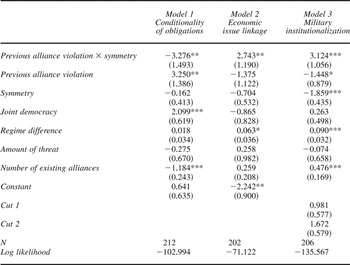
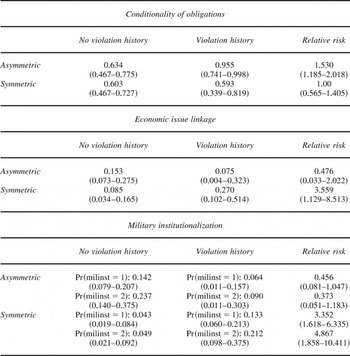
Depending on the nature of the dependent variable, the method of analysis is either logistic regression (for the limitations on alliance obligations dummy and the issue linkage measure) or ordered logit (for the military institutionalization index). Given potential nonindependence of observations associated with the same dyad, I use robust standard errors clustered on the dyad. The results of the analyses are depicted in Table 1. Note that the nonlinear nature of the empirical models means that the coefficients and standard errors on the interaction terms are not meaningful. In order to assess the effect of reputations for unreliability in both symmetric and asymmetric alliances and to provide substantive interpretations of this effect, I use Clarify.Footnote 68Table 2 provides predicted probabilities, relative risks, and their associated 95 percent confidence intervals.
Logit and ordered logit analyses of the effect of past alliance violation on the design of symmetric and asymmetric alliances, 1919–2001

Predicted probabilities of conditional obligations, economic issue linkage, and military institutionalization

Table 2 indicates that symmetric alliances are no more likely to specify precisely the conditions under which alliance obligations apply when one or both members have in the past violated an alliance than if neither leader has done so. On the other hand, in asymmetric alliances, limitations on obligations are 1.5 times more likely to be included in the alliance text when one or both members have in the past violated an alliance than when they have not. These results are surprising as they seem to run counter the theoretical expectations.
Contrary to H1, symmetric alliances do not use contingent obligations as a way to deal with concerns about reliability. As I discuss subsequently, however, they do opt for issue linkage and greater military institutionalization under these circumstances. What this suggests is that, in symmetric alliances, when members worry about alliance reliability they prefer to employ (and are able to negotiate) more costly but also probably more effective ways to bind their partners. Once issue linkage and/or military institutionalization are put in place, greater precision in alliance terms may not be necessary. In fact, limiting alliance obligations might be seen as being at odds with greater institutionalization, which presumes broader and more intense cooperation among the parties.Footnote 69
In contrast, in asymmetric alliances, more costly provisions are not used as means to increase reliability but these alliances do specify more precise terms when the alliance's reliability is in doubt. While on the surface this finding is not in line with H2, it does make sense within the theoretical argument, especially when we recall the fact that in almost all cases in which at least one member of an asymmetric alliance has a reputation for unreliability it is the major power who has the history of alliance violation. Because minor powers in asymmetric alliances depend on the major power for their security, they worry about their partner's dependability, and may press for reliability-enhancing provisions if the partner has a history of alliance violation. The results indicate that, as expected, their ability to compel more costly assurances, such as issue linkage and greater institutionalization, is limited given their unfavorable bargaining position, but they are able to get unreliable major powers to bind themselves more tightly by making very specific promises of when help is forthcoming. The major power may agree to more precise terms, not only because this is a relatively cheap concession, but also because the major power might be concerned about further worsening its reputation and prefers to avoid broad commitments that it might be unable to keep.
Note that the finding on the conditionality of obligations in asymmetric alliances has interesting implications for arguments about entrapment. It has been argued that entrapment concerns, which are another type of reliability concern, should be particularly prevalent in asymmetric alliances where the major power may worry about being dragged into an unwanted conflict.Footnote 70 As a result of these fears, the major power should insist on very specific alliance terms that limit the conditions under which it will help its ally. While this proposition needs to be subjected to a more rigorous test (given that past alliance violation, as measured here, does not necessarily get at entrapment concerns), the results here suggest that conditionality of obligations in asymmetric alliances may not be the result of entrapment worries of major powers but of abandonment concerns of minor powers. Asymmetric alliances seem to specify more precise alliance terms only when the major power has a history of alliance violation.Footnote 71 Furthermore, the limitations imposed rarely emphasize nonprovocation, which is the type of limitation seemingly most relevant for entrapment worries, but rather concern particular locations and adversaries.Footnote 72 While such conditions might also minimize entrapment, their relation to entrapment concerns is less obvious than that of nonprovocation requirements. On the other hand, making alliance obligations conditional on a particular adversary or location helps outline exactly when the major power will assist its minor power ally and thus increases the likelihood that the minor power can count on the support of the major power in the specified circumstances.
While the results regarding the conditionality of obligations are certainly surprising at first glance, they appear less so when we consider the particular nature of this reliability-enhancing provision. Precision in laying out agreement terms is the least costly but also likely the least effective of the provisions. Unlike issue linkage and institutionalization, it does not necessarily raise the costs of defection or make it more difficult to renege on the agreement. It also comes at the cost of limiting the alliance more than the parties might like to and need to if they use the other reliability-enhancing provisions. The fact that greater precision in terms is a cheap concession for the major power explains why we see it in asymmetric alliances. The fact that it is not likely to be the most effective tool to increase reliability explains why we do not necessarily observe it in symmetric alliances, where members have both the will and the ability to put in place issue linkage and greater institutionalization. Once those provisions are adopted, precision may not be considered necessary and may even be seen as decreasing the value of the alliance by limiting its applicability.
In contrast to the results regarding the conditionality of obligations, the findings on economic issue linkage are clearly in line with the theoretical expectations. As proposed by H2, asymmetric alliances are no more likely to provide for economic issue linkage when one or both members have in the past violated an alliance than when they have not. For symmetric alliances, the results indicate that when one or both members have reputations for unreliability, the alliance is 3.6 times more likely to provide for economic issue linkage than when neither member has a reputation for unreliability. This suggests that, in symmetric alliances, issue linkage is indeed used to increase the alliance's reliability. Because economic cooperation raises the value of the alliance, economic issue linkage can be used to make defection on the military portion of the agreement less desirable.
Similarly, the results regarding military institutionalization support H1 and H2. Asymmetric alliances where one or both members have in the past violated an alliance are no more likely to opt for deeper institutionalization than asymmetric alliances where neither member has a reputation for unreliability.Footnote 73 Symmetric alliances, however, are 3.4 times more likely to call for peacetime military contacts, set up a formal military organization, arrange for training exchanges or military technology transfers, require subordination of one state's forces, or specify troop and weapon contributions. They are almost five times more likely to opt for even deeper institutionalization in the form of an integrated military command during peace and wartime, a common defense policy, joint troop placement, or the use of bases in each other's territory.
While these results provide support for the notion that symmetric alliances increase military institutionalization in order to address reliability concerns and asymmetric alliances do not, there is another interesting pattern that emerges in the data. Note that even when neither of the members has a history of alliance violation, asymmetric alliances are quite likely to opt for deep institutionalization, certainly much more so than symmetric alliances.Footnote 74 Most likely, institutionalization in asymmetric alliances is the result of their role as instruments of control. To the extent that the major power's goal is to exert influence on the minor power's domestic and international policies, provisions such as foreign policy coordination and the establishment of bases are useful.Footnote 75 Thus, while military institutionalization in symmetric alliances is at least in part the result of an attempt to mitigate enforcement problems, in asymmetric alliances it likely reflects the major power's attempt to control the minor power.
The findings regarding the control variables are mixed. Joint democracy has a significant positive effect on the inclusion of limitations on alliance obligations. This runs counter to the expectation that jointly democratic allies should have fewer reliability concerns and thus perceive less of a need to employ reliability-enhancing provisions. Instead, this may be a reflection of the attempts of democracies to ensure that they are reliable by limiting their obligations to conditions under which they know they will be able and willing to fulfill their obligations. Because democracies are averse to reneging on their commitments, they prefer to specify their obligations in ways to maximize the likelihood that the agreement will be upheld.
Greater regime difference is associated with a greater likelihood of economic issue linkage and with deeper levels of military institutionalization. These findings are in line with the idea that states with different political systems, and thus differing levels of political constraints and divergent foreign policy preferences, will choose alliance designs that increase the likelihood that the agreement holds. Economic issue linkage helps increase the value of the alliance and military institutionalization helps bind the alliance partner.
Interestingly, the amount of threat that the allies confront is not statistically significant in any of the models, not even in the military institutionalization model. What this suggests is that military institutionalization may not be seen primarily as a means to counter a threat but as a way to deal with reliability concerns (in symmetric alliances) or as a way to ensure control over the ally (in asymmetric alliances).
Finally, the number of existing alliance ties in a dyad has a strong effect on alliance design. The more alliances the signatories share, the less likely the alliance features limitations on the primary obligations and the more likely it is to call for military institutionalization. The first finding is in line with theoretical expectations. The more alliances a dyad shares, the greater the members' confidence in each other and the less need to specify the alliance obligations and conditions in great detail. More puzzling, however, is that states that share multiple alliances become increasingly more likely, rather than less likely, to institutionalize.
In order to gauge the robustness of the results, I ran a number of additional analyses. First, it is possible that reputations adhere not only to particular leaders but that they reflect structural characteristics of the country itself.Footnote 76 Thus, following Gibler, I employ an alternative reputation measure that allows reputations for unreliability to persist for ten years after violation, whether the same leader who violated the alliance stayed in office or a new leader took over.Footnote 77 This reputation variable is thus coded 1 if one or both states have in the past ten years terminated an alliance in violation of its terms. Results using this alternative measure are robust although the effect of past alliance violation on the conditionality of obligations in asymmetric alliances is not quite as strong.
Second, I examine the effect of reputations for unreliability on components of the military institutionalization measure. When one or both members have violated an alliance in the past, symmetric alliances, but not asymmetric ones, are significantly more likely to include provisions for peacetime consultation or the development of a common defense policy, more likely to create a formal military organization, and they also appear to be more likely to provide for subordination or integration of forces. They are no more likely to provide for the stationing of troops or bases in each others' territory, arrange for military aid, or specify contribution levels.
Third, I include multilateral pacts alongside bilateral ones.Footnote 78 The inclusion of multilateral alliances significantly complicates the operationalization of the independent variables. The reputation measure is now the percentage of alliance members with leaders that have previously violated an alliance. The underlying assumption is that the fewer members with untainted reputations, the greater the perceived need to bind one another through reliability-enhancing provisions. Symmetry is measured based on whether all members were minor/major powers or whether the alliance contained both minor and major powers. Joint democracy indicates alliances where all members have Polity2 scores of 5 or higher. Regime difference is the difference between the most democratic and least democratic member. The threat measure divides the sum of threats the individual alliance members confront by the number of alliance members (that is, it becomes a measure of average threat). The number of existing alliance ties reflects the number of bilateral and multilateral alliances of the member-dyad with the fewest shared alliances.
The results of the analyses including multilateral alliances are generally robust but, as expected, the relationships are weaker in this set of cases than for bilateral alliances only. An increase in the percentage of alliance members with reputations for unreliability is positively but not significantly associated with economic issue linkage in symmetric alliances and, while a greater percentage of alliance members with reputations for unreliability has a statistically significant positive effect on deeper institutionalization in symmetric alliances, the substantive effect is somewhat weaker in this set of cases. Neither result is surprising as the costs of both economic concessions and deeper institutionalization rise when there are multiple alliance members.Footnote 79
Conclusion
Military alliances are without a doubt a frequently studied form of cooperation between states. Yet, there are still some unanswered questions. In particular, scholars currently do not have a good understanding of the design of alliances. This is surprising because there does seem to be a significant amount of variation in the provisions adopted in alliance agreements.
This article seeks to provide a rationale for some of the variation that we observe in alliance design. I argue that, when designing alliances, leaders are driven, at least in part, by the desire to ensure that their alliance is reliable. They weigh the benefits of including reliability-enhancing design features such as limiting conditions on when the casus foederis is invoked, issue linkage, and military institutionalization by the costs of negotiating and implementing these features. When concerns about reliability are high, because one or both members have shown themselves to be unreliable allies in the past, and when the reliability of an ally is crucial to a state's security, as it is in symmetric bilateral defense, offense, and neutrality pacts, members may be willing to pay the costs of adopting reliability-enhancing provisions. When neither member has a history of alliance violation or if the alliance is asymmetric, we should not necessarily expect these provisions to be adopted. In asymmetric alliances, the major power may not find reliability-enhancing provisions necessary and while the minor power does worry about the major power's reliability, it may not be able to dictate terms that increase the reliability of the alliance.
The empirical test generally provides support for the theoretical argument but also produces some surprising findings. Symmetric alliances where one or both members have a history of alliance violation are significantly more likely to provide for economic issue linkage and more likely to feature deeper levels of institutionalization than symmetric alliances where neither ally has a history of alliance unreliability. Yet, they are no more likely to be specific about when primary obligations are invoked. The opposite is the case for asymmetric alliances: if one or both members have a history of alliance violation they are significantly more likely to impose limitations on the primary alliance obligations but no more likely to provide for issue linkage and military institutionalization. It is important to note that the findings on asymmetric alliances are really about the effect of a reputation for unreliability by the major power. Given the lack of data on minor power violators in asymmetric alliances, the empirical test does not provide any insight on what effect bad reputations of minor powers may have on asymmetric alliance design. Future studies on this are certainly warranted.
This article presents an early attempt to explain alliance design, focuses on particular design features, and takes on a particular theoretical lens through which these design features are explained. Reliability considerations, in the form of concerns about abandonment, should certainly affect alliance design, and as this study shows, they do. However, other considerations should matter as well. While this article briefly addresses entrapment concerns and the desire of major powers to exert control over minor powers through institutionalization, more research on these and other motivations for the choice of different design features is desirable. Alliances can fulfill many purposes for signatories and these different goals are likely to be reflected in alliance design.
This article also conceptualizes alliance design in terms of a rational response to cooperation problems. Future work should study alliance design not only from the perspective of overcoming enforcement problems but also from a bargaining perspective that explains who gets what in terms of alliance design. This approach might also help explain variation in other alliance provisions that are not addressed here.
Ultimately, the goal of this line of research is a general theory of alliance design that considers and weighs different reasons for the choice of design features and is able to explain the variation that exists in all aspects of alliance design. This study does not develop such a theory but hopefully provides a starting point for such an endeavor. The article also provides additional insight into the role of reputation in international politics and cooperation in the security realm. Despite skepticism regarding reputation arguments, the findings suggest that reputations do form: states take the past behavior of their potential partners into account when making decisions regarding cooperation. In fact, reputation matters not only for whether cooperation occurs but also for the terms of cooperation. At the same time, the findings suggest that there are limits to the importance of reputation in explaining the terms of cooperation. Relative bargaining power conditions the situations in which reputational considerations affect alliance design.
This study also shows that the same basic rational design principles that explain the characteristics of economic and environmental treaties also provide insight into the design of alliances. Security cooperation has often been deemed more complex than economic and environmental cooperation and some have argued that different “rules” apply to cooperation in high versus low politics. This does not seem to be the case with respect to treaty design. As with other types of cooperative agreements, alliance design is determined, at least in part, by attempts to address enforcement problems in an anarchical international system.