Hepatitis B virus (HBV) is one of the most prevalent health problems, with 2 billion patients infected worldwide and 350 million chronic carriers.Reference Liaw and Chu 1 In 2016, there were 20,900 new cases in the United States, a 5% increase compared to the previous 3 years and a trend expected to worsen due to the ongoing opioid crisis. 2 Yearly, the number of US patients needing dialysis also increases by 5%. 3
Unlike patients infected with hepatitis C or HIV, who require only standard precautions during dialysis, HBV carriers must be dialyzed on dedicated equipment in a segregated setting in which providers are aware of patients’ serostatus before each dialysis session. 4 , 5
Given the prevalence of HBV and end-stage renal disease, and that fact that most hemodialysis is performed in more communal, multipatient settings, first-time dialysis patients could be chronic HBV carriers inadvertently dialyzed in a nonsegregated setting, especially if dialysis is urgent.Reference Lesho, Hix, Bronstein, Shastry and Grieff 6 – Reference Cervantes, Richardson and Raghavan 8 The chance of having a patient’s HBV serostatus escape predialysis verification is further heightened when medical history and records are sparse, as is often the case for some populations, including refugees and recent immigrants.
Following such an event, we sought to minimize subsequent exposure risk to roommates of the exposed patients if or when they seroconverted before their serology and HBV DNA results were available. All of the exposed patients required dialysis 3 times per week.
The high volume of patients needing dialysis and limited resources (especially staff), made segregating all exposed for the 6-month monitoring period logistically impossible. We also sought to use the electronic medical record (EMR) to prevent future incidents.
Setting
The health system performs an average of 121,000 treatments on 810 patients in 11 dialysis units yearly. Moreover, 9,400 of these occur in 2 inpatient units, and the remainder are performed in 8 outpatient units and 1 home unit. Immigrants comprise up to 18% of the population in upstate New York. Additionally, Rochester, New York, hosts a substantial Bhutanese refugee community as well as ∼3,500 Puerto Ricans displaced by Hurricane Maria in 2017. The nonprofit medical humanitarian assistance organization InterVol is also based at Rochester Regional Health. The incident occurred in an inpatient unit on a Friday and was detected the following Monday.
Methods
Horizontal exposure (n = 4) was defined the exposure of any nonimmune patient concurrently dialyzed in the same room with the index case. Vertical exposure (n = 1) was defined as the exposure of a nonimmune patient dialyzed on the same machine that was cleaned (but not bleached and heat treated) immediately after the index patient. Nonexposured patients (n = 3) were patients who previously demonstrated response to hepatitis vaccine but were concurrently dialyzed in same room.
All patients considered to have been exposed were vaccinated with HBV vaccine and immunoglobulin within 7 days, and all of the dialysis machines were sequestered, bleached, and heat treated after each dialysis. All patients were monitored for seroconversion with weekly tests: HBSAg (ADVIA Centaur CP Immunoassay System, Siemens Healthineers, Erlangen, GE) and DNA (Real-Time PCR LightCycler 480, Roche LifeScience, Indianapolis IN). The dialysis position of the vertical exposure was moved to the last appointment slot of the day, and a root cause analysis (RCA) was performed.
Results
The RCA revealed that the following factors contributed to a patient’s serostatus escaping verification: (1) emergent or urgent initiation of the first dialysis session, (2) having only a single manual verification step, (3) the appearance of the relevant graphic user interfaces of the medical software (Epic, Verona, WI), and (4) automatic importing of laboratory results. In response, we terminated the automatic importation of laboratory results into dialysis workspaces in the EMR.
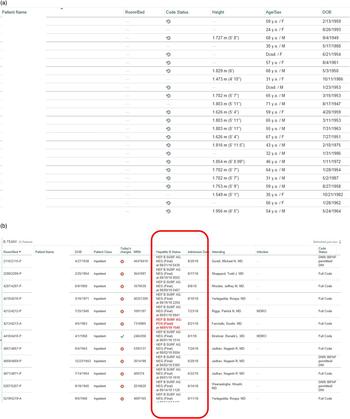
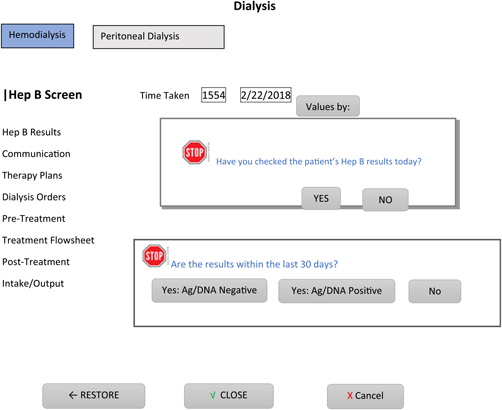
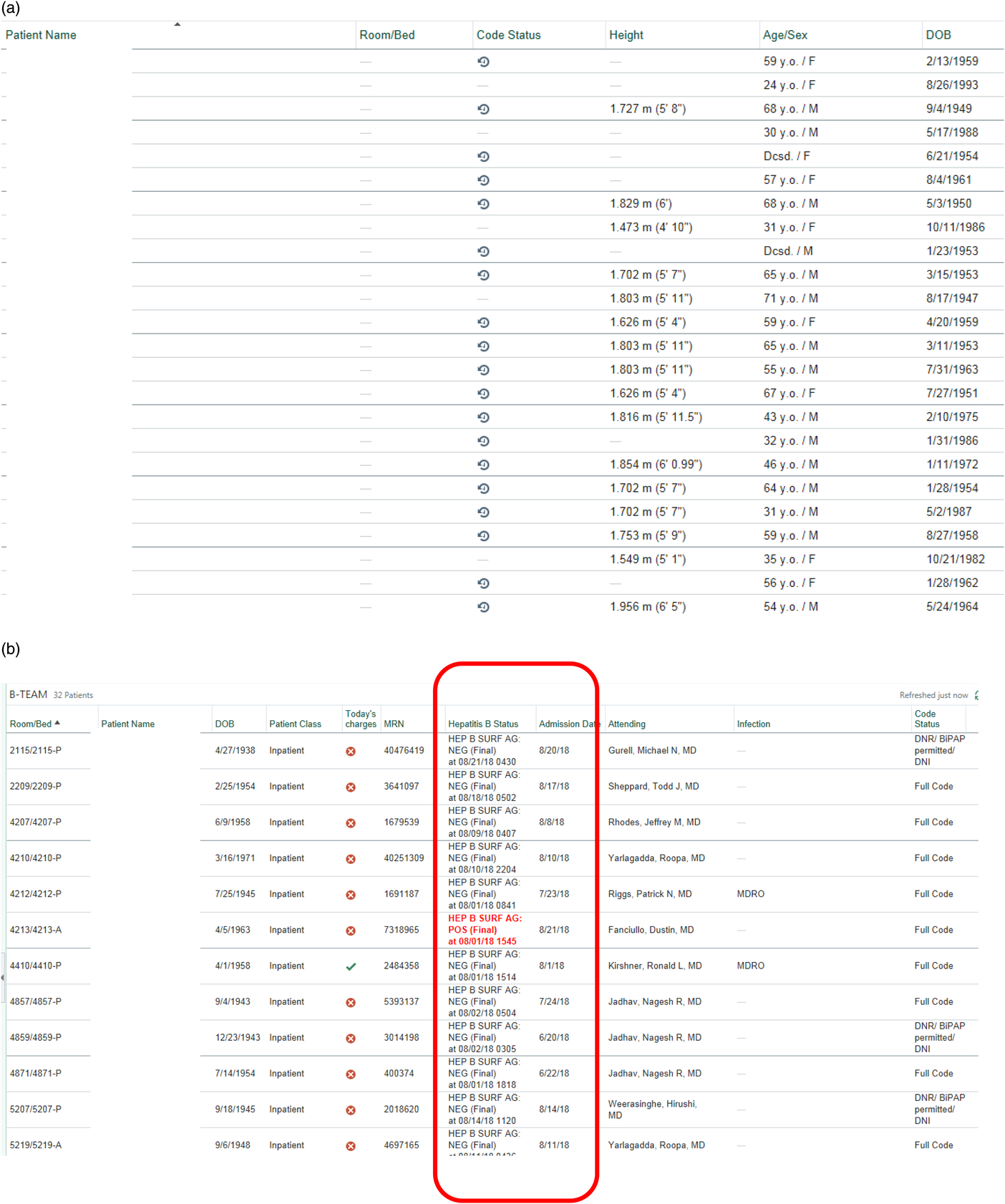
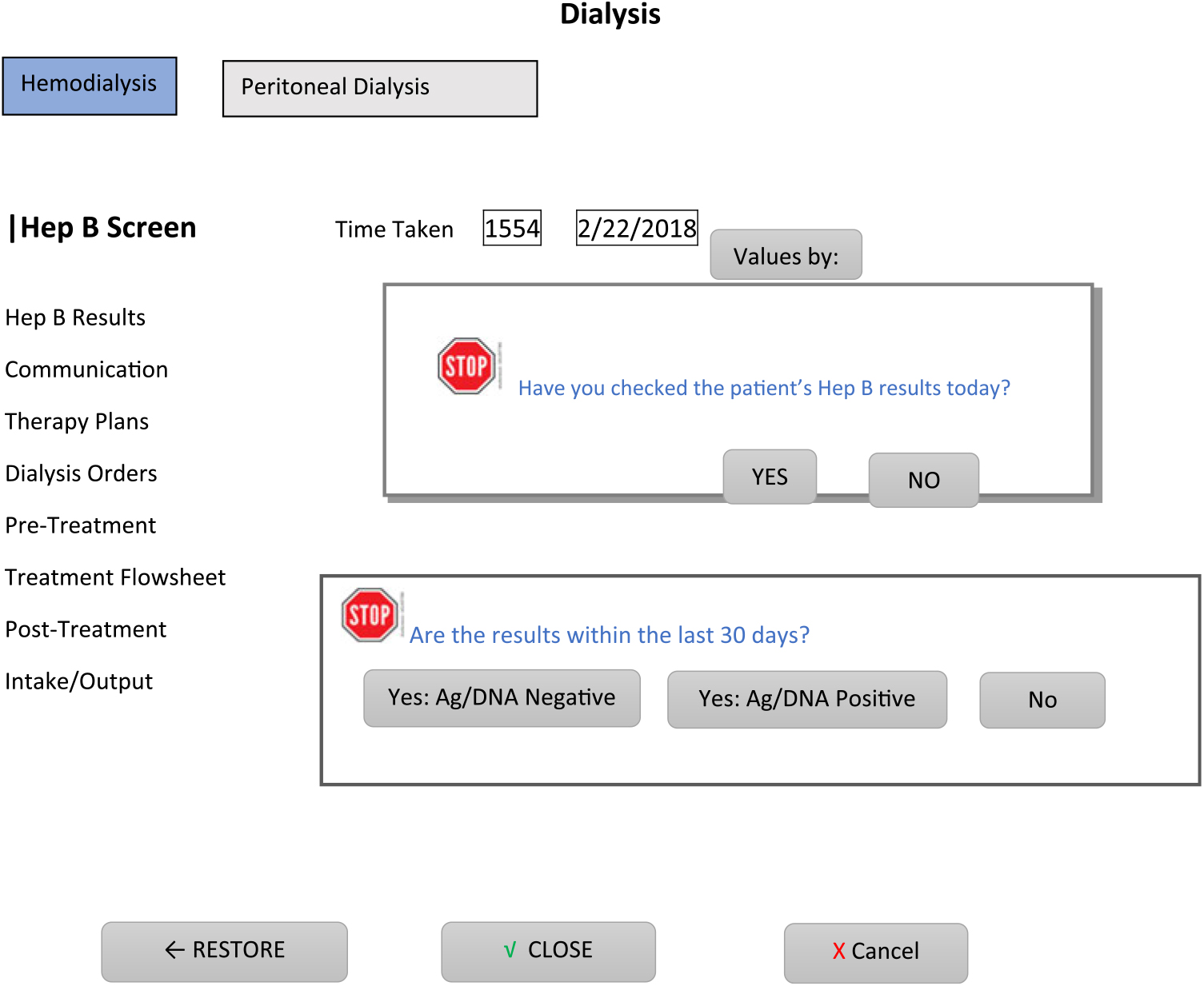
We implemented a multistep verification process. To support that, we made the following modifications to the EMR: a highly visible “HBV” column was added to the dialysis census (Fig. 1A and 1B); a ‘hard stop’ was inserted during the electronic ordering of dialysis (Fig. 2), and a “hepatitis tool- bar” (Supplemental Fig. 1 online) was added. The nurses loaded information into the patient tool bars so they could more easily see the immune status and other relevant laboratory results of their patients. Outcome measures included (1) any additional such exposures, (2) any reported ‘near misses’ of such an exposure almost occurring, and (3) any seroconversions or HBV DNA detected in the exposed. Two years after implementing the EMR modifications, all 3 outcome measures were zero.
Daily dialysis census. (A) The top panel indicates the appearance of the daily census sheet before the modification. (B) The bottom panel shows the appearance of the daily census after the highly visible hepatitis column was added, indicated by the red outline.
Mockup of the graphic user interface of the dialysis ‘hard stop.’ A mockup of the screen shot which appears when a provider places an order for dialysis. Before the order can be completed, the provider must answer both questions.
Discussion
Automatically importing laboratory results into provider electronic notes, having the initial dialysis session performed on an emergent or urgent basis, and certain ‘off the shelf’ characteristics of the graphic user interfaces of the EMR platform contributed to the exposure event.
When this exposure occurred in mid-2017, no specific recommendations were available regarding the optimum diagnostic algorithm (ie, the timing and type or combination tests [viral load, serology, or both]) for active surveillance during the interdialytic periods after an exposure.
We used both DNA and HBSAg for monitoring exposed patients because using only DNA would have risked missing an interdialysis SVC due to its 4-day turnaround time. Although HBSAg can be falsely positive from vaccination, results were available in ≤24 hours. During the 6-month postexposure monitoring period, no suspected or confirmed false-positive antigen tests resulted from the recent vaccinations. Another consideration was that hepatitis B immunoglobulin and HBV vaccine were not immediately available due to supply issues or shortages.
Finally, with current dialysis machines, there is no potential for blood contamination of predialytic pathways, even if a leak occurs. Dialysis systems, including the transducer, are replaced after each patient, and exterior surfaces of the station and chair are disinfected. For patients with HBV, machines are bleached and heat treated, and the chair and any other equipment are also bleached. All known HBV inpatients are dialyzed on dedicated equipment in their private rooms. Conditions such as critical hyperkalemia or volume overload permitting, potentially exposed and emergent cases are scheduled for the last shift of the day on a machine that has fewer adjacent stations.
Supplementary material
To view supplementary material for this article, please visit https://doi.org/10.1017/ice.2019.164.
Acknowledgments
We are grateful for assistance from the Monroe County and the New York State Public Health Departments, the US Centers for Disease Control and Prevention, and to Dr Balazs Zsenits, Rochester Regional Health.
Financial support
No financial support was provided relevant to this article.
Conflicts of interest
All authors report no conflicts of interest relevant to this article.