Introduction
Basidiolichens are very poorly understood organisms with many gaps in our knowledge of their systematics, morphology and species distribution (Oberwinkler Reference Oberwinkler2012). Although less than 1% of all known lichens have a basidiomycete as mycobiont (Lawrey et al. Reference Lawrey, Binder, Diederich, Molina, Sikaroodi and Ertz2007), their diversity is much higher than previously assumed (Lücking et al. Reference Lücking, Dal-Forno, Sikaroodi, Gillevet, Bungartz, Moncada, Yánez-Ayabaca, Chaves, Coca and Lawrey2014b ) and the best models to study the evolution of the lichen thallus can be found in basidiolichens (Dal-Forno et al. Reference Dal-Forno, Lawrey, Sikaroodi, Bhattarai, Gillevet, Sulzbacher and Lücking2013). Most basidiolichens are concentrated in the family Hygrophoraceae (Agaricales, Agaricomycetidae), which includes a great variety of basidiome types, including agaricoid, cyphelloid, stereoid and corticioid (Lawrey et al. Reference Lawrey, Lücking, Sipman, Chavez, Redhead, Bungartz, Sikaroodi and Gillevet2009; Dal-Forno et al. Reference Dal-Forno, Lawrey, Sikaroodi, Bhattarai, Gillevet, Sulzbacher and Lücking2013; Lodge et al. Reference Lodge, Padamsee, Matheny, Aime, Cantrell, Boertmann, Kovalenko, Vizzini, Dentinger and Kirk2014). Basidiolichens with clavarioid basidiomes are known from two orders, Cantharellales and Lepidostromatales (Nelsen et al. Reference Nelsen, Lücking, Umaña, Trest, Will-Wolf, Chaves and Gargas2007; Ertz et al. Reference Ertz, Lawrey, Sikaroodi, Gillevet, Fisher, Killmann and Sérusiaux2008; Hodkinson et al. Reference Hodkinson, Moncada and Lücking2014).
Sulzbacheromyces B. P. Hodk. & Lücking is a recently erected genus in Lepidostromatales, differing from Lepidostroma Mägd. & S. Winkl., another basidiolichen genus with a tropical distribution (Mägdefrau & Winkler Reference Mägdefrau and Winkler1967), in the entirely crustose, undifferentiated thallus lacking cortex and medullary structures. Originally, Sulzbacheromyces caatingae was the only species recognized (Hodkinson et al. Reference Hodkinson, Moncada and Lücking2014), but a second species has recently been described from Japan under the name Lepidostroma asianum (Yanaga et al. Reference Yanaga, Sotome, Suhara and Maekawa2015). For Lepidostroma s. str., four taxa are currently known: L. calocerum (G. W. Martin) Oberw. (including the type L. terricolens Mägd. & S. Winkl.), L. rugaramae (Eb. Fischer et al.) Ertz et al., L. vilgalysii B. P. Hodk. and L. winklerianum B. P. Hodk. & Lücking (Oberwinkler Reference Oberwinkler1984; Fischer et al. Reference Fischer, Ertz, Killmann and Sérusiaux2007; Ertz et al. Reference Ertz, Lawrey, Sikaroodi, Gillevet, Fisher, Killmann and Sérusiaux2008; Hodkinson et al. Reference Hodkinson, Uehling and Smith2012, Reference Hodkinson, Moncada and Lücking2014). One species is accepted in the genus Ertzia, viz. E. akagerae (Hodkinson et al. Reference Hodkinson, Moncada and Lücking2014).
Although the number of basidiolichens was believed to be relatively small, recent efforts have led to an increase in the diversity of this group of organisms through the discovery of new species in several countries, especially in the Neotropics, such as Costa Rica, Ecuador and Brazil (Chaves et al. Reference Chaves, Lücking, Sipman, Umaña and Navarro2004; Nelsen et al. Reference Nelsen, Lücking, Umaña, Trest, Will-Wolf, Chaves and Gargas2007; Sulzbacher et al. Reference Sulzbacher, Baseia, Lücking, Parnmen and Moncada2012; Yánez et al. Reference Yánez, Dal-Forno, Bungartz, Lücking and Lawrey2012; Dal-Forno et al. Reference Dal-Forno, Lawrey, Sikaroodi, Bhattarai, Gillevet, Sulzbacher and Lücking2013; Lücking et al. Reference Lücking, Dal-Forno, Lawrey, Bungartz, Holgado Rojas, Hernández, Marcelli, Moncada, Morales and Nelsen2013, Reference Lücking, Barrie and Genney2014a , Reference Lücking, Dal-Forno, Sikaroodi, Gillevet, Bungartz, Moncada, Yánez-Ayabaca, Chaves, Coca and Lawrey b ; Hodkinson et al. Reference Hodkinson, Moncada and Lücking2014; Schmull et al. Reference Schmull, Dal-Forno, Lücking, Cao, Clardy and Lawrey2014).
Since the description of Sulzbacheromyces caatingae from north eastern Brazil (Sulzbacher et al. Reference Sulzbacher, Baseia, Lücking, Parnmen and Moncada2012 as Lepidostroma; Hodkinson et al. Reference Hodkinson, Moncada and Lücking2014), we have accumulated a large number of additional data and sequences for this species. Based on these data, we discuss here the morphological and ecological features of this species and its geographical distribution. We also point out mycobiont features that can help in separating Sulzbacheromyces from the unrelated but morphologically similar genus Multiclavula R. H. Petersen in the Cantharellales.
Materials and Methods
Morphological studies
Colour codes follow Korneup & Wancher (Reference Korneup and Wancher1978). Presentation of basidiospore data follows the methodology proposed by Tulloss et al. (Reference Tulloss, Ovrebo and Halling1992), slightly modified by Wartchow (Reference Wartchow2012) and Wartchow et al. (Reference Wartchow, Buyck and Maia2012). Measurements and statistics are based on 20 spores. Abbreviations include L(W)=average basidiospore length (width), Q=the length : width ratio range as determined from all measured basidiospores, and Q=the Q value averaged from all basidiospores measured. For basidiospore shape, we follow Bas (Reference Bas1969): globose (Q=1·00–1·05), subglobose (Q=1·05–1·15), broadly ellipsoid (Q=1·15–1·30), ellipsoid (Q=1·30–1·60), elongate (Q=1·60–2·00), cylindrical (Q=2·00–3·00) and bacilliform (Q>3·00). Collections studied are deposited in JPB, UFRN-Fungos and F (Thiers Reference Thiers2013).
DNA extraction, amplification and sequencing
New ITS sequences of additional samples of Sulzbacheromyces caatingae were generated for this study using the SIGMA REDExtract-N-Amp Plant PCR Kit (St. Louis, Missouri, SA) for DNA isolation following the manufacturer’s instructions, except that 40 μl of extraction buffer and 40 μl dilution buffer were used. Primers for amplification were ITS1F (Gardes & Bruns Reference Gardes and Bruns1993) and ITS4 (White et al. Reference White, Bruns, Lee and Taylor1990) for ITS. PCR reactions contained 5·0 μl R4775 SIGMA REDExtract-N-Amp™ PCR ReadyMix, 0·5 μl of each primer (10 μM), 2 μl genomic DNA extract and 2 μl distilled water, for a total of 10 μl. Thermal cycling parameters were: initial denaturation for 5 min at 94 °C, followed by 39 cycles of 30 s at 94 °C, 30 s at 48 °C, 1 min 30 s at 72 °C, and a final elongation for 5 min at 72 °C. PCR samples were visualized on a 1% ethidium bromide-stained agarose gel under UV light and bands were gel-extracted, heated at 70 °C for 5 min, cooled to 45 °C for 10 min, treated with 1 μl GELase (Epicentre Biotechnologies, Madison, WI, USA) and incubated at 45 °C for at least 24h. The 10 μl cycle sequencing reactions consisted of 1·0–1·5 μl of BigDye v3.1 (Applied Biosystems, Foster City, California, USA), 2·5–3·0 μl of BigDye buffer, 6 μM primer, 0·75–2·00 μl gelased PCR product, and water. Samples were sequenced with PCR primers. The cycle sequencing conditions were as follows: 96 °C for 1 min, followed by 25 cycles of 96 °C for 10 s, 50 °C for 5 s and 60 °C for 4 min. Samples were precipitated and sequenced using ABI Applied Biosystems 3730 DNA Analyzer (Foster City, California, USA), and sequences were assembled in DNASTAR SeqMan 4.03 and submitted to GenBank (Table 1).
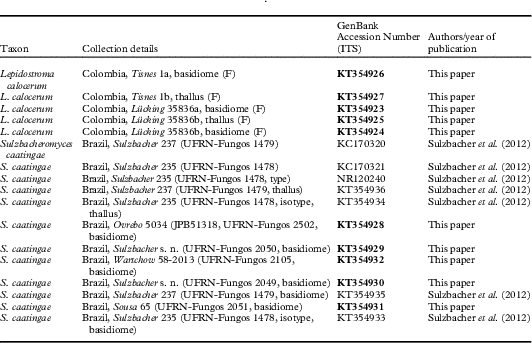
Specimens used in the study, with location, reference collection detail and GenBank accession numbers. Newly obtained sequences for this study are represented in bold font

Phylogenetic analysis
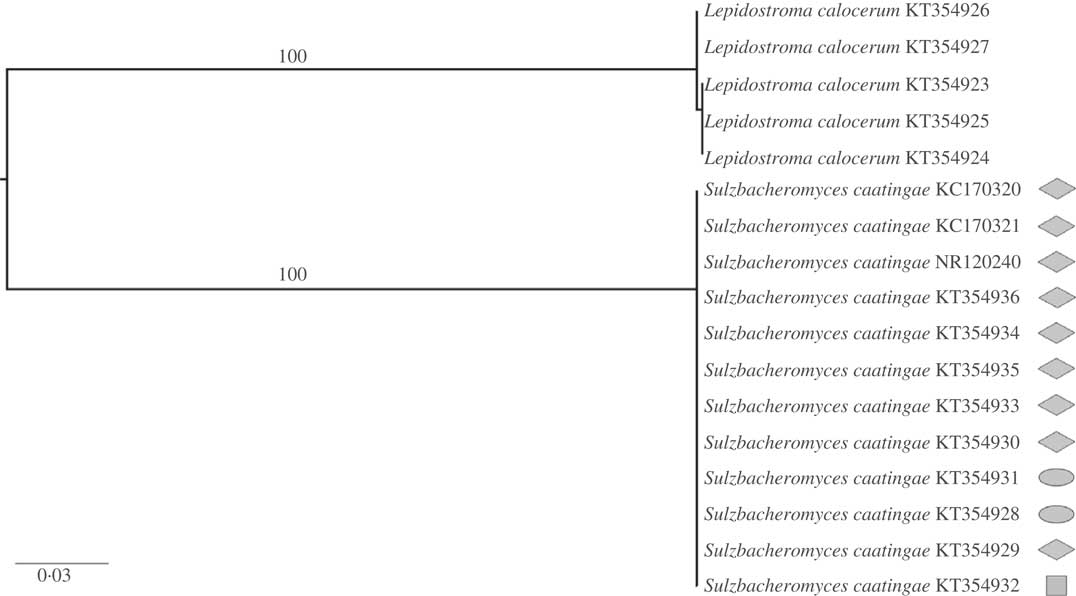
The newly generated ITS sequences for the new species were aligned with previously generated sequences of the same species downloaded from GenBank, and five sequences of Lepidostroma calocerum were used as outgroup (Table 1). Sequences were arranged into a multiple sequence alignment (MSA) using BIOEDIT 7.09 (Hall Reference Hall1999) and automatically aligned with MAFFT 6.850b using the –auto option (Katoh & Toh Reference Katoh and Toh2005; Katoh et al. Reference Katoh, Asimenos and Toh2009). The final alignment was subjected to a maximum likelihood search using RAxML 7.2.6 (Stamatakis et al. Reference Stamatakis, Ludwig and Meier2005; Stamatakis Reference Stamatakis2006) using the GTR-gamma model, with parametric bootstrapping using 500 replicates.
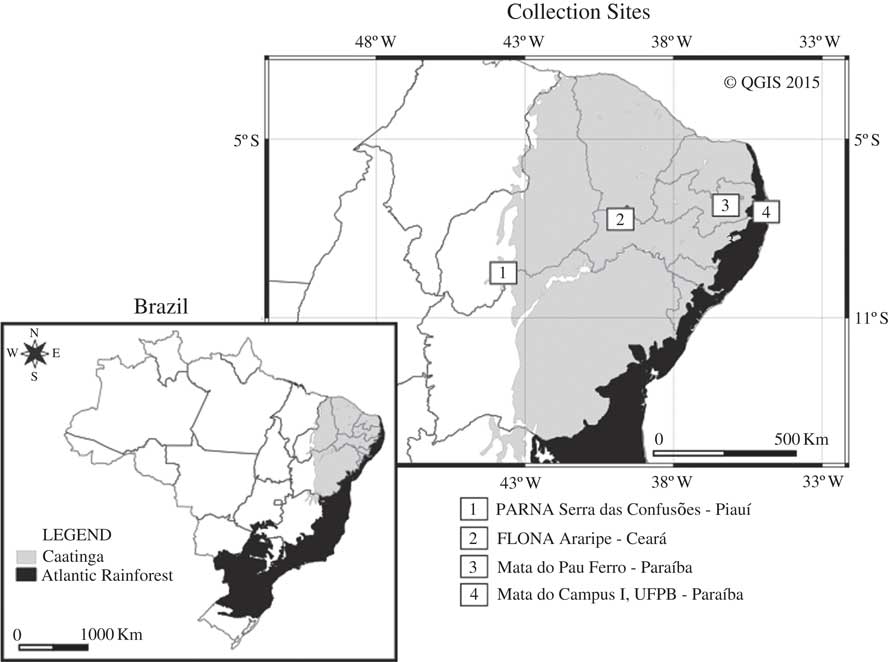
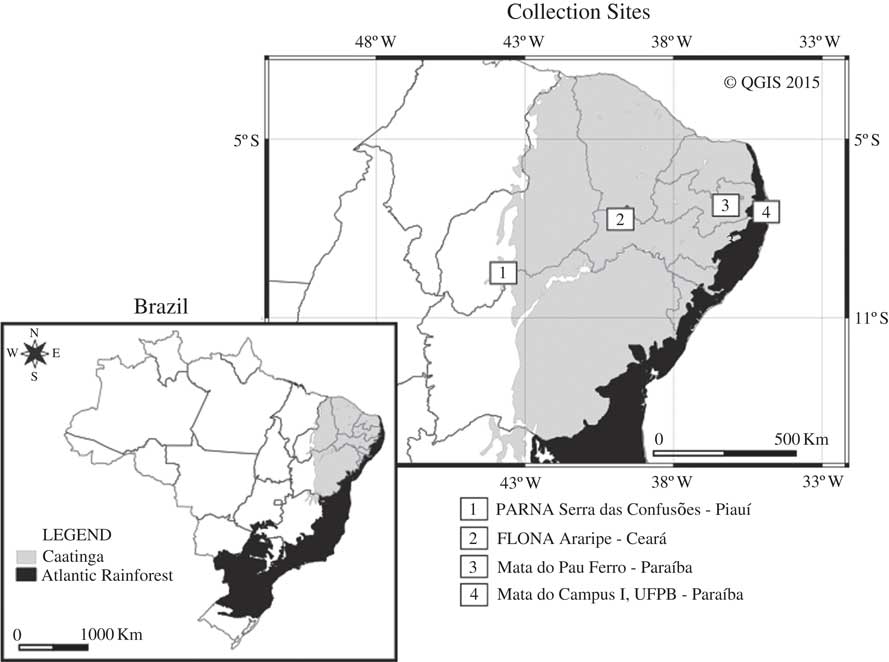
Map showing the distribution of Sulzbacheromyces caatingae in the Brazilian semi-arid region and in the north-eastern Atlantic rainforest biome.
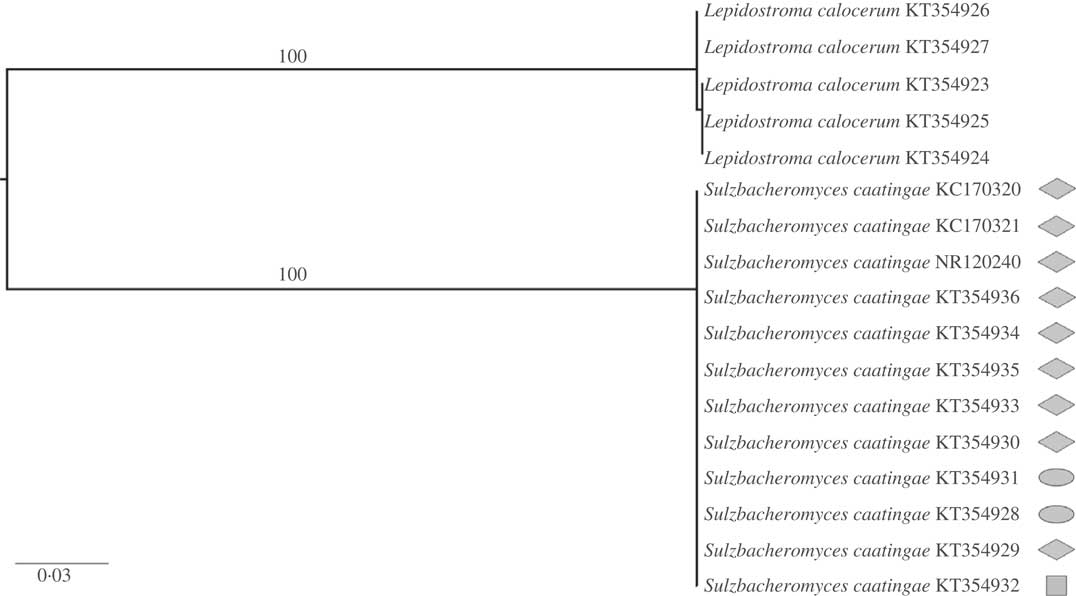
Maximum-likelihood tree of the ITS alignment of selected Basidiomycota, focusing on Sulzbacheromyces, with GenBank accession numbers. Shapes indicate the vegetation sites: rhombus, Caatinga biome; ellipse, upland wet forest of the semi-arid zone; square, Atlantic rainforest biome.
Results and Discussion
Taxonomy
Sulzbacheromyces caatingae (Sulzbacher & Lücking) Hodkinson & Lücking
Fung. Divers. 64: 176 (2014).
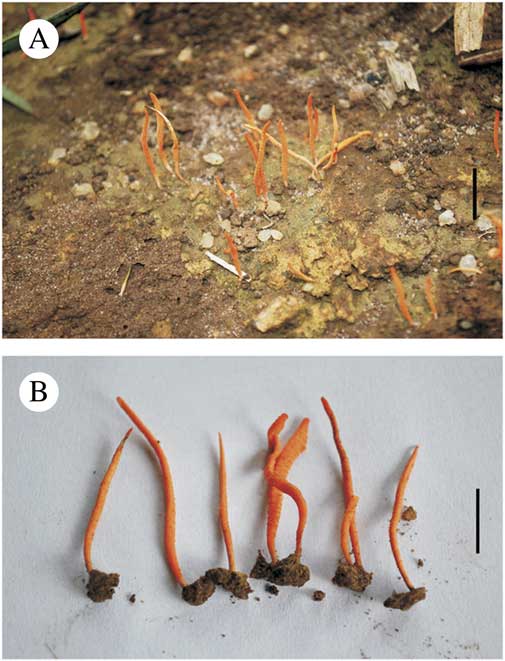
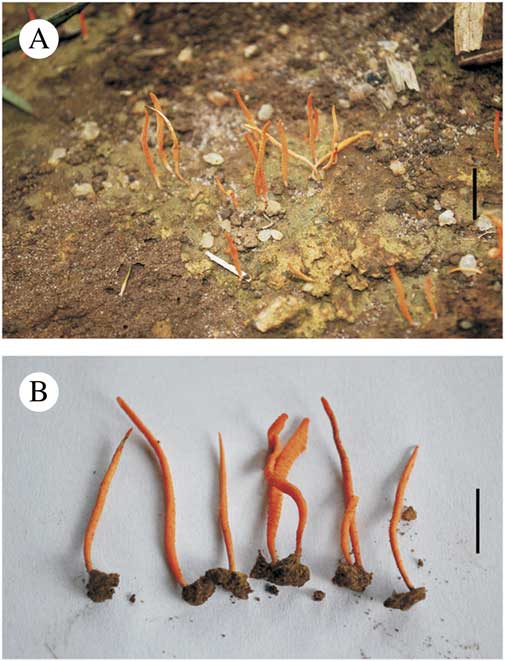
Sulzbacheromyces caatingae (C. L. Ovrebo 5034). A, habit in situ; B, basidiomata. Photographs: C. L. Ovrebo. Scales: A & B=10 mm. In colour online.
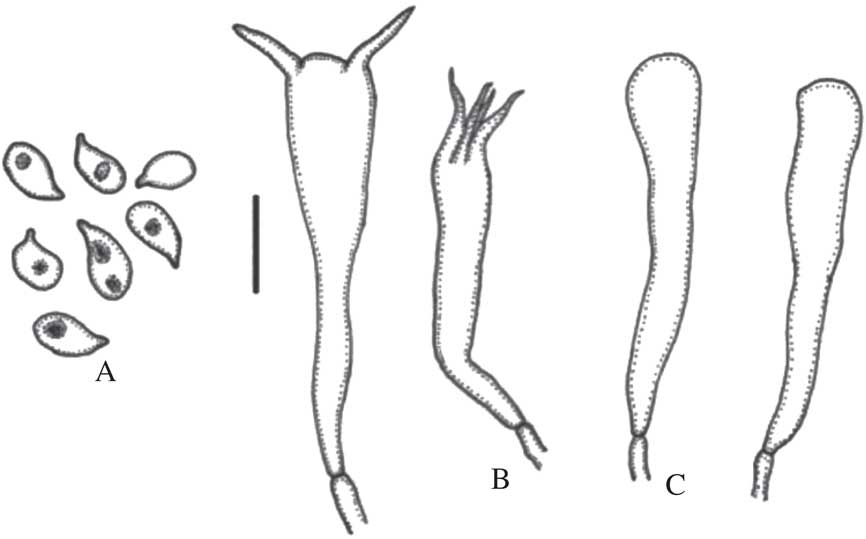
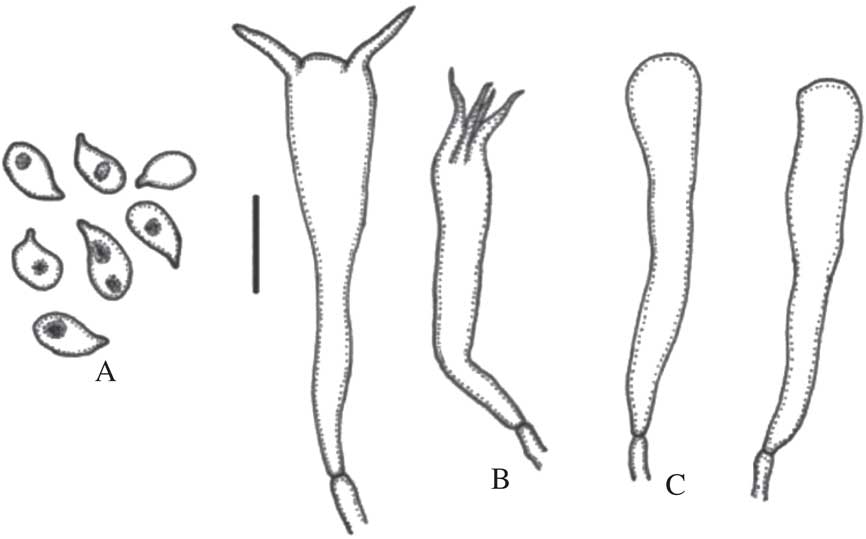
Sulzbacheromyces caatingae (C. L. Ovrebo 5034). A, basidiospores; B, basidia and adjacent hyphae; C, basidioles and adjacent hyphae. Scale=10 μm.
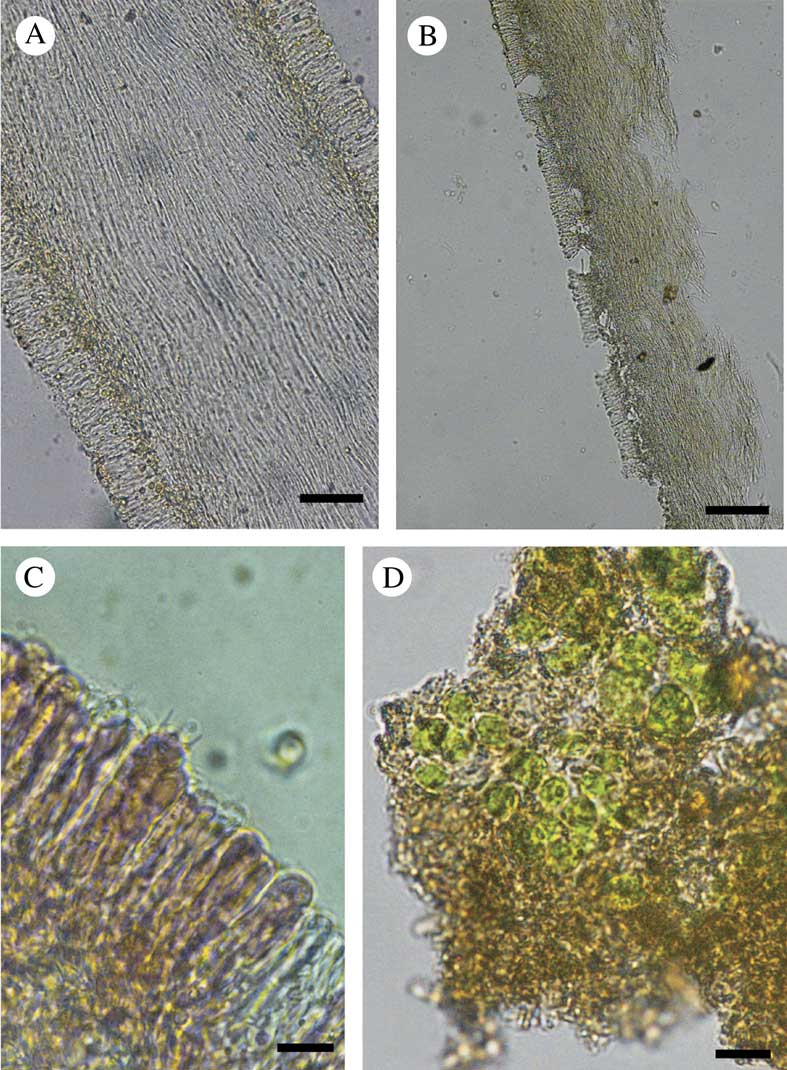
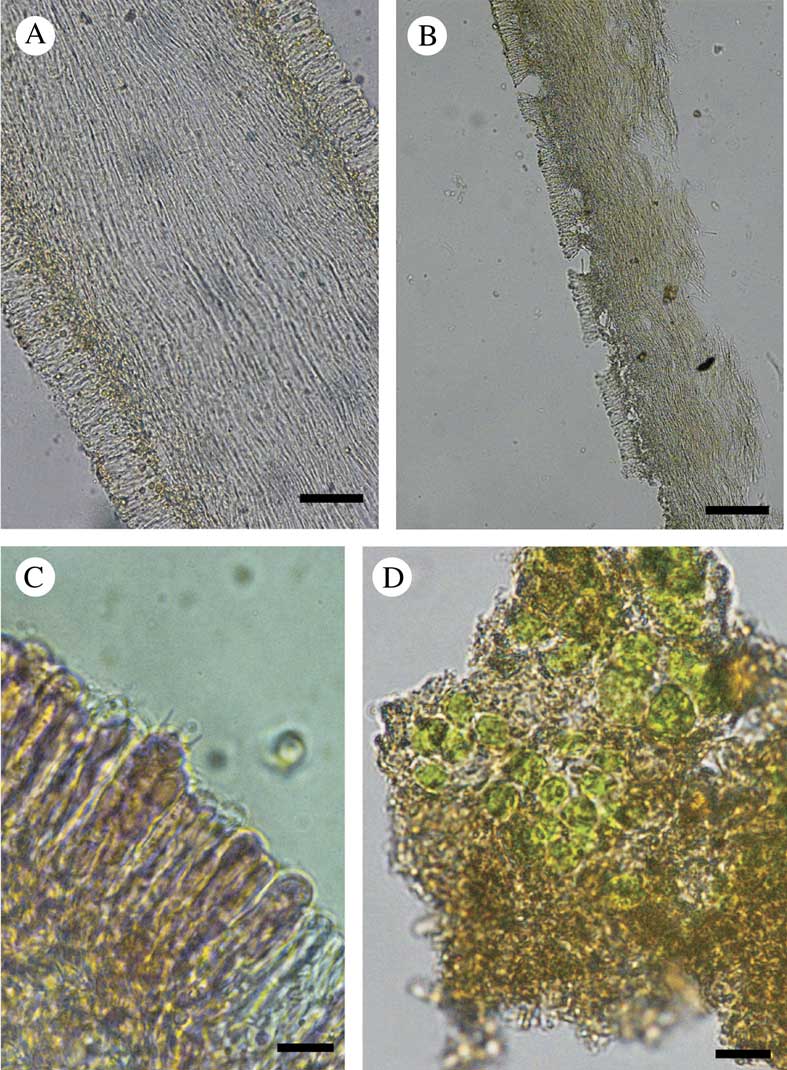
Sulzbacheromyces caatingae (C. L. Ovrebo 5034). A, tramal context; B, tramal context showing a crenulate surface; C, basidia and basidioles; D, green algal cells from the thallus. Scales: A=20 μm; B=100 μm; C & D=10 μm. In colour online.
Thallus forming a thin green crust on the substratum (Fig. 3A), not further differentiated, containing a single-celled green alga (Fig. 5D).
Basidiomata clavarioid-caloceroid (Fig. 3B), 20–30 mm high, 1·0–1·5 mm diam., unbranched, terete or slightly flattened, straight and equal or sometimes slightly enlarged at mid-section then frequently narrowing downward near base; surface cracking circumferentially (similar to old carrot), otherwise glabrous; dull orange-pink (KW 6A4) overall, context dull yellow. Basidia 23–45×4–7 µm, clavate, thin walled, hyaline, 2–4 sterigmate, each up to 7 µm long (Figs 4B & 5C). Basidioles 25–40×5–6 µm slender clavate, abundant (Figs 4C & 5C). Basidiospores 5·0–8·0(–8·5)×3·5–4·5 µm, L=6·5 µm, W=3·9 µm, Q=1·50–2·00(–2·28), Q=1·67; inamyloid, hyaline, ellipsoid, elongate to sometimes cylindrical, sometimes slightly adaxially concave, smooth, thin walled; contents as one or two guttules, hilar appendix present (Fig. 4A). Subhymenium 2·0–4·5 µm in diam., compact hyphae, hyaline. Tramal context made of parallel (Fig. 5A), agglutinated hyphae 2·5–9·5 µm in diam., thin walled, yellowish in mass, individually hyaline, clampless; in some basidiomata (e.g. C. L. Ovrebo 5034), a crenulate surface is observed at the hymenium layer (Fig. 5B).
Ecology and distribution. The species is found on roadside soil banks and on termite nests, usually near edges of well-conserved forest; it is gregarious, with basidioma developing apparently after rainfall. The species is now known from the semi-arid Caatinga biome as well as from upland wet forest enclaves within the Caatinga (‘brejo de altitude’) and from the Atlantic rainforest (Fig. 1).
Material examined. Brazil: Ceará: Crato, FLONA Chapada do Araripe, 07°17'23·14''S, 39°33'40·19''W, 3 v 2013, leg. M. A. Sulzbacher s. n. (UFRN-Fungos 2050); ibid., 3 v 2013, leg. M. A. Sulzbacher s. n. (UFRN-Fungos 2049). Paraíba: Areia, Reserva Ecológica Mata do Pau-Ferro, 06°59'02''S, 35°44'64''W, 2012, C. L. Ovrebo 5034 (JPB 51318, UFRN-Fungos 2502, F); ibid., 2013, Sousa JM65 (UFRN-fungos 2051); João Pessoa, Mata do Campus I da UFPB, 07°08'37''S, 34°50'73''W, 2013, leg. F. Wartchow 58-2013 (UFRN-Fungos 2105). Piauí: Parque Nacional Serra das Confusões, Caracol, Trilha da Andorinha 1, 09°13'S, 43°27'W, 2011, Sulzbacher 235 (UFRN-Fungos 1478, holotype; F, isotype); ibid., 2011, Sulzbacher 237 (UFRN-Fungos 1479)
Notes on the vegetation types where Sulzbacheromyces caatingae has been found
The term ‘caatinga’, used for naming this taxon, usually refers to a large area in north-eastern Brazil where the climate is predominantly semi-arid (Prado Reference Prado2003). However, this area presents several vegetation types with different floristic compositions (Sá et al. Reference Sá, Riché and Fotius2003; Leal et al. Reference Leal, Da Silva, Tabarelli and Lacher2005), including thornbush and particular forest types. This has already been shown by Andrade-Lima (Reference Andrade-Lima1981), who referred to this region as ‘caatingas’ in plural. While Sulzbacheromyces caatingae was originally described from the Caatinga biome (Sulzbacher et al. Reference Sulzbacher, Baseia, Lücking, Parnmen and Moncada2012, as Lepidostroma), the species was subsequently collected in several other localities partly belonging to different biomes:
-
1) “Parque Nacional da Serra das Confusões” (PARNA Serra das Confusões - 8°26'50''–8°54'23''S, and 42°19'47''–42°45'51''W) is located in the State of Piauí, North-east Brazil, representing the ecoregion Ibiapaba-Araripe complex, which covers an area c. 526·108 ha. The region is part of the Caatinga domain (IBAMA 2003), with a heterogeneous vegetation including caatinga-savanna (cerrado) transition zones (Ab’Sáber Reference Ab’Sáber1981), composed of shrubby and spiny trees (Santos et al. Reference Santos, Oliveira-Filho, Eisenlohr, Queiroz, Cardoso and Rodal2012). According to the Environmental Ministry in Brazil, this area is considered of extreme importance for biodiversity conservation in Brazil (Velloso et al. Reference Velloso, Sampaio and Pareyn2002).
-
2) The Araripe National Forest (FLONA Araripe - 07°11'42''–07°28'38''S and 39°13'28''–39°36'33''W) is located in the state of Ceará, North-east Brazil, ecoregion Ibiapaba-Araripe complex, on the Araripe Plateau (average height=750 m), the southern tip of the Ceará state. The region covers an area c. 38·262 ha and is also part of the Caatinga domain, but comprises many phytophysiognomies, including upland wet forest enclaves (brejos de altitude), savanna (cerrado), savanna woodland (cerradão) and ‘carrasco’, also with ecotones between caatinga and savanna (Austregésilo-Filho et al. Reference Austregésilo-Filho, Silva, Meunier and Ferreira2001). Field expeditions were conducted in ‘carrasco’ areas of the Caatinga. This particular and unique type of vegetation (Figueiredo Reference Figueiredo1986) occurs in a semi-arid region, comprising transitional vegetation between savanna and caatinga-savanna (Araújo & Martins Reference Araújo and Martins1999). According to the Environmental Ministry in Brazil, this area is also classified as important for biodiversity conservation (Velloso et al. Reference Velloso, Sampaio and Pareyn2002).
-
3) “Reserva Ecológica Estadual Mata do Pau Ferro” (Mata do Pau Ferro 06°58'12''S and 35°42'15''W): this natural reserve is located in the state of Paraíba, North-east Brazil, more specifically on the oriental humid slope of the Borborema Plateau. It covers an area c. 600 ha, with an altitude ranging between 400–600 m. The area represents a ‘brejo de altitude’ (upland wet forest enclave), humid ‘islands’ of Atlantic rainforest remnants which are isolated within the Caatinga biome (Barbosa et al. Reference Barbosa, Agra, Sampaio, Cunha and Andrade2004; Tabarelli & Santos Reference Tabarelli and Santos2004; Andrade et al. Reference Andrade, Oliveira, Nascimento, Fabricante, Sampaio and Barbosa2006; Oliveira et al. Reference Oliveira, Andrade and Félix2006). According to the Environmental Ministry, this area is also considered of high importance for biodiversity conservation (Velloso et al. Reference Velloso, Sampaio and Pareyn2002). A recent inventory reported 309 angiosperm taxa, with Rubiaceae, Malvaceae, Asteraceae, Convolvulaceae, Solanaceae and Fabaceae being the most diverse (Barbosa et al. Reference Barbosa, Agra, Sampaio, Cunha and Andrade2004).
-
4) “Mata do Campus I da UFPB” (7°08'S and 34°53'W): ‘Campus I’ of the Universidade Federal da Paraíba (UFPB) has 180 ha with c. 50% covered by Atlantic rainforest (Santos et al. Reference Santos, Melo, Araújo and Melo2011), and composed of 12 fragments from the same Atlantic forests (Silva et al. Reference Silva, Rosa, Barros and Araújo2010). This area belonged to ‘Mata do Buraquinho’, until the 1970s when it was deforested for the construction of the UFPB (Barbosa Reference Barbosa1996). The rainfall range is c. 1500–1700 mm and the humidity varies up to 80% between March and August (Barbosa Reference Barbosa1996). The most abundant family is Rubiaceae, but Fabaceae, Lauraceae, Sapotaceae, Anacardiaceae, and Euphorbiaceae also occur.
Our additional collections of S. caatingae agree with the type material in the undifferentiated crustose thallus and the caloceroid orange basidiomes, which in some specimens show a circumferentially cracked surface that resembles an old carrot. Statistical measures give the basidiospore size as 5·0–8·0(–8·5)×3·5–4·5 µm, L=6·5 µm, W=3·9 µm, Q=1·50–2·00(–2·28), Q=1·67, with clampless basidia with two or four sterigmata. Sulzbacher et al. (Reference Sulzbacher, Baseia, Lücking, Parnmen and Moncada2012) described the type with slightly deviating characters, so we initially thought our additional specimens corresponded to an undescribed taxon; for example, the basidiomes in the type are pale to reddish yellow to light orange and smooth, and the basidiospores are somewhat narrower, 6–9×2·5–3·8 µm (est. Q>2·00). However, ITS analysis shows no base differences between all collections and suggests that they represent the same species (Fig. 2); the observed variation is then interpreted as age-related, since the basidiomes are ephemeral and grow quickly after rainfall.
Molecular studies show that the genera Multiclavula R. H. Petersen (Cantharellales) and Sulzbacheromyces belong to distantly related clades within the Agaricomycetidae (Ertz et al. Reference Ertz, Lawrey, Sikaroodi, Gillevet, Fisher, Killmann and Sérusiaux2008; Hodkinson et al. Reference Hodkinson, Moncada and Lücking2014), although they are morphologically very similar. One possible character to partially separate both genera is the number of sterigmata. Multiclavula generally has 4–8 sterigmata, as frequently observed in other taxa in Cantharellales (e.g., Petersen Reference Petersen1967; Moncalvo et al. Reference Moncalvo, Nilsson, Koster, Dunham, Bernauer, Matheny, Porter, Margaritescu, Weiss and Garnica2006; Nelsen et al. Reference Nelsen, Lücking, Umaña, Trest, Will-Wolf, Chaves and Gargas2007), while most other basidiomycetes, including Lepidostromatales, have (1–)2–4 sterigmata (Oberwinkler Reference Oberwinkler1984; Fischer et al. Reference Fischer, Ertz, Killmann and Sérusiaux2007; Ertz et al. Reference Ertz, Lawrey, Sikaroodi, Gillevet, Fisher, Killmann and Sérusiaux2008; Hodkinson et al. Reference Hodkinson, Uehling and Smith2012; Sulzbacher et al. Reference Sulzbacher, Baseia, Lücking, Parnmen and Moncada2012). According to Petersen (Reference Petersen1967), most species of Multiclavula have 6-spored basidia, including, M. mucida (Fr.) R. H. Petersen, M. coronilla (G. W. Martin) R. H. Petersen, M. hastula (Corner) R. H. Petersen and the type species of this genus, M. corynoides (Peck) R. H. Petersen. However, Multiclavula afflata (Lagger) R. H. Petersen, M. clara (Berk. & M. A. Curtis) R. H. Petersen, M. constans (Corner) R. H. Petersen, M. delicata (Fr.) R. H. Petersen, M. fossicola (Corner) R. H. Petersen, M. pogonati (Coker) R. H. Petersen, M. sharpii R. H. Petersen and M. vernalis (Schwein.) R. H. Petersen have 4-sterigmate basidia (Petersen Reference Petersen1967) and some of these might represent Lepidostromatales, although M. vernalis has been confirmed in Multiclavula using sequence data.
Another possible way to distinguish Sulzbacheromyces from Multiclavula is by the mycological features of the thallus. The thallus granules in Sulzbacheromyces are ecorticate and composed of algal cells and fungal hyphae only, whereas species of Multiclavula usually form Botrydina-type granules with a paraplectenchymatous cortex (Oberwinkler Reference Oberwinkler2012; Hodkinson et al. Reference Hodkinson, Moncada and Lücking2014). However, not all species of Multiclavula have been well documented regarding their thallus structure.
The authors wish to thank the Conselho Nacional de Desenvolvimento Científico e Tecnológico (CNPq), Project ‘Programa de Pesquisa em Biodiversidade do Semi-arido’ (Proc. 457476/2012-5) for providing funds for trip collections, and ‘Auxílio para Pesquisador Visitante’-APV (Proc. 451590/2012-0) for funding CLO’s trip to Brazil. The molecular work was supported by a grant from the National Science Foundation: “Neotropical Epiphytic Microlichens – An Innovative Inventory of a Highly Diverse yet Little Known Group of Symbiotic Organisms” (DEB 715660 to The Field Museum; PI R. Lücking).