INTRODUCTION
The somatic growth and maturation size are important attributes in crustaceans' development and allow a better comprehension of population and reproductive biology. Crustacean growth is discontinuous and, throughout this process, some body parts have different growth rates compared to others (Castiglioni, Reference Castiglioni2003).
Thus, in the sequence of moults during ontogenetic growth, certain dimensions of the animal's body may grow much more than others, a phenomenon known as relative growth (Hartnoll, Reference Hartnoll1974).
According to Hartnoll (Reference Hartnoll1978), variation in the standard growth of some body dimensions between individuals of each sex in the same species or in different species, have biological consequences. In the Ocypodidae, and the Brachyura in general, the most remarkable changes appear in the chelipeds, abdomen and pleopods of both sexes during the transition from juvenile to adult stage. Morphometric studies have previously been performed in a number of ocypodids (Cott, Reference Cott1929; Crane, Reference Crane1941; Barnes, Reference Barnes1968; Haley, Reference Haley1969; Miller, Reference Miller1973; Frith & Brunenmeister, Reference Frith and Brunenmeister1983; von Hagen, Reference von Hagen1987; Colpo, Reference Colpo2001; Fransozo et al., Reference Fransozo, Negreiros-Fransozo, Bertini, Escobar-Bariones and Alvarez2002; Negreiros-Fransozo et al., Reference Negreiros-Fransozo, Colpo and Costa2003).
Another parameter of growth is the relative size at the onset of maturity (RSOM) that is used to compare the reproductive performance of different families, species or populations (Charnov, Reference Charnov1990). The RSOM compares the minimum size of sexually mature individuals with the maximum ‘asymptotic size’. For example, in several prawn species of the family Pandalidae, RSOM is a constant, oscillating slightly between 0.54 and 0.56 (Charnov, Reference Charnov1990). However, in other decapod families, such a growth index can vary, mainly in those cases in which there is phenotypic plasticity in the species.
Fiddler crabs are brachyurans that live in muddy and sandy areas with tidal influence, feeding and recycling organic matter in the sediment surface. Species in this genus (Uca) have the behaviour of building burrows in the substrate to avoid extreme temperatures, high salinities, desiccation and predators (Macintosh, Reference Macintosh1988).
The species Uca cumulanta Crane, 1943 inhabits mud galleries near trees in tropical mangrove areas and is distributed through the occidental Atlantic, Central America, north of South America, Guyana and Brazil (from Pará state to Rio de Janeiro state) (Melo, Reference Melo1996). Ahmed (Reference Ahmed1976) investigated the normal and the aberrant sexual types of a Venezuelan population of U. cumulanta and Chiussí & Díaz (Reference Chiussí and Diáz2001) studied some behavioural aspects of the same species, but studies on growth patterns of U. cumulanta are absent from the literature.
The aim of this investigation was to determine the relative growth and the RSOM of the fiddler crab U. cumulanta to gain a better understanding of the biology of this species.
MATERIALS AND METHODS
Sampling
The samplings of Uca cumulanta were collected in April, May, August, October, November and December 2001, and January, February, March and May 2002 in the Patitiba mangrove (23° 13′ 54″S and 44° 43′W), located in Paraty city, south coast of Rio de Janeiro state, Brazil, an area scheduled to be dragged to make a pier for tourist boats.
The fiddler crabs were collected using the procedure of capture per unit effort (CPUE) by two people, during 30 minutes at low tide.
Crab analysis
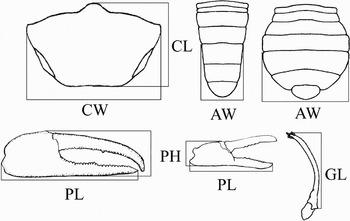
In the laboratory, several morphometric body dimensions were measured under a stereomicroscope with a calibrated ocular micrometer to the nearest 0.01 mm. Measurements included carapace length (CL), carapace width (CW), abdomen width (AW) of the fifth somite, propodus length (PL) and propodus height (PH), for each sex as well as gonopod length (GL) for males (Figure 1). Only crabs in the intermoult stage were used in this study. Crabs with damaged carapace or incomplete chelipeds were not considered in the analysis.
Uca cumulanta, dimensions used in the morphometric analysis. AW, abdomen width; CL, carapace length; CW, carapace width; GL, gonopod length; PH, propodus height; and PL, propodus length.

The software Mature II (Somerton, Reference Somerton1980) was used to determine morphological maturity size of males and females, in order to distinguish juveniles from adult crabs by relative growth analysis.
These analyses were based on biometric data, observing changes in relative growth of some body parts related to others, inferring the inflexion point of critical moult. The biometric data were plotted and the point dispersion for each regression was analysed. The data were adjusted to a power function y = axb (Huxley, Reference Huxley1950), with CL = independent variable (x), whereas the other dimensions were considered as dependent variables (y). The slope ‘b’ of the equation is the allometric constant that expresses the analogy between two variables, and it is then used to determine a growth coefficient for males and females. When b > 1 the growth is allometric positive, when b < 1 the growth is allometric negative and when b = 1 the growth is isometric. The b value was tested by the Student's t-test (H0: b =1; a = 5%). For each relation, a power function was obtained and linearized by a log-transformation (logy = loga + b.logx) for juvenile and adult crabs. To test the equality among slopes and intercepts of straight lines of life stages (juvenile and adult) an analysis of covariance (ANCOVA; a = 5%) was applied (Zar, Reference Zar1996).
Based on Charnov (Reference Charnov1990), the RSOM was defined as the size at the onset of maturity divided by the ‘asymptotic size’. Size at the onset of maturity was defined as the size of the critical puberty moult of females obtained by allometric analyses and ‘asymptotic size’ was defined as the maximum size attained by collected females (Conde & Díaz, Reference Conde and Diáz1992). The obtained value was compared with other populations of species in the genus Uca to examine its phenotypic plasticity, which was defined by Conde & Díaz (Reference Conde and Diáz1989), based on grapsoid crabs.
RESULTS
A total of 600 specimens of Uca cumulanta were collected, with their sizes ranging from 2.95 to 8.06 mm CL (5.54±0.34 mm) for males (N = 319) and from 2.66 to 7.03 mm CL (4.95±0.93 mm), for females (N = 281). There were no ovigerous females in our material. All fiddler crabs were intact enough to be used for data acquisition.
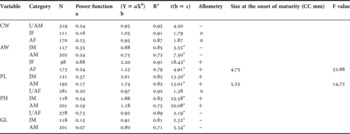
The software Mature II analysis (Somerton, Reference Somerton1980) indicated that males are mature at 5.25 mm of CL while females with CL inferior to 4.75 mm are considered juveniles (Table 1).
Uca cumulanta: results of the regression analysis of the morphometric data, based on the carapace length (CL) as independent variable.

*significant for the Student's t-test (α = 0.05) (H0: b = 1); CW, carapace width; AW, abdomen width; PL, propodus length; PH, propodus height; GL, gonopod length; F, female; M, male; A, adult; J, juvenile; N, number of crabs; R2, determination coefficient; F, statistic value; X, independent variable; Y, dependent variable; a and b, constants; 0, isometry; +, positive allometry; -, negative allometry.
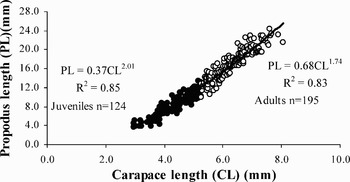
The scatter plot relationships that best evidenced the beginning of the sexual maturity of U. cumulanta were CL vs PL for males and CL vs AW for females (Figures 2&3) because these relationships showed well marked changes in the growth pattern.
Uca cumulanta: dispersion points for the relationship carapace length vs propodus length for males.

Uca cumulanta: dispersion points for the relationship carapace length vs abdomen width for females.

All allometric coefficients referring to the regressions performed for males and females are shown in Table 1.
In the present population, only the relationships CL vs CW (CW = 0.24CL0.95), for males, and CL vs PL (PL = 0.20CL0.97) and CL vs PH (PH = 0.73CL0.92) for females did not present significant differences between demographic categories by means of ANCOVA (P > 0.05) (Table 1).
The growth of U. cumulanta from Patitiba mangroves indicated a negative allometry for the relationships CL vs AW and CL vs GL in juvenile and adult males and a positive allometry for the relationships CL vs PL and CL vs PH in both demographic groups for males.
The negative allometry observed in the relationship CL vs AW for males is substituted by a positive allometry in this relationship for females. Moreover, juvenile and adult females showed an isometric growth pattern for the relationship CL vs CW.
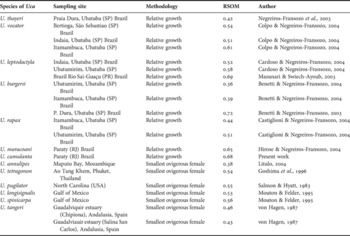
This population presented a RSOM of 0.68 and a comparative table with the values from other Uca populations is shown in Table 2.
The relative size at the onset of maturity (RSOM) of some species of Uca.

DISCUSSION
During the ontogenesis of brachyurans, some sudden or gradual changes occur in the external body parts, mainly in the form of chelipeds, abdomen and pleopodal setae. These changes in the secondary sexual characters are often related to the structural function and reproduction could be one of the critical factors of growth variation (Negreiros-Fransozo et al., Reference Negreiros-Fransozo, Colpo and Costa2003). According to Hartnoll (Reference Hartnoll and Bliss1982), the time of onset of sexual maturity represents a very important biological event that is characterized by a set of morphological and physiological transformations that promote habitat and/or behavioural changes. Such changes are typically associated with transformations of the endocrine system, which are also related to the reproductive maturation process distinguishing juvenile from adult phases (Hartnoll, Reference Hartnoll1969).
The size at onset of sexual maturity is commonly determined using the allometric technique and assists in investigations on species' reproductive aspects (Vaninni & Gherardi, Reference Vaninni and Gherardi1988). The morphological sexual maturity in Uca cumulanta showed a similar pattern compared with those obtained for other ocypodid species, such as U. thayeri and U. leptodactyla, with males attaining greater size of sexual maturity than females (Negreiros-Fransozo et al., Reference Negreiros-Fransozo, Colpo and Costa2003; Cardoso & Negreiros-Fransozo, Reference Benetti and Negreiros-Fransozo2004). This happens because females spend a lot of their energy with reproduction and hence they become smaller than males (Castiglioni & Negreiros-Fransozo, Reference Castiglioni and Negreiros-Fransozo2004).
The CL has been usually considered an independent variable in brachyuran morphometric studies because it shows few morphological changes throughout a crab's life history. However, the relationship between CL and CW is not appropriate to express biological alterations that occur in a crab's life (Santos et al., Reference Santos, Negreiros-Fransozo and Fransozo1995).
In many male brachyurans, the chelipeds become larger immediately after maturity as a secondary sexual character (Hartnoll, Reference Hartnoll and Bliss1982). Uca cumulanta shows this same pattern, having remarkable differences of size and shape between sexes. Males of Uca have one extremely developed, asymmetrical cheliped, while females have two small symmetrical chelipeds and, while females use both chelipeds to carry substratum particles to their mouthparts, males use only the small claw to feed (Castiglioni & Negreiros-Fransozo, Reference Castiglioni and Negreiros-Fransozo2004). The cheliped dimension growth is especially important for males because it promotes advantages during intra and interspecific conflict, agnostic behaviour, territory defence and courtship (Christy & Salmon, Reference Christy and Salmon1984; Castiglioni & Negreiros-Fransozo, Reference Castiglioni and Negreiros-Fransozo2004). Additionally, males may use their chelipeds as tools to hold and manipulate females during copulation (Salmon, Reference Salmon1987). The waving activity of males is an important criterion for mating choice and is primarily directed to receptive females (Latruffe et al., Reference Latruffe, MacGregor and Oliveira1999).
The allometric growth of the abdomen is clearly distinct between males and females, indicating evident sexual dimorphism in brachyurans (Negreiros-Fransozo et al., Reference Negreiros-Fransozo, Colpo and Costa2003). In the present case of U. cumulanta the relationship CL vs AW for females showed a positive allometry, being much more developed than the abdomen of males, which showed negative allometry. The growth of the abdomen, thus, follows the general brachyuran trend in U. cumulanta (Hartnoll, Reference Hartnoll and Bliss1982). In the males, where it only functions as a protective cover for the gonopods, its growth is negatively allometric. In females, in contrast, it produces an incubatory chamber together with the sternum, which holds the eggs and hatchlings. Thus, abdomen width has a highly positive allometry. This was also verified in other ocypodids such as those studied by Fransozo et al. (Reference Fransozo, Negreiros-Fransozo, Bertini, Escobar-Bariones and Alvarez2002), Masunari & Swiech-Ayoub (Reference Masunari and Swiech-Ayoub2003), Negreiros-Fransozo et al. (Reference Negreiros-Fransozo, Colpo and Costa2003), Castiglioni & Negreiros-Fransozo (Reference Castiglioni and Negreiros-Fransozo2004), Cardoso & Negreiros-Fransozo (Reference Cardoso and Negreiros Fransozo2004) and U. cumulanta in the present work.
The positive allometry registered for the relationship CL vs AW can be an advantage as its increase promotes a better and safer incubatory condition for the new generation of crabs (Lewis, Reference Lewis1977).
In some cases, the growth of gonopod length is the best criterion to estimate size at the onset of maturity for males, as the size of this appendage is specifically related to mating (Negreiros-Fransozo & Fransozo, Reference Negreiros-Fransozo and Fransozo2003). However, this dimension is allometrically negative in the species studied in this work and its growth pattern could not estimate the size of morphological sexual maturity.
A single analysis of relative growth cannot be used as the best criterion to define the reproductive onset for some brachyurans, because sometimes the morphological maturity does not occur at the same time as physiological maturity. Thus, micro and macro-analysis of gonads for each sex may further define the point at which the crab is able to copulate and generate descendents (González-Gurriarán & Freire, Reference González-Gurriarán and Freire1994).
Size at the onset of maturity is considered as a key life-history parameter that should reflect also the longevity and life-time investment in reproduction of a species (Anger & Moreira, Reference Anger and Moreira1998). The comparison of the size at the onset of maturity in different species is increased when it is given as a relative number, the RSOM. In the analysed populations of Uca (Table 2), RSOM ranged between 0.36 and 0.72 with a mean of 0.527 (standard error = 0.02267). In the shrimp family Pandalidae, Charnov (Reference Charnov1990) obtained a rather constant RSOM of about 0.55, regardless of the species or latitude, and suggested that this is probably a more applicable number in Crustacea. The values shown in Table 2 indicate a greater interspecific variability than assumed by Charnov (Reference Charnov1990), as was also reported for Palaemonidae shrimps (Anger & Moreira, Reference Anger and Moreira1998) and most of the values are different from the 55%, suggested as a possible biological rule. The differences found here (Table 2) might be related to the plasticity that Uca species have shown. In this way, the restrictions and the differences in the growth have their origin in environmental factors and would not be determined genetically (Conde & Díaz, Reference Conde and Diáz1989). The main variables that can affect growth and, consequently the RSOM, in brachyuran crabs are related to food availability (habitat productivity) and environmental complexity stress (Conde & Diáz, Reference Conde and Diáz1992).
However, the actual RSOM (0.68) might even be different, because the maximum size reported is only an approximation of the theoretical maximum (Charnov, Reference Charnov1990), and the possible size at onset of sexual maturity found here can be different. The studies about size of sexual maturity can be made with different methodologies to determine this parameter, such as gonadal analyses and the smallest ovigerous female in the population. Once some species of the genus Uca had the cryptic behaviour when the females were incubating eggs (Goshima et al., Reference Goshima, Koga and Murai1996), it became harder to obtain ovigerous females and, consequently, the determination of the sexual maturity by this methodology (size of the smallest ovigerous female) became more difficult. In this way, the different methodologies of obtaining the size at onset of sexual maturity can directly influence the RSOM value.
The construction of a marine pier for tourist boats substantially modified the environment of the Patitiba mangrove, transferring a large quantity of sediment from one area to another. Further studies on the ecology and biology of crabs and other biological representatives that inhabit what remains of the Patitiba mangroves will be extremely important to determine the construction's impact on the fauna and to define mitigating actions for the region.
ACKNOWLEDGEMENT
We thank FAPESP for the financial support to NEBECC Laboratories.