Introduction
One of the main issues in producing agricultural and garden crops is a lack of ability to forecast production/yield using accessible and easily measured indicators. For instance, the estimation of crop yield using the concentration of nutrients in the leaf, fruit, or soil is a matter of concern. In this regard, a variety of methods have been introduced to estimate and predict the various natural variables such as winter oilseed growth and yield of sugarcane (Bartoszek, Reference Bartoszek2014; Domínguez et al., Reference Domínguez, Kumhálová and Novák2015; Dias and Sentelhas, Reference Dias and Sentelhas2017). In this context, different regression methods have been widely used to derive transitional functions (Sepaskhah et al., Reference Sepaskhah, Moosavi and Boersma2000; Marashi et al., Reference Marashi, Mohammadi Torkashvand, Ahmadi and Esfandyari2017, Reference Marashi, Mohammadi Torkashvand, Ahmadi and Esfandyari2019), which can be handled by artificial neural networks (ANN) using existing software such as Neurosolution software. Neural networks, like the human nervous system, are smart modelling techniques that can learn to analyse information and make generalizations (Francis, Reference Francis1989). One advantage of ANN transitional functions over common regression methods is that there is no need for a primary regression model to connect the input and output data (Kumar et al., Reference Kumar, Raju and Sathish2004; Mermoud and Xu, Reference Mermoud and Xu2006; Dai et al., Reference Dai, Zhou, Lv, Wang and Liu2014; Eslami et al., Reference Eslami, Shadfar, Mohammadi Torkashvand and Pazira2019).
An ANN is a set of computational elements, connected in a similar way to biological neurons (Hertz et al., Reference Hertz, Palmer Richard and Krogh1991; Saffari et al., Reference Saffari, Yasrebi, Sarikhani, Gazni, Moazallahi, Fathi and Emadi2009), that can be used in the discovery of intrinsic connections between available data regarding the issue without any previous background (Farkas et al., Reference Farkas, Reményi and Biró2000). In addition, no physical correlation between converting inputs to outputs are needed, which is an important advantage of ANN application in modelling: the only required elements for this system are a set of input-output pairs (Hertz et al., Reference Hertz, Palmer Richard and Krogh1991; Nayak et al., Reference Nayak, Sudheer, Rangan and Ramasastri2004).
An important factor in waste reduction, further improvements in quantitative and qualitative performance, and extension of the storage life of harvested garden products is the sufficient and balanced supply of nutrients to plants (Hargreaves et al., Reference Hargreaves, Adl and Warman2008; Ashoorzadeh et al., Reference Ashoorzadeh, Torkashvand and Khomami2016). In this regard, it is important to improve methods to determine nutrient levels in fruit trees such as kiwifruit (Clark and Smith, Reference Clark and Smith1988; Ferguson et al., Reference Ferguson, Thorp, Brnett, Boyd and Triggs2003; Golmohammadi et al., Reference Golmohammadi, Rashtari and Pile Froush2011).
Nutrient imbalances cause disorders and consequently affect yield (Maynard, Reference Maynard1979; Fageria, Reference Fageria2001; Gee et al., Reference Gee, Zhu, Peng, Chen and Jiang2018). Investigation of the specific level of each nutrient satisfies that the plant's demand has attracted consideration (Halavatau et al., Reference Halavatau, O'Sullivan, Asher and Blamey1998; Dar et al., Reference Dar, Wani, Raina, Bhat and Malik2015). Excessive application of chemical fertilizers has resulted in imbalances of nutrients (Malakouti et al., Reference Malakouti, MC Karimian and Keshavarz2008; Mohiti et al., Reference Mohiti, Ardalan, Mohammadi Torkashvand and Shokri Vahed2011; Hushmandan Moghaddam Fard and Shams, Reference Hushmandan Moghaddam Fard and Shams2016; Mohammadi Torkashvand et al., Reference Mohammadi Torkashvand, Rahpeik, Hashemabadi and Sajjadi2016; Amerian et al., Reference Amerian, Ali-Mohamadian and Malekhosini2018), besides disruption in the biochemical and biological properties of soil (Halavatau et al., Reference Halavatau, O'Sullivan, Asher and Blamey1998; Amerian et al., Reference Amerian, Ali-Mohamadian and Malekhosini2018).
Kiwi (Actinidia deliciosa, belonging to the family Actinidiacea) is a flowering plant phylum Magnoliophyta. Only two species of Actinidia are economically and commercially important; A. deliciosa and A. chinensis, with the latter grown widely in China. The fruits of the two species are delicious with appetizing aroma and are rich in vitamin C (Khazaee Poul, Reference Khazaee Poul2003). The number of kiwifruits produced globally was estimated at about 4 million tons in 2017, with 87% of this amount produced by five countries: China, Italy, New Zealand, Iran and Chile (UN Food and Agriculture Organization, Corporate Statistical Database (FAOSTAT)).
In plants, metabolism is mainly carried out in the leaves (Barker and Pilbeam, Reference Barker and Pilbeam2007; Lahiji et al., Reference Lahiji, Torkashvand, Mehnatkesh and Navidi2018), producing photosynthates that are then transported to other parts of the plant. Therefore, nutrient concentrations in the leaf are related to different qualitative attributes and yield of fruit crops, as they play an important role in structural components, cellular maintenance, energy transformer, and enzyme activity (Dar et al., Reference Dar, Wani, Raina, Bhat and Malik2015). Growth and fruit yield are affected by several factors, of which the most important is nutrition (Ferguson et al., Reference Ferguson, Thorp, Brnett, Boyd and Triggs2003; Gee et al., Reference Gee, Zhu, Peng, Chen and Jiang2018). In this regard, variations in nutrient availability are reflected in the leaf mineral composition. The quality and quantity of fruit produced are strongly related to available nutrients in leaves and their balance (Huang and Ferguson, Reference Huang and Ferguson2003; Lahiji et al., Reference Lahiji, Torkashvand, Mehnatkesh and Navidi2018). Today, fertilizer recommendation is based on soil and leaf tests (Fageria et al., Reference Fageria, Barbosa Filho, Moreira and Guimarães2009; Paulo and Furlani, Reference Paulo and Furlani2010): most researchers believe that tissue analysis is a good guide to assess the nutritional requirement of perennial fruit trees (Sauz et al., Reference Sauz, Heras and Montañés1992; Dar et al., Reference Dar, Wani, Raina, Bhat and Malik2015). Plant analysis one of the most useful available tools available to assess the nutritional status of agricultural products (Fageria, Reference Fageria2001; Zaremehrjardi et al., Reference Zaremehrjardi, Okhovatian Ardakani and Dehghani2019). Recent advances in the nutrition of fruit products have proven that leaf analysis is a great tool for identifying the nutritional status of plants (Nascente et al., Reference Nascente, Carvalho and Rosa2016); Bhargava and Chadha (Reference Bhargava, Chadha, Chadha and Pareek1993) proposed that plant leaves are the best option for determining plant nutrient status (Dar et al., Reference Dar, Wani, Raina, Bhat and Malik2015).
Plant grain and fruit yield depend on the concentration of nutrients in leaves during the various growth stages (Dumenil, Reference Dumenil1961; Nachtigall and Dechen, Reference Nachtigall and Dechen2006; Barker and Pilbeam, Reference Barker and Pilbeam2007; Honarkarian and Mohammadi Torkashvand, Reference Honarkarian and Mohammadi Torkashvand2018; Lahiji et al., Reference Lahiji, Torkashvand, Mehnatkesh and Navidi2018). Studies have shown that nutrient deficiency, determined via decreasing concentration in leaves, reduced plant yield, and fruit (Sauz et al., Reference Sauz, Heras and Montañés1992; Ivanyi, Reference Ivanyi2011). Awasthi et al. (Reference Awasthi, Bhutani, Sharma and Kaith1998) found a direct correlation between leaf nutrients and the yield and quality of apples, while Lahiji et al. (Reference Lahiji, Torkashvand, Mehnatkesh and Navidi2018) reported a significant correlation between leaf nutrient concentrations and olive yield.
The chemical composition of kiwifruit depends on several factors such as genotype, pre-harvest weather conditions, fruit maturity at harvest time and storage conditions (Lee et al., Reference Lee, Kim, Kang, Ko, Kim and Han2001). Considering plant nutrition, the availability and balance between nutrients are important (Mohammadi Torkashvand et al., Reference Mohammadi Torkashvand, Rahpeik, Hashemabadi and Sajjadi2016). For instance, nitrogen (N) deficiency leads to a reduction in fruit size and zinc (Zn) deficiency increases fruit falling. The ratio of nitrogen to calcium (N/Ca) and potassium to calcium (K/Ca) are among the most important factors in fruit quality (Mengel and Kirkby, Reference Mengel and Kirkby2001). Calcium can cause a delay in ageing, preserves quality and firmness of fruits, and improves resistance to disease during storage (Chardonnet et al., Reference Chardonnet, Charron, Sams and Conway2003; Hernandez-Munoz et al., Reference Hernandez-Munoz, Almenar, Ocio and Gavara2006).
Numerous studies have been carried out to estimate soil variables through ANNs (Zhou et al., Reference Zhou, Shi, Luo and Shao2008; Bocco et al., Reference Bocco, Willington and Arias2010; Gago et al., Reference Gago, Martínez-Núñez, Landín and Gallego2010; Parvizi et al., Reference Parvizi, Gorji, Omid, Mahdian and Amini2010; Peng et al., Reference Peng, Zhang, Pang and Wang2010; Ayoubi et al., Reference Ayoubi, Shahri, Karchegani, Sahrawat and Atazadeh2011; Mokhtari Karchegani et al., Reference Mokhtari Karchegani, Ayoubi, Honarju and Jalalian2011; Besalatpour et al., Reference Besalatpour, Ayoubi, Hajabbasi, Mosaddeghi and Schulin2013; Dai et al., Reference Dai, Zhou, Lv, Wang and Liu2014; Aitkenhead et al., Reference Aitkenhead, Donnelly, Sutherland, Miller, Coull and Black2015). Also, some studies have been conducted to predict crop yield by remote sensing, stochastic, ANN and simulation models (Bannayan and Crout, Reference Bannayan and Crout1999; O'Neal et al., Reference O'Neal, Engel, Ess and Frankenberger2002; Bartoszek, Reference Bartoszek2014; Farjam et al., Reference Farjam, Omid, Akram and Fazel Niari2014; Domínguez et al., Reference Domínguez, Kumhálová and Novák2015; Emamgholizadeh et al., Reference Emamgholizadeh, Parsaeian and Baradaran2015; Dias and Sentelhas, Reference Dias and Sentelhas2017), based on weather, soil and growth characteristics as input data.
Kiwi harvesting in northern Iran starts mainly in November, so estimating the yield of this product 2–3 months before harvesting can allow the farmer to forecast income and managers to plan fruit marketing, exports and storage. However, according to our knowledge, there have been no studies to estimate orchard fruit yields with regard to the chemical properties of leaf or fruit that have not been found. The goal of the current study was to predict fruit yield in kiwifruit via a new ANN modelling approach, using measurements of the concentrations of four nutrients in the leaves during the growing season.
Materials and methods
Location and time of the experiment
The experiments were conducted by collecting data from 31 kiwifruit orchards (6–7 years old) in Rudsar area, Guilan Province, north of Iran, in August 2017, in order to estimate the yield of kiwifruit ‘Hayward’ using nutrient concentrations and ratios. Kiwifruit grows well in Guilan Province due to deep, fertile and well-drained soil with a suitable pH (Mohammadian and Eshaghi Teymoori, Reference Mohammadian and Eshaghi Teymoori1999). In these orchards, 101 plots (each with three trees) were selected randomly for analysis. The selected trees were similar regarding age, growing conditions, soil type, shade and management practices including the amount of water, fertilization and other farming conditions. The complete leaves of branches with fruit were harvested and analysed for N, K, Ca and Mg concentrations (Emami, Reference Emami1996). Finally, the fruit yield of each tree and the fresh and dry weights of fruit were measured after harvesting the fruit.
The fruits were harvested in mid-November when their sugar content was approximately 7–8 °Brix. All the fruit samples from each tree were picked and packed into separate baskets before weighing, then transferred to the laboratory within 24 h to evaluate indices such as the fresh and dry weight of the fruits.
Experiments using leaf and kiwifruit
The samples were collected from healthy leaves in the middle of branches at average height. Six or seven leaves of each tree were harvested, chopped, and dried in an oven at 75°C for 48 h. The acid mixture for nutrient measurement was prepared by adding 6 g salicylic acid to 25 ml distilled water, then adding 100 ml concentrated sulphuric acid. A sub-sample of the dried leaves (0.3 g) was transferred to a 50 ml volumetric flask: 3 ml of the above acid mixture and five drops of hydrogen peroxide were added to the volumetric flasks, and the mixture heated to 180°C for 1 h. This step (adding hydrogen peroxide and heating) was repeated as many times as required to produce a clear extract to prepare the fruit clear extract (Goos, Reference Goos1995). Total N in the extract was measured using the titration method after distillation by Kjeldahl distillation apparatus (model 23130-20, company Hach, USA), K was measured using a Jenway flame photometer (model PFP7, Stone, UK), at a wavelength of 766.5 nm (Goos, Reference Goos1995), and Ca and Mg were measured using a flame atomic absorption spectroscopy instrument (PINAACLE 900H, Perkin Elmer, Waltham, MA, USA) (Emami, Reference Emami1996).
Development and evaluation of artificial neural networks models
After collecting data and before using them for training, two other stages should be considered; the pre-processing of the data and dividing the input data into sub-sets. If the pre-processing operation is performed on input and output data, the neural networks can be used more effectively. In the current study, 70% of the data (training-dataset1) were randomly used for training, 15% (training-dataset2) for validation of models and the remaining 15% (test-dataset) were used for testing of the models. In this context, the test-dataset was introduced to ANN models to assess their reliability; the models' responses were calculated, and R2 between actual (observed values) and estimated values were determined.
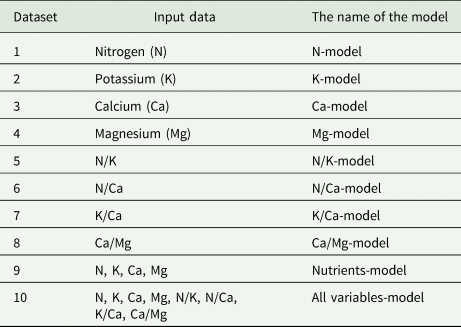
As demonstrated in Table 1, different variables were included as input variables in ANN models. The models were designed based on previous studies in the kiwifruit orchards of Rudsar, Guilan Province, Iran (Khoshnood and Mohammadi Torkashvand, Reference Khoshnood and Mohammadi Torkashvand2016; Mohammadi Torkashvand et al., Reference Mohammadi Torkashvand, Rahpeik, Hashemabadi and Sajjadi2016; Honarkarian and Mohammadi Torkashvand, Reference Honarkarian and Mohammadi Torkashvand2018). Khoshnood and Mohammadi Torkashvand (Reference Khoshnood and Mohammadi Torkashvand2016) reported that significant correlation coefficients (r) between N, K, Ca, Mg and N/Ca ratio in leaf and yield of kiwi were 0.386, 0.270, 0.235, 0.215 and 0.355, respectively. Therefore, a set of these nutrients and their ratios (N, K, Ca, Mg, N/K, N/Ca, K/Ca, and Ca/Mg) was considered in the current paper (Khoshnood and Mohammadi Torkashvand, Reference Khoshnood and Mohammadi Torkashvand2016).
Different data sets used as input data in modelling by artificial neural network (ANN)

For training ANN models a multi-layer perceptron combined with the Levenberg–Marquardt back-propagation training algorithm, and a sigmoid function as a transition function were used, and models were designed by Neuro Solutions 5.05 software (Florida, USA, http://www.neurosolutions.com/).
In back-propagation training, the input data are multiplied by the weight, and the bias is added and accumulated, then the resulting value, which is the input of the nerve, is entered into the transfer function. Then, the output neuron was calculated by transfer functions and enters the output layer. The same procedure is performed on this layer, the output of the transfer function, which is linear, is compared to the expected value and the error value is calculated. If this error value is greater than the specified value, the weights and bias values are corrected by the back-propagation algorithm, and this process is repeated so that the error value is less than the specified value. The coefficient of determination or R squared (R2), the geometric mean of error ratio (GMER), and root mean square error (RMSE) was used to evaluate the ANN model:


where Xk is the measured value, Yk is the estimated value, $\bar{X}$ is the mean of measured values, $\bar{Y}$
 is the mean of estimated values, and n is the total number of observations.
Results
The efficiency of the model
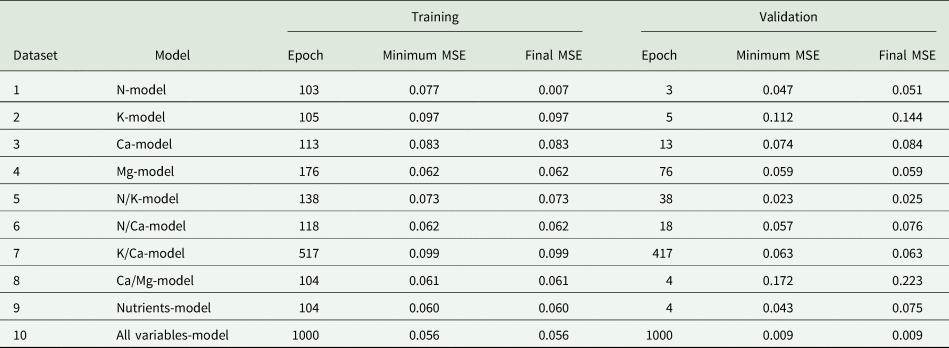
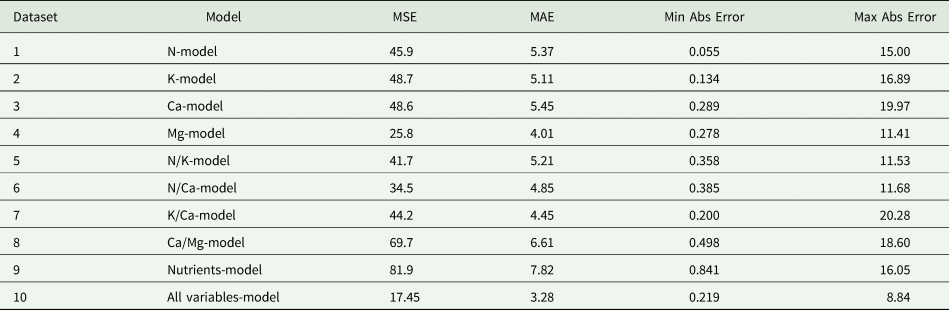
The parameters of the ANN are given in Tables 2 and 3, representing the efficiency and network error in predicting the yield of kiwi for the training and validation data sets. The model including all variables (four nutrients and their ratios) showed a sharp increase in Epoch and the smallest final error in the validation phase. The lowest mean square error (MSE) and the mean absolute magnitude error (MAE) was found in the all-variable model.
Parameters related to the neural network used to predict the yield of kiwi in ten data sets used in the network training and validation process

MSE, mean square error; N, nitrogen; K, potassium; Ca, calcium; Mg, magnesium.
Model efficiency and artificial neural network error in estimating kiwi yield

MSE, mean square error; MAE, absolute magnitude error; N, nitrogen; K, potassium; Ca, calcium; Mg, magnesium.
Correlation between measured and predicted yield in the test data sets
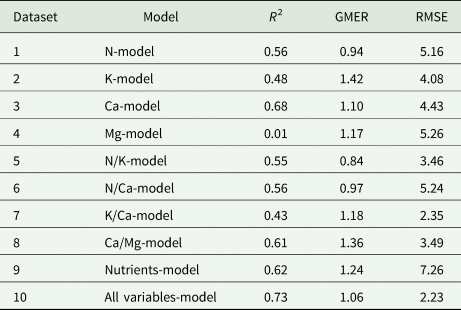
The accuracy and error of the model with different data sets in estimating kiwi yield are shown in Table 4. When nitrogen was the input variable (N-model), the coefficient of determination was recorded as 0.56. However, this coefficient cannot be accurate and feasible to estimate kiwi yield at harvest time, since 0.44 of the variation has not been predicted.
Values of R 2, GMER and RMSE of test data in different datasets in artificial neural network model

R 2, determination coefficient; GMER, geometric mean of error ratio; RMSE, root mean square error; N, nitrogen; K, potassium; Ca, calcium; Mg, magnesium.
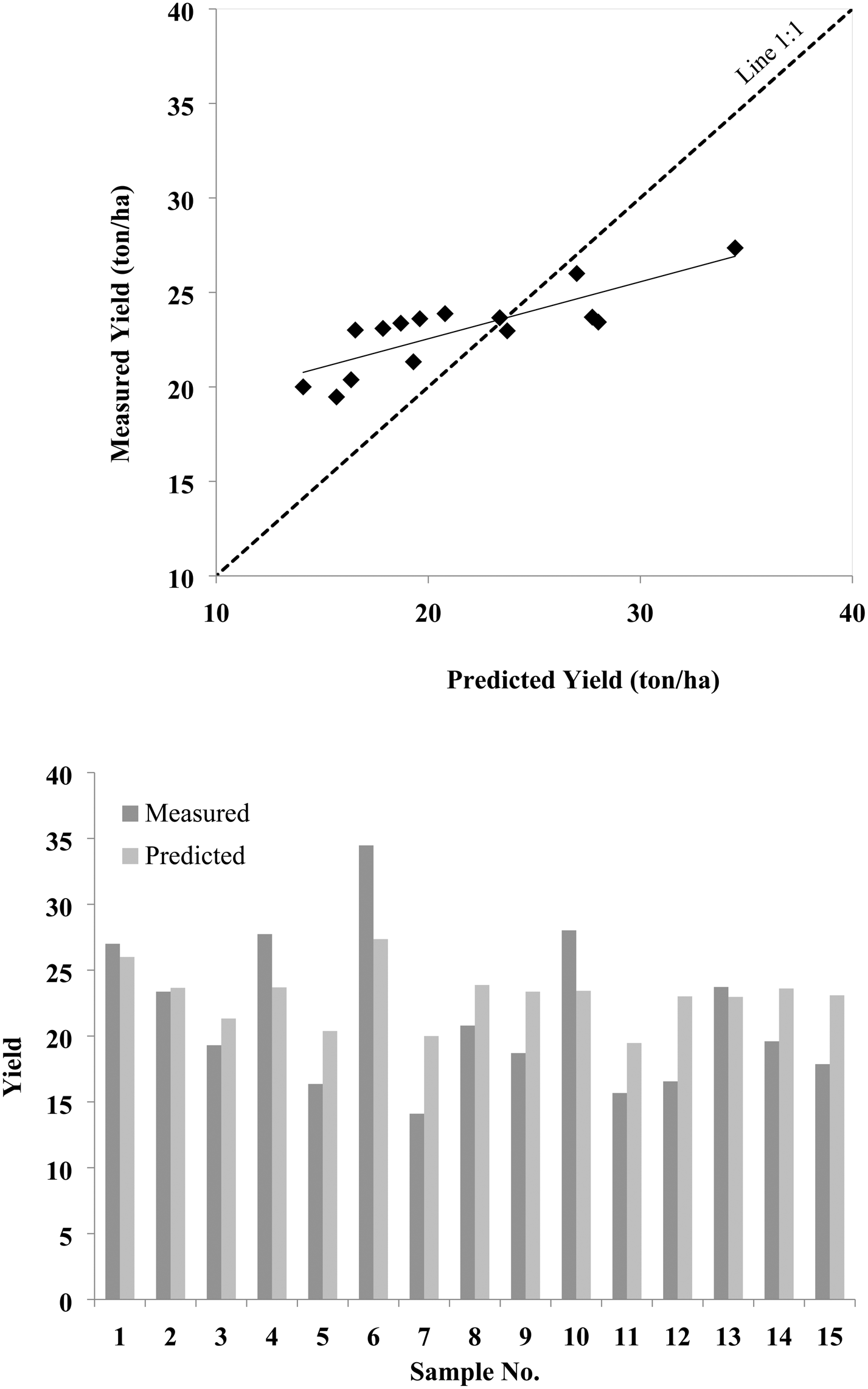
In the neural network constructed with potassium concentration as an input variable (K-model), R2 of the model was 0.48, a reduction of 0.0855 in comparison to the N-model (Table 4 and Fig. 1). Figure 1 presents the correlation between the measured and predicted factors in Ca-model.
Correlation and relation between measured and predicted yield in Ca-model.

According to Table 4, in the sets of data for the four nutrients, the highest R2 besides the RMSE and GMER were related to the Ca-model followed by the N-model, and also the RMSE of Ca-model (4.43) was less than N-model (5.16).
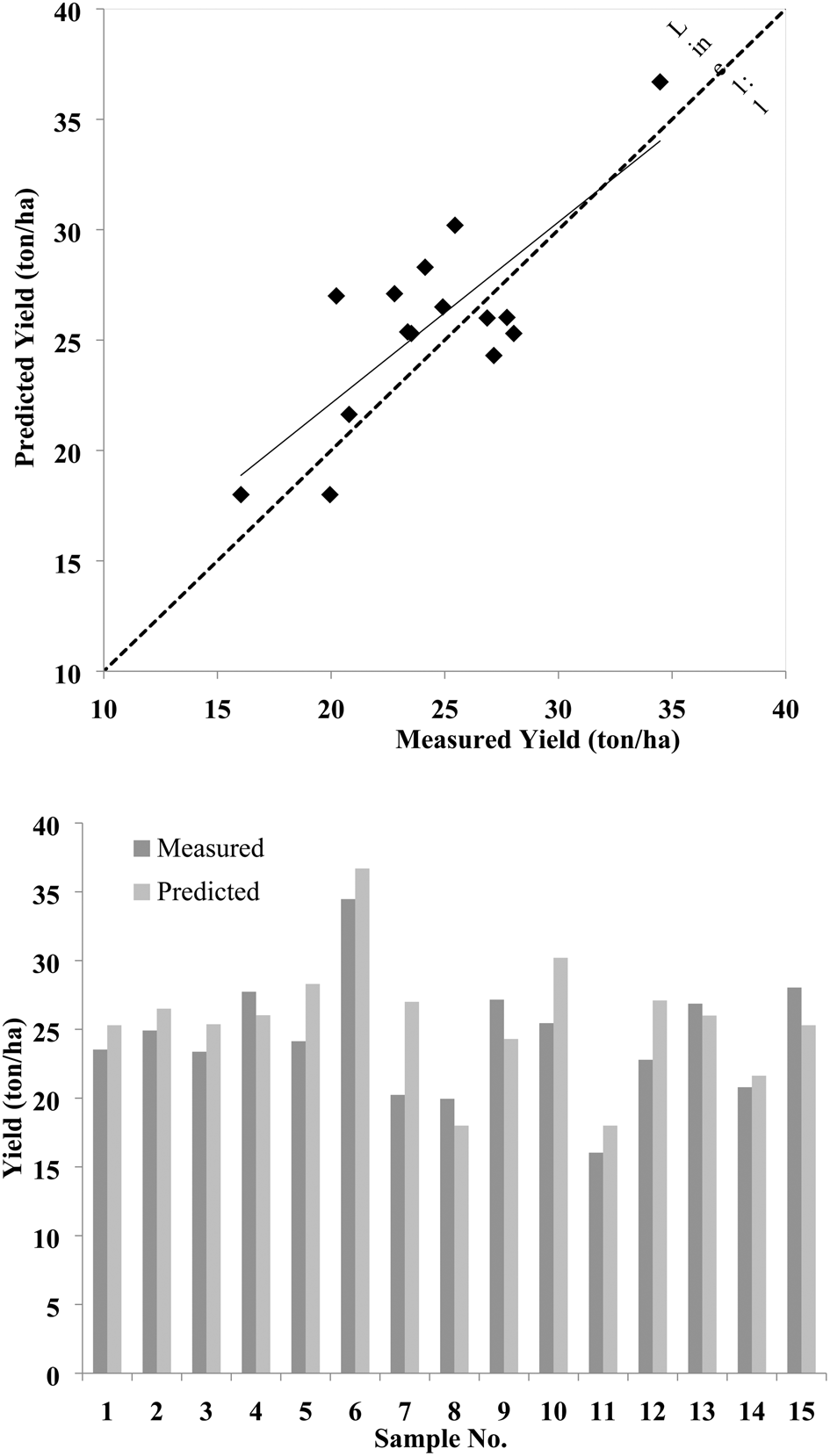
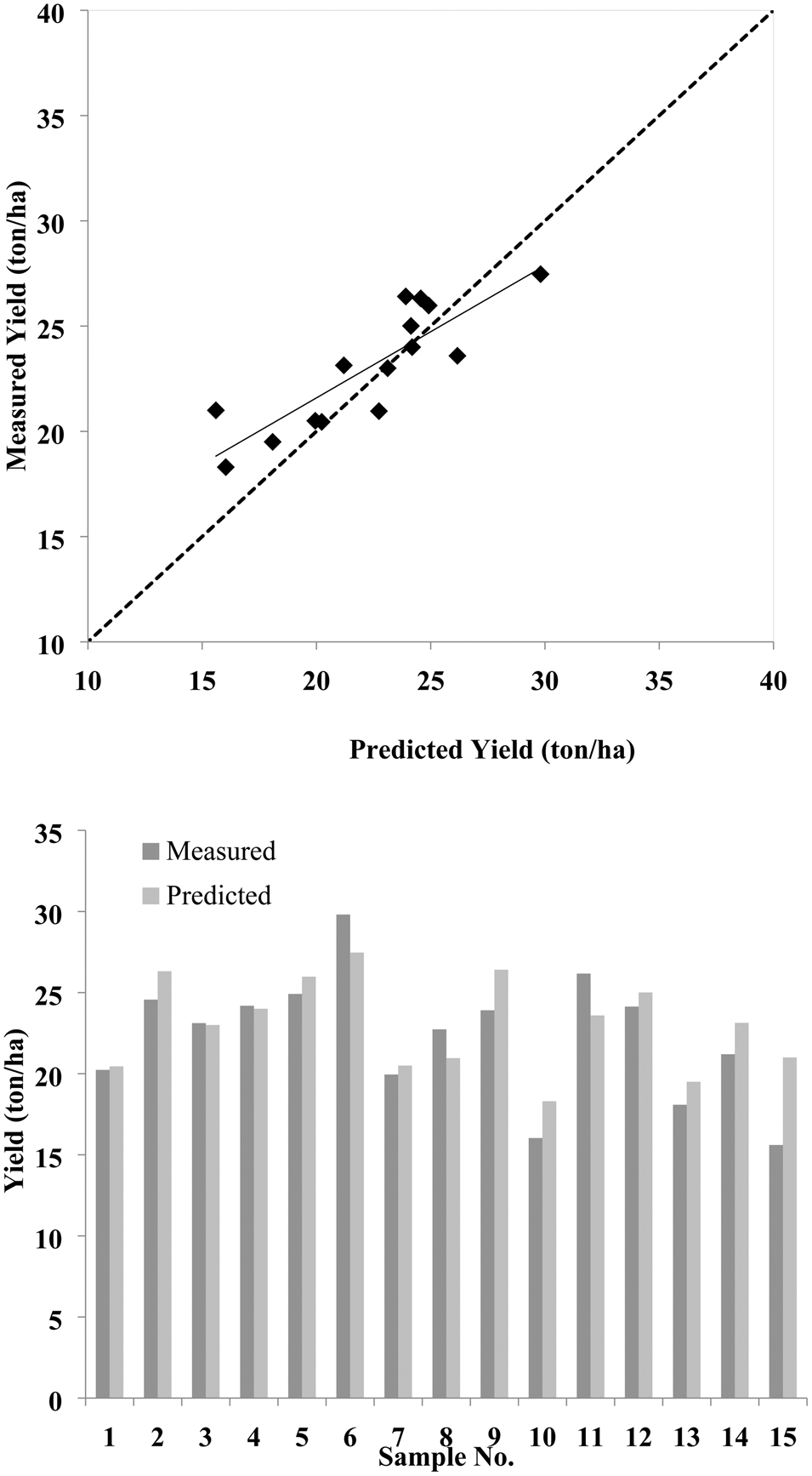
The models in which nutrient ratios alone (N/K, N/Ca, K/Ca, Ca/Mg) constitute the input variable had lower R2 than the models using Ca alone or all variables (Ca-model and All variables model), while in the N/Ca-model and Ca/Mg-model R2 was calculated as 0.56 and 0.61, respectively. The lowest and the highest RMSE was related to K/Ca model and Nutrients-model. When all four nutrients were used as input data (nutrients-model), the R 2 of the model was 0.62; the correlation of the measured and predicted yield is shown in Fig. 2. However, when calcium alone was the input variable, R 2 = 0.68 was greater than that of the nutrients-model. The greatest R 2 (0.73) and the smallest error (RMSE = 2.23 kg) were observed in all variables-model: the relationship between measured and estimated data is shown in Fig. 3. The GMER showed that the conformity between measured and estimated yield in the all-variables-model was greater than in the other models. The models of N/K, K/Ca, and Ca/Mg had less RMSE than in the Ca-model, but their R 2 was also lower than Ca-model. GMER of Ca-model was closer to the unit (1) indicating greater conformity of the estimated values to the measured (actual) values.
Correlation and relation between measured and predicted yield in Nutrients-model.

Correlation and relation between measured and predicted yield in all variables-model.

Discussion
Predictive models of yield usually use empirical-based data (Vandendriessche, Reference Vandendriessche2000; Domínguez et al., Reference Domínguez, Kumhálová and Novák2015) which makes it difficult to build models for predicting yield before harvesting (Niedbała, Reference Niedbała2019). Forecasting models of plant yield are prognostic tools that can be an important element in precision agriculture (Shearer et al., Reference Shearer, Burks, Fulton and Higgins2000; Dias and Sentelhas, Reference Dias and Sentelhas2017; Mohammadi Torkashvand et al., Reference Mohammadi Torkashvand, Ahmadi and Nikravesh2017) and the principal factor in decision-making systems (Park et al., Reference Park, Hwang and Vlek2005). Artificial neural network models have been used previously to estimate yield in other plants, e.g. for sesame seeds (Emamgholizadeh et al., Reference Emamgholizadeh, Parsaeian and Baradaran2015) and maize (O'Neal et al., Reference O'Neal, Engel, Ess and Frankenberger2002; Farjam et al., Reference Farjam, Omid, Akram and Fazel Niari2014). In the studies mentioned above, the emphasis of models is on weather, soil, and growth characteristics and the studies have mostly ignored plant nutritional indices.
Kiwifruit, as with any other plant, can be influenced by many factors, particularly soil fertilization and plant nutrition (Mohammadi Torkashvand et al., Reference Mohammadi Torkashvand, Rahpeik, Hashemabadi and Sajjadi2016). It is, therefore, beneficial to identify what parameters are most important for the aspect you wish to study, such as fruit/grain yield. For instance, Niedbała (Reference Niedbała2019) used fertilization data for the development of an ANN model to predict the yield of winter rapeseed and reported plant nutrient status as the most important parameter in predicting yield. Therefore, the quality and quantity of yield are connected to nutrient levels and balance in leaves, as found for olives by Lahiji et al. (Reference Lahiji, Torkashvand, Mehnatkesh and Navidi2018).
Between four nutrients (N, K, Ca and Mg), two models fitted by nitrogen and calcium had a greater R 2 and conformity (GMER closer to the unit). With regards to models, a higher relationship between Ca of leaves and yield was observed. The R 2 and RMSE values of the Mg-model were 0.01 and 5.26, respectively; but its ratio with Ca caused to increase R 2 to 0.61 and decrease RMSE to 3.49.
Nutrients affect the quantity and quality of fruits equally (Barker and Pilbeam, Reference Barker and Pilbeam2007). In this regard, nitrogen, zinc and calcium are among the most effective factors in fruit formation (Sharma, Reference Sharma2002). Without the existence of N, the protein will not be produced. Nitrogen is used to make various plant tissues such as wood, leaves, roots, stems, buds and, finally, flowers and fruits (Sharples, Reference Sharples, Atkinson, Jackson, Sharples and Walter1980). In this regard, the incorporation of N in the soil may affect some other elements, including Ca content of the kiwi plant. Hence, increasing the amount of N inside the plant can reduce the quality of kiwi fruit (Crisosto and Kader, Reference Crisosto and Kader1999). Calcium also plays a crucial role in pollination and fruit formation (De Freitas and Mitcham, Reference De Freitas, Mitcham and Janick2012). The existence of a large amount of Ca ions allows proper movement of the pollen tube from style cells to seeding cells. The growth of the pollen tube in the style is performed along the calcium gradient (Holdaway-Clarke et al., Reference Holdaway-Clarke, Weddle, Kim, Robi, Parris, Kunkel and Hepler2003).
The particular impact of K (Pacheco et al., Reference Pacheco, Calouro, Vieira, Santos, Neves, Curado, Franco, Rodrigues and Antunes2008) and Mg (Ashouri Vajari et al., Reference Ashouri Vajari, Ghasemnezhad, Sabouri and Ebrahimi2015) on the kiwifruit yield and firmness have been confirmed. Egilla et al. (Reference Egilla, Davies and Boutton2005) believed that increasing K causes an increased photosynthesis; conversely, photosynthesis, yield and dry matter decrease with decreasing K. Deficiency or toxicity of Mg causes a decrease in yield and fruit quality (Carvajal et al., Reference Carvajal, Martinez and Cerda1999). Of course, K and Mg alone could not promote model precision while compared with N and Ca alone. The precision of models of K and Mg was lower than models of N and Ca.
The ANN technique has been used in the estimation of different characteristics of fruit and given satisfactory results (Chia et al., Reference Chia, Abdul Rahim and Abdul Rahim2012). Prasad et al. (Reference Prasad, Prakash, Mehrotra, Khan, Mathur and Mathur2017) proposed a model based on the neural network to predict maximum biomass yield Centella asiatica using some nutrients as input data.
Concerning the greater R 2 found in the Ca-model of the current study than in the N, K and Mg-models, it indicates a further relationship between Ca concentration in leaves and fruit yield. According to Honarkarian and Mohammadi Torkashvand (Reference Honarkarian and Mohammadi Torkashvand2018), Ca foliar spray increased dry matter and kiwi yield in Guilan. Although N is a key element in plant growth and production, and Ca is more effective on the resistance and quality of the product, the present study shows that the role of Ca in estimating kiwi yield is greater than that of N, K and Mg. Foliar spray of Ca in 2–8 times by kiwifruit growers is a conventional operation that can be a reason in closer relation between yield and Ca of leaves in the harvesting stage. The same relationship between N and Ca of kiwifruit and fruit firmness was reported by Mohammadi Torkashvand et al. (Reference Mohammadi Torkashvand, Ahmadi and Nikravesh2017). They tested and compared the performance of ANN and multiple linear regressions (MLR) in predicting 6-month fruit firmness of kiwifruit with different input datasets. They demonstrated that the optimum condition was obtained using ANN with an RMSE of 0.539 and a correlation coefficient of 0.85 (R 2 = 0.72) when the N/Ca ratio was considered as the input data. Prediction of 6-month fruit firmness using P1 (nutrient concentrations alone) and P3 (nutrient concentration ratios alone) data sets resulted in the lowest R-value by ANN and MLR, respectively (Mohammadi Torkashvand et al., Reference Mohammadi Torkashvand, Ahmadi and Nikravesh2017).
It should be noted that considering the ratio of Ca to Mg or all the nutrients increased the accuracy of the model prediction in the current study compared with the N variable. The maximum R2 of the model (0.73) and the least MRSE (2.23 kg) are related to the all variables-model.
Conclusion
The results of the current study showed that ANN models using N, K and Mg concentration variables could predict kiwi yield. The Ca-model was more accurate and responsive in compared with N, K and Mg models Although consideration of all nutrients and their ratios increased model accuracy and precision in each index of R2, GMER and RMSE, by measuring the concentration of Ca in the leaves alone, kiwi yield at harvest time can be predicted with a probability of 0.68; GMER and RMSE of 1.10 and 4.43. Evaluation of multivariate regression and neuro-fuzzy methods for prediction of kiwi yield and comparison with the neural network model is recommended.
Acknowledgements
The authors thank Islamic Azad University Rasht Branch, for supplying kiwifruit leaf sampling and laboratory facilities
Financial support
None
Conflict of interest
The authors declare no conflict of interest.
Ethical standards
Not applicable.