




Introduction
The government’s electoral struggles were not done by 2025. While they gained support at first, due to the Greenland crisis, over the year, both the Social Democrats and Moderates further lost support, while the Liberals regained some. Elections were to be held no later than November 2026 but with this standing, the PM did not call for an early election. Rather, the government has spent the time getting more of their government program finished, on top of the Greenland crisis and necessary defense and security action.
Election report
Elections to the municipal councils, that is, local elections, are held every fourth year on the third Tuesday in November, with offices taken up on the following 1 January. Traditionally, the largest and dominating parties have been the Social Democrats, Liberals, and Conservatives, the three of which acquired 2/3 of the votes in 2021. In 2025, they all took a dip of around 15–18%, while most of the other parties gained support, showing a clear trend toward greater fragmentation of the municipal party systems.
The municipal elections hurt the Social Democrats to a much larger extent than the Liberals, because the latter were able to increase their number of mayors from 34 to 42, while the Social Democrats lost heavily and declined from 44 to 26 mayor offices (Altinget 2026). The major parties lost mayoralties to the Conservatives, whose total grew from 14 to 20, the Green Left, from 2 to 5, and the Liberal Alliance from 1 to 2. In sum, the municipal elections, like the EP elections in 2024, displayed an increase in the fragmentation of the Danish party system both among the rank-and-file elected municipal council representatives and the mayors. Turnout at the municipal elections was 69.2%, which is a slight increase from 2021 (67.2%) but otherwise part of a decreasing longer-term trend (Danmarks Statistik 2026).
A special note should be made about the capital, Copenhagen’s municipality. In 2024, the Mayor of Copenhagen, Social Democrat Sophie Hæstorp Andersen (female, 1974), took over as Minister for Social Affairs and Housing from Pernille Rosenkrantz-Theil. There was an interim Social Democratic Mayor (Lars Weiss), while Rosenkrantz-Theil focused on running the campaign to become Mayor. She did not succeed. Frederiksen and the Social Democrats had believed that she, as a Copenhagen resident and former Red-Green Alliance MP and member, had a chance to keep the Social Democrats in the Mayor’s office. But the Social Democrats lost a drastic quarter of their votes compared to 2021. The two left-wing parties Red-Green Alliance and Green Left, who got almost 40% of the votes, chose to collaborate with all the other parties, leaving the Social Democrats outside the negotiations on policies and offices in the municipality. The mayoral chain of Copenhagen ended up in the hands of a new Mayor, Sisse Marie Welling of the Green Left party.
Elections to the regional councils are held at the same time as the municipal elections, that is, voters bring two ballots into the voting booth. The main task of the regions is to manage the Danish healthcare system. They also handle some social tasks as well as regional development. Until 2007, the regional level consisted of 14 municipalities, but as the 271 municipalities were reduced to 98, the number of regions was reduced to five. Prior to the 2025 election, the regions of Copenhagen and Zealand were combined into one large region. At the regional elections, a total of 134 members were elected (25 in the Northern Jutland, 31 in both mid-Jutland and Southern Denmark, and 47 in the Region East of Copenhagen, Zealand etc.).
The results, to a large extent, mirror those at the municipal level. The Social Democrats, Liberals, and Conservatives all lost compared to 2021 and ended at, respectively, 22.5%, 17.5%, and 10.7%. The Green Left increased their support (10.7%). The Danish Peoples’ Party doubled their support, in part due to the party founder Pia Kjærsgaard’s candidacy in the Region East (8.9%). Red-Green Alliance and Social Liberals kept their support (7.2% and 6.4%). The Liberal Alliance jumped the highest, increasing around four times to 5.9%. The Liberals acquired three chairpersonships, while the Social Democrats kept the fourth.
Cabinet report
The uncommon, or ‘strange’ (as the PM herself called it in her New Year speech, 1 January 2026 (Frederiksen Reference Frederiksen2026)), Danish government spans the traditional center-left and center-right blocs. The Social Democratic-led majority coalition government was formed in December 2022. The ‘strange’ character is that it is formed with the Social Democrats’ traditional main counterpart, the Liberals. The third party in the government is the Moderates, which is a new party formed in 2022 by the former Liberal chair and PM Lars Løkke Rasmussen (Kosiara-Pedersen Reference Kosiara-Pedersen2023). However, it is also uncommon for Danes to have a majority government, and a government with opposition parties on both the left and right.
By the end of 2025, several polls indicated that the government’s support had decreased from half of the electorate in 2022 to just a third (DR 2026). In particular, the Social Democrats stood to lose 40% of their seats (reduced from 50 to 30), while the Moderates were at risk of losing all their 16 seats (DR 2026). This implied that a center-right majority was a realistic alternative in a forthcoming election. The drastic decline in electoral support for the Social Democrats and Moderates has, according to the opinion polls, been taken up by all the other parties than the left-wing party The Alternative (DR 2026).
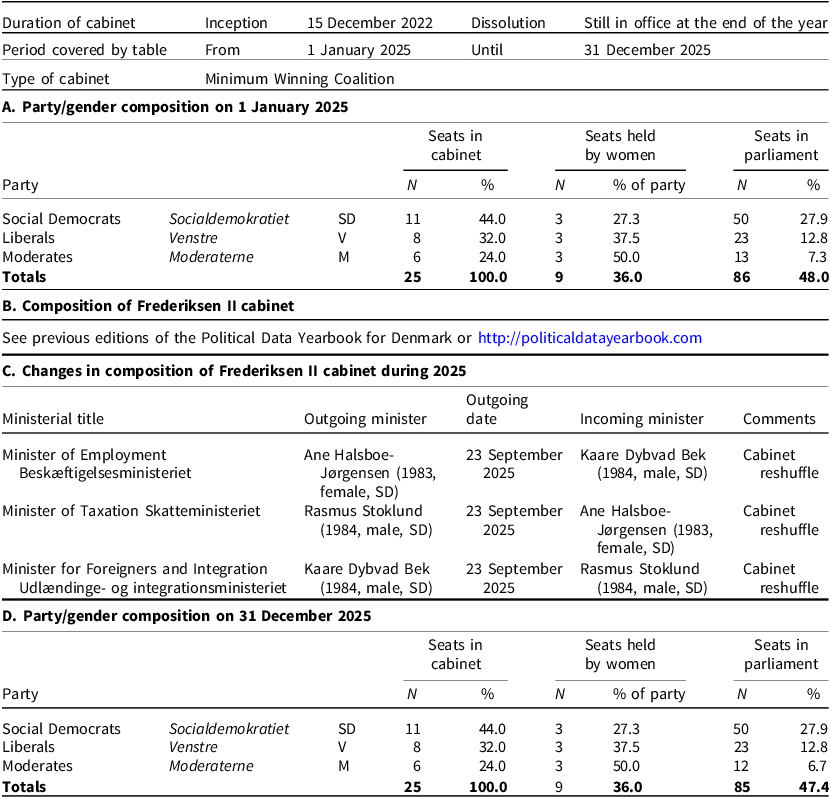
Three Social Democratic ministries were reshuffled on 23 September 2025, which did not change the overall composition of the government but allowed two ministers a better platform for their ideological pursuits (Table 1). The integration-immigration hardliner Rasmus Stoklund was moved from the operation-wise heavy-duty Ministry of Taxation to the Ministry of Foreigners and Integration. Kaare Dybvad Bek, focused on ideology and as the author of several books, including one titled ‘The Tyranny of the Scholars’ (De lærdes tyranni), acquired the suitable Ministry of Employment.
Cabinet composition of Frederiksen II in Denmark

Table 1. Long description
The table provides detailed information about the composition and changes in the Frederiksen II cabinet in Denmark during 2025. It includes data on the duration of the cabinet, party/gender composition, and changes in ministerial positions. The table is divided into several sections: A, B, C, and D. Section A shows the party/gender composition on 1 January 2025, listing the Social Democrats, Liberals, and Moderates with their respective seats in the cabinet and parliament. Section B mentions the composition of the Frederiksen II cabinet. Section C details changes in the composition of the cabinet during 2025, including ministerial title, outgoing and incoming ministers, and the dates of these changes. Section D shows the party/gender composition on 31 December 2025, similar to Section A. The table captures the reshuffles and the overall stability in the cabinet’s composition despite the changes in ministerial positions.
Source: Statsministeriet (2026).
According to the government itself (Regeringen 2026), 201 political agreements (laws) have been made since their accession, between 15 December 2022 and 1 December 2025. Of these, 90.5% have been decided with opposition parties from both sides of the government.
Parliament report
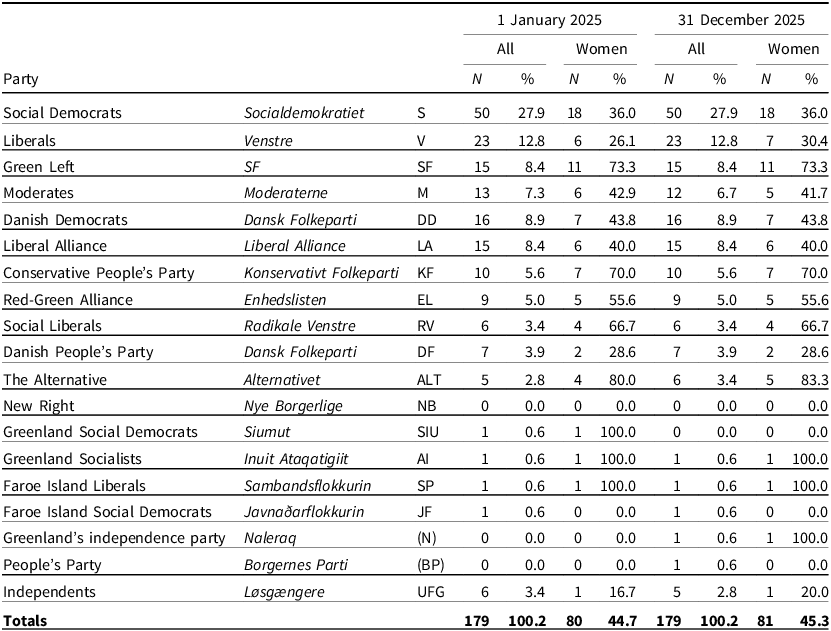
Changes in parliamentary parties and in the number of independents were at a slower pace in 2025 compared to 2024 (Kosiara-Pedersen Reference Kosiara-Pedersen2025; Table 2). In January, former New Right chair, Lars Boje Rasmussen, left his status as independent to represent the People’s Party (see Political party report). For a short time, two MPs became independents in their transition from one party to another. Karin Liltorp changed from the Moderates to the Alternative. Matilda Høegh-Dam, elected for Siumut (Social Democrats), shifted in January to Naleraq (the party advocating speedy independence for Greenland (Naleraq 2026)). None of the MPs who became independent remained so in 2025; hence, by the end of 2025, only five MPs were outside any parliamentary group (Folketinget 2026).
Parliamentary report

Table 2. Long description
The table presents data on the number and percentage of parliamentary party members and women members on January 1 and December 31, 2025. It includes 17 parties and independents, with columns for the total number and percentage of members, and the number and percentage of women members. The table has 17 rows and 12 columns. Column headers are: Party, 1 January 2025 All N, 1 January 2025 All %, 1 January 2025 Women N, 1 January 2025 Women %, 31 December 2025 All N, 31 December 2025 All %, 31 December 2025 Women N, 31 December 2025 Women %. Row 1: Social Democrats, Socialdemokratiet, S, 50, 27.9, 18, 36.0, 50, 27.9, 18, 36.0. Row 2: Liberals, Venstre, V, 23, 12.8, 6, 26.1, 23, 12.8, 7, 30.4. Row 3: Green Left, SF, SF, 15, 8.4, 11, 73.3, 15, 8.4, 11, 73.3. Row 4: Moderates, Moderaterne, M, 13, 7.3, 6, 46.2, 12, 6.7, 5, 41.7. Row 5: Danish Democrats, Dansk Folkeparti, DD, 16, 8.9, 7, 43.8, 16, 8.9, 7, 43.8. Row 6: Liberal Alliance, Liberal Alliance, LA, 15, 8.4, 6, 40.0, 15, 8.4, 6, 40.0. Row 7: Conservative People’s Party, Konservativt Folkeparti, KF, 10, 5.6, 7, 70.0, 10, 5.6, 7, 70.0. Row 8: Red-Green Alliance, Enhedslisten, EL, 9, 5.0, 5, 55.6, 9, 5.0, 5, 55.6. Row 9: Social Liberals, Radikale Venstre, RV, 6, 3.4, 4, 66.7, 6, 3.4, 4, 66.7. Row 10: Danish People’s Party, Dansk Folkeparti, DF, 7, 3.9, 2, 28.6, 7, 3.9, 2, 28.6. Row 11: The Alternative, Alternativet, ALT, 5, 2.8, 4, 80.0, 6, 3.4, 5, 83.3. Row 12: New Right, Nye Borgerlige, NB, 0, 0.0, 0, 0.0, 0, 0.0, 0, 0.0. Row 13: Greenland Social Democrats, Siumut, SIU, 1, 0.6, 1, 100.0, 0, 0.0, 0, 0.0. Row 14: Greenland Socialists, Inuit Ataqatigiit, AI, 1, 0.6, 1, 100.0, 1, 0.6, 1, 100.0. Row 15: Faroe Island Liberals, Sambandsflokkurin, SP, 1, 0.6, 1, 100.0, 1, 0.6, 1, 100.0. Row 16: Faroe Island Social Democrats, Javnaðarflokkurin, JF, 1, 0.6, 0, 0.0, 1, 0.6, 0, 0.0. Row 17: Greenland’s independence party, Naleraq, (N), 0, 0.0, 0, 0.0, 1, 0.6, 1, 100.0. Row 18: People’s Party, Borgernes Parti, (BP), 0, 0.0, 0, 0.0, 1, 0.6, 0, 0.0. Row 19: Independents, Løsgængere, UFG, 6, 3.4, 1, 16.7, 5, 2.8, 1, 20.0. Row 20: Totals, 179, 100.2, 80, 44.7, 179, 100.2, 81, 45.3.
Notes: 1. This table is, like the Political Data Yearbook for 2023 and 2024, based on all 179 seats in the Danish parliament.
Source: Kosiara-Pedersen (Reference Kosiara-Pedersen2025) and Terp-Hansen et al. (Reference Terp-Hansen, Madsen and Engell Kjøller2026).
Three experienced MPs left parliament in 2025: two Social Democrats, one of whom was a former minister who pursued a civil society career, and a Liberal former minister, who pursued a career in municipal politics (Terp-Hansen et al. Reference Terp-Hansen, Madsen and Engell Kjøller2026).
Political party report
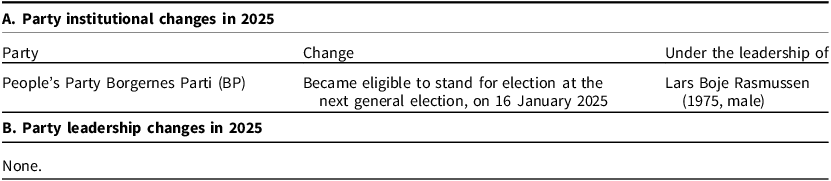
The People’s Party (Borgernes Parti), formed by Lars Boje Mathiesen, who had been chair of the New Right in 2023 prior to being expelled (Kosiara-Pedersen Reference Kosiara-Pedersen2024), was formally approved as eligible to stand for election by the Ministry of the Interior in mid-January 2025 (Table 3).
Changes in political parties in Denmark in 2025

Table 3. Long description
The table is divided into two sections: A. Party institutional changes in 2025 and B. Party leadership changes in 2025. Section A has one row detailing the People’s Party (Borgernes Parti (BP)) becoming eligible to stand for election at the next general election on 16 January 2025. The change is noted under the leadership of Lars Boje Rasmussen. Section B indicates there were no party leadership changes in 2025.
Source: Indenrigsministeriet (2026).
The Red-Green Alliance is not traditionally rife with public fractionalization (Bischoff and Kosiara-Pedersen Reference Bischoff and Kosiara-Pedersen2023), but the reheating of the Israel–Palestine conflict ignited internal disagreement within the party in 2024. In light of this, the fraction Red Left (Rødt Venstre) aimed to create an independent party, but was unsuccessful.
Issues in national politics
The ‘Greenland crisis’ was at its height at the start of the year. President-elect Trump had in December 2024 reiterated his desire to own Greenland. In early January, Trump Jr. visited Nuuk (the capital of Greenland) and raised questions about the future of the Kingdom of Denmark (Commonwealth of Greenland, Faroe Island, and Denmark), the self-determination of Greenlanders, global security policy, and Denmark’s relationship with the USA. Trump refused to discard the use of military or economic power to gain control. He also threatened Denmark with a trade war. This was – and is – a serious crisis for Greenland, The Kingdom of Denmark, and the Danish government. The Ministers of Foreign Affairs of Denmark, Lars Løkke Rasmussen, and Greenland, Vivian Motzfeldt, met with J.D. Vance and Marco Rubio in Washington on 14 January. Members of the European Union backed Denmark and landed some international troops in Greenland on 15 January. Trump’s inauguration address was awaited with concern in Denmark: would he, or would he not, again mention his appetite for acquiring Greenland? While Greenland was not specifically mentioned in the address, Trump’s remarks about expanding the size of the USA were more than enough to keep Danish politics alert to this agenda. And in the coming weeks, the issue remained at the top of the agenda with Trump expressing his desire to buy Greenland, and with the Greenland and Danish governments declining. The Greenland crisis subsided over the course of the year. However, by the end of 2025, it remained a sleeping giant rather than a resolved dispute. As a consequence of the Greenland crisis, pressure on European defense and Russia’s invasion of Ukraine, an agreement to increase defense spending markedly was decided by a broad parliamentary majority.
Denmark took over the EU presidency in the summer of 2025 with the priorities of security and defense, economic competitiveness, and creating the basis for the next EU budget (Folketinget 2026). Among the accomplishments were new initiatives to support Ukraine, stronger armament across Europe, and new climate goals. It was also agreed to remove legal restrictions enabling asylum processing to be conducted with third countries outside Europe.
On the national agenda were several issues regarding employment and the size of the labor force. One of these is to leave more room for private companies in getting the unemployed employed, a task otherwise mainly taken by the municipalities. On the basis of the ‘welfare settlement’ of 2006 (Velfærdsforliget; Sørensen Reference Sørensen2026), the pension age was raised from 69 to 70 years from 2040. A new two-year high school degree directed at a combination of academic and vocational training was implemented, an indication of the government’s – and in particular the Social Democrats’ – emphasis on vocational rather than academic education, as seen, for example, also in the reduction of a share of university degrees in 2023.
Data availability statement
Data is publicly available according to the references.
Competing interests
The author declares none.

 Open access

