

INTRODUCTION
Immigration is at the forefront of national politics, commanding attention in the 2016 presidential election and in the policies pursued by the Trump administration. Moreover, Americans increasingly identify immigration as an issue of national importance. In a 2016 Gallup poll, when asked to name the most important issue facing the United States, 14% of respondents named immigration. Only the economy was mentioned more often (by 17% of respondents) (Newport Reference Newport2016). To put this in perspective, in similar Gallup polls fielded from 2000 to 2012, mentions of immigration never comprised more than 3% of responses (Saad Reference Saad2012). There may be a dramatic shift in the issue priorities of Americans, and it is therefore imperative to fully understand public attitudes toward immigrants in the United States.
Although it is well established that Republicans and conservatives are more likely to favor restrictive immigration policies than are Democrats and liberals (Chandler and Tsai Reference Chandler and Tsai2001; Cosby et al. Reference Cosby, Aanstoos, Matta, Porter and James2013; Hajnal and Rivera Reference Hajnal and Rivera2014; Newport Reference Newport2016; Ramakrishnan and Wong Reference Ramakrishnan, Wong and Varsanyi2010), there is nonetheless a “hidden American immigration consensus” (Hainmueller and Hopkins Reference Hainmueller and Hopkins2015, 531). People, regardless of party and ideology, prefer immigrants who are highly skilled, have plans to work in the United States, entered with authorization, and speak English (Hainmueller and Hopkins Reference Hainmueller and Hopkins2015). This paper deepens understanding of immigration attitudes, first, by providing an analytical framework to explain why certain characteristics are ubiquitously desirable in assessments of immigrants. Many of these desirable attributes are related to norms—standards of conduct dictated by an identity. Additionally, I offer a new typology of norms by positing that they can be broken down into two primary components: norms of propriety (p-norms) and norms of culture (c-norms). P-norms deal with “good” behavior, actions like retaining employment and following the law. C-norms are markers of American cultural identity, actions like speaking English.
Often, people discuss an opposition to immigration in the language of p-norms. For example, in support of restrictive immigration policies, some may assert that immigrants do not respect law and order (particularly if they believe most immigrants are undocumented). People might claim that their opposition to immigration has nothing to do with the identity of immigrants, that there is no discomfort with other cultures, thereby rejecting the notion that c-norm violations drive attitudes. To explore the effect of norms on immigration attitudes, I designed a survey experiment to answer the following question: If an immigrant is described as an upstanding member of society (a p-norm follower), but nonetheless holds on to a non-American cultural identity (a c-norm violator), will the immigrant be accepted in American society? It is important to explore acceptance because it is in the best interest of a nation to ease tensions among the public, particularly in a major immigrant destination like the United States. Acceptance is also important because the lack of acceptance may lead to laws that harm the unaccepted group, as will later be discussed in greater detail.
In the experiment, respondents read a vignette about an immigrant who was always described as a p-norm follower (documented and employed). Treatments varied whether the immigrant came from Europe or Mexico and whether the immigrant was described as following or violating c-norms. In terms of c-norm violations, the immigrant was described as either fluent or not fluent in English, and as either a fan of American football or of a non-American soccer team. Respondents were then asked whether they supported or opposed the immigrant's reception of a green card.
Green card support is an appropriate dependent variable in analyses aiming to understand the acceptance of an immigrant in the United States because receiving a green card is the pivotal step in being able to remain in the country permanently. Green card support is a higher bar of acceptance than is general support for allowing immigrants to enter the United States, precisely because green card support means one is in favor of an immigrant becoming a permanent member of American society. Although an even higher bar of acceptance is support for an immigrant's citizenship, a green card is more consequential to an immigrant's tenure in the country. Without a green card, time in the United States is limited, but without citizenship, a permanent resident may remain in the country indefinitely.
This paper also deepens understanding of immigration attitudes by clarifying the conditions under which norms are more or less salient in structuring attitudes. Although Hainmueller and Hopkins (Reference Hainmueller and Hopkins2015) found that a preference for immigrants who follow certain norms, like speaking English, is a ubiquitous one that crosses ideological and partisan lines, it remains unclear whether political orientations affect reactions to norm violations depending on who is violating the norm. Results from the green card experiment reveal that norm violations negatively affect green card support, and Mexican and European immigrants are treated the same overall. However, conservatives (and Republicans) demonstrate more positive attitudes toward an immigrant who is fluent in English only when the immigrant is European. Liberals (and Democrats) express more positive attitudes toward an immigrant who is fluent in English only when the immigrant is Mexican. Therefore, the results enhance understanding of immigration attitudes by simultaneously showing that, although commonalities between liberals (and Democrats) and conservatives (and Republicans) exist—they agree that immigrants should follow c-norms—fundamental divisions remain—they treat c-norm violations by Mexican versus European immigrants differently.
Analyses are confined to white respondents because within a society, it is the group that holds the reins of power, where power refers to economic and political power, that is able to set the salient norms. In the United States, this group is white Americans.Footnote 1 There is also a theoretical focus on Latino immigrants because they are both the largest immigrant group and the largest minority group in the United States.
The remainder of this paper proceeds in the following manner. First, identity and norms are discussed, as a discussion of identity is necessary to provide a thorough definition of norms. Second, a theory of white attitude formation toward Latinos and immigrants is presented by distinguishing between p- and c-norms. Third, existing research on immigration attitudes is analyzed. Fourth, hypotheses are developed. Fifth, the green card experiment is presented. Finally, the conclusion discusses caveats, implications, and avenues for future research.
NORMS
People hold multiple, overlapping identities, like gender, age, race, and nationality. From such identities, people sort themselves and others into social categories (Akerlof and Kranton Reference Akerlof and Kranton2010). A social category is defined by a label, there are rules that decide membership, and attributes believed to characterize group members (Fearon Reference Fearon1999). “American” is a social category. There is a label, explicit rules define American citizenship, and there are attributes associated with Americans, such as a commitment to individualism and freedom, and a presumption that Americans speak English (de la Garza, Falcon and Garcia Reference de la Garza, Falcon and Garcia1996; Lipset Reference Lipset1990; Schildkraut Reference Schildkraut2005). When one derives dignity and self-respect from a social category, one personally identifies with that social category. A personal identity is, “a set of attributes, beliefs, desires, or principles of action that a person thinks distinguishes her in socially relevant ways and that (a) the person takes special pride in; (b) the person takes no special pride in, but which so orient her behavior that she would be at a loss about how to act and what to do without them; or (c) the person feels she could not change even if she wanted to” (Fearon Reference Fearon1999, 11). Similarly, Schildkraut (Reference Schildkraut2011, 5) describes a social identity as “the part of a person's sense of self that derives from his or her membership in a particular group and the value or meaning that he or she attaches to such membership.”
A personal identity is a powerful motivator of actions because “one's degree of attachment to the group and particular understanding of what it takes to be a member of ‘group X’ are key factors in shaping the role that social identities—including national identities—play in determining subsequent political attitudes and behaviors” (Schildkraut Reference Schildkraut2011, 5). In other words, social categories are tied to beliefs about how one should behave. Notions about how one should behave are norms (Akerlof and Kranton Reference Akerlof and Kranton2010). Norms are standards of conduct that “can take the general form ‘Members of category X are supposed to do (or ought to do) Y in situations A, B, C’” (Fearon Reference Fearon1999, 27). Norms are especially clear when there is an ideal group member to emulate, where ideal refers to the “exemplary characteristics and behavior associated with a social category” (Akerlof and Kranton Reference Akerlof and Kranton2010, 11). Akerlof and Kranton (Reference Akerlof and Kranton2010) provide the example of Christianity and Jesus as the ideal. The behavior that Jesus exhibits is one that Christians should strive to emulate.
Norms structure behavior in two ways. First, they structure how members of a social category believe they should behave; they want to follow norms. Evidence “indicates that those who follow norms do so because they believe in them,” because norms hold “communal systems together” (Akerlof and Kranton Reference Akerlof and Kranton2010, 35). Norm followers strengthen their identity by coming closer to the ideal image they strive to meet, thereby enhancing their utility. Second, norms affect how members of a social category believe others should behave. Group members want others to follow norms because a norm violator is viewed as eroding away at the ideal, collective group identity. Group members experience a loss in utility when others violate norms (Akerlof and Kranton Reference Akerlof and Kranton2010). Resultant negative attitudes toward a norm violator may affect political stances.
Applying the effect of norms on behavior to interactions between whites who were born in the United States and immigrants or Latinos, one can categorize the relevant social category as “American.” The norms associated with “Americanism” are set by native whites since they hold the reins of economic and political power. Although white Americans certainly do not represent all Americans, there is evidence that whites and racial and ethnic minorities have internalized an association between whiteness and American identity (Devos and Banaji Reference Devos and Banaji2005; Schildkraut Reference Schildkraut2005).Footnote 2 When immigrants’ and Latinos’ behavior signals “American” identity, perhaps by speaking English or rooting for Team USA in the Olympics, native whites will be more likely to view immigrants and Latinos as fellow Americans. When immigrants’ and Latinos’ behavior signals a foreign identity, perhaps by speaking Spanish or rooting for Mexico in the Olympics, native whites will be more likely to experience a loss in utility, and such feelings may structure immigration attitudes.
P-Norms and C-Norms
I offer a new typology of norms by positing that there are two categories of norms: norms of propriety (p-norms) and norms of culture (c-norms). P-norms are actions pertaining to “good” or “proper” behavior, like retaining employment and following the law. They are associated with an upstanding member of society. C-norms are markers of American cultural identity. Behavior that signals identification with a non-American country, actions like speaking Spanish and flying a Mexican flag, are c-norm violations. White Americans will view Latinos and immigrants who follow p- and c-norms more favorably than they will view those who violate norms. While both types of norms affect attitudes, the distinction is important for enhancing understanding of the factors behind immigration stances.
People often voice opposition to immigration in the language of p-norm violations. For example, in an interview where Iowans were asked about undocumented immigrants, one man stated, “Yeah, they should deport ‘em if they don't come in legally…they get unemployment, they get welfare, and they pay nothing and they just keep givin’ to ‘em’” (Schaper Reference Schaper2011). The man believes that immigrants do not follow laws, do not work, and do not pay taxes. For many, these seem like pragmatic reasons for an opposition to immigration, and people can assert that such opposition does not stem from negative attitudes toward certain ethnic, racial, or cultural groups. Of course, one may suspect that there is more to the Iowan's pro-deportation attitude. Even if he believed (or learned) that most immigrants follow p-norms, the Iowan might continue supporting restrictive immigration policies. Therefore, the relevant question becomes: if an immigrant is an upstanding member of society (follows p-norms), but retains a non-American identity (violates c-norms), will the immigrant be accepted in the United States? The green card experiment was designed with this question in mind. All respondents read vignettes describing a p-norm following immigrant, but whether the immigrant follows or violates c-norms is experimentally manipulated. Any observed differences in green card support between those who read about c-norm following immigrants versus c-norm violators is evidence that even when an immigrant is an upstanding member of society, cultural distinction is viewed negatively, and such views structure immigration attitudes.
Acceptance of immigrants is an important outcome to explore because the lack of acceptance may lead to support for laws that negatively target immigrant groups. For example, enhanced border enforcement in the 1990s led to more death along the Southwest border (Cornelius Reference Cornelius2001). Additionally, official-English laws in the United States do little more than make Latinos feel marginalized (Schildkraut Reference Schildkraut2005). Enhanced border enforcement, official-English laws, and other immigrant-related policies are generally understood as targeting Latinos, may have harmful consequences for Latinos, and often do not even achieve their stated aims. Enhanced border enforcement has actually led to more undocumented immigrants permanently settling in the United States (Cornelius Reference Cornelius2001). Official-English laws are superfluous, as the incentives for immigrants to speak English are already very high in the absence of such laws (Schildkraut Reference Schildkraut2005). It is therefore imperative to fully understand the factors behind acceptance, or lack thereof, of immigrants and Latinos because of the weighty political consequences that come with a lack of acceptance. Only through fully understanding attitudes can political leaders plan the best way to address tensions between rooted and immigrant populations.
The distinction between p- and c-norms is also important because of the consequences of expectations that Latinos follow both types of norms. To want people to follow p-norms is not the most controversial desire because most individuals want to do things like retain employment and follow the law. However, to expect immigrant groups to always follow c-norms—in other words, to never violate a c-norm—is a weighty request. The latter expectation requires people to deny their personal, cultural identity, an identity from which they may derive dignity and self-respect.
It is not that Latinos do not want to follow c-norms. For instance, 99% of respondents in the 2006 Latino National Survey (LNS) indicated that learning English is “somewhat” or “very” important (92.5% said “very”) and 84.7% said it is important for Latinos to change to blend in with the larger American society. Yet, many Latinos simultaneously want to retain their ethnic heritage. For example, 97% of respondents in the LNS also said it is important to maintain Spanish-speaking abilities and 94.5% said it is important for Latinos to maintain their distinct cultures. Because the desire that immigrant groups follow c-norms is consequential for the personal identity of immigrants, it is c-norms and their impact on attitudes that are the focus of this paper. Before turning to the experiment, it is first necessary to analyze existing literature on immigration attitudes.
ATTITUDES TOWARD IMMIGRANTS
One strand of research, stemming from group conflict theory, focuses on material self-interest as explaining immigration attitudes (Blumer Reference Blumer1958; Harell et al. Reference Harell, Soroka, Iyengar and Valentino2012; Key Reference Key1949; LeVine and Campbell Reference LeVine and Campbell1972). According to group conflict theory, members of a dominant group feel superior to a subordinate group, entitled to maintaining advantages that come with group dominance, and threatened by the prospect of the subordinate group undermining the dominant group's privileges (Barreto, Gonzalez and Sánchez Reference Barreto, Gonzalez, Sánchez, Kun and Pulido2014; Blumer Reference Blumer1958). Competition over resources, like jobs or housing, is perceived as a material threat and may lead to negative attitudes toward immigrants (Mayda Reference Mayda2006; Olzak Reference Olzak1992; Scheve and Slaughter Reference Scheve and Slaughter2001; Sides and Citrin Reference Sides and Citrin2007). Additionally, natives who believe that immigrants place a burden on public finances, leading to increased taxes, may support restrictive immigration policies (Dustmann and Preston Reference Dustmann and Preston2007; Hanson, Scheve and Slaughter Reference Hanson, Scheve and Slaughter2007). This research depicts people as making cost-benefit financial calculations about immigration.
Hainmueller and Hiscox (Reference Hainmueller and Hiscox2010), however, use an experimental survey design to show that there is almost no evidence in support of material self-interest explanations. For example, if it were true that anti-immigrant attitudes arise from a perceived threat over job competition, then highly skilled natives should prefer the entrance of low-skilled immigrants over highly skilled immigrants, and low-skilled skilled natives should prefer the entrance of highly skilled immigrants over low-skilled immigrants. In other words, people should be more likely to oppose the entrance of immigrants that they might actually compete with on the job market. Instead, respondents of all skill levels prefer highly skilled over low-skilled immigrants (Hainmueller and Hiscox Reference Hainmueller and Hiscox2007; Reference Hainmueller and Hiscox2010; Hainmueller, Hiscox and Margalit Reference Hainmueller, Hiscox and Margalit2015; Iyengar et al. Reference Iyengar, Jackman, Messing, Valentino, Aalberg, Duch, Hahn, Soroka, Harell and Kobayashi2013; Sniderman, Hagendoorn and Prior Reference Sniderman, Hagendoorn and Prior2004). Only when the focus is on highly skilled native workers in the high-tech sector for whom the threat from highly skilled immigrants is elevated does one find support for a material self-interest explanation. Yet, fewer than 5% of Americans are employed in high-tech (Malhotra, Margalit and Mo Reference Malhotra, Margalit and Hyunjung Mo2013).
Another strand of research focuses on in-group favoritism and/or out-group hostility, where such theories are related to ethnocentrism and prejudice (Allport Reference Allport1979; Kinder and Kam Reference Kinder and Kam2010; Sniderman and Hagendoorn Reference Sniderman and Hagendoorn2007; Tajfel Reference Tajfel1981; Tajfel et al. Reference Tajfel, Billig, Bundy and Flament1971). Ethnocentrism is defined as “a predisposition to divide the human world into in-groups and out-groups…a readiness to reduce society to us versus them” (Kinder and Kam Reference Kinder and Kam2010, 8). Also, the “division of humankind into in-group and out-group is not innocuous. Members of in-groups (until they prove otherwise) are assumed to be virtuous: friendly, cooperative, trustworthy, safe and more. Members of out-groups (until they prove otherwise) are assumed to be the opposite: unfriendly, uncooperative, unworthy of trust, dangerous, and more” (Kinder and Kam Reference Kinder and Kam2010, 8). Minority group members are characterized the same in the minds of ethnocentric whites, as “dangerous” outsiders. The particular source of distinction is not so important, it is enough that any distinction exists (Hopkins Reference Hopkins2015).
Sniderman and Hagendoorn's (Reference Sniderman and Hagendoorn2007) discussion of prejudice, although distinct from ethnocentrism theories, shares the view that prejudice is not targeted toward individual minority groups. Rather, a person who dislikes African Americans is also likely to hold disdain for Hispanics, Muslims, immigrants in general, and any other minority group. Sniderman and Hagendoorn (Reference Sniderman and Hagendoorn2007, 45) define prejudice as “a readiness to belittle minorities, to dislike them, to shun them, to be contemptuous of them, and to feel hostility toward them.” Racial “antipathy” is expressed by, “Indiscriminately ascribing negative characteristics to minorities—describing them as lazy, untrustworthy, selfish, and the like” (Sniderman and Hagendoorn Reference Sniderman and Hagendoorn2007, 45). Thus, people who assume immigrants tend to misbehave (violate p-norms) and are detrimental to American culture (violate c-norms) may simply be prejudiced individuals, quick to ascribe any characteristics that they perceive as negative to immigrants. Yet, even the tolerant may care that immigrants follow norms.
When an immigrant violates a norm, prejudiced people will engage in aversive behavior because they will feel that their negative assumptions about immigrants are verified. When an immigrant follows norms, the prejudiced will still exhibit aversive behavior because encountering such an immigrant will not change the readiness to ascribe negative characteristics to immigrants. A norm-following immigrant, however, should be treated with less aversion than a norm-violating one because a norm-follower is viewed as at least trying to fit in. When the tolerant encounter a norm-following immigrant, they should not display aversive behavior; there is no reason to do so. Nonetheless, the tolerant may show some aversion to a norm-violating immigrant because they may feel that American cultural identity is compromised. Schildkraut (Reference Schildkraut2005) explores public support for official-English laws in the United States and finds that support is affected by people's notions of American identity. She cautions, “It would be a mistake to dismiss all support for official-English policies as racist. Some of it is, but a nontrivial amount stems from legitimate desires to see that people know English. The reasoning for such desires is rooted in universally accepted beliefs about the norms and values that constitute American identity” (Schildkraut Reference Schildkraut2005, 205). Similarly, it is a mistake to assume that all aversion to norm violations stems from prejudice. Some of it does, but some of it stems from notions of an ideal American identity. Norms are shared and consensual, attracting support from wide swaths of society.
Finally, in existing research on the effect of culture and American identity on immigration attitudes, culture is often discussed ambiguously. For example, Vidanage and Sears (Reference Vidanage and Sears1995) find that prioritizing an American identity over a racial or ethnic identity affects immigration attitudes. Yet, Schildkraut (Reference Schildkraut2005, 31) points out that “it is not clear what ‘thinking of oneself as American’ means.” Citrin et al. (Reference Citrin, Green, Muste and Wong1997, 13) find a relationship between believing that “Hispanic and Asian immigration would improve ‘our culture’” and immigration stances, but it is unclear what constitutes “our culture.”
Schildkraut (Reference Schildkraut2005; Reference Schildkraut2011) identified belief systems that characterize American identity, finding that civic republican and liberal political philosophies are paramount traditions in American culture, and that such traditions structure political attitudes pertaining to immigration and immigrant groups. These political philosophies should not be confused with the modern usage of the terms “Republican” and “liberal” in American politics. Instead, civic republicanism as a political philosophy refers to the responsibilities of members of society, including an idealized image of the United States as a participatory democracy with engaged and connected communities. A liberal political philosophy refers to the rights of individuals, encompassing the conception of the United States as a land of freedom and opportunity (Schildkraut Reference Schildkraut2005; Reference Schildkraut2011). This paper, then, is not the first to distinguish among various normative components of American identity. Yet, the typology of p- and c-norms is distinct from Schildkraut's (Reference Schildkraut2005; Reference Schildkraut2011) categorizations. Although Schildkraut (Reference Schildkraut2005; Reference Schildkraut2011) certainly advances knowledge about core American values, it is necessary to specify actions that signal American identity. Americans do not walk around thinking to themselves, “I wish immigrants would subscribe to ideals of liberalism and civic republicanism more.” Instead, people hold beliefs over what it means to be American, and an immigrant's actions send signals about whether that immigrant is likely to subscribe to one's notion of Americanism. This paper, therefore, identifies specific behavior that signals American cultural identity.
The distinction between p- and c-norms further builds on Schildkraut (Reference Schildkraut2005; Reference Schildkraut2011) because either norm can arise from the various conceptions of Americanism she identified. For example, Schildkraut (Reference Schildkraut2005) explored the content of American identity by asking focus groups to discuss, “what is it that makes us American?” (96). She categorized those who mentioned symbols of Americanism, like the American flag, as viewing American identity under the civic republican tradition. She also coded respondents who named being “other regarding” or “decent human beings” as subscribing to a civic republican view of American identity (105). By this coding scheme, both p- and c-norms are present in the civic republican tradition. National flags are related to c-norms; being a “decent human being” is the crux of a p-norm, as p-norms are characterized by actions signaling that one is a “good” or “upstanding” member of society. The liberal conception of American identity also encompasses both p- and c-norms, as Schildkraut (Reference Schildkraut2005) coded respondents who mentioned obeying the law and who mentioned the importance of English for immigrant success within this tradition. Obeying the law qualifies as a p-norm, and language is related to c-norms. The point is not to suggest that Schildkraut's (Reference Schildkraut2005) distinctions among various notions of American identity are incorrect, quite the opposite, as her work has made great strides in describing how American cultural identity affects political attitudes. Rather, the point is that p- and c-norms can arise out of various conceptions of American identity.Footnote 3
Finally, one might assert that valuing the English language is not aptly characterized as a c-norm, particularly when English is mentioned as important for an immigrant's success, as exhibited by some respondents in Schildkraut's (Reference Schildkraut2005) study. Perhaps people dislike a lack of English fluency, so the assertion goes, not due to a cultural threat, but because an inability to speak English inhibits communication, and language barriers are not optimal in a society. People may make sociotropic assessments about the impact of immigration on the national economy (Dancygier and Donnelly Reference Dancygier and Donnelly2013), and they may, therefore, be less likely to support immigrants who lack English fluency if they believe such immigrants are less likely to succeed in the host country, thereby being less likely to make an economic contribution in the country. Nonetheless, because language is so intimately tied to culture, it is probable that many with an aversion toward immigrants who do not speak English feel some cultural threat, even if economic reasons are used to justify an aversion to non-English languages. After all, an immigrant who lacks English fluency may eventually learn the language. Yet, if one believes that immigrants do not learn English because they do not want to, then language is aptly characterized as a c-norm violation because it is viewed as an intentional rejection of American culture. Even so, a more explicit language norm violation occurs when a bilingual English and Spanish speaker chooses to speak Spanish. The bilingual individual does not inhibit communication in society, nor is there reason to expect the bilingual individual to be less able to make an economic contribution in the country than a monolingual English speaker, so any remaining aversion toward the person must arise from cultural threat. Yet, it was a conscious decision to focus on fluency, and lack thereof, in the green card experiment because it is more natural in the context of the experiment to say an immigrant is or is not fluent, as many immigrants grapple with language barriers.Footnote 4 Additionally, in the green card experiment, as will be discussed below, the immigrant is always described as employed, so any aversion to English that arises is likely not coming from a concern about the immigrant's employment prospects.
HYPOTHESES
Speaking English is among the most prominent American cultural norms. There is widespread agreement among the public that “true Americans” speak English (Dowling, Ellison and Leal Reference Dowling, Ellison and Leal2012; Theiss-Morse Reference Theiss-Morse2009), and evidence shows that exposure to Spanish is related to the expression of anti-immigrant attitudes (Hainmueller and Hopkins Reference Hainmueller and Hopkins2015; Newman, Hartman and Taber Reference Newman, Hartman and Taber2012). However, Hopkins (Reference Hopkins2015) finds no difference in immigration attitudes between respondents who encounter a Spanish-speaking immigrant and those faced with an English-fluent immigrant. This divergent result may be due to a key difference in survey design between Hopkins (Reference Hopkins2015) and others. For example, Hainmueller and Hopkins (Reference Hainmueller and Hopkins2015) evaluated attitudes toward individual immigrants, but Hopkins (Reference Hopkins2015) evaluated attitudes toward immigrants as a group.
Hopkins (Reference Hopkins2015) showed respondents videos, either with an unauthorized immigrant who speaks broken English with a Mexican accent, who speaks English fluently, or who speaks Spanish. Respondents were then asked questions about immigrants as a group and on policies. Those who watched the immigrant speaking broken English were more likely to express pro-immigrant attitudes than were respondents in the other two conditions. There were no differences in attitudes between the fluent English and Spanish conditions. Hopkins (Reference Hopkins2015) theorized that people appreciated the assimilation effort made by the immigrant with the strong accent, and respondents were then primed to think more favorably about immigrants overall. The fluent English condition did not have the same positive impact as the broken English condition because respondents viewed an unauthorized immigrant who speaks English perfectly as an anomaly, not as representative of immigrants. Respondents’ attitudes toward immigrants as a group, therefore, remained unaffected.
However, when people evaluate an individual, they weigh the person's specific characteristics. Hainmueller and Hopkins (Reference Hainmueller and Hopkins2015) asked respondents to evaluate individual immigrants. They found that English-speaking immigrants are preferred. Like Hainmueller and Hopkins (Reference Hainmueller and Hopkins2015), respondents in the green card experiment were asked to evaluate individuals. English-speaking immigrants should be favored.
H1: Immigrants who are fluent in English will be favored over those who are not.
National cultural identification may also be signaled through sports fandom, where rooting for non-American teams constitutes a c-norm violation. Sports have a relationship with national identity, pride, and solidarity, and they transmit symbolic political messages to the public (Elling, Van Hilvoorde and Van Den Dool Reference Elling, Van Hilvoorde and Van Den Dool2014; Hartman, Newman and Bell Reference Hartman, Newman and Bell2014; Horak and Spitaler Reference Horak and Spitaler2003; Kersting Reference Kersting2007; Mower Reference Mower2012; Stevenson and Alaug Reference Stevenson and Karim Alaug2000; Tomlinson and Young Reference Tomlinson and Young2006). Stevenson and Alaug (Reference Stevenson and Karim Alaug2000) assert that the Super Bowl is not simply entertainment, but a “signifier of American cultural values” that conveys messages about the “greatness of America” (460). An immigrant who is a football fan is embracing a solidly American sport. An immigrant who is a fan of a non-American soccer team signals greater identification with a foreign country, both because soccer is more associated with non-American countries and because of allegiance to a non-American team.
H2: Immigrants who signal American identity through their sports fandom will be favored over immigrants whose sports allegiance signals greater identification with a non-American country.
Norms are shared; they are points of consensus. Therefore, vastly different types of people should react negatively to norm violations. While the prejudiced, conservatives, and Republicans are more likely to hold anti-immigrant stances (Chandler and Tsai Reference Chandler and Tsai2001; Cosby et al. Reference Cosby, Aanstoos, Matta, Porter and James2013; de Zúñiga, Correa and Valenzuela Reference de Zúñiga, Correa and Valenzuela2012; Dustmann and Preston Reference Dustmann and Preston2007; Hajnal and Rivera Reference Hajnal and Rivera2014; Ramakrishnan and Wong Reference Ramakrishnan, Wong and Varsanyi2010; Sniderman and Hagendoorn Reference Sniderman and Hagendoorn2007), because of the consensual nature of norms, negative reactions to norm violations should exist regardless of respondents’ levels of tolerance versus prejudice and regardless of political orientations. As discussed previously, prejudiced individuals will feel that their negative assumptions about immigrants are justified when they face a norm-violating immigrant, and they will exhibit an aversion toward the immigrant. However, even the tolerant may feel that American identity is compromised when immigrants violate norms, and may be less supportive of extending green cards. In terms of partisanship and ideology, just as Hainmueller and Hopkins (Reference Hainmueller and Hopkins2015) found that certain attributes are desirable among immigrants, regardless of one's political orientation, the propensity to favor norm-following immigrants is expected to cross ideological and partisan lines.Footnote 5
H3: The tolerant, the prejudiced, conservatives (and Republicans), moderates (and independents), and liberals (and Democrats) will have negative reactions to norm violations.
Although respondents, regardless of their levels of tolerance/prejudice and political orientations, are expected to react negatively to norm violations, it is possible that the face of the norm violator matters. An immigrant's race, ethnicity, and region of origin may affect evaluations of the immigrant. Yet, it is unclear whether Mexicans and Europeans will be treated differently, overall, in the green card experiment for multiple reasons. While much research shows that minority immigrants incite anti-immigrant attitudes more than do European immigrants (who respondents assume are white) (Brader, Valentino and Suhay Reference Brader, Valentino and Suhay2008; Hainmueller and Hangartner Reference Hainmueller and Hangartner2013; Hainmueller and Hopkins Reference Hainmueller and Hopkins2015; Hartman, Newman and Bell Reference Hartman, Newman and Bell2014; Sniderman and Hagendoorn Reference Sniderman and Hagendoorn2007), Hainmueller and Hopkins (Reference Hainmueller and Hopkins2015) found that Mexican immigrants are just as likely to gain support for admission in the United States as are European immigrants. Also, while there might be more anti-immigrant sentiments associated with Latino over European immigrants if prejudiced people prefer Europeans over Latinos, it is also possible that the prejudiced oppose the entrance of all immigrants, regardless of region of origin. Beyond the prejudiced, people, in general, might display an anti-Latino affect in immigration attitudes if they assume that Latinos are more likely to violate norms than are Europeans. However, in an experimental setting where people are told about immigrants either following or violating norms, the immigrant's region of origin may be less consequential if the effect of norms drives results. In sum, there is no clear expectation in regard to whether Mexicans or Europeans will be treated differently by respondents, overall. However, expectations are clarified when ideology and partisanship are taken into account because political orientations color the lens by which people view the immigration landscape.
Republicans are more likely to hold anti-immigrant stances toward Mexicans than they are when no country of origin is specified, but Democrats show no such pattern (Knoll, Redlawsk and Sanborn Reference Knoll, Redlawsk and Sanborn2011). Additionally, when subjects are exposed to Spanish, support for bilingual education and a pathway to citizenship for unauthorized immigrants declines only among Republicans (Hopkins Reference Hopkins2014). Furthermore, de Zúñiga, Correa and Valenzuela (Reference de Zúñiga, Correa and Valenzuela2012) find that conservatives are more likely to watch Fox News, and that exposure to Fox News reduces support for immigration from Mexico. If conservatives are more likely to be inundated with messages from conservative media outlets that may paint Latino immigrants in a negative light, conservatives may be very reluctant to support a green card for a Mexican, regardless of the immigrant's individual characteristics. In other words, although norms are expected to matter overall, regardless of one's ideology and party, norms are not expected to affect conservative (and Republican) evaluations of Latinos. Instead, status as a Latino immigrant may be enough to induce green card opposition among conservatives (and Republicans), whether or not a Latino follows norms. Conversely, if conservatives (and Republicans) are faced with a European immigrant, norms should affect their evaluations, as there is no current evidence of an anti-European affect that could overshadow the impact of norm violations. Previous research does not show an anti-Latino affect among liberals, Democrats, moderates, nor independents in immigration attitudes, so these respondents are expected to prefer norm-following immigrants, regardless of the immigrant's region of origin.
H4a: Conservatives (and Republicans) will prefer a norm-following European immigrant over a norm-violating European immigrant, but norms are not expected to affect conservative (and Republican) evaluations of Mexican immigrants.
H4b: Liberals (and Democrats) and moderates (and independents) will prefer a norm-following immigrant over a norm-violating immigrant, regardless of the immigrant's country of origin.
THE GREEN CARD EXPERIMENT
Data comes from YouGov, an internet-based survey research firm, funded by Stanford's Laboratory for the Study of American Values. At the time the survey was fielded, YouGov had a global panel of nearly two million respondents of all ages and socioeconomic statuses. Almost 1.3 million panelists resided in the United States, and 1,000 Americans were selected for inclusion in this survey to create a nationally representative sample. YouGov uses a matching methodology that imitates a random probability sample, where Americans were matched on gender, age, race, education, partisanship, ideology, and political interest to create the sample. Among the respondents, 737 are white and provided an answer in the green card experiment.Footnote 6 Analyses are confined to white respondents, and the sample resembles the white American population as reflected in U.S. Census Bureau data. YouGov sample demographics and comparisons with Census data are presented in Appendix A (all appendices can be found online). The survey was fielded online in July 2013.
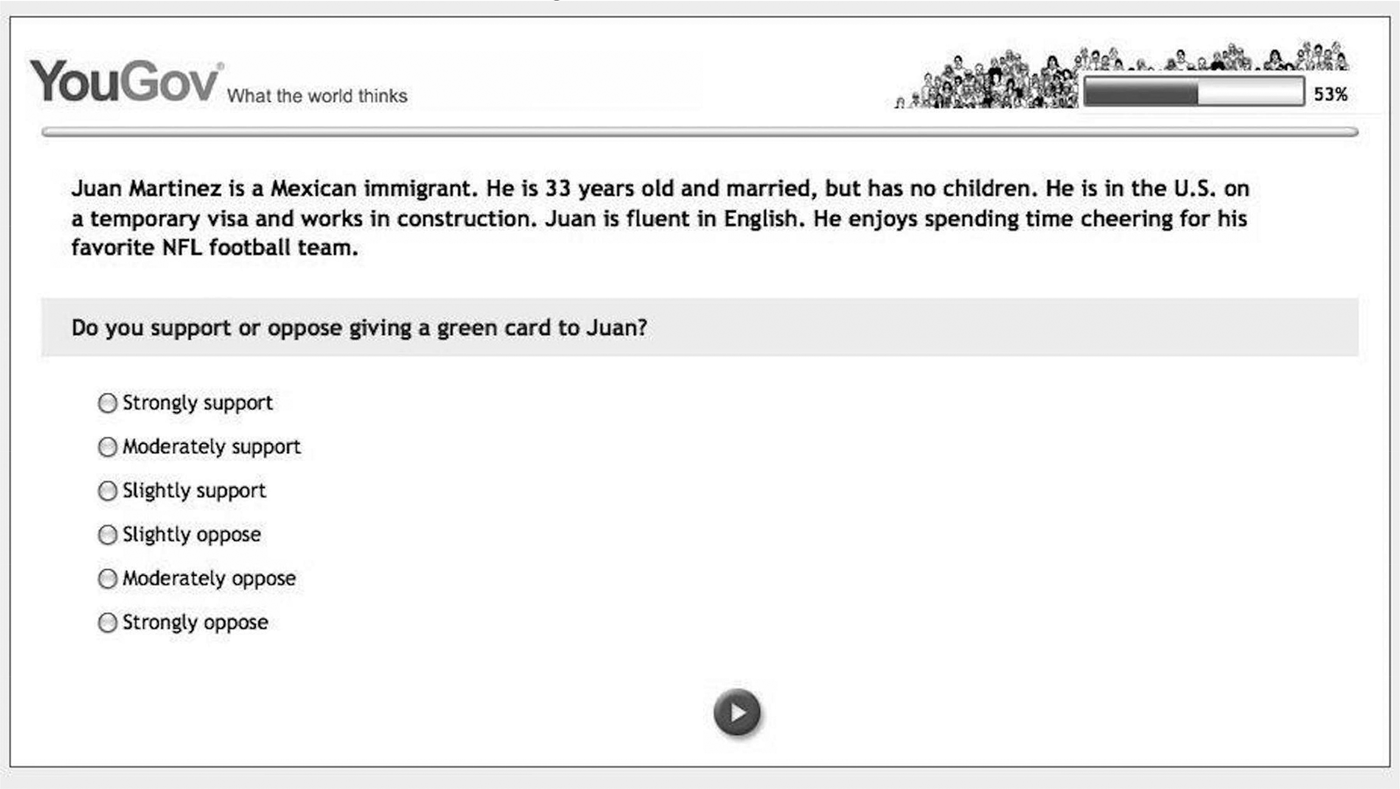
Figure 1 displays an image of the green card experiment, showing one condition.Footnote 7 There were eight possible, randomly assigned, conditions. First, respondents read about either a European or a Mexican immigrant. Most people will assume a European immigrant is white, allowing for a comparison between evaluations of norm violations by co-ethnics versus by Latinos. This design feature follows Sniderman and Carmines (Reference Sniderman and Carmines1997) who use European immigrants to signal white ethnicity to respondents.
Question Text.

Respondents assigned to a European condition were then assigned to one of five possible immigrants: Jakub Kowalski from Poland, Ivan Kuznetsov from Russia, Maxim Kovalenko from Ukraine, Victor Jensen from Denmark, or Bram Jansen from the Netherlands. This design feature avoids country-specific effects when analyzing attitudes toward Europeans.Footnote 8 The Mexican immigrant, Juan Martinez, appears in Figure 1. Country-specific effects are not a concern for the Mexican because most Latino immigrants, and most immigrants in the United States, are Mexican. In 2014, Mexicans accounted for 11.6 million of the nation's 41 million immigrants (28.3%), and made up 54.3% of the Latino foreign-born population (United States Census Bureau 2014). The second largest immigrant group in the United States, from China, pales in comparison with 2.4 million immigrants (5.7%) (Brown and Stepler Reference Brown and Stepler2015). It is therefore not problematic if respondents think of Mexicans when thinking about Latino immigrants because such thoughts match the real world. Conversely, no European country comes close to the Mexican population, so it is problematic if European country-specific effects bias results. In analyses, European conditions are pooled together, allowing for a comparison of reactions toward Europeans versus Mexicans.Footnote 9
All respondents read that the immigrant is documented and employed, signals that he follows p-norms. P-norms are held constant because an aim of this paper is to understand the effect of c-norms when immigrants are depicted as upstanding members of society. Additionally, trade-offs must be made in designing experiments. The addition of each new manipulation reduces cell sizes, thereby reducing statistical power. Varying whether the immigrant is described as unemployed and/or undocumented versus employed and/or documented would reduce statistical power while only producing an obvious result. That is, of course, respondents would prefer an employed, documented immigrant over an unemployed, undocumented one. Moreover, plenty of existing research already shows that people express more favorable attitudes toward immigrants who are highly skilled, well-educated, documented, and have plans to work upon arrival (Hainmueller and Hiscox Reference Hainmueller and Hiscox2010; Hainmueller and Hopkins Reference Hainmueller and Hopkins2015; Harell et al. Reference Harell, Soroka, Iyengar and Valentino2012; Sniderman, Hagendoorn and Prior Reference Sniderman and Hagendoorn2004). By the theory presented in this paper, these traits correspond to p-norms (although previous research does not identify p-norms). What is less clear is whether c-norm violations are consequential for immigrants described as upstanding members of society (p-norm followers). For these reasons, immigrants in vignettes are always described as following p-norms.
Turning to c-norms, in Figure 1 the immigrant “is fluent in English,” a condition which half of the respondents received. The other half read about a c-norm violation, where the immigrant “is not fluent in English.” Also in Figure 1, the immigrant enjoys “cheering for his favorite NFL football team.” Half of the respondents read this text. The other half read a second c-norm violation, that the man enjoys “cheering for the [country] National Soccer Team,” where the immigrant's country of origin appeared in place of the bracketed text. Therefore, in the national sports allegiance manipulation, American versus foreign identity is signaled in two ways. First, the sport is either a solidly American sport (football), or a sport more associated with non-American countries (soccer). Second, the immigrant roots for the United States or for a non-American team.
In sum, there are three manipulations: Mexican versus European, a lack of English fluency versus English fluency, and foreign versus American sports allegiance treatments. The 2 × 2 × 2 design results in eight conditions.Footnote 10 Wording for each condition is included in online Appendix B.
MEASURES
The dependent variable, green card support, is coded on a six-point scale ranging from zero (strongly oppose) to one (strongly support). Treatments—Mexican, not fluent, and foreign team—consist of indicator variables, where a value of one is assigned to the Mexican condition and to each c-norm violation, and zero otherwise (for European, fluent, and American football conditions).
Stereotype questions are commonly used to measure prejudice because they tap into negative characterizations of minorities. The measure, prejudice, is continuous and runs from zero to one, with higher values corresponding to increased prejudice.Footnote 11 See online Appendix B for the prejudice measure question wording, and for all other variables described in this section.Footnote 12
Ideology is coded on a five-point scale ranging from zero (very liberal) to one (very conservative). Party is a seven-point measure, ranging from zero (strong Democrat) to one (strong Republican). Models also include age, education, and gender as covariates.Footnote 13 Although a great advantage of survey experiments is that random assignment to conditions should create cells where respondents’ characteristics are evenly balanced, the inclusion of covariates may increase precision in analyses (Green Reference Green2009; Hopkins Reference Hopkins2015).Footnote 14 All covariate measures range from zero to one; higher values represent older respondents, the highly educated, and gender is an indicator variable where a value of one represents women (and zero otherwise). There is no substantive difference in results when covariates are included versus excluded from models.
RESULTS
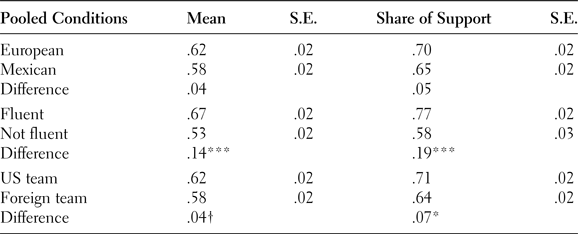
Table 1 displays average support for green cards by pooled conditions. For example, the row “European” includes all respondents asked about Europeans, regardless of which language and sports condition they received. The “Mean” column presents averages for the six-point dependent variable. The “Share of Support” column shows the share of those who strongly, moderately, and slightly support green cards. The two columns simply present alternate views of the dependent variable. The former displays the strength of support. The latter shows willingness to express any level of support. These alternate views provide a richer understanding of the data, as described below. Differences in means are compared with t-tests.
Green Card Support

Cell sizes range from 358 to 379, n = 737.
Note: †p < .1; *p < .05; ***p < .001.
First, language has a strong impact on results. A lack of English fluency leads to a 19 percentage point decrease in the share of support. National sports allegiance has a marginal impact on the strength of support but significantly affects the willingness to show any support, with a seven percentage point decrease for fans of foreign teams. The two alternate views of the dependent variable, then, reveal that although national sports allegiance has little impact on the strength of people's convictions, it may nonetheless provide an extra little push for people who are on the fence about their attitudes. One who slightly opposes a green card can be induced to slightly support the green card based on a characteristic as seemingly trivial as sports fandom. These results support hypotheses 1 and 2 (support will be higher for those fluent in English and for those rooting for American football teams, respectively).
Language is more consequential than national sports allegiance, a result that makes intuitive sense. Sports are not as important to a culture as is language. Plenty of people do not pay attention to sports, but everyone (that is able to) uses language every day.Footnote 15 The region of origin does not significantly affect green card support, suggesting that previous research finding that European immigrants are favored over non-white immigrants may stem, at least in part, from an assumption that minorities are more likely to violate norms. However, the differences between the region of origin treatments and between the national sports allegiance treatments are similar, so it is possible that with a larger sample size, significant differences between the region of origin treatments could emerge.
One might be surprised to see that in every condition, over half of the respondents support a green card. However, a high share of support is not surprising for two reasons. First, respondents read that the immigrant follows p-norms. People who generally oppose green cards may do so because they assume that many immigrants are undocumented and/or unemployed. Here, such assumptions are removed. Second, although willingness to show any level of support is high, the strength of support hovers around slightly supporting a green card (.6 on the six-point scale). Therefore, even when an immigrant is described as a p-norm follower, on average he receives the lowest level of support. Once again, the two alternate views of the dependent variable provide a deeper understanding of the data, clarifying that while the share of support is high, respondents are not enthusiastically, strongly supportive of green cards.
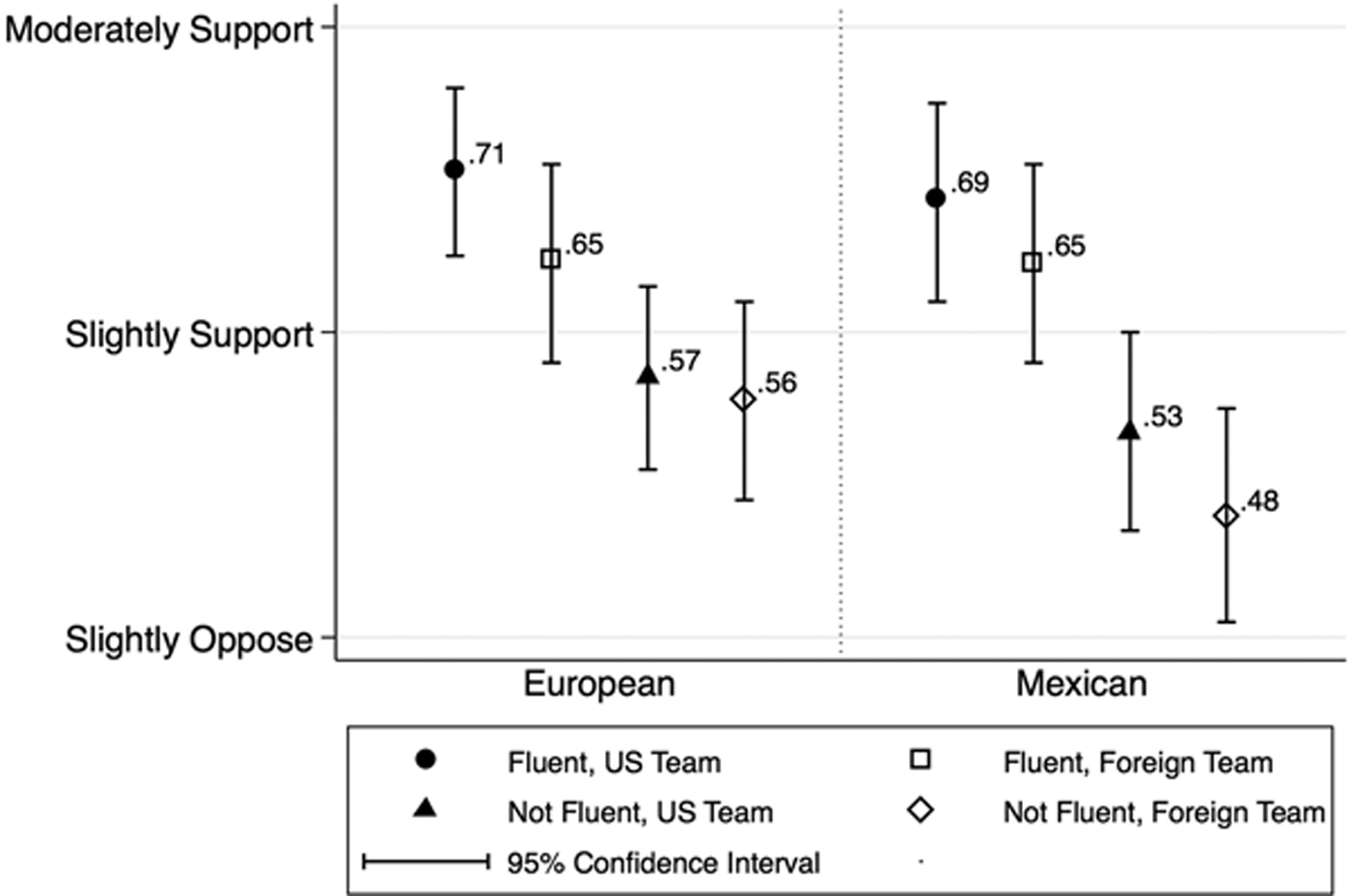
Figure 2 displays average support for all eight conditions. There is a stark, linear drop in support as each additional norm is violated (moving from left to right), regardless of region of origin. Two-way analysis of variance (ANOVA) does not produce a significant interaction between the c-norm violations (F(1, 733) = .14, p = .71). This means that the negative effect of one norm violation is the same whether or not a second norm is violated. Although a Mexican receives less support than a European when both c-norms are violated, two-way ANOVA reveals that the interaction between region of origin and fluency is not significant (F(1, 733) = .74, p = .39), nor between region of origin and national sports allegiance (F(1, 733) = .04, p = .84). Three-way ANOVA does not uncover a significant interaction among all three treatments (F(1, 729) = .40, p = .53). Therefore, there is no evidence that c-norms, nor their interaction, affect Mexicans and Europeans differently.Footnote 16
Mean Green Card Support.

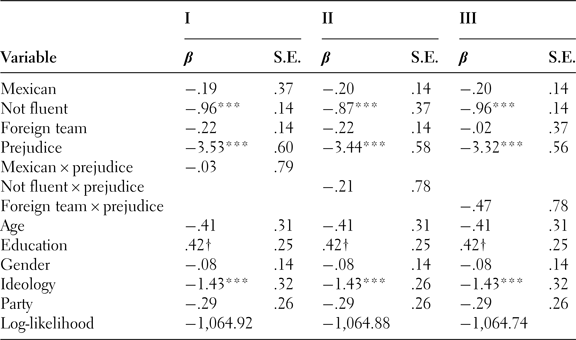
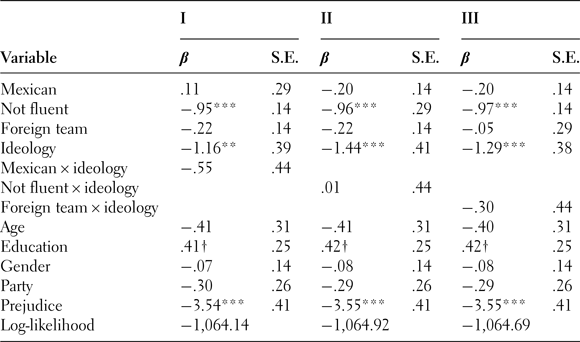
Hypothesis 3 posits that people across the ideological, partisanship, and prejudice spectrums will react negatively to norm violations. In other words, to find that a subgroup of respondents is unresponsive to norm violations would refute hypothesis 3. Table 2 shows ordered logistic regression results that include the interaction of each treatment with prejudice. Model I includes the interaction between the region of origin and prejudice, followed by the interaction of language and prejudice in model II, and model III includes prejudice interacted with national sports allegiance.
Prejudice Interactions

Note: †p < .1; ***p < .001. Ordered logistic regression, n = 682.
Often, researchers search for significant effects, but here an insignificant interaction is more telling in support of hypothesis 3. If tolerant versus prejudiced people had disproportionately different reactions to the treatments, perhaps if the tolerant were immune to c-norm violations while the prejudiced had negative reactions, then the interaction terms in Table 2 would be significant, thereby refuting hypothesis 3. However, there are no significant interaction terms, suggesting that reactions to the treatments do not substantially differ across the prejudice spectrum.
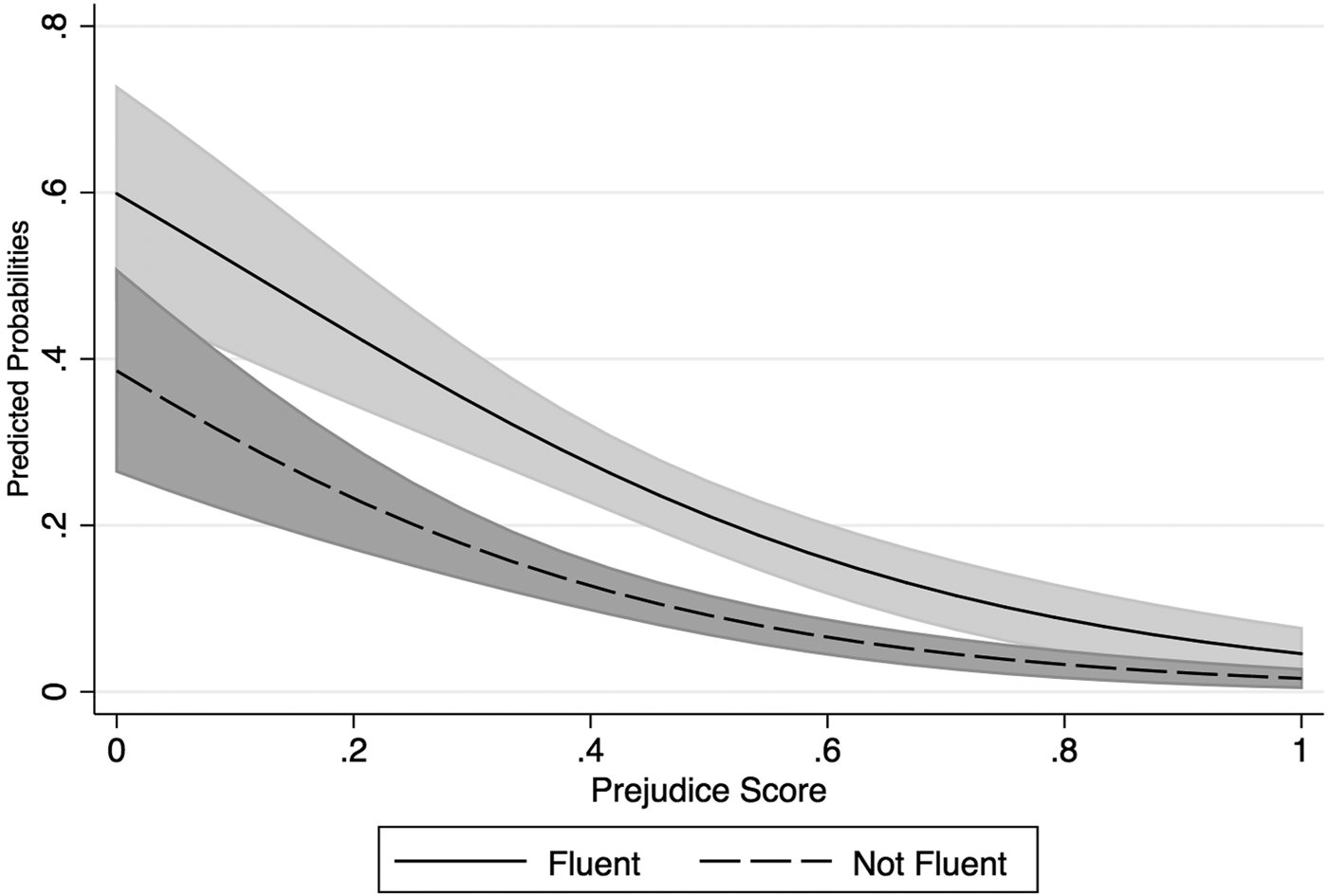
To understand the substantive effect of the treatments across the prejudice measure, predicted probabilities of green card support were generated from the models in Table 2, where the value of one, strong support, is predicted. However, only predicted probabilities from model II, the interaction of language and prejudice, are shown in Figure 3, below, because the region of origin and national sports allegiance do not substantially affect the evaluation of immigrants across the prejudice spectrum. Although national sports allegiance significantly affected results in Table 1, the impact is too small to affect outcomes in subgroup analyses.Footnote 17
Predicted Probabilities of Strong Support, Immigrant Language, and Respondent Prejudice.

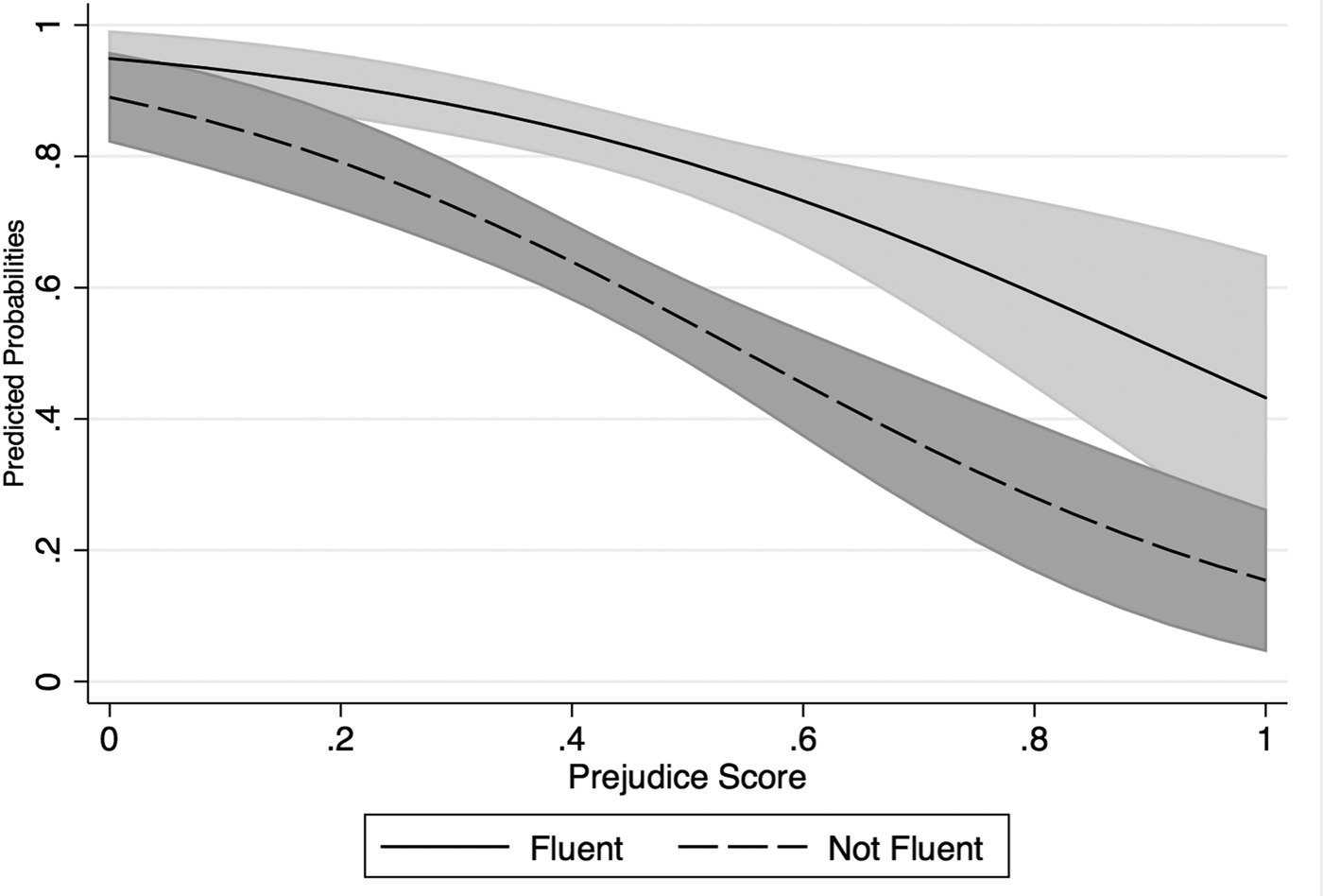
Figure 3 shows that support plummets as prejudice increases, but also that language impacts attitudes across nearly the entire prejudice spectrum. All but the most prejudiced are substantially more likely to strongly support English-speaking immigrants.Footnote 18 Of course, it is not surprising that the most prejudiced people are unlikely to strongly support green cards in any condition. The prejudiced are expected to indiscriminately dislike immigrants, people they view as “others.” Yet, once again, an alternate view of the dependent variable may deepen understanding of respondents’ attitudes. Figure 4 is analogous to Figure 3, except that Figure 3 displayed the probabilities of strongly supporting a green card, but Figure 4 displays the predicted probabilities of showing any level of support—strong, moderate, and slight. In Figure 4, the more prejudiced respondents are actually the most affected by the immigrant's language.Footnote 19 The overall picture that emerges is that the language norm violation is consequential for the tolerant and for the prejudiced.Footnote 20
Predicted Probabilities of Strong/Moderate/Slight Support, Immigrant Language, and Respondent Prejudice.

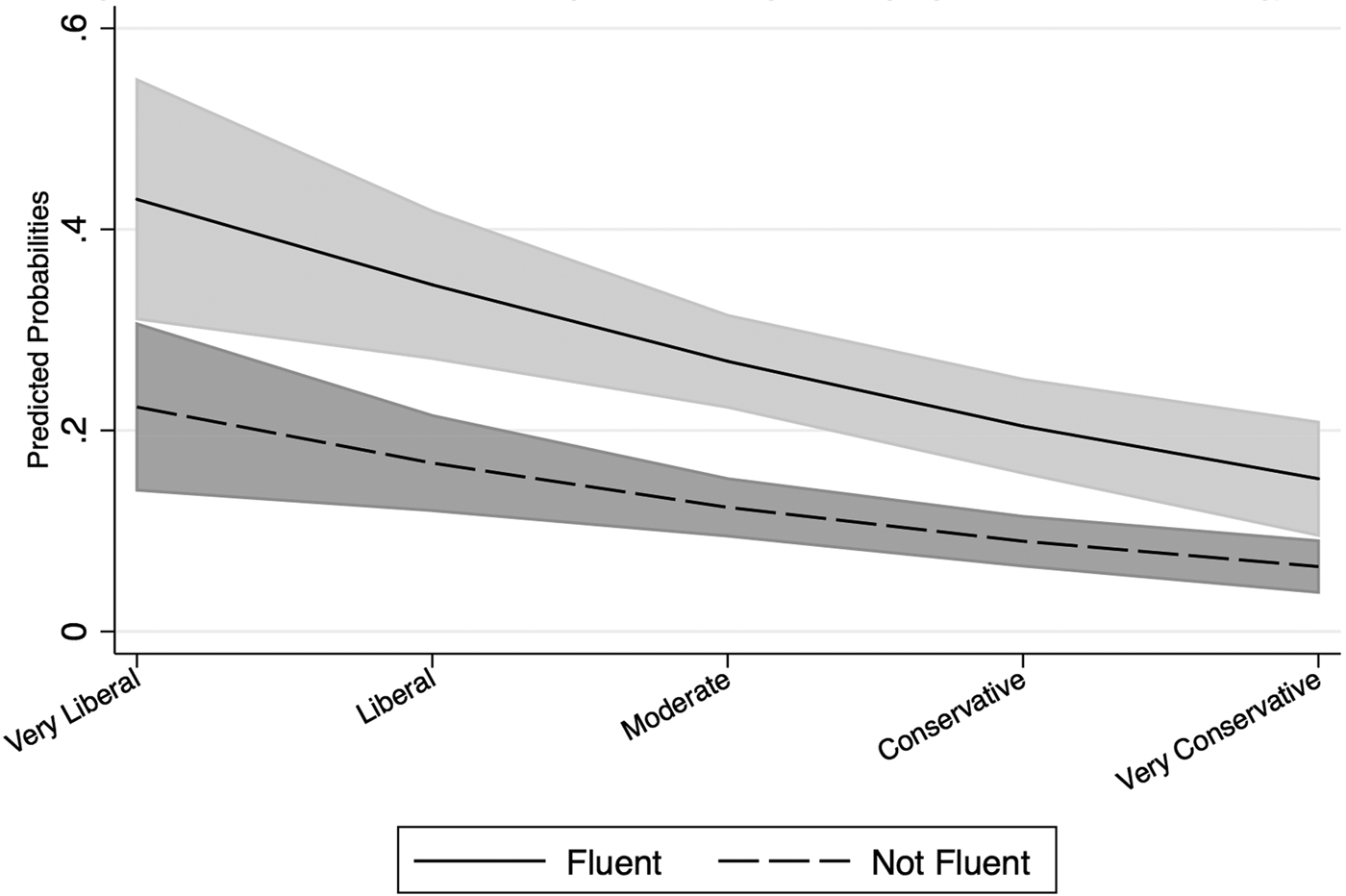
Hypothesis 3 also specified that people, regardless of political orientations, would react negatively to norm violations. To test hypothesis 3, Table 3 presents ordered logistic regression analyses that include interactions between ideology and each treatment. In support of hypothesis 3, the interaction terms in models II and III are insignificant, which suggests that people along the ideological spectrum are not having dramatically different responses to the norm violations. Figure 5 plots the predicted probabilities of strongly supporting a green card generated from model II of Table 3, as only language substantially affects attitudes across the ideological spectrum.Footnote 21
Predicted Probabilities of Strong Support, Immigrant Language, and Respondent Ideology.

Ideology Interactions

Note: †p < .1; **p < .01; ***p < .001. Ordered logistic regression, n = 682.
Figure 5 shows that green card support decreases as conservatism increases, but more importantly that language affects attitudes across the ideological spectrum with remarkable uniformity, as the two plotted lines appear nearly parallel. From the most liberal to the most conservative, respondents punish a language norm violation with significantly reduced green card support, and there is a similar treatment effect across the board.Footnote 22
Subgroup analyses with the partisanship measure were carried out, but in the interest of space, these results are not shown. Partisanship and ideology are highly correlated (correlation coefficient = .71), and ideology has a stronger relationship with green card support than party. Moreover, partisanship subgroup analyses simply mimic the ideology subgroup analyses in that there is a significant positive reaction to English language fluency that exists across the entire partisanship measure.Footnote 23
Altogether, subgroup analyses focused on prejudice, ideology, and partisanship support hypothesis 3. Norms are shared and consensual. A language norm violation is consequential for the tolerant and for the prejudiced. From liberals (and Democrats) to conservatives (and Republicans), and those in between, people favor English-speaking immigrants.
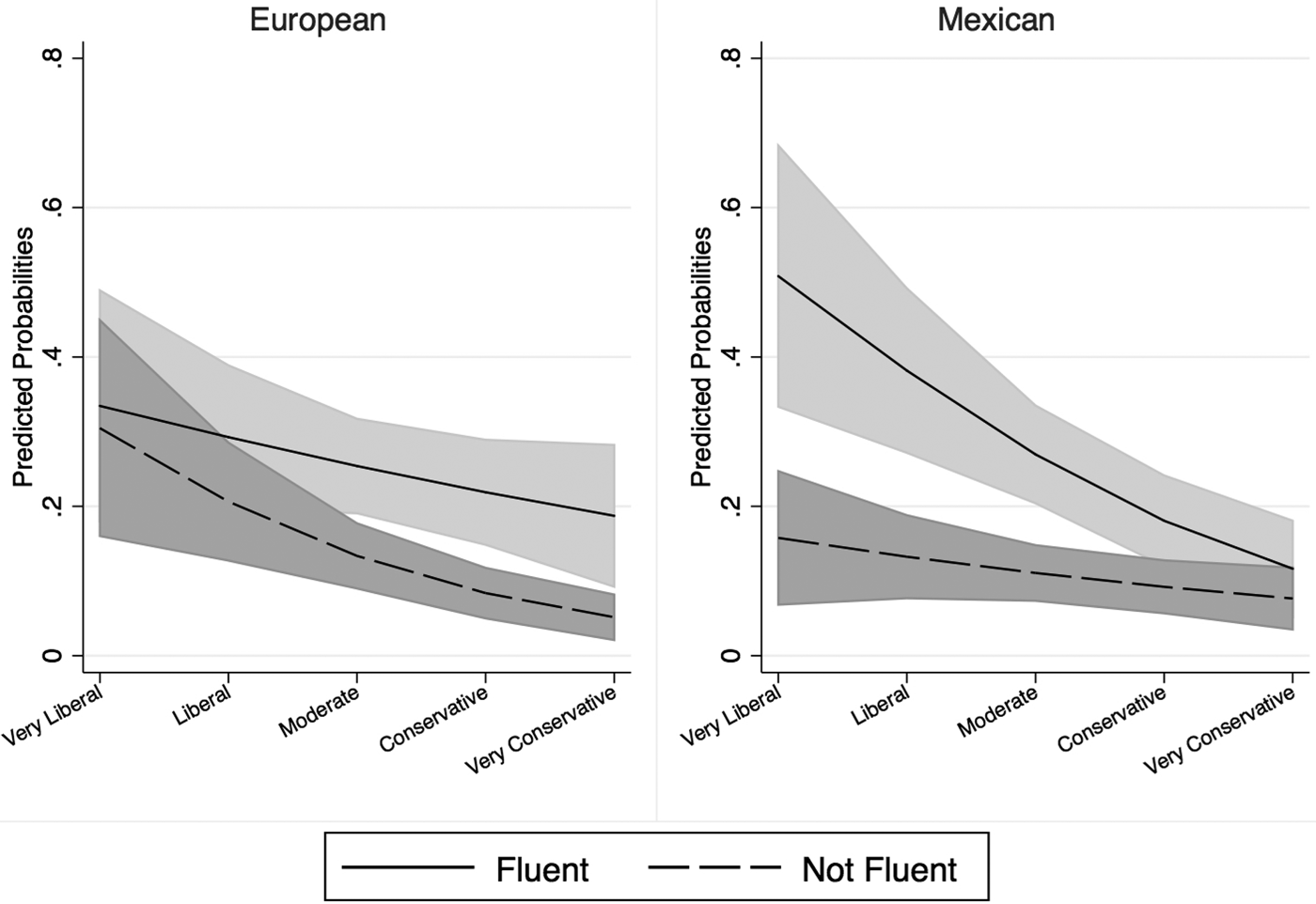
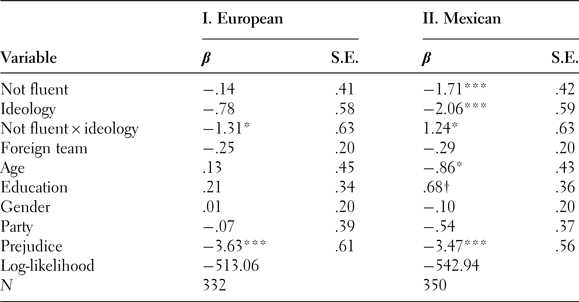
Finally, hypothesis 4a predicts that conservatives (and Republicans) will prefer a norm-following European immigrant over a norm-violating European, but that norms will matter less in evaluations of Mexicans. Hypothesis 4b predicts that liberals (and Democrats) and moderates (and independents) will react negatively to norm violations by all immigrants. To test these hypotheses, Table 4 is analogous to column II of Table 3 in that the interaction between respondent ideology and immigrant language is explored. However, Table 4 presents separate models for respondents asked about Europeans versus Mexicans.Footnote 24 Unlike in previous tables, the interaction terms in Table 4 are significant, signaling heterogeneous treatment effects across the ideological spectrum. To understand the heterogeneous treatment effects, Figure 6 plots the predicted probabilities generated from both models in Table 4.
Predicted Probabilities of Strong Support, Immigrant Language, and Respondent Ideology, by Region of Origin.

Ideology and Fluency Interactions, by Region of Origin

Note: †p < .1; *p < .05; ***p < .001.
Figure 6 lends support to hypothesis 4a, as English language fluency matters to conservative respondents only when the immigrant is European. Conservatives are very unlikely to support green cards for Mexicans, regardless of language abilities. It may be the case that conservatives are inundated with news from conservative media outlets that depict Latino immigrants in a negative light (de Zúñiga, Correa and Valenzuela Reference de Zúñiga, Correa and Valenzuela2012). Conservatives may then hold an anti-Latino bias in immigration attitudes, making them especially unwilling to accept Latino immigrants as permanent members of society. However, it is not the case that norms are inconsequential for conservatives, as the language norm violation affects their evaluations of Europeans in the expected manner.
In regard to hypothesis 4b, an unexpected result emerges. While moderates are unaffected by an immigrant's region of origin, liberals show a dramatic boost in support for English speaking Mexican immigrants, but English fluency matters less in liberal evaluations of Europeans. It is likely that liberals are predisposed to hold pro-immigration attitudes overall, and that they associate immigration with Latinos. If both of these assumptions are true, then liberals may hold pro-immigration attitudes specifically in regard to Latino immigrants. In other words, they are probably not thinking about Europeans when they form their overarching immigration attitudes. Therefore, when liberals read about someone they may view as an exemplary Latino immigrant—a man who is an upstanding member of society (follows p-norms) and fits in culturally (speaks English)—everything lines up nicely for them. Liberals can express a pro-immigration outlook in evaluations of a person who matches the image they envision when thinking about immigrants.
Conversely, the least preferred immigrant among liberals is a Latino who lacks English fluency. Perhaps liberals experience a cognitive dissonance when evaluating a norm-violating Latino. If it is true that liberals are predisposed to be accepting of immigrants, and if they assume most immigrants are Latino, but they nonetheless dislike the language norm violation, it then follows that liberal attitudes toward the norm-violating Latino do not line up with their pro-immigration predispositions. People feel discomfort when they experience cognitive dissonance (Kuklinski et al. Reference Kuklinski, Quirk, Jerit, Schwieder and Rich2000; Kunda Reference Kunda1990; Lodge and Taber Reference Lodge and Taber2013), and perhaps such discomfort induces liberal respondents to be less supportive of the norm-violating Latino than they are of the norm-following Latino and Europeans.
It is more difficult to explain why language is not so consequential in liberal evaluations of Europeans (although, the English-speaking European is slightly favored over the norm-violating European). Perhaps liberals assume that even Europeans who lack English fluency are better-suited to fit in with American culture than they assume of Latinos who do not speak English, maybe even assuming that Europeans who grapple with language barriers are more likely to eventually learn English than are Spanish-dominant Latinos. In the end, support for hypothesis 4b is mixed, as moderates, but not liberals, behave in the predicted manner.
What is clear from Figure 6 is that, while there is a “hidden American immigration consensus” in the sense that people across the prejudice spectrum and regardless of their political orientations agree that English matters, political orientations like ideology color the lens through which respondents view norm violations, depending on the face of the norm violator.
Subgroup analyses analogous to those in Table 4 and Figure 6, but focused on partisanship instead of ideology, were carried out but are not presented in the interest of space because the results once again mirror those with ideology.Footnote 25 Democrats are less responsive to norm violations by Europeans, enthusiastically support green cards for English-speaking Mexicans, and support for Spanish-dominant Mexicans is low. Independents and party leaners prefer English speaking-immigrants over those who lack English fluency, regardless of region of origin. Republicans are quite unsupportive of green cards for Mexicans, regardless of the immigrant's language abilities, and significantly prefer English-speaking Europeans over Europeans who do not speak English.
Finally, it should be noted that analyses analogous to Table 4 and Figure 6 were also carried out using prejudice instead of ideology. Results are not shown because people along the prejudice spectrum do not react differently to norm violations by Europeans versus Mexicans. This suggests that it is not simply the case that conservatives are more likely to be prejudiced, and that such prejudice is driving the results in Figure 6. If this were the case, one would expect similar patterns to emerge in analyses with the prejudice measure (and in any event, prejudice is controlled for in the models used to create Figure 6). Instead, it seems that immigration from Mexico is politicized in such a manner that makes conservatives quite unsupportive of Mexican immigrants.
CONCLUSION
Among white Americans, regardless of levels of tolerance/prejudice and political orientations, it is important that immigrants speak English. There is also evidence that an aspect as seemingly trivial as sports fandom has a marginal impact on the propensity to accept immigrants. Rather than structure attitudes as language does, national sports allegiance can provide an extra little push in support for or opposition to green cards among respondents who do not hold strong opinions in either direction. Overall, the results reveal that, while it is popular to couch opposition to immigration in the language of p-norm violations, where some may assert that they feel no discomfort with foreign cultures, such assertions do not represent the whole story. Instead, even when respondents face an immigrant who is an upstanding member of society (a p-norm follower), c-norm violations reduce respondents’ willingness to accept immigrants as permanent residents. Although the results support the assertion that a “hidden American immigration consensus” exists (Hainmueller and Hopkins Reference Hainmueller and Hopkins2015, 531), as English fluency matters across the board, political orientations affect reactions to norm violations depending on the face of the norm violator. Therefore, this paper deepens understanding of immigration attitudes by clarifying the conditions under which norm violations are more or less salient.
In regard to future research, scholars should explore how racial and ethnic minorities in the United States react to norm violations by immigrants. Additionally, researchers should evaluate whether the patterns found in the United States can be replicated in other countries, as many societies grapple with the integration of immigrants. A third avenue for future research is to explore the impact of bilingualism on attitudes toward immigrants. As discussed earlier, some might assert that English fluency matters, not because of an aversion to non-American cultures, but because people are concerned about immigrants’ abilities to contribute to the economy, and not speaking English may hinder economic success. Yet, a bilingual immigrant who is fluent in English faces no such linguistic barriers to economic success. Therefore, if people continue to show aversion toward a bilingual immigrant who sometimes chooses to speak Spanish, it seems likely that such an aversion is culturally-based.
Nonetheless, because the immigrant in the green card experiment was always described as employed, respondents were prevented from assuming that language barriers hindered the immigrant's ability to secure and retain employment, and to contribute to the economy through employment. This is not to assert that sociotropic economic considerations are not present in people's assessments of an immigrant's language skills, but sociotropic considerations and an aversion to norm violations are not mutually exclusive, and it is difficult to deny that language is intimately tied to culture. Moreover, “Immigrants’ support for sports teams should have little bearing on their economic prospects, for instance, so a positive reception for an immigrant who roots for the LA Dodgers would be evidence for norms-based approaches” (Hainmueller and Hopkins Reference Hainmueller and Hopkins2015, 31). While the impact of national sports allegiance on green card attitudes is quite small, there does seem to be a marginal preference for American sports fans, lending additional support to a norms-based approach.
In regard to the national sports allegiance treatment, one may feel that the design includes a confound, and may assert that it would have been better to keep the sport constant. However, the two different sports were selected for a couple reasons. First, it was imperative to choose a sport in the c-norm following condition that is synonymous with “Americanism.” Football is the clear choice. In a Pew Research Center survey, 34% of Americans named football as their favorite sport to watch, taking the top spot among all sports (Taylor, Funk and Craighill Reference Taylor, Funk and Craighill2006). Some may say that baseball signals “Americanism” as well, but baseball has waned in popularity. Baseball takes the third place spot as Americans’ favorite sport, with 13% of the vote in the Pew survey. Moreover, baseball is a more global sport than football, and is popular in Latin America. Since the goal was to signal American versus non-American identity, it was necessary to make the c-norm following sports condition a solidly American one, thereby making football a better choice than baseball. Of course, it would not make sense to hold football constant across conditions, as the sport is not played around the world. On the other hand, soccer is popular in Europe and Latin America. Additionally, only 4% of Americans named soccer as their favorite sport (Taylor, Funk and Craighill Reference Taylor, Funk and Craighill2006). In the end, the hypothesis pertaining to national sports allegiance was not explicitly concerned with the effect of soccer versus football but instead sought to explore the effect of American versus non-American identity, as signaled through sports. Therefore, by including two indicators of national identity in the treatments, the sport and the team, the design may have only strengthened the American versus non-American signals sent to respondents, achieving the goal set in designing the experiment.
With immigration being salient on the national political stage, it is necessary to fully understand attitudes toward immigrants. Immigrants have been in the United States since the country's founding and will continue to shape the nation. In the ever-changing and increasingly ethnically, racially, and culturally diverse United States, fostering amicable relations among the groups in society is a worthy goal. To understand the best way to reduce tensions between rooted natives and immigrants, one must first understand why tensions arise. This paper clarifies such an understanding, and carries implications and lessons.
Notably, the desires of Latinos and many Americans are not at odds. As discussed earlier, Latinos in the United States overwhelmingly agree that Latinos should speak English. Most white Americans—Democrats, liberals, independents, and moderates—are more willing to accept Latino immigrants who speak English. It is, therefore, possible that most white Americans and Latinos would support government efforts to provide more English language programs. Of course, conservatives and Republicans are likely to oppose such programs, not only because of their attitudes toward Latino immigrants, but also because they are, by definition, more likely to oppose government intervention and spending.
If conservative and Republican attitudes are to evolve on immigration, it may be the case that the leadership (in conjunction with conservative media outlets) would have to lead the way, as it seems that attitudes toward Latinos have been politicized in a manner that makes conservatives and Republicans unlikely to support immigration from Latin America. Although Donald Trump forwarded an anti-immigrant platform to win the 2016 presidential election, other prominent Republicans have expressed concern over alienating Latinos. For example, Lindsay Graham stated that Republicans are in a “demographic death spiral” (Graham Reference Graham2013). The ability of such concerns to actually produce a shift in how immigration is politicized by conservative leaders, however, seems unlikely, especially since Trump's victory. If anything, conservative and Republican leaders are likely to continue politicizing immigration from Latin America in a manner that exacerbates anti-Latino affect among the public.
Acknowledgements
I thank Paul Sniderman and Mike Tomz for funding this project through Stanford's Laboratory for the Study of American Values (SLSAV), as well as for their comments. Additionally, many thanks to Gary Segura, David Laitin and all the participants in the SLSAV for the invaluable critiques.
SUPPLEMENTARY MATERIAL
The supplementary material for this article can be found at https://doi.org/10.1017/rep.2017.24.