Introduction
Current theories of post-traumatic stress disorder (PTSD) place considerable emphasis on the role cognitive distortions such as self-blame, hopelessness or preoccupation with danger play in the etiology and maintenance of the disorder. Some authors have implicated mainly specific thoughts about the dangerousness of the world and one's perceived weaknesses (Foa & Rothbaum, Reference Foa and Rothbaum1998; McCann & Pearlman, Reference McCann and Pearlman1990; Resick & Schnicke, Reference Resick and Schnicke1992) whereas others have focused on negative appraisals of the traumatic event itself in addition to one's own reactions during the event (Ehlers & Clark, Reference Ehlers and Clark2000). Although these models highlight somewhat different cognitive factors influencing post-traumatic functioning, each model emphasizes the salient role of maladaptive cognitions as a maintenance factor in PTSD. A series of studies has shown that individuals who meet criteria for current PTSD have significantly more negative beliefs about the world and themselves compared to healthy traumatized and non-traumatized individuals, and that such cognitive distortions can predict concurrent and future PTSD symptom severity over and above symptoms of acute stress disorder (ASD), depression or anxiety (Ehlers et al. Reference Ehlers, Mayou and Bryant1998; Foa et al. Reference Foa, Ehlers, Clark, Tolin and Orsillo1999; Dunmore et al. Reference Dunmore, Clark and Ehlers2001; Beck et al. Reference Beck, Coffey, Palyo, Gudmundsdottir, Miller and Colder2004; Kleim et al. Reference Kleim, Ehlers and Glucksman2007; Moser et al. Reference Moser, Hajcak, Simons and Foa2007; Ehring et al. Reference Ehring, Ehlers and Glucksman2008; Karl et al. Reference Karl, Rabe, Zollner, Maercker and Stopa2009). Furthermore, therapy-induced reductions in negative cognitions have repeatedly been shown to be associated with reductions in PTSD symptom severity (Foa & Rauch, Reference Foa and Rauch2004; Ehlers et al. Reference Ehlers, Clark, Hackmann, McManus and Fennell2005; Karl et al. Reference Karl, Rabe, Zollner, Maercker and Stopa2009), underscoring the influence of cognitive distortions on symptom maintenance.
In the acute aftermath of a traumatic event it is imperative to identify early markers for pathogenesis so as to determine who is at risk and should thus be offered close monitoring or early interventions. Equally, identification of protective factors exhibited in resilient individuals would inform neurobiological models of PTSD and could be of use in the development of early interventions. Previous studies have shown that cognitive distortions in the early aftermath of man-made and non-man-made traumatic events can predict future PTSD severity over and above early symptomatology (Kleim et al. Reference Kleim, Ehlers and Glucksman2007; O'Donnell et al. Reference O'Donnell, Elliott, Wolfgang and Creamer2007), but very little is known about causal processes underlying this trajectory. To our knowledge, no studies have investigated the neural underpinnings of the association between cognitive distortions and symptom severity in acutely traumatized samples. Patients with ASD typically show a significant autonomic response when confronted with trauma cues that can predict PTSD development over and above symptom severity (Ehlers et al. Reference Ehlers, Suendermann, Boellinghaus, Vossbeck-Elsebusch, Gamer, Briddon, Martin and Glucksman2010) and has been linked to amygdala activation (Lanius et al. Reference Lanius, Hopper and Menon2003). However, Elsesser et al. (Reference Elsesser, Freyth, Lohrmann and Sartory2009) reported that cognitive distortions and autonomic reactivity were only loosely related in a sample with ASD, which raises the question which neurobiological processes mediate the relationship between cognitive distortions and PTSD development. We therefore conducted a combined questionnaire and functional magnetic resonance imaging (fMRI) study in which we applied the well-established traumatic script-driven imagery paradigm to investigate the neural activations during trauma recall. As the hyperarousal reaction assessed by Elsesser et al. (Reference Elsesser, Freyth, Lohrmann and Sartory2009) did not account for the correlation between cognitive distortions and symptom severity, we hypothesized that the severity of cognitive distortions would be directly related to activation in brain areas previously implicated in intrusive trauma recall and emotion regulation. In turn, such activation differences were hypothesized to correlate significantly with symptom severity scores at 12 weeks post-trauma.
Method
Participants and procedure
This study included 106 subjects (mean age=37.7±14.0 years; females n=71) who presented to the Emergency Department at the London Health Sciences Centre in London, Ontario or to the Department of Emergency Medicine at the University of Alberta in Edmonton, after they had been involved in a motor vehicle accident (n=94), workplace accident (n=6), physical assault (n=2), or another traumatic event (n=4). Of the current sample, 8.5% (n=9) left high school before completing grade 12, 18.9% (n=20) reported holding a high school diploma, 24.5% (n=26) attained some university or college education, another 36.8% (n=39) finished this with a degree, an additional 8.5% (n=9) with a graduate degree.
All subjects met DSM-IV criteria A for PTSD. Subjects were assessed three times within the first 3 months post-trauma (t1 n=84, t2 n=96, t3 n=77). A subsample of 20 subjects (age=36.4±12.5 years, females n=17, motor vehicle accident n=19, physical assault n=1) underwent an fMRI scan at 2 to 4 months post-trauma. Exclusion criteria for all participants were: (i) significant head injury, (ii) history of neurological disorders, (iii) lifetime history of bipolar disorder or schizophrenia, and (iv) concurrent psychiatric illness. For the MRI sample, lifetime psychiatric history and psychotropic or steroid medication were also excluded. The study was approved by the research ethics board at the University of Western Ontario and the University of Alberta and informed written consent was obtained from all patients.
Measures
The Acute Stress Disorder Scale (ASDS; Bryant et al. Reference Bryant, Moulds and Guthrie2000; α=0.945) is a 19-item questionnaire that measures the severity of ASD symptoms on a five-point Likert scale (1=not at all, 5=very much). We applied a cut-off score of 56 to establish diagnostic status 1 to 2 weeks post-trauma (Bryant et al. Reference Bryant, Moulds and Guthrie2000). The Clinician-Administered PTSD Scale (CAPS; Blake et al. Reference Blake, Weathers, Nagy, Kaloupek, Gusman, Charney and Keane1995; α=0.952) is a semi-structured clinical interview that assesses post-traumatic symptoms as defined in the current DSM-IV. Severity scores were calculated as the sum of frequency and intensity ratings across all DSM-IV symptoms of PTSD and diagnostic status was coded as CAPS <50 indicating subclinical and CAPS >50 indicating clinically significant symptoms. The Cognitive Distortions Scales (CDS; Briere, Reference Briere2000; α=0.974) is a 40-item questionnaire assessing five types of cognitive distortions with a five-point Likert scale (1=never to 5=very often in the past month). As all five subscales have been shown to be predictive of PTSD symptom severity, we used a total score in all analyses presented in this article. The Mood and Anxiety Symptom Questionnaire – Short Form (MASQ; Watson & Clark, Reference Watson and Clark1991) is a 62-item measure assessing symptoms that commonly occur in the mood and anxiety disorders on a five-point Likert scale (1=not at all, 5=extremely). The Responses to Script-Driven Imagery Scale (RSDI; Hopper et al. Reference Hopper, Frewen, Sack, Lanius and van der Kolk2007) is an 11-item self-report measure of state PTSD and dissociative symptoms evoked by script-driven imagery using a seven-point Likert scale (0=not at all, 6=a great deal). The re-experiencing subscale consists of four items specifically assessing intrusion characteristics.
Statistics
Group statistics were calculated as Pearson correlations and two-sample t tests. Correlation coefficients were compared using usignificance (http://peaks.informatik.uni-erlangen.de/cgi-bin/usignificance.cgi). A stepwise linear regression analysis was used to predict concurrent and future PTSD symptom severity as a function of trauma-related cognitions after accounting for gender, ASD symptoms as measured with the ASDS, and general distress, anxiety and depression as measured with MASQ. In addition, we performed a stepwise binary, logistic regression analysis with Wald χ2 statistics to predict diagnostic status. Statistical analyses were carried out using SPSS version 15.0 (SPSS Inc., USA).
Functional imaging paradigm
We used a well-established script-driven symptom provocation paradigm (Lanius et al. Reference Lanius, Williamson, Densmore, Boksman, Gupta, Neufeld, Gati and Menon2001). Pre-recorded 30-s scripts were read to the participant. Participants were asked to focus on the script and imagine all the feelings and sensations associated with the memory while listening to the script and also for 30 s after the script ends. Participants heard three neutral scripts followed by three traumatic scripts. Baseline brain activation was calculated on the basis of the average activation patterns 60 s before each recollection of the traumatic event, brain activation during the recall on the basis of the average activation patterns during the final 30 s of recall. MRI scans were performed on a 4-T whole-body Varian/Siemens imaging system (USA). Each functional brain volume was acquired by using a navigator echo-corrected, interleaved multi-shot (four shots), echo–planar imaging (EPI) pulse sequence with a 128×128 matrix size and a total volume acquisition time of 5 s [echo time (TE)=15 ms, flip angle=45°, field of view=24.0 cm]. The volume acquired covered the whole brain and consisted of 12 transverse slices, 6 mm thick (voxel size=1.87×1.87×6 mm). Image processing was performed with SPM2 (http://www.fil.ion.ucl.ac.uk/spm/software/spm2/). Volumes were realigned to the first volume of the series and parameters for normalization were determined from the mean functional image. Realigned functional images were spatially normalized to an EPI template and spatially smoothed with an 8-mm full-width at half-maximum (FWHM) isotropic Gaussian kernel.
Statistical mapping
For each subject a contrast of trauma script greater than neutral script was created. These contrasts were entered into a second-level analysis and correlations between subjects' CDS total score and the blood oxygen level-dependent (BOLD) response were examined. To our knowledge, there are no published empirical investigations into the neural correlates of cognitive distortions in acutely traumatized subjects; thus, we conducted an undirected whole-brain search with analyses thresholded at k=10 and p=0.001. In a second step, activation sites were corrected for small volume using a 10-mm sphere. A covariation analysis controlling for RSDI re-experiencing scores was calculated. Finally, we used the MarsBaR software (http://sourceforge.net/projects/marsbar/) to extract percent change (trauma script >neutral script) in the region showing the strongest correlation with CDS scores (precuneus, 10-mm sphere centered at 20, −90, 22).
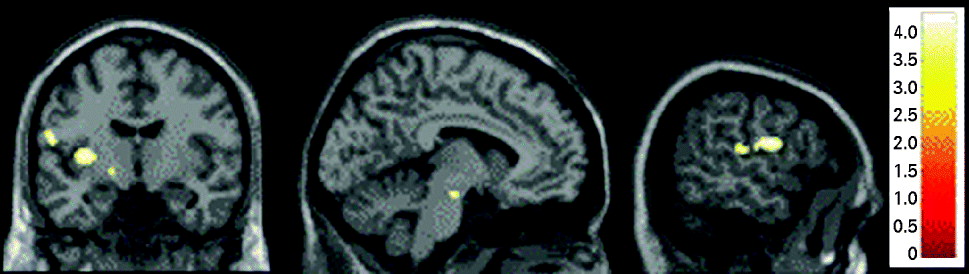
Neural correlates of cognitive distortions. Brain activations during trauma versus neutral script in the left putamen, precentral and postcentral gyri, and medial globus pallidus correlated positively with Cognitive Distortions Scales (CDS) total scores (n=20).

Results
Descriptive statistics and zero-order correlations
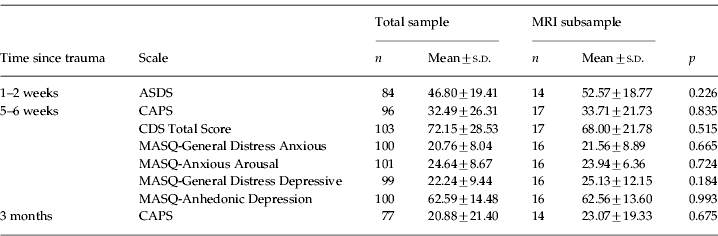
Descriptive statistics for all scales are listed in Table 1. Twenty-nine (34.5%) of the 84 subjects assessed with the ASD 1–2 weeks post-trauma met the diagnostic cut-off for ASD. At 5 to 6 weeks post-trauma, 34 (32.1%) of the 96 subjects who underwent the CAPS interview were diagnosed with PTSD. At 3 months post-trauma, 77 subjects were available for interviewing with the CAPS, 11 (14.3%) of whom met diagnostic criteria for PTSD. The mean CDS subscale scores for this sample fell below the diagnostic cut-off, but are considerably higher those published for trauma-exposed subjects in the general population (self-criticism 15.1 v. 11.9; self-blame 13.9 v. 11.1; helplessness 15.1 v. 11.1; hopelessness 13.5 v. 12.1; preoccupation with danger 14.5 v. 12.5, respectively). According to the published gender-specific norms, 34 subjects (32.07%, 24 females) scored in the clinical range on at least one, and nine subjects (8.49%, seven females) scored on all five subscales. The subgroup undergoing fMRI scanning did not differ significantly from the remaining sample in terms of psychopathology (see Table 1) and was assessed on the day of the scan for cognitive distortions as measured with the CDS (mean total score=64.3±20.29) and also for reactions to the script-driven imagery with the RSDI re-experiencing subscale (mean=1.93±1.06). These two scales correlated with r=0.437 non-significantly at p=0.054.
Descriptive statistics

MRI, Magnetic resonance imaging; ASDS, Acute Stress Disorder Scale; CAPS, Clinician-Administered Post-Traumatic Stress Disorder (PTSD) Scale; CDS, Cognitive Distortions Scales; MASQ, Mood and Anxiety Symptom Questionnaire – Short Form; s.d., standard deviation.
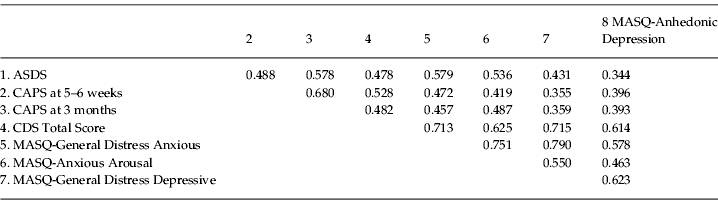
Consistent with previous studies on the relationship between PTSD and negative cognitions, the CDS total score was significantly related to PTSD symptom severity at 1 to 2 weeks (r=0.478), 5 to 6 weeks (r=0.528), and 3 months (r=0.482) post-trauma (see Table 2). However, the CDS total score correlated significantly more closely with the MASQ subscales assessing general distress at 5–6 weeks post-trauma (r=0.713, |u|=2.107, p<0.05 and r=0.715; |u|=2.141, p<0.05) than with PTSD symptom severity at all three time points. PTSD symptom severity itself was also at both time points positively related to depression (r=0.396 and r=0.393), anxiety (r=0.419 and r=0.487), and general distress (r=0.355 to r=0.472) as measured by the MASQ.
Zero-order correlations

ASDS, Acute Stress Disorder Scale; CAPS, Clinician-Administered Post-Traumatic Stress Disorder (PTSD) Scale; CDS, Cognitive Distortions Scales; MASQ, Mood and Anxiety Symptom Questionnaire – Short Form.
All values significant at p=0.001.
Regression analysis
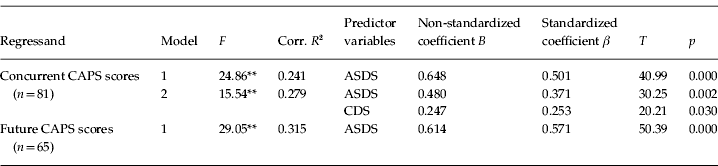
Model estimation for the prediction of PTSD symptom severity at 5 to 6 weeks post-trauma stopped after the second iteration. Educational background was not identified as a significant predictor. The final model only contained ASD symptoms and cognitive distortions as significant predictors (see Table 3). Model estimation for the prediction of future PTSD symptom severity as assessed 3 months post-trauma stopped after the first iteration, identifying ASD as the solely significant predictor.
Linear regression analyses

CAPS, Clinician-Administered Post-Traumatic Stress Disorder (PTSD) Scale; ASDS, Acute Stress Disorder Scale; CDS, Cognitive Distortions Scales.
** Significant at p=0.001.
When predicting PTSD diagnostic status instead of symptom severity, concurrent PTSD was best predicted by cognitive distortions (see Table 4). However, when predicting future PTSD diagnostic status as assessed 3 months post-trauma, ASD emerged as the only significant predictor.
Binary, logistic regression analyses

PTSD, Post-traumatic stress disorder; CDS, Cognitive Distortions Scales; ASDS, Acute Stress Disorder Scale.
PTSD diagnostic status defined as Clinician-Administered PTSD Scale (CAPS) score <50 or >50.
* Significant at p=0.001.
fMRI results
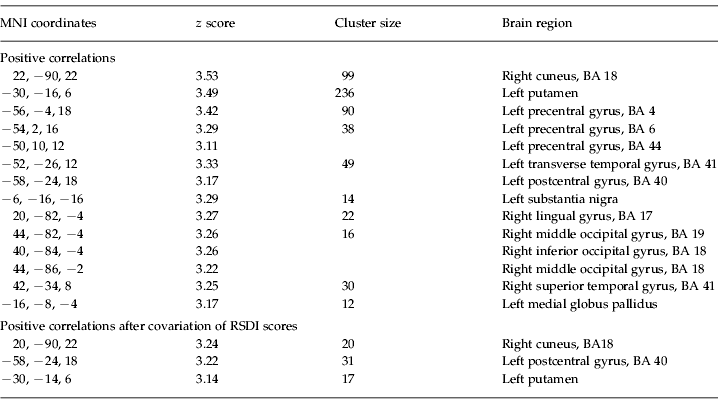
The CDS total score was significantly correlated with BOLD signal intensity during trauma recall in several brain areas previously implicated in imagery, autobiographic memory recall, and motor preparation (see Table 5). The strongest correlations emerged with a cluster in the visual cortex and multiple sites in the primary and secondary somatosensory cortex [Brodmann area (BA) 4, 6, 40, 44] and also in the basal ganglia (i.e. dorsal striatum, globus pallidus and substantia nigra) (see Fig. 1). Finally, significant correlations could be established with areas in the inferior and middle occipital gyri (BA 18, 19) and also the superior temporal gyrus (BA 41).
Brain activations during trauma versus neutral script correlated significantly with CDS total score (n=20, p=0.001, corrected for small volume)

CDS, Cognitive Distortions Scales; MNI, Montreal Neurological Institute; BA, Brodmann area; RSDI, Responses to Script-Driven Imagery Scale.
After controlling for RSDI re-experiencing scores, only three small brain areas remained significantly correlated with the CDS total score: the cuneus (BA 18), the postcentral gyrus (BA 40) and the putamen.
Percent change scores in the precuneus (mean=0.0825, s.d.=0.6558) correlated with r=0.542 (p=0.014) with CDS scores. In a subgroup of 12 subjects available for assessment at t3, percent change scores in the precuneus did not correlate significantly with CAPS scores at 12 weeks post-trauma (data not shown).
Discussion
To our knowledge, this is the first study investigating the relationship between cognitive distortions, PTSD symptom severity and brain activation during trauma recall in an acutely traumatized sample. Consistent with previous investigations, the present study demonstrated a positive relationship between cognitive distortions and concurrent and future PTSD severity. However, although cognitive distortions predicted concurrent symptom severity over and above severity of ASD symptoms, they failed to significantly enhance prediction of future PTSD symptom severity or future diagnostic status. The CDS total score was significantly correlated with BOLD signal intensity during trauma recall in several brain areas previously implicated in imagery, autobiographic memory recall, and motor preparation. The neuroimaging data presented here suggest that subjects characterized by stronger cognitive distortions tend to re-experience the traumatic event during script-induced imagery significantly more vividly and in more detail.
Questionnaire study
Regression analyses indicated that gender, educational background, marital status, depression, anxiety or general distress did not account for the association between cognitive distortions and PTSD. Cognitive distortions predicted concurrent PTSD symptom severity over and above ASD severity and were the best predictor of concurrent diagnostic status. However, they could not be established as a significant predictor of future PTSD symptom severity or diagnostic status once ASD severity was taken into account. Together, these data provide support for the unique importance of negative self-cognitions in relation to concurrent PTSD symptom severity, but call into question their predictive value in an acutely traumatized sample. They might therefore best be understood as an inherent part of PTSD. Many studies have noted high rates of co-morbidity between PTSD and depression (e.g. Kessler et al. Reference Kessler, Sonnega, Bromet, Hughes and Nelson1995; Perkonigg et al. Reference Perkonigg, Kessler, Storz and Wittchen2000). Similarly, depressive symptoms were related to PTSD symptoms in the present study. However, once negative trauma-related cognitions were taken into account, PTSD symptoms were unrelated to symptoms specific to depression, anxiety or general distress. These findings suggest that the relationship between depressive symptoms and PTSD may be accounted for by negative trauma-related cognitions, further highlighting the significance of negative trauma-related cognitions in understanding the development and maintenance of PTSD.
fMRI study
Activity in the visual cortex was significantly correlated with CDS scores (BA 18; Hasnain et al. Reference Hasnain, Fox and Woldorff1998), indicating stronger visual activity during the script-induced imagery in subjects with more severe cognitive distortions. Positive correlations were also established with multiple sites in the precentral, postcentral and transverse temporal gyri known to be recruited during vivid imagery (Gerardin et al. Reference Gerardin, Sirigu, Lehericy, Poline, Gaymard, Marsault, Agid and Le Bihan2000; Yoo et al. Reference Yoo, Freeman, McCarthy and Jolesz2003; Gilboa et al. Reference Gilboa, Winocur, Grady, Hevenor and Moscovitch2004; Szameitat et al. Reference Szameitat, Shen and Sterr2007; Munzert et al. Reference Munzert, Zentgraf, Stark and Vaitl2008; Guillot et al. Reference Guillot, Collet, Nguyen, Malouin, Richards and Doyon2009) and previously linked to processing of fear cues (Phillips et al. Reference Phillips, Young, Scott, Calder, Andrew, Giampietro, Williams, Bullmore, Brammer and Gray1998) and traumatic recall (Lanius et al. Reference Lanius, Williamson, Densmore, Boksman, Neufeld, Gati and Menon2004). Of note, a decrease in BOLD intensity in these areas during exposure to threat cues has been shown to be correlated with therapy effectiveness in a sample of borderline patients (Schnell & Herpertz, Reference Schnell and Herpertz2007) and deactivations were established in resilient, trauma-exposed subjects during a script-driven imagery investigation of childhood sexual abuse-related PTSD (Shin et al. Reference Shin, McNally, Kosslyn, Thompson, Rauch, Alpert, Metzger, Lasko, Orr and Pitman1999). Activations in somatosensory areas in conjunction with activations in the basal ganglia (i.e. putamen, globus pallidus, substantia nigra) are probably related to the so-called fear-related motor neurocircuitry (Lane et al. Reference Lane, Reiman, Bradley, Lang, Ahern, Davidson and Schwartz1997; Williams et al. Reference Williams, Phillips, Brammer, Skerrett, Lagopoulos, Rennie, Bahramali, Olivieri, David, Peduto and Gordon2001). This circuitry has been linked to cognitively induced fear and is thought to be of relevance in models of pathological fear in humans (Butler et al. Reference Butler, Pan, Tuescher, Engelien, Goldstein, Epstein, Weisholtz, Root, Protopopescu, Cunningham-Bussel, Chang, Xie, Chen, Phelps, Ledoux, Stern and Silbersweig2007). Convergently, the implication of the globus pallidus in the recall of traumatic memories has been reported previously by our group (Lanius et al. Reference Lanius, Williamson, Boksman, Densmore, Gupta, Neufeld, Gati and Menon2002; Lanius et al. Reference Lanius, Williamson, Densmore, Boksman, Neufeld, Gati and Menon2004). Taken together, these data indicate that cognitive distortions are related to vivid imagery as it is elicited by trauma cues.
This hypothesis is supported by extensive activations of brain regions involved in the recall of autobiographical memories, that is the inferior (Addis et al. Reference Addis, Wong and Schacter2007) and the middle (Piefke et al. Reference Piefke, Weiss, Zilles, Markowitsch and Fink2003, Reference Piefke, Weiss, Markowitsch and Fink2005) occipital gyri. In conjunction, these data strongly suggest that cognitive distortions are positively correlated to intrusive trauma recall in acute trauma. To test this hypothesis directly, we conducted a covariation analysis with the RSDI re-experiencing scores assessed during the scan. After accounting for re-experiencing, only three smaller brain regions in the visual and the primary somatosensory cortex and also the putamen remained significantly correlated to cognitive distortions.
Correlated activations in visual and motor areas in conjunction with brain regions associated with autobiographical memory recall might indicate that cognitive distortions are directly linked to the intrusive nature of traumatic memories. Patients with PTSD often re-experience intrusive recollections of the event in ways that are highly distressing and may be described as reliving the memory. Intrusive recall has long been theorized to be the causal agent underlying PTSD symptomatology as it indicates that the memories of the traumatic event are highly fragmented and not well integrated into the episodic memory system (for a recent review, see Brewin et al. Reference Brewin, Gregory, Lipton and Burgess2010). Narrative memories of the traumatic event develop slowly, with trauma victims initially struggling to put their experience into words (van der Kolk & Fisler, Reference van der Kolk and Fisler1995). What differentiates traumatized samples with and without PTSD is not the absolute number of intrusive memories that individuals report but the extent to which these memories are vividly relived in the present, lack context, and cause distress (Michael et al. Reference Michael, Ehlers, Halligan and Clark2005). The RSDI re-experiencing subscale used in the covariation analysis assesses precisely these characteristics. Therefore, it seems likely that specifically these intrusion characteristics are associated with cognitive distortions. Based on the cognitive models of PTSD, we expected to find a significant negative relationship between cognitive distortions and brain activation in emotion regulation areas. No such correlation could be established, although the script-driven imagery paradigm would certainly elicit emotion regulation efforts.
Activation differences in the precuneus as analyzed in a small subsample did not predict CAPS scores 3 months after the traumatic event. However, as this could be due to the small sample size, future studies should seek to predict symptom severity on the basis of BOLD signal increases in a larger sample.
Limitations
One important limitation of the current study is that all assessments were carried out post-trauma. Thus, it is impossible to determine whether negative trauma-related cognitions are part of, or cause, PTSD. The scale measuring cognitive distortions used in this study does not assess catastrophizing interpretations of PTSD symptoms, which have been hypothesized to be involved in symptom maintenance (Ehlers & Clark, Reference Ehlers and Clark2000). This might have contributed to the limited predictive power concerning future symptom severity. Future studies should therefore separately investigate the neural correlates of such interpretations. Because of power limitations, fMRI results were not covaried for depression and anxiety symptoms. Future studies should use samples large enough to allow for such additional analyses.
Conclusions
Notwithstanding the above concerns, this investigation revealed a significant relationship between cognitive distortions and concurrent PTSD severity, but failed to establish such distortions as a significant predictor of future PTSD symptoms once initial symptom severity was accounted for. The fMRI study exposed a significant relationship between cognitive distortions and neural activations associated with imagery and autobiographical memory recall in an acutely traumatized sample. Taken together, these data indicate that cognitive distortions may be an inherent part of PTSD and may be directly associated with the intrusive nature of trauma memories.
Acknowledgments
The work presented in the manuscript was supported by a grant from the Canadian Institutes of Health Research. K. Hegadoren and B. H. Rowe are supported by 21st Century Canada Research Chairs from the Government of Canada (Ottawa, ON). N. J. Coupland is supported by the Alberta Heritage Foundation for Medical Research (AHFMR; Edmonton, AB).
Declaration of Interest
None.