1. Introduction
Recent studies on the electoral performance of parties in Central and Eastern Europe (CEE) reveal the vital role of their organizational strength (van Biezen Reference van Biezen2003; Gherghina Reference Gherghina2014; Tavits Reference Tavits2013; Webb and White Reference Webb and White2007). Political parties do not exist in vacuum, but are an integral part of society through their organizational presence across communities and through the activities of their members during and between elections (Gherghina et al. Reference Gherghina, Iancu and Soare2018). In such context, parties with extensive organizational network and membership, continuity of representation and decentralized candidate selection are more capable of establishing firm links with society and, thus, improving their electoral performance (Gherghina Reference Gherghina2014). The recent experience of the communist successor parties, however, questions the validity of this notion in absolute terms. On the one hand, existing studies on parties with roots in the communist regime in the form of property, membership and/or leadership (Ishiyama Reference Ishiyama1995 p. 148), emphasized the crucial role of their party organizations for their electoral performance. In the 1990s these parties inherited from their predecessors extensive and largely intact organizational networks with considerable memberships that aided their electoral survival in the initial democratic elections following the end of the authoritarian regimes in CEE (Bozoki and Ishiyama Reference Bozoki and Ishiyama2002; Grzymala-Busse Reference Grzymala-Busse2002). Even nowadays communist successor parties remain among the largest organizations in the party systems in CEE (van Biezen et al. Reference van Biezen, Mair and Poguntke2012). Yet, while these parties have extensive organizational networks, some continuity of representation and centralized candidate selection (Bozoki and Ishiyama Reference Bozoki and Ishiyama2002), it was their non-material resources, such as usable pasts and cadre expertise that shaped their electoral redemption and eventual return to power by the turn of the century (Grzymala-Busse Reference Grzymala-Busse2002). This suggests that the strength of party organization should be rather understood in relative terms. The main puzzle in this respect is to what extent the party organizations of communist successors in Central and Eastern Europe explain their electoral performances in the past decade.
A suitable methodological and theoretical approach to this puzzle is the territorial distribution of their electoral support at national elections. A focus on it offers a contextual explanation for their electoral performance, as it holds the unit of analysis (a political party) and the timeframe (an electoral period) constant (Snyder Reference Snyder2001), thus placing the party in different socio-economic and political circumstances across a country. In doing so, this approach focuses on the role of party organization in a variety of social settings and its ability to use these settings for its electoral goals. In other words, the role of party organization in different conditions reveals how well political parties use their organizational capabilities, understood as the organizational resources and opportunities at a party’s disposal, for electoral mobilization. The main research question of this article, therefore, is to what extent do the organizational capabilities of communist successor parties in CEE contribute to their territorial distribution of electoral support? On the one hand, the territorial distribution of electoral support for a communist successor may be a product of the external socio-economic and political environment (H1), thus revealing a limited organizational contribution. On the other hand, a party may successfully build up electoral support across a country through its organizational capabilities (H2), highlighting the considerable role of its party organization in this respect.
This article focuses on the case of the Communist Party of Bohemia and Moravia (KSČM) from the Czech Republic, since 2010. While the party both excelled and failed electorally in the decade since the Great Recession, its territorial distribution of electoral support at national elections remains rather stable, as the party mobilizes relatively similar levels of electoral support across the 14 electoral constituencies of the country. A study of the reasons for this development reveals that the party is not able to use its organizational capabilities to mobilize support. On the one hand, the party remains present across the country through its comprehensive organizational network that allows it to mobilize its core voters across the Czech Republic. On the other hand, KSČM struggles to expand its electoral base due to the declining activeness of its party structures across the country and due to its inability to transpose its presence and engagement with communities into a source for electoral mobilization at national elections. The main reason for these challenges is an organizational impasse, characterized by an organizational disconnect between national and regional party structures and by declining membership turnaround. Overall, the experience of KSČM could not confirm either hypothesis, suggesting that while the organizational strength is an important factor for the electoral performance of parties in CEE, the way this strength has been used by a party accounts for the extent of its influence.
The basis for this argument is the qualitative analysis of semi-structured interviews with party representatives at national and regional level and independent researchers, held prior to the 2017 general election. These interviews aimed to investigate the role of the KSČM regional party organization for the electoral performance at national elections in three Czech regions (Ústí nad Labem, South Moravia, and Prague), where the party mobilizes consistently different levels of electoral support at the 2010 and 2013 elections. This article is structured as follows: the following two sections discuss the theoretical background for the potential role of party organization to the territorial distribution of electoral performance of a party. Afterwards there is a brief presentation and justification of the research methodology, and three sections that analyse the interview data in light of the research question. A conclusion summarizes the overall argument of this article and looks into the broader implications for the party systems and for the electoral performance of communist successor parties in CEE in recent times.
2. The Role of Party Organization for the Territorial Distribution of its Electoral Support
Party organization plays a crucial role for the territorial distribution of electoral performance as it enables a party to accommodate the diverse social contexts across a country in order to handle the effects of its political structures. In this sense, a political party can shape its electoral performance through its own organizational capabilities. The main organizational capabilities of a party that allows it to do so are its organizational presence, engagement with communities, and transposition of local legitimacy.
2.1. Organizational Presence
First, organizational presence refers to the level of party complexity. Having a comprehensive territorial coverage across a country through a network of regional and local organizations, represented by active members is an important prerequisite for a party to successfully reach potential voters and mobilize them electorally (Harmel and Janda Reference Harmel and Janda1982). A party organization at a particular place offers a stable basis to facilitate the process of socialization between a party and community and perpetuate its effects throughout time (Johnston and Pattie Reference Johnston and Pattie2006). Furthermore, regional and local party structures serve as important campaign resources, through which a party can spread its electoral messages to potential voters (Seyd and Whiteley Reference Seyd and Whiteley2002). Organizational presence is expected to be the main organizational asset for communist successor parties to influence their territorial distribution of electoral support. Previous studies regularly emphasize their comprehensive organizational networks and high levels of membership in comparison with their political and electoral opponents (Bozoki and Ishiyama Reference Bozoki and Ishiyama2002). Yet, despite this organizational advantage, their membership experiences continue to decline (van Biezen et al. Reference van Biezen, Mair and Poguntke2012), which may prevent communist successors from maximizing their electoral potential across a country. Nevertheless, it is expected that the territorial outreach of its party organization and the concentration of its members across a country reveal the organizational abilities of a communist successor to influence the territorial distribution of its electoral performance.
2.2. Engagement with Communities
Second, engagement represents the level of activity of party organization across communities. Being present across a country is not enough for a party to shape its territorial distribution of electoral support. There is need for active interaction with society in order to successfully develop a lasting association between a voter and a party and, thus, improve the electoral potential of a party within a community. In other words, a party needs to be active in a community in order to become a viable electoral option for the electorate. To do so, a communist successor may rely on two specific factors. First, it can be engaged in regional and local politics. By representing particular regional or local interests in the system of regional governance, a communist successor may in fact use this system to build local legitimacy across a territory that can be mobilized electorally at national elections. While such engagement may not be completely relevant for communist successors, as the majority of the post-socialist democratic systems across CEE remain unitary, the history of their predecessors during the inter-war period highlights the electoral potential of using regional governance. For example, between 1910 and 1923, the Bulgarian Communist Party established in the places where it governed so-called ‘municipal communes’, providing cradle-to-the-grade services and, thus, promoting its political programme. In this respect, the more engaged a party is in regional and local politics across a country, the more impactful would be its party organization on the territorial distribution of electoral support.
Second, a party can interact with a community through its relations with mass organizations and social movements that share its ideological and programmatic aims. Supporting or facilitating joint campaigns with non-party organizations highlights the sensitivity of a party organization to the specific regional socio-economic and political conditions and, thus, allows it to build electoral support as a reliable local actor. Despite the declining influence of mass organizations in CEE, these relations have made an important contribution to the electoral recovery of communist successors since the 1990s (Waller Reference Waller1995). Furthermore, since the turn of this century, CEE has experienced noticeable growth in activity from organized civic society (Forbrig and Demeš Reference Forbrig and Demeš2007), which can potentially also be of benefit for communist successors. In this context, if a communist successor maintains active relations with mass organizations and social movements across communities, these should highlight the impact of party organization on the territorial distribution of its electoral performance.
2.3. Transposition
Third, in order to make an impact of its organizational presence and local engagement, a party organization should be able to transform these experiences into electoral capital in national elections. This article calls this transformation a transposition, as it essentially requires a party to bridge its engagement at sub-national level with nationwide political contexts. Pivotal for transposition is the level of autonomy of sub-national party structures from the national headquarters. Existing work has highlighted that both a centralized party authority around the party elite, if not leader (Grzymala-Busse Reference Grzymala-Busse2002; Keith Reference Keith2011), as well as decentralized party powers that control the party leadership and provides other party organs with powers (Gherghina Reference Gherghina2014; Harmel and Janda Reference Harmel and Janda1982) can lead to improved electoral performance at national elections. From that perspective, the transposition of local presence and engagement consists of two main factors. First, the internal party procedures of candidate selection can bring the communist successor closer to communities across a country. In particular, this can be done by providing regional and local organizations with candidate selection powers, which enables the promotion of candidates with local electoral credibility and reflecting local conditions (Gherghina Reference Gherghina2014). Therefore, by involving sub-national party organizations in the decision-making process related to national elections a communist successor highlights the importance of its own organizational network for mobilizing electoral support across a country.
Second, the particular approach of an electoral campaign can further influence the extent a party organization shapes the electoral performance across a territory. In this respect, generally at national elections, parties strive to communicate a coherent electoral message across a country in order to maximize their voter potential. Hence, its campaign efforts should focus on ensuring such coherence. In order to achieve this, a party requires a centralized electoral campaign that coordinates and controls the efforts of regional and local party organizations to mobilize support at national elections. Therefore, the more centralized, the more influential will be the party organization for the territorial distribution of electoral support at national elections.
Overall, a party organization can influence the territorial distribution of electoral performance in three main ways. First, it should be present across a country, reflected in the organizational outreach and concentration of party members. Second, it should be engaged across communities through its involvement in regional and local politics and through its relations with non-party organizations. Third, it should be able to transpose its regional and local presence and engagement across a country into a source of electoral mobilization at national elections through a decentralized candidate selection procedure and centralized campaign strategy.
3. Case Selection and Research Methodology
The Communist Party of Bohemia and Moravia (KSČM) is a typical case of the contemporary experiences of communist successor parties in CEE, for three main reasons. First, the party experienced a noticeable decline in its performance in the last decade compared with the 2000s. While its average electoral support in the 2000s was 15.7%, this decade the party dropped to 11.3% on average (Czech Statistical Office 2018). Second, the party remains a permanent actor in the Czech parliamentary arena, in spite of the fact that it kept ‘communism’ in its name. Third, organizationally the party remains the largest Czech party in terms of membership (Gherghina Reference Gherghina2014), highlighting the potentially significant role of its party organization for its territorial distribution of electoral performance. Overall, KSČM represents one of the most likely cases of shaping its electoral performance through its organizational capabilities.
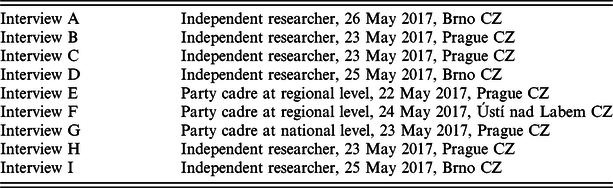
In contrast to previous studies on the territorial distribution of electoral support for KSČM, this article relies on a qualitative research design, given the focus on the role of party organization. This, therefore, demands data directly or closely associated with the party. In such a context, primary data came from semi-structured interviews with KSČM elite cadres at national and regional level, as well as with independent researchers who follow closely the developments of the party (see Table 1). While such data, especially from the former, may be biased, given the direct relation of the interviewee and the object of study, it is nevertheless worth engaging in a discussion with such sources, as they dispose of rich experience in electoral and party politics, and thus, may provide important insights for the actual role of party organization across different settings.
List of cited interviews

The identification of potential interviewees from KSČM followed a two-stage process. First, the electoral performance of the party in the 2010 and 2013 elections for the lower chamber of the Czech parliament, the Chamber of Deputies (Poslanecká sněmovna), was used to identify places with consistently different levels of electoral performance. That way the research can compare the role of the party organization in qualitatively different electoral settings for the party. The analysis on the electoral performances of KSČM was done at regional level (kraje), as the 14 Czech regions coincide with the electoral constituencies for parliamentary elections. The analysis at this stage identified the Ústí nad Labem, South Moravia and Capital City Prague regions as constituencies of consistently different levels of electoral support for KSČM at the 2010 and 2013 elections.
Second, executive party cadres from the KSČM regional organizations in these three regions were approached for interviews, given their recent experience in daily party and campaign work. Furthermore, executive party cadres from the national headquarters were also approached for interviews in order to obtain information about the general involvement of party structures across the Czech Republic and the ways national and regional party structures approach national elections. The identification of independent researchers was based on their previous work that explored the three party faces (Key Reference Key1964) of KSČM. These researchers are not affiliated with the party, which ensures their impartiality. The information from their interviews helped to triangulate the information from the elite interviews with party cadres.
Potential interviewees were contacted via email in two separate waves in early 2017. In total, 37 unique potential interviewees were contacted with 28 responding in total. From the 28 respondents, interviews were successfully conducted with nine persons: three party representatives (one at national and two at regional level) and six independent researchers, held at their place of work in the spring of 2017. While this may seem a limited base for an informed and comprehensive assessment, it should be noted that parties remain very secretive about their inner workings (Mudde Reference Mudde2007). This is particularly the case for KSČM, as very few academic studies on the party included insights gained from elite interviews. Hence, even if nine interviews seem very few, this still is a significant number for research of any political party. The discussions with the interviewees aimed at gathering their insights on the role of the party organization in general across the country, or in the particular region in which they live, without the intent to challenge their views. Transcripts of these interviews were analysed qualitatively with the aim of identifying common themes related to the influence of five independent variables on the territorial distribution of electoral performance of the party.
4. The Territorial Distribution of Electoral Performance of KSČM since 2010
In the past decade, KSČM participated in three elections (2010, 2013 and 2017) with noticeably volatile results. While, in 2013, the party achieved its second best vote share in Czech post-communist history (14.9%), in 2017 it dropped to an all-time low (7.8%) (Czech Statistical Office 2018). Despite its electoral volatility, the territorial distribution of electoral performance of the party remains largely unchanged. The party consistently achieves its worst results in Prague and its best performances in the Ústí nad Labem constituency, whereas in the remaining 12 constituencies the differences remain generally marginal. As it will be seen in the following, such a combination of electoral volatility and stable territorial distribution derives from an organizational impasse within KSČM, where the party both has strong and is lacking organizational capabilities. In this context, neither of the two hypotheses could be confirmed.
4.1. Passive Presence
Such an impasse is visible in the passive presence of the party across the Czech Republic. While KSČM maintains a wide territorial coverage through a vast network of party organizations, the majority of those organizations remain rather inactive. The party remains one of the largest political parties in the Czech Republic by membership numbers (van Biezen et al. Reference van Biezen, Mair and Poguntke2012). It also enjoys a dense organizational network that stretches across all regions and districts of the country, it is also present in a majority of municipalities, according to data from the official KSČM website. As one party member states in this respect: ‘We are still a mass party […] other parties don’t have structures, don’t use members’ (Interview E, 2017). This allows KSČM to ‘combine different levels of activities to [address] issues’ (Interview E, 2017), suggesting that the stability of the territorial pattern of electoral support is enshrined in its party complexity.
However, despite this comprehensive organizational presence, the party remains rather disengaged and inactive across communities. This is particularly visible in the lack of a correlation between the number of members and electoral performance. While official data are not accessible, the conversations revealed that the party has its largest party organization in Prague, where the party continuously fails to mobilize significant support. One party cadre explains this trend by the socio-economic conditions in the city: ‘We are able to mobilise vast numbers of members here in Prague, but the overall situation of wealth does not allow us to perform better’ (Interview E, 2017). More importantly, despite the importance of organization and members, the conversations revealed significant challenges for the party to maintain this network. One party cadre highlights the problem, stating that ‘we have now villages, where our local party organization does not exist since already 10 years, [although] people still vote for us there’ (Interview G, 2017). The main reason for this is the declining activity of party members: ‘Our members, unfortunately, are unable to actively support us for a long time. That is why we often don’t know whether a party organization in a particular place, especially if it is a small place, still exists’ (Interview G, 2017).
An important reason for the passivity of party members is the lack of generational turnover within the party. ‘What we lack is attracting younger members, engaging the youth, we face real challenges there’, highlights a party member (Interview E, 2017). Another adds that ‘to attract the youth we would need a fundamental change in our structures, in our approach, in our work, but I don’t see that happening for now’ (Interview G, 2017). An independent researcher explains that the sources for the lack of generational turnover are to be found in the traditionalist image of the party.
The youth is in the big cities, studying or travelling to work, very few of them remain in their place of living. […] This party, however, seems out-dated for them, very conservative, very unattractive; it does not correspond to their rather cosmopolitan views. (Interview C, 2017)
As another independent researcher highlights this is a major issue even for those who enter the party to develop as career politicians.
KSČM is very open for newcomers and will almost immediately place them on top places on their lists for local elections, for example. […] But you do some work and start to engage with the party and you clash with an ideological wall, which discourages many. (Interview H, 2017)
The outcome of such passivity is the general difficulty of the party to address the particular regional or local socio-economic conditions across the country and, hence, to build electoral support. According to the interviews these conditions determine the extent of support for the party across the country. For example, when discussing the party performance in Prague, a party representative immediately stressed that the city is an economic, financial, and service centre of the Czech Republic and that its overall higher standard of living is an important reason for the limited interest in the topics that the party raises (Interview E, 2017). In discussions with independent researchers, it comes out that Prague is not an exception in this respect, as other major cities, such as Brno or Liberec, are in similar situation: a high standard of living stifles the appeal of topics raised by the communists (Interview B, 2017; Interview C, 2017). This suggests that due to its organizational passivity, the party is unable to offer a relevant political agenda across communities, highlighting the potentially limited role of party organization for its electoral performance and territorial distribution.
Despite its inability to mobilize support in places, where the party underperforms or achieves relatively average results, KSČM remains a viable electoral option in its strongholds. As the interviews highlighted, the historical legacies from the authoritarian communist regime in the country remain a major source of electoral mobilization for the party. A party member states in this respect that KSČM ‘reaps the [voters’] experiences from the previous regime’ (Interview G, 2017), suggesting that it is the individual relation to the past regime that determines whether a person would support the party. This is particularly visible in the sources for its strong support in the border areas of the Czech Republic. First, a party member from Ústí nad Labem pointed out the loss of industries and services after 1990 is an important factor that mobilizes people in the region to vote for KSČM (Interview F, 2017). This highlights that the social context of economic and social decline is an important factor for the strong electoral performances of the party in the Czech peripheries. Second, conversations with independent researchers attributed the strong support for the party there with the concentration of former border guards alongside the former Sudeten region (Interview A, 2017; Interview I, 2017). Given that former border guards remain an important social constituency for the party (Holubec Reference Holubec, Daiber, Hildebrandt and Striethorst2011), especially in Czech border areas where KSČM maintains an image of a representative of minor regional interests (Lach et al. Reference Lach, LaPlant, Peterson and Hill2010), it seems that the stable territorial distribution of electoral performance stems from the strong linkage between the party and its core voters. This, therefore, suggests that the role of its party organization is to maintain this linkage, while it is unable to provide resources for expanding its electoral base.
4.2. Hollowed-out Engagement
Its organizational passivity is also visible in the rather limited engagement with communities. In terms of involvement in regional politics, the party achieved noticeable success in regional elections in the past decade, but failed to use this to mobilize support in national polls. In the late 1990s, the Czech Republic introduced a comprehensive administrative reform that saw the introduction of 14 regions with some executive and legislative authority enshrined in regional governments and parliaments (Baun and Marek Reference Baun and Marek2006). Since 2002, KSČM has entered into regional governments in 12 of those (only the Prague and Liberec regions have not had communist participation in regional government), experiencing a significant rise in support at the 2012 regional elections (Ryšavý Reference Ryšavý2013) and decline in 2016 (Pink and Eibl Reference Pink and Eibl2018). This suggests that its party organization across the Czech Republic maintains significant organizational capabilities to engage with communities.
Participation in regional politics, however, does not translate into an improved electoral potential for the party at national elections for two main reasons. First, KSČM party cadres at national and regional levels were unanimous that regional politics have limited impact at national elections. This is due to the rather de-politicized nature of regional politics. An independent researcher states that
the region is the last [place] where people think [it] can change something for them. Prague is too far, it’s only taxes, but when it’s a social question it is a local question, but it is not an ideological question, not a political struggle, people had to live together. (Interview B, 2017)
In other words, it seems that regional politics in the Czech Republic remain rather detached from national politics. Second, although the involvement of the party in regional politics allowed it to detoxify to some extent its pariah image across the country (Interview E, 2017), a regional party cadre assesses its government experience as a problem for KSČM, as it has to carry the responsibility for the effects of national and regional politics on the regions where they are or were in power (Interview F, 2017). Hence, despite its involvement in regional politics, the party does not seem capable of building up electoral support across the country given its government record and the relative detachment between regional and national politics.
Similarly, the party remains rather isolated in its relations with potential non-party organizations. The interviews reveal that KSČM maintains a network of front organizations that, however, have limited social influence. Beyond these, the most effective organization affiliated with the party remains the Club of Czech Border Areas (Klub českého pohraničí) that, according to independent researchers, is still an important source for electoral mobilization in the Czech peripheries owing to the lack of mobility in these places (e.g. Interview D, 2017). Furthermore, despite the emergence of a relatively young, yet hardly influential radical left milieu of social movements in the country, the party has limited connections to it. The main reason for this is ideological differences: ‘[…] many of these organizations remain very anti-communist and suspicious for associating with the communists. Some of them are even more radical than KSČM, so it is difficult to find a common ground’ (Interview B, 2017) states an independent researcher in this respect. Similarly, linkages to mass organizations are also rather marginal for two reasons. First, trade unions maintain rather closer links with the major social democratic competitor of the party, the Czech Social Democratic Party (ČSSD), particularly in Moravia, which prevents KSČM from expanding its electoral potential (Interview D 2017; Interview E, 2017). Second, even when KSČM may enjoy some good relations with trade unions, these are rather geographically restricted:
It depends where any trade union sees it feasible to work with the communists. For example, in Ostrava they work very well, because of the huge mining business there, but across the country trade unions are reluctant in having something in common with them. (Interview D, 2017)
Overall, it seems that the party could not compensate for its organizational passivity through its linkages to non-party organizations.
The result of the limited relevance of the involvement in regional politics of KSČM and its limited linkages to non-party organizations is the lack of competitive advantages for the party vis-à-vis its direct electoral opponents. According to the interviews, the territorial distribution of electoral performance depends to very large extent on the competition with ČSSD, described by an independent researcher as a ‘zero-sum game’ (Interview H, 2017). This is due to the fact that the two left-wing parties are perceived as very similar entities by the public. One party cadre explains in this respect that ‘people don’t see major differences between us [and ČSSD]; the more they don’t see a difference, it is dangerous for us because of [the parliamentary] influence [of the social democrats] after the elections’ (Interview G, 2017). Another party cadre emphasizes that such danger is more accelerated by their differences in financial resources: ‘We cannot compete with financially healthy parties, such as the ČSSD’ (Interview F, 2017). Hence, while KSČM cannot present a distinctively different ideological profile to the social democrats, its financial disadvantage could not be overcome through its organizational capabilities.
Furthermore, given the similar ideological profiles of the two parties, they also compete for similar social groups, described by one independent researcher as ‘natural unity of [their voters] and the [current] closeness of both parties’ (Interview H, 2017), especially at regional level (Interview H, 2017; Interview D, 2017). In such a context the intensity of their competition offers a potential advantage for KSČM following a period in government for the social democrats: ‘When [ČSSD] are in power, then the communists benefit, as they can criticize the government from left-wing positions, but if the social democrats are in opposition as well, then the communists are in trouble’ (Interview H, 2017). Yet, the past decade saw ČSSD government participation only since 2013, suggesting that KSČM was not able to benefit from this advantage due to their similar status of parliamentary opposition. Only in the 2017 elections did KSČM benefit from the government participation of ČSSD, overcoming its social democratic opponents for the first time since 1992. Therefore, rather than the role of its party organization, it is the different political status of KSČM that allows it to compete with the social democrats.
Yet, when the party faces electoral competition from parties of similar political status, particularly from other anti-political establishment opponents, it rather fails to respond properly. A party cadre was clear that KSČM fails to maximize its electoral potential among protest voters, as other parties ‘offer [them] more options to choose’ (Interview E, 2017). Particular competition in this respect is seen in the centrist populist ANO 2011 and the radical right Freedom and Direct Democracy (Interview D, 2017; Interview A, 2017), mentioned regularly as direct challengers in communist strongholds. According to party cadres, the direct access to mainstream media outlets for these two parties (Interview E, 2017; Interview G, 2017) is a major reason for the inabilities of KSČM to respond to that challenge. Hence, whereas its anti-political establishment competitors have the competitive advantage of media presence, KSČM could not compensate for this organizationally, highlighting a rather limited contribution of its party organization to its electoral performance and territorial distribution.
4.3. Centralized Disorganization
The organizational impasse of the party is mostly visible in its limited abilities to transpose its organizational presence and engagement across communities into a source for mobilization at national elections. This is particularly the case regarding its candidate selection process. According to the party statutes, candidates for national positions are subject of selection through primaries among party members (KSČM 2016). Yet, the same party statutes also indicates that these selections are mere nominations and may be altered at local and regional level, while the Central Committee of the party has the final say on the list order (KSČM 2016). This suggests a slightly centralized decision-making process that potentially prevents the party from fielding candidates with local credibility in electable places. More importantly, the way the candidate selection process is conducted suggests a limited interest in regional and local organizations. For example, a party cadre at regional level described their involvement the following way: ‘well, we make our recommendation to the Central Committee and then they confirm it and that’s it’ (Interview F, 2017). This suggests that sub-national party organizations have limited involvement and, hence, contribution to the electoral performance of the party at national elections.
The limited involvement of regional and local party organizations is also noticeable in the way the party campaigns during elections. The interviews reveal that KSČM is mainly focused on distributing a common message without much experimentation and innovation. A party cadre states that ‘we don’t have different campaigns, we make meetings with our members across the country and that’s it’ (Interview E, 2017). One reason for the lack of experimentation is the previous failed attempts to do so: ‘[KSČM] tried in 2010 to do a modern campaign, with billboards and TV spots, but they haven’t got any better in terms of electoral support, so that’s why they stopped doing it’ (Interview H, 2017). Furthermore, the campaign seems to have rather limited goals, concentrated solely on ‘informing the party members and supporters about the elections, nothing else. That’s why they don’t require a more sophisticated campaign’ (Interview I, 2017). In such a context, the regional and local party structures at national elections are involved as much as they facilitate the electoral campaign in their region that was devised by the national headquarters (Interview F, 2017). Therefore, while the party maintains a rather centralized campaign effort, it is rather hollowed out due to the limited, rather technical involvement of its sub-national structures.
An important reason for such limited involvement is an apparent mismatch between the party goals at regional and at national levels. An independent researcher hints at such a mismatch in the following way:
regional party [representatives] are very distanced from national politics and very pragmatic in their work in the region. Certainly communism gives them some value orientation for their choices, but generally they don’t really differ from any other politicians on regional levels. (Interview H, 2017)
This suggests that the political expertise and behaviour of regional KSČM politicians in qualitatively different from that of national politicians. Such a difference in goals and behaviour is at the core of the inability of the party to transpose its government involvement at regional level into an electoral asset in national elections. As one regional representative explains:
The party at national level should present what it has achieved; we have mayors in towns and municipalities and we have achieved lots of things at regional and local levels, so they can use the achievements of [our region] to do that. But if the general policy [in the central headquarters] in Prague is to play the role of the opposition, they will not be willing to point these things. (Interview F, 2017)
This suggests that the party organization purposefully chooses not to transpose its involvement in regional politics due to an apparent incongruence between the office-oriented regional party branches and the rather anti-political establishment and policy-oriented national headquarters.
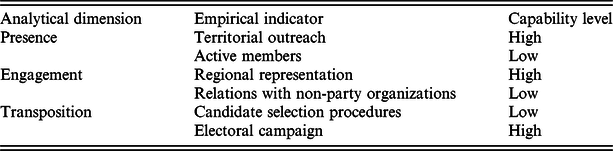
Overall, in the past decade, KSČM has considerable organizational capabilities in the three elements of party organization, as well as it is wanting in crucial capabilities (Table 2). It maintains a rather passive presence across the country, which enables the party to mobilize its core supporters but prevents it from building up a stable electoral support across the country. Furthermore, while the party is engaged with communities by providing them with political representation at regional and national levels, KSČM remains a rather isolated entity, particularly given its limited linkages to non-party organizations. Furthermore, the party is unable to transpose its organizational presence and involvement across communities mainly due to its highly centralized candidate selection procedures despite its centralized campaign efforts. However, as the previous sections highlighted, the majority of its positive aspects seemed rather hollowed out. This is particularly visible in the inability of the party to use its involvement in regional politics due to the separation between regional and national politics, as well as the mismatch of party goals between its regional and national party organizations. Furthermore, although the party has a centralized campaign strategy, it lacks innovation and fails to significantly involve its sub-national structures. Therefore, while its party organization provides KSČM with sufficient resources to sustain its parliamentary presence at national level, the party fails to use these resources to expand its electoral potential, as is visible in a rather stable electoral geography and volatile electoral performance. In light of the two hypotheses of this article, it seems that neither of them can be confirmed due to the organizational impasse of the party.
Organizational capabilities of KSČM since 2010

5. Conclusion
Party organization still matters for the electoral performance of communist successor parties even after almost three decades since the end of the authoritarian communist regimes in Central and Eastern Europe. As this article revealed, a party needs to be present across a country, engaged with communities and able to use this presence and engagement for its goals. In the particular case of KSČM this was not entirely the case. While the party was electorally volatile in the past decade, its territorial distribution remained stable. The evidence from a series of semi-structured interviews reveals that this is due to an organizational impasse within the party. While KSČM remains present across communities and, thus, is able to mobilize its core voters, its declining engagement and reluctance to use its local legitimacy for electoral purposes in national elections prevent the party managing the volatile influences of the external socio-economic and political environment. Hence, while its organizational presence secures a certain level of electoral support, the party is unable to expand electorally. In this context, party organization indeed still matters for the electoral performance of communist successors, but it also highlights major challenges.
These insights have important implications in three main directions. First, the case of KSČM reveals an important caveat for the contribution of party organization to electoral performance. While the article confirms the relevance of organizational strength for political parties in CEE, this should be understood in relative terms. In particular, the evidence of this article reveals that the party organization is strong not because of its numbers, but because of how it uses its resources and opportunities. Second, this article highlighted the continuous relevance of communist successor origins for the majority of left-wing parties in CEE. On the one hand it may seem odd to still refer to these parties as communist successors, given that in the past almost 30 years they came to terms with their authoritarian past. On the other hand, however, these parties still remain organizationally strong through their main organizational inheritance from their communist predecessors, a comprehensive party network and large membership. This suggests that while these parties changed ideologically towards a catch-all profile, their legacy of being a mass party still has implications for their functioning within the party systems in CEE. Therefore, future studies may need to recognize the influence of their party origins even after the substantial ideological and organization change these parties went through.
About the Author
Petar Bankov is a PhD candidate at the University of Glasgow. His research interests are in comparative politics, multi-level party politics, regional and local governance, and electoral geography with a focus on Central and Eastern Europe.