Congenital Heart Disease (CHD) is a general term of cardiovascular malformation caused by incomplete development of cardiac structure during embryonic period.Reference Calcagni, Unolt and Digilio1 It is one of the most common congenital diseases in newborns. Hoffman and others have found that the incidence of CHD in newborns is about 1‰, and this ratio is even higher in death foetal or abortion.Reference Hoffman2,Reference Methlouthi, Mahdhaoui and Bellaleh3 Children with CHD often have a series of physiological, psychological, and social problems due to repeated infections and long treatment.Reference Ladak, Hasan, Gullick and Gallagher4-Reference Serinelli, Arunkumar and White7 The two most common types of CHD are ventricular septal defect and atrial septal defect, which accounts for 31.49 and 20.20% of CHD, respectively.Reference Abdulkadir and Abdulkadir8,Reference Zhao9
With the development of medical technology, medical devices, and surgical treatment of CHD, minimally invasive procedures are becoming more common in paediatric cardiology. Since the introduction of the Amplatser occlusion device at the end of the last century, which had a positive effect on the treatment of left-to-right shunt CHD, interventional therapy has gradually developed into the first choice of treatment for some forms of CHD.Reference Rahkonen, Lee, Chaturvedi and Benson10-Reference Jang12 Although guidelines and quality control standards exist for interventional catherisation therapy, the prognosis and complications vary among children with CHD. Studies have shown that patients post-percutanous closure continue to have changes in the aggregation and activation of platelets.Reference Pan, Xie, Zhang, Long, Xu and Zhang13,Reference Orford and Berger14 A statement from the American Heart Association addresses that cardiac catherisation remains associated with complications such as device embolism, marker band embolism (located at the tip of the sheath), and cerebral embolism.Reference Feltes, Bacha and Beekman15 Krumsdorf and colleagues documented that thrombus formation was found in the left atrium, right atrium, or both in five of the 407 (1.2%) children with atrial septal defect and 15 of the 593 (2.5%) children with ventricular septal defect.Reference Krumsdorf, Ostermayer and Billinger16 Therefore, in these groups of children, long-term oral anti-platelet aggregation medication is recommended.
Aspirin is usually been prescribed for 6 months after atrial septal defect or ventricular septal defect closure via cardiac catherisation.Reference Bartakian, El-Said, Printz and Moore17,Reference Du, Hijazi, Kleinman, Silverman and Larntz18 The recommended aspirin dose is 3–5 mg/day to avoid cardiac thrombosis and prevent post-interventional systemic embolism.Reference Pan, Xie, Zhang, Long, Xu and Zhang13,Reference Tomar, Khatri, Radhakrishnan and Shrivastava19 Therefore, maintaining good compliance to aspirin medication is imperative to successful treatment and reducing complication rates in children with CHD after percutaneous closure. To our knowledge, there is currently no evidence describing predictors of compliance with aspirin in children following cardiac catheterisation. Therefore, the aim of our study is to explore the compliance with aspirin of children with CHD post-percutaneous transcatheter occlusion as reported by the child’s caregivers. Specifically, the objectives of our study are: to identify the caregivers’ knowledge about aspirin in children with CHD; to describe the compliance with aspirin intake in children after percutaneous transcatheter occlusion; and to identify predictors of compliance with aspirin medication in children after percutaneous transcatheter occlusion.
Methods
Design
The study adopted a cross-sectional explorative survey design. The study was conducted over a 12-month period: May 2017 to May 2018. Ethical approval of the study was obtained from the Ethical Review Board of Hunan Children’s Hospital (approval number: HCHLL-2017-43). The Strengthening the Reporting of Observational Studies in Epidemiology Statement: guideline for reporting observational studies has been used for reporting the study.Reference Vandenbroucke, von Elm and Altman20 Specifically, the Strengthening the Reporting of Observational Studies in Epidemiology checklist for cross-sectional studies was used.
Setting
The study was performed at Hunan Children’s Hospital in Changsha, Hunan Province, China. The cardiology department is a tertiary centre serving children with cardiac diseases within Hunan Province with a population of 67 million. The department includes the interventional paediatric cardiology unit with a catheterisation laboratory performing over 1500 interventional therapies or cardiac catheterisation. Of these, around 900 percutaneous transcatheter occlusion interventions are carried out in children with atrial septal defect or ventricular septal defect.
Participants
The participants were children who underwent successful atrial septal defect or ventricular septal defect percutaneous transcatheter occlusion and their parents.
Sample size
A cluster sampling method was adopted for the study. According to the single population proportion formula n = Z21-α/2 p(1-p)/d2, where n is a desired sample size for population over than 10,000; Z1-α/2 is the standard normal distribution usually set as 1.96 (which corresponds to 95% confidence level); p means that we use estimated omega-3 polyunsaturated fatty acid supplementation average adherence rate at 0.85Reference van der Wurff, Meyer and de Groot21, to maximise sample size; negative prevalence = 1 − 0.85 = 0.15; d is the degree of accuracy desired (marginal error is 0.05); then the sample size is n = 1.962 * 0.85 (1 − 0.85)/0.052 = 196. Adding a 10% contingency, the final sample size is 216.
Inclusion and exclusion criteria
Included were: children with ventricular septal defect or atrial septal defect post-successful percutaneous transcatheter occlusion treatment and have been prescribed oral aspirin for 6 month for anticoagulant therapy; children with oral aspirin for more than 1 month; children aged below 9 years of age; caregivers responsible for providing aspirin to the child; caregivers able to read Chinese and complete the questionnaire; caregivers able to sign the written consent form.
Excluded were: children with other complicated congenital malformations, such as complex CHD requiring surgery, congenital oesophageal fistula, and other surgical treatments; children with other serious chronic diseases requiring long-term oral medication, such as epilepsy or asthma.
Instruments
A three-part survey was employed to measure (1) basic characteristics of children and caregivers, (2) aspirin-related knowledge, and (3) compliance with medication. The first part included characteristics of children and caretakers: gender; age; disease type; length of aspirin use; relationship to child; childcare experience; marital status; education level; occupation; monthly income; and health insurance policies.
The second part of the survey was aspirin-related knowledge post-percutaneous transcatheter occlusion and was developed by the paediatric cardiovascular interventional therapy specialist group with six doctors and 10 nurses after a three-round Delphi method. A pre-test of this survey was performed among 10 caregivers of children in March 2017. The feedback of the caregivers was reviewed and the survey was modified. The final version of the aspirin-related knowledge survey included six questions related to: major role of low-dose aspirin; reasons for taking aspirin after catheter interventional closure; dosage of aspirin intake; length of aspirin intake after interventional closure; proceedings of how to take aspirin; and common side effects of aspirin. The survey used a five-point scoring scale. If the question was answered correctly, the item received a score of 2; when the multiple-choice answers were partly correct, the item received a score of 1; if the answer was incorrect or the option “unclear” was used, a score of 0 was given. The total score of this survey was 12 points; the higher the score, the higher the aspirin-related knowledge. As we did not have any reference of this new survey, we defined a score of ≥6 as having an adequate level of knowledge about aspirin and <6 as insufficient knowledge. The internal consistency of the survey resulted in a Cronbach’s α of 0.70. The content validity ratio was 0.71.
The third part of the survey included the 8-item Morisky Medication Adherence Scale.Reference Morisky, Ang, Krousel-Wood and Ward22 The Chinese version of the scale was used in our study.Reference Ho and Lee23 The answer options of the first seven items were Yes and No (yes = 0 and no = 1). The scale of the last items was a five-point Likert scale: never, occasionally, sometimes, frequently, all time, with the scores 1, 0.75, 0.50, 0.25, and 0 points, respectively. The total score of the 8-item Morisky Medication Adherence Scale is 8; a score <6 indicates low compliance with medication, 6–7 medium compliance with medication, and 8 high compliance with medication. The scale has been used among children with asthma, and the results indicated a Cronbach’s α coefficient of 0.90.Reference Janezic, Locatelli and Kos24
Recruitment and data collection
Recruitment of eligible children and caregivers was performed at the follow-up clinic one month after hospital discharge. A specialist nurse from our department always contacts the caregivers for a follow-up appointment. During this phone call, the specialist nurse provided a brief information about the study and informed the caregivers that they would receive a study invitation during the follow-up clinic. Once the children and caregivers visited the follow-up clinic, they received an invitation letter including the study objectives, information about the survey, assurance of confidentiality, and their right to withdraw at any time. After signed consent was obtained, the anonymous survey was distributed to the caregivers for completion while they visited the follow-up clinic. The doctors at the follow-up clinic were informed about the study.
Statistical analysis
Data were entered into IBM SPSS Statistics for Windows, Version 20.0 (IBM Corp., Armonk, New York, United States of America). Descriptive statistics including frequency, mean, percentage, standard deviation was used to summarise baseline data and evaluate distribution of responses. Univariate analysis was performed to analyse the association between compliance with medication and independent variables. All variables with p < 0.05 in the univariate analysis were included in the multivariate binary logistic regression analysis, which was performed to identify potential predictors of compliance. Confidence interval (95%) was reported in each logistic regression analysis. P value < 0.05 was considered as statistically significant.
Results
Of the 220 eligible children and caregivers, 210 (95.5%) responded. Of these, 209 questionnaires were valid to be included in the analysis.
Characteristic of children and caregivers
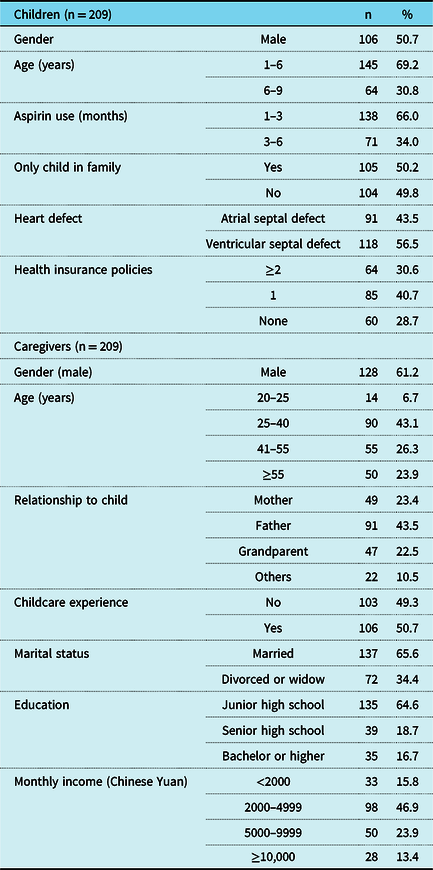
The characteristics of the children and caregivers are presented in Table 1. The mean age of the children was 4.2 years (standard deviation 2.70). The questionnaires were mostly completed by mothers or fathers (66.9%). Of the 209 respondents, 103 (49.3%) had no previous parenting experience.
Characteristics of children and caregivers

Aspirin-related knowledge
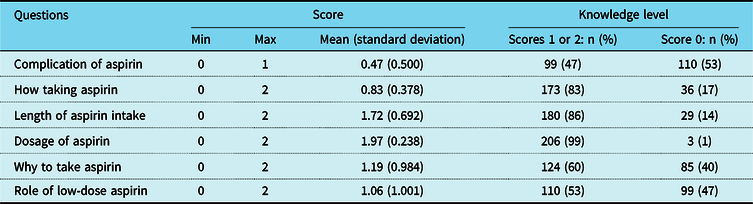
The knowledge about aspirin mean scores of the caregivers was 7.25 (standard deviation 2.27; min 2, max 10). 134 respondents had an overall score of ≥6, representing 64.1% of the respondents having an adequate level of aspirin knowledge. Detailed scores of the six individual questions of the knowledge about aspirin survey are presented in Table 2.
Knowledge about aspirin of caregivers (n = 209)

Score range of the multiple-choice questions was 0–2
Compliance with aspirin
The maximum score of the 8-item Morisky Medication Adherence Scale reported by 209 caregivers was 8, the minimum score was 2.5, with an overall mean score of 5.65 (standard deviation 1.36). Of the 209 respondents, 101 (48.3%) had a low compliance score (<6) and 108 (51.7%) respondents had a medium to high compliance score (6–8). Notably, only five respondents complete the 8-item Morisky Medication Adherence Scale with a maximum score of 8.
Univariate analysis of characteristics and compliance with aspirin
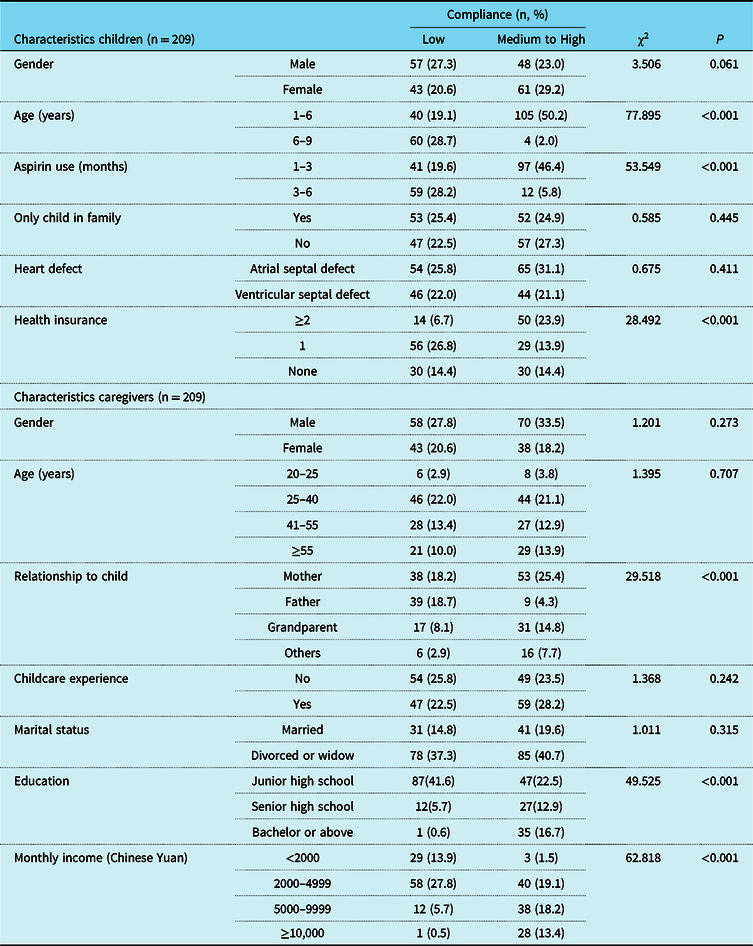
The analysis revealed several predictive factors related to compliance with aspirin. Significant differences were observed between compliance with aspirin medication and the predictive factors child’s age, length of aspirin use, health insurance policies, relationship to child, education of caregivers, monthly income, and knowledge about aspirin of caregivers (Table 3).
Univariate analysis characteristic and compliance with aspirin (n = 209)

Multivariate binary logistic regression analysis of compliance with aspirin
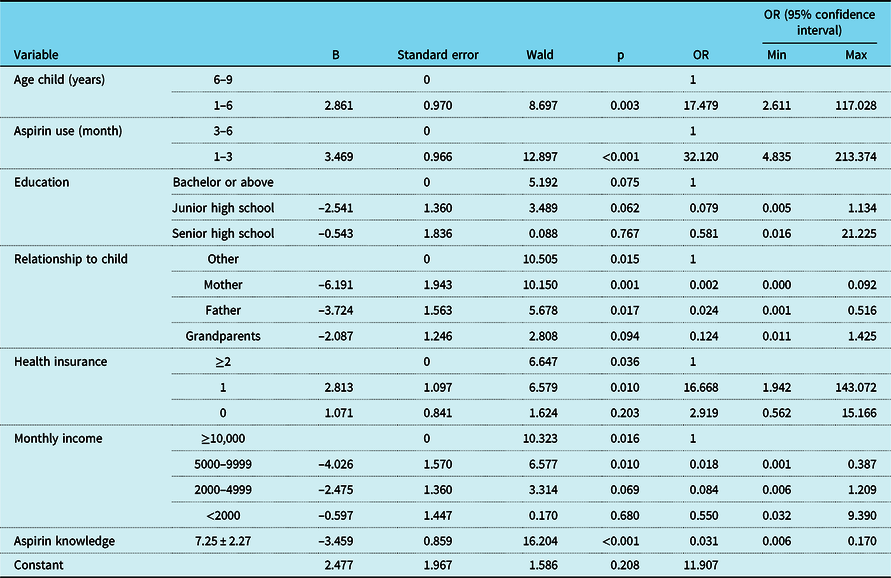
Based on the results of univariate binary logistic regression analysis, the variables child’s age, length of aspirin use, health insurance policies, relationship to child, education of caregivers, monthly income, and aspirin knowledge of caregivers were included in the multivariate binary logistic regression analysis. The results showed that child’s age, aspirin use, and knowledge about aspirin were significantly associated with aspirin compliance (Table 4). The variable relationship to child showed that only the father and mother were significantly associated with aspirin compliance. Having health insurance policies and a monthly income of caregivers over 5000 Chinese Yuan were also significant predictors of compliance with aspirin.
Multivariate binary logistic regression analysis of predictors of non-compliance with medication (n = 209)

OR = odds ratio
Discussion
This study explored the knowledge about aspirin and compliance with aspirin of children post-percutaneous transcatheter occlusion as reported by caregivers, and predictors of compliance with aspirin were identified. In our study, 209 caregivers participated and the majority (64%) of the caregivers had adequate knowledge of aspirin. Half of the caregivers reported a medium to high compliance with aspirin scores. The main identified predictors affecting compliance with aspirin included child’s age, aspirin use, and knowledge about aspirin, and socio-economic factors.
Knowledge about aspirin
Aspirin-related knowledge was defined as knowledge about complications, administering, duration, dosage, reason, and pharmacological action of aspirin. In our study, the overall parental aspirin knowledge was 7.25 (max scale score 12; participants scores max 10) indicating that parents had possibly an adequate level of aspirin knowledge. A reference or cut-off point has not been identified to determine the minimal level of knowledge for providing optimal medication support to children. Duffy et al reported in their review that knowledge about aspirin and compliance were not optimal ranging between 72 and 92%.Reference Duffy, Kelly, Trang, Whellan and Mills25 Of the 12 included studies in this review, none of the studies were related to children. Specifically, in children, Lee and colleagues conducted a study among parents of 87 children waiting for organ transplantation. The results showed that if parent have more knowledge about medication, the children have better compliance with medication.Reference Lee, Eaton and Loiselle Rich26 Therefore, educational interventions are recommended as our study also confirms that aspirin knowledge was a predictor of low aspirin medication intake.
Compliance with medication
Compliance to medication is referred to the compliance level of prescribed medication use. The connotation includes taking the medicine according to the dose and time. Studies have been using the 8-item Morisky Medication Adherence Scale to explore compliance with medication among patients. Basharat and colleagues identified low compliance with medication (45%) among 310 children with asthma.Reference Basharat, Jabeen, Zeeshan, Bano, Bari and Rathore27 Another study among 75 children with sickle cell anaemia receiving hydroxyurea documented a high compliance with medication of 84%.Reference Thornburg, Calatroni, Telen and Kemper28 Both studies were related to children with chronic conditions which needed medication to enhance treatment or relieve symptoms. In our study, the compliance with aspirin was low to medium, 48.3%, 49.3%, respectively. In our population, the cardiac malformations were corrected by percutaneous transcatheter occlusion. Parents might have believed that aspirin was not necessary to prevent post-interventional complications. The results suggest to improve the compliance with aspirin and knowledge of parents. Discharge information interventions might help parents to increase compliance with medication regimes.Reference Pye and Green29,Reference Tregay, Wray and Crowe30
Predictors of compliance with aspirin
The child’s compliance with medication was related to age. The results of this study showed that the medium to high compliance rate of children with CHD between 1 and 6 years old accounted for 72.4% (n = 145) and the medium to high compliance rate of children aged 6–9 years were just 6.2% (n = 64). A study among children (n = 2860) and adolescents (n = 17,179) with acne vulgaris documented differences in compliance with acne medication; adolescents were less likely to adhere to the medication regime than children.Reference Hester, Park, Chung, Balkrishnan, Feldman and Chang31 In our study, all patients were under 9 years of age and might have less autonomous behaviour ability and rely on the caregivers’ responsibility to adhere to the medication regime.Reference Mickley, Burkhart and Sigler32 Various factors might influence the caregiver’s level of knowledge and compliance with aspirin such as advice given by medical and nursing staff or family support strategies.
The length of aspirin use is one of the predictors that can influence negatively compliance with aspirin. Our study documented that aspirin use more than 3 months showed a decrease in compliance rates. So far, this result has not been confirmed in other studies with children in cardiology. However, a study among children with anxiety disorders documented that treatment adherence was associated with the length of medication usage.Reference Bushnell, Brookhart, Gaynes, Compton, Dusetzina and Sturmer33 Possible reasons for a decline in the compliance with medication over a longer time period could be the lack of continuous or regular health education support.
Social and economic factors have been identified as predictors of compliance with medication. A review of studies on compliance with medication in children with epilepsy identified several environment-related factors influencing compliance with medication.Reference Bushnell, Brookhart, Gaynes, Compton, Dusetzina and Sturmer33,Reference Yang, Hao, Yu, Xu and Zhang34 For example, three identified studies in the review documented that support form medical and nursing staff was related to better adherence. Three other studies reported that better socio-economic status of the family would predict better compliance with medication. These factors have been confirmed in our study where compliance with aspirin was better when family and caretakers had a higher monthly income.
Implication for clinical practice
The attention to predictors of compliance with aspirin in children post-percutaneous transcatheter occlusion is warranted by clinicians. Providing targeted support to parents or the primary caregivers might benefit the long-term adherence and reduce complication rates. General strategies to improve compliance with medication can be related to family members but should also include healthcare professionals.Reference Tregay, Wray and Crowe30,Reference Bushnell, Brookhart, Gaynes, Compton, Dusetzina and Sturmer33 For parents, support strategies could include education or counselling, information brochures, and reminders. Healthcare professionals need to consider to organise continuous education on compliance with medication, build a stronger child–professional relationship, or develop multi-disciplinary teams with specific roles in follow-up clinics. Further studies are needed to identify effective aspirin prescriptions in terms of frequency and length of use for children post-percutaneous transcatheter occlusion.
Limitations
This study warrants several limitations to be addressed. First, the use of self-reported questionnaires has its limitation because respondents might exaggerate the responses to the survey questions or might be uncomfortable to disclose private details. Therefore, we performed a rigorous method in designing the survey related to the knowledge about aspirin. Second, this was a single-centre study which might limit the generalisability of the findings. Third, we only recruited children and their caregivers who visited the follow-up clinic. This might have been a bias in the selection procedure. It is unclear what the knowledge and the compliance with aspirin is of the no-show children in the follow-up clinic. Further investigation is warranted to determine the overall compliance in children post-percutaneous transcatheter occlusion.
Conclusion
Our study documented that caregivers of children post-percutaneous transcatheter occlusion had an adequate level of knowledge about aspirin. However, the knowledge level of the caregivers was correlated with a low compliance with aspirin. Several predictors have been identified that might influence the compliance with medication of the prescribed aspirin regime of 6 months. The compliance with medication was better in children who were younger and when children had health insurances, higher monthly incomes, better awareness of aspirin, and being the father or mother of the child. Further studies are needed to identify the consequences of low compliance with aspirin such a long-term complication rates and effective parental educational interventions.
Acknowledgements
We like to thank all staff members of the cardiovascular interventional therapy specialist group at Hunan Children’s Hospital for their valuable contributions to the design the aspirin-related knowledge questionnaire. The authors like to thank all participating parents for their time and sharing their experiences.
Authors’ Contributions
Q-QS, L-HZ, O-YC, and JML initiated the study and were responsible for the study protocol and design of the study. Q-QS, Z-RX, ZC, and J-CM contributed to the data acquisition. Q-QS, CZ, and JML performed the analysis. All authors were involved in the data interpretation. Q-QS, Y-BX, and JML drafted the first manuscript and substantively revised it. All authors approved the submitted version after substantially modified previous versions. All authors, Q-QS, L-HZ, O-YC, Z-RX, ZC, Y-BX, J-CM, CZ, and JML, agreed both to be personally accountable for the author’s own contributions and to ensure that questions related to the accuracy or integrity of any part of the work, even ones in which the author was not personally involved, are appropriately investigated, resolved, and the resolution documented in the literature.
Financial Support
The study was partially supported by the Hunan Provincial Government of the People’s Republic of China through the Hundred Talent Program (JML). The funding body was not involved in the design of the study and collection, analysis, and interpretation of data and in writing the manuscript.
Conflicts of Interest
None.
Ethical Standards
Ethical approval of the study was obtained from the Ethical Review Board of Human Children’s Hospital (approval number: HCHLL-2016-32).