1. Steam Machine Music
Steam Machine Music Footnote 1 is a mechanical musical instrument built mostly from vintage Meccano parts and driven by a steam engine (Movie example 1). The grand object of this invention is to generate mechanical sounds, audible to the mindful observer, which then become amplified with the aid of contact microphones connected to a mixing desk for further amplification. Furthermore, small surveillance cameras are placed at central parts of the apparatus, which capture the movement of the mechanical transmissions and motions, and transmit them to an accompanying display monitor or projecting device. An apparatus of this sort, being mechanical and independent of electricity to generate its core musical sounds, is driven by a steam engine whose energy is provided by a small gas burner that heats the water in the boiler. The boiling water becomes pressurised steam as it vaporises, creating the motion of the main piston that drives the rest of the machine. More particularly, the mechanical parts that constitute the sounding output of Steam Machine Music are as follows:
-
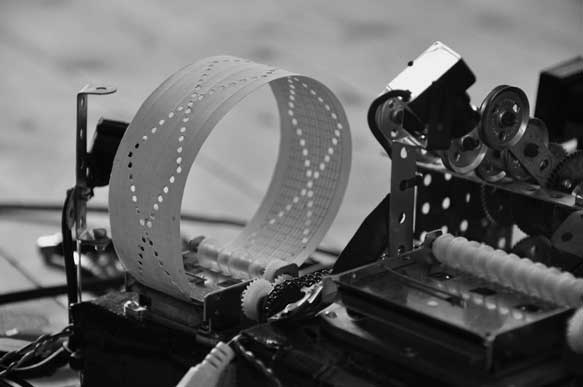
1. Two small music boxes, each programmable with musical content by means of perforated paper strips, making it possible to ‘punch out’ any imaginable melodic and rhythmical structures. Because these are made of paper, it is also possible to loop or chain several perforated strips with the aid of tape, making endless repeating musical structures possible (Figure 1). Additionally, the larger of the two music boxes has had parts of its musical comb prepared with tin foil in an attempt to expand its sounding possibilities.
Figure 1Detail from Steam Machine Music by Morten Riis showing the two music boxes.

-
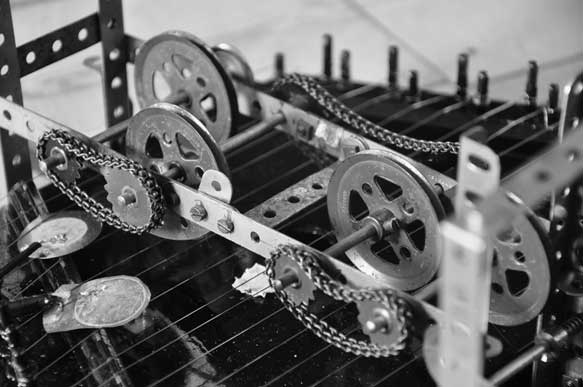
2. A small stringed instrument, commonly referred to as a zither,Footnote 2 is incorporated into the apparatus structure in such a way that its strings are excited by pulley wheels instead of the more traditional plucking, bowing or striking. This enables the generation of continuously held tones that have a metallic sound quality, which furthermore have small fluctuations in the sound due to the tiny imperfections in the metal surface of the pulleys.
-
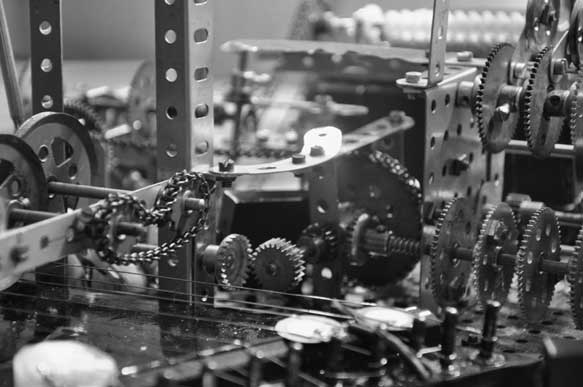
3. A simple four-part Meccano-built rhythm generator, which uses a simple hanging lever that is excited by nuts forming rhythmical structures by their distribution on the rotating cogwheels mounted on a central revolving shaft (Figures 2–4).
Figure 2Detail from Steam Machine Music by Morten Riis showing the zither being excited by Meccano pulleys.
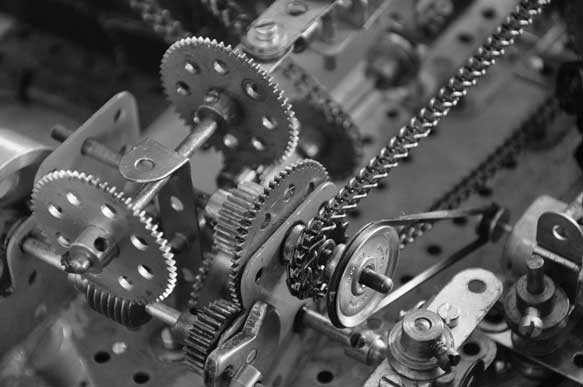
Figure 3Detail from Steam Machine Music by Morten Riis showing the central gearing mechanism.
Figure 4Detail from Steam Machine Music by Morten Riis showing the zither (in foreground) and part of the hanging level rhythm generator (background).
-
4. A dynamo connected to the main driving wheel of the steam engine, generating alternating current, which drives a small LEGO electrical motor. The motor output is fed directly to a mixing desk, creating a continuous tone with a frequency dependent on the speed of the steam engine. This method of generating sound is of course dependent on amplification and speakers in order to be audible and is accordingly not an acoustic mechanical sounding part of the apparatus. It should be mentioned that the alternating current generated in the dynamo could be connected directly to the mixing desk, making a perfectly good sounding oscillator,Footnote 3 but following extensive research into the sound qualities of different motors, I chose the Electric Technic Mini-Motor LEGOFootnote 4 engine for its outstanding timbres and textures.
-
5. The sound of the machine itself. In an apparatus of this sort, the rhythmic patterns and pulsating drones of the steam engine, the squeaking of the gear trains and the rattling of the whole structure are all important and crucial aspects of the sonic experience, both acoustically and amplified through a mixing desk and speakers. The mechanical parts are assembled to be solely functional, ensuring a given functionality. However, they are sonically inseparable from the previously described sounding outputs of the apparatus, making the sounds from the machine itself essential to the musical expression that the construction is capable of generating.


2. Steam Machine Music as point of departure
The rattling chains and shaky functionality of Steam Machine Music raises manifold questions regarding the valid, rational and legitimate aspects of its construction in the fast-moving present-day digital reality. On one level, as an artistic argument, it can be seen as a way of my positioning myself as an artist in relation to other contemporary electronic musicians and composers, and to distance myself from the current technological breakthroughs that enable the composer to allegedly compose new wonderful, magnificent music with just the press of a button.
In this context Steam Machine Music surely makes a comment in relation to the skill-less operation of musical instruments because of its obvious lack of an interface, which conceals the physical functionality of the machine. On another level, which could be seen as my research argument for building Steam Machine Music, this mechanical device raises some more in-depth questions regarding fundamental aspects of what it means to compose for and build and operate what could be described as machine-based music. Because of its extensive references to various technological inventions regarding the development of what we today denote electronic music, Steam Machine Music can be regarded as a prototype of electronic music. This mechanical musical instrument outlines some of the fundamental aspects of what constitutes the term electronic music, in contrast to numerous historical, technical and aesthetic accounts (e.g. Appleton, Perera and Luening Reference Appleton, Perera and Luening1975; Holmes Reference Holmes1985; Roads Reference Roads1996) that since the 1950s have tried to get a hold of this fleeting and diffuse field of study. These fundamental aspects of machine-based music will give the material physicality a pivotal role in contrast to the otherwise more symbolic understanding of electronic music that seems to be dominant, thus distancing the research done in this paper from the symbolic conceptualisations of electronic music primarily related to algorithmic descriptions.
To investigate the physicality of the music machine, I will use a media archaeological method to excavate an expanded understanding of what electronic music is through a notion of machine music as perceived through the ears of the repairman.
My own electronic music practice (see Riis Reference Riis2010a; Reference Riis2010b) can be described as being concerned with the aesthetics of failure, unravelling hidden functionalities in the machine through use of various bending (Ghazala Reference Ghazala2004; Goriunova and Shulgin Reference Goriunova and Shulgin2008; Thomson Reference Thomson2004: 212) and hacking techniques. A common denominator in this artistic practice is the comprehension that electronic music is the music of the machine, with the inherent notion that, in order to get as close as possible to the machine's own voice, the artistic examination must take as its starting point the alternative use of the malfunctioning of electronic and mechanical sonic processes. This post-digital glitch aesthetic, which stages noise and irregularity as primary aesthetic expressions, is primarily understood as a phenomenon associated with and originating from twentieth-century electronic and computer music that referred to the futuristic movement of the 1910s (Cascone Reference Cascone2000; Kelly Reference Kelly2009; Sangild Reference Sangild2003; Reference Sangild2004). But in order to give a more diverse and wide-ranging understanding of my own place in the story of the malfunctioning music machine, I propose a different way of grasping the history of electronic music and its machines. This history is not driven by the traditional genealogical urge to tell the story of how electronic music always has been stimulated by the invention of new technologies: new inventions that proposed new ways of composing, conceptualising and understanding music.Footnote 5 I, on the other hand, propose an alternative way of telling the story of machine music by shifting focus to all the by-products of these machines. The sounds of failure are just as important as the sound of when things went right. Failure and breakdown are not phenomena exclusively associated with modern digital computer music; the malfunction of machines is a constantly continuing factor for the use and existence of technology, and this paper will examine some of these inevitable errors of the machine through the pre-electronic case of mechanical music.
Of course, the connection between mechanical musical instruments and modern electronic music are not new. Many scholars (e.g. Collins Reference Collins2009b: 36; Luening Reference Luening1964: 90–1; Schrader Reference Schrader1982: 61–2) have made these connections, but these attempts were very superficial and related mostly to connections found on the symbolic level. I, on the other hand, try to lift the lid on these old instruments and, through the execution of musical programs and operational machines, make new connections that will bring new understanding to the most problematic term ‘electronic music’.
Steam Machine Music and the scope of this paper go further and deeper into the subject of machine music, consequently dealing with topics that concern a return to the machine's more rudimentary appearance and functionality, which points towards the fact that the basic building blocks of the automatic music have not changed: it is still the issues of programmability, regulation of speed, and instability that point towards physical materiality in terms of the executing the symbolic program. The following excavation must not be understood as a history of electronic music, or even a chronological genealogy of technologies that have led up to what today constitutes electronic music, but rather as an examination of what I, through my artistic practice, regard as key elements in the conceptualisation of machine music.
3. Media archaeology
When we press a key on a computer keyboard we normally associate this with some kind of symbolic meaning – as part of a word, a sentence, forming longer sections and so on – which is then displayed on our computer screens, making us able to read it. But, from a media archaeological viewpoint (Ernst Reference Ernst2009), something else is at stake in this seemingly simple example. The keyboard sign is transformed into an electro-physical signal, thus losing all its semantic referentiality, and becomes a coded element, an electrical signal, within a physical computer, losing its traditional symbolic meaning and gaining electro-physical indexicality. This media archaeological way of observing an otherwise simple daily action surely brings a new and more diverse understanding to the relationship between encoded symbols and their physical manifestation. Furthermore, the digitalisation process transforms what could be described as a form of narrative into what Wolfgang Ernst denotes as ‘non-discursive, algorithmic configuration[s] of events’ (Ernst Reference Ernst2009) So, from this media archaeological point of view, purposed by Ernst, the symbols generating the narrative lose their semantic meaning and become electrical indexes that have a new meaning and application inside the digital circuitry.
The term media archaeology allegedly originates from Siegfried Zielinski, who built upon an archaeological term borrowed from Foucault but gave it a technological turn in his 1985 PhD thesis Zur Kulturtechnik des Videorecorders (Lovink Reference Lovink2003). Later, Zielinski pointed out that ‘I name this approach media archaeology, which in a pragmatic perspective means to dig out secret paths in history, which might help us find our way into the future’ (Zielinski Reference Zielinski1996: n.p.). But recent research shows that Zielinski is not the media archaeological denominator. Instead, the first scholar to introduce the term was Jacques Perriault in his Mémoires de l'ombre et du son: Une archéologie de l'audio-visuel (Memories of Shadow and Sound: An Archaeology of the Audio-Visual) from 1981 (Huhtamo and Parikka Reference Huhtamo and Parikka2011: 3).
The archaeology in media archaeology is greatly influenced by Michel Foucault's The Archaeology of Knowledge (Foucault Reference Foucault1972), which deals with discontinuities, gaps and absences, silence and ruptures, in opposition to a traditional historical discourse, which privileges the notion of continuity. Media archaeology and Foucault both agree that the search for true origins is a wasted effort, and also that the construction of linear histories runs the risk of leaving important statements, objects and networks in neglected margins (Parikka and Hertz Reference Parikka and Hertz2010). Thus, a search for obsolete, forgotten media is needed in order to try to unfold what could be characterised as ‘the history of losers’ (Parikka and Hertz Reference Parikka and Hertz2010: n.p.).
Media archaeologist Wolfgang Ernst brands media archaeology as cultural engineering, as something that focuses on the time-critical processes that engineer our lives. Media archaeology does not narrate – it counts, because machines do not narrate, they count (Parikka Reference Parikka2009). Ernst's approach comes from the Medienwissenschaft of Friedrich Kittler (Kittler Reference Kittler1999), which could be described as doing an almost hardware analysis of media with an anti-hermeneutic focus on real media apparatuses. The machine's operations are – in the media archaeological moment – fundamentally un-historical, meaning that the specific function of the machine is in some way outside history, and to some extent outside discourse. Ernst outlines a more physical materialistic understanding of media apparatuses, which focuses on how machines themselves record the passing of time, and opens up for new possibilities to unfold our media history and technological awareness. The exercise, according to Ernst, is to be aware that each technological moment comprises media, not humans, and these media are not dead, but operating (Ernst Reference Ernst2010), bringing an awareness of the moment when media themselves become active ‘archaeologist[s] of knowledge’ (Ernst Reference Ernst2011: 239).
It has been pointed out that by an increasing number of media archaeologists that media archaeology needs to be executed, not constructed, as a narrative in that ‘History is the form of narratives, while media archaeology is a non-linear engagement with devices and concrete apparatuses that physically carry the past into the present’ (Parikka and Hertz Reference Parikka and Hertz2010: n.p.). Media archaeological artworks could be seen as a form of spatialised, conversational historical writing, as a way of maintaining a dialogue with the technological past in moving back and forth in time, looking for correspondences and points of rupture (Huhtamo Reference Huhtamo1995). From that perspective the following account of the music box repairman is comparable to the physical materiality found in the workings with Steam Machine Music, as an approach resembling that of an engineer, and takes as its starting point the operational functionality of the machine. The archaeological findings extracted from this examination focus on the physical functionality of the mechanism, but at the same time the study also tries to place these mechanisms into a broader epistemological perspective.
4. Machine music through the ears of the repairman
‘Automatic instruments are documents’, as David Fuller claims (Reference Fuller1983: 164). But what sort of documents? The traditional musicological study of these mechanical instruments focuses on the distribution of musical repertory through a study of the tune list associated with the instruments (Bulleid Reference Bulleid1994: 106) and through examining the various performing styles, melodic ornamentation and tempi (Ord-Hume Reference Ord-Hume1983: 186). As this musical data is regarded an authentic source to the musical performance practice of the time, nothing is mentioned about the performance practice of the mechanical instrument itself. The traditional method of analysing mechanical instruments has been to examine the symbolic data inherent in the cylinders and perforated punch cards. These musical documents function merely as a symbolic database of past melodic and general rhythmical musical tendencies, but, by fine-tuning the archaeological gaze towards a notion of the operational machine, it becomes evident that these mechanical instruments can tell us much more than the preferred tempi and tonalities of past popular tunes.
The cylinder music box is one of the, if not the, most popular mechanical musical instruments from the last three centuries, and its mass production has its birthplace in the western part of Switzerland in the 1790s (Bowers Reference Bowers1974: 19), where thousands and thousands were produced (Bowers Reference Bowers1974: 51). The music boxes come in a vast variation of sizes, shapes and designs, but the mechanism that produces the musical sound has maintained, with little variation, the same fundamental appearance and functionality: the tuned teeth in a steel music comb are plucked by metal pins arranged in the form of a musical composition on a revolving metal cylinder, driven by a mainspring.
Sources tells us that the cylinder music boxes had several unintended noises and errors that where typical and recurring phenomena in the daily use of these instruments: noises and rattles that any musical box during the course of time will develop (Clark Reference Clark1952: 209). These mechanical noises are described as a grating noise due to the poor adjustment of the dampers that should dampen the comb (Webb Reference Webb1968: 41). The pins of the cylinder will also produce a harsh disagreeable sound if not properly oiled (Bowers Reference Bowers1974: 59). Also the effect of atmospheric conditions on parts of the mechanism, or the result of long use, will lead to tiny changes, which noticeably affects the performance (Bijsterveld Reference Bijsterveld2008: 155; Buchner Reference Buchner1961: 38). Additionally, one could mention that repairing defective teeth in the cogwheels driving the cylinder (Chapuis Reference Chapuis1961: 44), broken pins on the cylinder and broken teeth on the comb (Clark Reference Clark1952: 204–5) were a daily part of the music box repairman's routine. At times it might be found that one of the wings of the air-brake (governor) on the endless screw is loose and will not stay in the exact position necessary for the movement to run at the correct speed (Webb Reference Webb1968: 103).
The Mechanical Music Digest archive (Kravitz Reference Kravitz2010) is an insightful source to the malfunctioning mechanical musical instrument. Hundreds of forum posts from dedicated collectors and repairmen gives an intensive insight into the world of these old instruments. Among other things the archive points towards some of the most common problems of the music box, described as non-musical noises from the governor mechanism (Heintz Reference Heintz2002) and mechanical noise from the drive wheel (Smith Reference Smith2004), together with buzzing sounds from the lid and the soundboard of the music box that sympathetically evolve into strong tones from the mechanical mechanism (Brougher Reference Brougher1997; McClure Reference McClure2001), pointing towards the fragile malfunctioning reality of the music box.
A most detailed account of a malfunctioning music box is additionally found in C.H. Jacot's How To Repair Musical Boxes: Practical Instructions to Watchmakers With Complete Illustrated Catalogue of Material, third edition 1890 (Ord-Hume Reference Ord-Hume1973: 74–81). In this popular repair guide, first two editions promptly sold out, we find accounts for how the repairman must ensure that comb dampers are properly adjusted ‘otherwise the box will give certain disagreeable, whistling sounds, which greatly impair the effect of the music’ (Ord-Hume Reference Ord-Hume1973: 76). Also, the repairman should be careful not to place the comb too close to the cylinder, which would result in the sound of the box becoming harsh; in addition, he should remember that every screw must be fastened as firmly as possible in order to avoid rattling sounds (Ord-Hume Reference Ord-Hume1973: 78). Regular oiling of the cylinder pins and the rest of the mechanism in the musical box is required to prevent wear and screeching noises (Ord-Hume Reference Ord-Hume1973: 79). But the most dreadful scenario for the repairman is when the music box is said to ‘run’. This phenomenon occurs when the cylinder is accidentally disconnected from the fly-wheel governor while the mainspring is still wound, which results in the cylinder suddenly whirling with lightning speed, breaking parts off, and bending and breaking pins of the cylinder and teeth of the comb. If this happens the cylinder must be re-pinned, a quite expensive and comprehensive task for the repairman (Chapuis Reference Chapuis1961: 42). Accordingly, hundreds of boxes are ruined by this accident every year (Ord-Hume Reference Ord-Hume1973: 75). It is a very delicate process to avoid the ‘running’ of the music box and requires the repairman's utmost attention when loosening the governor bracket screws, while still maintaining pressure on the main gear-train assembly screw (Metzger Reference Metzger1971: 212).
5. Ontology of malfunction and accidents
The repairman tells the story of the malfunctioning technology. It is the history of accidents and how machines break down. The following section will try to implement a more ontological framing of the malfunctioning machine; a framing that is deeply rooted in the operating music machine, taking its starting point in materialistic functionality and dysfunctional break, the ruptures and the accidents. The notion of technology somehow being capable of revealing an inner logic (Parikka Reference Parikka2007: 294) or essence when breaking or malfunctioning can be found in several scholars during the course of time. An obvious example comes from Heidegger and the breaking hammer. For Heidegger there is no distinction between subject and object, which consequently means that equipment, tools or things, is defined as something in-order-to (Heidegger Reference Heidegger1996: 64). This in-order-to is an assignment which employs, for example, a piece of equipment to achieve a task. The term assignment indicates that a piece of equipment is made visible in its ontological genesis, meaning that a thing only becomes truly visible as equipment through its use, in the act of assigning it to a task. Furthermore, if a tool or machine becomes damaged or malfunctions it will present itself as unusable, a state not discovered by looking and ascertaining its properties, but rather by ‘paying attention to the associations in which we use it’ (Heidegger Reference Heidegger1996: 68). This statement may seem obvious, but in Heideggerian terminology the discovery of the malfunctioning tool in its use makes the equipment conspicuous and renders possible a reflection upon its being. When we discover that the thing is unusable, the equipment becomes what Heidegger denotes as ‘conspicuous’ (Heidegger Reference Heidegger1996: 68), a shifting state in which the thing's objective presence emerges in a shift between repairing and using the equipment. Handiness, the equipment in use, is the way in which entities in themselves are defined ontologically, but this state is only possible by reason of something's objective presence. Thus the thing's handiness cannot exist without its objective presence (Heidegger Reference Heidegger1996: 65–6).
Another level of malfunction is described by Heidegger as when the equipment is missing several pivotal functional elements rendering it ‘unhandy’ (Heidegger Reference Heidegger1996: 68) and losing its handiness and becoming a mere objective presence. This kind of unhandiness is described as a mode of obtrusiveness (Heidegger Reference Heidegger1996: 69), a mode in which the more obtrusive a thing becomes, the more it loses its character of handiness; for example, when a piece of equipment is unusable or completely missing.
A third level of failure in terms of using a piece of equipment is described by Heidegger as being obstinacy. This mode of unhandiness is when something is not missing and not unusable, but rather ‘gets in the way’ (Heidegger Reference Heidegger1996: 69) of taking care of things: an obstruction and disturbance in the flow of action, or the use of the wrong tool for a given task. Thus it is in the interconnected, ever-revolving and shifting relationship between handiness, objective presence, conspicuousness, obtrusiveness and obstinacy that a thing reveals its being-in-the-world.
This constant shift between the various states of functioning and malfunctioning outlined in Heidegger perfectly frames the notion of the repairman and his important role in telling a more diverse history of machine music. As Hertz and Parikka point out, referring to Bruno Latour (Hertz and Parikka Reference Hertz and Parikka2010: 8), it is the malfunctioning or failure of a given piece of technology that opens up the possibility of revealing the inner functioning of relational and connected objects residing inside any apparatus. The perfect functioning cylinder music box would not exist without the maintenance of the repairman, which presupposes the malfunction of the failing music machine with its noisy outburst and unstable timing issues. This is the operative media machine in its essence, understood as a continuous shift between functioning and malfunctioning, operating and breaking down; a shifting reality that is evidently present in Steam Machine Music, where the machine is in need of constant service and maintenance, requiring the repairman's utmost attention in order to ensure a bare minimum of desired functionality.
The notion of malfunctions and the accidental character of technology are additionally investigated by philosopher and theorist Paul Virilio, who brings insight into what could be described as an ontology of the accident, even though his investigation to some extent is of a rather negative and dystopian character (Parikka Reference Parikka2007: 5). One of Virilio's main arguments is that failure is programmed into any product at the moment of its production or implementation (Virilio Reference Virilio1993: 212). The production of any substance is simultaneously the production of an accident, breakdown or failure (Virilio Reference Virilio1993: 212). With the invention of the ship, the shipwreck was invented; with the train came the railway catastrophe; with fire, the forest fire (Virilio Reference Virilio1993: 212). The accident and its meaning for technology and culture, presented by Virilio, have inherent and critical political and technological issues that originally were part of a larger context. However, I would still claim that it is meaningful to propose Virilio's theoretical foundation in the frame of reference of this ontology of malfunction. Central to Virilio is the importance of not neglecting the existence of the accident, which can result in a trivialising and reduction of the understanding of technology. This could be interpreted as the accident bringing new possibilities, proposing an alternate understanding of the importance of malfunction in relation to unfolding media history. In the context of the media archaeological examination of the music machine it is evidently true that a more diverse understanding of technical media is brought forth by taking into account the malfunctioning nature of technology.
6. Constant speed of the music box: Introducing speed regulation
The cyclical musical box is powered by one or two spring motors wound up by a key, lever or winding handle. The energy of the spring is then transmitted to the revolving cylinder by the use of a gear train mechanism. Special attention should be paid to a part of this mechanism called the governor, which is a series of gears usually connected in the a form of fan. This fan uses the air resistance to provide an effective way of regulating the speed of the cylinder, making it revolve at a constant tempo (Bowers Reference Bowers1974: 19), which normally would be that the cylinder rotates at one-tenth of an inch per second.
The repairman (Roesch Reference Roesch1972b) tells the story of how tension springs in the governor mechanism often require replacement, because they have been stretched in an attempt to regulate the speed of playing. These tension springs can be shortened if the music box plays too slow, but it is important to shorten the two springs equally. If the music box plays too fast, the springs can be stretched, allowing the governor vanes to fly out further than they originally did. But if the stretching of the springs is not done with extreme caution, then they lose their tension, resulting in their losing the ability to control the vanes properly. If the tension of the springs is uneven, the result can be that, while the box now plays at the desired speed, the springs cannot respond quickly enough to close the governor vanes promptly if, say, a high density of musical notes is being read from the cylinder. Ultimately, this results in variations in the music box's speed (Roesch Reference Roesch1972b: 163). Another factor that will affect the timing of the music box and result in the mechanism running slowly or sporadically is when one or more of the pivot holes are worn down to such an extent that the pivots will wedge in their holes (Roesch Reference Roesch1971: 184). These pivot holes for the two governor wheels are the ones that frequently require rebushing (Roesch Reference Roesch1971: 184, 191). If the governor runs dry of oil, the escape wheel will accumulate dirt and ultimately cut a groove in the endless screw, which means that the screw must be re-cut (Heckert Reference Heckert1967: 42). In this context it is important only to oil the pivots, never the shaft (Chapuis Reference Chapuis1961: 42).
If the governor fails to start or runs sluggishly the problem may be caused by severely worn pinions, which create excessive friction, potentially altering the proper depth of the gears. Alternatively, badly worn pivot holes and a flattened or scored staff-head can cause the governor to malfunction (Roesch Reference Roesch1972a: 269–70). Hair and dirt are common sources of error in a malfunctioning governor mechanism: these foreign objects often get stuck and jam the revolving governor (Roesch Reference Roesch1973: 326). It should also be mentioned that most mainsprings are overpowered, causing wear on the governor; therefore, it is recommended to change the spring to one with an appropriate amount of power to drive the music box in order to avoid serious damage to the governor mechanism (Burnett Reference Burnett1966: 7). Moreover, the mainspring arbour can in some cases become so worn down that it will break, resulting in the music box running, as described above, ultimately destroying the pins of the cylinder and the teeth of the comb (Roesch Reference Roesch2007: 9).
Speed regulating stands as one of the most important factors of the mechanical instrument and at the same time the most difficult to ensure (Buchner Reference Buchner1961: 39). Without regular revolving of the cylinder ‘the music would be worthless’, as Kircher writes (Buchner Reference Buchner1961: 39). Kircher invented, among other things, a variety of automatic mechanical musical instruments, many of which were greatly influenced by the work of Arabic inventors and scientists in the ninth and tenth centuries (Farmer Reference Farmer1931: 27). In regard to these inventions he mentions that the most important factor, and at the same time the most difficult to ensure, was regularity in the revolutions of the cylinder. Scholar Stephen Ryder additionally points out that with the invention of clock escapements, air-brakes and toothed wheel transmission the development for greater accuracy in regulating the tempo of automatic music began (Ryder and Eric Reference Ryder and Eric1990: 4).
The governor control mechanism used to regulate the speed of the music box has a long history that originates with the constant quest for more and more exact ordering of time. This quest in many ways can be compared with that of the symbolic deterministic ordering of the machine, thus more and more accurate timing ushers in a stronger anticipation of an exact comprehension of the machine's functionality.
The centrifugal or fly-ball governor is, besides being used in music boxes, mostly associated with the steam engine. This control mechanism was invented by Thomas Mead in 1787 to regulate the action of windmills; however, the governor is generally referred to as the Watt governor, since James Watt adopted it a year later to control the speed of his steam engine (Denny Reference Denny2002: 339; Lütken and Holst Reference Lütken and Holst1913: 96). The governor had an enormous impact on the development of industrialisation because it rendered the possibility of standardisation of the industry. As early as 1789 the governor was regarded as of great importance to the further development of industry: ‘The governor is of a nature solely calculated to secure more effectually an equable motion under different degrees of heat from the fire; a property so extremely essential in preparing cotton to work into fine yarn’ (Bennett Reference Bennett1979: 7).
The development of the governor links in several ways to the development and improvement of the mechanical clock, in that both instances strive for perfect controllable regulation and standardisation of the flow of energy, whether it be steam or the force of a mainspring. This development culminates with the invention of the quartz crystal resonator, invented in 1921, which ensured even more precise timekeeping (Marrison Reference Marrison1948: 517–60). The quartz crystal was later used in computers to generate a stabile and reliable clock frequency in CPUs. This steady clock is the basis upon which all computational calculations are made, in the sense that if the frequency becomes unstable it can have catastrophic consequences for the functionality of the digital system (Carnevale 1970; Patchen Reference Patchen1990).
7. Philosophical implications and questions concerning timekeeping
As the previous section indicated, the development of a more and more precise ordering of time has had a profound impact on the way we construct our lives and routines, a comprehension that Lewis Mumford also outlines. The introduction of the ‘modern’ mechanical clock in the thirteenth century forever changed modern civilisation (Mumford Reference Mumford1963: 12). These clocks, which first appeared in European monasteries, placed a mechanical ordering of the twelve temporal hours of the day, but it also had a more profound meaning, namely as synchronising the actions of men. The bells of the clock tower almost defined urban existence (Mumford Reference Mumford1963: 14). This synchronisation process is exemplified by Heinrich Suso's Horologium sapientiae (Clock of Wisdom), dated 1339, in which a system of prayer and communication with the divine is regulated by a mechanical clock (Kluitenberg Reference Kluitenberg2011: 57). The marriage between clockwork technology and automatic music ensured the execution of musical content without human intervention (Ryder and Eric Reference Ryder and Eric1990: 4), and the use of clock escapements, airbrakes and toothed wheel transmissions ensured greater accuracy and provided the means to regulate the tempo of the music. Mumford additionally states that it is evident that ‘the clock, not the steam-engine, is the key-machine of the modern industrial age’ (Mumford Reference Mumford1963: 14). This conceptualisation could be expanded by stating that it is the speed regulation, or the governor mechanism, that is the key mechanical principle in ensuring equal regulation of the machines functionality. This conceptualisation ultimately creates and develops the symbolic deterministic ordering of technology, as these regulating principles propose the possibilities and development of the standardising modern life. The accurate clock is thus ‘a new kind of power-machine, in which the source of power and the transmission were of such a nature as to ensure the even flow of energy throughout the works and to make possible regular production and a standardized product’ (Mumford Reference Mumford1963: 15).
In that way the notion of exact timing can be regarded as the foundation of a predeterminate ordering of technology, but important to remember is that this ordering originates from a physical mechanism that has an inherent possibility of malfunction. As the accounts of the repairman have shown in regards to speed regulation, there are still great challenges concerning ‘perfect’ timekeeping, which – whether solely mechanical, electromechanical or electrical pulses flowing in conductors – will forever be an inherent part of any piece of technology due to the physicality and materiality of the machine. These conditions challenge and question our otherwise predeterminate understanding and conceptualisation of time and technology.
8. Repairman Sounding Off
The main question regarding how Steam Machine Music can help us come closer to an expanded understanding of the nature of electronic music is answered through a heterogeneous and transversal media archaeological exposition that portrays the music machine as a multifaceted entity in which a complex shifting between material physicality and symbolic pre-determinacy is unfolded. The main contribution lies not within a theoretical exposition of various readings of, for example, Heidegger, Virilio and Foucault, but more in the use of these philosophical ideas in a technological, musical framing in which the use of these epistemological and ontological questions and conceptualisations gives new insight and knowledge to the field of machine music. The proposed philosophical and theoretical framings are something that arises from the actual technological objects themselves; thus it is not theoretical issues that I read into the machine, but something that comes from a close encounter with the physical machine. As outlined in the phenomenological exposition of Heidegger's conceptualisation of the thing, my artistic practice and the media archaeological excavation can also be regarded as a phenomenological exposition of the physicality of the music machine. This proposes a different understanding of the field of research, something that could be described as a return to the quite outmoded understanding of experiencing the world as seen in Heidegger and early Wittgenstein.
The understanding proposed by the investigation of this paper regards technology used to create music as much more widespread than through a comprehension of it being artificial music. Instead I propose a more entangled understanding that includes notions of operational physical materiality, pre-determination and symbolisation: contexts in which these objects of techne become even closer to the sixteenth-century understanding of the term technology, as a interconnected physical, rhetorical and philosophical compound that intervenes in the natural world. This notion, furthermore, is emphasised by an investigation of the Latin term technologia, which through the sixteenth century was related ‘not to mechanical practices but rather to rhetorical or philological methods’ (Wolfe Reference Wolfe2004: 4), thus referring to an act or discipline connected to humanistic learning, for example the systematic treatment of grammar, as opposed to the study of nature. So, traditionally, this pre-modern definition of technology coincides well with Martin Heidegger's notion that the essence of technology is nothing technical (Heidegger and Lovitt Reference Heidegger and Lovitt1977: 20).
In the optics of Deleuze and Guattari (Reference Deleuze and Guattari2000) the relationship between the repairman and the machine can be regarded as a machine in itself, as a social relation, a connection that is also present between the repairman and me as a performing artist. So, in that context, Steam Machine Music becomes a re-enactment, not in the experimental archaeological way, but more through a notion of finding the essence of media machines in the process of its operation. The daily routine of the repairman repairing mechanical, musical instruments is re-enacted and unfolded in the performance practice, not only as a performative musical, sensual experience, but also as a demonstration and orchestration of some rudimentary conditions of interacting and using technology, focusing on conditions of rupture, failure and accident. In most cases, these conditions can be mended by the repairman instantly, but in other instances the failures will be of extended character and present themselves as unfixable unless extensive maintenance is being conducted.
Besides being used as a media archaeological tool for presenting the rudimentary physical and ontological conditions regarding an expanded understanding of the concept of machine music, Steam Machine Music can also be regarded as a contemporary piece of electronic music. As outlined, I bear affinity with the music box repairman when building, performing and repairing Steam Machine Music, but this affinity is also present and mimed in the present day DIY communities that build and perform with their own music machines. Projects such as Mutable Instruments (Gillet Reference Gillet2012), the return of the analogue embodied in the development of the Eurorack modular systems, the Arduino (Arduino 2012) platform, and so on, all showcase the processual potential of these machines, along with their fragility and their tendency to break, and to some extent reintroduces the concept of the repairman as an active, inevitable part of the development and configuration of electronic music.Footnote 6 The forums surrounding these projects are mostly filled with instructions on how to build, repair and service these instruments, indicating that there is a clear tendency within the field of electronic music to be the repairman, to build, repair and control every aspects of the artistic process.
The investigation in this paper opens up possibilities regarding the unfolding of broader cultural and technological perspectives that present themselves when exposing mechanical and digital technology to a media archaeological excavation. As the story of the music box repairman has shown, malfunction can never truly be avoided. Error and breakdown will always be an inherent part of any piece of technology, media or machine. This is what lies at the core of any functioning apparatus: the possibility of malfunction.