Introduction
Depression is a common mental disorder and a major cause of illness and disability worldwide (Kessler & Bromet, Reference Kessler and Bromet2013). Depression is among the leading causes of decreased work productivity (Stewart et al. Reference Stewart, Ricci, Chee, Hahn and Morganstein2003). The estimated prevalence of depression among US adults is currently 9.1% (www.cdc.gov/features/dsdepression/index.html#reference). Both genetic and environmental factors contribute to the risk of depression (Lanni et al. Reference Lanni, Govoni, Lucchelli and Boselli2009).
In general, individuals with depression in addition to mental illness have a higher rate of cigarette smoking. However, the association between tobacco smoking and depression seems to be bidirectional. On one hand, there is evidence suggesting that cigarette smoking increases the risk of depression (Weaver & Etzel, Reference Weaver and Etzel2003; Boden et al. Reference Boden, Fergusson and Horwood2010; Aubin et al. Reference Aubin, Rollema, Svensson and Winterer2012); on the other hand, increased cigarette smoking may be a result of self-medication (Pomerleau & Pomerleau, Reference Pomerleau and Pomerleau1992; Lerman et al. Reference Lerman, Caporaso, Main, Audrain, Boyd, Bowman and Shields1998; Crone & Reijneveld, Reference Crone and Reijneveld2007). Tobacco and tobacco smoke contain more than 8400 chemical constituents (Rodgman & Perfetti, Reference Rodgman and Perfetti2008). Among the compounds found in tobacco smoke are lead, which has been associated with major depression (Bouchard et al. Reference Bouchard, Bellinger, Weuve, Matthews-Bellinger, Gilman, Wright, Schwartz and Weisskopf2009), and cadmium, which has neurotoxic properties (ATSDR, 2012).
Cadmium is a non-essential carcinogenic metal that occurs in the Earth's crust and is commonly associated with zinc, lead and copper ores and is a natural constituent of ocean water (ATSDR, 2012). Cadmium is released into the atmosphere by natural and anthropogenic sources, with emissions from anthropogenic sources greatly exceeding those of natural origin. Major industrial sources of cadmium emissions include zinc-, lead-, copper- and cadmium-smelting operations, coal- and oil-fired boilers, and phosphate fertilizer manufacture, a major source of cadmium input to agricultural soil, and municipal and sewage sludge incinerators. Cadmium bioaccumulates at all levels of the food chain, with the highest levels found in leafy vegetables, such as lettuce and spinach, potatoes, grains, peanuts and organ meats such as liver and kidney. Cadmium also accumulates naturally in large amounts in tobacco leaves. Cadmium-containing products, including nickel–cadmium batteries, jewelry, toys and electronic devices, are another important source of exposure. Among the routes of exposure, inhalation is the predominant route of exposure for the smoking general population and for occupational populations whereas oral exposure is the predominant route of exposure for the non-smoking general population. Dermal exposure plays a minor role in exposure for the general population. Cadmium toxicity affects several organs including the kidney, lung, liver and brain (ATSDR, 2012).
Cadmium association with neurobehavioral effect has been found in occupational studies (Hart et al. Reference Hart, Rose and Hamer1989; Viaene et al. Reference Viaene, Masschelein, Leenders, De Groof, Swerts and Roels2000) and also in animal studies (Barański, Reference Barański1984; Ali et al. Reference Ali, Mathur and Chandra1990; Leret et al. Reference Leret, Millan and Antonio2003; Gonçalves et al. Reference Gonçalves, Nicoloso, da Costa, Farias, Carvalho, da Rosa, Gutierres, Abdalla, Pereira, Dias, Barbosa, Dressler, Rubin, Morsch and Schetinger2012). Cadmium exposure has been associated with learning disabilities and lower neuropsychological test scores in children (Capel et al. Reference Capel, Pinnock, Dorrell, Williams and Grant1981; Stellern et al. Reference Stellern, Marlowe, Cossairt and Errera1983; Ciesielski et al. Reference Ciesielski, Weuve, Bellinger, Schwartz, Lanphear and Wright2012). A statistically significant increase in serum cadmium and lead has also been found in patients with depression compared to healthy age- and sex-matched controls (Stanley & Wakwe, Reference Stanley and Wakwe2002).
Based on this evidence of a possible association between cadmium and neurobehavioral outcomes, we decided to analyze a large representative sample of young US adults, 20–39 years of age, from the National Health and Nutrition Examination Survey (NHANES) to determine whether blood cadmium (BCd) is associated with depressive symptoms. To our knowledge, this is the first study reporting on the association of BCd levels with depressive symptoms using a nationally representative sample.
Method
Study population
NHANES is a cross-sectional, nationally representative survey of the non-institutionalized civilian population of the USA conducted by the National Center for Health Statistics (NCHS), Centers for Disease Control and Prevention (CDC) (NCHS, 2008a). Beginning in 1999, the survey has been conducted continuously and released in 2-year cycles. For our study we merged the publicly available files for NHANES cycles 2007–2008 and 2009–2010 using the NCHS recommendations (NCHS, 2008b). The survey uses a multistage stratified probability sample based on selected counties, blocks, households, and persons within households.
NCHS-trained professionals conducted interviews in participants’ homes, and extensive physical examinations, including blood collection, were conducted at mobile examination centers (MECs). CDC's National Center for Environmental Health (NCEH), Division of Laboratory Sciences (DLS) coordinates the National Biomonitoring Program (NBP), which offers an assessment of nutritional status and the exposure of the US population to environmental chemicals and toxic substances.
All procedures were approved by the NCHS Research Ethics Review Board (Continuation of Protocol #2005–06 www.cdc.gov/nchs/nhanes/irba98.htm), and all participants provided written informed consent. CDC/ATSDR has determined that our research did not meet the criteria for human research according to federal regulation and therefore did not require review by an Institutional Review Board (IRB).
The unweighted response rates for participants aged 20–39 years for NHANES 2007–2008 and 2009–2010 were 75.2% and 78.1% respectively (www.cdc.gov/nchs/nhanes/response_rates_CPS.htm). For our analysis, we focused on young adult (ages 20–39 years) participants (n = 3785) to minimize conditions such as osteoporosis, which mobilizes cadmium and lead from the bone, thus increasing their levels in the blood. Pregnant women were excluded. Of the participants who answered the Patient Health Questionnaire (PHQ)-9 module (n = 3316), we included only those participants who had measurements for blood lead (BPb) and BCd (n = 3169). Additionally, participants with missing information on a priori covariates were excluded from our analysis for a total sample size of 2892 participants.
Outcome
The outcome was the presence or absence of depressive symptoms, as determined by the score on the PHQ-9, a self-administered version of the depression module of the Primary Care Evaluation of Mental Disorders Questionnaire (PRIME-MD). PHQ-9 contains nine questions that were used as a depression screener in NHANES 2007–2008 and 2009–2010. These are based on the nine signs and symptoms for depression listed in DSM-IV. Responses to these nine questions were on a four-point Likert scale from 0 to 3, indicating that the participant experienced the symptom ‘not at all’, ‘on several days’, ‘on more than half the days’ or ‘nearly every day’ during the past 2 weeks for a total score ranging from 0 to 27. For our sample, the scores ranged from 0 to 25, with a median value of 2, a 95th percentile of 13, and less than 10% having scores ⩾10. A prior validation study found that a score ⩾10 achieved 88% sensitivity and 88% specificity for major depression (Kroenke et al. Reference Kroenke, Spitzer and Williams2001). Therefore, a participant who scored ⩾10 was defined as having depressive symptoms. This cut-off has been validated for the general population (Kocalevent et al. Reference Kocalevent, Hinz and Brahler2013) and has been applied in other NHANES studies (Golub et al. Reference Golub, Winters and van Wijngaarden2010).
Covariates
Whole BCd and BPb concentrations were measured using inductively coupled plasma mass spectrometry by CDC's NCEH, DLS. Detailed methodology and QA/QC instructions are discussed in the NHANES Laboratory Procedures Manual (www.cdc.gov/nchs/data/nhanes/nhanes_07_08/PbCd_E_met_lead_cadmium.pdf; www.cdc.gov/NCHS/data/nhanes/nhanes_09_10/PbCd_F_met.pdf).
BCd was categorized by weighted quartile (Q) distribution. A total of 833 participants had BCd values below the limit of detection (LOD 2007–2012: 0.20 μg/l); therefore, these participants were considered the referent lowest cadmium quartile (BCd Q1). The cutpoints for the other BCd quartiles were as follows: BCd Q2 0.20–0.27 μg/l; BCd Q3 0.28–0.54 μg/l; and BCd Q4 > 0.54 μg/l. BPb was categorized by weighted quartiles: BPb Q1 ⩽0.63 μg/dl; BPb Q2 0.64–0.90 μg/dl; BPb Q3 0.91–1.36 μg/dl; BPb Q4 > 1.36 μg/dl.
The regression models were adjusted for covariates that are associated with depression: age (categorized in weighted quartile), sex, race/ethnicity, education, poverty income ratio (PIR), obesity, alcohol consumption, smoking status and BPb. We obtained information about age (years), gender, race/ethnicity and education from the household interview. Race/ethnicity was categorized as non-Hispanic white, non-Hispanic black, Hispanic, and other. The PIR is a measure of socio-economic status and represents the calculated ratio of household income to the poverty threshold after accounting for inflation and family size. Body mass index (BMI) is calculated by the weight divided by height squared (kg/m2). The adult population was classified as overweight and obese with BMI measures of 25–29.9 and ⩾30 kg/m2 respectively.
Alcohol consumption (amount consumed per week) and smoking information were obtained from the associated questionnaire. Cigarettes smoking was defined as non-smoker (smoke < 100 cigarettes ever), former smoker (not currently smoking but has smoked ⩾100 cigarettes ever) and current smoker. Serum cotinine is a biomarker of secondhand smoke (SHS) and was categorized as: low exposed non-smoker (serum cotinine below the detection limit); high exposed non-smokers (serum cotinine levels ⩽3.0 ng/ml); and exposed smokers (serum cotinine > 3.0 ng/ml). The cut-off of 3.0 ng/ml to define active smoking was derived from Benowitz et al. (Reference Benowitz, Bernert, Caraballo, Holiday and Wang2009). Therefore, to avoid information bias due to self-reported cigarette smoking, we used both self-reported cigarette use and serum cotinine cut-off to define smoking status: smokers included self-reported current smokers and those with serum cotinine levels > 3.0 ng/ml and non-smokers included self-reported former and never smokers and those with serum cotinine levels ⩽3.0 ng/ml. Former smokers were included with never smokers because the BCd levels were similar [geometric mean = 0.25 μg/l and 0.22 μg/l respectively] whereas current smokers had a higher BCd level (geometric mean = 0.76 μg/l). Moreover, the use of SHS and self-reported smoking status as independent variables in the model did not change the association between cadmium and depressive symptoms.
Statistical analyses
MEC examination sample weights were used for analyses to account for the complex sampling design and non-response of NHANES. Weights for combined NHANES survey cycles were calculated according to NHANES guidelines (NCHS, 2008b). We estimated sampling errors using the Taylor series linearized method. We used logistic regression to calculate adjusted odds. SAS 9.3 (SAS Institute, USA) was used for all statistical analyses and SAS-Callable SUDAAN 10 (Research Triangle Institute, USA) was used to account for the NHANES complex sample design. We also assessed possible interactions between cadmium and sex, but because the interaction was not statistically significant, it was not included in the models. p values from Satterthwaite statistics are presented at the significance level < 0.05.
Results
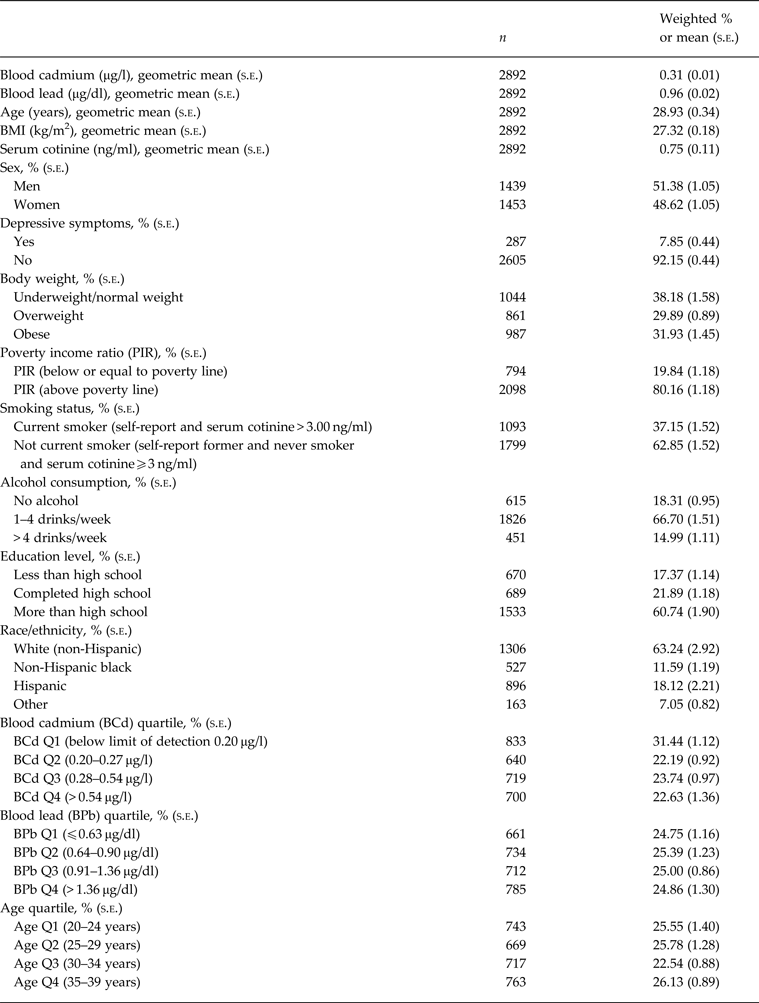
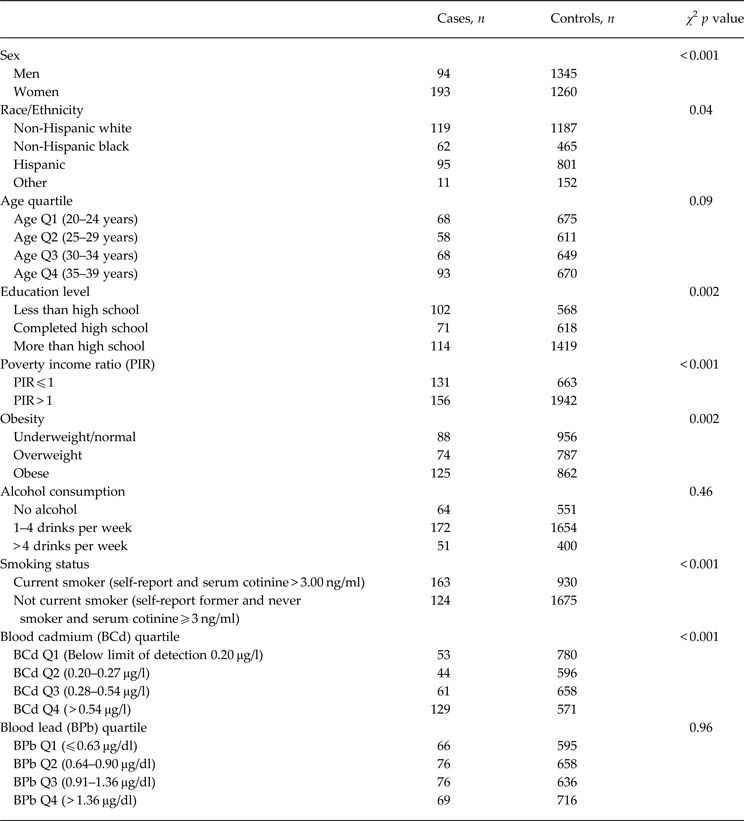
Table 1 presents the characteristics of the study population. The geometric mean age was similar in both men and women (data not shown). The geometric mean BCd level was 0.31 μg/l. The BCd geometric mean was 0.33 μg/l for women and 0.30 μg/l for men (data not shown). The number of individuals with depressive symptoms was 287 (weighted percentage 7.85%). Table 2 shows the characteristics of depressive symptom cases and controls by covariates used in the models. Depressive symptoms were statistically significantly higher in women, in individuals with a lower PIR, in those with less than high school education, in obese individuals, and in smokers. Additionally, depressive symptoms were significantly associated with BCd.
Sample size (n) and weighted characteristics of young adults participants in NHANES 2007–2010

BMI, Body mass index; s.e., standard error.
χ2 analyses of depressive symptoms between cases and controls in young adults (aged 20–39 years) in NHANES 2007–2010

NHANES, National Health and Nutrition Examination Survey; BMI, body mass index; s.e., standard error.
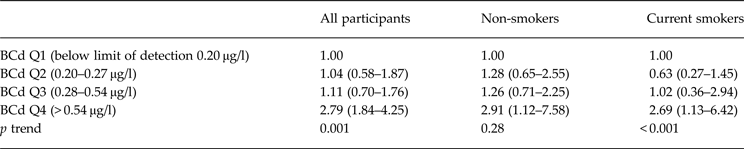
Logistic regression analysis adjusting for age, sex, race/ethnicity, education status, PIR, obesity, alcohol consumption, BPb and smoking status showed that the highest BCd quartile was significantly associated with higher odds of having depressive symptoms [odds ratio (OR) 2.79, 95% confidence interval (CI) 1.84–4.25, p value for trend = 0.001] compared to the referent lowest BCd quartile (Table 3). Analyses using continuous natural log-transformed cadmium confirmed the statistically significant association (data not shown). Higher odds of having depressive symptoms was statistically significantly associated with current smoking status (OR 1.54, 95% CI 1.00–2.36) compared to non-smokers whereas BPb levels were not statistically significantly associated (data not shown). As cigarette smoking is related to cadmium exposure, we conducted a stratified analysis based on smoking status. We found that the highest quartile of BCd was statistically significantly associated with depressive symptoms both in non-smokers (OR 2.91, 95% CI 1.12–7.58) and in current smokers (OR 2.69, 95% CI 1.13–6.42) compared to the referent BCd quartile (Table 3).
Adjusteda ORs (95% CIs) of depressive symptoms by blood cadmium (BCd) levels in young adults (aged 20–39 years) in NHANES 2007–2010

OR, Odds ratio; CI, confidence interval; NHANES, National Health and Nutrition Examination Survey; Q, quartile.
a Adjusted for age, sex, race/ethnicity, education, poverty income ratio (PIR), obesity, alcohol intake, blood lead (BPb) and smoking status (defined as current smoker: self-report and serum cotinine > 3.00 ng/ml; and non-smoker: self-report former and never smoker and serum cotinine⩾3 ng/ml).
Discussion
To our knowledge, this is the first study to report an association of BCd levels with depressive symptoms using a nationally representative sample.
Compared with persons with BCd levels < 0.20 μg/l, those with a level > 0.47 μg/l had a 2.8-fold increased risk of having depressive symptoms. Furthermore, after stratification by smoking status, the association of BCd with depressive symptoms persisted in both current smokers and non-smokers; therefore, the association of cadmium with depressive symptoms is not likely to be confounded by smoking or other compounds present in cigarette smoke such as cotinine and lead.
Bouchard et al. (Reference Bouchard, Bellinger, Weuve, Matthews-Bellinger, Gilman, Wright, Schwartz and Weisskopf2009) previously reported an association between BPb and major depression among young adult (20–39 years of age) participants in NHANES 1999–2004. In our study using NHANES 2007–2010, BPb was not associated with depressive symptoms. Similarly, Golub et al. (Reference Golub, Winters and van Wijngaarden2010) did not find an association between BPb and depression in adults aged ⩾20 years participating in the NHANES 2005–2006 cycle. These differences may be due to the decrease in BPb that occurred in the past decades or to residual confounding.
There is a strong association between smoking and depression; however, this link may be bidirectional: depression increases the risk of smoking (Pomerleau & Pomerleau, Reference Pomerleau and Pomerleau1992; Lerman et al. Reference Lerman, Caporaso, Main, Audrain, Boyd, Bowman and Shields1998; Crone & Reijneveld, Reference Crone and Reijneveld2007) and smoking increases the risk of depression (Weaver & Etzel, Reference Weaver and Etzel2003; Boden et al. Reference Boden, Fergusson and Horwood2010; Aubin et al. Reference Aubin, Rollema, Svensson and Winterer2012). Studies conducted among non-smoking adults suggest that exposure to SHS is correlated with depression (Nakata et al. Reference Nakata, Takahashi, Ikeda, Hojou, Nigam and Swanson2008; Bandiera et al. Reference Bandiera, Arheart, Caban-Martinez, Fleming, McCollister, Dietz, Leblanc, Davila, Lewis, Serdar and Lee2010) but other studies have failed to find such an association (Bot et al. Reference Bot, Vink, Willemsen, Smith, Neuteboom, Kluft, Boomsma and Penninx2013; Lam et al. Reference Lam, Kvaavik, Hamer and Batty2013). In the current study, among individuals not currently smoking, we did not find any association between serum cotinine and depressive symptoms (data not shown). However, there was an association between cadmium and depressive symptoms among those not currently smoking. This suggests that cadmium, whether from SHS or diet in non-smokers, may be a contributing risk factor to depression.
The biological plausibility of our findings is unclear because of the scarcity of studies pertaining to cadmium exposure and neurobehavioral outcomes. Studies in rats have shown that cadmium can increase the permeability of the blood–brain barrier, which can lead in the brain to intracellular cadmium accumulation and cell dysfunction in adult rats (Mendez-Armenta & Rios, Reference Mendez-Armenta and Rios2007; Gonçalves et al. Reference Gonçalves, Fiorenza, Spanevello, Mazzanti, Bochi, Antes, Stefanello, Rubin, Dressler, Morsch and Schetinger2010). Impairment in the monoaminergic neurotransmission system is associated with depression and anxiety disorders (Lanni et al. Reference Lanni, Govoni, Lucchelli and Boselli2009), and cadmium may contribute to the etiology of depression through perturbation of the catecholamine/serotonin system. Adult male rats exposed to cadmium show a decreased content of serotonin, dopamine and norepinephrine in all brain regions (Lafuente et al. Reference Lafuente, Márquez, Perez-Lorenzo, Pazo and Esquifino2001, Reference Lafuente, Gonzalez-Carracedo, Romero and Esquifino2003). Other experimental studies on rats indicate that early exposure to cadmium can induce behavioral and neurotoxic effects, including a decrease in locomotor activity or an increase in anxiety-like behavior (Barański, Reference Barański1984; Ali et al. Reference Ali, Mathur and Chandra1990; Leret et al. Reference Leret, Millan and Antonio2003). Gonçalves et al. (Reference Gonçalves, Nicoloso, da Costa, Farias, Carvalho, da Rosa, Gutierres, Abdalla, Pereira, Dias, Barbosa, Dressler, Rubin, Morsch and Schetinger2012) reported an impaired cognition and enhanced anxiety-like behavior associated with increased acetylcholinesterase activity and a decrease in Na+, K+-ATPase activity in pubertal male rats treated with cadmium in the diet. Studies of exposed children show that high cadmium concentrations in hair are associated with learning difficulties (Capel et al. Reference Capel, Pinnock, Dorrell, Williams and Grant1981; Ciesielski et al. Reference Ciesielski, Weuve, Bellinger, Schwartz, Lanphear and Wright2012).
One of the strengths of the present study is the use of the structured self-report assessment PHQ-9, which is widely used in psychiatric research and has a high degree of correspondence with clinical interviews (Martin et al. Reference Martin, Rief, Klaiberg and Braehler2006). The present study has several limitations, the most important being its cross-sectional design, which limits the inferences that can be made based on the findings. Medical conditions such as osteoporosis, during which cadmium and lead are released from the bone matrix to the blood, may affect our findings. However, in this study few individuals were likely to have had osteoporosis because of their young age (maximum 39 years). BCd is considered a biomarker for recent, short-term exposure; however, it was found that cadmium in blood is composed of a short half-life of 3–4 months (Jarup et al. Reference Jarup, Rogenfelt, Elinder, Nogawa and Kjellstrom1983). The latter is reflective of the cadmium body burden; therefore, BCd may be a good indication of long-term low-level exposure (Jarup et al. Reference Jarup, Berglund, Elinder, Nordberg and Vahter1998). The depression status in our study is limited to answers in the PHQ-9 about the experience of the participants during the past 2 weeks, so the presence of depressive symptoms reflects the current status. Therefore, BCd (as a biomarker of recent exposure) may be appropriate to use in this case.
The association reported in this study could be biased by uncontrolled confounders such as genetic predisposition (Cohen-Woods et al. Reference Cohen-Woods, Craig and McGuffin2013). However, the models were adjusted for several possible important confounding factors (sex, age, race/ethnicity, education status, annual income, obesity, alcohol, smoking status, serum cotinine and BPb). Although the possibility that depression leads to behavioral changes that increase exposure to cadmium (i.e. tobacco smoke) cannot be ruled out, the results among current non-smokers may indicate otherwise. Analyses that included only non-smokers indicate that residual confounding by smoking does not explain the associations of BCd levels and risks of depression, and that cadmium may be an independent risk factor for depression.
If cadmium exposure is associated with depression, continued efforts at reducing cadmium population exposures mainly through tobacco smoking cessation programs, which have the added benefit of decreased cadmium exposure through second- and third-hand smoke, may help to decrease the population incidence of depression A recent meta-analysis reported that smoking cessation is associated with reduced depression (Taylor et al. Reference Taylor, McNeill, Girling, Farley, Lindson-Hawley and Aveyard2014), a finding that may help to overcome professional reluctance to intervene with smokers who have mental health problems (Johnson et al. Reference Johnson, Moffat and Malchy2010; Chang et al. Reference Chang, Hayes, Perera, Broadbent, Fernandes, Lee, Hotopf and Stewart2011). Given that cadmium is associated with several chronic diseases (ATSDR, 2012), the benefits of smoking cessation are multifold by decreasing the incidence of both smoking-related and cadmium-associated diseases.
However, further studies, such as well-designed prospective studies to evaluate the effect of cadmium exposure and the risk of developing depression, are needed to more fully understand the implications of the findings of this study.
Acknowledgments
This research was supported in part by an appointment to the Research Participation Program at the CDC administered by the Oak Ridge Institute for Science and Education through an interagency agreement between the US Department of Energy and CDC (M.C.B.). The findings and conclusions in this report are those of the authors and do not necessarily represent the views of CDC/ATSDR.
Declaration of Interest
None.