The US Census Bureau reported that about 29 million Americans were aged 70 and older in 2012, and that number is expected to increase to 64 million by 2050; the number of those 80 and older is expected to increase from 12 million in 2012 to 31 million by 2050 (US Census Bureau, 2012, 2013). This is important given that more older adults are remaining active motorists, with a large percentage of the population 70 and older remaining licensed and driving more miles (Federal Highway Administration, 2009, 2014). The number of accidents per mile driven is highest for older adults and young adults (Keall and Frith, Reference Keall and Frith2004). For drivers aged 21–96, the risk of death following a crash with physical injury increases by 3% for each year (Kahane, Reference Kahane2013). This suggests that older adults are at greatest risk for lethality following a motor vehicle accident.
On-road driving tests are the most face valid method of evaluating driving safety in older adults. In one study, cognitively impaired participants committed a greater number of impaired driving maneuvers during an on-road driving test compared to controls (Davis et al., Reference Davis2012). In a separate study, patients with Alzheimer's disease (AD) were deemed more impaired on an on-road driving test than those with another neurodegenerative disorder (Grace et al., Reference Grace, Amick, D'Abreu, Festa, Heindel and Ott2005). However, while on-road driving tests are sensitive to driving difficulties, not all older adults are amenable to undergoing this type of evaluation, with many expressing anxiety and fear related to the process (Bhalla et al., Reference Bhalla, Papandonatos, Stern and Ott2007). Therefore, it is important to explore factors that may be indicative of driving safety in older adults beyond the on-road driving test alone, such as cognitive performance, behavioral dysfunction, and informant report of driving skill. The current study has two primary goals in exploring aspects of the informant-based AAN Caregiver Driving Safety Questionnaire, a measure developed by the AAN to assess driving concerns among older adults (details on its development are described in the original article; Iverson et al., Reference Iverson, Gronseth, Reger, Classen, Dubinsky and Rizzo2010). The current study will (1) explore the psychometrics of the informant-based AAN Caregiver Driving Safety Questionnaire and (2) examine the questionnaire's associations with patient cognitive performance and informant report of patient behavioral functioning.
AAN caregiver driving safety questionnaire
In 2010, the American Academy of Neurology (AAN) updated its previous 2,000 practice parameters to address questions and concerns about the evaluation of driving safety in older adults by suggesting an alternative method to assess for potential unsafe driving (Iverson et al., Reference Iverson, Gronseth, Reger, Classen, Dubinsky and Rizzo2010). In this update, they explored multiple components that may be associated with driving difficulty in order to create an informant-based questionnaire that could easily be administered during clinical visits to better identify patients who may be at higher risk for unsafe driving (Iverson et al., Reference Iverson, Gronseth, Reger, Classen, Dubinsky and Rizzo2010).
The first component in the AAN update is patient and/or caregiver concerns about patients’ driving ability. While there is evidence that patients who made recent changes or restrictions to their own driving are at an increased risk of vehicle accidents in the future (Lesikar et al., Reference Lesikar, Gallo, Rebok and Keyl2002), patients with cognitive difficulties tend to have limited insight into their driving difficulties. For example, AD patients who are unable to pass an on-road driving test still report themselves to be safe drivers (Hunt et al., Reference Hunt, Morris, Edwards and Wilson1993; Brown et al., Reference Brown, Ott, Papandonatos, Sui, Ready and Morris2005). Thus, impaired insight may play a role in further increasing driving safety risk in older adults. There is some evidence that evaluator ratings on a standardized road test are more strongly correlated with caregivers’ report of driving problems than self-reported driving ability in AD patients (Wild and Cotrell, Reference Wild and Cotrell2003); therefore, informant-reported concerns are an important contribution when considering patient driving ability.
Additionally, Iverson and colleagues (Reference Iverson, Gronseth, Reger, Classen, Dubinsky and Rizzo2010) noted that elements of older adult driving history, which explores a history of vehicle accidents and traffic citations, may be associated with decreased driving ability. For example, in older adults, negative associations have been found between crashes and traffic violations and on-road driving test scores (Fitten et al., Reference Fitten1995; Davis et al., Reference Davis2012) and between self-reported motor vehicle accidents and road driving test performance (de Raedt and Ponjaert-Kristoffersen, Reference de Raedt and Ponjaert-Kristoffersen2000). There also is evidence that suggests a history of prior accidents in older adults is predictive of future accident risk (Foley et al., Reference Foley, Wallace and Eberhard1995; Owsley et al., Reference Owsley1998; McGwin et al., Reference McGwin, Sims, Pulley and Roseman2000; Daigneault et al., Reference Daigneault, Joly and Frigon2002). A past history of traffic citations in older adults (within three years or less from the time of the study) also is associated with increased future citations (Daigneault et al., Reference Daigneault, Joly and Frigon2002) and accidents (Gebers and Peck, Reference Gebers and Peck1992).
Changes or restrictions to a patient's driving behaviors (self or externally imposed) also predict driving difficulties. Reductions in the number of miles patients drive are associated with lower scores on an on-road driving test (de Raedt and Ponjaert-Kristoffersen, Reference de Raedt and Ponjaert-Kristoffersen2000) and predictive of failing an on-road driving test (Cushman, Reference Cushman1996). Additionally, a history of patients limiting driving in the rain or at night also is associated with failing on-road driving tests (Baldock et al., Reference Baldock, Mathias, McLean and Berndt2006), and this type of restriction tends to be associated with being referred to a licensing agency due to driving safety concerns (Staplin et al., Reference Staplin, Lococo, Gish and Decina2003).
Finally, aggressive personality characteristics in older adults also are noted to be independently associated with driving difficulties. Specifically, Herrmann et al. (Reference Herrmann, Rapoport, Sambrook, Hebert, McCracken and Robillard2006) found that agitation and aggression were predictive of a refusal to discontinue driving in a sample of older adults with dementia. As behavioral changes are common in dementia, this adds an additional complicating factor to maintaining safe driving in some older adults.
To summarize, the four major elements associated with decreased driving ability in dementia patients as reported by the AAN includes, (in no specific order), (1) a history of crashes/citations, (2) informant-reported concerns, (3) reduced mileage/situational avoidance, and (4) aggressive driving. Thus, the AAN Caregiver Driving Safety Questionnaire was designed to address these specific areas of functioning (Iverson et al., Reference Iverson, Gronseth, Reger, Classen, Dubinsky and Rizzo2010).
Cognitive and behavioral associations with driving ability
Performance on cognitive screening tools such as the Mini-Mental Status Examination (MMSE) also have been associated with on-road driving test performance (Odenheimer et al., Reference Odenheimer, Beaudet, Jette, Albert, Grande and Minaker1994; Fitten, et al., Reference Fitten1995; Fox et al., Reference Fox, Bowden, Bashford and Smith1997; Davis et al., Reference Davis2012), with a cutoff of MMSE ≤ 24 suggestive of increased concerns regarding driving; however, these associations between the MMSE and on-road driving test performance have not consistently been found (De Raedt and Ponjaert-Kristoffersen, Reference De Raedt and Ponjaert-Kristoffersen2001; MacGregor et al., Reference MacGregor, Freeman and Zhang2001). Neuropsychological domains of visual attention, executive functioning, and visuoperception are most strongly associated with driving safety risk in older adults (Ott et al., Reference Ott, Heindel, Whelihan, Caron, Piatt and Noto2000; Brown et al., Reference Brown, Ott, Papandonatos, Sui, Ready and Morris2005; Grace et al., Reference Grace, Amick, D'Abreu, Festa, Heindel and Ott2005).
While associations between driving abilities and cognitive dysfunction are documented, less is known about associations between driving safety and reported behavioral dysfunction. Personality and behavioral characteristics of apathy and agitation on a brief neuropsychiatric inventory were associated with limited driving in dementia patients (Herrmann et al., Reference Herrmann, Rapoport, Sambrook, Hebert, McCracken and Robillard2006), though this relationship has not been examined using more comprehensive behavioral measures. Behavioral problems are commonly found in patients with cognitive impairment, including AD (Malloy et al., Reference Malloy, Tremont, Grace and Frakey2003), thereby potentially increasing their risk for unsafe driving. Therefore, further exploration of associations between behavioral changes and concerns about driving safety is warranted.
Current study
Using the AAN Caregiver Driving Safety Questionnaire (as described in Iverson et al., Reference Iverson, Gronseth, Reger, Classen, Dubinsky and Rizzo2010), the current study has two primary goals. As the first exploration of the factor structure of the AAN Caregiver Driving Safety Questionnaire, an exploratory factor analysis (EFA) will be run to examine the factor structure of the scale. We expect the EFA will reveal a four-factor structure within the questionnaire, consistent with the four-proposed components associated with driving safety, and supporting the internal consistency reliability of the measure.
A second goal of the current study is to examine associations between the four factors that emerge from the EFA and cognitive and behavioral impairment in cognitively impaired older adults. After creating factor scores from the four questionnaire factors, we will explore associations between scores on cognitive measures and behaviors associated with frontal systems functioning and AAN Caregiver Driving Safety Questionnaire scores. We expect negative associations between cognition and driving safety concern scores, with strongest associations between driving safety concerns and executive dysfunction. We also expect positive associations between frontal systems behavioral dysfunction and concerns about driving safety. In a series of regressions, we will also explore whether cognitive and/or behavioral dysfunction predicts caregiver concerns about patient driving safety.
Method
Participants and procedure
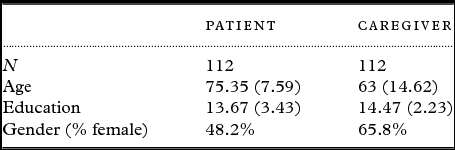
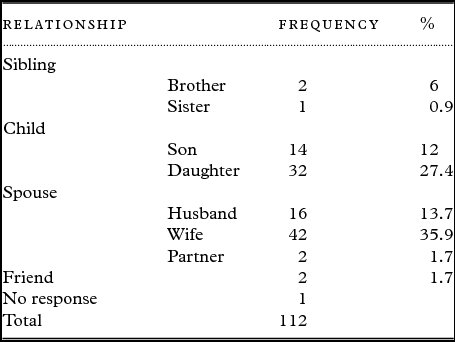
Participants were 112 patients who underwent an outpatient neuropsychological evaluation due to concerns regarding dementia/memory loss and their accompanying friend or family member caregiver (informant and patient demographics in Table 1). Most caregivers were a spouse or child of the patient (Table 2). The sample was predominately Caucasian, representative of the Rhode Island population (US Census Bureau, 2016). While patients completed the neuropsychological evaluation, caregivers completed a series of questionnaires about patients’ functioning, including the AAN Caregiver Driving Safety Questionnaire. Caregiver burden was measured, as this may negatively affect informant reporting. Caregivers in the current sample did not endorse clinically significant caregiver burden on the Zarit Burden Interview (Zarit et al., Reference Zarit, Todd and Zarit1986; M = 23.42, SD = 15.69), based on cut-offs (< 24) established by Schreiner et al. (Reference Schreiner, Morimoto, Arai and Zarit2006).
Participant demographics

Frequencies of caregiver relationships to patient

All patients had some degree of cognitive impairment as measured by the MMSE (M = 25.12, SD = 4.18; Folstein et al., Reference Folstein, Folstein and McHugh1975), and patients met diagnostic criteria for mild cognitive impairment (MCI) consistent with both Petersen's and the National Institute on Aging/Alzheimer's Association diagnostic criteria (Petersen, Reference Petersen1995 and Albert et al., Reference Albert2011, respectively) or possible or probable AD based on the NINCDS–ADRDA criteria (McKhann et al., Reference McKhann1984). Patients with primary psychiatric diagnoses or cognitive deficits likely secondary to a dementia other than AD (e.g. dementia with Lewy bodies, frontotemporal dementia, stroke) were excluded. Data from these clinical evaluations were entered into a clinical research database and extracted for use in this retrospective study that was approved by the Institutional Review Board.
Measures
The AAN Caregiver Driving Safety Questionnaire is a 13-item informant-reported questionnaire that examines driving risk in elderly patients and patients with dementia (Iverson et al., Reference Iverson, Gronseth, Reger, Classen, Dubinsky and Rizzo2010). As previously stated, the four major elements examined by the AAN include a history of crashes/citations, informant-reported concerns, reduced mileage/situational avoidance, and aggressive driving. Caregivers rate patients on a 1–4 scale, and higher scores reflect greater concern about driving safety.
Cognitive functioning. The MMSE (Folstein et al., Reference Folstein, Folstein and McHugh1975) is a brief cognitive screening tool widely used in medical settings. It has sound inter–rater (O'Connor et al., Reference O'Connor1989) and test–retest (Mitrushina and Satz, Reference Mitrushina and Satz1991) reliability and sound predictive validity as a dementia screening tool (Schmand et al., Reference Schmand, Lindeboom, Launer, Dinkgreve, Hooijer and Jonker1995).
The Dementia Rating Scale, 2nd edition (DRS-2) measures cognitive status in adults with cognitive impairment (Jurica et al., Reference Jurica, Leitten and Mattis2004). The DRS-2 measures cognitive ability in five major subscales: Attention, Initiation/Perseveration, Construction, Conceptualization, and Memory and is a valid and reliable measure of cognitive functioning (Jurica et al., Reference Jurica, Leitten and Mattis2004). Higher scores reflect better cognition, with a maximum score of 144. Dementia cut-off is 123.
Other selected cognitive performance measures included visuospatial and executive functioning; as previously stated, these domains are most strongly associated with driving safety risk in older adults. Visuospatial abilities were measured using an angle estimation task, Judgment of Line Orientation (JLO, abbreviated form), in which patients are asked to match the angles of lines to an array of lines below it; greater score reflects greater correct responses with maximum score of 15 (Benton et al., Reference Benton, Varney and Hamsher1978). Executive functioning was measured using a set-shifting task, the Trail Making Test-part B (TMTB), in which patients are asked to alternate between connecting numbers and letters on a sheet. Scores reflect total time required to complete the task. Finally, visual organization was measured by evaluating approach and organization to a figure copy task, specifically the Rey Osterrieth Complex Figure, using the Boston Qualitative Scoring System Organization score; higher scores reflect better visual planning and organization (Stern et al., Reference Stern1994).
Behavioral dysfunction was measured using the Frontal Systems Behavior Scale (FrSBe; Grace and Malloy, Reference Grace and Malloy2001) a 46-item informant-reported questionnaire used to measure behavioral dysfunction related to frontal systems dysfunction in adult neurological patients. Three index scores emerge on this scale, theoretically driven to measure behaviors linked to three frontally mediated brain circuits, specifically the dorsolateral prefrontal cortex (Executive Functioning), orbitofrontal cortex (Disinhibition/Emotional Dysregulation), and anterior cingulate cortex (Apathy/Akinesia). Two factor analytic strategies have supported the factor structure of this scale (Stout et al., Reference Stout, Ready, Grace, Malloy and Paulsen2003; Carvalho et al., Reference Carvalho, Ready, Malloy and Grace2013). Higher scores reflect greater problematic behaviors.
Statistical analysis
We used EFA to explore the factor structure of the AAN Caregiver Driving Safety Questionnaire. Factors with an eigenvalue > 1 were considered relevant components. Based on results of the factor structure in the EFA, a series of linear regressions were run using the AAN Caregiver Driving Safety Questionnaire factors to determine, after controlling for objective cognition (raw scores), whether informant reported behavioral problems (raw scores) predicted caregiver concerns about driving safety. Notably, shared variance that is being captured by multiple informant measures (having caregivers rate concerns about driving safety on the AAN Caregiver Driving Safety Questionnaire and behavioral changes on the FrSBe) creates the baseline potential for associations between these scales. To correct for this effect, we used a more conservative p < 0.01 to indicate significant effects.
Results
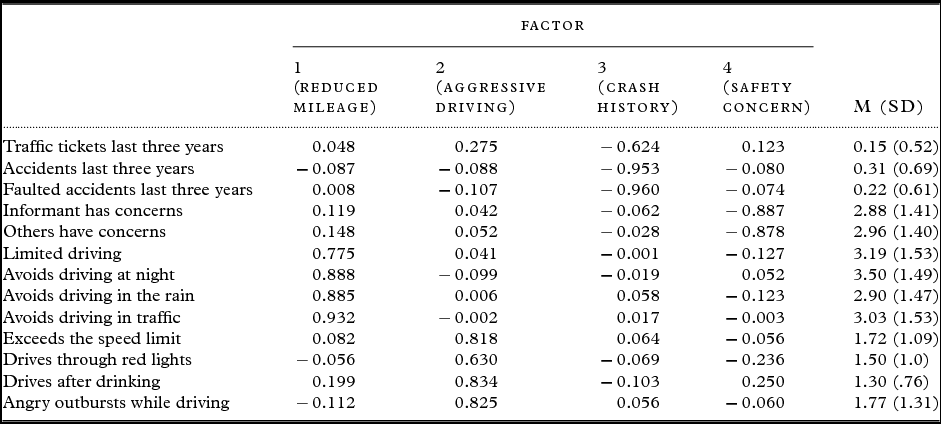
Exploratory principal component factor analysis using direct Oblimin rotation was conducted as the factors were conceptually similar. A four-factor solution was specified based on the theoretical conceptualization of the items from the scale. A four-component structure was found with eigenvalues > 1 (76.71% of the total variance). Salient item loadings from the four factors were consistent with (1) a history of crashes/driving citations, (2) caregiver and other safety concerns, (3) reduced mileage, and (4) aggressive driving, consistent with the measure's initial design (Table 3). Notably, a similar four-factor solution was found when not restricting the number of factors.
Factor loadings of individual AAN Caregiver Driving Safety Questionnaire items

Next, composite scores were created for the four factor scores. Pearson correlations were conducted between the four factors and performance on the MMSE and DRS-2. Poorer global cognition on the MMSE was associated with increased caregiver safety concerns (r = −0.29 p = 0.003) and reduced mileage (r = −0.23; p = 0.018). Caregiver safety concerns also were correlated with poorer DRS-2 Initiation/Perseveration (r = −0.34, p < 0.001) and Memory (r = −0.23; p = 0.017) scores. Poorer visuoconstructional skills were correlated with reduced mileage (r = −0.26; p < 0.01). All other correlations were not significant (p > 0.05).
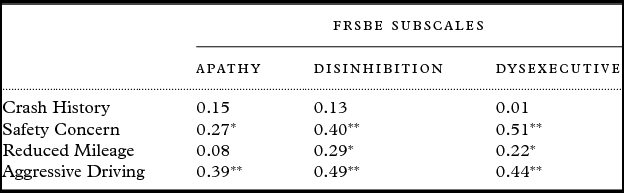
Pearson correlations also revealed significant associations between some AAN Caregiver Driving Safety Questionnaire factor scores and FrSBe index raw scores, controlling for patient age, education, and global cognition on the MMSE. Significant small to moderate associations (Table 4) were found between caregiver concerns about patient safety and aggressive driving and FrSBe index scores of disinhibition/emotional dysregulation, executive functioning, and apathy/akinesia and between reduced mileage/situational avoidance and FrSBe disinhibition/emotional dysregulation, executive functioning. There were no significant correlations between crash history and FrSBe subscales.
Correlations between AAN Driving Safety Questionnaire factor scores and FrSBe subscales

Note: Controlling for MMSE, age, and education; **p < 0.01, * p < 0.05.
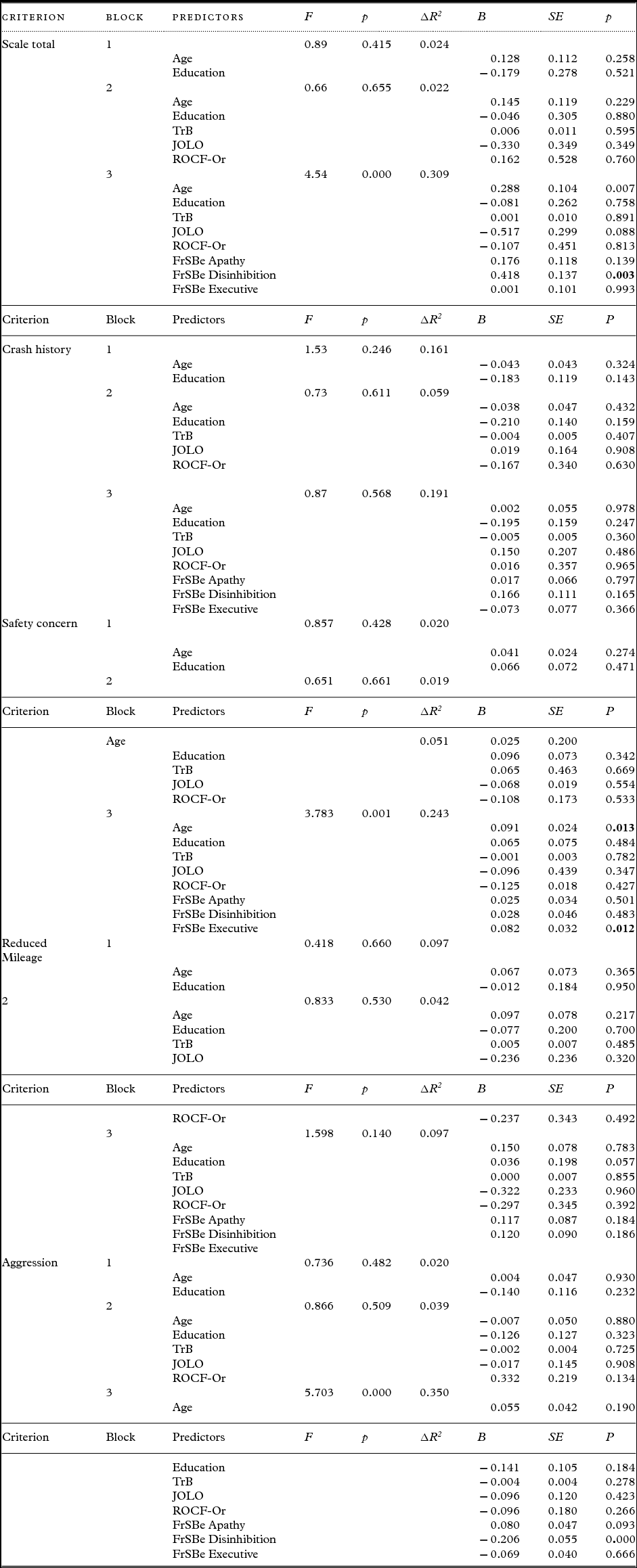
A series of linear regressions were run to explore whether behavioral dysfunction (as measured by the three FrSBe subscales) predicts caregiver concerns about patient driving safety (as measured by AAN Caregiver Driving Safety Questionnaire factor scores) beyond patient objective cognition (JLO; TMTB; and Rey Osterrieth Complex Figure Organization). After controlling for patient age, education, and cognitive performance, FrSBe disinhibition (p = 0.003) predicted total caregiver concerns about patient driving (as measured by total score on the AAN driving safety questionnaire) and aggressive driving (p < 0.001). Both increasing age (p = 0.013) and increasing FrSBe executive dysfunction (p = 0.012) significantly predicted caregiver concerns about driving safety. There were no significant predictors when crash history or reduced mileage/situational avoidance were the dependent variables (Table 5).
Summary of regressions between AAN Driving Safety Questionnaire factor scores and FrSBe subscales

Note: Bolded items reflect p < 0.01; TrB = Trail Making Test part B; JOLO = Judgment of Line Orientation; ROCF-Or = Organization of Rey Osterrieth Complex Figure using Boston Qualitative Scoring System Organization subscore; FrSBe = Frontal Systems Behavior Scale.
Discussion
This study is the first known psychometric review of the AAN Caregiver Driving Safety Questionnaire. Consistent with expectations and the theoretical basis upon which the questionnaire was developed (Iverson et al., Reference Iverson, Gronseth, Reger, Classen, Dubinsky and Rizzo2010), the factor structure of the scale revealed four factors: a history of traffic tickets and accidents, caregiver concerns about driving safety, reduced mileage/situational avoidance, and aggression. This four-factor structure also explained 77% of the variance of the scale. An EFA is a crucial first step in exploring the validity of a measure; therefore, this current study contributes to important exploration about informant-reported concerns about driving safety in caregivers of cognitively impaired patients.
Factor scores were based on EFA results, allowing further exploration of associations between patient behavior and cognition and caregiver concerns about patient driving safety. Correlations revealed significant negative associations between caregiver concerns about driving safety and performance on cognitive measures, particularly executive functioning, memory, and visuoconstruction. Overall, this is consistent with previous research which has shown that visual attention, executive functioning, and visuoperception are most strongly associated with driving safety risk in older adults (Ott et al., Reference Ott, Heindel, Whelihan, Caron, Piatt and Noto2000; Brown et al., Reference Brown, Ott, Papandonatos, Sui, Ready and Morris2005; Grace et al., Reference Grace, Amick, D'Abreu, Festa, Heindel and Ott2005).
To date, less is understood about the relation between patient behavior and caregiver concerns about driving safety. Personality and behavioral characteristics of apathy and agitation were associated with decreased driving in dementia patients using the brief Neuropsychiatric Inventory (Herrmann et al., Reference Herrmann, Rapoport, Sambrook, Hebert, McCracken and Robillard2006); similarly, we also found significant correlations between concerns about driving safety and caregiver reported apathy. However, the current study extends this finding to other frontally mediated behaviors, including significant correlations between caregiver reported executive dysfunction and disinhibition. Thus, caregiver concerns about patient driving safety may be guided by patient behaviors associated with frontal lobe functioning. Results of regressions further supported this by demonstrating that caregiver reported frontal systems behaviors, particularly disinhibition, predicts caregiver concerns about driving safety beyond objective cognitive impairment.
Associations between reported driving concerns and behavioral dysfunction highlights the importance of evaluating patient behaviors when examining driving safety. Patients with suspected cognitive impairment should be examined for possible frontal systems behavioral changes. Additionally, caregiver concerns about driving safety are more influenced by patient behavioral deficits (disinhibition) than by patients’ objective cognition. Thus, caregivers may benefit from psychoeducation about cognitive factors that may negatively impact driving safety to increase their sensitivity to driving safety concerns.
This study has a number of limitations. First, it is important to note the shared variance that is being captured by multiple informant measures; caregivers rated both concerns about driving safety on the AAN Caregiver Driving Safety Questionnaire and frontal systems behavioral changes on the FrSBe. As mentioned, to correct for this, we used a more conservative p < 0.01 to indicate significant effects. Additionally, biases in reporting concerns about a loved one's driving safety may depend on the relationship of the informant to the patient (Bixby et al., Reference Bixby, Davis and Ott2015). In our sample, caregivers who rely on the patient for transportation may have underreported driving safety concerns, raising questions about the validity of their report. Unfortunately, we did not collect data to explore this, but future studies may consider the reliance of informant on the patient for transportation to explore for potential reporting bias. Length of time informants have contact with the patients or exposure/observation of patient driving also may affect caregiver report. Exploring objective behavioral functioning (observational report or clinician evaluation) rather than informant report of behavioral dysfunction may be explored. Finally, comparison of AAN Caregiver Driving Safety Questionnaire and objective on-road driving performance would provide important information about factors that caregivers consider regarding driving safety.
This study is an important first step in assessing the psychometric properties of the AAN Caregiver Driving Safety Questionnaire, a standardized measure among clinicians who evaluate older adults in their various practices (Iverson et al., Reference Iverson, Gronseth, Reger, Classen, Dubinsky and Rizzo2010). It can be difficult to evaluate driving safety, and in many cases caregivers are among the few persons who have personal knowledge of the patient's driving ability and are called upon to provide their perspective on patients’ ability to drive safely. Evaluating and further exploring the validity of informant report on this questionnaire is a critical component before heavily utilizing this measure of informant report in the assessment of cognitively impaired patients who are still driving. The current study supports continued use of this scale in office driving safety assessments.
Conflict of interest:
None.
Description of authors’ roles:
J. O. Carvalho designed the study and was responsible for writing the manuscript. B. Springate assisted with study design and writing. R. Bernier assisted with data collection and writing. J. Davis supervised the study and assisted with design and writing.