Existing hospital resources in many regions would be overwhelmed in responding to major disasters,Reference Bravata, McDonald and Owens1 especially if large numbers of children were involved. 2–Reference Kanter and Moran4 One strategy to extend resources is to alter standards of care.5, Reference Phillips and Knebel6 By limiting care to only immediately essential interventions, and delaying or forgoing less essential interventions, lifesaving care may be extended to more than the usual number of patients.
Other authors have proposed interventions that should be provided when circumstances require altering standards of disaster care, 7–Reference Rubinson, Nuzzo and Talmor9 but they provided no information on their methods to quantitatively match overwhelming needs and constrained resources. Methods suitable for reaching professional consensus on appropriate disaster standards have not been reported. A sustained alteration in standards of care would represent a virtually unprecedented shift for clinicians, public officials, patients, and families. No evidence, professional consensus, or regulatory procedures exist to guide clinicians and decision makers in altering standards of care in disasters.Reference Hogan and Lairet10 The lack of a legal framework or professional consensus on appropriate standards of care in disasters leaves clinicians vulnerable to criminal charges and civil suits when usual standards of care cannot be provided.Reference Okie11 The failure of government, professional organizations, and researchers to take a more active leadership role in defining appropriate disaster standards of care may be viewed as collective denial in the face of disturbing choices.
In this study, our objectives are to explore the feasibility of using a quantitative framework for analyzing the balance between overwhelming needs and limited resources, and to describe the application of a standard consensus development method in proposing appropriate standards of disaster care. Using a single set of assumptions about disaster needs and resources, we present the results of such an analysis used by an interdisciplinary panel of pediatric acute care practitioners, to illustrate the utility of this approach.
METHODS
General Assumptions and Justification
Consensus building on interventions for pediatric hospital disaster care was based on the following assumptions: A surge of 500 patients per million population needing hospital inpatient care has been used as 1 basis for federal disaster planning.12 Previous analysis in 1 metropolitan area indicated that a surge of 500 children per million usually would exceed existing resources.Reference Kanter and Moran4 One strategy to accommodate 500 children per million would involve altering standards of care sufficiently that 4 times the usual number of hospital patients could be served.Reference Kanter and Moran13, Reference Kanter14 Quantitative models for large disasters suggest that tradeoffs would favor population outcomes when standards are altered to allow essential care for 4 times the usual patient number, compared with unlimited care for individuals.Reference Kanter14 Previous planning efforts have aimed for similar increases in hospital capacity.Reference Rubinson, Nuzzo and Talmor9 Therefore, the present study develops consensus on those essential interventions that could serve 4 times the usual number of inpatients within specified workload constraints.
The problem of workload constraints is considered in the context of a sudden onset emergency having a relatively short duration (days rather than weeks). This emphasizes the transition from normal to disaster responses, using local resources, before additional assistance arrives from outside the region.Reference Rubinson, Nuzzo and Talmor9 Like many previous planning efforts,5–7,Reference Rubinson, Nuzzo and Talmor9,15 the problem was considered in an all-hazards context to develop an approach that pertains to a range of disaster mechanisms. It is recognized that specific mechanisms of disaster may require planning for unique interventions, but these are beyond the scope of our efforts to begin consensus development.
Professional Panel
A consensus development panel was chosen by the principal investigator for members’ clinical experience in various fields of pediatric acute care. Panel members are each practitioners in 1 or more areas of disaster planning, prehospital emergency services, emergency medicine and nursing, surgery, anesthesia, critical care, or inpatient hospital care. Some of the members also have academic departmental leadership, administrative, educational, and research roles in their respective fields. All of the coauthors of this report participated as panel members, except the principal investigator (R.K.K.), who served as referee for the process. The Institutional Review Board for the Protection of Human Subjects at Upstate Medical University did not regard this survey of professional opinion as human experimentation, and thus viewed the study as exempt from review.
Delphi Process
A consensus of opinion was developed in a modified Delphi process involving iterative rounds of questions and answers.Reference Fink, Kosecoff and Chassin16–Reference Graham, Regehr and Wright19 The referee presented questions to the panel by electronic mail. Answers were returned to the referee. Although panel members’ identities were known to each other, answers and comments were tabulated and reported back to the group anonymously. Panel members did not directly discuss the questions with each other. Opinions stated in a prior round were intended to influence opinions and change answers in subsequent rounds in the process of seeking consensus. Iterative rounds were considered to reach a consensus when at least 75% of the panel members agreed with an answer. Discussion was ended and consensus was considered to be incomplete for those interventions lacking agreement after 4 rounds. All of the panel members support the findings and recommendations of this report.
Workload Constraints
Opinions regarding interventions considered essential and plausible in a large disaster surge were developed within the context of the Therapeutic Intervention Scoring System (TISS).Reference Cullen, Nemeskal and Zaslavsky20, Reference Miranda, Rijk and Schaufeli21 The TISS system describes relative staff time and resource utilization necessary to carry out standard clinical interventions. The TISS methodology describes workload quantitatively, distinguishing among such non–intensive care unit (ICU) hospital interventionsReference Cullen, Nemeskal and Zaslavsky20 as checking and recording vital signs and fluid balance, monitoring cardiac rhythm and pulse oximetry, placing intravenous catheters and nasogastric tubes, caring for wounds, administering supplemental oxygen, and dispensing scheduled or unscheduled medications. Interventions unique to the ICU are described and distinguishedReference Miranda, Rijk and Schaufeli21 such as vasoactive infusions; extensive wound care; mechanical ventilation; vascular volume resuscitation to replace large fluid losses; invasive monitoring of arterial, central venous, and intracranial pressure; and dialysis.
Previous observations indicate that peak workload for an ICU nurse caring for multiple patients was 66 TISS points.Reference Miranda, Rijk and Schaufeli21 For purposes of the present study, the following workload assumptions were made: In a disaster, staff assignments would expand to care for 4 times the usual number of patients, but the peak workload per staff member cannot increase, and staff numbers do not change. It was assumed that TISS methodology for nurse workload would represent other resources whose utilization has no validated measure. Prior inpatients as well as disaster victims would require care, thus altered standards would involve withdrawing some aspects of care from prior inpatients, as well as withholding some conventional interventions from new inpatients. Assuming that an ICU nurse cares for an average of 1.5 patientsReference Marcin, Rutan and Rapetti22 in normal circumstances, then in disaster surges this would increase to 6 ICU patients. Assuming that non-ICU nurses normally care for 6 pediatric patients,23 then in disaster surges this would increase to 24. If staff included a mix of registered nurses, licensed practical nurses, and nursing assistants, then this registered nurses-to-patient ratio is consistent with the range recommended for Modular Emergency Medical Systems Acute Care Centers.7
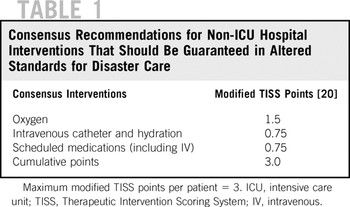
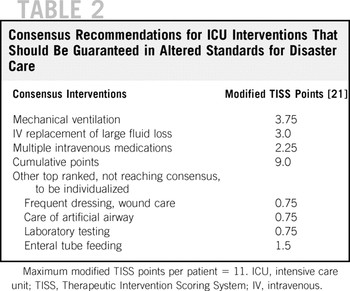
A quantitative framework for allocating resources in a disaster, to accommodate 4 times the usual peak number of patients, was obtained as follows: If the peak workload of a nurse caring for multiple patients is 66 points on the TISS-28 scale,Reference Miranda, Rijk and Schaufeli21 then the interventions per patient would be defined by this work capacity and the numbers of patients. For a disaster surge of ICU patients, a maximum of 66 workload points per ICU nurse is distributed among 6 patients, amounting to 11 TISS points per patient. For a disaster surge of non-ICU hospital patients, a maximum of 66 workload points per nurse is distributed among 24 patients, or approximately 3 TISS points per patient. As a point of reference, in normal circumstances a severe non-ICU hospital patient requires interventions amounting to 20 to 30 TISS points,Reference Cullen, Nemeskal and Zaslavsky20 whereas a severe ICU patient requires 40 to 50 intervention points.Reference Miranda, Rijk and Schaufeli21
TISS points for each intervention were adjusted for the purposes of this study because federal and professional groups have recommended modifications in the general approach to patient care in disasters in a way that increases efficiency of all interventions.5,7–Reference Rubinson, Nuzzo and Talmor9,15 These include standing order templates standardizing treatment, simplifying the medical record, increasing reliance on clinical judgment with less radiographic and laboratory testing, reusing some disposable supplies and equipment, and reducing privacy and confidentiality. No evidence is available to measure the extent of efficiency gained in use of these approaches.
Questions to the Panel
Question 1 was, “If efficiency of all interventions is improved by the approaches suggested above, based on your own acute care experience, what is your opinion on the resulting reduction in time and resource utilization for each therapeutic intervention? Assume that any efficiency improvement would reduce TISS points for all interventions to a similar extent.” Consensus was developed on the mean value for potential efficiency improvement estimated by the panel.
Question 2 was, “Choose specific interventions that you think are most essential to provide to patients in a disaster if it were necessary to extend care to 4 times the usual number of patients. Select interventions from the lists of the Intermediate TISS interventionsReference Cullen, Nemeskal and Zaslavsky20 for non-ICU hospital care and from TISS-28 interventions for ICU care,Reference Miranda, Rijk and Schaufeli21 with all intervention points adjusted for efficiency improvements based on consensus answers to question 1.” Consensus was developed on interventions ranked according to numbers of panel members choosing each, up to the maximum allowable TISS points.
RESULTS
The panel of pediatric acute care practitioners estimated efficiency improvements that are possible in carrying out interventions in a disaster (question 1). The panel provided opinions and agreed with the average value in a single question/answer round. The panel estimated that general measures to improve efficiency would result in a mean improvement in efficiency of 25% (range 10%–50%). Thus, modified TISS scores for time and resource consumption associated with all interventions were obtained by reducing standard TISS scores for interventions by 25%.
The panel considered recommendations for essential therapeutic interventions (question 2) in 4 iterative rounds. Consensus was reached on recommendations for non-ICU hospital interventions, but disagreements on ICU interventions could not be completely reconciled.
Consensus on non-ICU hospital interventions (Table 1) was reached by 9 of 10 panel members. The recommended interventions included administration of supplemental oxygen, an intravenous catheter, and scheduled intravenous medications. The panel assumed that presence of an intravenous catheter would include the option for routine intravenous hydration. Even after reaching consensus, the panel was unsatisfied with the prospect of forgoing some other interventions that did not meet the ranking cutoff. In particular, for trauma patients, wound and fracture care would have to be provided at some point even though this exceeds initial crisis workload constraints. The TISS scoring system assumes that patients feeding normally by mouth do not add TISS points, so the consensus recommendations assume that oral nutrition and hydration are provided when clinically warranted. In addition, if a crisis continued for a protracted period, gastric tube feedings of some patients would contribute to their recovery, even though these exceed initial crisis workload constraints.
Consensus Recommendations for Non-ICU Hospital Interventions That Should Be Guaranteed in Altered Standards for Disaster Care

For ICU interventions (Table 2), 9 of 10 panel members reached a consensus on the top 3 intervention choices: mechanical ventilation, intravenous replacement of large fluid losses, and multiple intravenous medications. Consensus could not be reached on the remaining intervention choices without exceeding TISS points per patient limits. Seven panel members preferred to offer any 2 interventions out of the following 3 choices: frequent dressing changes and wound care, care of artificial airways, and laboratory testing, resulting in a cumulative TISS point total of 10.5. Two panel members preferred to offer enteral tube feedings for a cumulative TISS point total of 10.5.
Consensus Recommendations for ICU Interventions That Should Be Guaranteed in Altered Standards for Disaster Care

The panel agreed to emphasize support for the top 3 ICU interventions and to recommend individualizing additional ICU interventions without exceeding the maximum TISS points per patient. For patients with trauma and burns, wound care would be essential. In a protracted crisis, enteral tube feedings may be crucial in some patients’ recovery.
Because excessive numbers of interventions would exceed specified workloads, we would delay or forgo such standard interventions as monitoring and recording hourly vital signs and fluid balance, the infusion of vasoactive medications, use of arterial and central venous pressure measurements for hemodynamic monitoring, intracranial pressure monitoring, and dialysis. Attempting to provide all of these interventions would exceed specified workload constraints and would exclude many patients from receiving more important interventions in a disaster surge.
There is ambiguity in published TISS terminology regarding central venous catheters. Some versions specifically refer to “central venous pressure,”Reference Cullen, Nemeskal and Zaslavsky20, Reference Cullen, Civetta and Briggs24 whereas another refers to “central venous lines.”Reference Miranda, Rijk and Schaufeli21 We view the use of a central venous catheter for intravenous access as potentially more efficient and reliable than peripheral intravenous catheters, without excess time spent in use or care of the central catheter. However, added staff time spent in measuring and recording would be likely if the catheter were used for pressure monitoring. Therefore, although we would reluctantly forgo central venous pressure measurements in an overwhelming crisis, central venous access for fluid infusions would be an effective use of resources within the constraints of our assumptions.
DISCUSSION
This report demonstrates a method to select essential hospital disaster interventions that are feasible within a quantitative framework of constrained resources and overwhelming clinical needs. Because only a single set of assumptions was considered, the findings should be regarded as a prototype for future analysis of a broader range of disaster scenarios. However, the assumptions in the present report represent a large disaster surge. Therefore, the recommended interventions should be considered to be clinically feasible in responding to a less overwhelming event. In particular, the ICU interventions recommended may be regarded as a minimum set that we should attempt to guarantee if intensive care could be provided at all.
Altered standards of care in disasters also have been referred to as “austere care,”Reference Phillips25 “minimal acceptable care,”Reference Hogan and Lairet10 or “a standard of care that has been shown to optimize patient outcomes in a given disaster scenario.”Reference Koenig, Cone and Burstein26 Lacking such data on optimized outcomes,Reference Hogan and Lairet10 professional consensus on appropriate standards of care in disasters does not exist. Consistent standards and smooth transitions among hospital areas are essential to maintain patient flow and allow emergency departments to continue receiving new patients from the community. The shortage of ICU resources in most communities suggests the need for particular attention to ICU surge capacity. 13,14,27
The following considerations pertain to assumptions made for this study. Regarding the assumption that staffing levels remain normal in a hypothetical disaster, one can imagine more pessimistic scenarios in which staffing levels are depleted.Reference Irvin, Cindrich and Patterson28 Alternatively, some disaster plans5consider using provider extenders with lower levels of training and credentials to expand staffing levels, at least for simple interventions. In particular, many aspects of routine care and supervision of children may be provided by nonprofessionals, including family members, without adding to the workload of nursing staff. This is consistent with assumptions of the TISS methodology that normal oral fluid and nutritional intake do not add TISS points for children or adults. The present study reflects conditions in a crisis lasting days rather than weeks. In a more protracted event, organizational efficiencies may be developed to improve capacity, or resources may be depleted, further limiting capacity. In a large disaster involving a single predominant mechanism of illness or injury, efficiencies may be gained in caring for homogeneous patient populations.7 Triage decisions on palliative care for the most severely ill or injured patients are not considered in the present analysis. Disaster capacity in prehospital, operating room, and imaging services have been considered by other investigators and are not explored in this study.29, Reference Hirschberg, Scott and Granchi30
The modified Delphi process used to seek a consensus in the present study has the following advantageous featuresReference Fink, Kosecoff and Chassin16–Reference Fink, Kosecoff and Chassin19: The Delphi process is intended to structure group communications in developing consensus when existing scientific evidence is incomplete. Mailed questions and answers are inexpensive. Information can be shared at a distance without meetings. In an iterative process, opinions expressed in 1 round are intended to influence emerging opinions in a subsequent round. However, by maintaining anonymity in the discussion, the focus is on content, not personal persuasion. The process is flexible, with the number of iterative rounds individualized to generate consensus for the issue under consideration. The method has been criticized as limiting insights that may have developed in a group face-to-face discussion. Because all interaction is conducted through the referee, it is possible that consensus could be distorted by referee bias.
The TISS scoring system, devised more than 30 years ago to describe use of ICU resources,Reference Cullen, Civetta and Briggs24 was used in the present study to impose quantitative limits on interventions. This instrument is still used in current clinical investigation to describe resource utilization in clinical trials,Reference Laterre, Levy and Clermont31 benchmarking of intensive care units,Reference Metnitz, Velely and Valentine32 and cost-utility analyses.Reference Graf, Wagner and Graf33 The revised TISS-28 version simplifies and validates the TISS methodology in relation to the modern bedside care process.Reference Miranda, Rijk and Schaufeli21 The method also has been validated and used to describe interventions in the non-ICU hospital setting (Intermediate TISS).Reference Cullen, Nemeskal and Zaslavsky20 In addition, the TISS score has been used to describe emergency departmentReference Kissoon and Walia34 and interhospital transportReference Lee, Yeung and Lo35 interventions, although quantitative validation of how well the score represents workloads in these settings is incomplete. Average TISS-28 scores are similar for pediatric and adult ICU patients, Reference Reinoud, Bonsel and McDonnell21,32,36 and published equations demonstrate similarities of TISS score values among the versions. Reference Cullen, Civetta and Briggs20,21,24
Our recommendations supplement the work done by other disaster planners. Some similarities and differences are worth noting. Our consensus non-ICU hospital interventions are similar to order templates previously developed for Modular Emergency Medical System Acute Care Centers.7 As in previous recommendations,Reference Hick and O’Laughlin8, Reference Rubinson, Nuzzo and Talmor9 we consider mechanical ventilation and fluid resuscitation to be high-priority ICU interventions. However, numbers of patients who could receive mechanical ventilation would be limited by the national lack of ventilator stockpiles,Reference Hick and O’Laughlin8,Reference Rubinson, Nuzzo and Talmor9,Reference Neyman and Irvin37–Reference Powell, Christ and Birkhead39 even if staff could be extended. The lack of national ventilator stockpiles suggests that professional consensus has not yet developed sufficiently for mechanical ventilation to be viewed as a true priority in national disaster planning. Analyzing surge workload constraints more quantitatively than some previous planning efforts,Reference Rubinson, Nuzzo and Talmor9 our recommended interventions do not include the infusion of vasoactive medications.
The prospect of altering standards of disaster care raises difficult questions. Should alteration of care be specified at multiple levels according to the surge volume, or should a single standard of essential interventions be guaranteed? Whatever the ethical equivalents and distinctions in withholding care versus reducing care, the implementation of either decision at the bedside would be difficult. Consistent implementation would be necessary for alteration of standards to be seen as fair. Even if clinicians agree on particular limited interventions, collaboration with government at multiple levels also is necessary to define a regulatory process for implementing these standards. What are the criteria for shifting from normal care in which resources are used to optimize individual outcomes and make the transitions to care designed to optimize population outcomes? Would the decision be made on a hospital-by-hospital basis or regionwide? Would the changes be permitted or mandatory? Who decides? What would be the liability issues? What education of clinicians, decision makers, and the public is necessary to prepare for this option?
CONCLUSIONS
Presently, state and national leaders have the authority to declare a state of emergency “suspending some of the normal standards without giving any idea of what the alternative standards ought to be.”Reference Okie11 The quantitative methodology and consensus development process described in the present report may have utility in planning. Groups with appropriate expertise must develop action plans according to their authority within each jurisdiction, addressing likely disaster scenarios according to the needs in each medical service region using available regional resources and accounting for the capabilities of each institution.