Introduction
Salivary calculi can form within the parotid glands and ducts, because of stasis or other local factors such as trauma and infection.Reference Karas1 Calculi are more commonly found in the submandibular (Wharton's) ducts, because of gravity countering flow and salivary composition. The parotid (Stensen's) duct is shorter and less tortuous; calculi in the parotid duct account for 19 per cent of total salivary calculi.Reference Karas1 Calculi have been reported to range in size from 1 to 30 mm.Reference Bodner2 Typical symptoms of partial or complete obstruction are colicky postprandial pain and gland swelling.Reference Karas1
Management strategies for parotid duct stones include lithotripsy, basket retrieval using endoscopy, fluoroscopy or ultrasonography, and surgical techniques.
We discuss an extra-oral approach to parotid stones that cannot be approached intra-orally, and we discuss two cases managed in recent years at our centre. Brief descriptions of other management options are also given.
Technique
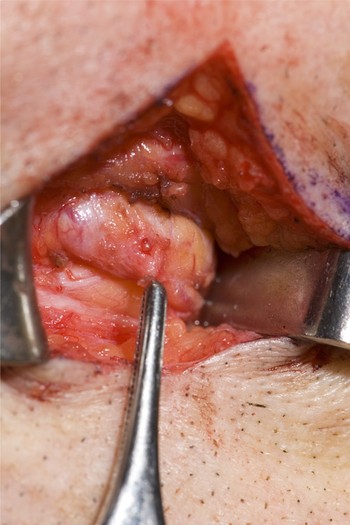
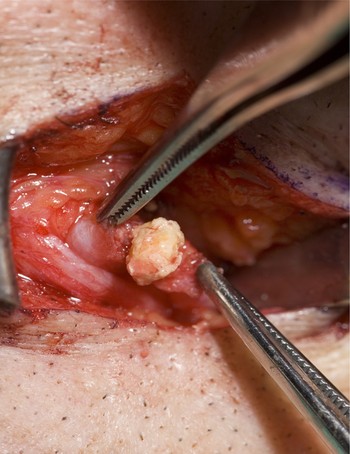
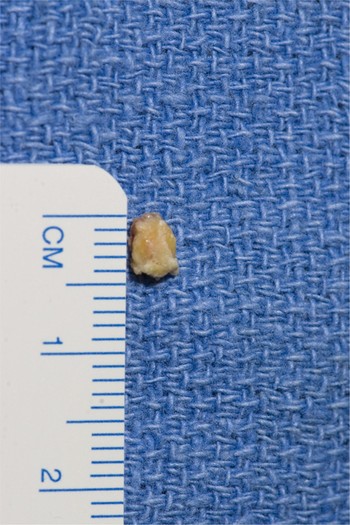
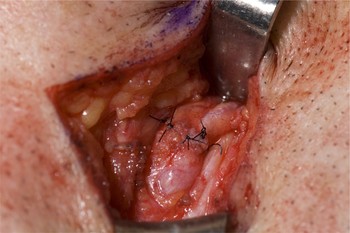
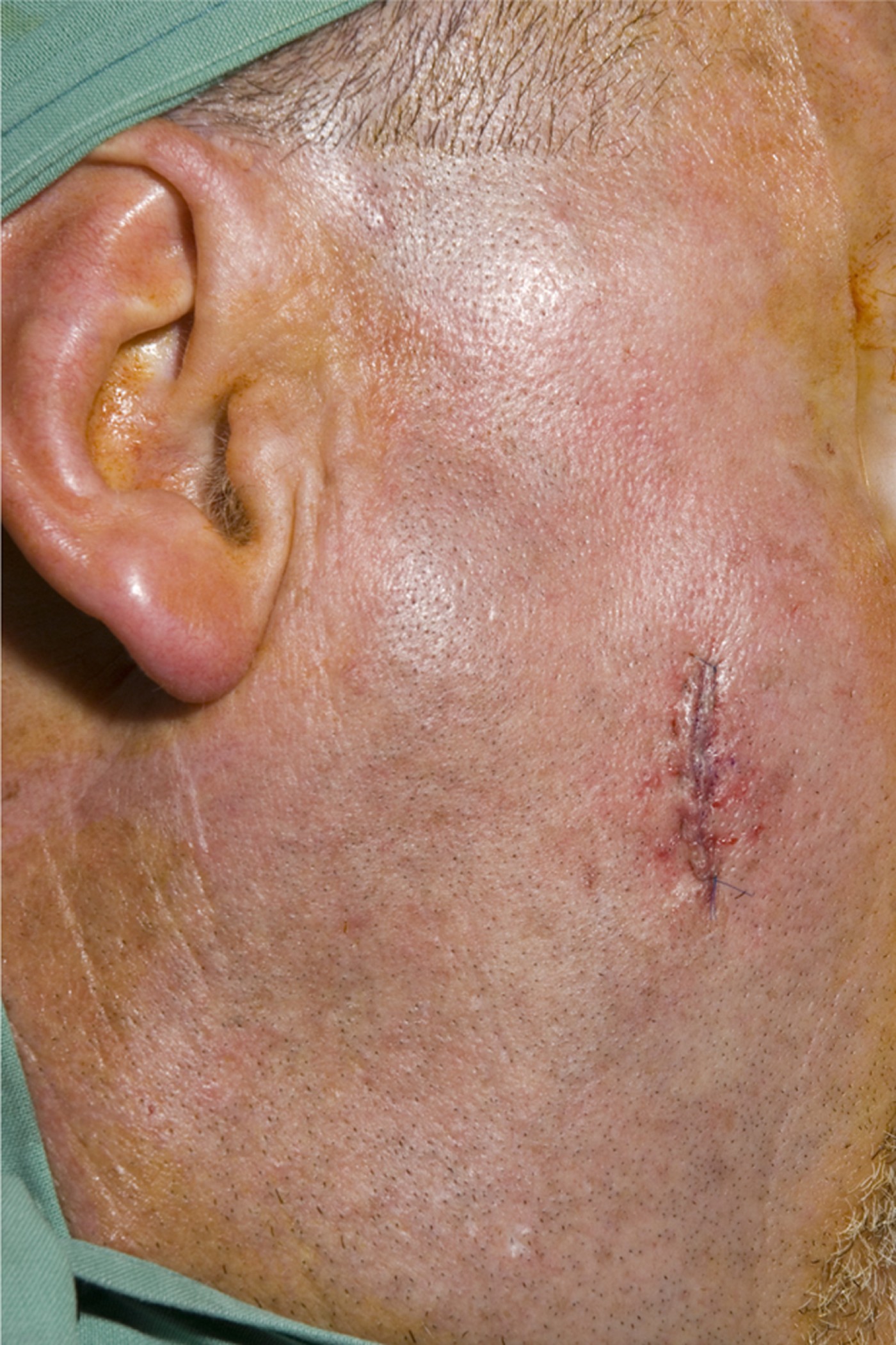
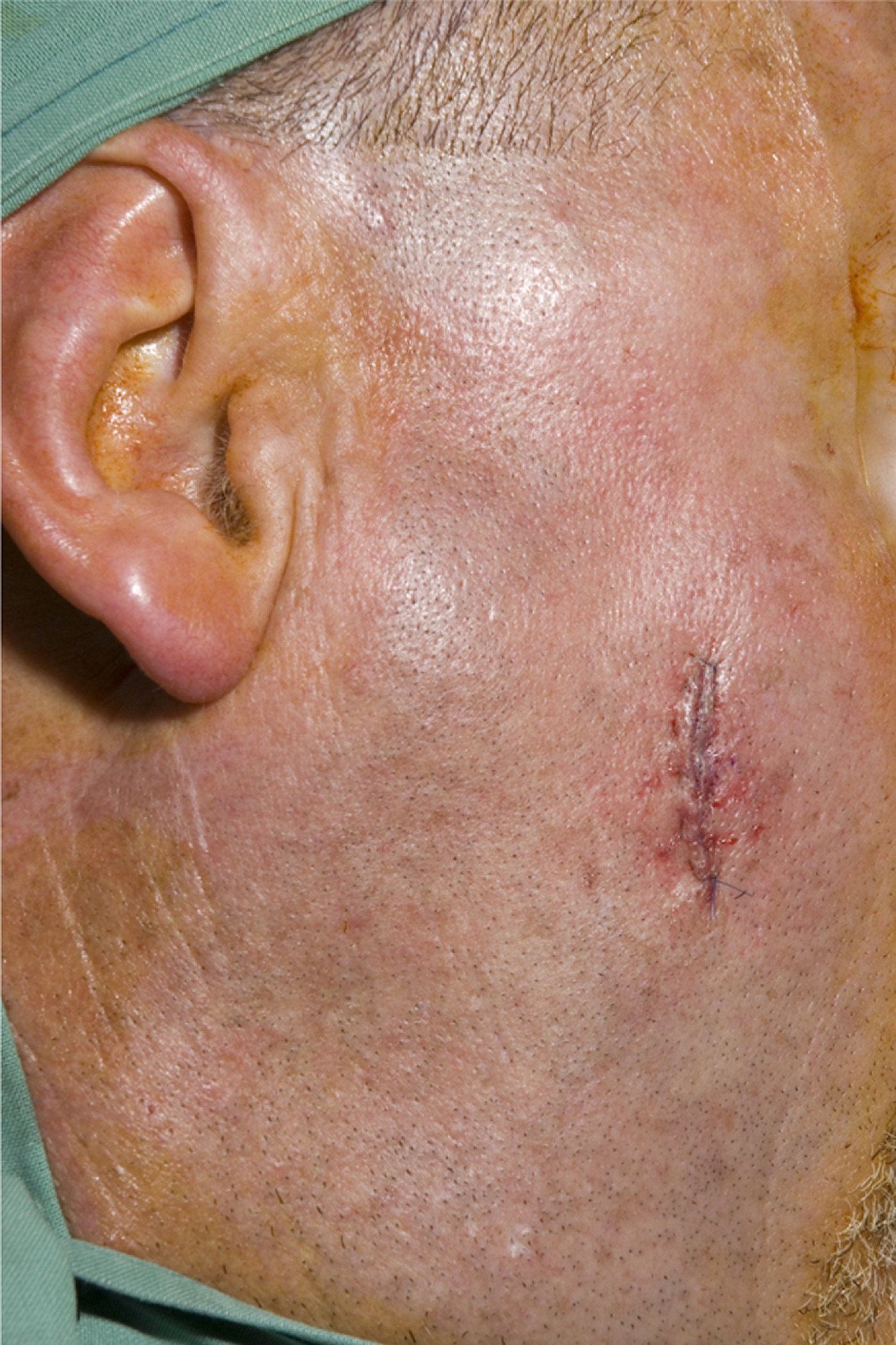
The parotid stone is marked externally while the masseter muscle is clenched. A 3-cm incision is made using skin crease lines. Using surgical loupes, the tissues are dissected down to the duct, working parallel to the branches of the facial nerve to avoid damage. Any branches of the facial nerve can be confirmed using a facial nerve monitor. The duct is identified (Figure 1). A transverse incision is made and the stone is removed (Figures 2 and 3). The proximal and distal ends of the duct are probed to exclude any further stones. The duct is closed using interrupted 6-0 nylon sutures (Figure 4), and the skin wound is closed appropriately (Figure 5). Stents are not generally used if no stricture is present.
Identification of the parotid duct.

Removal of the parotid duct stone.

A 4-mm parotid duct stone.

Sutures to close the ductal incision.

Closure of the skin incision.
Case histories
Case one
A 45-year-old man presented with a mass in his right cheek and a recurrent foul taste in his mouth. He had no history of parotid gland swelling or pain.
Ultrasonography confirmed a 5-mm stone in the parotid duct.
The patient consented to surgery, which was carried out as described above.
There were no residual symptoms at post-operative follow up.
Case two
A 61-year-old woman presented with a two-year history of recurrent left parotid pain and swelling.
She had a palpable stone anterior to the parotid gland, confirmed on computed tomography scanning.
The patient consented to excision.
Post-operatively, she had a transient salivary fistula, which closed spontaneously with avoidance of spicy foods.
At the time of writing, the patient had been well throughout two years' follow up.
Discussion
Salivary duct calculi were traditionally managed surgically. In the late 1980s, however, endoscopy of the salivary ducts began to be performed, using a 0.8-mm endoscope; subsequently, techniques such as basket retrieval and dye laser lithotripsy were used.Reference Katz and Fritsch3 The use of Endoscopic technique is limited in the presence of: unavailability of the equipment and/or expertise; ductal stenosis or tortuosity; sialadenitis; or when stones are too big or too ‘soft’ for lithotripsy.Reference Katz and Fritsch3 One series quoted an 82 per cent treatment success rate.Reference Nahlieli and Baruchin4 Some ductal techniques such as intracorporeal lithotripsy may cause ductal damage and stenosis.Reference Katz and Fritsch3
After the success of extracorporeal shockwave lithotripsy on renal stones, its use was explored with salivary stones. One trial treated 52 stones judged not amenable to endoscopic removal, and had a 46 per cent success rate for removing the stone; a further 31 per cent of patients were left with concrements smaller than 2 mm.Reference Ottaviani, Capaccio, Campi and Ottaviani5
Surgery often involves an intra-oral approach, as the stone is generally located close to the papilla.Reference Karas1 Many reported surgical techniques involve incision of the duct at the papilla and extraction of the stone(s).Reference Karas1 However, ductal stenosis can occur as a complication of such techniques.
However, in some cases the calculus cannot be felt intra-orally. Surgical removal of the parotid gland itself carries an approximately 3–7 per cent risk of facial nerve injury.Reference Gallo, Berluco, Bruschini and McGurk6 A previously described technique involves a combined endoscopic and external approach, using a parotidectomy incision, involving location of all branches of the facial nerve and then the parotid duct.Reference Marchal7 Walvekar et al. published a case series of seven such combined procedures, but the average operating time was 103 minutes.Reference Walvekar, Bomeli, Carrau and Schaitkin8 Baurmash and Dechiara have also described one case involving an extra-oral technique with pre-operative radiological imaging.Reference Baurmash and Dechiara9
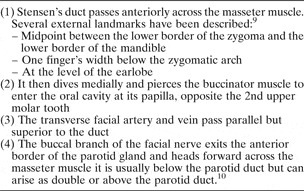
The anatomy of the facial nerve and parotid duct is fairly constant as regards external landmarks (see Table I). We present a technique for targeted removal of parotid duct stones, using anatomical landmarks, and we describe two cases and present intra-operative photographs. This technique is suitable for palpable stones that cannot be reached using an intra-oral approach. This technique, in the hands of an experienced head and neck surgeon, is a relatively simple and effective procedure with few cosmetic issues.
Relevant parotid duct anatomy