Introduction
The lifetime prevalence of post-traumatic stress disorder (PTSD) in community-living older adults carried out between 2004 and 2005 in the US, using data from the National Epidemiologic Survey on Alcohol and Related Conditions, has been estimated to reach 4.5% (Pietrzak et al., Reference Pietrzak, Goldstein, Southwick and Grant2012). A recent review of the literature carried out by Volkert et al. (Reference Volkert, Schulz, Härter, Wlodarczyk and Andreas2013) also reported one-month prevalence estimates of PTSD reaching 1.7%. These reports suggest that PTSD is as prevalent as other affective disorders in older adult general populations. Reports have also shown that women exposed to traumatic life events are more likely to develop PTSD than exposed men (Kessler et al., Reference Kessler, Sonnega, Bromet, Hughes and Nelson1995; Pietrzak et al., Reference Pietrzak, Goldstein, Southwick and Grant2012). The presence of PTSD in older adults has also been associated with a number of physical chronic conditions such as cancer, gastrointestinal conditions, and cardiovascular disorders such as ischemic heart disease, hypertension, and lower self-rated health (Durai et al., Reference Durai2011; Glaesmar et al., Reference Glaesmer, Brähler, Gündel and Riedel-Heller2011, Pietrzak et al., Reference Pietrzak, Goldstein, Southwick and Grant2012). PTSD has also been associated with decreased quality of life (van Zelst et al., Reference van Zelst, de Beurs, Beekman, van Dyck and Deeg2006; Chopra et al., Reference Chopra2014). Increased rates of co-morbid depression and anxiety in older adults with PTSD have also been observed (Pietrzak et al., Reference Pietrzak, Goldstein, Southwick and Grant2012; Zhang et al., Reference Zhang, Shi, Wang and Liu2012).
Warner et al. (Reference Warner, Warner, Appenzeller and Hoge2013) recently reported that first-line treatment options for PTSD should include trauma-focused psychotherapy and pharmacotherapy with antidepressants. Clinical guidelines for PTSD also state that benzodiazepine use should not be used for treating the hyperarousal symptoms such as sleep disturbances and insomnia (Jeffreys et al., Reference Jeffreys, Capehart and Friedman2012; Lund et al., Reference Lund, Bernardy, Alexander and Friedman2012). In fact, a recent systematic review of the literature by Guina et al. (Reference Guina, Rossetter, Derhodes, Nahhas and Welton2015) showed that the use of BZD are not effective for the treatment and prevention of PTSD and are associated with increased adverse effects such as clinical severity and psychiatric comorbidity such as anxiety and depression.
Reports have also shown important gender differences in BZD prescription patterns for PTSD. Between 1999 and 2009, rates for men decreased from 37% to 30% but increased for women from 33% to 38% (Bernady et al., Reference Bernardy, Lund, Alexander, Jenkyn, Schnurr and Friedman2013). In an earlier population-based study, van Zelst et al. (Reference van Zelst, de Beurs, Beekman, van Dyck and Deeg2006) also showed increased BZD use with the presence of PTSD in older adults. Older adults are important BZD users with reported estimates reaching up to 32% (Alvarenga et al., Reference Alvareng, Loyola Filho, Firmo, Lima-Costa and Uchoa2008; Fourrier et al., Reference Fourrier, Letenneur, Dartigues, Moore and Bégaud2011; Préville et al., Reference Préville2012). A recent study in community-living older adults also showed that the use of BZD was associated with suicide ideation and death thoughts which can worsen symptoms related to PTSD (Bossé et al., Reference Bossé, Préville and Vasiliadis2011). The new Beer's Criteria (American Geriatrics Society, 2012) and the recent systematic review by Guina et al. (Reference Guina, Rossetter, Derhodes, Nahhas and Welton2015), reiterated the avoidance of BZD in older adults due to their potential for dependence and aggravation of PTSD and related symptoms.
We therefore aimed to determine in a large sample of older adults seeking services in primary care, within a public-managed healthcare system, the association between BZD use and the presence of a probable post-traumatic stress syndrome, while also considering clinical and socio-demographic factors and other psychotropic drug use. Given the literature that females are more likely to use BZD and fill criteria for PTSD, we aimed to assess whether there exists a differential association between BZD use and PTSS by gender group by testing the interaction [gender*PTSS]. We also aimed to assess whether the presence of co-morbid depression and anxiety had a differential impact on the association between BZD use and PTSS. We hypothesize that despite clinical guidelines, in this recently recruited sample of community living older adults, benzodiazepine use is still significantly associated with the presence of PTSS and that this association depends on gender and the presence of co-morbid psychiatric disorders. The linking of health survey to administrative data, on health service use, will allow the study of a number of socio-demographic, clinical (physical and mental) health factors as well medications dispensed increasing the validity of results by minimizing information bias. This study will help identify vulnerable populations and potential modifiable risk factors that can inform on reducing the use of BZD.
Methods
Data were retained from the ESA-Services study conducted in 2011–2013 and included n = 1,811 older adults aged 65 years and over who were recruited while waiting to receive primary care services in one of the general practice clinics that were included for the study. A total of 1,325,000 inhabitants were covered by the health region covered in this study. The clinics were categorized by type of practices: local community health services center (CLSC), family medicine group (GMF), private medical clinics with less than three physicians (PC < 3), and medical clinics with three or more physicians (PC ≥ 3). Clinics were recruited via the acceptance of participation of general practitioners. First, a list of GPs working at least 4 days/week in the region selected for the study was identified. Of the 744 eligible GPs, a total of 409 agreed for us to use their clinic to recruit participants for the study. Older adults aged 65 years and over who were waiting to receive primary care services were invited to fill out the study pamphlet, which also explained the procedure and objectives of the ESA-Services study. More detail as to the methodology and recruitment can be found elsewhere (Préville et al., Reference Préville2014).
Data collection
Participants having returned the completed study pamphlet were contacted within 30 days by the study coordinator who went over the objectives of the study and scheduled an at-home interview, which was carried out by a trained professional. Interviewers were carried out in the most isolated area of the house to limit information and desirability bias created by the presence of a family member or friend. To minimize the impact of recall bias, the Mini-Mental State Examination (MMSE) (Folstein et al., Reference Folstein, Folstein and McHugh1975) was administrated by the interviewers and participants with a score below 22 were subsequently excluded from the study (n = 46).
Participants, were also asked to provide written informed consent for the research team to access their medical and pharmaceutical services data from the RAMQ, the province's public-health insurance agency. The RAMQ pharmaceutical registry holds, for all Quebec residents covered under the public drug plan, information on all drugs dispensed, the drug identification number, the dosage, quantity, duration, and the date the prescription was filled. The RAMQ medical services registry contains information on all claims and physician fees paid out by the Medicare system for consultations and acts provided to all residents of Quebec. Data from the ESA survey was linked to the individual level information from the RAMQ's pharmaceutical services database using the respondents’ health insurance number or, in the case where this number was missing, using the name, sex, address as well as the respondents’ month and year of birth. Of the n = 1,765 eligible participants who completed the at-home interview, n = 1,456 agreed to give access to their RAMQ data and were covered under the public drug plan. Preliminary analyses however did not show a significant difference between those included (n = 1,456) and excluded (n = 309) in the study with regards to sex (p = 0.14), education (p = 0.77), and the presence of PTSS (p = 0.08), depression (p = 0.09) and anxiety (p = 0.15), thus limiting the potential for selection bias. The results however, did show that participants as expected covered under the public drug plan were more likely to report lower revenue (p < 0.001). Participants received a $15 CAN compensation for their participation. The Ethics Committees of the University of Sherbrooke, Institute of Geriatrics, and the Centre de Recherche – Hôpital Charles-Le Moyne approved the ESA-Services study.
Measures
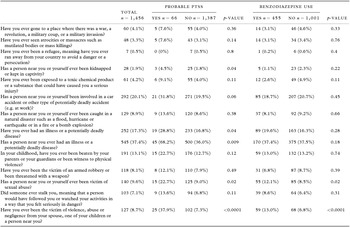
The presence of a probable PTSS was measured using an adapted French version of the IES-R (Christianson and Marren, Reference Christianson and Marren2012), which has been shown to have good internal consistency with coefficients ranging from 0.81 to 0.93 (Brunet et al., Reference Brunet, St-Hilaire, Jehel and King2003). Respondents who endorsed at least 1 of 14 stressful traumatic life events (Table 1) were invited to complete the IES-R, which includes the presence of 22 symptoms of intrusion, avoidance and hyperarousal in the past 6-month period, rated on a four point-Likert scale ranging from “not at all” to “often”. Creamer et al. (Reference Creamer, Bell and Failla2003) suggested a cut-off point of 33 to categorize probable cases of PTSD.
Reported lifetime stressful live events in study sample (n = 1,456) by presence of a probable PTSS and benzodiazepine use

The presence of BZD use (yes/no) was measured by available data from the RAMQ drug registry in the year prior to interview. The presence of at least one prescription BZD drug used in the last 6 months included the following drugs alprazolam, bromazepam, clonazepamclobazam, diazepam, lorazepam, oxazepam, temazepam, flurazepam, nitrazepam, and midazolam.
The presence of antidepressant use (yes/no) was also ascertained based on information from the RAMQ drug registry in the year prior to interview. The presence of at least one antidepressant prescription was considered and included the following classes of medications: selective serotonin reuptake inhibitors (i.e. citalopram, fluoxetine, and paroxetine,); serotonin antagonist and reuptake inhibitors (i.e. trazodone, nefadozone); selective norepinephrine reuptake inhibitors (i.e. venlafaxine); norepinephrine and serotonin modulators (for example, mirtazapine); norepinephrine and dopamine reuptake inhibitors; and tricyclic antidepressants (i.e. amitriptyline and clomipramine).
The presence of a physician code for a psychotherapy consultation (minimum 30 minutes), individually or in a group, was also captured through the RAMQ medical services registry (ICD-9 codes 8929, 8934, 8944, 8949).
The presence of a probable past year major and minor depression and anxiety disorder including specific phobia, social phobia, agoraphobia, panic attack, obsessive-compulsive disorder, generalized anxiety disorder were assessed with the ESA questionnaire which was based on DSM-5 criteria (American Psychiatric Association, 1994; Préville et al., Reference Préville2008). Participants who reported depressed mood or loss of interest or pleasure in usual daily activities nearly every day and most of the day during at least two consecutive weeks and who reported at least five of the seven associated symptoms of depression, were classified as having major depression. Participants who presented with the essential features of depression and reported anywhere between two and four of the seven associated symptoms of depression were classified as having minor depression. Participants with a major or minor depression and an anxiety disorder also had to report that these symptoms caused impairment in at least one area of social functioning. Respondents whose symptoms were due to a physical disease, drug addiction were also excluded from having these disorders.
The presence of multi-morbidity (0–2 vs. 3 and over conditions) (Fortin et al., Reference Fortin, Mercer, Salisbury, Mercer, Salisbury and Fortin2014) was based on the number of chronic conditions was assessed through self-reported data from a list of 20 chronic health problems (0–20), as defined in the International Classification of Diseases, version 10, developed and revised by the WHO (World Health Organization, 2004), included the following: e.g. arthritis, cardiac disease, disorders of the digestive system, endocrine system, diabetes, diseases of the kidney, liver, lungs, eyes, and psychiatric conditions such as schizophrenia.
Additional socio-demographic variables considered included age (65–74 years vs. 75 years and over), gender (female vs. male), education (primary school vs. secondary/post-secondary/university), marital status (married vs. separated, divorced, widowed, or never married), income (less than $25,000 and $25,000 and more).
Analyses
Multivariate logistic regression analyses controlling for study variables were conducted to assess the association between BZD use and the presence of a probable PTSS while also considering the following interaction terms: gender*PTSS, anxiety*PTSS, and depression*PTSS. Unadjusted and adjusted odds ratios with 95% CI are presented.
Results
The prevalence of a probable PTSS as measured with the IES-R reached 4.5%. The prevalence of BZD use reached 31.2%. The most prevalent lifetime stressful events reported were the presence of an illness or potentially deadly disease in a person near the respondent (37.4%) or themselves (17.3%); being involved, or a person near the respondent, in a car accident (20.1%); and having been beaten by parents or guardian or witness to physical violence (13.1%) (Table 1). The results also showed that respondents with a PTSS were more likely to report “having ever been, or a person near them, kidnapped or in captivity” (p = 0.04); “the presence of an illness or potentially deadly disease in a person near them” (p = 0.0009) or “themselves” (p = 0.04); “having been, or a person near them, victim of sexual abuse” (p = 0.02) and “violence or abuse” (p < 0.0001). The reporting of these last two events was also associated with an increased likelihood of BZD use (p = 0.02; p < 0.0001).
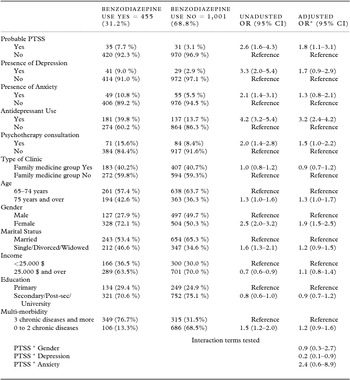
The multivariate analyses showed that the presence of a PTSS was associated with BZD use (1.9 OR; 95% CI = 1.1–3.2), the presence of anxiety (3.5 OR; 95% CI = 1.8–6.5) and the presence of multi-morbidity (2.1 OR; 95% CI = 1.0–4.3).
The multivariate analyses regarding determinants of BZD use are presented in Table 2. Aside from the presence of PTSS, BZD use was also associated with the presence of an antidepressant (3.2 OR; 95% CI = 2.4–4.2), the presence of at least one psychotherapy consultation (1.5 OR; 95% CI = 1.0–2.2), older age (1.3 OR; 95% CI = 1.0–1.7), and female sex (1.9 OR; 95% CI = 1.5–2.5). When looking at the interaction terms tested, the presence of depression had an impact on the association between BZD use and PTSS (p = 0.04). Among respondents without depression, the presence of PTSS was associated with BZD use but not among respondents with depression.
Characteristics of study sample (n = 1,456) of older adults seeking services in primary care with respect to benzodiazepine use

*Adjusted for all other variables in the model.
Discussion
This study contributes to the present literature by reporting on the impact of depression on the association between BZD use and the presence of a PTSS in a large community sample of older adults seeking services in primary care in a public-managed healthcare system.
In this study sample, the 6-month prevalence of a probable PTSS reached 4.5%, which is similar to reports from large-scale population-based surveys in the USA (Pietrzak et al., Reference Pietrzak, Goldstein, Southwick and Grant2012). Respondents with a PTSS were twice more likely to also have been dispensed a BZD as opposed to those without a PTSS and this after controlling for a number of clinical and socio-demographic factors as well as the use of antidepressants and having received psychotherapy from a physician. The increased BZD use associated with PTSS has also been reported in a previous study by van Zelst et al. (Reference van Zelst, de Beurs, Beekman, van Dyck and Deeg2006), which was carried out in a large sample of older adults participating in the Longitudinal Aging Study Amsterdam (LASA).
Despite, clinical published guidelines such as the Beers's criteria (American Geriatrics Society, 2012), the results also showed an important prevalence of BZD use in older adults (31.2%). In this study, females were twice more likely to use BZD. However, when looking at the interaction terms tested, there was no gender difference in the association between BZD use and PTSS. This result is not consistent with a previous study that showed that between 2001 and 2009, female veterans with PTSD were more likely to use BZD than male veterans with PTSD (Bernardy et al., Reference Bernardy, Lund, Alexander, Jenkyn, Schnurr and Friedman2013). This difference can in part be explained by the fact that in the veteran's sample, women reported a higher prevalence of depression and anxiety disorders and this psychiatric comorbidity may reflect more complex clinical patterns leading to higher BZD use in this already vulnerable population.
In this general population study of older adults, the results however did show that the presence of co-morbid PTSS and depression was associated with a reduced odds of BZD use, but not with co-morbid PTSS and anxiety, and this after controlling for antidepressant use and the presence of psychotherapy and other study variables. This result could be explained by the guideline recommendations for the treatment of major depressive disorders and co-morbid PTSD. The CANMAT task force recommends using psychotherapy and antidepressants to treat PTSS and depression comorbidity (Schaffers et al., Reference Schaffer2012). Further, according to Canadian guidelines, BZD should not be used for the independent treatment of both PTSD and major depressive disorders (Lam et al., Reference Lam2009; Katzman et al., Reference Katzman2014).
The results of this study need to be considered in light of the following limitations. First, 55% of physicians practicing in primary care settings were recruited. This has been rarely achieved in epidemiologic studies where rates have ranged between 4% and 55%. Analyses showed that physician participation did not depend on type of practice or gender (p = 0.09). Second, the study was based on a sample of older adults recruited in primary care clinics and therefore may not be representative of the older adult general population or those institutionalized which may present more complex clinical profiles. Third, of the n = 1,765 eligible participants who completed the at home interview, n = 1,456 agreed to give access to their RAMQ data and were covered under the public drug plan. Preliminary analyses however, did not show a significant difference between those included (n = 1,456) and excluded (n = 309) in the study with regards to sex, the prevalence of a probable PTSS, depression, and anxiety, thus limiting the potential selection bias. Fourth, recall bias may have influenced the results on the reporting of lifetime traumatic events which may have underestimated the overall prevalence of PTSS, however, the time frame of symptom impact was for the past 6 months. Fifth, the presence of chronic conditions and depression and anxiety were also assessed through self-reported data and may have been subject to recall and a social desirability bias. The depression and anxiety modules in our study have not been validated but, in order to minimize information bias, health professionals were trained in interviewing techniques and used highly standardized procedures. Further, Volkert et al. (Reference Volkert, Schulz, Härter, Wlodarczyk and Andreas2013) conducted a meta-analysis on the prevalence of mental disorders in older adults, which showed that the results obtained in a previous ESA study with the same modules were comparable to those reported in other studies. Further, the interviews with participants were also carried out in an isolated area of the house to limit the impact any social desirability or reporting bias associated with the presence of family members or friends.
Conclusion
The use of BZD in older adults with PTSS seeking services in primary care is still prevalent. While controlling for a number of important socio-demographic, economic, and physical and mental health conditions, the results also showed that females overall are more likely to use these drugs. Interestingly, the results also showed that the presence of co-morbid PTSS and depression was associated with a reduced odds of BZD use, which is in line with clinical guidelines. Future studies on gender differences with regards to physician prescribing patterns in more complex co-morbid psychiatric cases may be of interest.
Conflict of interest
None.
Description of authors’ roles
H-M Vasiliadis, formulated the question, designed the study and statistical analysis, supervised the data collection and wrote the paper. C Lamoureux-Lamarche, assisted in data analysis and with writing of the paper. M Préville, formulated the question, designed the study and supervised the data collection and assisted in interpretation of results.
Acknowledgments
This study was supported by a Quebec Health Research Fund (FRQ-S) operating grant # 22251. The corresponding author is a senior research scholar with the FRQ-S.