Introduction
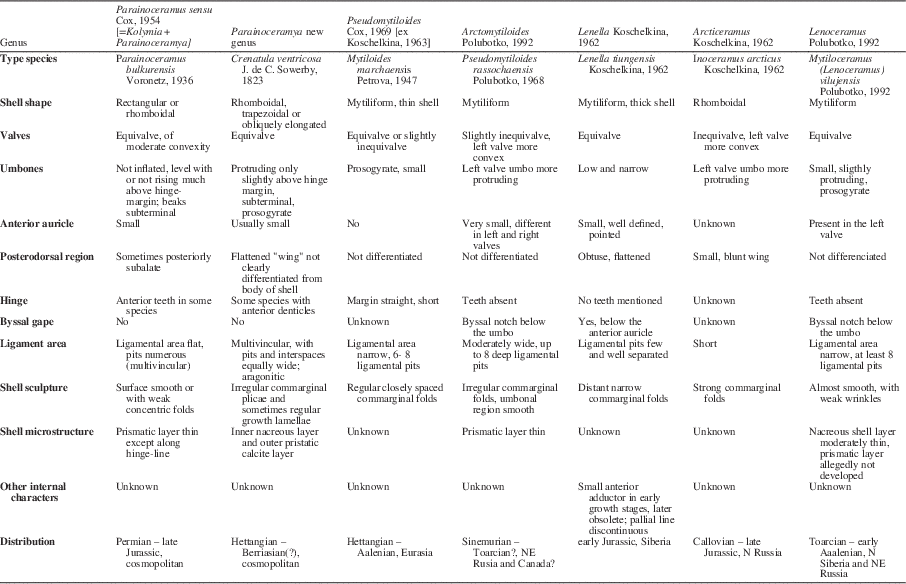
Despite their abundance and diversity, the ‘inoceramids’ are a poorly understood set of bivalves, and especially Jurassic taxa allied to this group have been the subject of many controversies about their affinities (Crame, Reference Crame1982; Crampton, Reference Crampton1996; Knight and Morris, Reference Knight and Morris2009). In this context, several species of small pterioid bivalves known from Jurassic deposits worldwide, some of them formerly referred to “Inoceramus”, were regarded by Cox (Reference Cox1954) as belonging to a separate genus, which he referred to Parainoceramus Cox, Reference Cox1954 (ex Voronetz, Reference Voronetz1936 [unavailable due to lack of type species designation]) instead of proposing a new taxon. This decision, which was followed by most subsequent authors, was later proved to be inadequate for several reasons discussed in this paper. Some of these Jurassic species were referred to the genus Pseudomytiloides Cox, Reference Cox1969 (ex Koschelkina, Reference Koschelkina1963) or to Parainoceramus (e.g., Parainoceramus lunaris Hayami, Reference Hayami1960 and Parainoceramus matsumotoi Hayami, Reference Hayami1960 were referred to Pseudomytiloides by Hayami [Reference Hayami1975]) but there are enough morphological characters to distinguish the two stocks (see Table 2). Ros (Reference Ros2009, p. 86), Ros et al. (Reference Ros, Damborenea and Márquez-Aliaga2009) and Ros-Franch et al. (Reference Ros-Franch, Márquez-Aliaga and Damborenea2014) noticed this situation and concluded that this group of Jurassic species can no longer be referred to Parainoceramus s.s.
We discuss here the Jurassic species referred to Parainoceramus s.l., and provide a solution to the taxonomic/nomenclatural problems by proposing a new genus to include some of them, while trying to maintain Cox’s concept of Jurassic Parainoceramus.
Background
The generic name Parainoceramus was proposed by Voronetz (Reference Voronetz1936, p. 23–24) on the basis of 15 badly preserved specimens from sediments then dated as Carnian from northern Siberia. The author included four new species in this new genus: P. bulkurensis, P. nikolaewi, P. lenaensis, and P. (?) gervillia, but he did not designate a type species, and thus this generic name was not available. He described all species as being edentulous.
Years later Cox (Reference Cox1954) completed the requirements for the validity of the name by designating P. bulkurensis (Fig. 1.1) as the type (ICZN Art. 13B, 50). He did not see Voronetz’ material, but nevertheless he included within Parainoceramus two other species, widely distributed in the European Early Jurassic: Crenatula ventricosa J. de C. Sowerby, Reference Sowerby1823 (Fig. 1.7–9) and Inoceramus substriatus Münster in Goldfuss, 1835 (Fig. 1.2–4). On the basis of his knowledge of these Jurassic species, he added to Voronetz’ original diagnosis the presence of an anterior auricle and anterior tooth-like ridges on some species. It is here necessary to point out that Voronetz’ original diagnosis already mentioned the presence of an anterior auricle, but his Russian text was incorrectly translated into English in his paper (1936, p. 34), and the word “lunule” was used instead of the intended “auricle”.
(1), Kolymia bulkurensis (Voronetz), reproduction from Voronetz (Reference Voronetz1936), pl. 2, fig. 1; (2–4), Parainoceramya substriata (Münster in Goldfuss, 1835), reproduction from Goldfuss (1835), pl. 115, fig. 1 and pl. 109, fig. 2; (5), Parainoceramya? apollo (Leanza, Reference Leanza1942), lectotype, MLP 6252, composite mould of left valve, specimen figured in Leanza, Reference Leanza1942, pl. 2, fig. 1 and Damborenea, Reference Damborenea1987, pl. 4, fig. 1; (6), Parainoceramya? dubia (Sowerby, Reference Sowerby1829), Dörnten, Harz, Germany, lower Toarcian, collected by G. Westermann, right valve, MLP 34455; (7–9), Parainoceramya ventricosa (Sowerby, 1823), reproduction from J. de C. Sowerby (1823), pl. 443. Scale bar 1 cm for figures 1.5 and 1.6.

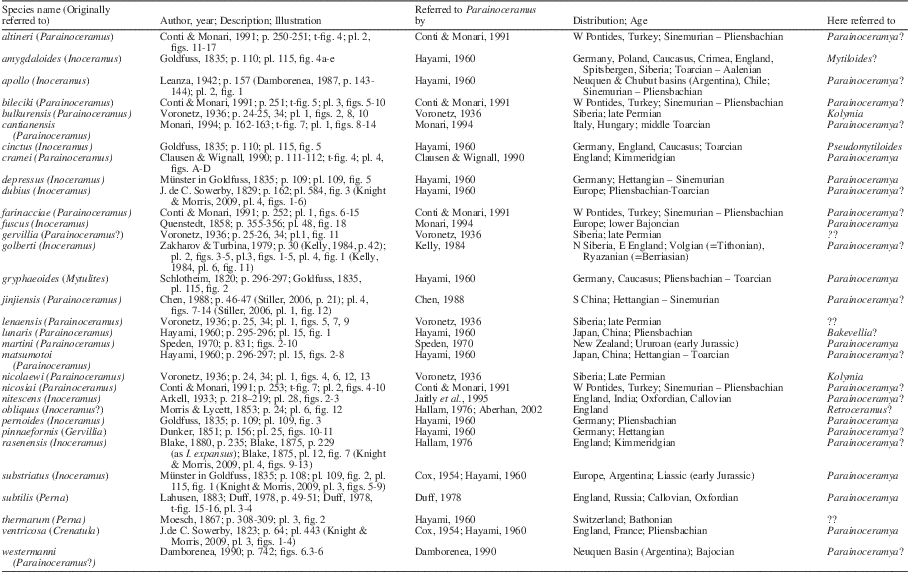
Cox’s (Reference Cox1954) concept of the genus Parainoceramus was adopted by nearly all later authors dealing with Jurassic material (i.e., Hayami, Reference Hayami1960; Speden, Reference Speden1970; Duff, Reference Duff1978; Crame, Reference Crame1982; Kelly, Reference Kelly1984; Damborenea, Reference Damborenea1987, Reference Damborenea1990; Chen, Reference Chen1988; Conti and Monari, Reference Conti and Monari1991; Monari, Reference Monari1994; Knight and Morris, Reference Knight and Morris2009), and more Jurassic species from around the world were added (Table 1). Nevertheless, it is evident that this was often done in the absence of a better alternative; hence, almost all authors felt the need to provide their own diagnosis of the genus. These diagnoses differ from each other in important aspects of the hinge region such as the presence or absence of anterior and/or posterior teeth.
List of species which have been referred to Parainoceramus, with indication of the original description and illustration of each of them, and their relationships according to the present paper.
Along this line Hayami (Reference Hayami1960) recognized the need to taxonomically group small Jurassic inoceramid species without regular ornamentation, which he referred to Parainoceramus following Cox (Reference Cox1954). Hayami (Reference Hayami1960) described two Japanese species and reviewed previous literature, including in the genus Parainoceramus other Early Jurassic species from several parts of the world (Alps, Carpathians, Caucasus, Siberia, New Caledonia, and Argentina). He then extended the genus concept to include species with posterior teeth. Nevertheless, he later referred his Japanese species to Pseudomytiloides (Hayami, Reference Hayami1975).
A significant detail is that in the Treatise on Invertebrate Paleontology (Cox, Reference Cox1969), the type species of Parainoceramus was not illustrated. Furthermore, although the figure legend states that fig. C48-4 corresponds to P. substriatus taken from Münster in Goldfuss (1835); in fact the reproduced figure does not correspond to any of Münster’s illustrations of that species (pl. 109, fig. 2, and pl. 115, fig. 1, reproduced here on Fig. 1.2–4). Instead, the figure reproduced in the Treatise is Goldfuss (1835) figure 3 from plate 109, which corresponds to material referred to P. ventricosus (Sowerby, 1823) (=Inoceramus pernoides Goldfuss 1835), see Oppel (1856, p. 180) and Giebel (Reference Giebel1866, p. 55). Significantly, the specimen figured in the Treatise lacks anterior auricles, which, together with the incorrect translation of Voronetz’ diagnosis already mentioned, may have added confusion about recognition of Parainoceramus species and distinction between Parainoceramus and Pseudomytiloides, whose type species (Mytiloides marchaensis Petrova, Reference Petrova1947) lacks anterior auricles. The stratigraphical range of Parainoceramus was stated as Late Triassic-Jurassic by Cox (Reference Cox1969).
Another point overlooked in the Treatise and by later authors is that Emel’yantsev et al. (Reference Emel'yantsev, Gramberg, Kratsova and Puk1960; see also Muromtseva, Reference Muromtseva1979 and Astafieva, Reference Astafieva1986) had re-dated the beds where Voronetz’ original material was found as late Permian (Wuchiapingian and Changhsingian), and thus the stratigraphical range of Parainoceramus sensu Cox (Reference Cox1954) should have been late Permian (Siberia), Hettangian to Tithonian (cosmopolitan), with no record during the Triassic.
Speden (Reference Speden1970) described a new species from the Ururoan (Early Jurassic) of New Zealand, and at the same time pointed out the differences between Voronetz’ and later authors’ concepts of the genus. He noticed that in Voronetz’ original material no teeth were described, while either anterior or posterior (or both) teeth were mentioned in some Jurassic species. He stated the need to carefully re-examine the original species and those included in the genus by subsequent authors.
In his monographic work Duff (Reference Duff1978) described Parainoceramus subtilis (Lahusen, Reference Lahusen1883), and included anterior and posterior teeth in his emended diagnosis of the genus.
A breakthrough was provided by Muromtseva (in Muromtseva and Guskov, Reference Muromtseva and Guskov1984) who referred some of the species described by Voronetz (Reference Voronetz1936) to Kolymia Likharev, 1941 in Likharev and Einor, Reference Likharev and Einor1941 (type species Kolymia inoceramiformis Likharev, 1941), and by Astafieva (Reference Astafieva1986, Reference Astafieva1993), who revised Voronetz’ original material, and concluded that P. bulkurensis and P. nikolaewi are subjective synonyms, P. lenaensis probably does not belong to the same genus, and P. (?) gervillia was based on too poorly preserved material. She also compared the diagnosis and the species referred by their original authors to the nominal genera Parainoceramus and Kolymia, concluding that these two generic names should be regarded as synonyms, since they share the diagnostic characters and the stratigraphical distribution. She regarded Parainoceramus as the junior subjective synonym, as it was validated only in 1954. Astafieva (Reference Astafieva1986) thus placed the type species of Parainoceramus within the Paleozoic genus Kolymia, but did not include there any of the Jurassic species later referred to Parainoceramus by other authors.
Although Kolymia was regarded as a junior synonym of Atomodesma von Beyrich, Reference von Beyrich1864 by Newell (Reference Newell1969), Kauffman and Runnegar (Reference Kauffman and Runnegar1975, p. 43) later argued that they should be considered as different genera, since Kolymia “lacks any trace of an umbonal septum, has a well developed ear on each valve, and a prominent byssal gape.” Kolymia and related genera were grouped in the separate Family Kolymiidae Kuznetsov, Reference Kuznetsov1973 (see revision in Biakov, Reference Biakov2008, Reference Biakov2012).
More recently, Conti and Monari (Reference Conti and Monari1991) and Monari (Reference Monari1994) described new Early Jurassic species from Turkey and Italy, respectively, and referred them to Parainoceramus.
At the same time Polubotko (Reference Polubotko1992) described the new genus Arctomytiloides Polubotko, Reference Polubotko1992 from Hettangian and Sinemurian beds of Far East Russia, with Pseudomytiloides rassochaensis Polubotko, Reference Polubotko1968, as the type, and referred it to the Retroceramidae. This genus was only used again by Aberhan (Reference Aberhan1998) for Early Jurassic material from western Canada (Arctomytiloides? cf. rassochaensis and Arctomytiloides? cf. turomtchensis Polubotko, Reference Polubotko1992).
Recently Knight and Morris (Reference Knight and Morris2009) thoroughly revised the morphology and ultrastructure of the hinge plate of Jurassic and Cretaceous ‘inoceramids’, including several of the species discussed here. They followed Cox’s concept of Parainoceramus and thus referred several Jurassic species to that genus. Their descriptions and discussions of the hinge characters of these species are instrumental to understand their morphology and relationships.
Thus, if we follow Paleozoic specialists in restricting usage of Parainoceramus to late Paleozoic species, and including its type Parainoceramus bulkurensis within the genus Kolymia, several widely distributed and common Jurassic species which were referred to Parainoceramus remain without a genus to be allocated. Due to the differences between this group of species with related genera, as discussed further down, a new name is required, which is proposed below. The new genus is doubtfully referred to the Inoceramidae on account of its multivincular ligament, shell ultrastructure and general shell shape. To choose the type species we tried to preserve as far as possible the current usage of Jurassic ‘Parainoceramus’, mostly based on Cox’ (Reference Cox1954) concept. Suprageneric systematic arrangement follows Carter et al. (Reference Carter, Altaba and Anderson2011).
Systematic Paleontology
Class Bivalvia Linné, 1758
Order Myalinida Paul, Reference Paul1939
?Superfamily Inoceramoidea Giebel, Reference Giebel1852
?Family Inoceramidae Giebel, Reference Giebel1852
(Placed on the Official List by Opinion 473 [1957, p. 281] but attributed erroneously to Zittel [Reference Zittel1881])
Genus Parainoceramya new genus
Type species
Crenatula ventricosa J. de C. Sowerby, 1823 (p. 64, pl. 443), from Pliensbachian (Lower Jurassic) beds of Great Britain. Original illustrations reproduced here in Figure 1.7–9; for illustrations of hinge details see Knight and Morris (Reference Knight and Morris2009, pl. 3, figs. 1–4).
Diagnosis
Shell equivalve, convexity low to high, very inequilateral, obliquely elongated, with variable outline in lateral view (rectangular, mytiliform or rhomboidal), ortho- to proso-cline, with depressed posterior wing not clearly separated from body of shell, and usually with a small anterior auricle. Umbones terminal to subterminal, prosogyrate, only slightly protruding above hinge margin. Hinge plates diverging from each other. Multivincular ligament with numerous subtriangular resilifers separated by equally wide interspaces. Ventral margin of hinge plate undulate. Poorly developed anterior umbonal septa, larger on left valves. Some species with anterior denticles or crenulations. Ornament consisting of weak irregular concentric plicae, and sometimes regular growth lamellae. Few species with fine radial striae. Shell very thin, with outer prismatic calcite layer and inner nacreous layer. Hinge plate aragonitic in continuation with the inner nacreous shell layer and ligament attachment surfaces covered by a thin layer of aragonitic prisms.
Etymology
After Parainoceramus plus mya (f., Latin), a sea-mussel.
Remarks
All species of this genus show a great shell shape variability in lateral view. Despite their abundance and wide distribution, hinge plate and internal characters are unknown in many of them, thus hindering a comprehensive revision and a proper discussion of possible relationships. On the other hand, the hinge morphology of some of them (including the type species) was recently revised and superbly illustrated by Knight and Morris (Reference Knight and Morris2009).
A posterior tooth is mentioned in some of the species once referred to Parainoceramus, but this structure was not confirmed in any of the species included with certainty in Parainoceramya. Umbonal septa and clefts may have been interpreted as anterior teeth, and anterior “denticles” were illustrated by Knight and Morris (Reference Knight and Morris2009, pl. 4, figs. 4–6) for P?. dubia (J. de C. Sowerby).
Included species
The nominal species once referred to this taxon are listed in Table 1, with indication of the species we regard now as belonging to Parainoceramya according to the diagnosis given here. For different reasons some species are only doubtfully referred to this genus. For instance, Inoceramus dubius Sowerby was usually included into Pseudomytiloides (for instance Caswell et al., Reference Caswell, Coe and Cohen2009), but it does not have the regular, closely spaced concentric folds mentioned in the original diagnosis of that genus. Instead, it bears a set of commarginal faint regular growth lamellae (which are not evident in all specimens), and thus it is most probably related to Parainoceramya (see Knight and Morris, Reference Knight and Morris2009, pl. 4, figs. 1–6).
Geographical occurrence
Parainoceramya had a cosmopolitan distribution during the Early Jurassic, especially during Pliensbachian times, but later it appears to have been mostly restricted to high latitudes (Damborenea, Reference Damborenea1996; Ros, Reference Ros2009).
Stratigraphical distribution
The genus Parainoceramya as here understood ranges in age from Hettangian to Tithonian-Berriasian. The first appearance is P. depressa (Münster in Goldfuss, 1835, pl. 109, fig. 5) from the Hettangian-Sinemurian of Germany, and probably also P.? jinjiensis Chen (Reference Chen1988, pl. 4, figs. 7–14), from the same age in China, and Inoceramus sp. from Hettangian beds of Chile (Escobar, Reference Escobar1980, pl. 3, fig. 9). Late Jurassic species do show some differences with the Early Jurassic ones in the morphology of resilifer pits (e.g., Knight and Morris, Reference Knight and Morris2009, appendix), and they may belong to another genus. With inclusion of these species in Parainoceramya, the last appearance of the genus would correspond to Parainoceramus golberti (Zakharov & Turbina, Reference Zakharov and Turbina1979) from upper Volgian (=Tithonian) of Eastern England (Kelly, Reference Kelly1984) and Ryazanian (=Berriasian) of northern Siberia. The genus was most diverse during the Early Jurassic times.
Systematic relationships
The systematic affinities of this group of species have been subject of debate. Cox (Reference Cox1954) placed them within the Isognomonidae, but later several authors included them within the Inoceramidae (Hayami, Reference Hayami1960, Reference Hayami1975; Duff, Reference Duff1978; Kelly, Reference Kelly1984; Damborenea, Reference Damborenea1987, Reference Damborenea1990; Clausen & Wignall, Reference Clausen and Wignall1990; Conti & Monari, Reference Conti and Monari1991; Monari, Reference Monari1994; Aberhan, Reference Aberhan1998). The new genus is here doubtfully referred to the Inoceramidae on account of the differential characters between both families listed by Crampton (Reference Crampton1988). Recently Knight and Morris (Reference Knight and Morris2009) indicated important differences between the hinge plate of P. ventricosa and P. substriata and Cretaceous inoceramid species, involving both mineralogy and ultrastructure of the hinge plate. Even considering these differences, these authors propose that Jurassic ‘inoceramids’ with an aragonitic hinge plate could have been ancestors to the Upper Cretaceous inoceramids with calcitic hinge plate.
The comparison with similar genera with Jurassic occurrences is summarized in Table 2, mostly based on their type species. Pseudomytiloides differs from Parainoceramya by lack of anterior auricle and presence of more regular commarginal folds on the whole shell. Arctomytiloides and Arcticeramus Koschelkina, Reference Koschelkina1962 both have clearly inequivalve shells with left valves being more inflated. Species referred to Lenella Koschelkina, Reference Koschelkina1962 have thick shells, which are mytiliform in shape, and the anterior region is small and pointed. This genus may instead be related with the bakevellid Aguilerella Chavan, Reference Chavan1951, as indicated by Zakahrov (Reference Zakharov1965), who included it as its junior synonym (see also Damborenea, Reference Damborenea1987, table 2 and Polutbotko, Reference Polubotko1992, p. 61). Lenoceramus Polubotko, Reference Polubotko1992 differs from Parainoceramya by having a conspicuous byssal notch and more developed anterior auricle; while the reported absence of prismatic layer may be a preservational artifact.
Comparison of Parainoceramya with other related genera.
When the material is not well preserved and hinge characters are not clear, species of Parainoceramya can be particularly difficult to distinguish from species of Pseudomytiloides Cox, Reference Cox1969 (Aberhan, Reference Aberhan1998; Stiller, Reference Stiller2006).
Although the erection of Parainoceramya does solve the key nomenclatural problems associated to these Jurassic inoceramids, additional systematic work on them is necessary, which may eventually show the need to subdivide Parainoceramya, but that is clearly beyond the scope of this contribution.
Conclusions
Permian species originally included in Parainoceramus by Voronetz (Reference Voronetz1936) are referred to the genus Kolymia, while most of the Jurassic species later referred to Parainoceramus do not belong to this taxon and are assigned to the new genus Parainoceramya here proposed, with Crenatula ventricosa J. de C. Sowerby as type. As here understood, this was a cosmopolitan taxon ranging from Hettangian to (probably) Berriasian times.
Acknowledgments
This paper is a contribution to the Grupo de Trabajo Español (project PICG nº 506, ACI2008-0796, MICINN) and to the Ministry of Science and Innovation of Spain Project "CGL2011-24408". A MAEC-AECID research fellowship from the Spanish Government to SRF is also acknowledged. SED and MOM thank funding from CONICET Argentina (PIP 5635/05) and Agencia Nacional de Promoción Científica y Tecnológica (PICT 07-26236). We thank Fernando Robles for his advice on nomenclatural questions; Alistair Crame and Graciela Delvene kindly helped with bibliography. This paper benefited by the thorough reviews of Joseph Carter, Alistair Crame, and Michael Hautmann, who are gratefully acknowledged.