1. Introduction
1.1. What is electroacoustic audiovisual music?
The desire to combine sound and image in a multisensory art form has fascinated and transfixed artists and philosophers for centuries. Sir Isaac Newton is suggested to have discerned seven colours in his prism experiment, so that light might correspond to the seven notes in the Western musical scale (Collopy Reference Collopy2000: 356), and during the eighteenth and nineteenth centuries inventors sought to devise ever more complex machines for live audio visual performance (for example: Louis Bertrand Castel's ‘Clavecin Oculaire’ and Bishop Bainbridge's ‘colour organ’ (Peacock Reference Peacock1988)). The subsequent development and recent affordability of digital and computer technology have empowered ever greater numbers of practitioners to cross from music specialisms towards the visual, and vice versa, creating a rich and expanding audiovisual community.
In his discussion of the development of absolute film, Richard S. James suggests that extensive experimentation with sonic manipulation technically precedes Pierre Schaeffer's experimentation in the studios at Radiodiffusion-Télévision Française (RTF) (James Reference James1986), although there is no apparent presence of the conceptual leap in the practitioners towards utilising concrète, mimetic, materials in a reduced way.Footnote 1
Developments in creativity led to the possibility of works built from abstract (or abstracted) sounds and images, in which the audio and visual elements could be related in almost any way (no longer parametrically related as in the pitch–chroma/colour associations of Newton or Castel). On canvas, form and musical tensions could be embodied by the interaction of points, lines and planes (Kandinsky Reference Kandinsky1947) and, with the development and availability of the moving image, these relationships could be constructed and developed through time.
Such a history has resulted in a plethora of works that could be described as ‘visual music’, including those that explore the interaction of sounds and images, or indeed silent images composed in a musical fashion. In each of these categories, artistic practices involved in the creation, and the final resulting characteristics, of the works may differ. Thus, the way that audiences act to interpret the works in each category might also differ. In order to limit the number of potential variable factors within the study, a decision was made to investigate only those works that contained both sound and image components, and in which these components were regarded as equal within the discourse of the work, being structured according to musical principles in a form of audiovisual counterpoint. Furthermore, the works studied within this project were fixed media compositions existing in a set physical form. Works of this type change little – in terms of their physical signal – between subsequent performances, and their fixed form affords composers a greater opportunity to construct complex hierarchical associations within the temporal development of the work, unrestricted by physical mechanical or real-time computational limitations.
Within electroacoustic audiovisual music works, the textures/timbres, colours, forms and motions of materials are explored, in either abstract or representational discourses. In order to define such works a definition of electroacoustic music by Denis Smalley and Simon Emmerson, presented on the Electroacoustic Resource Site (EARS) website, was adapted:
An electroacoustic audio-visual music work could be defined as a cohesive entity in which audio and visual materials are accessed, generated, explored and configured, primarily currently with the use of computer-based electronic technology, in the creation of a musically informed audio-visual expression. Electroacoustic audio-visual music works explore the possibilities that the combination of their two time-based media (sound and moving image) allow. (Hill Reference Hill2010)
It is important at this point to note that while electroacoustic audiovisual music is related to, and uses many techniques from, the field of electroacoustic music, it is not a subversion or rejection of acousmatic tradition. As Andrey Tarkovsky wrote of film, ‘I want to dispel the widely held idea that [film] is essentially “composite”. This notion seems to me wrong because it implies that cinema is founded on the attributes of kindred art forms and has none specifically of its own; and that is to deny that cinema is an art’ (Tarkovsky Reference Tarkovsky1989: 113). The same is true of audiovisual music. Such works are quite often met with resistance or suspicion by those of the acousmatic stable, with the addition of a visual component viewed as being in complete opposition to acousmatic ideals. As defined above, the electroacoustic audiovisual works with which this research is concerned are not sound-based works with added video, nor visual works with added sound. They are intermedia art-forms which utilise both sonic and visual materials in their construction, and in which these media are co-dependent.
1.2. Context for the research
Audience research has been undertaken in many disciplines since the early twentieth century, both academically and commercially. The most widely publicised form of commercial audience research occurs in film, cinema and television, in which preview audiences are asked to comment on the presented work, providing feedback to the directors and producers on the marketability of the product. Within an academic and artistic setting, however, the focus of research is less that of marketability and extends more into questions of interpretation, semantics and cognition.
Film music has enjoyed scrutiny from a wide range of academic research disciplines for many years. These studies range from theoretical discussions (e.g. Chion Reference Chion1994), to empirical psychological research (e.g. Hodges, Hairston and Burdette Reference Hodges, Hairston and Burdette2005), to theories on cognitive models of film-music reception (e.g. Cohen Reference Cohen2001). Most previous audience-based studies can be generalised into two categories: those that seek to investigate human sensory perception of individual audiovisual events (e.g. Hodges, Hairston and Burdette Reference Hodges, Hairston and Burdette2005; Lipscomb and Eugene Reference Lipscomb and Eugene2004) and those that seek to investigate audience reception for sections of, or entire works (e.g. Lipscomb and Kendall Reference Lipscomb and Kendall1994; Marshall and Cohen Reference Marshall and Cohen1988). The former type of study tends to be more focused upon investigating human sensory responses, seeking to explore how different streams of sensory information influence one another, while the latter study type tends to investigate human cognition of more extended audiovisual correlates, taking into account larger structural contexts in the form of both mimesisFootnote 2 and diegesis.Footnote 3
Since the late 1990s a number of audience research projects have been undertaken within the field of electroacoustic music studies (for example Delalande Reference Delalande1998; Landy Reference Landy2006; Weale Reference Weale2005). These projects have formed the basis and inspiration for the current research project (as well as many other projects that are currently under way internationally). The Intention/Reception project undertaken by Rob Weale and Leigh Landy investigated the responses of audiences to works of acousmatic music. Their results suggested that two-thirds of inexperienced participants (participants who had no previous experience of electroacoustic music) were able to make interpretations for electroacoustic music works (Weale Reference Weale2005: 231; Landy Reference Landy2006: 49). Such results were cited as demonstrating that potential appreciation was much higher for electroacoustic music within inexperienced groups than previously imagined (Landy Reference Landy2006: 49).
Further, Weale discovered that inexperienced audiences found it more difficult to interpret, identify and appreciate abstract works.Footnote 4 ‘Real-world’, recognisable, sonic characteristics were identified as the most significant ‘something to hold onto’ factors, increasing the access to and interpretability of works, along with imagery established through sounds and a sense of trajectory/narrative.
These research findings, and those of a multitude of other research projects, informed the development or the research hypotheses for the current project. The empirical project was divided into three distinct and successive phases:
-
• Phase one (P1) investigated audience responses to a selection of electroacoustic audiovisual works,
-
• Phase two (P2) took the responses of P1 and used them to inform the composition of a new work that was subsequently shown to audiences and their interpretations recorded.
-
• Phase three (P3) took these P2 results and utilised them to inform the recomposition of the P2 work, followed by a final round of audience response collection for this reworked composition.
In this fashion, the impact of the material qualities of the work were assessed as a variable factor. It is not possible to discuss the research findings for the entire project within this paper. Therefore only one strand of the research can be introduced and discussed here. A full exposition of the research project along with the raw data and subsequent analysis can be found within the PhD thesis on the research (Hill Reference Hill2013). This paper will continue to discuss the research project but focus upon the role of audiences in interpretation.
2. Phase One (P1)
Since Nattiez outlined his tripartition diagram it has become commonly accepted that audiences themselves play an active part in the interpretation of works (Nattiez Reference Nattiez1990). Elements of Nattiez's theory, however, have been more contentious, such as the question of the ‘neutral level’, challenged as contradictory, and an indicator of the structuralist underpinning of his theory (Dunsby Reference Dunsby1983; Keiler Reference Keiler1981). The initial phase of this project sought to further investigate the nature of the neutral level, and what Nattiez calls the ‘trace’, and to investigate empirically the question of the neutrality of the physical signal of the work.
2.1. Selection of P1 works
The P1 test works were solicited via an open call, and from the multitude of submissions three works were eventually selected. These works represented a diversity of styles, with variation in terms of their materials (both audio and visual) and the associations of their materials. The works were selected with the help of a ‘Language Cube’ (Hill Reference Hill2013). This schema was devised and developed from Simon Emmerson's Language Grid (Emmerson Reference Emmerson1986: 23).
The three works were:
-
• Work A: Destallos by Elsa Justel (containing mimetic sounds and images, and largely causal/mimetic audiovisual relationships; Movie example 1);
-
• Work B: Portrait d'une femme by Thierry Gauthier (containing mimetic and abstracted visual materials with largely abstract sounds, and a more abstract audiovisual syntax; Movie example 2);
-
• Work C: Sinus Aestum by Bret Battey (containing abstract materials but recognisable mimetic forms, such as wave patterns or flocking, constructed within the work's discourse; Movie example 3).
2.2. Phase one research session
Within each phase of the research, data was collected using qualitative questionnaires.Footnote 5 Participants were asked to record information about the material properties of the work, their perceived meanings for the work, their emotional responses to the work, a desire to see more or keep listening to the work, and a desire for contextual information about the work.
The compositions were presented to participants with no prior contextual information, and immediately after each presentation audiences were asked to complete a questionnaire. Following completion of this first questionnaire they were then provided with contextual information from the composer and asked to complete a second questionnaire, about the contextual information itself and its usefulness with regards to aiding or informing interpretations. The order of work presentation was varied for each subsequent group so as to add a normative effect and ensure that the order of presentation did not inadvertently impact upon the research data.
2.3. P1 results
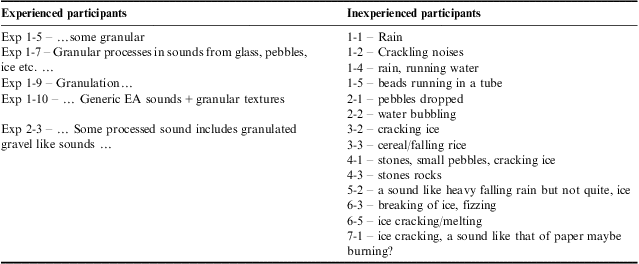
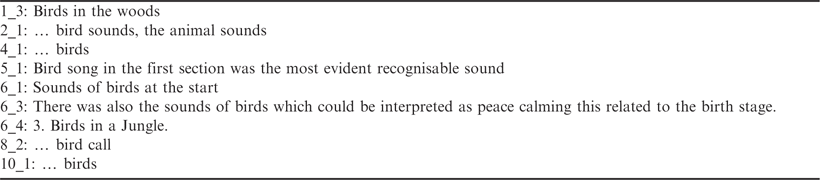
The results of P1 identified that the lived experience and training of individual participants were significant factors in the interpretation of both the materials and forms (structures) within the works.Footnote 6 Results clearly demonstrated how experienced participants, individuals with a background in electroacoustic music, approached the works in a more analytical fashion, providing a higher proportion of responses regarding the intra-musical interaction of events within the work's discourse, while the responses of inexperienced participants were more contextual or emotional in character (see Table 2 below). One particular example of this is aptly demonstrated through the way that participants described the granular materials within Work A. Experienced participants recorded descriptions of the materials using the schemas of electroacoustic music analysis. Such responses utilised advanced analytical terminology derived from academic literature and study. In contrast, the inexperienced participants interpreted the same materials in the work using their own schematic associations, drawn from lived experience. Lacking the expertise and knowledge of electroacoustic literature and terminologies, these inexperienced participants were forced to utilise schematic associations with which they were familiar in order to negotiate a description and interpretation of these granular materials, for example describing them contextually (Table 1).
Excerpts of responses referencing ‘granular materials’ within Work A (numbers identify the participant)

Individual elements of personal lived experience were also demonstrated to impact upon responses to the presented compositions, with individual participants providing unique interpretations.Footnote 7 However, the fact that trends emerged in interpretations suggests limits to this individual subjectivity and indicates that aspects of the work's physical signal might have acted to direct participant interpretations. Without some encouragement from the discourse, no individual interpretations would have been comparable. As Lawrence Kramer writes:
Interpretative statements … are culturally and socially conditioned, context sensitive, and the product of education and dialogue. … [Subjectivity] is not to be understood as a condition of self-enclosed private existence, but as a condition of public relatedness, a position – or series of positions – in a network of practices and representations. (Kramer in Atkinson Reference Atkinson2008: 89)
The fact that commonalities appear within the responses of participants suggests that some properties of the work's physical signal are interpreted in a similar fashion by a number of participants and that the work's discourse probably acted to narrow the interpretative potential of the work. This might be considered as a form of context, within which a series of individual events or gestures might be positioned. Should the order of presentation for these events be altered then subsequent interpretation might be quite different. Therefore, the discourse of the work can be seen as a significantly influential factor in audience interpretations. The term subject-position can be used to describe the relationship of the object to individual.
On the one hand there is the empirical spectator whose interpretation of the film will be determined by all manner of extraneous factors like personal biography, … previous viewing experience, variables of conditions of reception, etc. On the other hand the abstract notion of a ‘subject-position’, which could be defined as the way in which a film solicits, demands even, a certain closely circumscribed response from the reader by means of its formal operations … this distinction seems fruitful, in as much as it accepts that different individuals can interpret a text in different ways, while insisting that the text itself imposes definite limits on their room to manoeuvre. (Johnson in Clarke Reference Clarke2005: 92)
The subject-position of the discourse is dictated by the physical signal of the work (its formal operations and ‘fixed’ physical nature), and the position of the individual is dictated by the subject's unique lived experience. Both act in combination to constitute final interpretation. The subject-position of the work's discourse does not make communication explicit, but limits the interpretative potential from infinite to plural. Responses to Work A demonstrate the action of a subject-position and begin to highlight potential issues regarding limitations in interpretability which might result from a work with a narrow subject-position.
Work A was technically inspired by the possibilities of development and processing available in its sonic and visual materials, with the composer describing the work as an exploration of technical processing to highlight the sparkling nature of the materials. The composer cites that it is a work about: ‘the direct observation of the nature of things’, and based upon the musique concrète ideas of abstraction and reduction (both reduced seeing and listening), in which materials are to be deconstructed and perceived as entities free from association (Hill Reference Hill2013: 73). As such it seeks to demand a more ‘reduced’ hearing intention. Therefore, it might be asserted that this intention led to the construction of a work that is reliant on an explicit code: an understanding of the concepts of reduced listening and an application of analytical deconstructive properties of interpretation.
Work A was selected for its use of both mimetic sounds and images.Footnote 8 Both experienced and inexperienced participants responded to the work analytically when describing the materials of the work, but inexperienced participants suffered significant challenges in making the leap from a descriptive interpretation to an aesthetic one. Indeed, even the experienced participants struggled to approach the work aesthetically. Responses to the work's materials demonstrated the clear distinction in approach by experienced and inexperienced participants and demonstrated the action of an individual position (see above). Therefore, despite this clearly evidenced difference in individual position, some aspect of the work's subject-position (encoded within the nature of the physical signal) must have acted to encourage the clear trend towards analytical responses.
The mimetic nature of the materials within work A, and the clear and direct relationships between sound and image, were plainly perceived and recorded by both the inexperienced and experienced participants. Therefore, results from Phase one (P1) perhaps suggest that the recognisable materials in work A might have obstructed aesthetic interpretation and comprehension of the work. Such a finding potentially subverts the notion, suggested by Weale, that works of mimetic materials are more readily interpretable by inexperienced participants (Weale Reference Weale2006: 219).
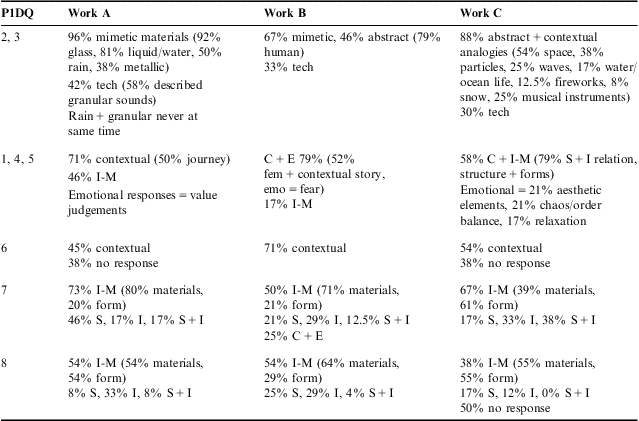
The nature of the materials within work A induced mimetic interpretations and extra-musical interpretative schema in the inexperienced participants. In turn, a significant number of participants were then unable to correlate these outside associations with the work's discourse. Individuals were unable to understand the work as a musical exploration of materials (i.e. responses to work A were largely descriptive). On the contrary, work C – made from entirely abstract materials – provided an open framework upon which participants could project their own aesthetic interpretations. This work (C), afforded audiences the possibility of multiple interpretative options, without the necessity for previous technical or aesthetic knowledge. Response types for all three P1 works are outlined in Table 2.
Summarised responses from inexperienced participants to P1 works

Key: P1DQ = Phase one directed questionnaire; I-M = intra-musical; C + E = contextual and emotional; emo = emotional response; S = sound; I = image; fem = female character.
The interpretations collected for works A and C suggest that, while mimetic materials might indeed be recognisable objects within a work, the external schematic influences accompanying them are potentially obstructing to aesthetic interpretations of the work. On the contrary, the more ‘open’ nature of the abstract materials within work C afforded inexperienced participants the opportunity to apply a plethora of plausible interpretations in their rationalisation of the work. Therefore, it might be argued that mimetic materials potentially obstruct aesthetic interpretation due to the complexes of association that mimetic events carry with them. Training in reduced, or expanded, listening (as possessed by experienced participants) helps individuals to ignore these complexes of association and to attend to the events themselves, in an abstracted fashion.
3. Phase Two
3.1. P2 introduction and aims
In order to confirm and further explore the P1 findings discussed above, the P2 composition was devised and composed to explore:
-
1. the limitation of the negative, distracting, impacts of source bonding and associated connotations encouraged by complexes of association with regards to mimetic materials; and
-
2. the creation of a work with a relatively open subject-position that does not require a specific model audience with any experience of listening training or an understanding of the concept of reduced listening.
3.2. Composition of the P2 work
In order to create a cohesive work that might present mimetic familiarity, but not overtly distracting source bonding, it was decided that materials from a single source should be used and that the cultural significance, or purpose, of the source be utilised as a model and a means for structuring the work.
To assemble mimetic materials from a diverse array of sources might potentially inspire diverse and contradictory complexes of association in the interpreting audience. Interpreting electroacoustic audiovisual works was demonstrated to be challenging enough for inexperienced audiences in P1, without complicating matters further through the use of mimetic materials from various sources. Therefore, the source location needed to provide opportunities for the capture of a diversity of interesting sounds and images for use within the composition, and which might be mimetic but not inspire highly specific schema or contexts in their interpretation.
A paternoster lift was chosen as the source due to its unique specificity, but general and common archetypal role (original and unprocessed footage and recordings of the paternoster lift can be seen in Movie example 4). The lift itself – a mechanical contraption – possessed a role and purpose familiar to almost all participants – that of being a lift, carrying humans, travelling up and down, and so on. Its mechanical sounds and imagery were deemed to be recognisable in general, but not specific, instances. The majority of audience members were expected not to have experienced a paternoster lift first hand, but to be familiar with all of its elements through the common nature of its materials: wood, metal handles, mechanical clanking sounds of the driving machinery and so on. Therefore, the role and materials of the paternoster lift might be described as common and archetypal, but their combination and specific instance uncommon.
The materials for the composition were captured at the location of the lift and their shapes, motions and textures explored within the compositional process. Thus, they were presented within the work as abstracted mimetic materials. Such abstraction was intended to minimise the negative and distracting possibilities of direct mimetic and associated schematic associations. Where the materials were abstracted, they were often recombined in simple recognisable geometric forms and gestures.
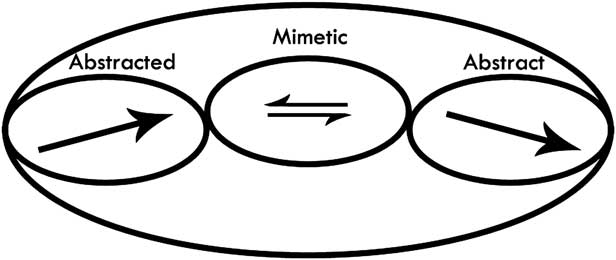
After opting to capture materials from a single source, the next required decision was how to structure the work and the materials within it. The spectromorphological nature of the materials themselves was initially considered as providing possible inspiration for the structure of the work. However, this was deemed to be too esoteric and potentially might require the audience to have considerable experience – training and familiarity with electroacoustic and electroacoustic audiovisual works – in order that they might possess the specific analytical interpretative schema which would enable them to understand such relationships between the material properties and structures of the work. As opposed to simply presenting a study of the source and its properties, it was decided that the form of the work should be articulated and clearly defined. As Schaeffer asserted, ‘[t]here must be an affinity between the material and construction, so in this new music there will be an affinity between the object as micro-structure, and the musical phrase, the macrostructure, of which it becomes an element. … This initial idea is the hypothesis that musical discourse can be created by bringing together sites and calibres of sound objects in perceptual fields’ (Chion Reference Chion2009: 59). With this in mind it was decided that the nature of the lift itself, and the process of travelling within it, would be used to metaphorically inform the structure of the work (Figure 1).
Diagram of the work's structure.

As a result, the work was conceived as divided into three sections: the first representing travelling upwards, the second from a static perspective (‘on the landing’) with objects passing and travelling by, and the third and final section evoking descent. One of the most significant unique features of a paternoster is the open carriages and lift shaft, allowing those travelling on the lift to observe the passing floors and for those on each landing to observe the passing of the carriages. This element was a significant inspiration for the work, and the main reason that the location proved to be so interesting both visually and sonically (Movie example 5). The nature of the journey around the lift, its cyclical nature, but also rising and falling provided potential for emotional connection and inference that were demonstrated in the responses to the P2 work.
3.3. P2 results
Responses to the P2 work provided further insight into the processes of interpretation and also helped to expand the examination of the interaction between physical signal, perceived object and subject-position. The most significant finding in this regard related to the issue of technical process and compositional insight obstructing aesthetic intention.Footnote 9
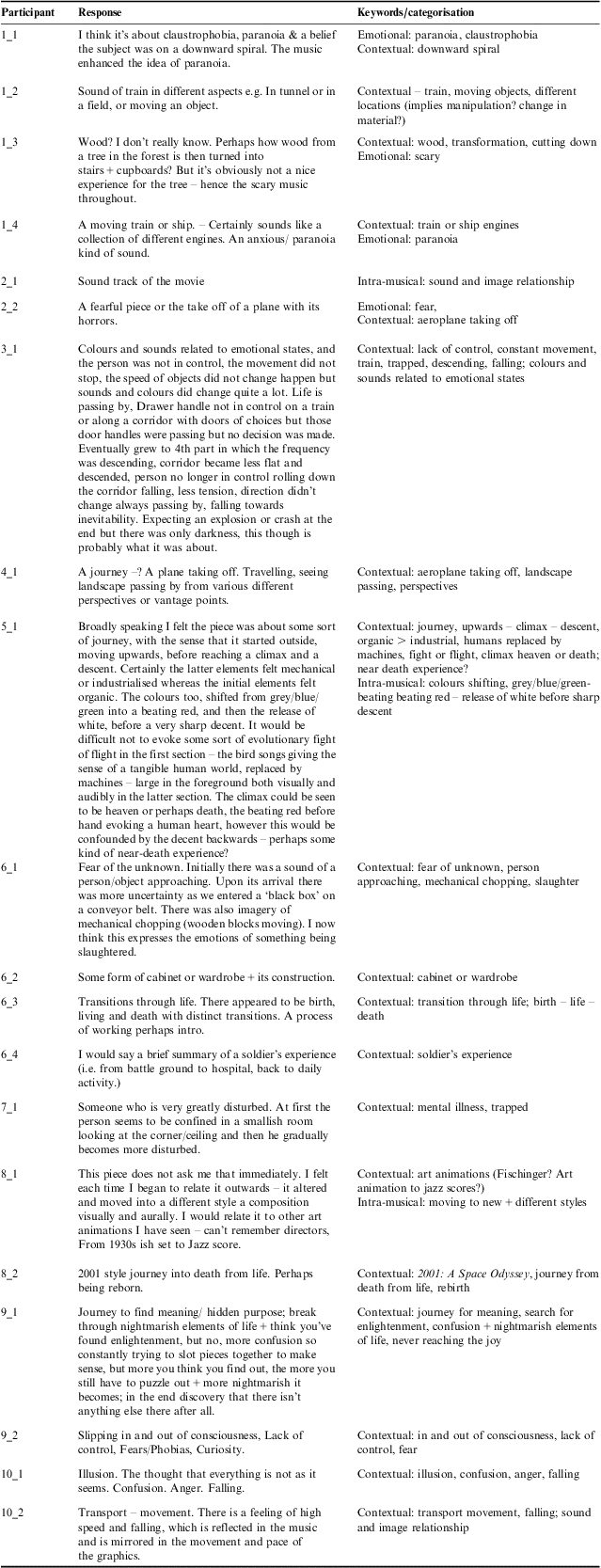
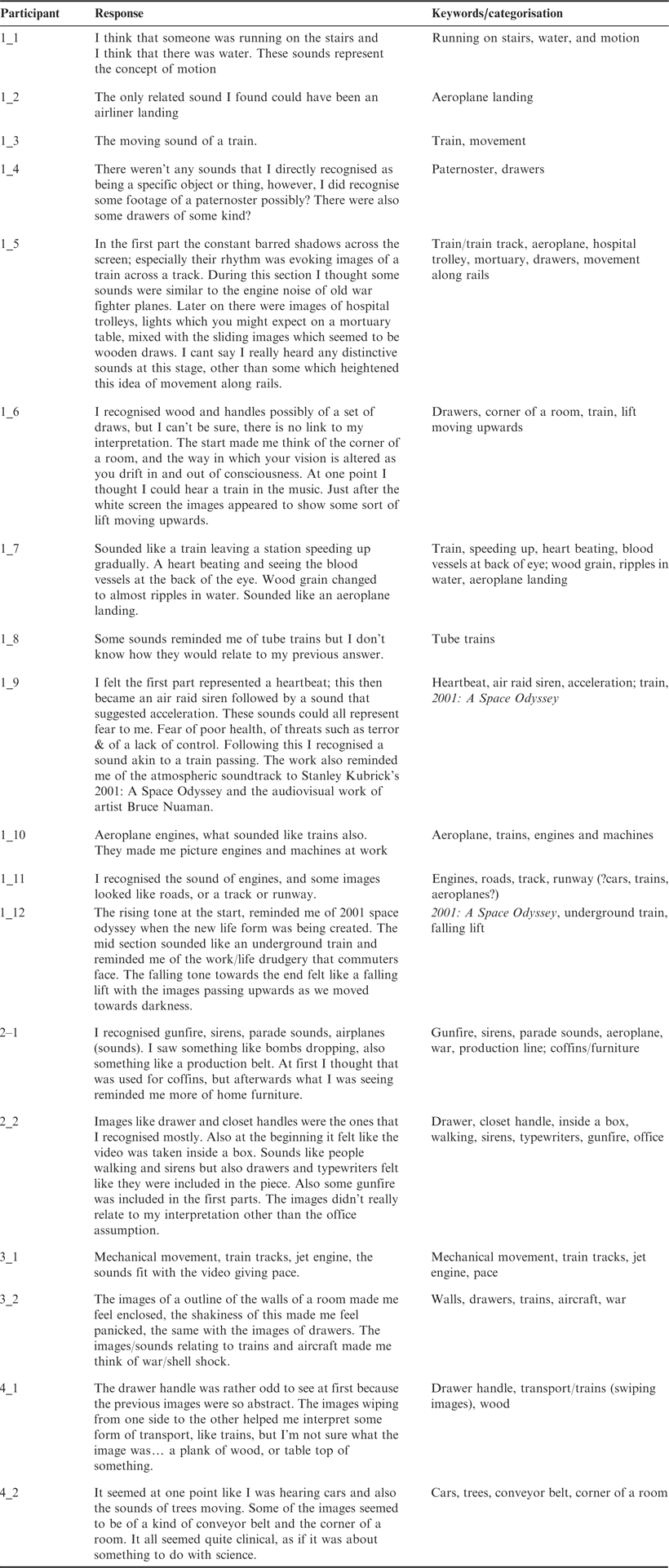
The diversity in interpretations recorded within P2 again demonstrated explicitly the division of physical signal from perceived object. Schaeffer defines the sound object as a phenomenon (a perceived object) as opposed to physical signal (a scientifically defined attribute of frequency and amplitude). The ‘sound object is the meeting point of an acoustic action and a listening intention’ (Schaeffer in Chion 2009: 27). Although common lived experience and the subject-position of the physical signal might induce trends and commonality between interpretations, a lack of division between physical signal and perceived object would result in all participants making identical interpretations. Responses to the P2 work clearly displayed that participants did not describe a common interpretation expressed in individual vocabularies and metaphor, but that they made genuinely unique interpretations (Table 3) (Hill Reference Hill2013: 236).
Phase two directed questionnaire 1: What might this piece be about?


The disjunction between physical signal and perceived object also proved to be highly significant in highlighting challenges arising from the compositional perspective. One particular sonic element, present within opening section of the work between 01′05″ and 2′13″, became a source of particular interest within the interpretations of the P2 work (Sound example 1). This sonic material might be described as clusters of rapid swooping gestures (swooping in both pitch and amplitude). This sound was derived from a recording of the paternoster creaking and rattling.
The original sound underwent spectral stretching to create the final swooping sounds heard. For the composer, with experience of the processes of creation and recording, the schematic links between the original audio source and the final sound were clear and coherent, concordant with regard to the discourse and intent for the larger forms of the work. The compositional concept might be encapsulated as: this material is developed from the sounds of the lift and imparts a sense of rapidly passing objects, speed and energy to the discourse of the opening section of the work.
However, without the compositional schema of association and experiences of the composer,Footnote 10 the connection between the original source and final sound was demonstrated to be far less clear. Compounded by the inexperienced nature of the research participants, who were probably unaware of the possibilities of sonic manipulation or the transformation of recorded sound, this sonic element was frequently interpreted as ‘birds’. This association of ‘birds’ often subsequently fed into larger complexes of association resulting in the interpretation of references to nature, animals, the environment and so on (Table 4).
Excerpts of responses to the P2 work mentioning ‘birds’

Due to the intentions of the composer and the subsequent articulation of the physical signal, no other, or similar, references to ‘nature’ existed within the subject-position of the work. This placed the audience member in a situation whereby the ‘nature’ schemas were not reinforced and indeed stood alone, isolated from the rest of the work. Such contradiction potentially led to confusion, incomprehension and a lack of engagement with the work.Footnote 11 As outlined in attribution theory, ‘if the change in stimulus array is too great, if there are a lack of common features in transformation from part A to part B, then no cohesive attribution can be specified’ (Newtson Reference Newtson1976: 236).
The association of ‘birds’ and ‘nature’ were not concordant with the subject-position of the rest of the P2 work, and thus could not be negotiated into a cohesive interpretation of it. Inexperienced participants were presented with materials that engaged disparate schemas of association and that could not be consolidated into a single interpretation. Further, as Marylin Boltz outlined within her theory of expectancy violation, individuals apply greater powers and energy of mental processing towards unexpected information so as to be able to rationalise the anomaly (Boltz Reference Boltz2001: 429). Therefore, elements that do not conform to common schematic frameworks attract higher levels of attention than those elements that are concordant. Thus, where anomalies or contradictions exist within the discourse there is significant potential for aesthetic engagement with the work to be derailed into analytical consideration. In such a situation the audience member attends to questions of ‘why certain sounds, or images, appear’ as opposed to regarding the work aesthetically as an artistic expression using sounds and images (see also, Hill Reference Hill2013: 168). The result, for audience interpretations of work P2, was a multiplicity of interpretation, conflict between these multiple interpretations, confusion and finally a lack of engagement with the work.
The assumptions from an experienced and compositional perspective presumed that the materials and forms of the work would be interpreted in a reduced fashion, within electroacoustic and spectromorphological schemas. However, as proven within responses to P1 work A (see above), where the subject-position of a composition depends upon such knowledge in its audience and the audience member does not possess such information, the audience member will be unable to interpret and understand the subject-position of the work. Such an occurrence may be inconsequential, and works may be flexible and open to multiple interpretations – for example, P1 work C presented a diversity of possible interpretative solutions to participants – but often, and as in the case of the P2 test work, without a reduced listening approach the spectrally stretched materials were demonstrated to be far more difficult to integrate within a cohesive interpretation.
From the compositional perspective, the links between original material and final aesthetic result unified the stimuli into a cohesive interpretation. The composer's schema of association contained links between the original source of the paternoster lift and the final processed sound. Deafened/blinded by the experiential associations of the compositional process, the composer was unable to recognise the possibilities of alternative interpretation for the ‘bird’ sound and the potential conflict that such an interpretation, and its associated schematic associations, might have upon the constructed interpretation of the work. The composer made an assumption that the audience would be able to recognise the development of materials from the original source within the final result, or that if they did not then they would appreciate the materials for the spectral and morphological properties in a reduced or expanded fashion. Thus, the compositional process of developing and transforming the source materials into interesting and useful elements for composition neglected the original aesthetic concept of the work and failed to appreciate the distinction between physical signal and perceived object and the subsequent plurality of interpretative possibilities.
The compositional intent, within this case, focused upon a result within the physical signal. Such a focus is entirely erroneous because the audience responds not to the physical signal but to perceived objects. Wherever compositional intent, or action, fails to take into consideration the final perceived object, process has the potential to obscure aesthetic. Such obstruction in interpretation occurred for audiences of P1 work A and in elements of the middle section of P1 work B, as well as within the P2 work. Moving into P3, the process of re-composition was used in order to attempt to confirm this analysis of the situation, to remove conflict between dislocated schematic associations and to ensure clarity within the work's subject-position.
4. Phase Three
4.1. P3 introduction and aims
P3 began by critically examining the P2 aims with respect to the responses of the research participants within the P2 research sessions. Critical reassessment of those aims (set out above) highlighted the importance of consistency between mimetic materials and the work's overarching form. One of the main factors of obstruction in interpretation of the P2 work was demonstrated to be the process of material abstraction, whereby materials of the work were transformed to such an extent that they became entirely abstracted from their original context and subsequently dislocated from the larger discourse of the work.
A composer might employ either mimetic or abstract sounds (mimetic or abstracted based upon the composer's own interpretation), but must appreciate that such sounds will be interpreted by the subject, based primarily upon the subject's own lived experience, and only secondarily based upon the subject-position of the discourse. Where the composer imagines that audiences interpret the physical signal of sound (or that any explicit meaning is encoded within signals), a dislocation will occur between anticipated and actual interpretations. In such a situation, it becomes redundant for the composer to consider materials as abstract or mimetic with regards to their impression of the world. Instead, they should seek to consider whether the materials are abstract within the context of the discourse of the work.
The mimetic materials within the P2 work encouraged conflicting interpretations through the activation of disparate schemas of interpretation. This conflict can be linked directly to the actions of the composer and their development of the work itself. The experience of the composer, and their knowledge of the processes under which the materials of the P2 work had developed, obscured the potential conflict between the final materials and the work's discourse when interpreted by inexperienced audiences.
Therefore, the P2 work did not entirely fulfill the goals of the second aim outlined, and thus did not escape the requirement for its audience to approach the work in a reduced way. The P3 aims were only modulated from those in P2 to a minor extent and were thus:
-
1. Limit the conflicting, distracting, source bonding and associated connotations encouraged by schema with regards to mimetic materials by considering how the work will respond as a collection of perceived objects and so that the work's discourse does not inspire contradictory associations.
-
2. Create a work that does not require a specific model audience with any experience of listening training or an understanding of the concept of reduced listening.
The P2 test work was developed into the P3 test work with three main goals:
-
• to decrease the contradictory nature of the work's subject-position, thus reducing the prevalence of contradictory schema engaged within inexperienced audience interpretations;
-
• to integrate all aspects (sections) of the work into a cohesive trajectory; and
-
• to increase audience engagement with the middle and final sections of the work.
Within the process of recomposition the ‘birds’ element of the work was removed and replaced with a collection of glissandi. These materials were also chosen as an appropriate replacement so as to further integrate the opening section with the final section of the work, reinforcing the cohesive overall form of the work and its three-part structure (Movie example 6).
Responses to the P3 work demonstrated the significant impacts that subtle alterations of the physical signal can have upon emergent interpretations, and how focusing compositional attention upon the perceived object – and awareness of how others might perceive the same physical signal – can aid the interpretability and cohesion of electroacoustic audiovisual works.
4.2. P3 results
All participants within P3 were able to make an interpretation of the work, with a larger majority demonstrating significant levels of engagement compared to P2. Responses to the P2 and P3 works were consistent in some regards, thus helping to corroborate some elements of the P2 findings and further highlighting the significance of variation within the responses to P2 and P3 works.
Every single participant in P3 made a contextual interpretation of the work's materials (Table 5), none of which related to ‘nature’ or ‘birds’.Footnote 12
Phase three directed questionnaire 2: Were there any sounds or images that you recognised in the work? How did these relate to your interpretation (q1)?

P3 responses suggested a far lower incidence of contradictions in interpretation, indicating that the changes made to the physical signal of the work were effective in reducing contradictory aspects of the work's subject-position.
Despite the fact that the P3 (and P2) work utilised mimetic materials within its discourse, participants were able to make interpretations and engage with the work. Responses to P1 work A initially suggested that mimetic materials might obscure the possibilities of aesthetic interpretation. However, responses to the P3 work suggest that where mimetic materials are situated within an appropriate discourse – one that does not exert a highly specific subject-position demanding a highly specialised model audience – then mimetic materials can be interpreted aesthetically.
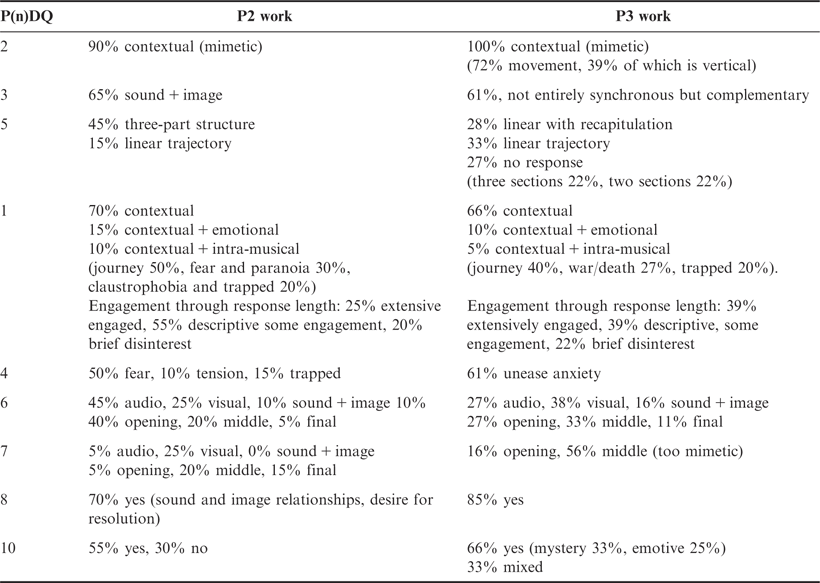
All of the of participants identified mimetic materials within the work, which might initially imply an analytical approach (as in P1 responses to work A). But they subsequently utilised these to construct non-analytical, aesthetic, interpretations of the work (Hill Reference Hill2013: 274). Further, when requested to technically evaluate the interactions between sound and image within the piece, inexperienced audience participants instead provided contextual interpretations of sound and image complexes (Hill Reference Hill2013: 273). The majority of responses to the P3 work demonstrated engagement and successful, individual, interpretation of the work. Aesthetic engagement was most clearly demonstrated through the responses to a ‘desire to keep listening’ (P2/3DQ-8) and ‘to see/hear similar works in the future’ (P2/3DQ-10); comparison of the P2 and P3 responses suggest that the insight afforded by the responses to P2 and the subsequent process of recomposition resulted in higher levels of appreciation for the P3 work and a greater desire to experience other works of electroacoustic audiovisual music (see Table 6 and Appendix).
Responses to question 8 and question 10 within both P2 and P3 as indicators of engagement

Such findings further highlight the importance of eliminating contradiction within the work's subject-position and the potential benefits in engaging feedback from external and non-specialist sources within the composition of works.
5. Conclusion
Through empirical testing, knowledge of the processes of interpretation was demonstrated to be highly significant in informing the composition of cohesive and interpretable works. The abstract and/or mimetic nature of materials is frequently discussed with regard to musical aesthetics and the interpretability of works, but the current research has demonstrated that the division between physical signal and perceived object renders the distinction of abstract and mimetic materials to be less significant than consistency within the subject-position. It is redundant for the composer to consider materials as abstract or mimetic with regards to their own impression of the work, because, when interpreted, this impression may not be shared by their audience (categorisation of mimetic or abstract materials is fluid, not fixed). Instead, composers should consider whether their materials are abstract within the context of the discourse of the work, and whether or not they might encourage conflicting schemas of association. As Schutz wrote, ‘a phenomenological approach to music may safely disregard the physical qualities of the sound as well as rationalisation of these sounds which leads to the musical scale’ (Schutz Reference Schutz1976: 6).
Common lived experience can be used to approximate the ways in which audiences might interpret works, but such common experience cannot be guaranteed. It is challenging for the subject to identify what experiences truly are common and to distinguish these from individual experience. Phenomenological theory demonstrates that all individuals are defined by their past experience, and that previous experience allows for the construction of schematic associations which afford the possibility for stimuli to be interpreted and situated within a frame of reference. Correlation, as defined by Schaeffer (Chion Reference Chion2009: 17) and resulting from common interpretative schema, have led scholars to infer the existence of intrinsic meaning, or the lack of a division between perceived object and the physical signal. It is significant, however, to distinguish these common interpretations as a result of common lived experience and not as a result of any form of intrinsic meaning.
As David Hume wrote:
What never was seen, or heard of, may yet be conceived; nor is any thing beyond the power of thought, except what implies an absolute contradiction.
But though our thought seems to possess this unbounded liberty, we shall find, upon a nearer examination, that it is really confined within very narrow limits, and that all this creative power of the mind amounts to no more than the faculty of compounding, transposing, augmenting, or diminishing the materials afforded us by the senses and experience. (Hume Reference Hume1977: 11)
Phase 2&3 questionnaire
-
1. What might this piece be about?
-
2. Were there any sounds or images that you recognised in the work? How did these relate to your interpretation (q1)?
-
3. Can you comment on the relationship between the sounds and images in this piece? Do these relate to your interpretation (q1)?
-
4. Did you have any emotional responses to the piece? Did these relate to your interpretation in any way?
-
5. How would you describe the structure or form of the piece? (How the piece was structured/its architecture). Please elaborate.
-
6. What aspects did you find most engaging?
-
7. Which aspects did you find least engaging?
-
8. During the work did you want to keep listening?
-
9. Do you think that having more information about the work might help you to understand it more? If yes, why? If no, why not?
-
10. Do you think that you would like to watch/listen to a similar type of work again? If yes, why? If no, why not?
Table A1P2 and P3 inexperienced responses to P(n)DQ
 Table A2
Content and length of responses to P(n)DQ-1 as an indicator of engagement.
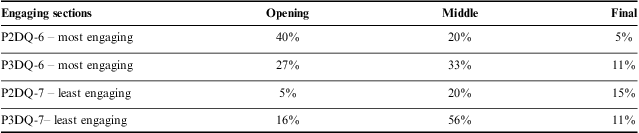
Table A3Responses indicating the most/least engaging elements of the P2 and P3 works: material elements
Table A4Responses indicating the most engaging elements of the P2 and P3 works: sections of the work