1. Introduction
How do institutions interact with preferences, and hence with the choices societies make (see Rodrik, Reference Rodrik2000, for a broad conceptual discussion of some of these issues)? Typically, in analytical modelling, the preferences of a politically powerful coalition play an important role in shaping institutions (Acemoglu, Reference Acemoglu, Blundell, Newey and Persson2006), which is, of course, consistent with the neoclassical approach whereby exogenously given preferences determine economic outcomes. On the other hand, an almost equally classical view – the Marxist and Weberian traditions – holds that institutions shape preferences. It seems, in fact, that this latter view may have been recently embraced, perhaps inadvertently, in influential literature arguing that transplanted institutions have the potential to reform recipient economies in developing countries. In the context of the legal system, this argument has been forcefully made by La Porta et al. (Reference La Porta, López-de-Silanes, Shleifer and Vishny1998); in the context of political and contract enforcement systems, work reviewed in Acemoglu (Reference Acemoglu, Blundell, Newey and Persson2006) attributes the success or lack thereof of former European colonies to whether good institutions were imposed on them by the colonizers; and Easterly and Levine (Reference Easterly and Levine2003) reject the significance of economic policies for growth in favour of good institutions.Footnote 1 There are, it seems, examples in support of the view that institutional transplantation can work and have positive durable effects. Thus, some literature makes the point that pre-independence institutions in colonized parts of the world often persevered and were sustained after independence, so that, in a sense, modern institutions in these countries took root under colonization.Footnote 2
For transplanted institutions to endure, however, they ultimately need to have political support. This necessarily implies that transplantation can work only insofar as it changes the collective preferences of the recipient population from rejecting good institutions to embracing them. Two different channels can lead to this change. Either transplanted institutions change the composition of politically decisive constituencies, or they change individual preferences through habitual addiction, for example. In this paper, we are interested in studying this second channel. Some related recent work, such as Corneo and Gruner (Reference Corneo and Gruner2002) and Alesina and Fuchs-Schuendeln (Reference Alesina and Ferrara2005), examines attitudes toward the role of the state in the 1990s and finds significant differences between West European market economies and those of the formerly communist countries of East Europe, with individuals in the second group being more favourable toward state ownership. Alesina and Fuchs-Schuendeln (Reference Alesina and Ferrara2005) attribute this difference to the durable effect that the existing institutional environment has on the formation of preferences.Footnote 3
On the other hand, there are other examples where institutional change, inasmuch as it was forcibly imposed, did not endure. The relatively rapid transition of the former communist countries to market economies (see Shleifer and Treisman, Reference Shleifer and Treisman2005) illustrates precisely that. As will be argued in more detail below, the Russian Revolution of 1917 entailed a decisive institutional change, dealing a death blow to the previously existing elites. Further, it led to a much more egalitarian distribution of economic resources than before, as well as to an ideological commitment to and relatively successful implementation of universal literacy, mass education, national health, and public housing. It is commonly agreed that as a result of these commitments – despite all the well-known problems and the frequent ruthlessness of their implementation – the degree of economic inequality in the Soviet Union, as well as in other countries within the Soviet domain, was among the lowest in the world.
Yet the system, which was mercilessly imposed for decades, did not endure and was overthrown when an opportunity presented itself in the late 1980s as a result of Gorbachev's policy reversal. One country after another engaged in economic liberalization and in attempts to reinvigorate private entrepreneurship.Footnote 4 This important recent example – or, rather, set of examples, since the system was implemented in about one-third of the world's countries – leads to several observations. One is that decisively and abruptly breaking up an old order with inefficient institutions and creating an alternative regime with commitments to equality is in itself no guarantee of economic success. The institutions created as a consequence of the Russian revolution, including central planning and state ownership, were thrown out as soon as the citizens were given free choice. As the data explored below seem to suggest, the populace in Soviet-dominated countries had developed a deep sense of dissatisfaction with economic equality – probably the most important tenet of the economic regime and one that had been promoted for decades through school indoctrination, the mass media, the silencing of any discontent, and the repression of dissidents.
While revealed behaviour – the relatively decisive move away from the communist system that occurred in many transition countries – speaks for itself, at least two important issues remain unsettled. First, it is not quite clear what specific aspects of the communist system aroused objection, leaving open the possibility that some features were acceptable or even approved. Second, it is unclear how widespread opposition to the system was; did it reflect mass disapproval or just the views of a relatively small group of interested parties?
To study these issues, we examine the emergence of the Soviet Union and, in particular, the imposition of a communist regime on some of its neighbours. The argument is that some of these cases come close to being ‘experiments’ and thus enable us to study the likelihood of a long-lasting imprint resulting from deep institutional change. Specifically, we compare the Baltic states, which came under Soviet occupation in 1940 and were part of the Soviet Union until 1988, and Finland, which fought the Soviet military invasion and remained independent throughout. Arguing that the economic and social outlook of the Baltic states and Finland was similar in the period predating the Soviet invasion, we then study how the imposition of the Soviet model, with its emphasis on state planning and economic equality, affected the views of the citizens in each of those areas.
We are able to replicate the previous findings that individuals in former communist countries tend to view state ownership and reliance on state support more approvingly than individuals in market-oriented economies. However, we also find strong evidence of their willingness to accept unequal distribution of income and to be exposed to more competition in order to enhance incentives. We regard these findings as proof that institutional imposition may not be durable, especially if it is not perceived to be successful.Footnote 5 Taken together, they seem to imply that when compared to a relevant group, individuals in the former communist countries welcomed at least some elements of transition to the capitalist system, such as increased competition, and were perfectly willing to accept growing inequality as the means to increase efficiency; but they were also reluctant to give up on government responsibilities. Moreover, during the course of the transition decade in the 1990s, these relative attitudes changed remarkably little, despite the wave of mass privatization in the Baltics in the early 1990s.
We also find some tentative evidence that individual trust as well as confidence in government generally boosts support for capitalistic institutions and may partly account for the differences in attitudes between the Finnish and the Baltic respondents. We argue that understanding these distinctions may be helpful for conducting institutional reforms.
To summarize, the question of the relevance of institutions for development can be usefully divided into two somewhat separate although arguably related components. One is whether an imposed, or transplanted, institutional change can promote economic performance. It is this issue that has been most directly addressed by the recent literature. Another question, however, is to what extent imposed institutions are durable and can be sustained over time, especially when citizens in the recipient countries are able to exercise at least some political will. This paper addresses the second question.
This paper is related to the literature, some of which is mentioned above, which studies the determinants of high-quality institutions. Berkowitz et al. (Reference Berkowitz, Pistor and Richard2003) find in the context of transplanted (legal) institutions that their legality is no less important than their inherent quality; Rodrik (Reference Rodrik2000) suggests that appropriate institutions may differ across countries; and Rajan (Reference Rajan2006) argues that supportive constituencies are essential for the ultimate success of an institutional change. Since the particular institution addressed in this study is inequality and its subject matter is the attitudes toward the role of government, the paper is also related to the work that studies the determinants of such attitudes. This work has been done mainly in the context of the comparison between the USA, with its reliance on markets and relatively high inequality, and Europe, with its state-provided social protection – see Alesina and Glaeser (Reference Alesina and Glaeser2004) and references therein. In the US context, Alesina and La Ferrara (Reference Alesina and Ferrara2005) relate preferences for redistribution and social mobility.Footnote 6 Some more recent work has also been done comparing attitudes within Europe, for example between West and East European countries (Corneo and Gruner, Reference Corneo and Gruner2002; Alesina and Fuchs-Schuendeln, 2005). This work typically finds that individuals in the former communist countries tend to favour more state intervention than their Western counterparts; the authors then attribute the finding to habit formation or the effects of indoctrination. In contrast, Shiller et al. (Reference Shiller, Boycko and Korobov1991, Reference Shiller, Boycko and Korobov1992) compare the United States and the Soviet Union in the early 1990s and do not find significant differences in regard to attitudes toward markets. Further, Di Tella and MacCulloch (Reference Di Tella and MacCulloch2009) find that individuals in developing countries are generally quite suspicious of the institutions of capitalism, such as markets and private ownership. While concurring with these findings, we also provide evidence that individuals in ex-communist countries favour more inequality and competition to enhance incentives. Thus, while they were suspicious toward private ownership, these individuals were perfectly willing to support other essential capitalistic elements viewed as important for economic incentives. From the viewpoint of the prospects for positive institutional change in a developing country, this conclusion can thus be considered as reflecting guarded optimism. On the other hand, we do not find much support in the data for theories suggesting that mass privatization creates constituencies in favour of further market reforms (see Biais and Perotti, Reference Biais and Perotti2002); at least within the span of a decade, the attitudes of the citizens in the Baltic states remained relatively stable despite the wave of mass privatization in the early 1990s.
The rest of the paper proceeds as follows. The next section describes the historical and institutional background. Section 3 then deals with data description. Section 4 presents some basic empirical findings, with a more detailed analysis in Section 5. Section 6 then concludes with discussion and interpretations.
2. Background
Historical details
Russia
In the first half of the 19th century, tsarist Russia was a very traditional society, with a patrimonial state that was fully controlled by an autocratic bureaucracy. Land and mining were highly concentrated, and most peasants were serfs. The judiciary was an integral part of the governing system, and religion was a solid part of the state mechanism. Reforms in the 1860s were designed to institute a more modern system of governance, with a modicum of separation of powers and abolishment of serfdom. The pace of their implementation was uneven, however, and only after two or three decades did some elements of modernization begin to manifest themselves. While the reforms gave impetus to the emergence of the bourgeoisie and to relatively rapid industrialization, they also exacerbated poverty (see Pipes, Reference Pipes1995).
The beginning of the 20th century was characterized by some continuing attempts at reform, along with the regime's confrontations with the emerging working class. The attempted 1905 revolution was followed by severe repression, which was in turn followed by the Stolypin land reforms of 1910–11. The Russo–Japanese War and World War I contributed to a severe and ongoing economic and social crisis. Though the 1917 revolution resulted in the abdication of the tsar and the formation of an elected government seemingly committed to progressive social reforms, the continuing war and a lack of visible economic progress brought about another, much more radical revolution led by Lenin's Bolshevik party (Walkin, Reference Walkin1962).
The ensuing civil war from 1918 to 1922, combined with droughts from 1920 to 1921, further contributed to the devastation of the country that became known as the Soviet Union, which defined itself as a federation of republics. The revolution decisively upset the previous balance of power, practically eliminated the ruling elite, and led to the emergence of new institutions.Footnote 7 In the late 1920s, in order to promote rapid industrialization, Stalin collectivized farms and imposed state ownership and central planning (Pipes, Reference Pipes1993). Massive investment, especially in heavy industries, brought about a period of strong economic growth. Much progress was also made in education – which was viewed as both a vehicle for modernization and a means of socializing individuals into the ruling ideology – and in the areas of science, health, and infrastructure. Although subsequently there were important deviations from these policies, they remained in place until Gorbachev introduced major changes in the late 1980s. While the Soviet Union's economic growth was initially very impressive, it slowed down considerably by the 1960s (see Nove, Reference Nove1992). During the entire period of communist rule, all aspects of democratic governance – such as free elections, an independent media, and the freedom of speech and of political organization – were absent throughout the Soviet-dominated areas.
Soviet Union and Eastern Europe
During the period 1918–40, the Soviet Union evolved as a political federation of separate republics. It came into being in 1922 as a union of the Russian, Ukrainian, Belorusian, and Transcaucasian republics. The autonomy and right of secession granted to the republics by the constitution were purely theoretical; political control was centralized. Some territories previously belonging to Imperial Russia – in particular, the Baltics – were lost in the course of the turbulent aftermath of the revolution. In 1940, however, some of these territories were regained as a result of a pact with Nazi Germany; thus, Moldavia, Estonia, Latvia, and Lithuania joined as new republics. Parts of Poland and Finland were also incorporated. By 1940, the Soviet Union had regained almost the entire territory of Imperial Russia, with the important exceptions of parts of Poland and Finland.
In the aftermath of World War II and as a part of the emerging Cold War, Stalin strengthened his grip on neighbouring countries through political and military pressure, as well as by signing economic and military agreements. As a result, countries in Eastern Europe, including Poland, Hungary, Czechoslovakia, Romania, Bulgaria, and East Germany, came to be dominated by communist regimes with fairly similar ideologies and policies to that of the Soviet Union.Footnote 8
The disintegration of the Soviet Union and the transition period
In the late 1980s, Soviet leader Mikhail Gorbachev embarked upon a series of reforms. In the economic sphere, they primarily meant the relaxation of state control, the abolishment of central planning, and mass privatization. In the political sphere, they led to democratization and to the dismantling of the Soviet Union in 1991, with its 15 constituent republics becoming independent states.
The reforms also had consequences beyond the Soviet borders. Revolutionary movements spread all over the Eastern bloc, resulting in the ousting of the regimes imposed after World War II. One country after another replaced the prevailing communist regime with another, less centralized governance system and a variation of the market economy. East Germany reunified with West Germany in 1990, and the pacts and agreements between the Soviet Union and the neighbouring countries were dissolved.
The transition period proceeded very differently in the different countries. This can be seen most clearly by comparing the growth rates across the transition economies. For example, in the period 1992–2002, average real income per capita in countries like Estonia and Poland grew at an annual rate of about 4%; in Ukraine it shrank by more than 4%; and in Russia it shrank by less than 1% (Beck and Laeven, Reference Beck and Laeven2006). The political and economic pace of reform differed greatly across the transition economies as well. By 2004–5, income per capita in several transition economies, such as Slovenia, the Czech Republic, Hungary, and Estonia, was approaching $20,000; whereas in Belarus and Ukraine it stagnated at less than $4,000 (World Development IndicatorsFootnote 9 ).
Finland and the Baltic states
We would like to argue that the formation of the Soviet Union and the Eastern bloc and their subsequent disintegration constitutes a unique social experiment – in fact, several of them – in particular creating a division between market-oriented economies in the West and planned economies in Eastern Europe. The above historical account helps us in the identification.
Finland and the Baltic states, which are the focus here, share many common historical features. Previously loosely controlled by the Russian Empire, they became independent as a consequence of the Russian Revolution of 1917. They then had to quickly set up their own national institutions and define their respective identities. All of them opted for democratic governance and a multiparty system. Comprehensive land reform and advanced social legislation were high on the agendas of the new parliaments, which were dominated for the most part by right-wing nationalist parties.
They were also able to develop their economies successfully, and build their respective social fabrics. In the 1930s, all these countries were relatively poor by West European standards, with per capita incomes of about $3,000 in Finland and almost that in Estonia and Latvia – about one-half of per capita income in the USA at the time. Although industrialization began taking off, agriculture and foresting were still the dominant sectors. As a result of a land reform that took place in all these countries in or around 1920, the number of small farmers grew considerably, the tenancy problem was almost completely resolved, and agricultural production rapidly increased. All these countries – especially Finland and Estonia – developed extensive trade relationships with other European countries, in particular Germany and England. Industry – initially based on a particular niche, such as timber in Finland or textiles in Estonia – gradually became more diversified (wood products, paper pulp, some oil products), and its relative share in total output increased. All these countries suffered significantly as a result of the Great Depression, but managed to rebound, so that in the late 1930s, standards of living were increasing, and there was minimal unemployment. Notably, almost universal literacy was achieved early in the 20th century, at least in Finland, Estonia, and Latvia, so that in the 1930s there was practically no illiteracy, and school standards across the Baltic states were relatively very high. Also, social legislation – women's suffrage, child labour regulations, social insurance for disability and old age – was among the most progressive in the world. Even political developments were similar in these countries in many regards, with right-wing nationalist governments dominating the scene. All these suggest that, in relevant aspects, these countries were similar in the interwar period.
In 1940, the Soviet Union managed to reacquire the Baltic states (and a part of Finland) through a pact with Germany, whereas Finland fought off the Soviet army and retained independence. Since the governments in all these countries were formed by right-wing parties vehemently opposed to communist influence, these developments can be regarded as being solely due to a geopolitical reality that had nothing to do with any social differences between Finland and the Baltic states. The period from World War II through the disintegration of the Soviet Union saw an independent and democratic Finland, whereas the Baltic states came to be fully dominated by the centralized Soviet bureaucracy. In 1990, despite very different economic systems, income inequality levels across all these countries were roughly similar, with Gini coefficients varying between 0.25 and 0.27, among the smallest in the world.
To summarize, Finland and the Baltic states shaped themselves in very similar ways during the interwar period – economically, socially, and politically. Therefore, the Soviet invasion of the B and the subsequent imposition of the communist regime there, as opposed to its defeat in Finland, provide an opportunity to compare the long-run effects of an imposed institutional regime.
3. Data
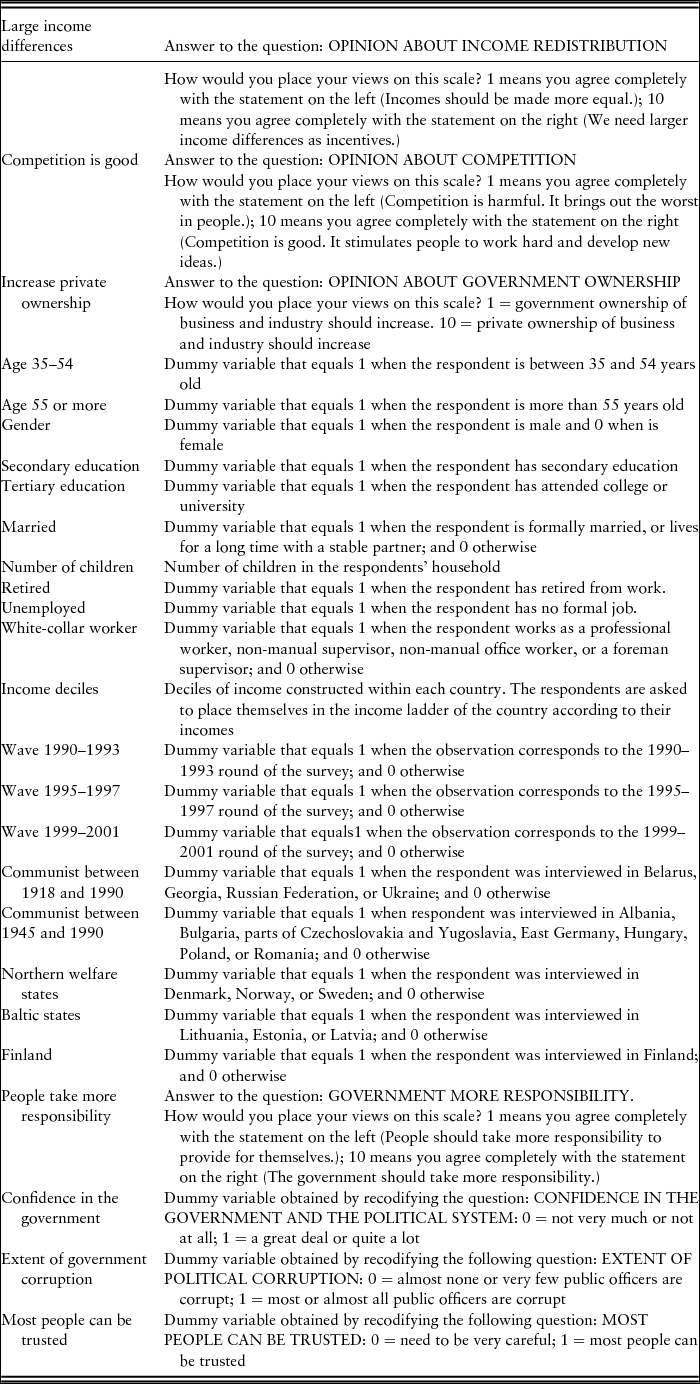
Our data sources are the European and World Values Survey (WVS), two worldwide surveys conducted by the Inter-University Consortium for Political and Social Research (ICPSR) that consist of individual cross-national responses to a variety of questions on topics including the economy, politics, and identity, and includes the socio-economic background of the respondents. The data are derived from face-to-face interviews with people 18 years of age and older from 83 developed and developing countries. Four survey rounds have been conducted: Reference Meltzer and Richard1981 (Wave 1); 1990–3 (Wave 2); 1995–7 (Wave 3), and 1999–2001 (Wave 4). Altogether, these amount to more than 267,000 individual responses, or an average of 66,000 per survey.Footnote 10
Within each country, the sample design and fieldwork were done by professional survey organizations with great experience (most of them members of the Gallup chain). In other cases, it was carried out by national academies of sciences or university-based institutes. Each sample has a multistage design and random selection of sampling points after stratification by region and degree of urbanization. National samples were used in all countries, but some of them were done just using country subsamples (Russia, Northern Ireland, Chile, Puerto Rico, Argentina, India, Nigeria, and China). The response rates vary significantly, going from 25% in Spain to 95% in Slovakia. To correct for the sample design and the response rate, sample weights were constructed with specific criteria for each country; a more detailed description of the variables used can be found in Appendix A.
Our main questions of interest were the following:
-
(1) OPINION ABOUT INCOME REDISTRIBUTION
How would you place your views on this scale? 1 means you agree completely with the statement on the left (Incomes should be made more equal.); 10 means you agree completely with the statement on the right (We need larger income differences as incentives.).
-
(2) OPINION ABOUT COMPETITION
How would you place your views on this scale? 1 means you agree completely with the statement on the left (Competition is harmful. It brings out the worst in people.); 10 means you agree completely with the statement on the right (Competition is good. It stimulates people to work hard and develop new ideas.). In addition, for the sake of comparison with previous studies such as Corneo and Gruner (Reference Corneo and Gruner2002) and Alesina and Fuchs-Schuendeln (2005), we present data pertaining to views on the role of the state:
-
(3) OPINION ABOUT GOVERNMENT OWNERSHIP
How would you place your views on this scale? 1 means government ownership of business and industry should increase; 10 means private ownership of business and industry should increase.
We will focus on Finland and the Baltic states – Estonia, Latvia, and Lithuania – because we consider the historical paths of these countries to most closely resemble an ‘experiment’. For the sake of robustness, we will however also refer to results pertaining to additional, more comprehensive groupings, which are described in more detail below.
4. A look at the data: the big picture
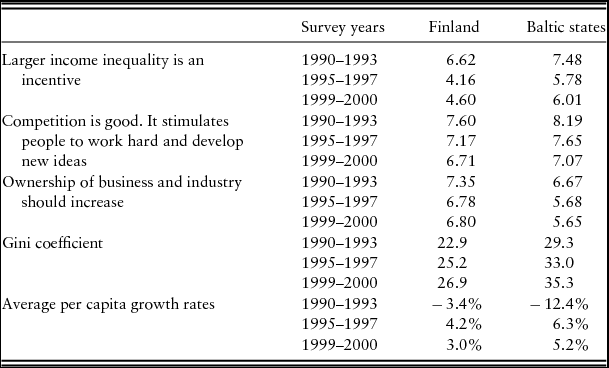
We begin by presenting some very broad data regularities. Table 1 presents the average of responses to some main questions of interest among the sample of Finnish citizens and those of the Baltic countries.Footnote 11
Opinions among respondents in Finland and in the Baltic statesFootnote a

a Averages of responses.
In the three waves used for this paper, the Baltic survey respondents are interested in larger income differences to increase incentives and more competition than the Finnish respondents. At the same time, and in line with previous studies, they opt for more government ownership. The differences in responses are significant, and had remained almost unchanged during the 1990s. During the study period, income inequality as measured by the Gini coefficient increased in all the countries, though somewhat more in the Baltic states than in Finland. The Baltic states experienced a steep growth decline in the early 1990s, followed by rapid economic growth during the third and fourth survey waves; Finnish growth changes – while exhibiting similar patterns – were somewhat less volatile.
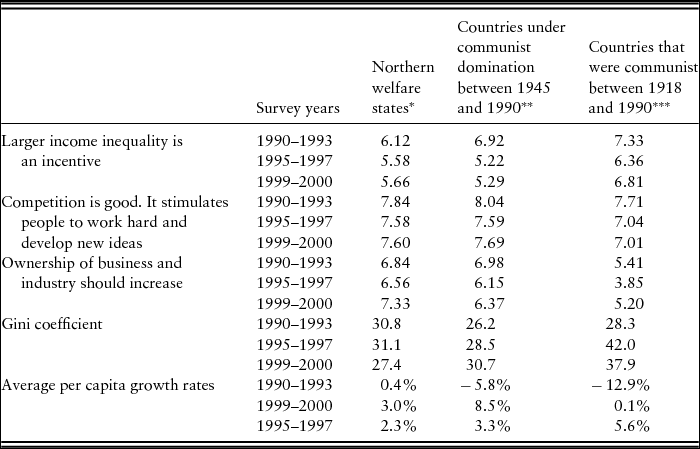
Table 2 shows the response averages from three groups of countries. One group consists of the original members of the Soviet Union that entered into federation in 1918. Another group consists of certain East European countries that came under communist domination in World War II, or, more, precisely, at the beginning of the Cold War. These countries include those that were under direct Soviet domination, such as Poland or Hungary, as well as those that were perhaps inspired by the Soviet example but pursued their own relatively independent paths, such as Yugoslavia. A third comparison group of countries includes West European democracies with well-developed welfare states (Sweden, Norway, and Denmark).Footnote 12
Opinions among respondents in former communist East European countries versus a sample of West European countries

*Includes Denmark, Norway, and Sweden;
**includes Albania, Bulgaria, parts of Czechoslovakia and Yugoslavia, East Germany, Hungary, Poland, and Romania;
***includes Belarus, Georgia, the Russian Federation, and Ukraine.
The results are quite revealing. Comparing the average responses across the three groups leads to the conclusion that the longer the exposure to communism, the more averse individuals are to equality and the more approving they are of competition. Respondents from the communist countries also view government ownership more approvingly than their Western counterparts. Thus, respondents from core areas of the Soviet Union seem to be most averse to the equality ideal propagated by the Soviet system, viewing it perhaps as an impediment to good incentives, whereas the West European welfare states are most open to it and respondents in the post-1945 communist-dominated countries take intermediate positions. These findings hold true for all three survey waves. Comparing these results with those in Table 1, we see an almost exact replication of the pattern; specifically, more time spent under a communist regime leads individuals to prefer a less equitable and more competitive regime and to be less satisfied with their own regime.
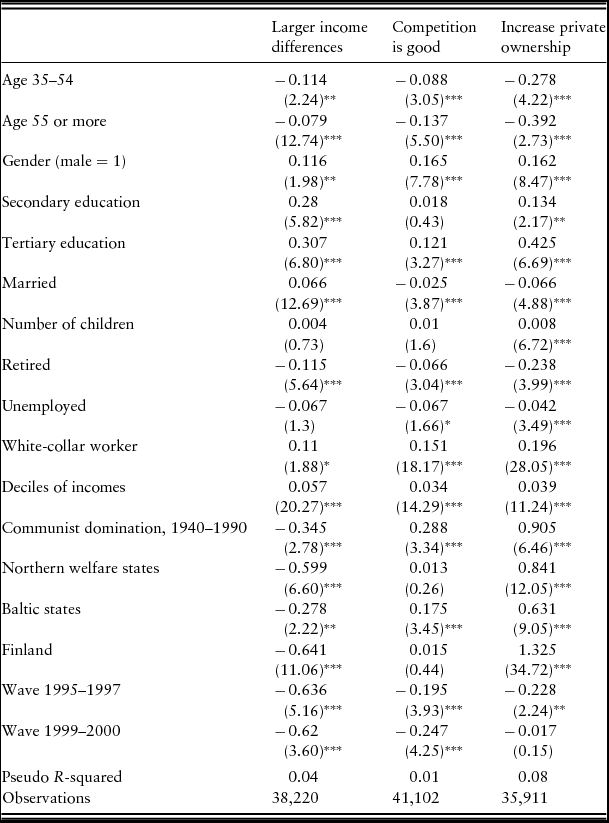
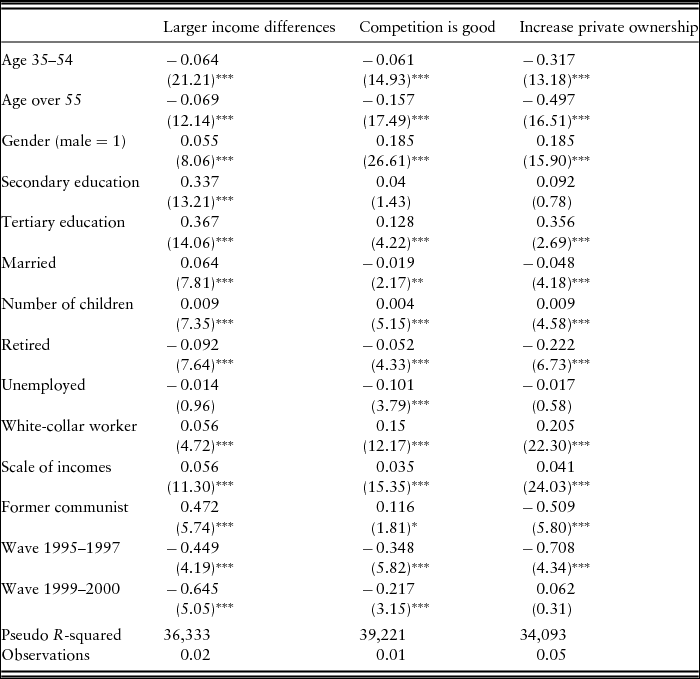
Finally, Table 3 contains an ordered probit regression with country groupings as above, with the group of 1918–90 communist countries constituting the baseline. It follows that all groups are interested in having greater equality, with Finland and the West European welfare states being the most interested, followed by the former communist countries and then the Baltic countries. With respect to competition, the countries with the longest exposure to communism favour it the most, while Finland and the West European welfare states do not tend to prefer it. Finally, when it comes to private ownership, these results are basically reversed; the Finnish and West European welfare states are the ones who have stronger preferences for it, while the Baltic states and the other former communist countries have weaker preferences. These findings are consistent with those presented in Tables 1 and 2. The results in this table also indicate that, between the second wave and the third and fourth waves, there was a secular increase in the willingness to redistribute, and in the desire for more government ownership and less competition. Furthermore – and consistent with the Meltzer–Richard (Reference Meltzer and Richard1981) paradigm – white-collar individuals with higher incomes and better education are less prone to favour redistribution, and are more open to competition, personal responsibility, and private ownership than others. Younger individuals as well as working individuals seem to exhibit similar preferences, although the statistical significance here is less clear.
Illustrative regressions for countries of interest

All are ordered probit regressions corrected for clusters; also, robust z-statistics in parentheses. Columns (1) and (3) do not include information for the northern welfare states in the last survey round. (*) Statistically significant at 10%; (**) statistically significant at 5%; (***) statistically significant at 1%.
We next proceed with a more specific and focused empirical analysis.
5. Results
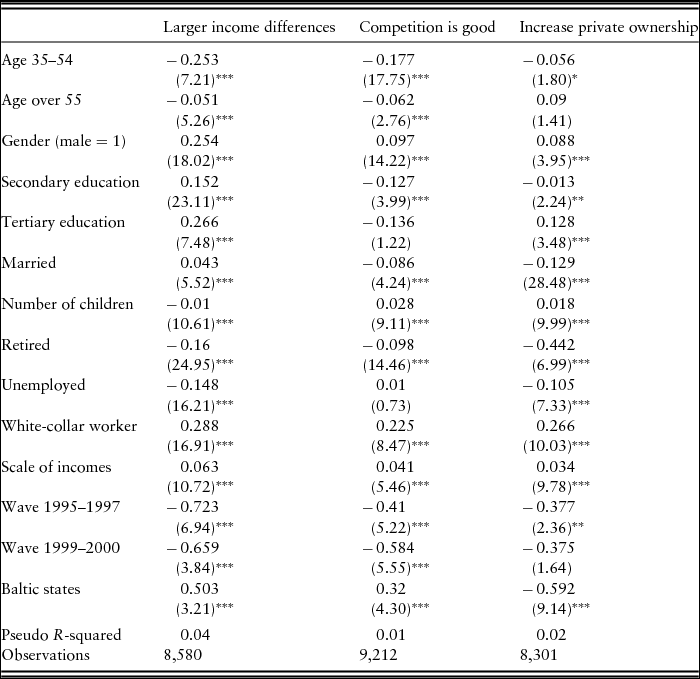
The empirical analysis focuses on comparing the Finnish and Baltic respondents’ attitudes.Footnote 13 As argued above, the period of the Soviet occupation of the latter, from 1945 to 1990, is viewed as an ‘experiment’, during the course of which the Baltic states were exposed to communist institutions and values. Our primary interest is to understand how this exposure has affected the respondents’ attitudes toward equality and redistribution, as well as toward state involvement. Here we run ordered probit regressions, using robust and clustered standard errors in order to control for possible heteroscedasticity and possible correlation within the responses of each country, respectively.
Empirical evidence
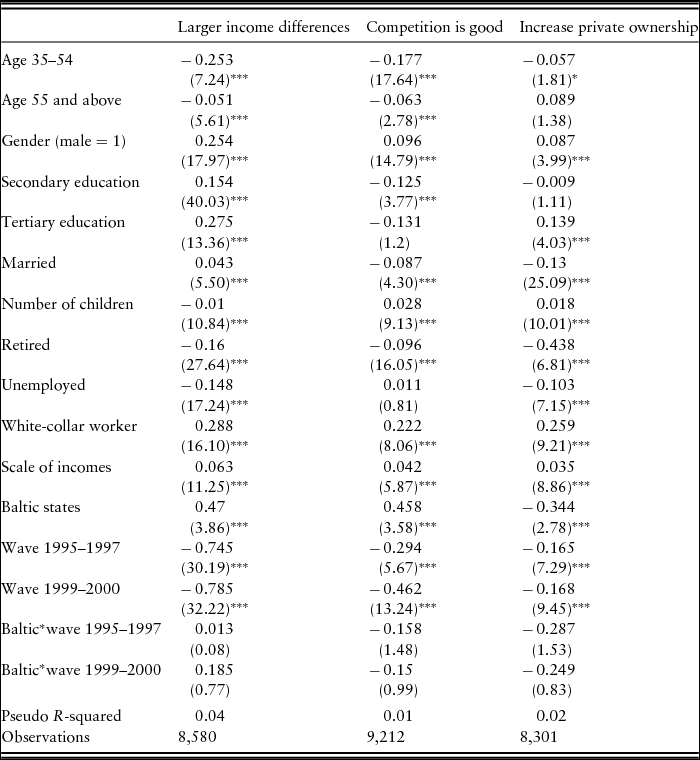
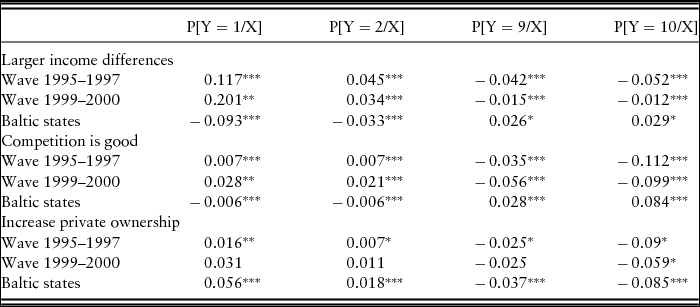
The basic regression results are presented in Table 4 and include the last three waves of the survey.Footnote 14 They show that employed, higher-income, better-educated individuals in white-collar occupations favour greater inequality, more competition, and private ownership; gender also matters, with males likewise exhibiting more pro-capitalist attitudes – i.e. more inequality, competition, and private ownership – relative to females. Also, younger individuals are more pro-capitalist than older ones – consistent with earlier findings, such as in Ravallion and Lokshin (Reference Ravallion and Lokshin2000). More importantly for our purposes, there are differences between the respondents in Finland and in the Baltic states: the dummy variable for the latter is significant, highly so when it comes to attitudes toward inequality. Generally, in the course of the 1990s, preferences for income redistribution have increased, especially when comparing the third wave with the second one.Footnote 15 Note that in regard to the issue of state ownership, we replicate earlier results from Alesina and Fuchs-Schuendeln (2005), observing that income, employment, and education level all reinforce pro-state attitudes. There also are differences between the two types of countries; respondents from the Baltic states prefer less private ownership than Finnish respondents. These results, also obtained in Alesina and Fuchs-Schuendeln (2005) are, again, highly significant.
The Baltic countries and Finland

All are ordered probit regressions corrected for clusters; also, robust z-statistics in parentheses. Data for Latvia for the 1999–2001 round are not available in columns (1) and (3). (*) Statistically significant at 10%; (**) statistically significant at 5%; (***) statistically significant at 1%.
The Baltic countries and Finland: interactive dummies

All are ordered probit regressions corrected for clusters; robust z-statistics in parentheses. Data for Latvia for the 1999–2001 round are not available in columns (1) and (3). All regressions include country clusters. (*) Statistically significant at 10%; (**) statistically significant at 5%; (***) statistically significant at 1%.
In summary, we observe that the communist legacy seems to have had an impact on the attitudes of respondents in the Baltic states in the following ways: they prefer more inequality and more competition as a means of enhancing incentives, while at the same time favouring more government ownership than their Finnish counterparts.
The effect of transition
Having data on the transition decade enables us to analyse whether the above differences in attitudes between ex-communist and West European countries narrow over time. To do so, we run regressions as above, but also include the interactive terms with survey waves.
We observe that the coefficients of the interactive terms between the Baltics and the survey waves are all insignificant. In particular, the differences in support for income inequality and competition have remained similar between these groups, with the Baltic countries showing a higher preference for both during the 1990s. Recalling that the Baltic states experienced a wave of mass privatization in the early 1990s, this finding can be interpreted as implying that mass privatization does not necessarily – at least in the span of several years – develop a sense of identification with markets by creating constituencies with stakes in them, as suggested by some important recent work (Biais and Perotti, Reference Biais and Perotti2002).
Individual versus government responsibility
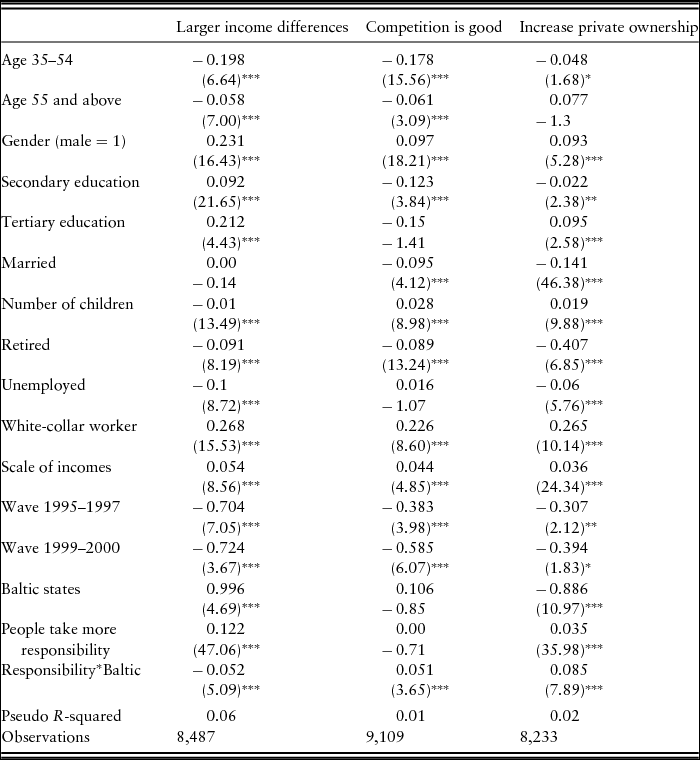
So far, the results seem to be contradictory: citizens in the Baltic states favour higher inequality to boost incentives, but also more state involvement than Finnish citizens. To highlight the contradiction, we now include in our base specification an additional variable that captures opinions on individual responsibility as opposed to government responsibility.
The results in Table 6 suggest that individual responsibility is positively linked with more inequality, and with a more market-oriented economy. In general, therefore, it appears that individuals who consider personal responsibility more favourably also like more competition, more inequality, and more private ownership. (While this holds for both groups, Finnish citizens are somewhat more pronounced in their support of more income inequality, whereas Baltic respondents are somewhat more pronounced in their support for more competition and more private ownership.)
The Baltic countries and Finland: government responsibility

All are ordered probit regressions corrected for clusters; also, robust z-statistics in parentheses. (*) Statistically significant at 10%; (**) statistically significant at 5%; (***) statistically significant at 1%.
Ex-communist countries
In this subsection we briefly test whether our main findings hold more generally by replacing the Baltic states with all ex-communist countries and by replacing Finland with the West European welfare states (see the precise definition above). This exercise provides a robustness check and also generates a much larger sample of responses, although its relative disadvantage is that the ‘experiment’ is not as clean as before. (We note, however, that the levels of inequality in the two groups of countries were similar to each other during the study period, which was the reason for focusing on West European welfare states as a comparison group.)
As in Table 7, the qualitative results almost exactly match those in Table 4. In particular, the dummy variable of ex-communist countries is positively correlated with inequality and with pro-competition attitudes (although the latter is only mildly significant); and is negatively correlated with private ownership. Thus, the pattern described above basically repeats itself: relative to individuals in West European economies, ex-communist respondents seem to favour more inequality and competition to boost incentives, while at the same time opposing private ownership.
Former communist countries versus northern welfare states

All are ordered probit regressions corrected for clusters; also, robust z-statistics in parentheses. Northern welfare states include Norway, Denmark, and Sweden. Former communist countries include Albania, Bulgaria, parts of Czechoslovakia and Yugoslavia, East Germany, Hungary, Poland, Romania, Belarus, Georgia, Russian Federation, and Ukraine. (*) Statistically significant at 10%; (**) statistically significant at 5%; (***) statistically significant at 1%.
Making sense of the results
How can one reconcile the Baltic (and, more generally, ex-communist) states’ apparent willingness to increase inequality and competition while at the same time retaining or even increasing state ownership? To provide at least some tentative answers to this question, we now focus more closely on the determinants of the latter.
Trust
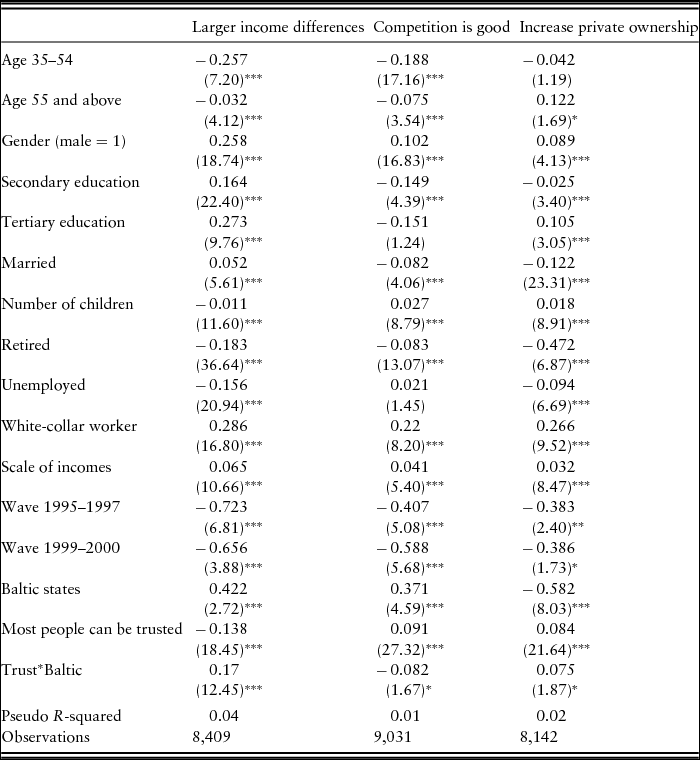
It has recently been noted that trust affects attitudes and economic behaviour in a significant way; for example, trusting individuals are more open to trade opportunities (see Guiso et al., Reference Guiso, Sapienza and Zingales2006, for a review). Along these lines, one can theorize that trusting individuals may be less suspicious of private ownership. In contrast, less trusting people may suspect potential fraud and cheating as a result of private ownership, especially in a context where regulatory ability is weak. To test this hypothesis, we employ a dummy variable obtained by the recodification of responses to a question in the WVS as follows:
 $$\begin{equation*}
\begin{array}{l}
\textrm{{Most people can be trusted: 0 = need to be very careful;}}\\
\textrm{\rm{1 = most people can be trusted}}.
\end{array}
\end{equation*}$$
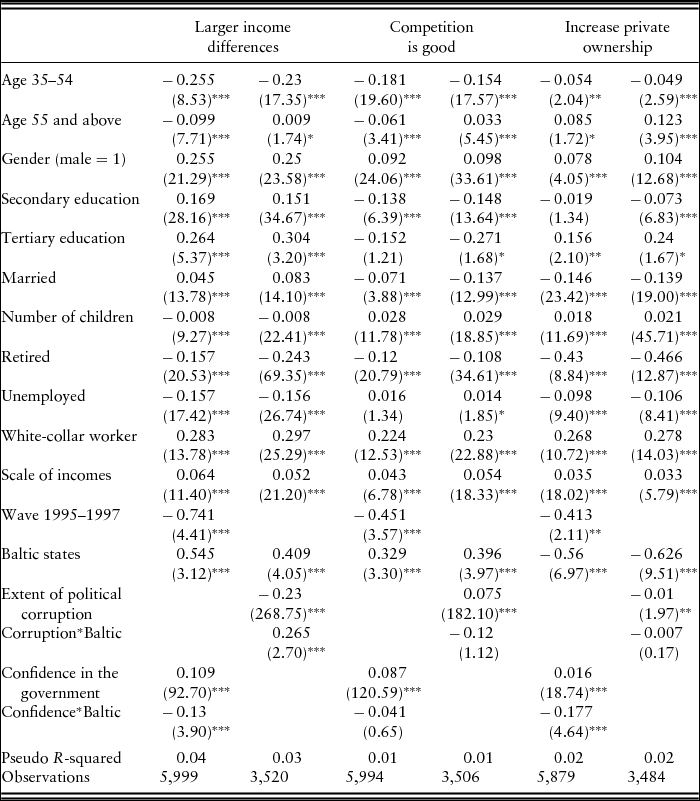
Adding this variable to the base specification, the results in Table 8 imply that, generally, trust is positively associated with supporting inequality, competition, and private ownership, which is consistent with the results in Guiso et al. (Reference Guiso, Sapienza and Zingales2006). The Baltics interaction variable is significant in explaining larger income differences, implying that trust does play a larger role in the Baltic states in this regard; but its significance is small when explaining attitudes to competition and to private ownership. It seems therefore that trust alone cannot explain the puzzle.Footnote 16
The Baltic countries and Finland: trust

All are ordered probit regressions corrected for clusters; also, robust z-statistics in parentheses. (*) Statistically significant at 10%; (**) statistically significant at 5%; (***) statistically significant at 1%.
Confidence in government
Another potentially useful suggestion comes from Di Tella and MacCulloch (Reference Di Tella and MacCulloch2009), who find that individuals in developing countries, possibly because of a lack of confidence in their governments, tend to disapprove of capitalistic institutions. Consequently, the regressions in Table 9 include new variables that capture confidence in the government and the political system as well as the perceived degree of corruption and their interactions with the Baltic countries dummy. The expected results here are that perception of government effectiveness will lead to a more favourable attitude and confidence in market economy institutions. Our findings are consistent with Di Tella and MacCulloch (Reference Di Tella and MacCulloch2009); we obtain positive signs in the corresponding coefficient linked with the confidence variable, implying that individuals with more confidence in the government are also pro-market. The signs on the Baltics interaction term indicate that the relationship between confidence in government and support for market institutions is stronger in the Baltic states. While the significance of the Baltics dummy is reduced in some specifications, it still remains quite robust.Footnote 17
The Baltic countries and Finland: political corruption and confidence in government

All are ordered probit regressions corrected for clusters; also, robust z-statistics in parentheses. Columns (1), (3), and (5) include data for the 1990–3 and the 1995–7 survey rounds only. Columns (2), (4), and (6) are only for the 1995–7 round. (*) Statistically significant at 10%; (**) statistically significant at 5%; (***) statistically significant at 1%.
6. Conclusions
Using otherwise previously similar groups of countries – Finland versus the Baltic states – this paper documents significant differences in attitudes toward redistribution and markets among citizens in capitalist countries and in ex-communist countries in transition. Further, these attitudes changed very little in the course of the transition decade, despite significant changes in the economic system such as pro-market trends. These differences, however, are seemingly inconsistent: while approving larger income differences and competition, the respondents from the Baltic states also favour more state ownership than those in Finland. Whereas the latter finding accords well with earlier work (Corneo and Gruner, Reference Corneo and Gruner2002; Alesina and Fuchs-Schuendeln, 2005), our other findings lead us to disagree with the tenor of these papers’ conclusions – that communist indoctrination and/or institutions were successful in instilling anti-capitalist attitudes in the citizens of ex-communist countries. Specifically, in regard to some important features of capitalism, the respondents from the Baltic states display definitely more pro-capitalist attitudes than those from Finland – which is, of course, consistent with the course of transition events, in particular the often sweeping market reforms. Similar results hold, more generally, for other ex-communist countries. We therefore tend to qualify the earlier works’ conclusions, arguing that imposed institutions, in this case at least, have had a limited effect on individual attitudes. We also find that trust and confidence in government are associated with pro-capitalist attitudes, as suggested by other related work, such as Guiso et al. (Reference Guiso, Sapienza and Zingales2006) and Di Tella and MacCulloch (Reference Di Tella and MacCulloch2009). Yet these factors do not fully account for the differences between the respondents in the Baltic states and Finland.
The presented pattern of attitudes being complex and puzzling, we can only hypothesize why citizens in ex-communist countries favour more competition and larger income differences while at the same time supporting state ownership.Footnote 18 Our sense is that – contrary to the previously offered theories – they in fact oppose leaving communist institutions, such as egalitarianism and central planning, in place. On the other hand, they were reluctant to completely dismantle the social protection system offered by the state. While, unfortunately, existing data do not enable us to directly test this hypothesis, such research would be indicative of the type of reforms that are likely to enjoy popular support in the course of institutional change.
In this context it is important to take into account, as Hare (Reference Hare, Davis and Charemza1989, Reference Hare2012) argues, that in the environment of a shortage economy, access to resources is more than a matter of having access to income as not everyone with the same income may be able to get access to the same goods – not, at least, at the same time. In order to reduce waiting time some may use social networking and their position in the party. There may also be resentment if it is widely known that an elite group of party members enjoy privileged access to products. Given this kind of experience of a supposedly equitable society not really being as equitable as it was made out to be, one can more readily appreciate why people in the Baltic states were keen to have more competition and income inequality. In addition, with the social safety net and elimination of unemployment, one is less at the mercy of events beyond one's control, but the problem of coping with shortages is a chronic threat to being in control of one's life. A more market-based system that still has the state provision of a safety net and can restrain the excesses of capitalism would thus be welcome as a means of achieving a greater sense of self-control and not being at the mercy of events, especially if one has the capability to do well in a more market-based system. Finally, the attitudes of people in the Baltic states may need not be seen as contradictory: it is possible to have greater use of markets and competitive pressures without privatizing production processes. Allowing citizens the freedom to become capitalists and create new enterprises could have gone hand in hand with maintaining state ownership of existing capital, with the state's market share shrinking if private enterprise were successful.Footnote 19
Description of variables

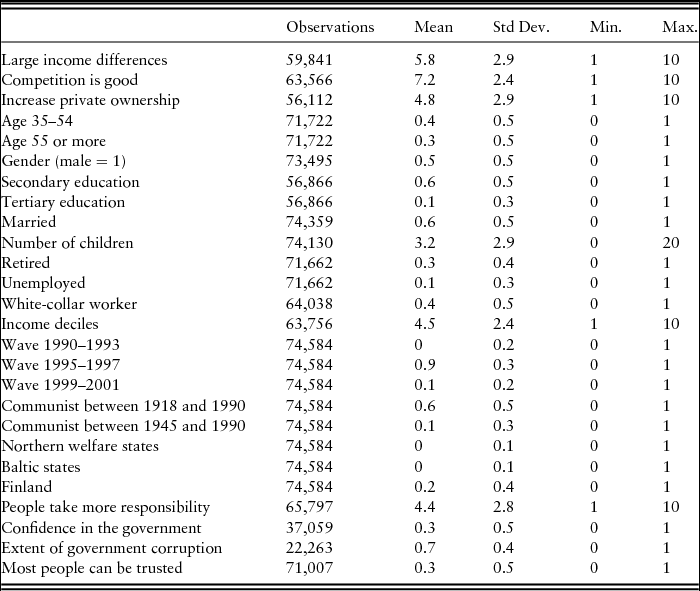
Descriptive statistics

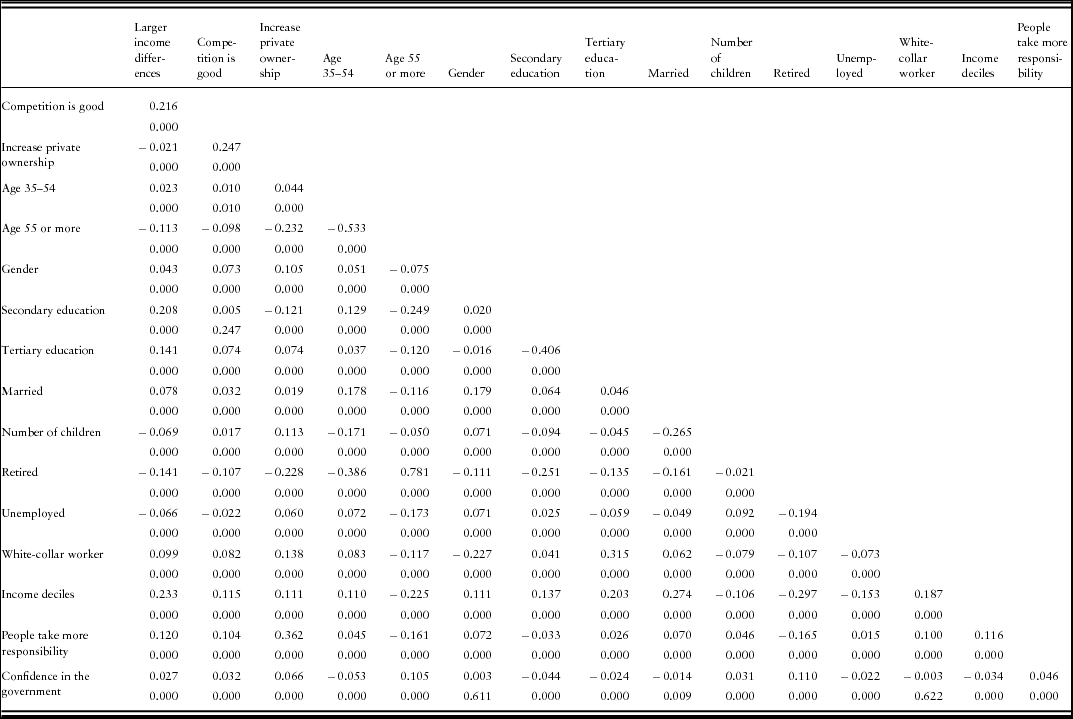
Pairwise correlation matrix

Selected marginal effects from ordered probits