INTRODUCTION
Free-floating gelatinous animals belonging to the phyla Cnidaria and Ctenophora, commonly referred to as ‘jellyfish', are important and conspicuous components of marine ecosystems. A multitude of recent human-induced stresses on marine ecosystems appear to be promoting a long-term increase in the frequency and intensity of jellyfish blooms, often to the detriment of fish populations (reviewed by Purcell et al., Reference Purcell, Uye and Lo2007; Pauly et al., Reference Pauly, Graham, Libralato, Morissette and Palomares2009; Purcell, Reference Purcell2012), although evidence supporting this view may be questionable (Condon et al., Reference Condon, Graham, Duarte, Pitt, Lucas, Haddock, Sutherland, Robinson, Dawson, Decker, Mills, Purcell, Malej, Mianzan, Uye, Gelcich and Madin2012).
Competitive interactions between jellyfish and fish have been depicted in the literature as the major source of variability of jellyfish populations: early stages of jellyfish are eaten by fish, adult jellyfish prey on fish eggs and larvae, and both fish and jellyfish compete for planktonic food (Purcell & Arai, Reference Purcell and Arai2001). Several authors have reported on the great diversity of biological interactions involving jellyfish (Mansueti, Reference Mansueti1963; Thiel, Reference Thiel1976; Purcell & Arai, Reference Purcell and Arai2001; Drazen & Robison, Reference Drazen and Robison2004; Gasca & Haddock, Reference Gasca and Haddock2004; Arai, Reference Arai2005; Raskoff & Robison, Reference Raskoff and Robison2005). However, the potential influence of these alternative interactions on population variability of jellyfish remains unknown. On the other hand, the inherent difficulty to collect gelatinous animals and study them as prey items in stomach contents has fostered the erroneous assumption that they merely reach enormous biomass, die, sink and decompose, thus functioning as ‘trophic dead ends' (Mianzan et al., Reference Mianzan, Pájaro, Alvarez Colombo and Madirolas2001). More directed collection methods are rendering stimulating information on the true diversity and importance of biological interactions involving jellyfish (Gasca & Haddock, Reference Gasca and Haddock2004).
Ecologists are increasingly recognizing that parasites have the potential to affect food web stability, species interactions strength and energy flow (Lafferty et al., Reference Lafferty, Allesina, Arim, Briggs, De Leo, Dobson, Dunne, Johnson, Kuris, Marcogliese, Martínez, Memmott, Marquet, McLaughlin, Mordecai, Pascual, Poulin and Thieltges2008) and pelagic ecosystems, cannot be an exception. However, current efforts to understand jellyfish effects on marine food webs largely ignore this crucial trophic link. As common in most cases, the main reason is that researchers tend to compile data on the easy-to-observe species in ecosystems (Lafferty et al., Reference Lafferty, Allesina, Arim, Briggs, De Leo, Dobson, Dunne, Johnson, Kuris, Marcogliese, Martínez, Memmott, Marquet, McLaughlin, Mordecai, Pascual, Poulin and Thieltges2008). Hence, there is an urgent need to go beyond the usually studied predator–prey trophic links involving jellyfish and characterize parasitic relationships, quantifying the biomass being removed by these alternative trophic relationships.
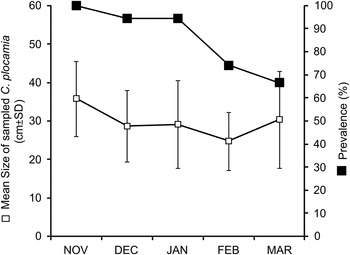
The scyphomedusa Chrysaora plocamia (Lesson, 1830) is a very large (up to 100 cm in bell diameter) and abundant (up to 2.3 medusae m−3: Zeballos et al., Reference Zeballos, Arones, Cabrera, Galindo, Lorenzo, Quiñones, Zavala, Flores and Carbajo2008) jellyfish species occurring on both sides of southern South America: the Humboldt Current Upwelling System of Peru and Chile and the western South Atlantic (Argentina) (Morandini & Marques, Reference Morandini and Marques2010). In this study, we reported and analysed a new association between this scyphomedusa and the parasitic anemone Peachia chilensis (Carlgren, 1931), which showed a high prevalence (Figure 1). According to Mills (Reference Mills1993), parasitic anemones of the genus Peachia are known to cause grazing damage to several species of hydromedusae, whose accumulative effects may lead to the demise of their host population (Mills, Reference Mills1993). In contrast, modern parasite population ecology postulates that the distribution of parasites among hosts is commonly best described by the negative binomial model, reflecting the fact that parasite distribution is highly aggregated (overdispersed) and, as a consequence, parasite-induced host mortality is also restricted to a few hosts (Bush et al., Reference Bush, Fernández, Esch and Seed2001). In fact, it is the overdispersion of parasites and hosts deaths which produces the dynamic equilibrium of host and parasite populations. Given the potential effect of overdispersion of parasites on the regulation of the host population it is important to assess the distribution pattern as the base line for more detailed studies. In this study, we: (i) evaluated the temporal changes of the mean intensity of infestation of P. chilensis and the mean biomass of parasites per host; and (ii) evaluated the fit of frequency distribution of P. chilensis among host to the negative binomial model.
Mean size (bell diameter) and standard deviation of sampled Chrysaora plocamia during its pelagic life phase (numbers indicate the monthly sample size) and monthly prevalence (percentage of infested medusa) of the parasitic anemone Peachia chilensis.

MATERIALS AND METHODS
Sampling
Sampling of C. plocamia was conducted off Mejillones Bay (23°S), northern Chile, from November 2010 to March 2011 to cover an entire pelagic (medusoid) phase of its life cycle. Samples were taken in the frame of a larger project aiming to study the population dynamics of this scyphomedusa. In this context, a monthly sample ranging from 6 to 27 individuals (total N = 83) were collected to perform this study. Individuals were selected from the available size-range in the population to cover roughly the same size-range each month, thus avoiding the influence of different size-ranges on the infestation patterns through time. The large variability in sample size (Figure 1) reflected the strong changes in the availability of this species throughout its pelagic life phase (low at the start and the end, high at the middle). Individuals were sampled during SCUBA diving immersions using individual plastic bags to avoid losing associated fauna.
On-board, the bell diameters of these medusae were measured with a metric tape (± 0.5 cm precision) and gastric pouches were excised, opened, and rinsed through a 100 µm mesh sieve. Gut contents, gonads and oral arms were preserved in 5% borate-buffered formalin in seawater. In the laboratory, the preserved tissues and gut content were sorted for the presence of P. chilensis. From monthly samples we determined the ‘intensity of infestation', defined as the number of larvae, of P. chilensis in each infested medusa and calculated the ‘mean intensity of infestation' (MI) as the monthly average intensity among infested medusae (following Bush et al., Reference Bush, Lafferty, Lotz and Shostak1997). We estimated the mean biomass (MB) being removed monthly by the parasite from the host, using the ash-free dry mass (AFDM) as a measure of the biomass of P. chilensis per medusa. For this, all the larvae of P. chilensis found in each medusa were oven-dried at 65°C to constant weight (DM). AFDM was obtained by ignition of dried samples at 550°C for 6 hours (AFDM = DM – ash content).
Statistical analyses
To evaluate the effect of time on MI or MB of P. chilensis, we applied one-way analyses of covariance (ANCOVAs) using the JMP 7.0.1 software package (SAS Institute Inc.). The analyses treated time (months) as a fixed effect, bell diameter of the medusa as the covariate and used the full interaction (separate slopes) model approach. Therefore, the interaction between the covariate and the main effect were included as an additional effect within the models. Prior to the analysis, the Shapiro–Wilk test and the Bartlett's test were used to assess normality and homoscedastity of variances, respectively, to meet ANCOVA assumptions. Accordingly, MI and MB of P. chilensis were log-transformed (Y = log X + 1). The Tukey's honestly significant difference test was used for post-hoc comparisons of least squared means between months.
Count data, i.e. the distribution of numbers of P. chilensis among sampled medusa were fitted to the negative binomial distribution model using the software XLStat (Addinsoft SARL). Data were modelled using the maximum likelihood fitting procedure and a Chi-squared test (α = 0.05) was used to test the hypothesis that parasite distribution among the host follows a negative binomial model.
RESULTS
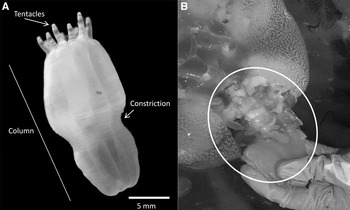
Polyps found in the medusa corresponded to the juvenile stage of the anemone Peachia chilensis (family Haloclavidae) (Figure 2A), which varied between 0.1 mm and 22 mm approximately in column length. Polyps were mainly found in gonad tissue of the host, attached with nematocysts, and to a lesser extent within gastric pouches. Smaller polyps are also located among oral arms of the medusa. The translucent, flesh-coloured column may be short, almost spherical, or elongated and often show circular constrictions. The polyp has 12 greyish-brown tentacles around the disc, which may contract when disturbed. In some medusa, P. chilensis was so abundant that they completely castrate the gonad of the host (Figure 2B). This was detected in December, when mean intensity was higher (see below), however parasitic castration occurs as a continuous process and determining a level at which the host is ‘castrated' is unrealistic. In this context, we could say that in December about 15% of the sampled animals showed some degree of parasitic castration.
(A) Main morphological features of the parasitic anemone Peachia chilensis; (B) dorsal view of a Chrysaora plocamia specimen. A gastric pouch (circle) was excised to show the numerous parasitic P. chilensis castrating the gonad tissue.

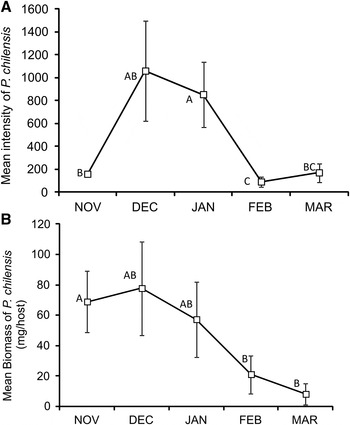
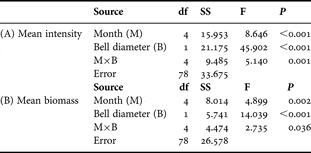
The MI of P. chilensis rapidly increased from November, peaked in December and decreased to the end of the pelagic stage of the host (Figure 3A). It showed significant differences among months (ANCOVA: F4,73 = 8.646; P < 0.001; Table 1). The bell diameter of the medusa was significant as a covariant for the MI of P. chilensis (F1,73 = 45.902; P < 0.001) and the interaction between month and bell diameter was also significant (F4,73 = 5.140; P = 0.001).
Monthly variability of (A) mean intensity of the infestation of Peachia chilensis on the scyphozoan Chrysaora plocamia; (B) mean biomass of P. chilensis per host. Months not sharing the same letter are significantly different after post-hoc comparisons (Tukey's honestly significant difference test, P < 0.05).

Results of the analyses of covariance testing the effect of time on (A) the mean intensity of infestation of Peachia chilensis on Chrysaora plocamia and (B) the mean biomass of all the individuals of P. chilensis infesting C. plocamia.

The MB of P. chilensis per host was high in November–December 2010 and steeply decreased thereafter (Figure 3B). This parameter showed significant differences among months (ANCOVA: F4,65 = 4.899; P = 0.002; Table 1). The bell diameter of the medusa was significant as a covariant for the MB of P. chilensis (F1,65 = 14.039; P < 0.001) and the interaction between month and bell diameter was also significant (F4,65 = 2.735; P = 0.036).
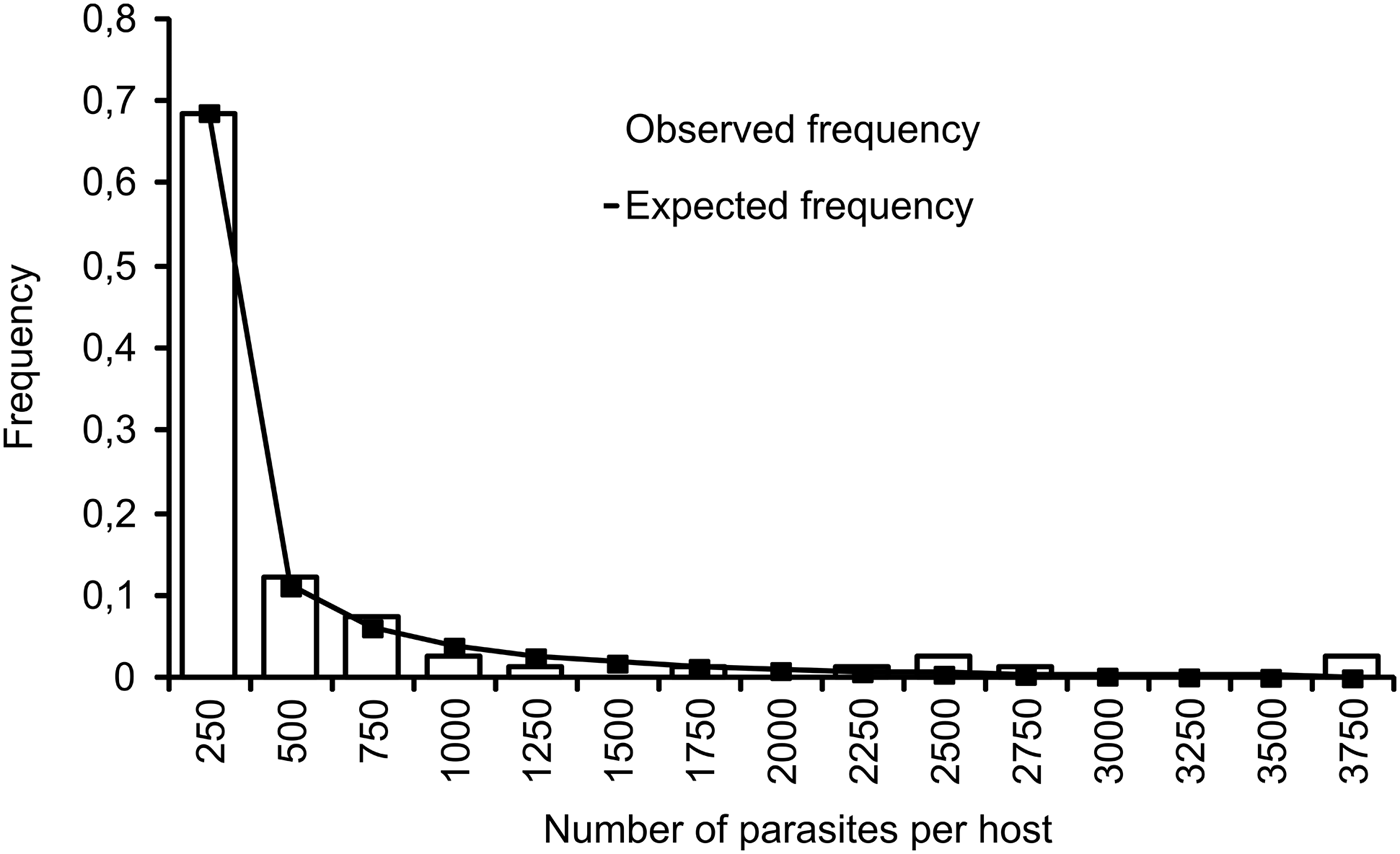
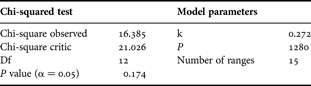
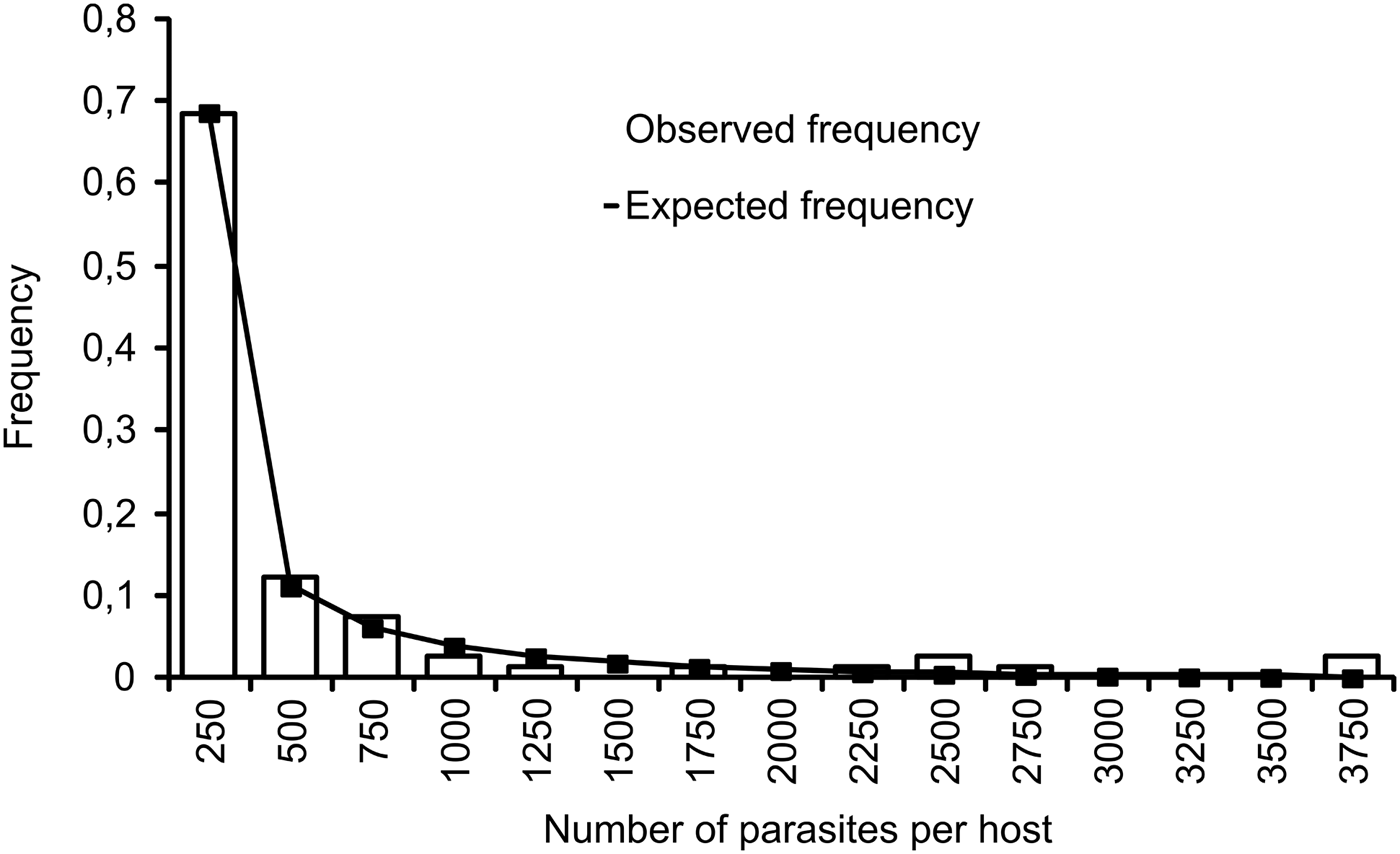
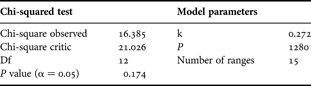
Figure 4 shows the frequency distribution of the parasites among the sampled medusa (N = 83). The distribution of parasites was highly aggregated, with most of the hosts harbouring a few or no parasites, whereas a few hosts harboured more than 3500 parasites. The distribution was well fitted to the negative binomial distribution model (χ 2 = 16.385; P = 0.174; Table 2).
Frequency distribution of the number of Peachia chilensis on the host Chrysaora plocamia (bars). Expected frequencies according to the negative binomial model (dotted line).
Results of the Chi-squared test to assess the fit of the frequency distribution of Peachia chilensis among Chrysaora plocamia to the negative binomial distribution model and estimations of the model parameters. N = 83.
DISCUSSION
Although medusophilous larval actinians have been described since the early 20th Century (e.g. McMurich, Reference McMurich1913; Badham, Reference Badham1917), systematic, quantitative assessments of prevalence and intensity of these parasites are rare. The prevalence of infestation (i.e. the percentage of medusae harbouring larval actinians) in our study was high, fluctuating from 100% in November to 66.6% in March. Spaulding (Reference Spaulding1972) reported prevalence ranging between 5% and exceptionally 62.5% for Peachia quinquecapitata parasitizing the hydrozoan Clytia gregaria, and occasional infestations for other medusoid hosts. Although the comparability is limited, the MI of the infestation (465 parasites per host) could be also considered high in comparison with that of the anemone Edwardsia lineata parasitizing the ctenophore Mnemipsis leidy (average = 7) or that of hyperiid amphipods parasitizing the scyphozoan Chrysaora hysoscella (maximum = 43) (Bumann & Puls, Reference Bumann and Puls1996; Buecher et al., Reference Buecher, Sparks, Brierly, Boyer and Gibbons2001). However, these large differences likely reflect: (i) the fact that commonly used standard plankton sampling devices are not suitable to study jellyfish-associated fauna (Gasca & Haddock, Reference Gasca and Haddock2004); and (ii) that the relative sizes of the hosts to parasites are radically different.
In contrast to the MI that showed a unimodal pattern, the MB showed a logistic-like pattern (Figure 3). This implies that at the onset of the pelagic life phase, C. plocamia was first infested by few but large larvae of P. chilensis (i.e. low intensity but high biomass). In December, a new cohort of larvae seemingly recruited to the host, thus explaining the strong increase of MI but a small increase in MB. Apparently, most of the larvae left the medusa between February and March, with only a few larvae infesting the host until the end of the pelagic life phase. Unfortunately, nothing is known about the adult benthic stage of this anemone in order to relate reproductive pulses to recruitment pulses of larvae to their host.
Scientists have long recognized the diversity of predators, parasites and commensals of jellyfish. However, descriptive information of these types of interactions is usually reported without an estimation of the fluxes involved and its importance. As stated before, the limitations of collection and preservation methods for these soft-bodied organisms led to the old paradigm that they are trophic dead ends in marine ecosystems (Mianzan et al., Reference Mianzan, Pájaro, Alvarez Colombo and Madirolas2001). Here we have estimated the trophic flow associated with a parasitic interaction involving a large and abundant scyphozoan predator inhabiting the Humboldt Current Upwelling System. This estimation adds evidence against that old notion and represents a link between the pelagic and benthic environments. On the other hand the consequences of parasitic castration observed at the highest intensity of P. chilensis should be further studied as it may have considerable influence upon the population dynamics of the host and life history of the parasite as proposed by Baudoin (Reference Baudoin1975) and Lafferty (Reference Lafferty1993) for other host–parasite systems.
A significant interaction between time (main effect on MI and MB) and bell diameter (the covariate) was found in this study (Table 1). This means that the host size is correlated with MI and MB of the parasite only sometimes (certain months). We hypothesize that this may reflect the fact that only when parasite loads are high, space or other resource within the host may impose limits for further increases in parasite load.
Typically, the distribution of macroparasites over their host population is highly aggregated and empirically best described by the negative binomial distribution (e.g. Wilson & Grenfell, Reference Wilson and Grenfell1997; Bush et al. Reference Bush, Fernández, Esch and Seed2001) as found in our case. This means that while the parasite affects the per capita survival or fecundity (e.g. parasitic castration) and hence it has a regulatory effect, it is highly restricted to a few hosts. Therefore, unless the distribution of parasites among hosts display significant changes, the demise of a host population must be analysed as the result of several contributory factors including predation, environmental factors, food availability and organismal senescence, among others.
ACKNOWLEDGEMENTS
We thank M. Vergara, R. Saavedra and J. Fajardo for their help during field samplings and laboratory work. This work was financed by the National Fund for Scientific & Technological Development (FONDECYT) grant No. 11100256. A.S. Pacheco was supported by a FONDECYT grant No. 3100085.