

Introduction
The Mangalarga Marchador (MM) horse is the most important Brazilian horse breed, and its natural gait is marcha, rather than trot. The marcha is a comfortable four-beat lateral and diagonal gait with moments of triple support and no suspension. The MM horse has been used for a specific functional trial, called the marcha test. This test was characterized as an equestrian submaximal intensity competitionReference Prates, Rezende, Lana, Borges, Moss, Moura and Rezenda1 of approximately 50 min with no rest and an average speed of 3.3 m s− 1. It is a standard evaluation procedure for most of the official breed championships. The training and nutritional management carried out in Brazilian farms are still quite empirical. It is necessary to investigate procedures that have currently been used for marcha tests to propose protocols for animal training. Moreover, the proportion of different types of muscle fibres in the MM horses has not been defined.
RalstonReference Ralston2 contraindicated soluble carbohydrate supplies to horses with less than 4 h before the prolonged exercise. The resulting hyperinsulinaemia may negatively interfere with lipid mobilization and lead to fatigueReference Jose-Cunilleras and Hinchcliff3. However, a Cr-enriched diet of MM horses submitted to the marcha test may facilitate the use of alternative energy sources and thereby reduce carbohydrate oxidation. As part of the chromodulin, Cr may potentiate the effects of insulin (INS)Reference Pechova and Pavlata4. Therefore, the purpose of this study was to measure the effect of three different intervals between concentrate feeding and the beginning of the marcha test and Cr feed supplementation on biochemical and clinical responses in MM horses during and after exercise.
Materials and methods
Horses
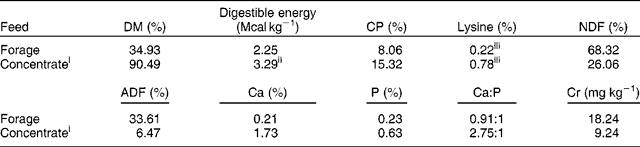
The experiment was carried out at Haras Catuni (latitude, 16°41′161″S; longitude, 43°31′210″W; altitude, 784 m), Montes Claros, Minas Gerais, Brazil, from January to February 2008. A total of 12 healthy MM mares, offspring of two stallions (mean ± SD), 4.25 ± 0.62 years old, 339.40 ± 23.10 kg body weight (BWT) and with body condition scoringReference Carrol and Huntington5 (CS) 2–3 (range 1–5), were used. Prior to the experiment the animals had received no training related to the marcha test. They were kept in an 8.3 ha paddock, continuously grazing Coast cross (Cynodon dactylon × Cynodon nlemfluensis) with water and mineral supplements ad libitum. In addition, concentrate (1.25% BWT day− 1) was offered subsequent to moderate work6 at 06.00 and 18.00 hours (Table 1). BWT and CS were measured weekly. All mares were treated at the beginning of the pre-experimental phase for internal and external parasites with 2% ivermectin (Altec; Tortuga Cia. Zootécnica Agrária, São Paulo, Brazil) and deltamethrin (Butox® P CE 25; Intervet/Shering-Plough Brasil, Brazil), respectively. The Ethics Committee in Animal Experimentation (CETEA/UFMG) approved the experimental protocol.
Nutritional composition of feed ingredients on a DM basis
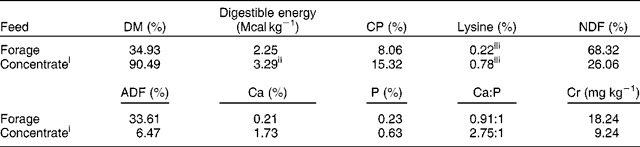
i Corn (61%), soyabean meal (19%), wheat bran (15%), limestone (3%), dicalcium phosphate (1%) and mineral salt without Cr (1%) (Coequi Plus; Tortuga Cia. Zootécnica Agrária) (basic composition per kg: Na, 120 g; Ca, 185 g; P, 60 g; K, 20 g).
ii In addition to the 0.368 Mcal provided by 50 ml of soyabean oil added to the concentrate daily.
iii From Valadares FilhoReference Valadares Filho32. DM – dry matter; CP – crude protein; NDF – neutral detergent fibre; ADF – acid detergent fibre; Ca – calcium; P – phosphorus; Cr – chromium.
Experimental design
Each of the 12 mares was assigned to one of two groups: Cr (10 mg chelated trivalent Cr capsules; Tortuga Cia. Zootécnica Agrária) and CON (no supplemental Cr), in a completely randomized design, with a split-plot arrangement. The capsules were orally administered daily, at 18.00 hours just before concentrate feeding. The distribution of the animals within the two experimental groups was based on the following criteria: each group included two mares, daughters of the same sire, of similar age, BWT, body CS, mean heart rate for marcha (HRM) and HR recovery index (Δ%). Each pair was assigned for CON or Cr supplementation. Within each group, two mares were randomly assigned to feed concentrate (0.63 kg 100 kg− 1 BWT) 0.5, 2 or 4 h before the marcha test. HRM and Δ% were observed after a period of 13 min in a continuous session divided into the following: 4 min walking, 4 min marching, 2 min walking and 3 min standing at rest, the latter two being the recovery period. Δ% was calculated as {[(HRM − HRR5)/HRM] × 100}, where HRR5 is the HR at the end of the recovery period. The first 29 days (pre-experimental phase) were used for diet, Cr and exercise adaptation, and the last 15 days were the experimental phase. During the experimental phase, the animals were submitted to three 50 min field marcha tests once a week, in the 1st, 8th and 15th days of this phase, according to the XXVI Mangalarga Marchador National Exhibition regulations7.
The adaptation of the animals to simulate the marcha competitionReference Prates, Rezende, Lana, Borges, Moss, Moura and Rezenda1, Reference Meirelles8 was carried out on an oval track (0% slope; approximately 20 m × 50 m). During the experimental phase, the ridden animals were submitted to a 5 min walk for warm-up (average speed 1.6 m s− 1), followed by a 50 min cadenced marcha (25 min in each direction and average speed 3.33 m s− 1). The marcha tests were performed at 10.00 and 16.00 hours each day, with six animals in each period. In each period, there was a mare from each treatment group (Cr by concentrate feeding). Thus, two mares were used for each concentrate feeding schedule, one supplemented with Cr and the other with placebo.
The mares remained in the paddock without any athletic activity 1 day before and 1 day after the marcha test. In the remaining days of this phase, they were trained every other day, as in the protocol adapted in the pre-experimental phase.
Diet analyses
Feed samples were collected (forage being hand-pluckedReference Gardner9) to determine the chemical composition: dry matter (DM), crude protein (CP), gross energy (GE), Ca, P, Cr (measured by atomic absorption spectroscopy10), neutral detergent fibre (NDF) and acid detergent fibreReference Van Soest, Robetson and Lewis11 (ADF). Faeces were analysed for DM and GE concentrations10.
Environmental analyses
The room temperature (T), relative air humidity (RH) (thermo hygrometer MT-242; Minipa Indústria e Comércio, São Paulo, Brazil), temperature–humidity index (THI) and wet bulb globe temperature (WBGT) indexReference Hahn and Yousef12 were measured during the days and periods of the marcha tests. A value of THI or WBGT ≤ 70 indicated a normal condition, not stressful; values between 71 and 78 indicated a critical condition; values between 79 and 83 indicated a danger condition; and values >83 indicated an emergency condition.
Clinical and biochemical analyses
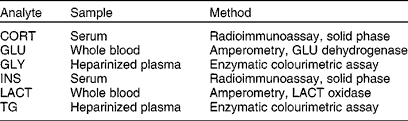
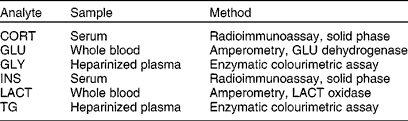
Polar RS400SD heart rate monitors (Polar Electro Oy, Kempele, Finland) were used to assess HR immediately before the test (BT), during the test, soon after the test (AT), and 5, 10, 15, 20 and 25 min after. Respiratory rate (RR), rectal temperature (RT) and blood INS (BET Laboratories Endocrinologia Veterinária, Rio de Janeiro, Brazil), cortisol (CORT; BET Laboratories), glucose (GLU; Accutrend GCT, Roche Diagnostics, Mannheim, Germany) and lactate (LACT; Accutrend Lactate, Roche Diagnostics), and plasma glycerol (GLY; Bioclin Quibasa Química Básica, Minas Gerais, Brazil), and triacylglycerol (TG; triglicérides líquido estável kit, K055, Bioclin Quibasa Química Básica) levels were measured BT, AT and 25 min AT (Table 2). In addition, the INS:GLU ratio was calculated. The blood samples were collected via the jugular vein in vacuum tubes using no anticoagulant or heparin. After the analyses of blood GLU and LACT, samples were maintained in a cooler with ice and centrifuged on the same day at 3000 rpm for 20 min. The supernatants were frozen at − 80°C with liquid nitrogen until processing.
Methods used to determine concentrations of the analytes investigated in this study
Statistics
The effects of treatments were analysed by ANOVA and the means compared by F-test using SAEG version 9.1 software (Universidade Federal de Viçosa, Minas Gerais, Brazil). Data subsets were created to analyse the effect of the treatments on each marcha test day. Post hoc comparisons were made, where appropriate, using the Fisher least significant difference test for RR and the Newman–Keuls test for the other variables. Significance was accepted when P < 0.05. A Lilliefors test for normality was conducted. Logarithmic transformations to approach normality were applied to RR and INS:GLU variables. A regression adjustment model was used to assess the effect of time on HR. Correlations between the biochemical and clinical variables were calculated using Pearson's correlation analysis.
Results
Environmental parameters
The WBGT index was (mean ± SD) 76.62 ± 3.56 during the marcha tests (critical conditionReference Hahn and Yousef12). T (°C), RH (%) and THI were high at the time of the tests: 30.32 ± 2.70°C, 47.83 ± 10.30% and 75.79 ± 2.74 (critical conditionReference Hahn and Yousef12), respectively.
Biochemical parameters
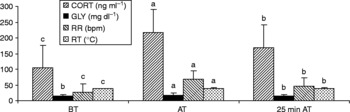
Considering all three marcha tests, there was no effect of Cr by the time of concentrate feeding prior to exercise (FEEDING) and the moment of evaluation (MOMENT; BT, AT or 25 min AT) on the biochemical variables analysed (P>0.05). However, for the three marcha tests, the effects of MOMENT on CORT, GLY (Fig. 1) and LACT were significant (P < 0.01). Blood LACT levels of AT (2.09 mmol l− 1) and 25 min AT (2.29 mmol l− 1) were similar; however, these values were higher (P < 0.01) than BT (1.84 mmol l− 1); coefficient of variance (CV) 24.63%. Nevertheless, there was no effect of either Cr or FEEDING on the variables GLU and TG (P>0.05).
Blood CORT and plasma GLY levels (P < 0.01), RR and RT (P < 0.0001) of MM mares BT, AT and 25 min AT. Mean ± SD CV, 34.67% (CORT); 55.56% (GLY); 10.72% (RR); 1.56% (RT). bpm, breaths per min a, b, c: Means followed by different letters vary by the Newman–Keuls test (CORT, GLY and RT) or Fisher's least significant difference test (RR).

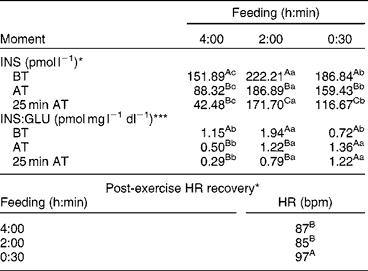
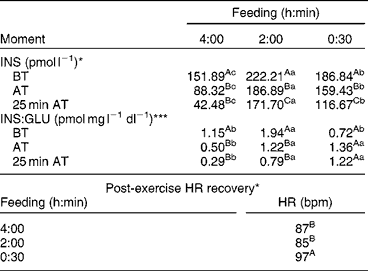
Table 3 presents a concentrate feeding strategy by MOMENT interaction effects on INS (P < 0.05) and INS:GLU (P < 0.001). The 4 h group showed the least severe insulinaemia BT, AT and 25 min AT. In this group, INS was lower AT and 25 min AT than BT. Interestingly, INS was higher when the concentrate was fed 2 h rather than 0.5 h prior to exercise BT, AT and 25 min AT. In both FEEDING groups, INS was higher BT, followed by AT, reducing further 25 min AT. Also, concentrate feeding < 2 h before the marcha test increased INS:GLU AT and 25 min AT. INS:GLU for the 0.5 h group remained high during the three time points of analysis.
Blood INS levels, INS:GLU ratio and post-exercise HR recovery of MM mares fed at different times before the marcha testsi
* P < (0.05).
*** P < (0.001).
i Only the results that were statistically different are shown in the table. Feeding, time of concentrate feeding prior to exercise. Means in rows followed by different lower case letters and in columns by different upper case letters differ by the Newman–Keuls test. CV, 64.79; 35.37 and 30.26%, respectively.
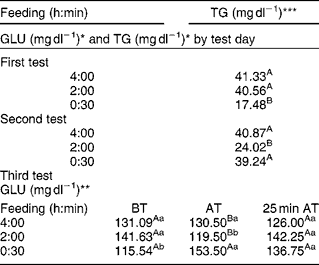
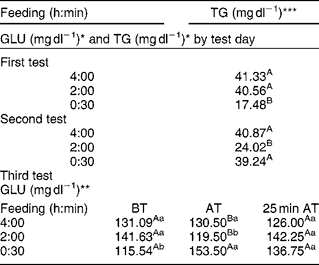
In the first test, the 0.5 h group showed the lowest TG (P < 0.001; Table 4). In contrast, the 2 h group showed the lowest TG on the second test (P < 0.05; Table 4).
Plasma TG and blood GLU levels of MM mares from three different marcha testsi
* P < (0.05).
** P < (0.01).
*** P < (0.001).
i Only the results that were statistically different are shown in the table. Feeding, time of concentrate feeding prior to exercise. Means in rows followed by different lower case letters and in columns by different upper case letters differ by the Newman–Keuls test. CV, 32.71; 49.83 and 17.80%, respectively.
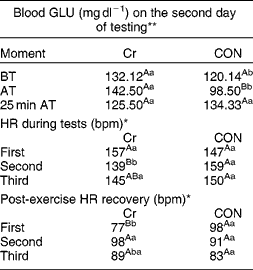
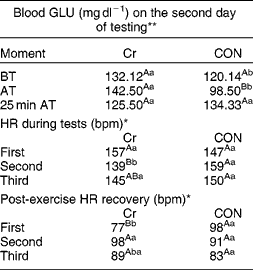
There was a Cr by MOMENT effect interaction on GLU in the second test (P < 0.01; Table 5). Surprisingly, Cr increased glycaemia BT and AT and maintained almost constant GLU at these moments. In contrast, the CON group showed a decline in GLU at the end of the exercise.
Cr effects on glycaemia and HR of MM mares during each marcha test and subsequent post-exercise recoveryi
* P < (0.05).
** P < (0.01).
i Only the results that were statistically different are shown in the table. Means in rows followed by different lower case letters and in columns by different upper case letters differ by the Newman–Keuls test. CV, 29.68; 29.75 and 38.36%, respectively.
In the third test, there was a FEEDING by MOMENT effect interaction on GLU (P < 0.01; Table 4). The group that consumed concentrate 4 h prior to the test showed GLU levels that were almost constant over the three moments of analysis. The 2 h group ended the test with lower GLU that returned to a value close to pre-exercise values by 25 min AT. The 0.5 h group began the exercise with reduced GLU in relation to the two moments AT. During the test, the 0.5 h group showed a higher GLU than the other groups.
Finally, there was a weak negative correlation between INS and CORT after exercise (r = − 0.42; P < 0.02), and the level of INS showed a weak positive correlation with GLU only 25 min AT (r = 0.44; P < 0.01).
Heart rate
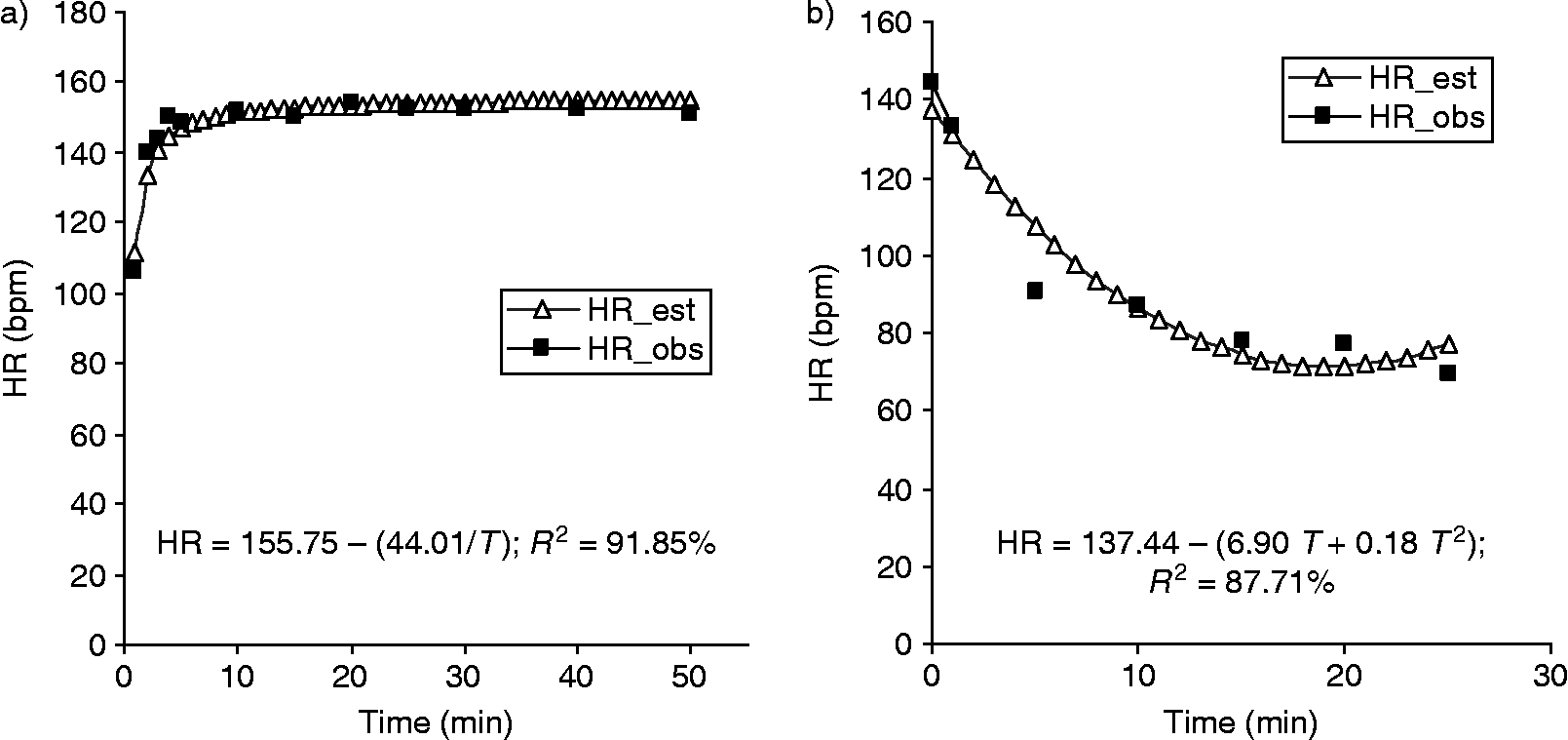
The main results of the HR analysis are shown in Figs 2a and 2b and Tables 3 and 5. The result of the HRM test was 145 ± 32 beats min− 1 (bpm). According to the regression prediction model (Fig. 2a), the peak HR (HRpeak) of the marcha test was 153 bpm at 17 min (P < 0.0001). HR reached stability after 2 min, remaining almost constant until the end of the activity period.
(a) HR of Cr and CON experimental groups during the 50 min of all three marcha tests (P < 0.0001). (b) HR during the 25 min of all three post-exercise recoveries (P < 0.01). HR_obs – observed HR; HR_est – estimated HR. T – time (min)
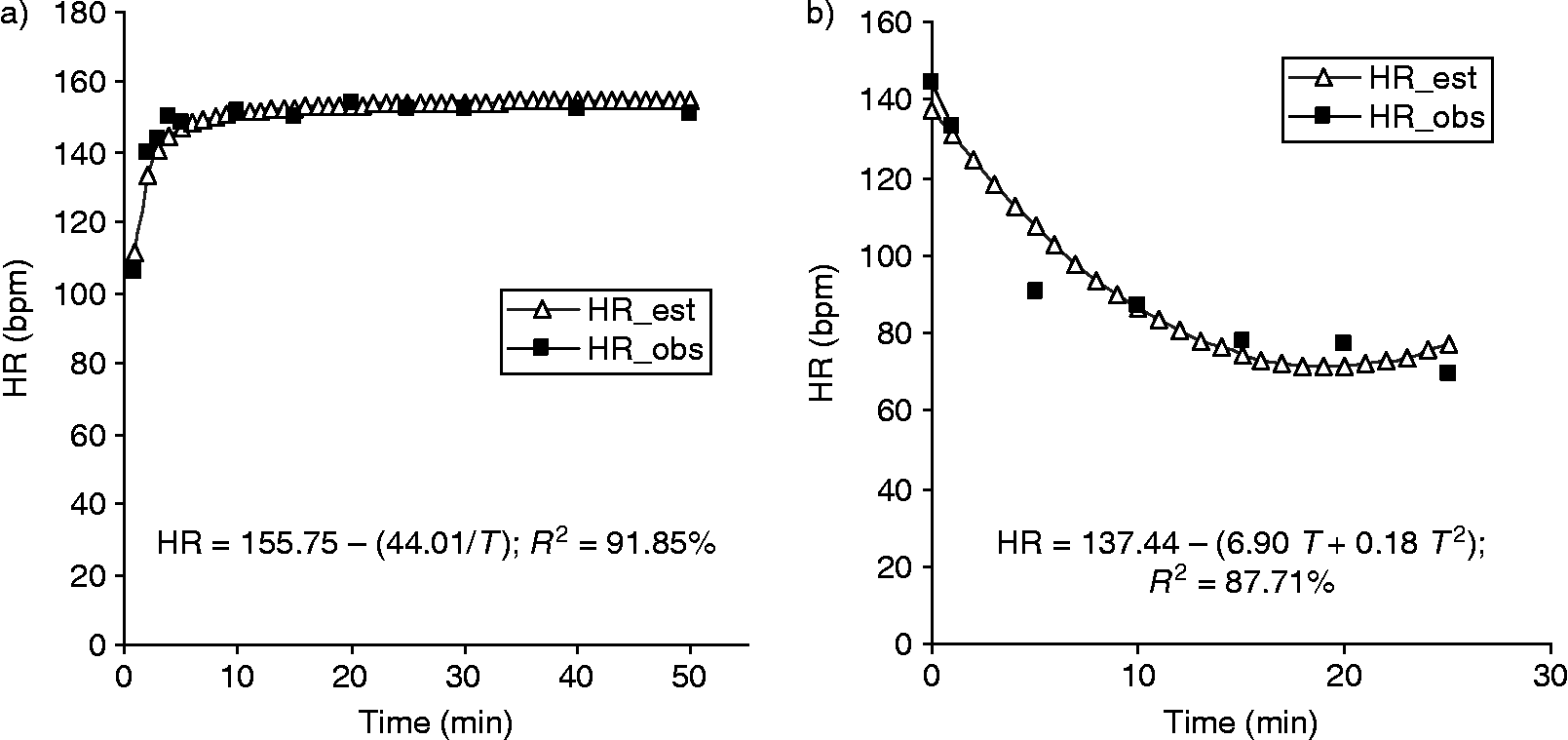
In accordance with the regression prediction model of post-exercise HR recovery (Fig. 2b), there was a rapid reduction in HR over the first 2 min, with 50% reduction in the HRpeak 25 min after exercise (P < 0.01). However, recovery values were higher (52 ± 10 bpm), even at the end of post-exercise recovery (77 bpm).
There was no Cr by FEEDING by MOMENT effect interaction on HR (test and post-exercise recovery; P>0.05). Also, there was no effect of the test day (TEST) on these variables (P>0.05). However, there was an interaction of Cr by TEST effect on HR of test and post-exercise recovery values (P < 0.05; Table 5). Cr was responsible for the lowest HR in the second test and the lowest post-exercise HR recovery in the first test. In addition, the 0.5 h group showed the highest level of post-exercise HR recovery (P < 0.05; Table 3).
Respiratory rate and rectal temperature
There was no effect of Cr or FEEDING on RR and RT (P>0.05). Also, there was no effect of TEST on these variables (P>0.05). However, Fig. 1 presents higher values of RR and RT AT, followed by 25 min AT (P < 0.0001). There was a strong positive correlation between RR and RT (r = 0.80; P < 0.0001).
Discussion
The HRpeak for the marcha test was lower than the maximum HR (HRmax)Reference Evans, Hodgson and Rose13 (220–260 bpm). When associated with the HRpeak value, the stability of the HR values was used to characterize this exercise as submaximal intensity (as in the study by Prates et al. Reference Prates, Rezende, Lana, Borges, Moss, Moura and Rezenda1). In addition, it may be deduced that the marcha test is essentially aerobic, as the HR remained close to 150 bpm and blood LACT remained close to 2 mmol l− 1 during exerciseReference Castejón, Riber, Santisteban, Tovar, Trigo and Agüera14.
From the HRM, the average VO2 of animals was estimated at 66.4 ml kg− 1 min− 1 Reference Eaton, Evans, Hodgson and Rose15. This value allowed us to estimate the mean energy expenditure during the test, assuming that each horse metabolizes approximately 4.86 kcal for each litre of oxygen utilized6. Additionally, from the HRpeak of marcha and considering the HRmax as 220 bpmReference Evans, Hodgson and Rose13, the oxygen utilization reached 55.3% of maximum VO2 (VO2max)Reference Eaton, Evans, Hodgson and Rose16. This value suggests that the marcha test is a moderate-intensity exercise (range 35–55% VO2max).
Dietary Cr supplementation has attracted attention because this micromineral improved both the performance of exercising horsesReference Prates, Rezende, Lana, Borges, Moss, Moura and Rezenda1, Reference Pagan, Rotmensen and Jackson17 and GLU tolerance in humansReference Anderson18, Reference Cefalu and Hu19, horsesReference Ott and Kivipelto20 and other farm animalsReference Bunting, Fernandez, Thompson and Southern21, Reference Amoikon, Fernandez, Southern, Thompson, Ward and Olcott22. It was therefore hypothesized that, in this study, Cr would reduce the interval between the marcha test and pre-exercise carbohydrate feeding (according to RalstonReference Ralston2, 4 h). However, Cr did not interact with FEEDING and did not prevent the adverse effects of this nutritional management.
Unexpectedly, Cr was responsible for increased glycaemia before and after the second test. A possible explanation could be a blood GLU-sparing effect, mediated by increased reliance on fat substrate stores, based on evidence of its lipolytic effectReference Kreider23. Another possibility is that Cr stimulated hepatic glycogenolysis and gluconeogenesis.
In this study, 10 mg of Cr did not reduce the RR or RT at the end of the exercise (in contrast to the results published by PratesReference Prates24). However, Cr reduced HR during the test and accelerated the speed of decline in HR recovery, improving cardiac performance (as in the study by Prates et al. Reference Prates, Rezende, Lana, Borges, Moss, Moura and Rezenda1). Furthermore, Cr made the marcha more energy efficient, because there is a strong relationship between HR and oxygen utilization at submaximal exercise intensitiesReference Eaton, Evans, Hodgson and Rose15.
Horses fed grain and subjected to prolonged aerobic exercise may have a higher degree of Cr deficiency due to increased excretion in the urine, especially in situations of high stressReference Clarkson25, Reference Jackson26. Therefore, the favourable effect of Cr on the marcha test can be explained partially by the intense thermal discomfort and high thermoregulatory demand suffered during the exercise.
Cr did not interfere with INS, CORT, lipolysis (which would be evidenced by higher GLY and TG) or LACT. These results are different from those published by Pagan et al. Reference Pagan, Rotmensen and Jackson17, in which exercising horses supplemented with 5 mg Cr yeast had higher plasma TG levels after a standardized exercise test (SET) and lower plasma CORT before and at the beginning of the exercise. There was still a trend towards a decrease in plasma INS (P < 0.10) 1 h after grain feeding and a trend towards a decrease in plasma LACT (P = 0.08) in the final stages of the SET.
In competition, MM horses perform various tests for about 50 min and are provided with short periods of rest between, often under intense heat and high RH. As the animals progress through the various competition stages, they may be allowed to compete for two to three consecutive days. Thus, a rapid recovery provides obvious advantages in marcha competitions. Based on the results of this study, Cr supplementation in the diet of MM horses submitted to the marcha test may be considered an effective nutritional ergogenic aid. However, Cr is neither a panacea nor a drug; rather, it is a nutrient. The complexity of neuroendocrine regulation during exercise (inherent in the type of exercise and food status involved) and the different methodological and environmental conditions could explain the variation in results recorded in the literature.
It is possible that the intravenous administration of GLU before exercise increases the time to fatigue during moderate-intensity exerciseReference Farris, Hinchcliff, McKeever and Lamb27. However, in long-duration and low-intensity exercise (>3 h) such as endurance racing, the concentrate intake may increase the level of insulinaemia during exercise. This would decrease the degree of fat utilization with a concomitant increase in carbohydrate oxidation during exercise and acceleration of fatigueReference Jose-Cunilleras and Hinchcliff3. The marcha test is a moderate-intensity exercise, and it has intermediate duration between explosion exercises (e.g. Thoroughbred racing) and endurance. Thus, its duration is not extensive enough for hypoglycaemia to occur, and a marked increase in lactataemia occurs even if concentrated meals are offered less than 2 h before exercise. Additionally, regular exercise may improve glycaemic CONReference Rose and Richter28 and prevent hypoglycaemia caused by concentrate feeding.
Contrary to expectations, animals in the 0.5 h group did not show an increase in INS as high as that observed in the 2 h group. When the mares were fed concentrate 30 min BT, there was probably insufficient time for digestion of the ingested concentrate, resulting in the recorded blood INS levels. According to FrapeReference Frape and Frape29, ingesta remain in the stomach for 15 min on average, and their passage through the small intestine occurs 30–90 min after food intake. Another explanation for this is that there is reduced blood flow to the splanchnic vascular bed during exerciseReference Manohar30, which may impair the digestion and absorption of nutrients.
The 4 h group experienced minimal fluctuations in GLU on the third test, which may reflect improved homeostatic regulation on GLU in this approach to nutritional management. In addition, the lower INS and INS:GLU recorded in this group are in agreement with RalstonReference Ralston2, who maintained that concentrate should be offered at least 4 h before the long-duration exercise to avoid hyperinsulinaemia. On the other hand, the slower return of HR recovery to resting values in the 0.5 h group is an indication of a clinical abnormality such as severe dehydration, and is associated with fatigueReference Evans, Hodgson and Rose13. Therefore, it is likely that this group experienced haemodynamic changes related to the displacement of fluid into the gastrointestinal tract associated with excessive sweating (subjectively analysed) during the marcha test.
As the concentrate supply 0.5 or 2 h before the marcha test increased INS and INS:GLU and had a negative influence on lipid mobilization, we recommend that researchers should not provide a concentrated meal within 2 h before the test. The marcha test can reach 2 h of duration in extraordinary conditions, and so higher blood INS levels during the exercise may lead to early fatigue.
Finally, CORT is considered a stress hormone and a factor for immunosuppression. It has an antagonistic effect on INSReference Hyyppä31, and a characteristic response was noted in this experiment (shown by the negative correlation between INS and CORT at the end of the test). CORT levels are increased to avoid the deleterious effects of hypoglycaemia, which can occur during an exercise of prolonged duration.
In conclusion, this study showed that dietary Cr did not reduce the appropriate interval between concentrate feeding and the marcha test in MM mares. Cr supplementation during training may improve cardiac performance during the test, and MM mares should be fed more than 2 h BT. The HR values characterized the marcha test as a predominantly aerobic and moderate-intensity submaximal exercise.
Acknowledgements
We thank the FAPEMIG, CAPES, CNPq, Escola de Veterinária da UFMG, Pró-Reitoria de Pesquisa da UFMG and Tortuga Cia. Zootécnica Agrária for funding this project. We would also like to thank Mr João Carlos Moreira's family for providing animals and logistics. In addition, we are grateful to Neimar Severo (ABS PecPlan), BET Laboratories, ABCCMangalarga Marchador and Leonardo de Freitas (Bioclin Quibasa Química Básica) for their support. Dr Ângela Lana and Dr Danusa Soares contributed invaluable advice with respect to the experimental design.