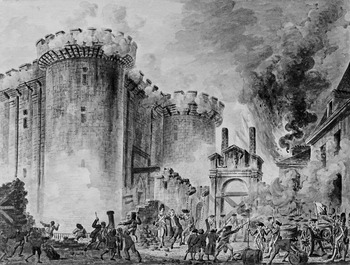
When Cherubini's comédie héroïque Lodoïska received its premiere at the Théâtre Feydeau on 18 July 1791, it reportedly overwhelmed audiences with its visual and musical effects.Footnote 1 Claude-François Fillette-Loraux's libretto presented violent revolt as the means to achieve harmony, equality and justice in a cataclysmic tableau of destruction at the climax of the opera. In so doing it reinforced and justified (even enacted) the ideology of the initial phase of the French Revolution as it was still unfolding.Footnote 2 The denouement presents the devastation by fire of the castle in which Lodoïska and her lover Count Floreski have been (separately) imprisoned by the tyrannical Baron de Dourlinski, and their rescue by Titzikan and his army of Tartars to an accompanying symphonie guerrière. This visual echo of the storming of the Bastille, the defining moment of the French Revolution, acquired added significance from the fact that its anniversary had been celebrated just four days before the premiere – and it was being re-enacted throughout France (Fig. 1).Footnote 3 Lodoïska herself can be understood in this context as an early embodiment of Marianne, an allegory of Liberty who came to stand for the triumph of the republic, inspiring the fight for freedom.
Jean-Pierre-Louis-Laurent Hoüel, Prise de la Bastille, Watercolour, 1789, Bibliothèque nationale de France

The nineteenth-century critic François-Joseph Fétis was to look back on Lodoïska as ‘creating a revolution in French music’, with a new ‘musique d'effet’ to match.Footnote 4 Indeed, Cherubini has been viewed as exemplifying a stylistic break with the previous generation of opéra comique composers, and melding the traditions of Gluck and Paisiello.Footnote 5 His representation of emotions as dynamic phenomena was part of the new aesthetic of musical effects being articulated in the mid-1780s by Bernard Germain de Lacépède and Michel Paul Guy de Chabanon.Footnote 6 And his scores embraced male choruses, military rhythms and an expanded orchestra, each typical of the open-air pageants with which he was to be involved in the mid-1790s, and which subsequently cemented his ‘revolutionary’ reputation. Such musical advances were not welcomed by all: Cherubini's ‘noisy’ orchestral and harmonic effects mirrored the chaos and violence in the political arena too closely for some, who preferred a simple, clear musical style that foregrounded melody.Footnote 7 As François-Joseph Gossec declared resonantly: ‘[M]elody, melody! That is the refrain of sensible men and the sane part of the public. Harmonic detours, barbaric transitions, exaggerated chromaticism, that is the truck of fools and fanatics’.Footnote 8 These musical innovations were matched by similarly ambitious advances in stagecraft, and visual effects created by an impressive team of technicians, designers and artists that stirred strong emotions in audiences.Footnote 9
The idea of being ‘overwhelmed’ by musical and visual effects is a recurrent theme in the critical reception of Cherubini's three operas for the Feydeau in the 1790s, each of which features a catastrophic denouement. The word ‘sublime’ was often employed, and in a variety of ways. On leaving Lodoïska, one critic was barely able to speak after the ‘enthusiasm’ excited by the music's ‘sublime beauties’.Footnote 10 Another contrasted Cherubini's ‘broad, daring and sublime touch’ with the lack of passion and dramatic colour in Rodolphe Kreutzer's opera on the same theme at the Salle Favart;Footnote 11 a third suggested that Cherubini's score was comparable to ‘the most sublime imaginings of the greatest masters’.Footnote 12 In Eliza, ou le voyage aux glaciers du Mont St Bernard (1794), attention turned from Cherubini's orchestral writing to the awe-inspiring spectacle of an avalanche engulfing the entire stage, declared by at least one critic to be ‘faithful to the greatest phenomena of nature’.Footnote 13 Finally, in Médée (1797), it was the talents of the actress Mme Scio that were repeatedly praised in extravagant terms. At the climax of the opera, Medea murders her children and leaps into the flames that are consuming the palace: ‘this sublime actress earned the admiration of the whole audience’, ‘a sublime enchantress’, ‘sublime talents’.Footnote 14 In other words, by 1797 the sublime – or the equivalence of art with the power and grandeur of nature – had come to be understood in such reviews as residing not only in the music or the visual effects, but in the performance of the singer, who appropriated the authority of the spectacle, incarnating its splendour.
The progression that can be traced in the critical reception – from representation to embodiment – echoes the observations of scientists documenting the effects of nature in the 1780s. David McCallam has examined the writings of Sir William Hamilton and Simon Linguet on volcanoes, concluding that their reports on the eruption of Vesuvius in 1779 demonstrate a shift from lyrical descriptions to heroic tales of the scientist in the field, pitting himself against the might of the volcano.Footnote 15 This ordering of the external chaos of nature produces a transfer of sublimity from the natural spectacle to the explorer, beholder and explicator that has much in common with other descriptions of awe-inspiring landscapes, such as the Alpine writings of Horace-Bénédict de Saussure, who ‘conquered’ Mont Blanc in 1787.Footnote 16 McCallam sees this shift in perspective as on one hand mirroring the philosophical evolution in conceptualising the sublime during the second half of the eighteenth century (by Burke (1757) and Kant (1790)), and on the other as a metaphor for the seeking out, confronting and appropriating of political power undertaken by the revolutionary generation.Footnote 17
This article will build on these observations, and demonstrate how in the cataclysmic tableau of Lodoïska, not only was a sublime scene of destruction represented through powerful musical and visual effects, but the audience was also encouraged to experience it as a sublime spectacle. First, I will survey the representation and appropriation of natural catastrophes at the end of the eighteenth century, and the theoretical and scientific writings about the sublime that were circulating in Paris during the early 1790s, in relation to the revolutionary experience. I will then analyse the musical and visual rhetoric of the tableau in this context, and explore contemporary models and theoretical frameworks for its effect on the audience. Finally, the concept of papillotage, adapted from art historical writing, will help us gauge the degree to which such operatic spectacle went beyond mere imitation, and accessed the emotions (fear, exhilaration, bravery) and moral questions associated with shared experiences and memories of revolutionary events. I conclude that the climactic tableau of Lodoïska can be understood as part of an evolving French discourse of the sublime rooted in revolutionary experience.
Revolutionary Sublime
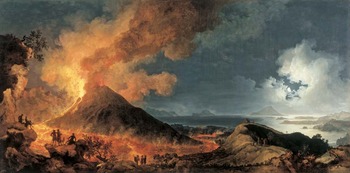
There had been a growing fascination in France during the eighteenth century with natural catastrophes – floods, storms, earthquakes, fires, avalanches, erupting volcanoes – as objects of scientific interest and as aesthetic spectacles in their own right. Some viewed them simply as examples of nature's destructive force, while others understood them as part of a divine cosmological plan.Footnote 18 Painters strove to capture something of the sublime quality – the overwhelming power, majesty and boundlessness – of such disasters. Their works often incorporated details gleaned (directly or indirectly) from scientific observation and a philosophy of nature that envisaged man in the face of events that overtook or exceeded him.Footnote 19 Pierre-Jacques Volaire's An Eruption of Vesuvius by Moonlight, (1774; Fig. 2), for example, sets a dramatic image of the volcano and other elemental forces against the reactions of onlookers uncomfortably close to the destruction.Footnote 20
(colour online) Pierre-Jacques Volaire: An Eruption of Vesuvius by Moonlight, 1774, Oil on canvas

Such natural catastrophes were also viewed more analogically by the philosophes, as metaphors for tyrannical rule and intolerance, and the volcano was a particularly resonant image. In 1768, for example, the journalist, advocate and pamphleteer Simon Linguet drew parallels between the devastations caused by volcanic eruptions and colonial conquest; and in 1770, the philosopher Jean-Baptiste-Claude Delisle de Sales described religious fanaticism as the ‘burning torrent that pours from the mouth of a volcano’.Footnote 21 By 1790, an erupting volcano was frequently identified with the unstoppable force of revolution – a liberating or threatening power, depending on one's political outlook. André Chénier's poem Le Jeu de Paume (1791) portrays the people of 1789 overwhelming the enemies of freedom thus:
[You laugh: but the imprisoned fires are erupting from the volcano. […] The people have awoken. The people are sovereign. All is vanquished.]Footnote 22
Forty years later, on the eve of another revolution, the image was still current: the eruption of Vesuvius at the conclusion of Daniel Auber's La Muette de Portici (Opéra, 29 February 1828) suggested divine punishment following a failed popular revolt.
The rapid development of geological science and the emergence of volcanology as a professional discipline during the late eighteenth century provided added support for this understanding of the relationship between man and nature at a time of revolutionary transformation in Europe and America. Just as volcanoes were no longer seen as isolated phenomena, but as expressions of the hidden forces that lay beneath the surface of the Earth, so revolution was increasingly seen as expressing the fundamental energies of political society, ready to burst out with unpredictable and transforming power. Similarly purgative qualities were recognised in lightning storms and earthquakes, and natural phenomena thus became important means of representing the transformative human experience of revolution.
A number of modern scholars have explored this understanding of the French Revolution as a sublime phenomenon. Mary Ashburn Miller traces the relationship between the language of natural history and political rhetoric through the revolutionary decade: during the early years a volcano tended to symbolise potential for unbridled force and destruction, but subsequently it became a positive symbol of patriotic passion and republican virtue.Footnote 23 David McCallam takes a more wide-ranging approach, demonstrating the importance of the volcano as a trope for the sublime in a variety of overlapping revolutionary discourses: writings on the figure of the political orator, the theatre of the Terror, and the novel.Footnote 24 Marie-Hélène Huet turns away from nature as metaphor to a more abstract idea of the sublime: she explores the crisis in political and semantic representation of the Terror through the writings of two leaders, Robespierre and Saint-Just. The word ‘sublime’ appears repeatedly in their speeches as the pure idea to which one must aspire.Footnote 25 For Robespierre, the ‘sublime’ project of the revolution was rooted morally in the Cult of the Supreme Being – a religion that would transcend all representation.Footnote 26 Huet suggests, however, that during the Terror (the period of violence that marked the most radical phase of the revolution, from September 1793 to July 1794), heightened passions led to a philosophical and linguistic collapse that prompted scrutiny of representation in all its forms.Footnote 27 Crucially, the impossibility of representing the political will of the people (one person could not represent the diverse and conflicting individual desires of everyone) led to a questioning of the limits of the political process itself. Robespierre's goal was ultimately flawed, as the political structure it relied on (by virtue of the representative principle of government) could only betray its sublime principles.
McCallam and Huet both take as their starting points the theories of Edmund Burke and particularly Immanuel Kant (although, as discussed below, the latter was not widely known in France in the 1790s). They suggest that there were points of connection between the philosophical and ideological concerns of Burke and Kant, and French political, literary and theatrical discourses that were engaging directly with the overwhelming and terrifying experience of revolutionary events as a source of pleasure and guarantee of moral purpose.Footnote 28 Burke's interest in the aesthetic contemplation of the destructive power of nature was set out in the Philosophical Enquiry into the Origin of our Ideas of the Sublime and the Beautiful (1757). The sublime represents the empirical production of strong emotion that transcends its object sensually. Kant divided the sublime into categories of terrifying, noble and splendid in his 1764 Beobachtungen über das Gefühl des Schönen und Erhabenen [Observations on the Feeling of the Beautiful and the Sublime], and in the Kritik der Urteilskraft [Critique of Judgment/Critique of the Power of Judgment] (1790), he explains how the sublime is to be found not in external objects, but in ourselves. The mathematical sublime results when we are confronted with something that is so large that it overwhelms imagination's capacity to comprehend it (his examples are mountains and the sea); the dynamical sublime, experienced when we are confronted with events beyond our power to control, triggers a recognition that our moral awareness transcends anything we can experience (the examples here include volcanoes and storms).Footnote 29 The sublime is therefore both an intensely subjective experience and the product of a shared moral culture, suggesting a universal validity of the pleasure: it is the feeling that arises when we become aware of the transcendental dimensions of experience.
Burke and Kant each applied their conceptions of the sublime to the French Revolution in ways that intersected with discourses in the political arena in Paris: Burke in 1790 in his Reflections on the Revolution in France, and Kant much more briefly in 1798 in Der Streit der Fakultäten [The Conflict of Faculties]. Both philosophers emphasised the distance and safety required in order to perceive the terrible as sublime rather than merely terrifying. For Burke, the revolution was an event of sublime theatricality in itself: the minds of those who gazed upon it were suspended by astonishment; distance from events allowed them to perceive the revolution as ‘sublime’.Footnote 30 But the crowd – which can be sublime to an observer – can all too readily obliterate this safe distance and swallow up even the most objective spectator, dissolving his or her voice in its common cry and common resolution.Footnote 31 For Kant, it was not the events themselves, but the manner in which the mind apprehended them that was sublime – specifically the wishful participation bordering on ‘enthusiasm’ of the spectators, the combined result of idea, affect and imagination.Footnote 32 He regarded such wishful participation as a potential danger, because it ran the risk of conflating the empirical and the transcendental. Nevertheless, the subjective thrill of the sublime was evidence of the unrepresentable idea of moral progress. In other words, revolution is an idea, and so cannot be represented as a whole, but the event can become a sign for the unrepresentable idea of history and human progress. In this way, ideas of freedom and progress are raised above the level of experience.Footnote 33
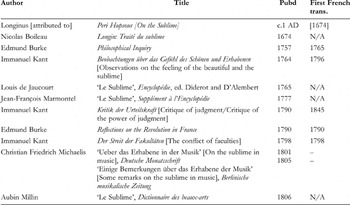
Although there are clear resonances with the ideas of Burke and Kant in French political writing and cultural practice, as I suggest below, their works had very little impact during the revolutionary decade. Burke's writings were translated into French and were reasonably well known by the 1790s, but Kant's theories did not have any significant influence until well into the next century (Table 1).Footnote 34 Instead, an earlier, classical conception of the sublime, derived from Boileau's 1674 ‘translation’ of Longinus's ancient treatise, dominated French writing and promulgated a simpler notion of the grand, the noble, and a sense of the divine.Footnote 35 After Boileau's death in 1711, the term had begun to be used in more varied ways, evoking powerful psychological realism as well as a more emotional pre-romanticism.Footnote 36 And Denis Diderot's Salon de 1767 broke with earlier aesthetic and poetic preoccupations more completely: ‘everything that surprises the mind, everything that imprints a feeling of terror leads to the sublime…. Darkness adds to terror…. Clarity is good for convincing, it is worthless when moving [the passions]. Clarity, in whatever manner one experiences it, harms enthusiasm’.Footnote 37 Whereas the classical sublime promoted an ideal of clarity, the romantic sublime delighted in terror and obscurity. Nevertheless, Diderot's was a lone voice in the 1760s, and the principal source for Louis de Jaucourt's article ‘Le Sublime’ for the Encyclopédie (vol. XV, 1765) remained Charles-Hugues Lefevre de Saint-Marc's five-volume edition of the complete works of Boileau (1747), and the classical conception of the sublime continued to underpin critical discussion and further publications such as Jean-François Marmontel's ‘Le Sublime’ for the Supplément à l'Encyclopédie (vol. IV, 1777).Footnote 38
Selective list of writings on the sublime*

* Excerpts from some of these writings are quoted (in English translation) in Peter le Huray and James Day, Music and Aesthetics in the Eighteenth and Early Nineteenth Centuries (Cambridge, 1981). Jaucourt and Millin also wrote about volcanoes; Jaucourt was responsible for the entry on Vesuvius for the Encyclopédie.
While theoretical writing may have remained classical in outlook, there were profound developments in literature and its reception. Ossian's poetry, for example, was reported in the Année littéraire (1776) as producing the same effect on the reader as ‘this immense amphitheatre of the Alps, which offers simultaneous glimpses of the durable and majestic beauties of Nature and the disorder of a chaos barely unravelled’.Footnote 39 And delight in the terrifying, awe-inspiring destructive power of nature, shadowed by awareness of its moral charge, was in evidence in journalistic writing. From the earthquakes in Lisbon (1755) and Messina (1783), to great fires such as that at the Hotel-Dieu in Paris (1772), to the eruptions of Vesuvius (including particularly severe ones in the 1760s and 70s), the Laki rift volcano in Iceland (1783) and Etna (1787), cataclysmic disasters were increasingly sensationalized, to elicit a strong emotional response from the reader: horror, awe, fear. But the reader was also encouraged to feel compassion for the victims and admiration for heroic rescue figures in the unfolding drama – and be reassured by the restoration of order through aid or charity.Footnote 40 It has been suggested that such reports about natural disasters in the press helped to stimulate the development of new forms of visual spectacle on the stage at this time, in which ‘catastrophe becomes more of a feeling than … an object of reflection’.Footnote 41
Revolutionary Opera
Spectacle had always been essential to tragédie lyrique, with music and visual effects working together to evoke the fantastical.Footnote 42 But in the 1790s the merveilleux – a fusion of décor, lighting and machine effects – previously reserved for divine interventions and other manifestations of the supernatural in mythological tales, was humanised in an array of operas. In contrast to the arrival of the deus ex machina in classical theatre, the catastrophic tableau in these works served to intensify the implications of human deeds, by foregrounding fear and bravery in the face of overwhelming forces, much in the manner of journalistic accounts of the period. Méhul's Cora (Opéra, 15 February 1791) demonstrates how a scene of destruction in a mythical tale was brought specifically into the service of revolutionary sentiment: an earthquake and an erupting volcano provide cover for the Spaniard Alonzo to rescue the Inca virgin Cora, whose fate is to marry the sun god. This violation of ancestral laws exposes Cora and her family to mortal punishment, but Alonzo's pleading (supported by the people) in the wake of his action is answered by a thunderbolt that is interpreted favourably, and a happy ending and moral victory are secured.Footnote 43 Natural destruction appears here as a metaphor for both political/social renewal and heightened emotions, and serves to magnify the bravery and inspirational leadership of Alonzo in the face of tyrannical rule.Footnote 44 The dramatic effect of the work is discharged in the extended moment of musico-visual spectacle as Cora is rescued.
The vogue for dramas featuring resistance to tyrants and the daring rescue of innocent victims from scenes of spectacular disaster was of course related to the events of the 1789, and such works often featured blazing buildings and explosions rather than natural catastrophes, in scenarios that more closely recalled real events. A number of scholars have analysed the nature of the relationship between theatre and politics during the revolutionary decade. Paul Friedland has perceived a conceptual merging – or métissage – for example, whereby participants in the system of political representation became passive observers of ‘the new realistic, representative spectacle’ in the theatre.Footnote 45 Marie-Hélène Huet has suggested that observers could not help but see events of 1789 as a powerful, if mixed, theatrical genre – a farce, a tragedy or a spectacle.Footnote 46 While for Michael McClellan, the revolutionary leaders ‘self-consciously perceived themselves as actors in a national drama’.Footnote 47 Conversely, drama itself was politicised in profound ways. Susan Maslan has posited theatre as a form of publicity, a battleground between the people of Paris and the government.Footnote 48 And melodrama – which emerged as a genre during the 1790s – came to be identified with a search for meaning in new, uncertain times, re-enacting the trauma of revolution, and capturing its symbolic redemption with Manichean stories of good triumphing over evil.Footnote 49 Revolutionary events had a profound impact on the development of French opera too. Anselm Gerhard has observed how ‘[t]he terrifying upheavals following the French Revolution had sensitized people to the perception of “unprecedented shocks,” and so it was only a question of time before these new impressions would be reproduced in works of art, for the artistic intensification of experiences would allow unforgettable horrors to be domesticated’.Footnote 50 Or, put slightly differently, memories of the intensity of lived experience magnified the emotional impact of similarly spectacular scenes in the opera house.
For Burke, the terrors of the prison contained the seeds for the transcendent freedom of the sublime, and during the first years of the revolution the stages were full of such narratives of transformation.Footnote 51 Walls tended to symbolise the unnatural political, social or sexual order against which the modern individual must struggle, and works such as Lodoïska can be understood in this context not quite as pièces de circonstances, but certainly as allegories about the struggle against social repression. William Pencak has claimed that by simplifying and reiterating the basic opposition between good and evil throughout the opera (further emphasised by stage directions and dialogue that contrast light with darkness), Fillette-Loraux transformed individual experiences of the revolution into an abstracted sublime.Footnote 52 But how precisely did the opera go beyond metaphor, and the imitation of real events, and how did the music and staging help to encourage audiences to access this as a sublime experience?
Lodoïska
By the time we arrive at the castle walls, Titzikan (baritone) has already demonstrated his virtue, reminding his men in the first act: ‘il ne faut pas que l'innocent souffre pour le coupable, et n'oubliez jamais, braves gens, qu'on ne doit point servir ses intérêts aux dépens de la justice et de l'humanité!’ [the innocent must not suffer for the guilty, and never forget, brave men, that we must not serve our own interests at the expense of justice and humanity!].Footnote 53 He swears an oath of allegiance with Floreski (tenor) in which a simple, confident vocal line and resonant lyrics suggest the idiom of a revolutionary song:
[Let us swear we'll do whatever it takes, friends, to join with their fate, yes, we will fight to the death to defend them.]Footnote 54
Titzikan's rescue of the imprisoned Floreski and Lodoïska in the third act, in which he makes good his promise, is set to a symphonie guerrière (a battle symphony) that provides a quasi-programmatic accompaniment to the events on stage as the Tartars gradually overcome the evil Dourlinski and his Polish soldiers and rescue the pair from an extravagantly blazing and collapsing building (Act III, scenes 5–7). After canon-fire is heard, and the attack has begun, Dourlinski anticipates with glee his moment of vengeance (Lodoïska has refused to marry him); elsewhere in the castle, Floreski fears for Lodoïska's safety:
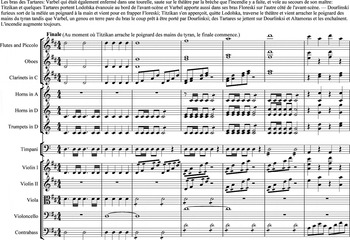
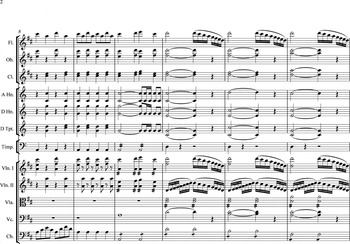
The first section (24 bars) of the symphonie consists of loud tutti passages interspersed with Floreski's comments, and modulates from D major (through D minor) to A major.Footnote 57 The urgent rhythmic motif that opens the section (A: a quaver and two semiquavers, then three pairs of quavers) is announced in the flutes, then repeated with a crescendo through four bars, gathering oboes and clarinets, strings, and finally horns and trumpets over a tonic D pedal sustained by string basses and timpani. Shorter iterations of this militaristic fanfare punctuate the dialogue before a descending sweep of semi-quaver scales leads into the dominant. During a passage of unaccompanied dialogue, Floreski is rescued by Titzikan, who then agrees to help him find Lodoïska. The main section (100 bars) of the symphonie then unfolds (see Example 1 for the opening measures of the score), reiterating the journey from tonic to dominant, with brief excursions to other keys, before being resolved definitively with a return to the tonic in the ensemble that follows the rescue. The detailed stage directions describe the progress of the narrative, the special effects, and the positioning of the characters and their emotional state – and suggest something of the building tension running through the entire scene:
Lodoïska, Act III symphonie guerrière, beginning of the finale section (bars 1–13)


This main section again foregrounds the heroic trumpets and drums, launched by a new rhythmic motif (B: dotted crotchet and pair of semiquavers, repeated once). Motif A from the first section returns, this time overlaid with the sound of clashing swords from the onstage action. There is no large-scale thematic development, and instead chords are extended through repetition or arpeggios, and short arpeggiated and scalar figures are repeated or sequenced. After tonic and dominant have once more been forcefully asserted, a simple descending scalarmotif is repeated three times in the tonic (bars 11–13, see Example 1), lending a new sense of urgency and leading once more into the dominant. Motif A returns briefly, to be repeated and sequenced once more, as the score moves through D minor and back to the dominant.
Within the relatively static and predictable harmonic framework, then, the music is propelled at the surface level by its rhythmic energy. The recurring motif A is not developed fully enough to qualify as a lyrical ‘theme’, but rather functions as militaristic signifier of determination and action, and as a kinetic figure that drives the music. Suspensions, syncopations, pedals and drum rolls – which often seem to suggest thunder, or the roar of canon fire – help to maintain the tension. The pace fluctuates, loosely suggesting a narrative, and brief, abrupt modulations and occasional variations in texture help to emphasize the sense of changing fortunes in the next section. For example, about two thirds of the way through the symphonie a syncopated reiteration of an F major chord in brass and strings, followed by a descending arpeggiated figure in the violins, is sequenced downwards through D minor to B-flat major, perhaps signalling struggle with and overpowering of the enemy. This seems to be confirmed when eight bars later a monumental passage in G minor (characterised by a majestic series of suspensions in the strings), emerges from the frantic activity. When motif A returns in the brass, it triggers a return to D major (via a rising chromatic bass line), and a hopeful, even triumphant, recapitulation of the opening section. This time it is underpinned by dominant, rather than tonic chords, and motif A helps to invigorate the extended dominant preparation for the return of the voices.
One might match some of the music to the specific actions described in the stage directions – frequent descending scales and arpeggios perhaps signify falling bodies, masonry or bridges, for example; and the return of the opening section and the tonic (noted above) surely marks Floreski's rescue of Lodoïska. The music also serves to magnify and extend the suspense: the chaos and struggle, suggested by the frenetic surface activity and skittish modulations, is underpinned by a powerful harmonic drive towards tonic affirmation. For at least some contemporary critics, the ‘sublime beauties’ of the music derived in part from this exhausting excess of effects ‘which are tiring when they are too lavish’.Footnote 59 A similar dynamic is set up in the staging, between the monumental architectural frame of the castle with its fortifications and the hordes of fighting men dashing about the stage; and between the inexorable destructive force of the fire and the activities of individual characters evading its progress. By combining monumental structure and surface detail (form and chaos) in this way, the musical and visual effects together not only suggest the progress of the narrative (the rescue), but also foreground human fear, courage and fraternity in the face of mighty, unpredictable, uncontrollable forces, and thus gesture to the opera's moral message of good triumphing over evil, the people's defeat of a tyrant.Footnote 60
Some composers in the 1780s shared a conception of drama rooted in Diderot's notion of the dramatic tableau (derived from painting), which combined calm and action, and allowed for pictorial spectacle and expression of character while also implying the action of the story around them.Footnote 61 Other composers mixed linear and spatial elements in sonata forms: hunting symphonies were particularly popular, in which compromises were made between narrative elements (hunting horns, galloping) and the repetitious structure of the form (Gossec's Sinfonia di caccia (1773) is a good example), experienced as a synchronous whole.Footnote 62 Nevertheless, in his 1785 essay De la musique, Chabanon asserted that music (unlike painting) pleased independently of imitation, through a direct appeal to the senses,Footnote 63 and the symphonie guerrière in Lodoïska may be understood at this aesthetic crossroads: it depicted the battle and suggested the emotions of the participants and onstage spectators, but it also had a more direct visceral appeal that gestured towards the transcendental, and by which the audience experienced the spectacle as overwhelming.
Musical sublime
There are a variety of musical and literary models at the end of the eighteenth century that can help us understand and analyse the ‘sublime’ effect of Cherubini's symphonie. One of them is eurythmy, a familiar concept in European music, which fed into the more developed German definitions of the musical sublime of the early 1800s; and in another sphere, the writing style of journalists and political orators offer comparative examples of the overwhelming effect of Cherubini's musical syntax.
The ancient (architectural) concept of eurythmy was a reference point for theoretical writing across the arts in the eighteenth century, and music was frequently discussed in this context in terms of symmetry and proportion.Footnote 64 Johann Georg Sulzer's definition was reproduced in translation in a supplement to the Encyclopédie in 1776:
[A]n object has eurythmy, when the beautiful proportions that it must have, when each member, each part has precisely the grandeur that is appropriate to its relationship with the whole.… But eurythmy is not concerned only with the proportions of grandeur, it extends to elaboration, to the execution of the parts.… It is not enough to grasp the whole at once; one must also feel its nature, and the effect it must produce: it is only after this feeling that one can examine whether each part contributes in fair proportion to the whole effect.Footnote 65
Cherubini's symphonie can, in this context, be understood as a carefully proportioned, monumental (harmonic) structure, that offers an intimation of the whole through the experience of its individual components. Its sense of grandeur is created in part through the effect of stasis communicated by surface repetition and oscillation between tonic and dominant. Edward Rothstein has explained how in the eighteenth century this principle of eurythmy was understood not only in relation to beauty – revealing, enlightening, affirming, charming and delighting the rational mind – but also to the (Kantian) sublime.Footnote 66 According to this way of hearing, as we experience the symphonie we try to imagine a structure, establish proportions and relationships between the elements, and thus control and contain it. Yet, the internal relationships conceal and rearrange themselves, and our orderings and interpretations are repeatedly undone by the size and constant flux of the tableau. Indeed, as Rothstein points out, this reaction is commonly found in German theories of the musical sublime at the turn of the century, where ‘the listener's imagination is severely taxed in an effort to grasp the whole’ (Christian Friedrich Michaelis, writing about the symphonies of Haydn and Mozart). Kant insists on the difference between the sublime and the beautiful, but as Rothstein underlines in this context, there are many points of connection, and our perception may flicker between the two: we analyse and interpret as we are being overwhelmed.
James Webster has called the transitional years of 1780 to 1815 the ‘age of the Kantian sublime in music’.Footnote 67 Few writers engaged with the term in relation to music before 1800, but the writings that then began to appear identify some of the ingredients in Cherubini's symphonie noted above, which were subsequently held up as examples of the sublime in the music of Haydn and Beethoven. The few French writers who discussed the sublime in music at this time remained – as we might expect – rooted in classical aesthetics: Aubin Millin, for example, noted in 1806 the qualities of power, passion and tranquillity of spirit found in Handel, Graun and Gluck.Footnote 68 But post-revolutionary German writers were rather more adventurous. Burke had already suggested implicitly ways in which the sublime might be understood aurally: ‘great variety and quick transitions from one measure or tone to another’ excited ‘tumultuous passions’ and ‘confound[ed] the imagination’, and so were ‘contrary to the genius of the beautiful in music’.Footnote 69 And in the early 1770s Sulzer had viewed nature and art (events and their representation) as equally capable of arousing sublime feelings.Footnote 70 But as Webster and others have demonstrated, it was Michaelis who was the first to attempt a thoroughgoing theorisation of the musical sublime, in articles published in 1801 and 1805.Footnote 71 The essence of his theory was that the sublime could be created either through uniformity (by repetition or static harmony, for example) or through diversity (using unexpected modulations, competing voices or dynamic contrasts) – in both cases creating a structure that could not be readily grasped by the listener.Footnote 72 Haydn's works of the late 1790s and early 1800s – characterised by formal ruptures, stylistic incongruities and grandeur – have been understood in this way as exemplifying the sublime in music, and Cherubini's symphonie might be added to this repertory.Footnote 73 Webster's list of Haydn's ‘sublime’ features includes techniques of contrast (of rhythm, harmony, topic, forces) and devices of gestural shock, majesty and discontinuity; and his works often include a climax built from opaque preparation, sudden apotheosis and a fast drive to cadence. By such means, Webster claims, music became something that could be placed alongside philosophy by means of a new dynamic sublime (in the Kantian sense), capable of suggesting a physical power and effect on the body.
As Nicholas Mathew has pointed out, however, Burke's treatise is witness to the slippage that implicitly attributed such powers to art itself. In Haydn reception, music was routinely described as the embodiment of sublime power, rather than the medium through which such powers might be depicted.Footnote 74 His works of the 1790s – such as the later London Symphonies (including the Military and the Drum Roll) and the Creation – are founded on martial topics and imitative effects, including an emphasis on trumpets and drums, and monumental choral writing, which together were understood as manifestations of the new political meanings associated with revolution.Footnote 75 Cherubini has been implicated in the aestheticisation of political power and the emergence of the musical sublime by modern scholars, through his involvement in the revolutionary festivals that reputedly inspired Haydn – and Beethoven.Footnote 76 But as we have seen, his operas – as exemplified by Lodoïska – cement this fusion of political and the sublime more completely in their cataclysmic tableaux, in which he and his co-creators developed a powerful audio-visual language in the service of a highly moral story that resonated with lived experience, employing recognisable heroic topoi alongside more abstract effects.
Compelling models for the ‘sublime’ effect of the tableau can also be found in writing of the period. In their volume devoted to interpretations of natural catastrophe in eighteenth-century culture, Anne-Marie Mercier-Faivre and Chantal Thomas document the new ways employed to present such indescribable scenes: references to myths were frequently incorporated to strike the imagination; diverse styles and types of imagery were jumbled together; words were piled up ‘like dead bodies’; ideas were condensed or juxtaposed.Footnote 77 In other words, they claim, catastrophe overturned genres and models, forcing writing to reinvent itself as an expression of chaos that overwhelmed the reader. In this manner, it not only encouraged awe in the face of the destructive power of nature, but also heightened the emotional response to those involved in such events.
An alternative though equally pertinent contemporary model can be found in the political arena. From 1789, revolutionary oratory was described frequently as sublime, in part because the speakers had to find new means of communicating with and persuading audiences.Footnote 78 Their approach was twofold: the use of powerful, highly moralistic stories, which encouraged the spectator to identify with the emotions and events depicted (in the manner of contemporary melodramas); and the use of syntax designed to overwhelm.Footnote 79 During the early 1790s, Jean-Paul Marat's speeches, for example, were structured around the opposition between innocence oppressed and the tyrannical persecutor, and Robespierre similarly described the miseries of the poor (or otherwise marginalised) and the tyrannical acts of oppressors.Footnote 80 David Denby has explained how the public was encouraged to read the sufferings of humanity as a whole, or (conversely) universal virtues of bienfaisance, into such individual actions and experiences, and the reaction of an observer functioned as proof of the existence of that universal category.Footnote 81 The moral superiority conferred by the status of (innocent) victim was thereby projected forward to a transcendent realm, and the audience members encouraged to recognise and identify with an experience that could be their own.Footnote 82 Transcendence is here a sort of sacred, eternal reality, which may be conceived by the mind without reference to sense experience; in the context of revolution, it is a response to a sense of loss.Footnote 83
These carefully chosen moral narratives were delivered in a new and compelling manner. As Patrice Guéniffey has demonstrated, Robespierre's speeches were interminably long, employing repetitive, monotonous rhetoric that reputedly stirred the enthusiasms of his Jacobin audience, who responded with ‘convulsive stamping, a religious enthusiasm and a holy furore’.Footnote 84 Robespierre believed that liberation from the deceptions of words and jargon was needed, and that the rhythm of the incantation mattered more than the rigour of the argument. Transcriptions of his speeches reveal sudden exclamations and incongruous juxtapositions; repeated patterns and formulas; the deployment of sequences of short phrases; and dynamic call and response patterns.Footnote 85 Robespierre's speeches were thus designed to awake in the listener vague feelings of admiration, terror and hope, and through him ‘confusion became order, obscurity became clarity’.Footnote 86 Like the language of reportage, this style of writing has much in common with the musical syntax of the sublime – repetition and sequencing, abrupt modulations – as identified by later writers, and as manifested in Cherubini's symphonie. Each was designed to persuade audiences of the truth of highly morally narratives by overwhelming them with a tirade whose structure and meaning could not quite be grasped, but which seduced by means of a compelling rhythmic energy that stood apart from the narrative content.
Revolutionary Reality
But what effect did the aural and visual spectacle of Cherubini's symphonie actually have on audiences? Scholars of revolutionary theatre have tended to assume a Diderotian absorption in the drama, but more recently, building on Marian Hobson's transdisciplinary work on art, theatre and music, a more complex engagement with the drama in relation to political events has been acknowledged, in which the spectator's attention flickers between illusion and awareness.Footnote 87 This aesthetic of papillotage was more commonly encountered (in negative terms) in Diderot's art criticism of the 1760s and 70s.Footnote 88 Sensuality and chaos of colours and form (temporal and spatial scattering) cause the eye of the beholder to move uncontrollably across the canvas.Footnote 89 This deflects rather than focuses the viewer's gaze, drawing attention to the surface of the picture and its mechanisms, rather than presenting the characters, actions and situations as ‘natural’. For Diderot, action should rather be concentrated in a privileged moment, absorbing and controlling rather than scattering the viewer's attention.Footnote 90 Yet, as Hobson demonstrates, these two experiences often coexist within an individual's work or within certain genres, and she extends the concept of papillotage productively to eighteenth-century theatre.
Mark Darlow sees this imaginative interplay between art object and perceiving subject as crucial to the aesthetic of revolutionary theatre.Footnote 91 He focuses on pièces de circonstances, which by definition make explicit connections between the fictional world and the lived experience of the audience, as demonstrated by this reviewer:Footnote 92
This play, each scene of which retraces for Parisians the troubles that have been agitating them, and the dangers they have run, compensates for many of these painful memories, while recalling the memorable event of the conquest of the Bastille, which assures the love and recognition of all the French. It would be impossible to paint the transports of enthusiasm that each new performance excites in the mind of the spectator.Footnote 93
Such reports suggest that contemporaries understood the value of drama in terms of its extrinsic accuracy, and judged the story as if it were real experience, or at least a faithful mirror of real events. The changes of medium inherent to dialogue opera – between sung numbers, speech and orchestral passages – further disrupted the potential for absorption in the fiction, and the climactic passages in such dramas tended to be highly charged emotional moments that stood out from the surrounding dramatic texture. Darlow concludes that they relied not on absorptive spectatorship as frequently assumed, but on a multi-textured approach in which the hors-texte was essential. It is a logical next step to include dramas that were not explicit pièces de circonstances, but nevertheless contained obvious evocations of recent experience. Clemens Risi helps us in this move, with his observations about opera in performance.Footnote 94 He notes on one hand the ‘intense corporeal reactions to what is being viewed, felt, and experienced’, and on the other, the phenomenological model of perception that defines every experience as ‘an interaction between the impression of the present moment, the memory of the recently experienced past, and the anticipation of the immediate future’. For Risi, these reactions (to opera of any period) together point to the ‘oscillating processes of perception’, and in this way he helps to free us from the narrowly referential frame of the pièce de circonstance.
The denouement of Lodoïska can thus be understood as an example of what Darlow describes as ‘neither closed fiction nor … an extension of some “real world” … but a space between the two’, which must surely have felt like a self-conscious (re-)enactment of the social drama surrounding contemporary audiences.Footnote 95 Yet critics made no explicit connections between the opera and the revolution. This was in part, perhaps, because the parallels were so obvious. But there were recurring observations that point to the resonances felt. As noted above, a number of critics reported that the excess and unrelenting nature of Cherubini's music made the whole experience almost too overwhelming to bear, and the total effect of the denouement was ‘truly terrifying’;Footnote 96 another declared that it would be impossible to bring the imitation of reality and theatrical illusion any closer together.Footnote 97 In other words, the overwhelming feeling of engagement with the spectacle felt ‘real’. Some were, inevitably, more inclined to suspend disbelief than others,Footnote 98 but by tapping into the already sublime intuition of moral purpose underpinning ‘real’ revolutionary experience, the opera sidestepped the need to try to represent the transcendent realm and instead harnessed audiences' complicity, imagination and moral awareness.
The musical and visual components of this cataclysmic scene in Lodoïska can each be understood as ‘sublime’ at a rhetorical level, and the combined musico-dramatic effect created a sublime spectacle that magnified the moral implications of the story by recalling lived experience on one hand, and intensifying the emotional impact on the other. In so doing, the scene raised individual knowledge to a universal level, and discharged the horror of violence and injustice by sublimating it through the collective memory of revolutionary experience. In one sense, time and the theatrical framework clearly distanced the spectator from powerfully evoked events and feelings, allowing him/her – in a Burkean sense – to perceive them as sublime rather (re-)experience them as terrifying; in another sense, the powerful combination of idea, affect and memory suggest something akin to the ‘enthusiasm’ experienced by the Kantian spectator, and awareness of the transcendental dimension.
The concluding scene of the opera seals the moral argument of the wickedness and injustice of tyranny. The symphonie guerrière flows directly into a passage of dialogue as Titzikan snatches Dourlinski's dagger; Floreski and Lodoïska sing lyrically and tenderly of their love, and then all join forces in an allegro spiritoso that spells out the legitimacy of anger in the face of such oppression and the importance of destroying the scene of such tyranny. The chorus concludes that such a ‘spectacle’ not only suits the crime, but also provides a lesson to all:
[Our anger is legitimate, swallow up this horrible place! This spectacle suits the crime; we can offer it to [the eyes of Heaven]].Footnote 99
In this way, the tableau encapsulated the confrontation with, and appropriation of, political power being enacted by the revolutionary generation.
***
Three years later, at the height of the Terror, Jacques-Louis David came close to realising the experience of a social community united in its affections and in its commitment to a set of abstract ideals in his plan for the 1794 Festival of the Supreme Being. Jean Starobinski has observed how the plan mixed descriptive and prescriptive modes, and included scene setting, the evocation of the spontaneous reaction of a group of spectators, and abstract reflections on the moral to be drawn from the ceremony.Footnote 100 The opening sequence gives a flavour of its vision:
Dawn has barely announced the day, and already the sounds of a warlike music echo everywhere, and replace the calm of sleep with an enchanted awakening. At the appearance of the benevolent sun, which livens and colours nature, friends, brothers, spouses, children, old men and women kiss each other, and hurry, keen to decorate and to celebrate the festival of the Divinity.Footnote 101
But it seems that the event itself failed to accomplish this ambitious fusion of abstract concepts with the emotions of the individual. Cherubini's opera came closer, as it took as its starting point the spectators' memories of diverse experiences and complex emotions instead of involving the audience as participants in the re-enactment of a simplified single viewpoint. Moreover, the real emotions triggered by the burning of Dourlinski's castle and the fighting were given space to grow and intensify as the opera's narrative unfolding was monumentalised in this tableau of destruction. The moral impact of the story was clinched as it discharged its full affective power.
France receives little attention in narratives about the sublime in the late eighteenth and the nineteenth centuries. Yet the vogue for operas with cataclysmic denouements at moments of revolutionary anxiety around 1830 and 1848, such as Auber's La Muette de Portici and Meyerbeer's Le Prophète, should encourage us to think more deeply about the ‘total aesthetic’ of French opera, and discover a coherent and distinctively French discourse of the sublime that extends beyond the 1790s, and can be understood in relation to wider European trends.