Introduction
22q11.2 deletion syndrome (22q11DS) is one of the most frequently cited genetic models of risk for the development of psychotic spectrum disorders, and allows for the examination of aetiological mechanisms underlying the transition to clinical psychotic outcomes. The syndrome is associated with general cognitive impairments, and social and adaptive functioning deficits (Schneider et al. Reference Schneider, Debbané, Bassett, Chow, Fung, van den Bree, Owen, Murphy, Niarchou, Kates, Antshel, Fremont, McDonald-McGinn, Gur, Zackai, Vorstman, Duijff, Klaassen, Swillen, Gothelf, Green, Weizman, Van Amelsvoort, Evers, Boot, Shashi, Hooper, Bearden, Jalbrzikowski, Armando, Vicari, Murphy, Ousley, Campbell, Simon and Eliez2014). 22q11DS is also associated with behavioural abnormalities and psychiatric disorders, including a 35-fold elevated risk for schizophrenia spectrum disorders (Murphy, Reference Murphy2002; Schneider et al. Reference Schneider, Debbané, Bassett, Chow, Fung, van den Bree, Owen, Murphy, Niarchou, Kates, Antshel, Fremont, McDonald-McGinn, Gur, Zackai, Vorstman, Duijff, Klaassen, Swillen, Gothelf, Green, Weizman, Van Amelsvoort, Evers, Boot, Shashi, Hooper, Bearden, Jalbrzikowski, Armando, Vicari, Murphy, Ousley, Campbell, Simon and Eliez2014). In particular, during adolescence, 22q11DS is associated with high rates of psychotic disorders (Murphy et al. Reference Murphy, Jones and Owen1999; Monks et al. Reference Monks, Niarchou, Davies, Walters, Williams, Owen, van den Bree and Murphy2014; Schneider et al. Reference Schneider, Debbané, Bassett, Chow, Fung, van den Bree, Owen, Murphy, Niarchou, Kates, Antshel, Fremont, McDonald-McGinn, Gur, Zackai, Vorstman, Duijff, Klaassen, Swillen, Gothelf, Green, Weizman, Van Amelsvoort, Evers, Boot, Shashi, Hooper, Bearden, Jalbrzikowski, Armando, Vicari, Murphy, Ousley, Campbell, Simon and Eliez2014), transient psychotic experiences and prodromal symptoms (Debbané et al. Reference Debbané, Glaser, David, Feinstein and Eliez2006; Stoddard et al. Reference Stoddard, Niendam, Hendren, Carter and Simon2010; Shapiro et al. Reference Shapiro, Cubells, Ousley, Rockers and Walker2011), and also schizotypal traits (Baker & Skuse, Reference Baker and Skuse2005; Debbané et al. Reference Debbané, Van der Linden, Glaser and Eliez2008; Monks et al. Reference Monks, Niarchou, Davies, Walters, Williams, Owen, van den Bree and Murphy2014; Tang et al. Reference Tang, Yi, Moore, Calkins, Kohler, Whinna, Souders, Zackai, McDonald-McGinn, Emanuel, Bilker, Gur and Gur2014).
Schizotypal traits are considered to be one of the possible phenotypic expressions of latent vulnerability to psychosis (i.e. schizotypy) (Meehl, Reference Meehl1962). Since Paul E. Meehl (Reference Meehl1962) first coined the term, schizotypy has been used in reference to its manifestation as a personality organization (Mason & Claridge, Reference Mason and Claridge2015) and equally as the phenotypic expression of an underlying disease process (Lenzenweger, Reference Lenzenweger2010). Considerable evidence from family, adoption and twin studies indicates that schizotypal traits are genetically contiguous with schizophrenia (Kendler et al. Reference Kendler, McGuire, Gruenberg, O'Hare, Spellman and Walsh1993, Reference Kendler, Myers, Torgersen, Neale and Reichborn-Kjennerud2007; Fanous et al. Reference Fanous, Neale, Gardner, Webb, Straub, O'Neill, Walsh, Riley and Kendler2007). Moreover, independent follow-up studies have shown that adolescents from the general population and those at clinical or genetic high risk for psychosis who report schizotypal traits are at greater risk of transition to psychosis and related conditions (Debbané et al. Reference Debbané, Eliez, Badoud, Conus, Flückiger and Schultze-Lutter2015). The set of traits described as schizotypal is qualitatively similar to, but quantitatively less severe than, the symptoms found in patients with schizophrenia and schizotypal personality disorder (Ettinger et al. Reference Ettinger, Meyhöfer, Steffens, Wagner and Koutsouleris2014). Furthermore, the literature consistently holds that schizotypy is a multidimensional construct most often represented by a three-factor solution (i.e. cognitive–perceptual, interpersonal, and disorganized) (Raine, Reference Raine2006), comparable with findings reported in patients with schizophrenia (Liddle, Reference Liddle1987). These findings suggest that schizotypal traits, at the behavioural level, may serve as a distal risk marker for psychosis (Debbané et al. Reference Debbané, Eliez, Badoud, Conus, Flückiger and Schultze-Lutter2015) and could reflect, at the clinical level, the underlying disease process that may be unfolding in the development of psychosis.
Previous studies using both self-reports and clinical interviews have found that individuals with 22q11DS display more schizotypal traits than control groups (Baker & Skuse, Reference Baker and Skuse2005; Debbané et al. Reference Debbané, Van der Linden, Glaser and Eliez2008; Monks et al. Reference Monks, Niarchou, Davies, Walters, Williams, Owen, van den Bree and Murphy2014; Tang et al. Reference Tang, Yi, Moore, Calkins, Kohler, Whinna, Souders, Zackai, McDonald-McGinn, Emanuel, Bilker, Gur and Gur2014). However, relatively little is known about the phenotypic expression of schizotypal traits in adolescents with 22q11DS. The factorial structure of schizotypal traits and their reliability have not received any detailed attention in this population. Furthermore, no previous study has tested either the stability of schizotypal traits or their relationships with prodromal states and psychotic symptoms. Importantly, this research is required to better understand the usefulness and validity of self-report instruments such as the Schizotypal Personality Questionnaire (SPQ) (Raine, Reference Raine1991) to assess schizotypal traits in adolescents with learning disabilities. Moreover, the combination of two risk factors (e.g. genetic risk and schizotypy), during adolescence and in a close-in strategy, may help us to improve our predictive capacity and enhance the early detection of psychotic spectrum disorders in a useful framework.
The main aim of the present study was to evaluate the phenotypic expression of schizotypal traits, to test the psychometric validity of assessing schizotypy in adolescents with 22q11DS, and to examine the value of schizotypy as a risk marker for psychosis in this population. Deriving from this broad objective were the following specific objectives: (a) to compare self-reporting of schizotypal traits in adolescents with 22q11DS and in an age-matched control group; (b) to examine the internal structure of schizotypal traits, using the well-established SPQ; (c) to analyse the internal consistency and temporal stability of schizotypal traits in a follow-up assessment; and (d) to test the relationship between schizotypal traits and interview-based ratings of prodromal states and clinical psychotic symptoms.
Method
Participants
The sociodemographic characteristics and clinical profiles of participants with 22.11qDS enrolled in this study have already been published elsewhere (Schneider et al. Reference Schneider, Debbané, Bassett, Chow, Fung, van den Bree, Owen, Murphy, Niarchou, Kates, Antshel, Fremont, McDonald-McGinn, Gur, Zackai, Vorstman, Duijff, Klaassen, Swillen, Gothelf, Green, Weizman, Van Amelsvoort, Evers, Boot, Shashi, Hooper, Bearden, Jalbrzikowski, Armando, Vicari, Murphy, Ousley, Campbell, Simon and Eliez2014). Briefly, all participants were recruited through advertisements in patient association newsletters and through word of mouth. The presence of a 22q11.2 microdeletion was confirmed in all participants by fluorescence in situ hybridization (Bassett et al. Reference Bassett, McDonald-McGinn, Devriendt, Digilio, Goldenberg, Habel, Marino, Oskarsdottir, Philip, Sullivan, Swillen and Vorstman2011).
The results from the present study were first obtained by analysing cross-sectional data from a sample of 61 adolescents with 22q11DS aged between 12 and 19 years (mean = 14.95 years, s.d. = 2.13; 45.9% males). In this sample, 31 (50.8%) participants were diagnosed with an anxiety disorder, 21 (34.4%) with attention-deficit/hyperactivity disorder (ADHD), four (6.6%) with an oppositional defiant disorder, four (6.6%) with a mood disorder, and four (6.6%) with a psychotic disorder. Of the participants, 12 (19.7%) were receiving methylphenidate, three (4.9%) were on antidepressant medication, two (3.3%) were on antipsychotics, and one (1.6%) was on anxiolytics at the time of testing. Cross-sectional analyses were complemented by longitudinal analyses performed on a subsample of 24 adolescents aged between 15 and 20 years (mean = 17.93 years, s.d. = 1.44; 33.3% males). Of these participants, 12 had a diagnosis of psychiatric disorder at time 2 (five of them had two or more diagnoses): two ADHD; two major depressive disorder; one schizophreniform disorder; one separation anxiety disorder; three generalized anxiety disorder; three obsessive–compulsive disorder; three simple phobia; two panic disorder; one psychotic disorder not otherwise specified; one schizo-affective disorder. The mean interval between the two visits in this subsample was 3.60 years (s.d. = 0.99; median: 3.39; range: 1.92–7.09). The mean full intelligence quotient (IQ) estimated in the 22q11DS sample was 70.67 (s.d. = 10.76) at time 1 and 70.75 (s.d. = 11.75) at time 2.
An age-matched control group comprised 61 French-speaking community adolescents (mean = 15.44 years, s.d. = 1.76; 45.9% males). Typically developing individuals were recruited through the local school system. Participants used in this study were selected on the basis of gender and age from a previously published sample (Badoud et al. Reference Badoud, Chanal, Eliez, Van Der Linden and Debbané2011). The Block Design and Vocabulary subtests of the Wechsler Scales of Intelligence were used for estimation of IQ (Wechsler, Reference Wechsler2003). Strict exclusion criteria were used to recruit the control group. Participants were excluded if they met one of the following criteria: any history of neurological problems or prematurity; history of any type of psychological treatment or speech therapy; estimated IQ lower than 80; and history of learning difficulties. Each adolescent received financial compensation (100 CHF) for completing the study.
Written informed consent was received from participants and their parents under protocols approved by the Institutional Review Board of the Department of Psychiatry of the University of Geneva Medical School.
Instruments
The SPQ (Raine, Reference Raine1991) is a self-report instrument made up of 74 items with a dichotomous response format (yes/no). The SPQ was developed for measuring schizotypal traits according to Diagnostic and Statistical Manual of Mental Disorders, third edition, revised (DSM-III-R) criteria (American Psychiatric Association, 1987). Based on previous factorial studies, the nine subscales of the SPQ are clustered in three higher-order dimensions. The cognitive–perceptual dimension comprises the odd beliefs, unusual perceptual experiences, ideas of reference, and suspiciousness subscales. The interpersonal dimension comprises the excessive social anxiety, no close friends, and constricted affect subscales. The disorganized dimension comprises the eccentric behaviour and odd speech subscales. This three-factor structure captures the underlying heterogeneity of the schizotypal traits (Raine, Reference Raine1991, Reference Raine2006). A French version of the SPQ validated in adolescents was used (Badoud et al. Reference Badoud, Chanal, Eliez, Van Der Linden and Debbané2011).
Full-scale IQ was obtained using the age-appropriate version of the Wechsler Intelligence Scale, third edition (Wechsler, Reference Wechsler1991).
The Structured Interview for Prodromal Syndromes (SIPS) (Miller et al. Reference Miller, McGlashan, Rosen, Cadenhead, Ventura, McFarlane, Perkins, Pearlson and Woods2003; McGlashan, Reference McGlashan2011) is a semi-structured diagnostic interview designed to assess attenuated schizophrenia-like symptomatology and to identify putative prodromal states. Within the SIPS, the Scale of Prodromal Symptoms examines five positive, six negative, four disorganization and four general (non-specific) symptoms on a scale ranging from 0 (‘absent’) to 6 (‘severe and psychotic’ in the positive symptoms scale, and ‘extreme’ in the three other scales).
The Positive and Negative Syndrome Scale (PANSS) (Kay et al. Reference Kay, Fiszbein and Opler1987) is a 30-item rating scale, specifically developed to assess patients with schizophrenia. It is composed of a positive scale (seven items: P1–P7), a negative scale (seven items: N1–N7) and a general psychopathology scale (16 items: G1–G16). Each item is rated on a seven-point severity scale (1 = ‘absent’ to 7 = ‘extreme’).
The Brief Psychiatric Rating Scale (BPRS) (Overall & Gorham, Reference Overall and Gorham1962) is one of the most frequently used instruments for measuring psychopathology and psychotic symptoms. The 24 items are rated on a seven-point severity scale (1 = ‘not present’ to 7 = ‘extremely severe’). The administration of clinical interviews at both visits was carried out by a trained child psychiatrist (S.E.).
Data analyses
The following statistical analyses were performed. First, the descriptive statistics of the nine SPQ subscales and three higher-order dimensions were calculated for each group at time 1. Second, the reliability of the scores on the SPQ subscales and three higher-order dimensions was estimated using Cronbach's α in the 22q11DS sample at time 1. Third, the mean group comparison between the two groups at time 1 in the nine SPQ subscales and three higher-order dimensions was carried out using multivariate analysis of variance. Fourth, with the aim of analysing the underlying structure of schizotypal traits, an analysis of the internal structure of the SPQ was performed using a principal component analysis with subsequent Oblimin rotation at subscale level. Fifth, the stability of the three higher-order dimensions of the SPQ between two temporal points was analysed using Pearson's correlations. Finally, the associations between SPQ higher-order dimensions and clinical interviews (SIPS, PANNS and BPRS) were conducted using Pearson's correlations. The statistical analyses were carried out using SPSS 15.0 (Statistical Package for the Social Sciences, 2006).
Results
Descriptive statistics and group mean comparisons
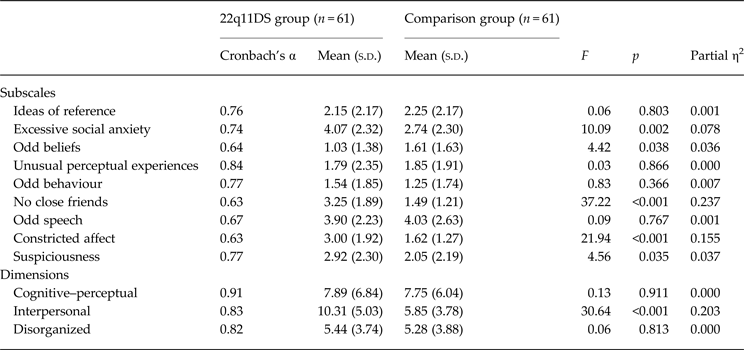
Table 1 shows the descriptive statistics for the SPQ subscales and higher-order dimensions in the 22q11DS sample and the comparison group. Neither the SPQ subscale scores nor the three higher-order SPQ dimensions correlated with gender or age when considering both groups individually at time 1 (all p values >0.05). In the 22q11DS sample, the SPQ subscales and higher-order dimensions of the SPQ were not significantly correlated with IQ at either time 1 or time 2 (all p values >0.05).
Time 1 descriptive statistics for the Schizotypal Personality Questionnaire, including subscale scores, higher-order dimensions and mean group comparisons

22q11DS, 22q11.2 Deletion syndrome; s.d., standard deviation.
Internal consistency levels for the SPQ subscales and three-higher order dimensions at time 1 ranged between 0.63 and 0.91 for the 22q11DS sample (see Table 1).
At time 1, 96.7, 96.7 and 94.3% of the 22q11DS sample reported cognitive–perceptual, interpersonal, and disorganized schizotypal traits, respectively. At time 2, percentages were 87.5, 95.8 and 83.3%, respectively. In the age-matched comparison group (time 1), 96.7, 95 and 93.3% of the sample endorsed at least one item among the cognitive–perceptual, interpersonal and disorganized schizotypal traits, respectively.
Group mean comparisons on the SPQ subscales and three higher-order dimensions were performed. The Wilks's λ multivariate results revealed statistically significant differences by group (λ = 0.613, F 9,112 = 7.850, p < 0.001, partial η 2 = 0.387). As can be seen in Table 1, statistically significant differences were found on the excessive social anxiety, no close friends, constricted affect, odd beliefs, and suspiciousness subscales, as well as in the interpersonal higher-order dimension. The 22q11DS group scored higher than the comparison group on all SPQ subscales except for odd beliefs. The first three SPQ subscales, which make up the interpersonal higher-order dimension, were those with the most significant results. The no close friends subscale showed the greatest partial η 2. In order to examine whether these results were driven by participants of the 22q11DS sample with a psychotic disorder at time 1 (n = 4), we performed new group mean comparisons on the SPQ subscales and higher-order dimensions excluding these four participants. Statistically significant differences were still found (λ = 0.623, F 9,108 = 7.258, p < 0.001, partial η 2 = 0.377) on the same SPQ subscales (i.e. excessive social anxiety, no close friends, constricted affect, odd beliefs, and suspiciousness) and higher-order dimension (interpersonal).
Factorial analysis for the SPQ subscales
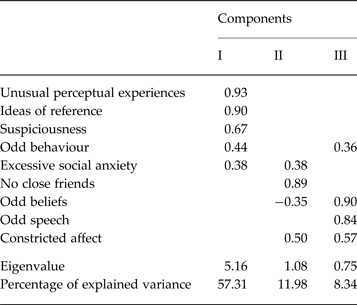
In order to explore the internal structure of the SPQ subscales in the 22q11DS group at time 1, a principal component analysis was computed. The Kaiser–Meyer–Olkin measure of sampling adequacy was 0.85, and the Bartlett test of sphericity was 482.4 (p < 0.001). The results suggested a three-component solution. This solution was selected on the basis of accuracy in terms of psychological interpretation, the scree plot and the parsimony criterion. Table 2 shows the factor loadings, eigenvalues and proportion of explained variance for the three-factor structure. The first component grouped aspects related to unusual perceptual experiences, ideas of reference, suspiciousness, excessive social anxiety, and odd behaviour (overlap in two components), and was therefore called cognitive–perceptual. The second component grouped aspects related to excessive social anxiety (overlap in two components), no close friends, and constricted affect, and was therefore labelled interpersonal. The third component brought together aspects related to odd beliefs, odd behaviour, odd speech, and constricted affect (overlap in two components), and was called disorganized. This factorial solution remained unchanged when 22q11DS participants with psychotic disorder at time 1 were excluded from the analysis.
Principal component analysis of the Schizotypal Personality Questionnaire subscales in the 22q11.2 deletion syndrome group at time 1 a

a Factor loadings less than 0.30 have been removed.
Association between schizotypal traits and temporal stability
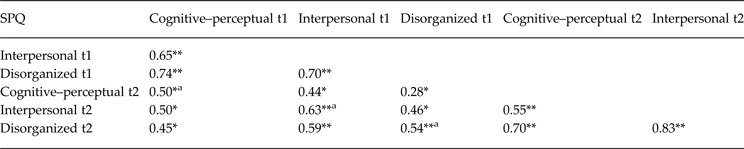
Pearson's correlation coefficients between the SPQ higher-order dimensions in the 22q11DS group at the two time points are shown in Table 3. At time 1, Pearson's correlation coefficients between the SPQ higher-order dimensions were statistically significant and ranged between 0.65 and 0.70 (p < 0.01). At time 2, Pearson's correlation coefficients were statistically significant and ranged between 0.55 and 0.83 (p < 0.01). Correlations between the SPQ higher-order dimensions over a 3.6-year interval are also shown in Table 3. The temporal stability of the cognitive–perceptual, interpersonal and disorganized SPQ higher-order dimensions was 0.50, 0.63 and 0.54 (p < 0.01), respectively.
Pearson's correlation coefficients between the SPQ higher-order dimensions in the 22q11.2 deletion syndrome group at t1 (n = 61) and t2 (n = 24)

SPQ, Schizotypal Personality Questionnaire; t1, time 1; t2, time 2.
a Test–retest values.
* p < 0.05, ** p < 0.01.
Associations between schizotypal traits, prodromal states and psychotic symptoms
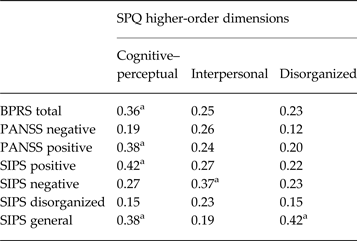
Table 4 shows the Pearson's correlation coefficients between the three SPQ higher-order dimensions and the SIPS, PANSS and BPRS scores. The SPQ cognitive–perceptual dimension was moderately associated with BPRS total, PANSS positive, SIPS positive and SIPS general scores. The SPQ interpersonal dimension was moderately associated with the SIPS negative score. Finally, the SPQ disorganized dimension was moderately associated with the SIPS general score.
Pearson's correlations between the SPQ higher-order dimensions and the BPRS, the PANSS and the SIPS in the 22q11.2 deletion syndrome group at time 1

SPQ, Schizotypal Personality Questionnaire; BPRS, Brief Psychiatric Rating Scale; PANSS, Positive and Negative Syndrome Scale; SIPS, Structured Interview for Prodromal Syndromes.
a Corrected for Bonferroni multiple comparisons (α* = α/c), p < 0.0024.
Discussion
The main purpose of the present study was to analyse the factorial structure, internal consistency and stability of schizotypal traits, as well as their associations with prodromal states and clinical psychosis symptoms, in adolescents with 22q11DS. A reliable means of assessing schizotypal traits in samples of adolescents with 22q11DS using self-reports may offer a way to improve the early identification of vulnerability to psychosis, prior to the impairment of functioning that immediately precedes transition to a clinical outcome. Furthermore, the use of distal risk markers such as schizotypal traits in an adolescent population at genetic high risk may help us to understand and examine potential aetiological mechanisms underlying these clinical manifestations in a developmental framework (Barrantes-Vidal et al. Reference Barrantes-Vidal, Grant and Kwapil2015).
To the best of our knowledge, the SPQ (Raine, Reference Raine1991) has not previously been validated in adolescents with 22q11DS. Identifying a reliable self-report instrument for a population with learning disability and at high risk for psychosis could be useful for clinical and research purposes. The results of the present study reveal that SPQ scores in adolescents with 22q11DS show adequate psychometric properties regarding the instrument's factorial structure, internal consistency, stability and association with external variables (e.g. prodromal states and psychotic symptoms). The internal consistency levels for the SPQ scores in this clinical sample were satisfactory. Furthermore, the results suggest that schizotypy is better considered as a multidimensional construct in adolescents with 22q11DS, as in other populations. The study of the underlying factorial structure of the SPQ confirmed the traditional three-factor solution of cognitive–perceptual, interpersonal, and disorganized (Raine, Reference Raine2006). This dimensional structure overlaps with those found in previous studies including typically developing adolescents and young adults (Fossati et al. Reference Fossati, Raine, Carretta, Leonardi and Maffei2003; Badoud et al. Reference Badoud, Chanal, Eliez, Van Der Linden and Debbané2011; Fonseca-Pedrero et al. Reference Fonseca-Pedrero, Fumero, Paino, de Miguel, Ortuño-Sierra, Lemos Giraldez and Muñiz2014). Taken together, these results suggest that a similar factorial structure of schizotypy can be found across samples with different clinical status (e.g. participants with a psychotic disorder, at clinical or genetic high risk, and non-clinical populations), which provides support for the multidimensional model of schizotypy and schizophrenia (Kwapil & Barrantes-Vidal, Reference Kwapil and Barrantes-Vidal2015). Nevertheless, small differences were noted in comparison with previous factorial studies. In particular, the subscale assessing excessive social anxiety showed high loading on both the cognitive–perceptual and interpersonal dimensions. This may in part be linked to the increased prevalence of social anxiety in populations with 22q11DS compared with the general population (e.g. Fabbro et al. Reference Fabbro, Rizzi, Schneider, Debbané and Eliez2012), which, as we have argued elsewhere, may augment the presence of cognitive–perceptual abnormalities and interpersonal difficulties through mechanisms such as increased sensitivity to threat (Eliez & Debbané, Reference Eliez and Debbané2008). While these questions lie beyond the scope of this paper, a careful longitudinal examination of the potential interactions between facets of anxiety and schizotypy dimensions during development may be relevant to mental health in youths with 22q11DS. On the basis of a recent study evaluating psychological distress in youths at ultra-high risk for psychosis (Rapado-Castro et al. Reference Rapado-Castro, Mcgorry, Yung, Calvo and Nelson2015), where anxiety symptoms appear to be predictive of conversion to psychosis, it appears justified to pay increased attention to early interactions between anxiety and schizotypy in individuals with 22q11DS.
As expected, schizotypal traits were common among all the adolescents studied. Adolescents with 22q11DS displayed more schizotypal traits than the age-matched comparison group in the interpersonal higher-order dimension and suspiciousness subscale of the SPQ. The result relating to findings in the interpersonal domain, also classified under ‘negative symptoms’ in high-risk studies, is consistent with findings from independent 22q11DS samples (Stoddard et al. Reference Stoddard, Niendam, Hendren, Carter and Simon2010; Shapiro et al. Reference Shapiro, Cubells, Ousley, Rockers and Walker2011; Armando et al. Reference Armando, Girardi, Vicari, Menghini, Digilio, Pontillo, Saba, Mazzone, Lin, Klier, Schäfer and Amminger2012). For instance, in the study of Stoddard et al. (Reference Stoddard, Niendam, Hendren, Carter and Simon2010), the SIPS interview scores of adolescents with 22q11DS clearly showed that a higher proportion of the group scored on a moderate to high level in the negative symptoms domain (85% of the sample) compared with the positive symptoms domain (45%). In another study, Armando et al. (Reference Armando, Girardi, Vicari, Menghini, Digilio, Pontillo, Saba, Mazzone, Lin, Klier, Schäfer and Amminger2012) found higher scores in a 22q11DS sample compared the ultra-high-risk patients on the PANSS negative dimension. The present findings are thus consistent with the idea that schizotypal traits, as a non-clinical psychosis-trait expression, are strikingly increased in the interpersonal/negative domain in 22q11DS.
By contrast, participants with 22q11DS scored lower than the control group on the odd beliefs subscale. This may be related to previous reports of high negative symptoms using instruments such as the SIPS, which consistently reveal significant ‘decreased ideational richness’. If ideational richness is required to elaborate odd beliefs, then it might not be surprising to find a low prevalence of odd beliefs in those with decreased ideational richness. For instance, Shapiro et al. (Reference Shapiro, Cubells, Ousley, Rockers and Walker2011), using the SIPS, found that the 22q11DS group demonstrated equivalent levels of negative symptoms when compared with a sample meeting diagnostic criteria for schizotypal personality disorder, except for ‘decreased ideational richness’. This interpretation, however, merits considerable caution and further investigation, as it could equally be the case that highly suspicious individuals with 22q11DS respond defensively to questions pertaining to odd beliefs. Furthermore, similar results were found in previous studies examining schizotypal traits in adolescents with 22q11DS (Baker & Skuse, Reference Baker and Skuse2005; Debbané et al. Reference Debbané, Van der Linden, Glaser and Eliez2008; Monks et al. Reference Monks, Niarchou, Davies, Walters, Williams, Owen, van den Bree and Murphy2014; Schneider et al. Reference Schneider, Van der Linden, Menghetti, Debbané and Eliez2015). For instance, Monks et al. (Reference Monks, Niarchou, Davies, Walters, Williams, Owen, van den Bree and Murphy2014) found that a 22q11DS sample had a higher Oxford Liverpool Inventory of Feelings and Experiences schizotypy total score as well as higher scores on the cognitive disorganization and introvertive anhedonia subscales compared with population norms. According to Monks et al. (Reference Monks, Niarchou, Davies, Walters, Williams, Owen, van den Bree and Murphy2014), this finding supports the theory that individuals with 22q11DS demonstrate a genetic liability for the development of psychosis and related conditions. Moreover, the schizotypal traits that are apparent during adolescence may reflect neurodevelopmental deviation as a norm that does not necessarily lead to a clinical outcome (Baker & Skuse, Reference Baker and Skuse2005). In this regard, this would suggest that schizotypy may reflect the progression of a pathological process, which may or may not reach its clinical form during development.
Self-reported schizotypal traits were stable over a 3.6-year period in adolescents with 22q11DS in the present study. No previous studies have tested the stability of trait schizotypy in 22q11DS. This long-term stability of self-reported schizotypal traits provides new support for the inclusion of the schizotypy construct within the vulnerability continuum of psychosis in this syndrome. A few studies have already examined the stability of schizotypal traits and symptoms over time in adult samples (Stefanis et al. Reference Stefanis, Vitoratou, Ntzoufras, Smyrnis, Evdokimidis and Stefanis2006; Rössler et al. Reference Rössler, Hengartner, Ajdacic-Gross, Haker and Angst2013) and also in adolescent samples (Ericson et al. Reference Ericson, Tuvblad, Raine, Young-Wolff and Baker2011; Debbané et al. Reference Debbané, Badoud, Balanzin and Eliez2013). For instance, Ericson et al. (Reference Ericson, Tuvblad, Raine, Young-Wolff and Baker2011) found that the longitudinal correlation of SPQ-child scores between early and middle adolescence was r = 0.58, which reflects moderate stability. These findings indicate that schizotypal traits are notably stable during development across samples. Recently, Debbané & Barrantes-Vidal (Reference Debbané and Barrantes-Vidal2015) have argued that adolescent schizotypy could represent a developmental vehicle between early risk factors (so-called first hits in the neurodevelopmental model of schizophrenia) and later development of psychotic disorders. Therefore, in adolescents at high risk for psychosis, such as those diagnosed with 22q11DS, schizotypal traits may be best characterized as a distal risk marker, and be employed to select participants early in development to examine some of the initial developmental interactions leading to distressing high-risk states.
Self-reported schizotypal traits were associated with interview-based ratings of prodromal states and clinical psychotic symptoms. Importantly, cognitive–perceptual schizotypal traits were significantly associated with clinical ratings of positive symptoms (SIPS and PANSS positive dimensions). On the other hand, disorganized schizotypal traits did not correlate significantly with the SIPS disorganization dimension. This may be due to the fact that SIPS items do not adequately capture the same kind of disorganization phenomena as those prompted by the self-report instrument. Interestingly, a previous factor analysis of the SIPS items did not replicate the original structure of the instrument. In particular, disorganization items were distributed across the three remaining dimensions (positive, negative and general) and not grouped together within a disorganization dimension (Schneider et al. Reference Schneider, Van der Linden, Glaser, Rizzi, Dahoun, Hinard, Bartoloni, Antonarakis, Debbané and Eliez2012). As Schneider et al. (Reference Schneider, Van der Linden, Menghetti, Debbané and Eliez2015) pointed out, no direct comparison has been performed between self-report and clinical interview methods. However, previous studies have found a moderate relationship between the two methods (Baker & Skuse, Reference Baker and Skuse2005). For instance, Baker & Skuse (Reference Baker and Skuse2005) found that clinical interview and self-report (Junior Schizotypy Scales) correlated (r = 0.55) in a sample of adolescents and young adults with 22q11DS. Similar results have been found in non-clinical populations when the relationship between self-reported schizotypal traits and interview-based ratings of prodromal states was examined (Cicero et al. Reference Cicero, Martin, Becker, Docherty and Kerns2014). These findings globally support the reliability and external validity of the SPQ in 22q11DS as well as the convergent validity across methods.
The results obtained in the present study must be interpreted in light of the following limitations. First, adolescence is a developmental period in which personality is still consolidating. The present results may thus be pursued further in order to understand the natural developmental course of schizotypal traits in adolescents with 22q11DS. Second, the sample size was relatively small, even if it can be considered acceptable given the low incidence of 22q11DS in the general population. Third, the sole measure of schizotypal traits in the present study was the SPQ. This self-report measure has the problems inherent to any research based on this type of measure. Self-reports should not replace interview measures but, rather, constitute a screening device for identifying distal risk, which can motivate more specialized assessment.
In conclusion, this study is one of the first to explore the phenotypic expression of schizotypal traits in adolescents with 22q11DS. The SPQ appears to represent an interesting tool to measure schizotypal traits and for use in 22q11DS samples. It can also be used to enhance the possibility of identifying individuals at risk for psychosis spectrum disorders. Future studies should examine the role of trait schizotypy in follow-up studies and evaluate the link with endophenotypes in samples at high clinical and genetic risk for psychosis. Further longitudinal studies are required to examine the extent to which schizotypal traits could contribute to improving the prediction of conversion to psychotic spectrum disorders in this population.
Acknowledgements
We would like to thank the families for their ongoing participation to our study. We extend our thanks to Sarah Menghetti for her help in data collection and management.
This study was supported by the Swiss National Science Foundation (grants to S.E. FNS 324730_144260 and FNS 324730_121996) and the National Center of Competence in Research (NCCR) ‘Synapsy – The Synaptic Bases of Mental Diseases’. M.S. is supported by a fellowship by the Swiss National Science Foundation (number 162006). E.F.-P. was supported by the Spanish Ministry of Science and Innovation (PSI 2011-28638 and PSI 2011-23818), ‘Programa Campus Iberus de Excelencia Internacional’ and Carlos III Health Institute, Centro de Investigación Biomédica en Red de Salud Mental (CIBERSAM). This research was also supported by research grants to M.D. from the Swiss National Science Foundation (100014-159440).
Declaration of Interest
None.