

1. INTRODUCTION
The focus on the topic of unauthorized immigration has recently increased due to its importance during the U.S. presidential elections of 2016 and the large inflow of asylum seekers from Northern Africa and the Middle East into Europe.Footnote 1 The management of undocumented immigration is done along two main dimensions, which are interdependent. The first aims at preventing undocumented immigrants from entering the country at all (i.e. by strengthening the control at the borders), while the second relates to the treatment of undocumented immigrants already present in the country.Footnote 2 For the latter, two policies at extreme opposites can be considered: providing a legal status to immigrants or deporting them.
Several countries have organized a legalization of their undocumented population (also referred to as an amnesty or a regularization). The largest, in terms of applicants, was the one that followed the Immigration Reform and Control Act (IRCA) of 1986 in the United States [for a list of the most recent amnesties, see Table 2 in Casarico et al. (Reference Casarico, Facchini and Frattini2012)].Footnote 3 An amnesty can be defined as a governmental pardon for violating regulations related to immigration, which might include forgiving individuals for using false documentation, such as fake social security numbers (SSN) or identification cards, in order to remain in the country and/or gain employment. It confers legal residency status in the host country to those unauthorized immigrants who respect the criteria for application. In general, an amnesty is a “one-off” political decision without a fixed institutional framework. Several political or social reasons may justify a regularization of undocumented workers. Without being exhaustive, these can include the improvement of undocumented workers’ life conditions or the increase in labor market transparency. The presence of an important number of undocumented immigrants might also be seen as undermining the authority of the public institutions who are unable to fully endorse their laws. Hence, an amnesty can also strengthen the knowledge and control over unauthorized immigration and increase the perception of safety among the population. Various application criteria are also recurrent in these procedures: the attribution of legal status might be based on duration of residence, on participation in the labor market or on socio-political reasons [Levinson (Reference Levinson2005)].
The empirical literature has analyzed the consequences of an amnesty on the wages of legalized individuals [Borjas and Tienda (Reference Borjas and Tienda1993), Kaushal (Reference Kaushal2006), Amuedo-Dorantes et al. (Reference Amuedo-Dorantes, Bansak and Raphael2007), Barcellos (Reference Barcellos2010), Lozano and Sorensen (Reference Lozano and Sorensen2011)] and their geographical and occupational mobility [Amuedo-Dorantes and Bansak (Reference Amuedo-Dorantes and Bansak2011), Steigleder and Sparber (Reference Steigleder and Sparber2017)]. However, its findings depend largely on the estimation methods and samples used [Borjas and Tienda (Reference Borjas and Tienda1993)]. The impact of policies targeting undocumented workers is also likely to go beyond wages and employment prospects of the concerned individuals.Footnote 4 Gang and Yun (Reference Gang and Yun2006) and Epstein and Weiss (Reference Epstein and Weiss2001) focus on the effects of an amnesty on migrants’ welfare and the dynamics of immigration.
The precise impact that undocumented workers have on the economy before a policy is implemented is key to determine the consequences of migration policy reforms targeted at them. Djajić (Reference Djajić1997) develops a two-sector economy model in which illegal immigration is beneficial for native workers (both skilled and unskilled) in the long run. A legalization can, in this setting, have no positive effect on natives’ real income. Magris and Russo (Reference Magris and Russo2016) explore the trade-off faced by governments between increasing the country’s fiscal base and reducing its immigrant stock by expelling rejected applicants. Edwards and Ortega (Reference Edwards and Francesc2016) assess the impact of a migration policy on the U.S. economy using a multi-nest Constant Elasticity of Substitution (CES) production framework that accounts for multiple industries and heterogeneous workers in terms of skills, experience, and productivity. Simulating a deportation of all unauthorized workers, they find that their annual economic contribution to the U.S. economy is approximately 3% of private-sector GDP. An amnesty would increase it to 3.6% of private-sector GDP.
The study closest to this one is Benítez-Silva et al. (Reference Benítez-Silva, Cárceles-Poveda and Eren2011) who develop a multi-period overlapping generations (henceforth OLG) model in order to assess the impact of an immigration amnesty in the United States. The authors assume that differences in productivity and in savings behavior between legal and undocumented immigrants are key. They find that legalizing half of the unauthorized population would reduce natives’ welfare by 0.2% and former legal migrants’ by 0.1%. The substantial improvement of the legalized agents’ welfare would however more than compensate this loss and lead to an average rise in welfare of 0.34%.
The main objective of this paper is to compare the economic impact of two different policies aiming to reduce the number of undocumented workers in an economy, an amnesty and a deportation, on different categories of agents. Contrary to new immigrants, unauthorized residents already play a role in the host country and its economy: they might work, pay certain taxes, and benefit from certain subsidies. The contribution of this paper is to develop a simple and tractable two-period OLG model which allows to take into account the effects of migration policies on different agents’ welfare throughout their life-cycle. This allows to disentangle the policies’ impact on less and highly educated workers and retired individuals. The model stresses the differences between legal and undocumented immigrants along different dimensions by accounting for the ex-ante role played by undocumented immigrants in the economy – an aspect often neglected in the literature. The two main channels through which the latter affect native workers are considered: the labor market (i.e. wages) and the social security system (i.e. public transfers and pensions). Several reasons have been provided in the literature in order to account for the different labor market outcomes of legal and undocumented immigrants (i.e. a different inherent productivity, hiring costs due to a risk of sanctions, status discrimination. . .). Although quite stylized, the model can be used to compare the impact of migration policies under these different assumptions. Finally, the short-run consequences of migration policies are contrasted to the long-run ones, a subject still debated in the literature. The model is calibrated in order to analyze the welfare impact of a legalization and of a mass deportation of undocumented workers in the United States. Several robustness checks allow to stress the importance of the various channels considered (i.e. impact on wages, income taxes, and returns on savings).
The model implies that the impact of a migration policy depends mainly on its effect on the total workforce. An increase in the productive workforce benefits capital owners (i.e. the retired generation) through higher returns on savings. The effect on the different wages depends on the substitutability between regularized individuals and legal workers. While legalized workers contribute to the sustainability of the pension system in the short run, the net fiscal effect of the migration policy reform depends on the difference between the additional contributions paid and transfers perceived by regularized workers. As this is largely unobservable, the calibration of the model under different assumptions highlights the cases in which a migration policy can lead to a lower tax burden for natives.
The benchmark simulation considers a liberalization and a deportation of the entire undocumented workforce (estimated at approximately 7.9 million workers) and shows that the impact on natives’ welfare lies between −0.1% and +0.15%. A legalization implies lower income tax rates which do not compensate for the decrease in the less-educated natives’ wages. Their long-run welfare is therefore below the baseline level (i.e. without a policy change). On the other hand, highly educated natives’ wages increase and their long-run welfare is above the baseline level. A deportation reduces return rates on retired individuals’ savings and increases contribution rates to the pension system. The less-educated wage rates increase, whereas the highly educated wage rates decrease. The loss of the deported workers’ income is not compensated by the change in the remaining workers’ wages, such that the income tax rate increases. In the long run, capital accumulation is therefore slowed down but less-educated natives’ welfare is higher due to their higher wages. Highly educated natives on the other hand are worse off.
Several robustness checks are provided on the benchmark calibration. The net fiscal contribution of undocumented and legalized individuals is a key factor which is difficult to extract from data. Varying the contribution of undocumented workers to the government budget and the social security system, and the fraction of transfers they perceive, shows to what extent the fiscal channel affects the evaluation of a migration policy reform. The higher is the fiscal compliance of undocumented workers, the lower is their additional contribution to the budget once they are legalized. The more public transfers they perceive, the lower is their additional impact on the budget. This is particularly important when the social security system is extensive (i.e. a high share of public funds transferred to individuals). The importance of complementarities between the different types of workers is analyzed by varying the values of the elasticities of substitution. In particular, the less native and foreign-born, and legal and undocumented workers are substitutable, the lower is the negative impact of an amnesty on the average native’s welfare. Several additional mechanisms are added to the benchmark model and simulated in order to analyze how they affect the main conclusions. The first accounts for differential population growth rates. The simulations show that population dynamics matter mainly when an increase in the number of less-educated workers allows the negative long-term impact of the amnesty on low-skill wages to dissipate. The second extension accounts for the discrimination of undocumented workers on the labor market. When undocumented workers are paid a wage below their marginal productivity, a rent is extracted on them and redistributed to legal capital owners. An amnesty and a deportation reduce the number of undocumented workers and thereby the size of this rent. This decreases natives’ welfare through an additional channel not accounted for in the benchmark. The third extension assumes that regularized individuals are less productive than legal immigrants. The lower is the regularized workers’ productivity relative to the legal immigrants’, the lower is the increase in production implied by an amnesty and the less beneficial it is for native workers.
The remainder of the paper is organized as follows. Section 2 presents the two-period OLG model used to investigate the consequences of an amnesty and a deportation in Section 3. Section 4 provides a parameterization of the model to the United States in 2014 and compares the effects of an amnesty with those of a deportation. A sensitivity analysis on the calibration of several parameters and variables is done in Section 5. Section 6 discusses the role of the mechanisms not included in the benchmark estimations and Section 7 concludes.
2. THEORETICAL FRAMEWORK
In this section, I develop a stylized two-period OLG model that allows to discuss the effects of migration policies on different types of agents. In the closed economy considered, one good is produced.Footnote 5 The perfectly foresighted j-type agents live for two periods and are differentiated along three dimensions: skill, origin, and legal status. A high-educated (i.e. at least some tertiary education) worker is denoted by subscript h and is either a native (h, n) or a legal immigrant (h, m). A low-educated worker is denoted by subscript l and is either a native (l, n), a legal (l, m), or an undocumented immigrant (l, i). Hence, undocumented immigrants are all assumed to be low educated.
2.1. Labor Market Structure
Following the recent immigration literature [see Borjas (Reference Borjas2003), Ottaviano and Peri (Reference Ottaviano and Peri2012), Docquier et al. (Reference Docquier, Özden and Peri2013), Edwards and Ortega (Reference Edwards and Francesc2016)], total labor in each period t is aggregated in a nested CES function. The first nest accounts for imperfect substitution between less- and tertiary-educated workers. The second nest, accounts for imperfect substitution between natives and immigrants. One labor aggregate is considered for less-educated natives and immigrants, and another for highly educated natives and immigrants. Hence, the model allows for a different skill-specific complementarity between natives and foreign-born workers. The third nest accounts for imperfect substitution between legal and undocumented low-educated immigrants.
The total labor aggregate (Q t ) is a nested CES function of the high- (Q h, t ) and low-educated labor (Q l, t ) expressed in efficiency units:
 $$\begin{equation}
Q_t=\left[\theta _{h}Q_{h,t}^{\frac{\sigma _{H}-1}{\sigma _{H}}}+(1-\theta _{h}) Q_{l,t}^{\frac{\sigma _{H}-1}{\sigma _{H}}}\right]^{\frac{\sigma _{H}}{\sigma _{H}-1}},
\end{equation}$$
where θ h is the relative productivity of high-educated labor and σ H the elasticity of substitution between the two education groups.
The high-educated labor aggregate regroups tertiary-educated natives (N h, t ) and immigrants (M h, t ):
 $$\begin{equation}
Q_{h,t}=\left[\theta _{e}N_{h,t}^{\frac{\sigma _{E}-1}{\sigma _{E}}}+\left(1-\theta _{e}\right)M_{h,t}^{\frac{\sigma _{E}-1}{\sigma _{E}}}\right]^{\frac{\sigma _{E}}{\sigma _{E}-1}},
\end{equation}$$
where θ e is the relative productivity of educated native workers and σ E is the elasticity of substitution between tertiary-educated natives and legal immigrants. Note that undocumented immigrants are not allowed to work as highly educated workers and are thus all assumed to be less educated. Orrenius and Zavodny (Reference Orrenius and Zavodny2004) argue that, although granting legal status might increase the competition between legalized and native workers, the latter keep a certain protection due to their language skills, their higher education level, and their better knowledge of the labor market institutions. The low-educated labor aggregate, Q l, t , can therefore account for imperfect substitution between less-educated natives, N l, t , and the less-educated foreign workers’ labor aggregate, Q m, t :
 $$\begin{equation}
Q_{l,t}=\left[\theta _{n}N_{l,t}^{\frac{\sigma _{N}-1}{\sigma _{N}}}+(1-\theta _{n})Q_{m,t}^{\frac{\sigma _{N}-1}{\sigma _{N}}}\right]^{\frac{\sigma _{N}}{\sigma _{N}-1}}.
\end{equation}$$
The parameter θ n represents the relative labor productivity level of native workers and σ N is the elasticity of substitution between the native and the foreign-born workforce. Legal (M l, t ) and undocumented (I l, t ) foreign-born workers are also imperfect substitutes and regrouped in one additional nest:
 $$\begin{equation}
Q_{m,t}=\left[\theta _{m}M_{l,t}^{\frac{\sigma _{M}-1}{\sigma _{M}}}+\left(1-\theta _{m}\right)\left(I_{l,t}\right)^{\frac{\sigma _{M}-1}{\sigma _{M}}}\right]^{\frac{\sigma _{M}}{\sigma _{M}-1}}.
\end{equation}$$
The complementarity between legal and undocumented immigrant workers allows to account for a lower productivity of the latter [Chiswick (Reference Chiswick1988)]. Undocumented workers might moreover be restrained on their mobility due to the lack of proper documentation, lower information about employment possibilities, or networks concentrated in certain sectors [Massey (Reference Massey1987)]. Kossoudji and Cobb-Clark (Reference Kossoudji and Cobb-Clark2002) argue that the IRCA’s amnesty provisions impacted on the wages of legalized workers mainly by improving their labor mobility, allowing them to access better-paid jobs. The CES production function can account for these different explanations.Footnote 6
2.2. Profit Maximization
The production is represented by a Cobb–Douglas function, using capital K t and labor expressed in efficiency units, Q t . Capital is given by the total savings of the previous period, such that K t + 1 = S t , and full depreciation is assumed:Footnote 7
 $$\begin{equation}
Y_t=AK_{t}^\alpha Q_t^{1-\alpha }.
\end{equation}$$
The firm’s problem can be written:
 $$\begin{eqnarray}
\max _{Z_t, I_t} \pi &=& AK_{t}^\alpha Q_{t}^{1-\alpha }-w_{h,n,t}N_{h,t}-w_{h,m,t}M_{h,t}-w_{l,n,t}N_{l,t}\nonumber\\
&&-\,w_{l,m,t}M_{l,t}-w_{l,i,t} I_t-R_tK_t,
\end{eqnarray}$$
where Z t = N h, t , M h, t , N l, t , M l, t , K t . The interest factor takes its competitive equilibrium value:
 $$\begin{equation}
R_t=\frac{\alpha Y_t}{K_t}.
\end{equation}$$
2.3. Utility Maximization
Each agent lives for two periods. Individual subscripts are left out for notational simplicity and the superscript (t) denotes the period of birth only when a distinction is necessary. When young, each individual supplies one unit of labor inelastically. Her income is either consumed or saved. The savings are used to consume when she becomes old and no bequests are left.Footnote 8 The lifetime utility of a j-type agent, born at time t, is given by
 $$\begin{equation}
U_j^t=\ln (c_{j,t})+\beta \ln (d_{j,t+1})-V_j, \ \ \ \ \ \text{where}\ {\it j = hn,hm,ln,lm,li}.
\end{equation}$$
β is the type-independent discount factor, whereas c j, t and d j, t + 1 represent, for an agent of type j, the consumption of the single good at time t and t + 1. V j is a non-monetary fixed cost that the illegal status imposes on immigrants without proper documentation. Thus, V i ⩾ 0, whereas V j = 0 for j = hn, hm, ln, lm.Footnote 9 This cost might reflect a variety of restrictions imposed by the illegal status, like the discomfort due to the irregular situation, the fear to be caught or limitations in the daily life that the absence of legal status imposes. I assume that this disutility is so strong that every undocumented immigrant prefers to be legalized and thus applies for an amnesty.Footnote 10 Given that she lives for two periods, the lifetime budget constraint of a j-type agent can be written:
 $$\begin{equation}
\psi _{j}^t=c_{j,t}+\frac{d_{j,t+1}}{R_{t+1}},
\end{equation}$$
where R t + 1 is the return on savings. The annualized lifetime income of a j-type worker born in period t, ψ t j , is given by
 $$\begin{equation}
\psi _{j}^t = w_{j,t}(1-\tau _t^b-\tau _t^p)+g_t+\frac{p_{t+1}}{R_{t+1}}\qquad {\it for\ j = hn,hm,lm,ln},\\
\end{equation}$$
 $$\begin{equation}
\psi _{i}^t = w_{i,t}(1-\tau _t^b\nu ^b-\tau _t^p\nu ^p)+\Theta g_t,
\end{equation}$$
where w j, t is the j-type worker’s wage, g t the constant public transfer provided by the government to legal workers (i.e. when the individual is young) and p t + 1 the public pension transfer perceived at retirement. The income tax rate, τ b t , and the pension contribution rate, τ p t , are used to finance the general government budget and pensions, respectively. Undocumented workers are assumed to contribute to the government budget by paying a fraction ν b of the income taxes, and a fraction ν p of the pension contributions, paid by legal workers.Footnote 11 Undocumented workers are eligible for specific public expenditures (e.g. urgent medical care, public education for their children). Therefore, they impose a cost on the government budget and the fraction of the transfers that an undocumented individual receives is denoted by Θ. However, they are not entitled to transfers from the public pension system when they retire.
Maximizing (8) subject to (9) yields per capita consumption and savings, which given the logarithmic utility function, are a constant fraction of the disposable life-cycle income:
 $$\begin{equation}
c_{j,t} = \frac{\psi _{j}^t}{1+\beta },\\
\end{equation}$$
 $$\begin{equation}
s_{j,t} = \frac{\beta \psi _{j}^t}{1+\beta }-\frac{p_{t+1}}{R_{t+1}},\\
\end{equation}$$
 $$\begin{equation}
d_{j,t+1} = \frac{\beta \psi _{j}^t}{1+\beta }R_{t+1}.
\end{equation}$$
Denoting the total number of j-type documented workers at time t with T j, t , the aggregate disposable income is defined as
 $$\begin{eqnarray}
\Psi _t&=&\sum\limits _{{j\in Z}} T_{j,t}\left(w_{j,t}(1-\tau _t^b-\tau _t^p)+g_t+\frac{p_{t+1}}{R_{t+1}}\right)\nonumber\\
&&+\,I_{l,t}\left(w_{l,i,t}(1-\nu ^b\tau _t^b-\nu ^p\tau _t^p)+\Theta g_t\right),
\end{eqnarray}$$
where Z = hn, hm, ln, lm is used for notational convenience. The corresponding consumption and savings aggregates become
 $$\begin{equation}
C_t=\frac{\Psi _t}{1+\beta },\ \ S_t=\frac{\beta \Psi _t}{1+\beta }-\frac{1}{R_{t+1}}\displaystyle \sum\limits _{{j\in Z}} T_{j,t+1}p_{t+1},\ \ D_t=R_t \frac{\beta }{1+\beta }\Psi _{t-1}.
\end{equation}$$
2.4. The Government Budget
Income taxation collected at the rate of τ b t constitutes the government’s revenue, whereas the pension contribution rate, τ p t , finances the pay-as-you-go pension system.Footnote 12 The split between two distinct government budgets, which are assumed to be balanced at each period t, allows to disentangle different fiscal effects. Public expenditures of the government consist of constant structural spending, G, and per capita transfers, g (which is an intra-generational transfer). The pay-as-you-go pension system collects contributions from workers and redistributes the funds in the form of a constant pension, p, to the retired individuals (and therefore represents an inter-generational transfer). Rearranging the two budget constraints yields the income tax rate:
 $$\begin{equation}
\tau _t^b=\frac{g \left(N_{h,t}+M_{h,t}+N_{l,t}+M_{l,t}+\Theta I_{l,t}\right)+G}{N_{h,t}w_{h,n,t}+M_{h,t}w_{h,m,t}+N_{l,t} w_{l,n,t}+M_{l,t} w_{l,m,t}+\nu ^b I_{l,t} w_{l,i,t}},
\end{equation}$$
and the pension contribution rate:
 $$\begin{equation}
\tau _t^p=\frac{p \left(N_{h,t}+M_{h,t}+N_{l,t}+M_{l,t}\right)}{N_{h,t}w_{h,n,t}+M_{h,t}w_{h,m,t}+N_{l,t} w_{l,n,t}+M_{l,t} w_{l,m,t}+\nu ^p I_t w_{l,i,t}},
\end{equation}$$
that balance the respective budget. The presence of undocumented workers in the economy is not neutral to the government budget. In the United States, there is evidence that some employers report and pay taxes on the wages paid to undocumented workers [either knowingly or unknowingly; see Becerra et al. (Reference Becerra, Androff, Ayón and Castillo2012) and the Congressional Budget Office (2007) report on the fiscal impact of undocumented immigrants and the studies reviewed therein]. Using firms’ Unemployment Insurance wage reports for the State of Georgia, Hotchkiss and Quispe-Agnoli (Reference Hotchkiss and Quispe-Agnoli2008) check the validity of the workers’ SSN and find that 0.39% of them (or the equivalent of “just over one million workers”) are invalid and used by undocumented immigrants. Thus, although they do not benefit from the public pension, undocumented workers partially pay income taxes (at compliance rate ν b ) and pension contributions (at compliance rate ν p ), and are entitled to a fraction (Θ) of the public transfer, g. Moreover, they contribute to the structural spending, G.
2.5. Population Dynamics
Population growth rates may differ among different agent groups. For simplicity, I assume exogenous population growth and education type. Children born in the United States have the U.S. citizenship, independent of their parents’ national and legal status. However, for notational simplicity, I assume here that each group of agents grows at a specific rate (i.e. immigrant children are implicitly accounted for in the growth rate of natives, whereas the growth rate of immigrants can be thought of as the inflow of new immigrants). Thus, high-skilled individuals give birth to high-skilled children and low-skilled individuals give birth to low-skilled children. Moreover, population growth rates can differ for legal and undocumented immigrants. Hence, population dynamics are written:
 $$\begin{equation}
N_{h,t+1} = N_{h,t}n_{h,n,t}, \\
\end{equation}$$
 $$\begin{equation}
M_{h,t+1} = M_{h,t}n_{h,m,t}, \\
\end{equation}$$
 $$\begin{equation}
N_{l,t+1} = N_{l,t}n_{l,n,t}, \\
\end{equation}$$
 $$\begin{equation}
M_{l,t+1} = M_{l,t}n_{l,m,t}, \\
\end{equation}$$
 $$\begin{equation}
I_{l,t+1} = I_{l,t}n_{l,i,t}.
\end{equation}$$
In the benchmark, the total population size and structure are assumed to remain constant (with the skill-origin-status specific population growth rate n e, s, t = 1 ∀e = h, l and s = n, m, i). This assumption is relaxed in Section 6.1.
2.6. Definition of the Equilibrium
Definition 1. The temporary equilibrium
Given a capital stock Kt, exogenous population growth rates (ne, s, t∀e, s), exogenous public transfers (g), and pensions (p), expectations about interest rates (Re t + 1), a temporary equilibrium is a vector {ct , dt , st , τ b t , τ p t , Yt , N h, t , M h, t , N l, t , M l, t , I l, t , w h, n, t , w h, m, t , w l, n, t , w l, m, t , w l, i, t , Rt } such that
-
• the young worker’s level of consumption (ct) and level of savings (st) are such that she maximizes her utility;
-
• the old agent’s level of consumption (dt) is such that she maximizes her utility;
-
• firms maximize their profit by choosing labor demands (Nh, t, Mh, t, Nl, t, Ml, t, Il, t) and capital demand (Kt). The combination of these factors defines the level of aggregate production (Yt);
-
• the wages (wh, n, t, wh, m, t, wl, n, t, wl, m, t, wl, i, t) are such that the labor markets clear;
-
• the gross interest rate (Rt) is such that profits are distributed;
-
• the income tax rate τ b t and the pension contribution rate τ p t are such that the government budget and the pension system are balanced.
The inter-temporal equilibrium
Given a level of capital (Kt) an inter-temporal equilibrium with perfect foresight is characterized by a sequence of temporary equilibria such that
-
• the capital stock is given by Kt + 1 = St.
3. THE EFFECTS OF AN AMNESTY AND A DEPORTATION
This section focuses on the consequences of a migration policy implemented in order to reduce the number of undocumented workers in the economy.Footnote 13 Two different counterfactual scenarios in which a one-time policy shock occurs (i.e. an amnesty or a deportation) are compared to the baseline trajectory of the economy. An amnesty allows undocumented workers, who already play a role in the economy through the labor market and the government budget, to regularize their illegal situation.Footnote 14 The effects of such a regularization can be contrasted to those of a deportation, which implies the extradition of undocumented workers.
A general notation for the exogenous change in the foreign-born workforce is used. The economy is assumed to start at the steady state (denoted s, which under constant population can also be interpreted as period T − 2).Footnote 15 The policy shock occurs at the beginning of period T and changes the structure of the foreign-born workforce. An amnesty implies a legalization of a fraction η of the undocumented workers. The fraction of deported individuals is denoted by δ. The workforce observed after the policy reform changes relative to the initial steady state (i.e. the baseline scenario) as follows:
 $$\begin{equation}
M_{l,T}=M_{l,s}+\varsigma \eta I_{l,s} \ \ \text{and} \ \ I_{l,T}=I_{l,s}\left(1-\eta -\delta \right).
\end{equation}$$
Hence, the CES labor aggregate of the foreign-born workers becomes
 $$\begin{equation}
Q_{m,T}=\left[\theta _{m}(M_{l,s}+\varsigma \eta I_{l,s})^{\frac{\sigma _{M}-1}{\sigma _{M}}}+\left(1-\theta _{m}\right)(I_{l,s}(1-\eta -\delta ))^{\frac{\sigma _{M}-1}{\sigma _{M}}} \right]^{\frac{\sigma _{M}}{\sigma _{M}-1}},
\end{equation}$$
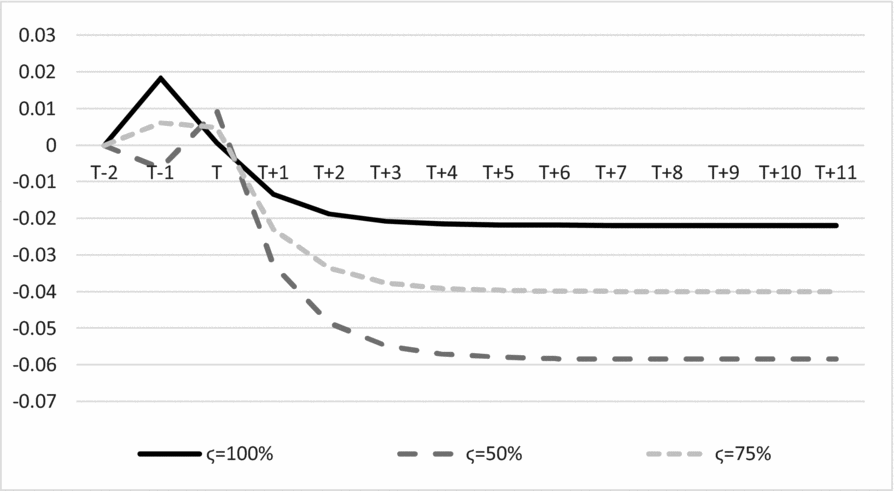
where η and δ are the fractions of legalized and deported undocumented workers, respectively. Imperfect substitution between undocumented and documented workers allows to account for an improved mobility of regularized workers. Moreover, legalized immigrants can have a lower productivity, denoted by a fraction ς ⩽ 1, than immigrants who entered the country legally. This allows to account for a negative selection of undocumented immigrants into the illegal status. In the benchmark results, legalized workers are perfect substitutes to legal immigrants (ς = 1). Different assumptions are discussed in Section 6.2.
An amnesty is obtained when a fraction δ = 0 of undocumented workers are deported and an exogenous fraction 0 < η ⩽ 1 of them are legalized.Footnote 16 With δ > η = 0, deportation occurs. The extreme case of a deportation of all the undocumented workers can be obtained with δ = 1 and η = 0. In addition, the model allows to account for an “attraction effect” of an amnesty e.g. a fraction of undocumented immigrants is legalized (η > 0), while additional undocumented immigrants enter the economy (δ < 0). This “attraction effect” might also materialize with a certain delay as new undocumented workers arrive after having observed an amnesty (i.e. one period later). The robustness of the results to this additional effect is checked in Section 6.1.
The impact of a policy shock on the lifetime utility of a representative j-type agent, born in period T, is given byFootnote 17
 $$\begin{equation}
\Delta U_{j,T} = U_{j,T}-U_{j,s}.
\end{equation}$$
This can be rewritten as
 $$\begin{eqnarray}
\Delta U_{j,T} &=&(1+\beta )\ln \left(1+\frac{\Delta \psi _{j,T}}{\psi _{j,s} }\right)+\beta \ln \left(1+\frac{\Delta R_{T+1}}{R_{s}}\right)\nonumber\\
&&-\,\Delta V_{j,T} \ \ \ \ \ \text{where}\ {\it j = hn,hm,ln,lm,li}.
\end{eqnarray}$$
Δψ j, T measures a j-type worker’s net income change, whereas the second term in equation (27) captures the variation in the interest factor. An amnesty and a deportation differ in how they impact the population structure. The latter affects wages, returns to savings, and the net fiscal contribution of all individuals. The different channels impacting a legal j-type agent’s intertemporal welfare (see equation (27)) are detailed below. The effects of an amnesty are then discussed in Section 3.3, whereas the effect of a deportation is analyzed in Section 3.4.
3.1. Short-Run Effects of a Policy Shock
In the short run, the capital stock K T is determined by the agents’ savings of the previous period. Given the assumptions of the model (i.e. that the pension transfer amount is constant), the retired agents in period T (born in T − 1) are only affected by the policy shock through the impact that it has on their return on savings:
 $$\begin{equation}
\Delta R_T=\alpha \left(\frac{\Delta {Q_{T}}}{K_T}\right)^{1-\alpha }.
\end{equation}$$
The numerator in equation (28) captures the change in the composition of the workforce, which depends on the evolution of the foreign-born labor aggregate ΔQ m, T = Q m, T − Q m, s :Footnote 18
 $$\begin{eqnarray}
\begin{array}{rcl}
\Delta Q_{m,T}&>&0 \displaystyle\Leftrightarrow (M_{l,s}+\varsigma \eta I_{l,s})^{\frac{\sigma _{M}-1}{\sigma _{M}}}-M_{l,s}^{\frac{\sigma _{M}-1}{\sigma _{M}}}\\[6pt] &>& \displaystyle\frac{1-\theta _m}{\theta _m} \left(I_{l,s}^{\frac{\sigma _{M}-1}{\sigma _{M}}}-(I_{l,s}(1-\eta -\delta ))^{\frac{\sigma _{M}-1}{\sigma _{M}}}\right). \end{array}
\end{eqnarray}$$
Proposition 1. In the case of an amnesty (with η > δ = 0), the sign of ΔQm, T depends on the parameter values. The higher is the legal immigrants’ relative productivity, the more likely the foreign-born labor aggregate is to increase (i.e. a higher θm implies a lower value of the right-hand side in equation (29)). This also applies to the relative productivity of legalized workers (the higher is ς, the higher is the left-hand side of the expression). Intuitively, regularized workers must at least provide the same productivity they had as undocumented workers for the labor aggregate to increase.
In the case of a deportation, it is straightforward to see that the foreign-born labor aggregate decreases (i.e. ΔQm, T < 0 because the left-hand side of equation (29) is 0; see Appendix B.3).
The fraction η of immigrants whose situation is regularized receives a higher wage and the same transfers as the legal immigrants (instead of the fraction Θ, they received as undocumented workers). The model implies, by construction, that the fiscal channel affects workers only and not the retired agents: the workers pay an income tax and the contribution to the pension system and receive public transfers. The retired generation benefits from the provision of the constant pension, to which legalized workers contribute to. Hence, retired agents (i.e. individuals born in T − 1) are only affected through the change in their savings’ return. For agents born in T, the policy impacts their net income when they are young in addition to the effect on the interest factor when they retire:
 $$\begin{eqnarray}
\begin{array}{ll} \Delta {\psi _{j,T}}= &(1-\tau _{T}^b-\tau _T^p)\Delta w_{j,T}-w_{j,T}(\Delta {\tau _T^b}+\Delta {\tau _T^p})+\frac{p}{R_{s}}\frac{\Delta R_{T+1}}{R_{T+1}} \ \ \ \text{for} \ j \ne i^{\ell } \\[4pt]
\Delta {\psi _{i,T}^{\ell }}= &(1-\tau _T^b-\tau _T^p)\Delta w_{i,T}- w_{i,s}(\Delta \tau _T^b+\Delta \tau _T^p+\tau _s^b(1-\nu ^b)\\[4pt]
&\quad+\,\tau _s^p(1-\nu ^p))+(1-\Theta )g+\frac{p}{R_{T+1}}, \end{array}
\end{eqnarray}$$
where Δw j, T = w j, T − w j, s represents the change in the j-type agents’ wage rate implied by a change in the population structure with a fixed capital stock. The following assumption is made on the values of the elasticities of substitution:
Assumption 1. In line with the existing literature [see Ottaviano and Peri (Reference Ottaviano and Peri2012); Edwards and Ortega (Reference Edwards and Francesc2016)], I assume that σH < σN = σE < σS.
This ensures that low-educated native workers’ wage rate (w l, n, t ) decreases with the size of the complementary low-educated foreign workforce (Q m, t ), whereas the high-educated native wage rate (w h, n, t ) increases (see Appendix B.4):
 $$\begin{equation}
\frac{\partial w_{l,n,t} }{\partial Q_{m,t}}<0 ; \ \frac{\partial w_{h,n,t}}{\partial Q_{m,t}}>0.
\end{equation}$$
A j-type worker’s net income is therefore affected by the policy’s impact on her gross wage rate and the net fiscal effect of the migration policy, reflected in the change of the income tax rate, Δτ b T , and the pension contribution rate, Δτ p T . Using the general notation, a migration policy affects these two rates as follows:
 $$\begin{equation}
\Delta {\tau _T^b} = \frac{g(\eta I_{s}-(\delta +\eta )\Theta I_{s})-\tau _T^b\Delta W_T^b}{W_{s}}, \\
\end{equation}$$
 $$\begin{equation}
\Delta {\tau _T^p} = \frac{p\eta I_{s}-\tau _T^p\Delta W_T^p}{W_{s}},
\end{equation}$$
where Wb s = N h, s w h, n, s + M h, s w h, m, s + N l, s w l, n, s + M l, s w l, m, s + ν b I l, s w l, i, s is the steady state taxable income base for the government budget and Wp s = N h, s w h, n, s + M h, s w h, m, s + N l, s w l, n, s + M l, s w l, m, s + ν p I l, s w l, i, s is the steady state taxable income base for the pension system. The first term in the numerator of equations (32) and (33) captures the change in the composition of the population entitled to the public transfer and the pension, respectively. The lower is the access of undocumented workers to public transfers (i.e. the lower is Θ), the higher is the regularization’s effect on the income tax rates. The second term in the numerator of equations (32) and (33) accounts for the change in the taxable income base due to the evolution of the population structure. The taxable income base is affected by the change in the wage rates of all documented workers and the change in the taxable income of the undocumented workers (i.e. the second line in equations (34) and (35)):
 $$\begin{eqnarray}
\begin{array}{ll} \Delta W_T^b= &N_{h,s}\Delta {w_{h,n,T}}+M_{h,s}\Delta {w_{h,m,T}}+N_{l,s}\Delta w_{l,n,T}+M_{l,s}\Delta {w_{l,m,T}}\\
&+\,I_{l,s}(w_{\ell ,T}\eta +(1-\eta -\delta )\nu ^b w_{l,i,T}-(\eta +\delta ) \nu ^b w_{l,i,s}) \end{array}
\end{eqnarray}$$
and
 $$\begin{eqnarray}
\begin{array}{ll} \Delta W_T^p= &N_{h,s}\Delta {w_{h,n,T}}+M_{h,s}\Delta {w_{h,m,T}}+N_{l,s}\Delta w_{l,n,T}+M_{l,s}\Delta {w_{l,m,T}}\\
&+\,I_{l,s}(w_{\ell ,T}\eta +(1-\eta -\delta )\nu ^p w_{l,i,T}-(\eta +\delta ) \nu ^p w_{l,i,s}) . \end{array}
\end{eqnarray}$$
The taxable income of the undocumented workers (i.e. the second line in equations (34) and (35)) is affected by three elements. The first captures the increase in the taxable income base due to the legalized workers (who receive wage w ℓ, T ). The second term represents the taxable income of the remaining undocumented workers, whereas the third term captures the loss of taxable income due to an amnesty or a deportation of undocumented workers. The fiscal impact of a migration policy results from the effects implied by the change in the population structure on the taxable income base and the net fiscal contribution of legalized agents (i.e. whether the additional taxes that they pay compensate for the additional transfers that they perceive, see equations (32) and (33)). A larger taxable income base (with ΔWx T > 0 for x = b, p) decreases the income tax rate, τ b T , and the pension contribution rate, τ p T , respectively.
3.2. Long-Run Effects
Each policy considered in this paper is by assumption a one-time shock (i.e. a “one-shot” policy) and no further changes in the population structure occur after the shock.Footnote 19 Under a constant population structure, the long-run effects in any of the two policy scenarios depend entirely on the capital accumulation dynamics that it generates. The difference in the inter-temporal welfare of two subsequent generations (not directly affected by the shock) is therefore exclusively due to the different capital levels and its implications (on income and taxation). In the post-shock periods, the disposable income of a legal j-type agent adjusts compared to the one of the previous generation:
 $$\begin{eqnarray}
\Delta \psi _{j,T+z}&=&(1-\tau _{T+z}^b-\tau _{T+z}^p)\Delta w_{j,T+z}-(\Delta \tau _{T+z}^b+\Delta \tau _{T+z}^p)w_{j,T+z-1}\nonumber\\
&&+\,\frac{p}{R_{t+z}}\frac{\Delta R_{T+z}}{R_{T+z}} \ \ \ \text{with} \ z\ge 2.
\end{eqnarray}$$
Under a constant population, the wage rates (the interest factor) increase (decreases) with the capital level. A higher capital accumulation implied by a policy shock thus leads to higher gross wages and a lower interest factor for the following generations. The tax rates decrease with the taxable income base:
 $$\begin{equation}
\Delta \tau _{T+z}^x=-\frac{\tau _{T+z-1}^x \Delta {W_{T+z}}}{W_{T+z}} \ \ \ \text{with} \ z\ge 2 \ {\it {\rm and}\ x = b, p}.
\end{equation}$$
The evolution of a j-type agent’s disposable income (given by equation (36)) is thus linked to the change in the total labor aggregate.
3.3. The Case of an Amnesty
An amnesty implies a change in the regularized workers’ gross wage (which is likely to increase) and provides them a full access to public transfers. Simultaneously, legalized immigrants must comply to the payment of all income taxes and pension contributions.
The impact of a regularization on the labor aggregate is not clear (see Proposition 1). If the latter increases, the capital–labor ratio decreases in the short run (i.e. at constant capital stock) which leads to higher returns on the retired individuals’ savings. The less-educated workers earn lower gross wages, whereas the highly educated workers benefit from higher wages. The fiscal impact of the amnesty depends on the change in the net contribution of undocumented workers and the taxable income of the legal workers. Income taxes used for the public transfer can decrease if the additional taxes levied on the legalized workers compensate for their additional transfers. Undocumented workers are net contributors to the pension system (from which they cannot benefit). When the amnesty occurs in T, the legalized workers contribute to finance the pensions of the retired individuals and hence τ p T is certain to decrease (which benefits legal workers). However, legalized individuals benefit from a pension when they are old, which weights on the next generation of workers and impacts the contribution rate that the latter have to pay (τ p T + 1).
The generation born after the period in which the shock occurs, (T + 1) faces a capital stock which was built up by the previous generation’s savings. These increase if the additional income received by the legalized and the highly educated workers compensates the decrease of the less-educated workers' income. A higher capital accumulation implies an increase in wages which can partially counterbalance the impact of the change in the population structure. The net effect of an amnesty depends on the combination of these different effects.
3.4. The Case of a Deportation
The deportation of a fraction δ of the undocumented workers decreases labor in efficiency units (see Proposition 1).Footnote 20 Thus, the capital–labor ratio decreases and reduces the return on the retired individuals’ savings. The latter are therefore certain to lose from the deportation of undocumented workers. The lower workforce implies, under Assumption (1), a decrease (increase) in the high-educated (low-educated) workers’ wages. The fiscal impact of a deportation depends on the net contribution of the deported workers and their impact on the taxable income of remaining workers. If the deported workers were net contributors to the government budget, a deportation is likely to increase the income tax rate τ b T . The contribution rate to the pension system, τ p T , is certain to increase as undocumented workers are net contributors. The deportation of these net contributors is not compensated by an increase in the taxable income base.
The generation born after the period in which the shock occurs, (T + 1) faces a capital stock which was built up by the previous generation’s savings. Although less-educated workers earn higher wages, these cannot compensate the loss of the undocumented workforce and the lower wages of highly educated workers. The lower capital accumulation that follows decreases wages in the long run. The net effect of a deportation depends on the combination of these different effects.
4. SIMULATIONS
In this section, I calibrate the model to the United States, based on data for the year 2014, in order to illustrate the theoretical results presented in Section 3. Section 4.1 presents the benchmark results for an amnesty and Section 4.2 the benchmark results for a deportation.
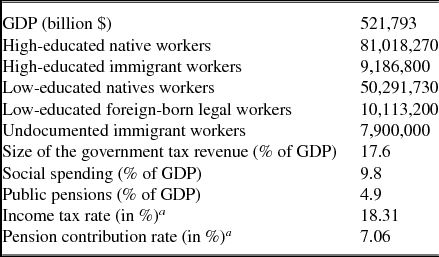
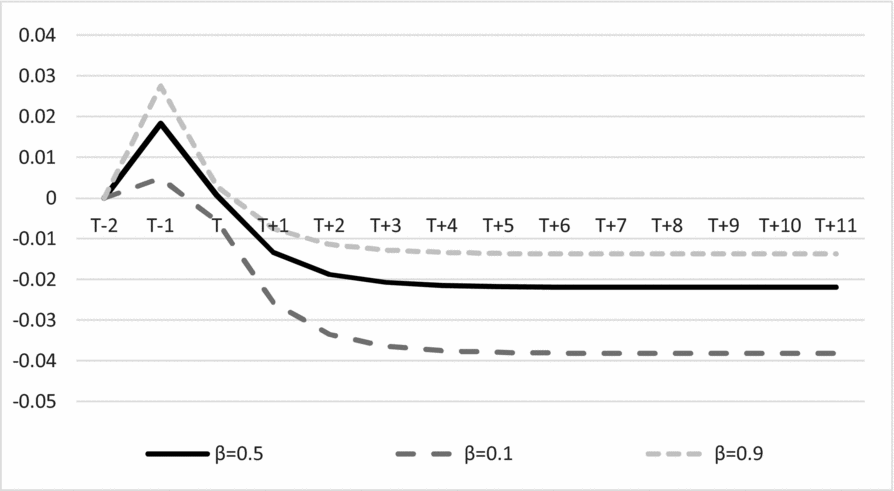
One period is assumed to last 30 years. Data on the composition of the workforce by country of birth is gathered from Passel and Cohn (Reference Passel and Cohn2016) and the latest issue of the “Statistical Portrait of the Foreign-Born Population in the United States” [Brown and Stepler (Reference Brown and Stepler2016)].Footnote 21 The workforce is given by the number of employed workers in 2014 and is composed of 131,310,000 native and 27,200,000 foreign-born workers. Passel and Cohn (Reference Passel and Cohn2016) estimate that 7,900,000 foreign-born workers are undocumented, whereas 19,300,000 have a legal status. The foreign-born undocumented workers therefore represent approximately 5% of the total, and 30% of all foreign-born workers, respectively.Footnote 22 In order to obtain the skill distribution of the workforce, I apply the educational attainment of the resident population aged 25+ provided in Brown and Stepler (Reference Brown and Stepler2016) to the labor-force, excluding the undocumented workers which are all assumed to be low skilled. This yields 9,186,800 tertiary-educated immigrant workers (i.e. 47.6% of the total legal foreign-born workforce) and 10,113,200 less-educated legal immigrant workers. 61.7% of natives have at least some tertiary education, which implies 81,018,270 highly educated and 50,291,730 less-educated natives.
GDP data and composition are taken from the Bureau of Economic Analysis Statistics [BEA (2017b)]. The US GDP was 17,393.1 billion $ in 2014. I multiply this figure by 30 in order to account for the period’s duration.Footnote 23 The discount factor β is fixed to 0.5 in order to approximate the share of resident consumption, whereas the share of total government expenditures is set to 17.6% of the GDP in 2014 [BEA (2017a)].Footnote 24 The public funds are either distributed as transfers or used for public consumption, which does not directly affect the agents’ income and utility. A generous transfer system implies a lower public consumption. The share of consumption expenditures on total current expenditures is 44.1% [BEA (2017c); approximately 7.8% of the GDP] and hence 55.9% of the public income is transferred to individuals (i.e 17.6%–7.8% = 9.8% of the GDP). In order to split these transfers between workers and retired individuals, I divide the total expenditures from the Old-Age, Survivors, and Disability Insurance Trust Fund [Social Security Administration (2017)] by the total amount of transfers given to agents. This gives a share of 50.41% of the transfers distributed to retired individuals as a pension (whereas the remaining 49.59% are distributed to workers). I use a 50%–50% split in the benchmark and test the impact of changing this assumption in Section 5. The constant per capita transfer and the public pension are
 $$\begin{equation}
g = \frac{\phi ^b Y_t}{N_{h,t}^t+M_{h,t}^t+N_{l,t}^t+M_{l,t}^t+\Theta I_{l,t}^t}, \\
\end{equation}$$
 $$\begin{equation}
p = \frac{\phi ^p Y_t}{N_{h,t}^{t-1}+M_{h,t}^{t-1}+N_{l,t}^{t-1}+M_{l,t}^{t-1}},
\end{equation}$$
where ϕ b = ϕ p = 0.098 · 0.5 = 0.049 denote the share of GDP devoted as a transfer to the workers and the retirees, respectively, and the superscript (t or t − 1) denotes the agents’ period of birth. Finally, the income tax rate, τ b t , and the pension contribution rate, τ p t , are set to balance the government budget and the pension fund. As shown in Table 1, the resulting values are τ b = 18.31% and τ p = 7.06%, respectively.Footnote 25
Data used in the model for the United States

Sources: BEA (2017a, 2017b, 2017c), Brown and Stepler (Reference Brown and Stepler2016), and a author’s own calculations.
The access of undocumented workers to public services (i.e. transfers) and their partial compliance to tax payments are crucial in order to determine the fiscal impact of migration policies. ITEP (2016) assumes an income tax compliance rate of 50% in order to evaluate the undocumented immigrants’ contribution to state and local taxes (see also the references therein). They obtain an effective tax rate of undocumented workers of 8%. I assume the same compliance rate of 50% (which is equivalent to assuming that all undocumented workers pay half the income tax rate of documented workers; ν b = 0.5) and obtain an effective tax rate of 9.2%. The Social Security Administration (2013) estimates the net contribution of undocumented workers to the Old Age, Survivors and Disability Insurance program (OASDI) to approximately 12 billion $ in 2010. Assuming a compliance rate of 50% of undocumented workers to the pension contributions, ν p = 0.5, implies a net contribution of 7.9 billion $ in the benchmark calibration of the model. Hence, income taxes are slightly overestimated, whereas pension contributions are likely to be underestimated in the benchmark. The compliance to income taxation and pension contributions is varied in Section 5 as a robustness check. The proportion of transfers to which an undocumented agent qualifies for is hardly quantifiable as, by definition, undocumented immigrants are in general not entitled to public support. Nevertheless, in many developed countries, several exceptions exist, like urgent medical care provision or children’s school enrollment. However, fear of being reported by public servants may reduce the application of undocumented immigrants to benefits they could, at least in theory, benefit from. In order to reflect the cost imposed by undocumented immigrants on the budget, they are assumed to receive 30% of the public transfer (i.e. Θ = 0.3) in the benchmark, whereas Section 5 assesses the impact of varying this value on the results.
The capital’s share of output α is set to 0.3 and the elasticities of substitution are taken from the literature.Footnote 26 The estimates for σ H range from 1.3 [Borjas (Reference Borjas2003)] and 1.5 [Katz and Murphy (Reference Katz and Murphy1992)] to 2 [Angrist (Reference Angrist1995)] and 3 [Ottaviano and Peri (Reference Ottaviano and Peri2012)]. The values for σ N , the substitutability between native and foreign-born agents belonging to the same skill group, range from 6 [Manacorda et al. (Reference Manacorda, Manning and Wadsworth2008)] over 20 [Ottaviano and Peri (Reference Ottaviano and Peri2012), Card (Reference Card2009) for the United States and D’Amuri et al. (Reference D’Amuri, Ottaviano and Peri2010) for Germany] to infinity [Borjas et al. (Reference Borjas, Grogger and Hanson2008)] depending on the assumptions and data used.Footnote 27 To the best of my knowledge, no estimator has been provided for the elasticity of substitution between documented and undocumented workers in the literature. I follow the strategy in Edwards and Ortega (Reference Edwards and Francesc2016) and set it to σ M = 1,000. In the benchmark estimation, I follow Ottaviano and Peri (Reference Ottaviano and Peri2012) and Edwards and Ortega (Reference Edwards and Francesc2016) and use σ H = 3, σ E = σ N = 20, and σ M = 1,000. Robustness checks in Section 5.3 highlight the impact that different values have on the results.
The relative productivity parameter for highly educated agents (θ h ) is calibrated in order to match a skill-premium between highly and less-educated native workers of 80%. This corresponds approximately to the difference in weekly wages of U.S. natives in the “Professional and business services” sector relative to the weekly average in the “Agriculture” sector [see Table 3 in Edwards and Ortega (Reference Edwards and Francesc2016)]. The relative productivity parameter between highly educated natives and immigrants (θ e ) is calibrated such that both types of workers earn the same wage [as it is the case for the “Professional and business services” sector; see Table 3 in Edwards and Ortega (Reference Edwards and Francesc2016)]. Given that the model does not consider skill upgrading by regularized workers (i.e. regularized workers cannot take high-skill jobs), the labor aggregate of highly educated workers is not affected by the policy shock and hence this assumption has no impact on the results (as shown in Appendix D.1). The relative productivity parameter of less-educated natives (θ n ) is calibrated in order to match a wage premium of 20% over legal immigrants. This is roughly the wage premium observed for natives in the “Construction” sector [see Table 3 in Edwards and Ortega (Reference Edwards and Francesc2016)].Footnote 28 The financial cost imposed by the undocumented labor status on workers is still debated in the literature. Kossoudji and Cobb-Clark (Reference Kossoudji and Cobb-Clark2002) estimate, from panel data on legalized immigrants, a wage penalty of 14% to 24% for undocumented workers due to their status. Taking into account national origins, Borjas and Tienda (Reference Borjas and Tienda1993) find that the legal workers earn up to 30% higher wages in similar positions. I calibrate θ m in order to match a status premium of 60% between documented and undocumented workers, which is approximately the premium observed in the “Construction” sector [see Table 3 in Edwards and Ortega (Reference Edwards and Francesc2016)]. The values obtained for the relative productivity parameters are θ h = 0.6444, θ e = 0.5272, θ n = 0.4456, and θ m = 0.6154. I check the robustness of the results by varying the wage premia in Appendix D.1. Table 1 summarizes the data used for the simulations.
4.1. The Impact of an Amnesty – Benchmark Results
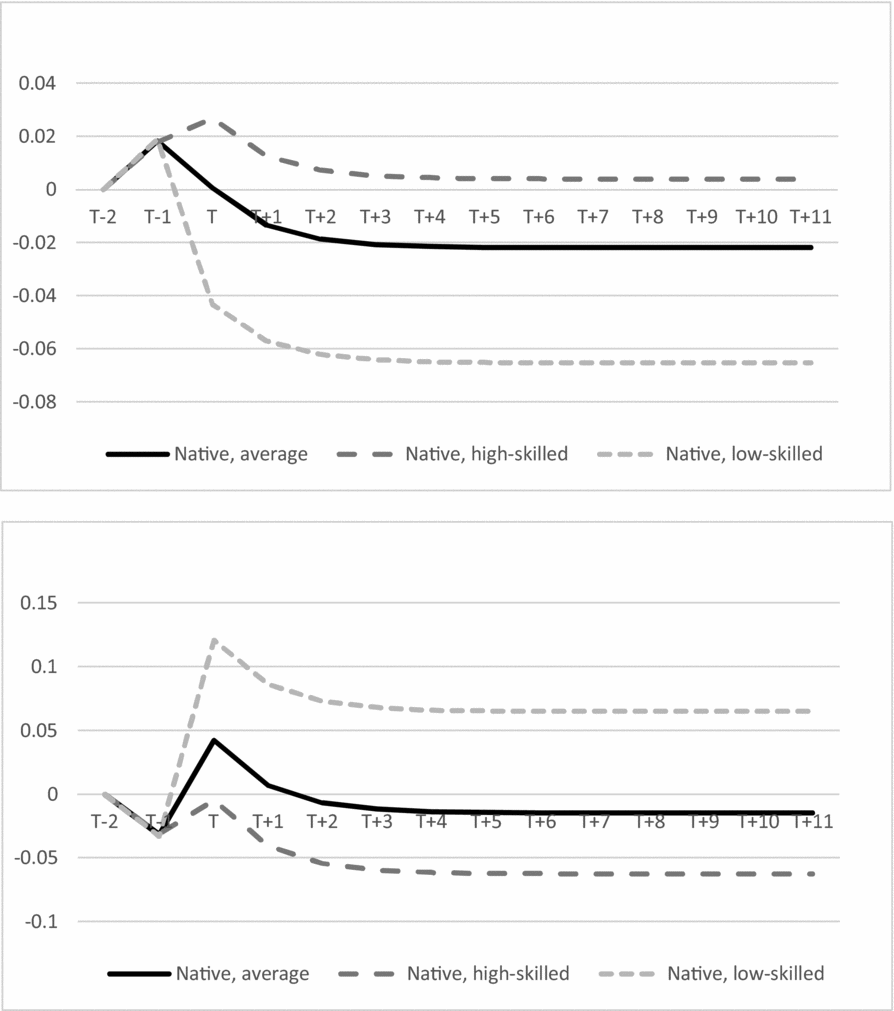
In the benchmark amnesty scenario, it is assumed that 100% of the undocumented workers are regularized (η = 1, δ = 0). Even though a 100% legalization rate is never observed in reality [Levinson (Reference Levinson2005)], this scenario allows to highlight the potential upper-bound effects of an amnesty. Figure 1 shows the impact of a migration policy on the lifetime utility of a low- and high-skilled native, born in period t, respectively. The average native’s welfare, accounting for the skill structure of the native population, is also provided. Each curve represents the deviation of the lifetime utility of an individual born in t relative to the baseline scenario where no shock occurs, as shown in equation (26). The shock occurs in period T.
Effects of a migration policy: amnesty and deportation. (a) Amnesty. (b) Deportation. Effect of a migration policy (an amnesty in Figure 1a and a deportation in Figure 1b) on the lifetime utility of a low-educated, high-educated, and average native individual born in t (horizontal axis). The policy shock occurs at time T and the reference steady state utility belongs to the generation born in period T − 2 (i.e. that is not affected by the policy shock).

Figure 1a shows that the impact of a complete amnesty on natives’ lifetime utility is generally limited, with the change lying between −0.07% and +0.03%. The retired agents in period T, born in period T − 1, benefit from a higher return on their savings due to the lower capital–labor ratio implied by the increase in the labor aggregate [see equation (28)]. This translates into a higher lifetime utility compared to the baseline scenario (i.e. without an amnesty). The workers born in period T, in which the shock occurs, are impacted through several channels. The increase of the labor aggregate decreases less-educated workers’ wages by 1%. The lower wages of the less-educated natives are however more than compensated by the higher wages of the highly educated natives (+0.05%) and the regularized individuals. The taxable income base therefore increases, which reduces the income tax rate (−0.054 percentage points). In the period of the shock, legalized individuals contribute to finance the pension of retired individuals without yet imposing a cost on the system (as they perceive pensions only one period later). The pension contribution rate decreases by 0.12 percentage points.
The higher income base implies a higher capital accumulation in the long run. However, the capital–labor ratio remains below the baseline level which translates into a higher interest rate and lower wage rates. In addition, under a constant population structure, the increase in taxable income base leads to a lower income tax rate, τ b . On the other hand, the fact that legalized individuals in period T have access to pensions in period T + 1 increases the pension contribution rate τ p . The combination of these different channels leads to a slight increase in highly educated natives’ welfare in the long run. The negative impact on wages dominates the other channels for the less-educated natives, such that their lifetime utility decreases compared to the baseline scenario.
4.2. The Impact of a Deportation – Benchmark Results
In the benchmark deportation scenario, it is assumed that 100% of the undocumented workers are expelled (η = 0, δ = 1). This rather extreme assumption allows to compare this policy to a complete amnesty. The change in the total number of workers (and thereby the labor aggregate) at time T constitutes the main difference between a deportation and an amnesty. Note that tracking and expelling undocumented residents is done at no cost such that the impact of a deportation should be seen as a lower bound.
Figure 1b shows that the impact of a deportation on a native agent’s lifetime utility ranges between −0.07% and +0.12%. Decreasing the size of the workforce through a deportation of the whole undocumented workforce decreases the capital–labor ratio. This decreases the interest factor that retired individuals (in period T) receive on their savings. Less-educated native and immigrant workers benefit from an increase of 1.9% and 3.9% in their respective wages. The high-skilled wage decreases by 0.1%. Even though undocumented workers are net contributors to the government budget, the income tax rate τ b decreases in the short run (−0.037 percentage points) due to the increase in less-educated workers’ wages. This decrease is however lower than under an amnesty. The pension contribution rate increases in period T, as undocumented workers are net contributors to the pension system.
In the long run, capital accumulates less than under the baseline scenario, implying a lower (higher) increase (decrease) in less-educated (highly educated) workers’ wages. The lower capital–labor ratio also implies a slightly higher interest factor. The higher wages of less-educated workers are however not enough to compensate for the loss of the undocumented workers’ fiscal contribution, such that the income tax rate and the pension contribution rate are higher in the long run. The combination of these different elements leads to an improvement of less-educated natives’ welfare in the long run, whereas highly educated natives experience a welfare loss. The average native’s welfare is also below the baseline scenario (i.e. without a policy shock).
5. SENSITIVITY ANALYSIS
This section analyzes the robustness of the benchmark amnesty results to a change in different characteristics of the economy.Footnote 29 Section 5.1 changes the structure of the government budget along different dimensions. These include the share of public consumption, the amount of the pension, the compliance of undocumented workers to the payment of income taxes and pension contributions and the undocumented workers’ access to the public transfers. Section 5.2 changes the number of undocumented immigrants affected by a policy using several variants, whereas Section 5.3 analyzes the impact of different elasticities of substitution. Section 6 reviews some additional mechanisms absent in the benchmark model.
5.1. Structure of the Government Budget
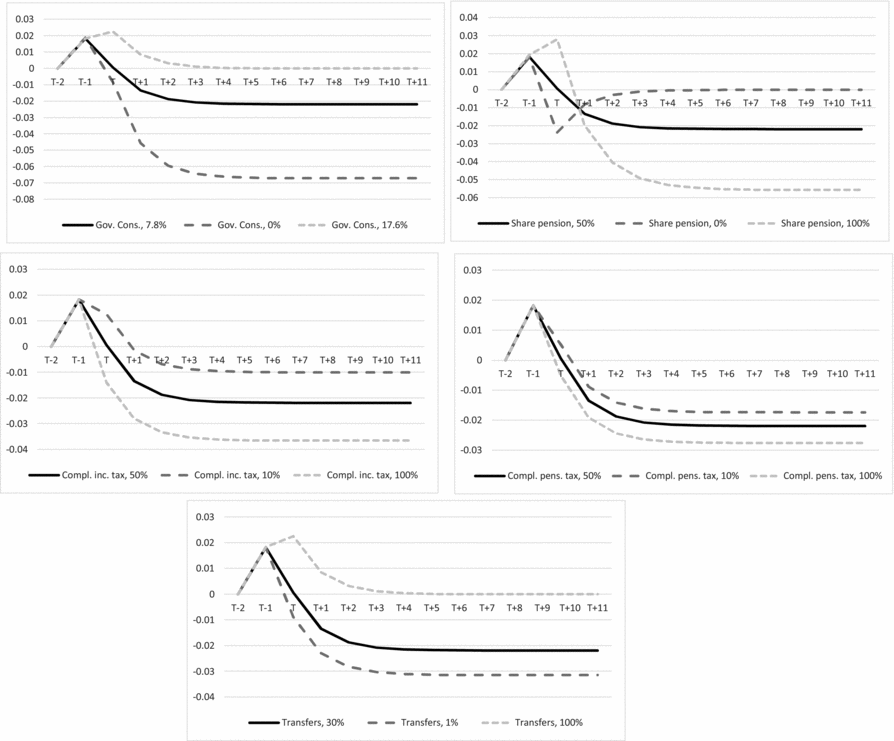
Figure 2 depicts how changing various key parameters of the model affects the impact of an amnesty on the average native’s welfare. This captures the role played individually by each parameter and allows a deeper understanding of the mechanisms at hand. The following results relate to a full liberalization, if not stated otherwise.
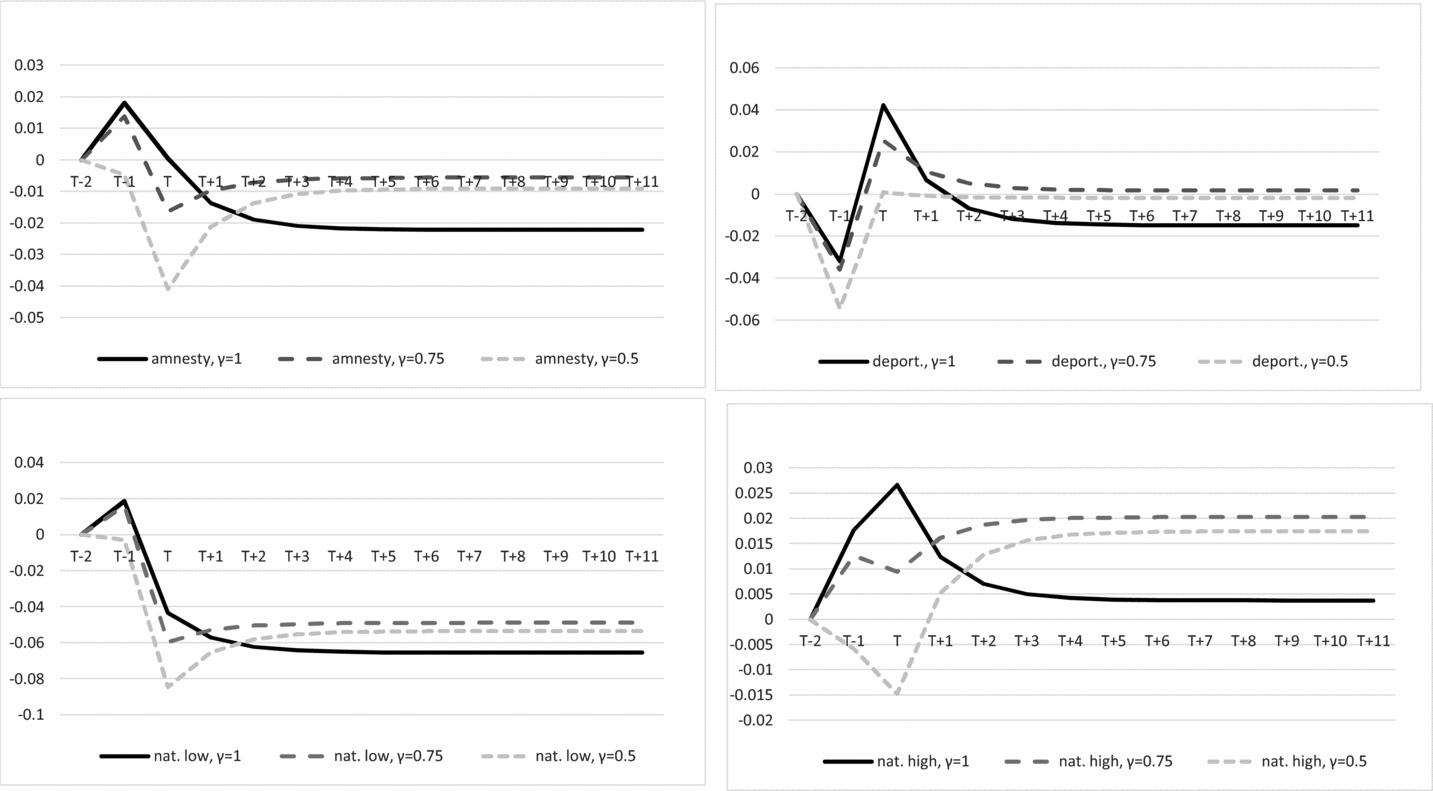
Robustness to a change in the structure of public finances. (a) Public consumption (as % of GDP) (b) Share of public funds devoted to pensions. (c) Contribution to the government budget (ν b ). Contribution to the pension system (ν p ). (e) Discrimination in the access to transfers (Θ). Note: Sensitivity of an average native’s welfare (born in period t) to a change in different parameters defining the structure of the public finances with an amnesty occurring at time T.

Figure 2a highlights the effects of an amnesty for different values of the public consumption (expressed as % of GDP). The 0% line shows the case where no public funds are consumed (and hence all income taxes are transferred to the agents), whereas the 17.6% line captures the case where the whole government budget is consumed (and hence the agents receive no transfers or pensions). In the latter case, the new steady state welfare is slightly above the initial value. Legalizing workers implies a higher income tax base in this case, which serves to finance the infrastructure (i.e. a fixed cost which does not enter the utility function of the representative agent). Legalized workers do not receive any form of transfers but fully contribute to the public expenses (due to full compliance to the payment of income taxes) which reduces the tax burden on native workers. On the other hand, if the whole budget is spent on transfers, average native welfare decreases more than under the benchmark calibration. The reason is that the regularized workers’ net contribution is lower. As undocumented workers, they subsidize the legal workers’ transfers. Once regularized, they have access to the same transfer amount.
Figure 2b highlights the impact of an amnesty under different assumptions for the share of public funds devoted to pensions (i.e. transfers to the retired generation). In the absence of a pension system, the complete fiscal impact of undocumented workers falls on the general government budget, which is composed of a structural expense and transfers to the workers (i.e. a unique intra-generational transfer). The income tax rate increases in the short run as the increase of the legalized individuals’ wages is not enough to compensate for the additional transfers that they perceive and the impact that they have on legal workers’ wages. Individuals born at the period of the shock are particularly harmed. However, capital accumulation implies that the average native worker is better off in the long run. A full dedication of public transfers to the pensions (i.e. a unique inter-generational transfer), substantially decreases the pension contribution rate τ p T used to finance pensions in the period of the shock, which improves the native agent’s welfare beyond the benchmark level. However, once they retire, the regularized individuals have access to the full pension and thus total pension expenses exceed the benchmark level. Hence, average native welfare is below the benchmark level in the long run.
Figure 2c shows the impact of varying the undocumented workers’ compliance to income taxation (ν b ) while keeping compliance to the pension contributions (ν p ) at 50%. If only 10% of undocumented workers pay income taxes, a complete amnesty has a stronger positive impact on the government budget due to the full compliance to income taxation that it generates. If undocumented workers already fully comply to income taxes, a legalization generates a higher fiscal burden, as the legalized individuals benefit from full access to public transfers while their contribution only increases due to their higher wages. Average welfare is therefore lower in the full compliance scenario. Figure 2d shows the impact of varying the undocumented workers compliance to the pension contributions (ν p ) while keeping compliance to income taxation (ν b ) at 50%. The pension system differs from the general government budget because undocumented workers contribute to the fund without being able to perceive any transfer from it (i.e. they are net contributors). The lower is the initial compliance rate, the higher is the additional contribution to the system at the period of the shock (as legalized workers only perceive the pension one period later) and the stronger is the decrease in the pension contribution rate. This explains why the impact of an amnesty is less negative under low compliance than in the benchmark. If undocumented workers fully comply to the payment of pension contributions, a legalization affects the pension system only through its impact on wages. The increase of legalized workers’ wages can compensate for the decrease of the legal workers’ wages, thereby leading to a reduction of the taxation rate, which is however smaller than in the benchmark.
Figure 2e shows the importance of undocumented immigrants’ access to the public transfer. The higher is availability of public support for undocumented workers, the lower is the fiscal effect of a regularization given that it generates a lower additional fiscal burden and a higher taxable income base. If undocumented workers receive only 1% of the transfers prior to regularization (Θ= 0.01), the average native loses at most 0.03% of her welfare with regularization. On the other hand, the absence of discrimination in the access to public transfers (Θ = 1) leads to a pure increase in the fiscal base. The decrease in the income tax rate is enough to compensate for the lower wages of less-educated native workers such that native workers’ net income is higher in the long run. Thus, the average native’s welfare level is above the benchmark amnesty and close to the baseline value.Footnote 30
5.2. Number of Undocumented Immigrants
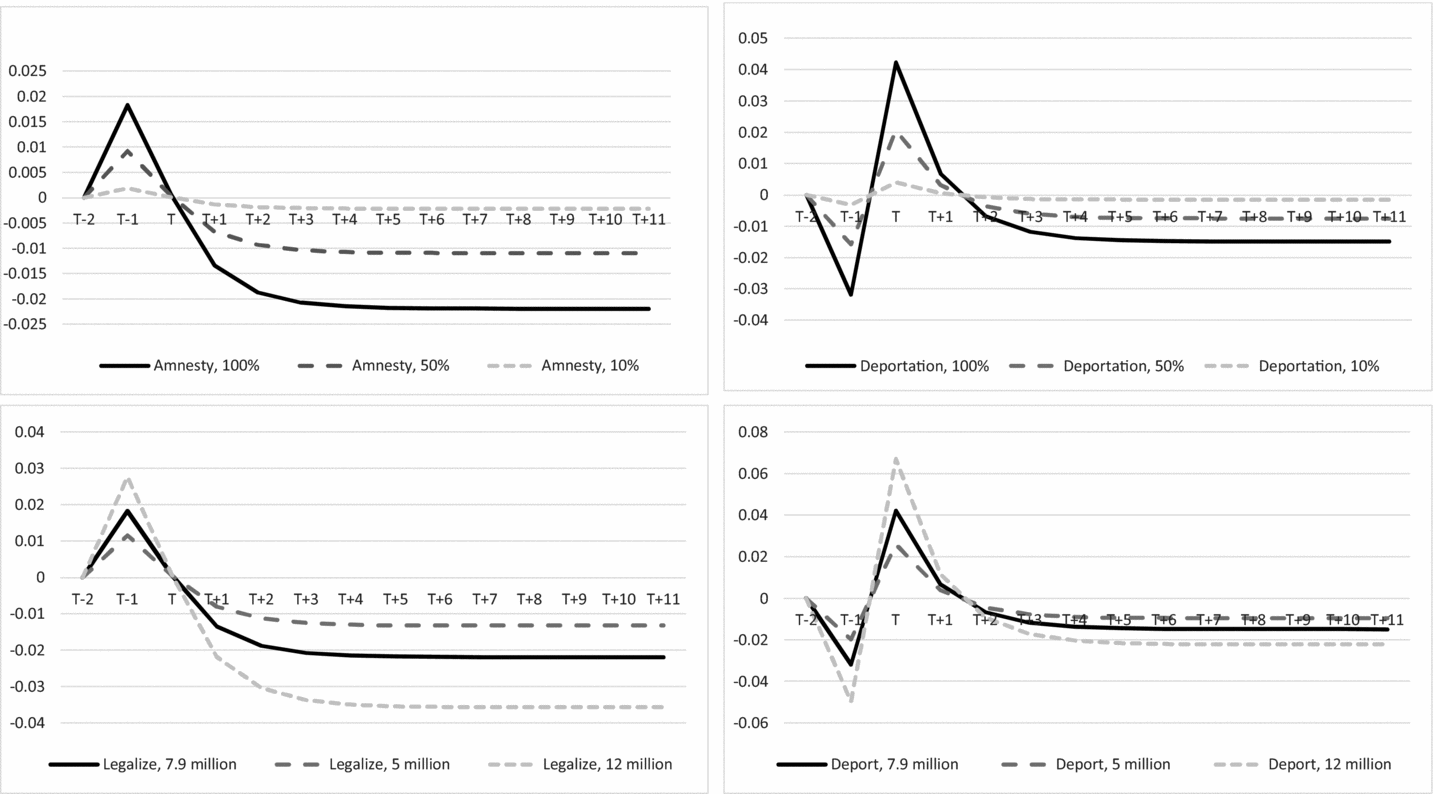
Figure 3 analyzes the impact of changing the number of undocumented workers affected by a policy. Figures 3a and 3b show the effect on average native welfare of regularizing or deporting a lower fraction of the undocumented workers, respectively. Reducing the share of the 7.9 million undocumented individuals affected by the policy mitigates its impact. The average retired and working native benefit less from an amnesty, whereas the long-term impact is less negative than under a full amnesty. In the case of a deportation, the average retired individual (i.e. born in T − 1) experiences a lower decrease in welfare, whereas the average native worker benefits less from it. The long-run average welfare level is also above the benchmark one. In Figures 3c and 3d, the two shocks are simulated in the benchmark economy with a lower (5 million) or a higher (12 million) number of undocumented workers. The results for both scenarios with a lower number of undocumented immigrants follow the same rationale as the scenarios presented in Figures 3a and 3b (i.e. a mitigation of the policy’s impact). A higher number of undocumented workers amplifies the effects observed in the benchmark. A legalization of 12 million undocumented workers increases benefits to retired individuals but decreases benefits to the workers and the long-run average native welfare level. A deportation of the same number of individuals, decreases retired individuals’ welfare but increases that of the native workers. Reduced capital accumulation however implies a long-run welfare level below the benchmark one.
Robustness to a change in the number of undocumented workers. (a) Proportion of regularized. (b) Proportion of deported. (c) Amnesty – Number of undocumented workers. (d) Deportation – Number of undocumented workers. Note: Sensitivity of an average native’s welfare (born in period t) to a change in the number of undocumented workers affected by a policy shock occurring at time T.

5.3. Sensitivity to the Elasticity of Substitution
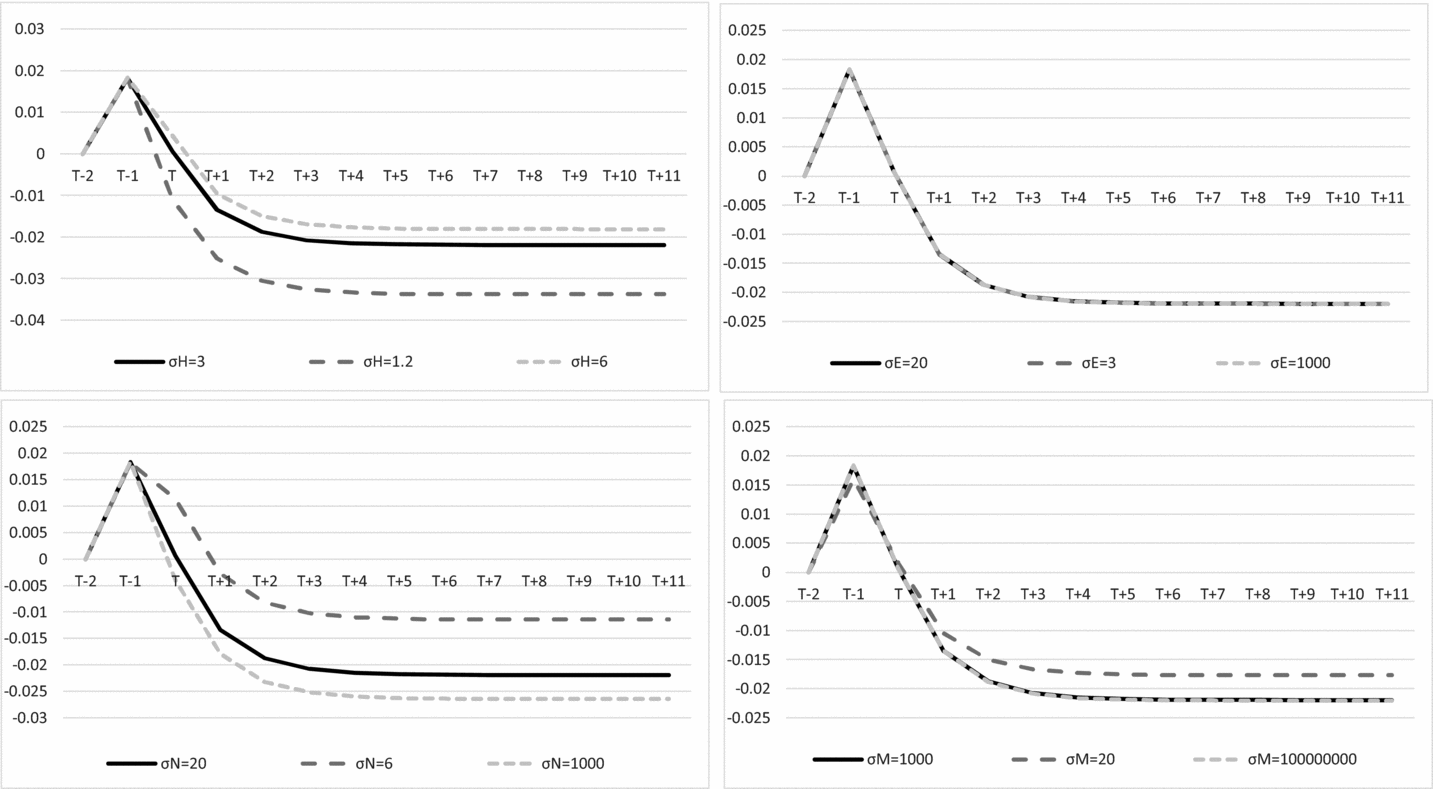
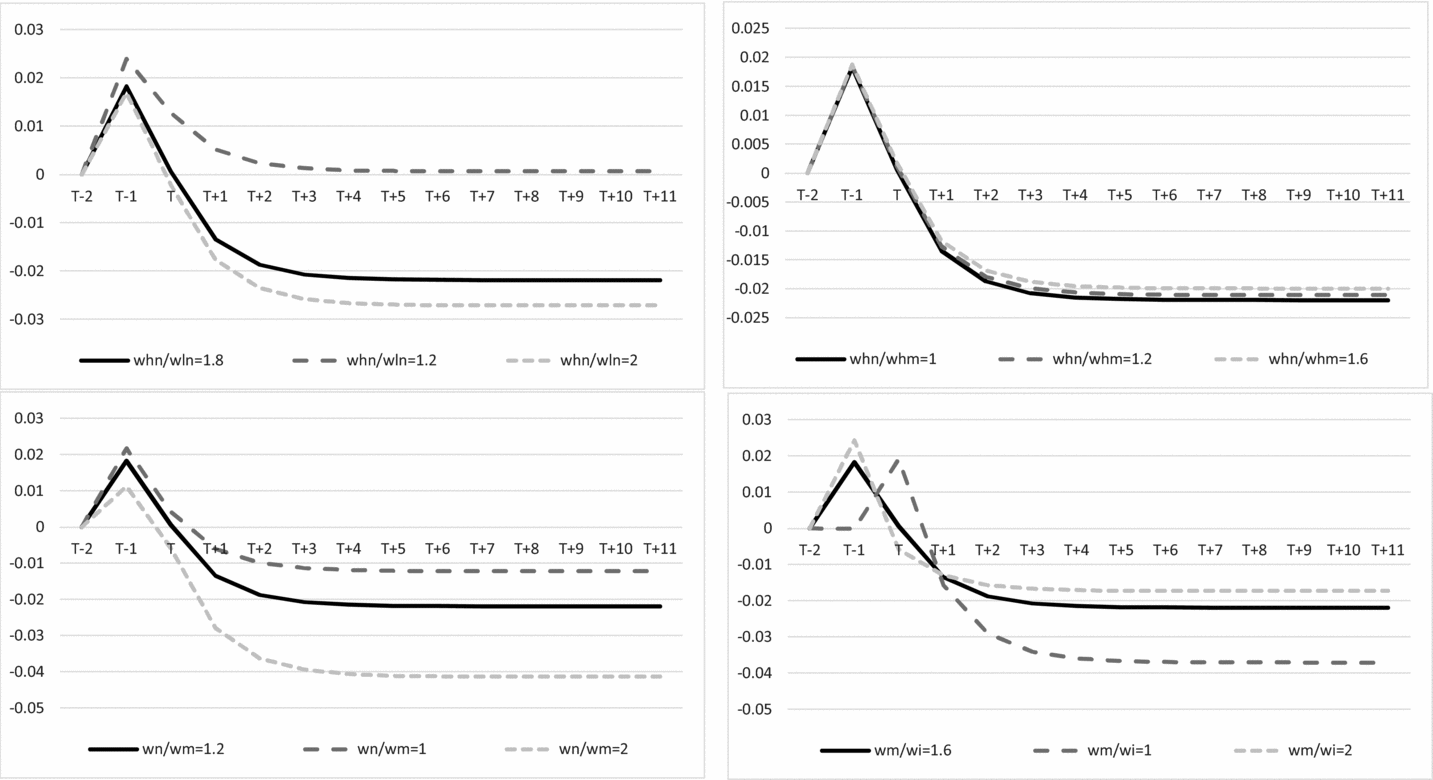
Figure 4 underlines the impact of changing the different elasticities of substitution. In each alternative scenario, the value of one of the four elasticities is varied while the remaining three elasticities are kept at their respective benchmark level (which are σ H = 3, σ E = σ N = 20, and σ M = 1, 000). Note that all the combinations of the elasticities of substitution respect Assumption (1). The values chosen are in general quite extreme and do not necessarily rely on estimations from the empirical literature. The purpose of this section is to highlight to what extent varying the values of these elasticities can change the results.
Robustness to a change in the elasticities of substitution. (a) Change in σ H . (b) Change in σ E . (c) Change in σ N . (d) Change in σ M . Sensitivity of an average native’s welfare (born in period t) to the change in the elasticities of substitution with an amnesty occurring at time T.

Figure 4a shows that a higher substitutability between less and highly educated workers (i.e. a higher σ H ) reduces the negative impact of a policy affecting the composition of the less-educated immigrant labor aggregate. In this case, the labor aggregate increases more than in the benchmark. High-skilled wages increase less, whereas less-educated wages decrease less. However, the interest rate increases and the income tax rate decreases slightly more relative to the benchmark simulation. Figure 4b highlights that the elasticity of substitution between highly educated natives and immigrants does not impact the results because the high-skill labor aggregate is not directly affected by a migration policy focusing on less-educated immigrants. The elasticity between less-educated natives and immigrants is of particular importance (see Figure 4c). A low value of σ N implies a high complementarity between less-educated natives and immigrants, which mitigates the decrease of less-educated natives’ wages [as it is the case for σ N = 6, which is the lowest value estimated in the literature, see Manacorda et al. (Reference Manacorda, Manning and Wadsworth2008)] and their long-run welfare loss.
The most disputable calibration choice is the value for the elasticity of substitution between legal and undocumented foreign-born workers, which has not been estimated in the literature so far. I follow the strategy of Edwards and Ortega (Reference Edwards and Francesc2016) and set a high initial value for this parameter (σ M = 1, 000). This value is already so high that increasing it further barely affects natives’ welfare. However, if a higher complementarity is assumed, with σ M = 20, the less-educated natives’ wages decrease less, whereas the highly educated natives’ wages increase more than in the benchmark scenario. Capital accumulation therefore increases which leads to a higher long-run average welfare level.
6. ADDITIONAL MECHANISMS
This section discusses three additional mechanisms absent in the benchmark model. Section 6.1 analyzes the impact of population dynamics. Section 6.2 accounts for a lower productivity of legalized workers, whereas Section 6.3 assumes that undocumented immigrants are discriminated on the labor market.
6.1. Population Dynamics
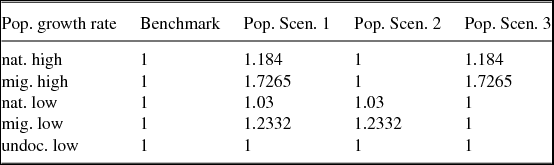
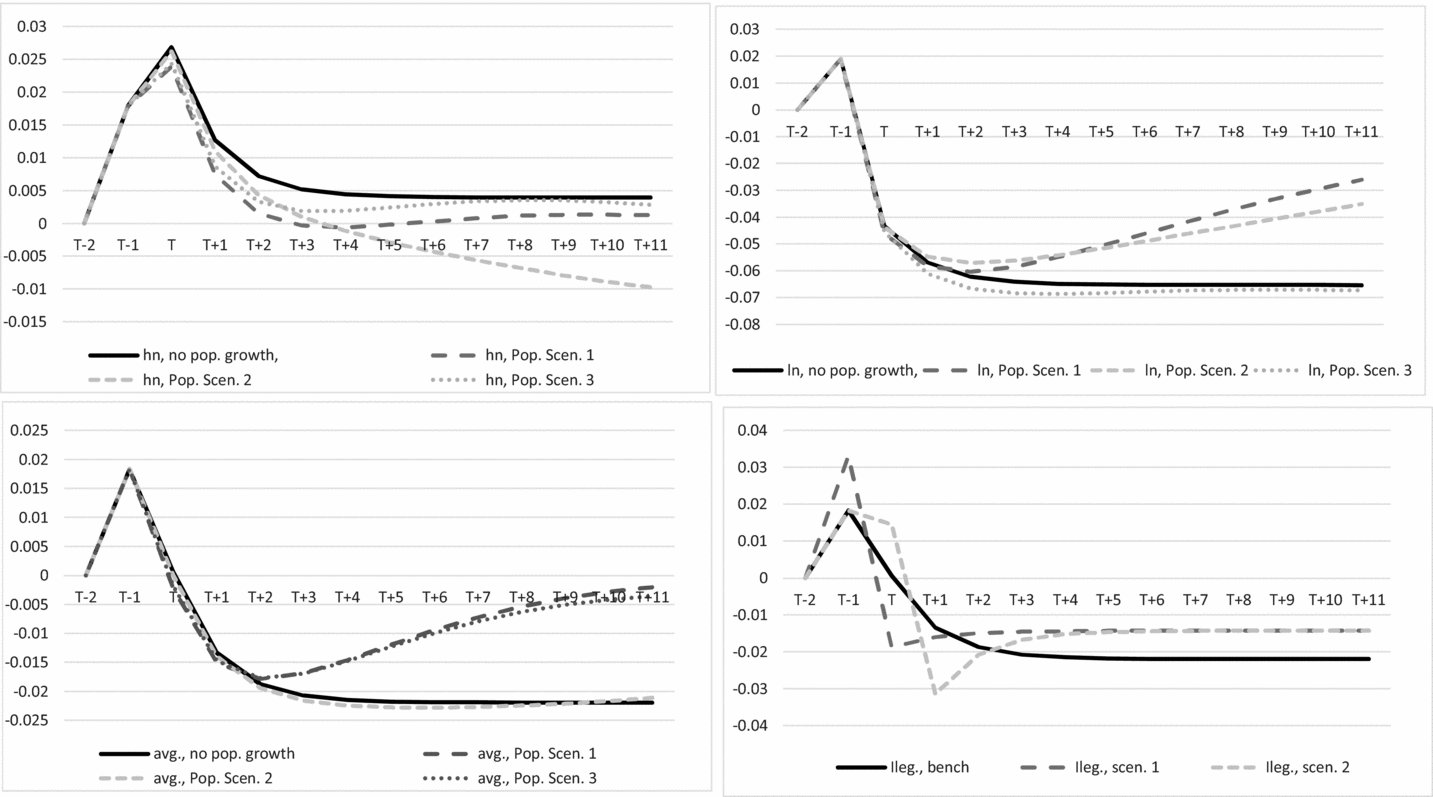
The benchmark calibration assumed a constant population. In this section, the population size changes using two different approaches. The first set of simulations allows for different population growth rates n s, t , for s = hn, hm, ln, lm, from period T on (i.e. retired individuals in T are not affected). Note that the undocumented workforce is kept constant (and equal to 0 after a regularization). Three different scenarios, detailed in Table 2, are compared to the benchmark. “Pop. Scenario 1” uses a skill-specific population growth rate, calibrated on the population projections of the U.S. Census (2014) for the period 2015–2040. The native and foreign-born populations are projected to grow by 12.5% and 46.8%, respectively. In order to account for skill-specific population growth rates and for the increasing trend in educational attainment, the native and foreign-born tertiary-educated population is assumed to grow 40% and 15% faster than the respective less-educated population group. This allows to consider a catch-up of the immigrant population in terms of educational attainment. “Pop. Scenario 2” assumes a constant highly educated population and uses the growth rates for the less-educated population from “Pop. Scenario 1”. Hence, the fraction of highly educated individuals among the total population decreases in this scenario. “Pop. Scenario 3” assumes a constant less-educated population and uses the growth rates for the highly educated population from “Pop. Scenario 1”. Hence, the fraction of highly educated individuals among the total population increases.
Population Dynamics – different population growth rates
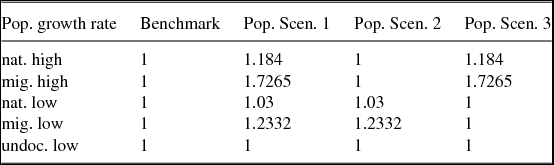
These scenarios are shown in Figure 5c.
Figures 5a and 5b show the impact of an amnesty under the three different scenarios on a highly educated and a less-educated native’s welfare, respectively. The population size is only affected from period T + 1. Hence, retired individuals in period T (born in T − 1) are not impacted by the change in the population growth. Native workers, born in T, are only affected by a change in the return on savings when they are old. The lung-run impact of a policy shock in the presence of population growth is affected by two main channels. First, the effect of a policy that changes the structure of the population dissipates with an increasing population size: e.g. changing the status of 5% of the total population size at period T has a different impact on individuals living in period T + 3 if the population size is constant or doubles over that time period. Second, the effect of a change in the population’s skill-composition varies with the education level of the individual. The differential population growth rates affect the wages, the income tax rates and the pension contribution rate of generations born after period T. The fiscal burden increases with the population size, whereas income taxation tends to decrease with the share of highly educated workers in the economy (because it is proportional to the wages).
Impact of population dynamics. (a) Population growth – highly educated native. (b) Population growth – less-educated native. (c) Population growth – average native. (d) Number of undocumented workers. Note: Sensitivity of a native’s welfare (born in period t) to a change in the population growth rates. Figures 5a and 5b show the impact of differential population growth rates on the welfare of a highly educated and less-educated native, respectively. Figure 5c shows the impact of differential population growth rates on the average native’s welfare. Figure 5d shows how a change in the number of undocumented workers after an amnesty in period T (i.e. an “attraction effect”) affects the average native’s welfare. The different scenarios are shown in Tables 2 and 3.

The number of less and highly educated individuals increases in “Pop. Scenario 1”, although the share of the latter in the total population increases over time. As all the labor aggregates increase, the impact of an amnesty dissipates over time relative to the benchmark scenario. The long-run increase (decrease) in highly educated (less-educated) wages is mitigated. The capital–labor ratio increases over time. Although this has a negative impact on the returns to savings, the lower decrease in less-educated native workers’ wages improves their welfare relative to the benchmark scenario. The positive long-run impact of an amnesty on highly educated natives’ welfare is however mitigated by its lower impact on wages. In “Pop. Scenario 2,” the share of less-educated natives in the population progressively increases, whereas the number of highly educated workers remain constant. As the less-educated labor aggregate increases, the negative long-term effect of the amnesty on the less-educated wage rates dissipates. This effect dominates the other channels and leads to a lower long-run welfare decrease for the less-educated workers. The decrease in the labor aggregate reduces capital accumulation and increases income taxation. The combination of these channels decreases the long-run welfare of highly educated native workers below the benchmark level. “Pop. Scenario 3” implies an increase in the share of highly educated workers in the economy, whereas the number of less-educated workers remains constant. The less-educated labor aggregate does not change relative to the benchmark case, and thus the negative impact of an amnesty on the less-educated native workers’ wages remains important. The higher share of high-wage earners leads to a stronger capital accumulation and a lower interest factor. The income tax rate slightly decreases at the same time. The combination of these channels, and the fact that an amnesty mainly affects less-educated workers, implies that its welfare effect does not change much in the alternative scenario in which the less-educated population is constant. The impact of a migration policy on the average native welfare level, depicted in Figure 5c, is a combination of the channels described above and a population composition effect. For example, although the effect of an amnesty under “Pop. Scenario 3” is close to the benchmark for both groups of natives, the average native welfare level shows an increasing trend. This is due to a pure population composition effect: the average native is increasingly educated, and thus less affected by an amnesty.
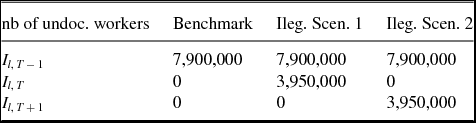
In the second set of robustness exercises, an amnesty can serve as a signal for new prospective immigrants, who hope that such a procedure is repeated in the future (see Table 3 for details). Thus, although intended as a means to manage existing stocks of undocumented workers, an amnesty can motivate new entries through this “attraction effect.” Footnote 31 “Ileg. Scenario 1” assumes that the regularized population is replaced at a 50% rate by new undocumented workers. Hence, while 7.9 million undocumented workers are regularized, the undocumented workforce in period T increases by 3.95 million new undocumented individuals. “Ileg. Scenario 2” assumes that the “attraction effect” materializes one period after the amnesty. Hence, in period T, the full undocumented population is regularized while 3.95 million new undocumented individuals arrive at the beginning of period T + 1. Note that after these different shocks, the undocumented population is assumed to remain constant in all the scenarios.
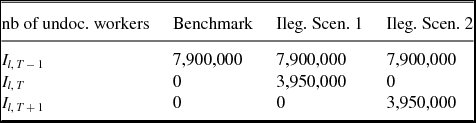
Figure 5d compares these two scenarios with the benchmark. “Ileg. Scenario 1” increases the undocumented workforce in the period of the amnesty, T, thereby decreasing the capital–labor ratio, which benefits the retired agents (born in T − 1). At the same time, the higher labor aggregate decreases wages further, which is not offset by the positive contribution of these new undocumented workers to the government budget. Hence, the average native is worse off in the period of the shock. These mechanisms are delayed in “Ileg. Scenario 2,” where the inflow of new undocumented workers arrives one period later. Hence, the impact of these undocumented immigrants only occurs through the interest rate that natives perceive in period T + 1 (i.e. wages in T are not affected). As in the previous scenario, new arrivals are particularly detrimental for the workers of that period (here, T + 1) who receive lower wages. The long-run population is higher than the benchmark level and identical in both alternative scenarios. Capital accumulation is therefore higher, which implies an equilibrium above the benchmark one.
6.2. Lower Productivity of Legalized Workers
In this section, regularized workers are assumed to have a lower productivity than documented immigrant workers [ς<1 in equation (25)]. This allows to account for a negative selection of undocumented immigrants into the illegal status (i.e. assuming that undocumented immigrants are, on average, inherently less productive). Amuedo-Dorantes and Bansak (Reference Amuedo-Dorantes and Bansak2011) find evidence on occupational mobility among individuals legalized under the IRCA, though the impact on their labor market participation is mixed [see also Casarico et al. (Reference Casarico, Facchini and Frattini2016) for a theoretical framework]. In a recent study using New Immigrant Survey data, Lofstrom et al. (Reference Lofstrom, Hill and Hayes2013) analyze how acquiring Legal Permanent Resident status influences labor market outcomes for previously undocumented workers. They do not find evidence of improved employment outcomes attributable to legal status for the low skilled.
Setting the productivity parameter ς<1 leads to a lower increase in the labor aggregate, which reduces the return on savings and the welfare of retired individuals in period T (see Figure 6). If the relative productivity parameter is sufficiently low, legalized workers are less productive than they were as undocumented workers. The labor aggregate decreases in that case, which implies a lower return rate on the retired agents’ savings (as it is the case in the scenario with ς = 0.5). The impact on the young generation is more mitigated. The lower increase in the less-educated labor aggregate leads to a lower decrease of the less-educated wage rates, whereas the highly-educated workers’ wages increase less. A lower ς implies lower wages for the regularized workers, who therefore contribute less to the government budget and the pension system (while they perceive the same transfers). Hence, the lower are the legalized workers’ wage rates, the higher are income tax rates. The lower net incomes lead to lower capital accumulation and thus to long-run average native welfare levels below those observed in the benchmark.
Different productivity of legalized workers. Note: Sensitivity of an average native’s welfare (born in period t) to a change in the relative productivity of a legalized worker with an amnesty occurring at time T.

6.3. Discrimination
In this section, I explore alternative explanations for the lower wages of undocumented migrants and address the consequences of an immigration policy reform under these assumptions. Rivera-Batiz (Reference Rivera-Batiz1999) argues that only half of the 41.8% wage premium that legal immigrants have over undocumented immigrants can be explained by observable characteristics. In the model, this traduces in employers being able to pay undocumented workers below their marginal productivity. Palivos (Reference Palivos2009) provides an alternative explanation based on a Nash bargaining model for the wages, where an undocumented immigrant has an outside option far below the legal migrants’ wage rate and therefore accepts to work for a discounted wage. In the presence of labor market discrimination, the representative firm extracts a rent by paying undocumented workers a fraction γ<1 of their marginal product (w l, i, t ). The firm’s problem can be written as
 $$\begin{eqnarray}
\max _{Z_t, I_{l,t}} \pi &=& AK_{t}^\alpha Q_{t}^{1-\alpha }-w_{h,n,t}N_{h,t}-w_{h,m,t}M_{h,t}-w_{l,n,t}N_{l,t}-w_{l,m,t}M_{l,t}\nonumber\\
&&-\,\gamma w_{l,i,t} I_{l,t}-R_t K_t ,
\end{eqnarray}$$
where Z t = N h, t , M h, t , N l, t , M l, t , K t and γ represent the fraction of her marginal productivity that an undocumented immigrant receives (and hence 1−γ represents the extent of discrimination on the labor market). In the absence of controls and sanctions for hiring undocumented immigrants, the firm thus hires the complete fixed stock of undocumented workers.
Alternatively, it can be assumed that the lower wages are due to the risk of financial sanctions for hiring undocumented workers passed on to them by the firm [see Chau (Reference Chau2001)]. In that case, the representative firm maximizes profits as follows:
 $$\begin{eqnarray}
\max _{Z_t, I_{l,t}} \pi &=& AK_{t}^\alpha Q_{t}^{1-\alpha }-w_{h,n,t}N_{h,t}-w_{h,m,t}M_{h,t}-w_{l,n,t}N_{l,t}-w_{l,m,t}M_{l,t}\nonumber\\
&&-\,w_{l,i,t}I_{l,t}-\varsigma I_{l,t}-R_tK_t,
\end{eqnarray}$$
where ς represents the cost for hiring one undocumented worker (e.g. a sanction). Both interpretations lead to a wage below marginal productivity for undocumented immigrants, which is equivalent when ς = w l, i, t (γ − 1). The difference between the two approaches is that the funds collected through sanctions would increase the government budget, whereas the rent is distributed directly to the legal capital owners (i.e. retired individuals).Footnote 32 While the micro foundation might be clearer in the case of a fine, it is hard to argue that an amnesty would lead to a significant decrease in the public revenues through the lower amount of sanctions collected, given that these are rarely imposed in practice.Footnote 33
If the firms pay undocumented immigrants below their marginal productivity, the dividend to be distributed is equal to the total rent captured by the capital holders divided by the number of retired legal agents (i.e. born in T − 1):
 $$\begin{equation}
\Gamma _t=\frac{(1-\gamma )I_{l,t}^t w_{l,i,t}}{N_{h,t}^{t-1}+M_{h,t}^{t-1}+N_{l,t}^{t-1}+M_{l,t}^{t-1}}.
\end{equation}$$
The per capita rent received by legal workers is added to their lifetime budget constraint:
 $$\begin{equation}
\psi _{j}^t=w_{j,t}(1-\tau _t^b-\tau _t^p)+g+\frac{p+\Gamma _{t+1}}{R_{t+1}} \ \ \ \ \ {\it for\ j = hn,hm,ln,lm}.\
\end{equation}$$
Hence, legal workers’ welfare is additionally affected by the migration policy’s impact on the rent:
 $$\begin{eqnarray}
\Delta \Gamma _T&=&\frac{(1-\delta )(1-\gamma )I_{l,t}^tw_{l,i,T}}{L_T^{t-1}}-\frac{(1-\gamma )I_{l,t}^tw_{l,i,t}}{L_t^{t-1}}\nonumber\\
&=&\frac{(1-\gamma )I_{l,t}^t\Delta w_{l,i,T}-\delta (1-\gamma )I_{l,t}^tw_{l,i,T}}{L_t^{t-1}},
\end{eqnarray}$$
where L t − 1 t = LT T − 1 = N T − 1 h, T + M h, T T − 1 + N T − 1 l, T + M l, T T − 1 denotes the number of legal retirees in period T (born in T − 1). The first term in the numerator of equation (44) captures the effect of a regularization on the rent extracted among the remaining undocumented workers. This term increases if the legalization increases the wage paid to the remaining undocumented workers. The second term captures the loss due to the decrease in the number of undocumented workers. Note that for the rent, the impact of a deportation is similar to the one of regularization: the number of undocumented workers on which a rent is captured decreases. The only difference between both policies comes from the different impact on the wage rate of the remaining undocumented workers, Δw l, i, T . The latter decreases less under a deportation, as the labor aggregate decreases. In the absence of labor market discrimination, with γ = 1, the rent disappears and the benchmark framework is recovered.
I simulate the model including the discrimination on the labor market. I first set γ = 0.75 (i.e. undocumented workers receive 75% of their marginal productivity), based on the rationale provided by Rivera-Batiz (Reference Rivera-Batiz1999). Palivos (Reference Palivos2009) sets this value to 0.71, assuming that migrants and natives earn the same wage. The model is also simulated with γ = 0.5. The loss of the rent, which increases with the degree of discrimination, acts differently on native agents, depending on their age. Retired individuals, who perceive the rent extracted on the undocumented workers, suffer a welfare loss which increases with the extent of the discrimination (see Figure 7a). Wages of working natives are not additionally affected by the discrimination of undocumented workers but the policy shock impacts their tax and pension contribution rates. The higher is the discrimination that regularized workers face, the higher is the increase in their gross wages and their fiscal contribution. However, the more their wages increase, the more regularized individuals save, which increases capital accumulation and decreases the interest factor of the next generation. Hence, the lower return on their savings and the loss of the rent explain why native workers are particularly harmed by the regularization. The capital accumulation dynamics impact the trajectory of the wages and the return rate on savings. Figures 7c and 7d show that both less and highly educated natives are better off after a regularization in the long run if there is some discrimination on the labor market.
Impact of labor market discrimination of undocumented immigrants. (a) Amnesty with discrimination. (b) Deportation with discrimination. (c) Amnesty with discrimination – low-skilled native (d) Amnesty with discrimination – high-skilled native Note: Sensitivity of an native’s welfare (born in period t) to the inclusion of labor market discrimination of undocumented workers with an amnesty occurring at time T.

A deportation in the presence of discrimination is particularly harmful to capital owners as in addition to the loss of the rent, the return rate that they perceive on their savings decreases with the reduction of the labor aggregate (see Figure 7b). Less-educated native workers’ wages increase, but this cannot compensate the loss of the rent and the lower return rates that they receive in the next period. Average native welfare is thus below the benchmark level. In addition, the higher is discrimination, the lower is the contribution of undocumented workers to the budget because taxation is proportional to wages. Thus, deportation under strong discrimination can have a positive impact on the government budget, which leads to a long-run average welfare level above the benchmark one.
7. CONCLUSION
This paper develops a simple and tractable two-period OLG model in order to analyze the impact of an amnesty and a deportation of undocumented workers on different types of native agents’ welfare throughout their life-cycle. The model accounts for the role played by undocumented workers in the economy: they work, partially pay taxes and pension contributions, and benefit from some public transfers. It allows to discuss several reasons provided in the literature to explain the different wages between legal and undocumented workers (i.e. a different inherent productivity, hiring costs due to a risk of sanctions, status discrimination, etc.) and their impact on the evaluation of the consequences of migration policy reforms. Moreover, it can be used to compare the short- and long-run effects of an amnesty and a deportation.
There are two main channels through which undocumented immigrants impact native workers: the labor market (i.e. wages) and the social security system (i.e. public transfers and pensions). The impact of a policy reform intended to reduce their number on the labor market depends on how it changes the workforce. An amnesty is likely to increase workers’ production in the economy, whereas a deportation unambiguously decreases it. An amnesty increases the wages of highly educated workers which are complementary to the regularized less-educated immigrants. Less-educated native wages, on the other hand, are likely to decrease. A deportation increases less-educated workers’ wages but reduces highly educated wage rates. The fiscal impact of a migration policy depends on the net fiscal contribution of the regularized workers. The latter contribute to the sustainability of the pension system in the short run. Once legalized, they have access to all the transfers and they fully comply to the payment of taxes and pension contributions. Moreover, the higher wages that they earn increase the taxable income base. The total effect of a migration policy results from the combination of these different channels.
The model is calibrated in order to analyze the welfare impact of the two migration policies in the United States. The benchmark simulation considers a liberalization and a deportation of the entire undocumented workforce (estimated at approximately 7.9 million workers) and shows that the impact of both policies on natives’ welfare lies between −0.1% and +0.15%. A legalization implies lower income tax rates which do not fully compensate the decrease in the less-educated natives’ wages. On the other hand, highly educated natives’ wages increase. Their long-run welfare level therefore exceeds its baseline value, whereas less-educated natives’ welfare is below its reference level. A deportation reduces return rates on retired individuals’ savings and increases contribution rates to the pension system. The less-educated wage rate increases, whereas the highly educated wage rate decreases, which leads to an increase of the income taxation rate. In the long run, capital accumulation is slowed down but higher wages imply a higher welfare for less-educated natives, whereas highly educated natives’ welfare decreases.
Several robustness checks are provided. The net fiscal contribution of undocumented and legalized individuals is a key factor which is difficult to extract from data. Varying the contribution of undocumented workers to the different government budgets and the fraction of transfers that they perceive shows to what extent the fiscal channel affects the evaluation of a migration policy reform. The higher is the fiscal compliance of undocumented workers, the lower is their additional contribution to the budget once they are legalized. The more public transfers they perceive, the lower is their additional impact on the budget. This is particularly important when the social transfer system is extensive (i.e. a high share of public funds transferred to individuals). The role of complementarities between the different types of workers is analyzed by varying the values of the elasticities of substitution. In particular, the less native and foreign-born (and legal and undocumented) workers are substitutable, the lower is the negative impact of an amnesty on the average native’s welfare. Population dynamics matter mainly when an increase in the number of less-educated workers allows the negative long-term impact of the amnesty on the low-skill wages to dissipate. In the presence of discrimination of undocumented workers on the labor market, the loss of the rent captured on them is one additional channel through which an amnesty (or a deportation) decreases natives’ welfare. Regularized individuals can be less productive than legal immigrants, which reflects a possible negative selection into the undocumented status. The lower is regularized workers’ productivity relative to the legal immigrants, the lower is the increase in production implied by an amnesty and the less beneficial it is for native workers.
The stock of undocumented workers has multiple effects on the economy which materialize through the labor market and the government budget. In order to predict the impact of an amnesty or a deportation of undocumented workers, it is important to understand the mechanisms through which these policies act. The model developed herein provides a simple and extendable toolbox to do so.
APPENDIX A: THE SMALL OPEN ECONOMY
In a small open economy, the interest rate is dictated by the international capital markets such that the return on capital
 $\bar{R}$
is fixed. This implies that the capita–labor ratio is given by
 $$\begin{equation}
\frac{K_t}{Q_t}=\left(\frac{\alpha A}{\bar{R}} \right)^{\frac{1}{1-\alpha }}.
\end{equation}$$
In this framework, capital flows into or out of the country until the interest rate equalizes the one prevailing on the international capital markets. Thus, the capital stock in a certain period is no longer predetermined by the savings of the previous generation and adjusts instantaneously to changes in the return to capital.
Given that the return on savings is fixed by the international capital markets, the capital owners living in period T are not affected by a shock on the population structure. In the absence of labor market discrimination against undocumented workers (with γ = 1), the capital stock adjusts in order to maintain a constant capital–labor ratio (in efficiency units), whatever the values of η and δ. The gross wages nevertheless change with the labor structure, which depends on the migration policy considered. This implies a change in the income tax rate which introduces a dynamic in the disposable income (similar to the one presented for the closed economy). Therefore, the repartition of the capital used in the economy between residents and foreigners, changes through the net foreign assets. The process continues until a new equilibrium is reached.
APPENDIX B: ADDITIONAL TECHNICAL DETAILS
B.1. Wage Rates
The wage rates of the different agents are given by
 $$\begin{eqnarray}
\begin{array}{ll} w_{h,n,t} &=\left(1-\alpha \right)\theta _h\theta _e \frac{Y_t}{Q_t}\left({\frac{Q_t}{Q_{h,t}}}\right)^{\frac{1}{\sigma _H}}\left(\frac{Q_{h,t}}{N_{h,t}}\right)^{\frac{1}{\sigma _E}},\\
w_{h,m,t} &=\left(1-\alpha \right)\theta _h(1-\theta _e)\frac{Y_t}{Q_t}\left({\frac{Q_t}{Q_{h,t}}}\right)^{\frac{1}{\sigma _H}}\left(\frac{Q_{h,t}}{M_{h,t}}\right)^{\frac{1}{\sigma _E}},\\
w_{l,n,t}&=\left(1-\alpha \right)\left(1-\theta _h \right)\theta _n \frac{Y_t}{Q_t} \left(\frac{Q_t}{Q_{l,t}}\right)^{\frac{1}{\sigma _H}}\left(\frac{Q_{l,t}}{N_{l,t}}\right)^{\frac{1}{\sigma _N}}, \\
w_{l,m,t}&=\left(1-\alpha \right)\left(1-\theta _h\right)\left(1-\theta _n\right)\theta _m \frac{Y_t}{Q_t}\left(\frac{Q_t}{Q_{l,t}}\right)^{\frac{1}{\sigma _H}} \left(\frac{Q_{l,t}}{Q_{m,t}}\right)^{\frac{1}{\sigma _N}} \left(\frac{Q_{m,t}}{M_{l,t}}\right)^{\frac{1}{\sigma _M}}, \\
w_{l,i,t}&=\left(1-\alpha \right)\left(1-\theta _h\right)\left(1-\theta _n\right)\left(1-\theta _m\right) \frac{Y_t}{Q_t}\left(\frac{Q_t}{Q_{l,t}}\right)^{\frac{1}{\sigma _H}} \left(\frac{Q_{l,t}}{Q_{m,t}}\right)^{\frac{1}{\sigma _N}} \left(\frac{Q_{m,t}}{I_{l,t}}\right)^{\frac{1}{\sigma _M}}. \end{array}
\end{eqnarray}$$
B.2. Capital Markets and Remittances
The capital market is assumed to be perfect in the sense that the savings of undocumented agents serve the capital accumulation. In other words, it is assumed that undocumented agents can place their savings at an interest factor R t . This rather strong assumption does not influence the intuition of the results. In the short term, capital is fixed and thus assuming imperfect access to capital markets only implies a level effect. In the long run, the capital stock does not only change due to the variations in disposable income but also due to the additional capital belonging to the regularized individuals. An amnesty therefore has an additional positive effect in the presence of imperfect capital market access. This channel is reinforced in Benítez-Silva et al. (Reference Benítez-Silva, Cárceles-Poveda and Eren2011), who assume that the savings behavior of regularized immigrants changes substantially (i.e. increased savings and reduced remittances) and reinforces capital accumulation.
The benchmark model does not account for remittances. Including remittances would demand to take into account trade imbalances between countries in order to compensate outgoing capital flows [see di Giovanni et al. (Reference di Giovanni, Levchenko and Ortega2015)]. Benítez-Silva et al. (Reference Benítez-Silva, Cárceles-Poveda and Eren2011) stipulate that legalized individuals’ savings behavior changes (i.e. they remit less). However, remittances of legalized workers could remain important if a legalization implies a reduction in transaction costs [i.e. due to an easier access to official transaction channels or cheaper banking services, see Beck and Peria (Reference Beck, Soledad and Peria2011) for a discussion on the factors that influence costs to remit]. Moreover, legalized individuals are likely to earn higher wages. A reduction of remittances can therefore only be observed if they reduce their propensity to remit (while simultaneously having higher financial resources). From a conceptual and technical perspective, the calibration of this channel poses serious challenges which are not yet completely solved by the existing literature (e.g. justification of the reduction in remitting propensity, reason to remit and preference intensity, etc. . .). Disregarding remittances allow for a higher tractability in the two-period model in contrast to the multi-period model developed by Benítez-Silva et al. (Reference Benítez-Silva, Cárceles-Poveda and Eren2011).
Adding remittances and assuming that they decrease for legalized individuals would reinforce the capital accumulation channel in my simulations as a higher amount of savings would remain in the country. The retired agents would be unaffected (as the short-run capital stock is given), whereas workers in the period following the amnesty would benefit from an increased capital–labor ratio and thus an increase in their wages. Return rates on capital would however decrease.
B.3. Change of Q m, t
The composition of the workforce is affected by the change in the foreign-born labor aggregate ΔQ m, T = Q m, T − Q m, s :
 $$\begin{eqnarray}
\begin{array}{ll} \Delta Q_{m,T}&=\left[\theta _{m}(M_{l,s}+\varsigma \eta I_{l,s})^{\frac{\sigma _{M}-1}{\sigma _{M}}}+\left(1-\theta _{m}\right)(I_{l,s}(1-\eta -\delta ))^{\frac{\sigma _{M}-1}{\sigma _{M}}} \right]^{\frac{\sigma _{M}}{\sigma _{M}-1}}\\
&\quad -\,\left[\theta _{m}(M_{l,s})^{\frac{\sigma _{M}-1}{\sigma _{M}}}+\left(1-\theta _{m}\right)I_{l,s}^{\frac{\sigma _{M}-1}{\sigma _{M}}} \right]^{\frac{\sigma _{M}}{\sigma _{M}-1}}, \end{array}
\end{eqnarray}$$
where the subscript s denotes the baseline variables (i.e. the initial steady state).
 $$\begin{equation}
\Delta Q_{m,T}>0 \Leftrightarrow M_{l,T}^{\frac{\sigma _{M}-1}{\sigma _{M}}}-M_{l,s}^{\frac{\sigma _{M}-1}{\sigma _{M}}} > \frac{1-\theta _m}{\theta _m} \left(I_{l,s}^{\frac{\sigma _{M}-1}{\sigma _{M}}}-(I_{l,s}(1-\eta -\delta ))^{\frac{\sigma _{M}-1}{\sigma _{M}}}\right).
\end{equation}$$
B.4. Effect of a Population Shock on the Wage Rates
In order to analyze the consequences of a change in the number of foreign-born workers on the wage rates, consider first the following results:
 $$\begin{equation}
\frac{\partial Q_{l,t}}{\partial Q_{m,t}} = (1-\theta _{n})\left(\frac{Q_{l,t}}{Q_{m,t}}\right)^{\frac{1}{\sigma _{N}}}, \\
\end{equation}$$
 $$\begin{equation}
\frac{\partial Q_t}{\partial Q_{m,t}} = (1-\theta _{h})\left(\frac{{Q_t}}{Q_{l,t}}\right)^\frac{1}{\sigma _{H}}\frac{\partial Q_{l,t}}{\partial Q_{m,t}}.
\end{equation}$$
These results allow to conclude the following impact on the wage rates:
 $$\begin{eqnarray}
\frac{\partial w_{h,n,t}}{\partial Q_{m,t}}= (1-\alpha )\left(\frac{1}{\sigma _H}-\alpha \right)\theta _h \theta _e AK_t^{\alpha } Q_t^{\frac{1}{\sigma _H}-\alpha -1} Q_{h,t}^{\frac{1}{\sigma _E}-\frac{1}{\sigma _H}} N_{h,t}^{\frac{1}{\sigma _E}}\frac{\partial Q_t}{\partial Q_{m,t}},
\end{eqnarray}$$
and thus if
 $\alpha <\frac{1}{\sigma _H}$
(which the literature suggests) sgn
 $\left(\frac{\partial w_{h,n,t}}{\partial Q_{m,t}}\right)$
= sgn
 $\left(\frac{\partial Q_t}{\partial Q_{m,t}}\right)$
. The population shock changes the wage of a national low-educated agent as follows:
 $$\begin{eqnarray}
\frac{\partial w_{l,n,t}}{\partial Q_{m,t}}= Z_1\frac{\partial Q_{l,t}}{\partial Q_{m,t}}\left[\left(\frac{1}{\sigma _H}-\alpha \right)(1-\theta _H)\frac{Q_t^{\frac{1-\sigma _H}{\sigma _H}}}{Q_{l,t}} +\left(\frac{1}{\sigma _N}-\frac{1}{\sigma _H}\right)\right]
\end{eqnarray}$$
obtained using (B.5) and with
 $Z_1=(1-\alpha )(1-\theta _h)\theta _n A K^{\alpha } N^{\frac{-1}{\sigma _N}} Q_t^{\frac{1}{\sigma _H}-\alpha } Q_{l,t}^{\frac{1}{\sigma _N}-\frac{1}{\sigma _H}-1}$
>0.
The values considered in the literature imply
 ${\frac{1}{\sigma _H}>\alpha }$
and
 $\frac{1}{\sigma _N} < \frac{1}{\sigma _H}$
. The sign of this expression is therefore a priori undefined. However, the term
 $Q_t^{\frac{1-\sigma _H}{\sigma _H}}/{Q_{l,t}}$
is very small as σ
H
> 1 which suggests that sgn
 $(\frac{\partial w_{l,n,t} }{\partial Q_{m,t}})$
= −sgn
 $(\frac{\partial Q_{l,t}}{\partial Q_{m,t}})$
.
APPENDIX C: THE CASE OF NEW LEGAL IMMIGRATION
The model can easily be extended in order to account for newly arriving legal immigrants, i.e. individuals who are not yet active in the economy. Equation (24) becomes in that case:
 $$\begin{equation}
M_{l,T}=M_{l,t}(1+\epsilon )+\varsigma \eta I_{l,t} \ \ \text{and} \ \ I_{l,T}=I_{l,t}\left(1-\eta -\delta \right)
\end{equation}$$
such that ϵ > η = δ= 0 implies a positive shock on the size of the legal foreign low-educated workforce (while the number of undocumented workers remains unchanged). The labor aggregate increases (see Proposition 1) and, under Assumption (1), a positive (negative) effect is observed on the high-skill (low-skill) wage rate. Given that the capital–labor ratio decreases, the interest factor in this scenario increases further. Capital owners (i.e. retired individuals) living in the period of the immigration shock are better off in the case of new legal immigration than under the policy shocks analyzed in the paper because the impact on the labor aggregate is higher under this scenario. The effect on the income tax rate is ambiguous due to the new immigrants’ access to all the transfers but simultaneous full compliance to the tax payments. The additional burden on the government budget is higher than in the benchmark, given that the formerly undocumented workers were already receiving part of the transfers.
APPENDIX D: ADDITIONAL ROBUSTNESS CHECKS
D.1. Skill Ratios
The robustness of the results to a change in the different skill premia is assessed in this section. Changing one-skill premium implies a recalibration of the relative productivity parameters θ s , ∀s = h, e, m, n.
Figure D.1a highlights the impact of changing the relative productivity between less and highly educated workers. A decrease in the wage ratio between highly and less-educated native workers is reflected in a lower (higher) relative productivity of highly educated (less-educated) workers. An amnesty implies in this case a higher increase in the labor aggregate Q t , which translates in a lower decrease of less-educated workers’ wages and a stronger human capital accumulation in the long run. The average welfare is therefore above the benchmark level.
Changing the calibration of the relative productivity parameters. (a) w h, n /w h, m . (b) w l, n /w l, m . (c) w l, m /w l, i . Note: Sensitivity of an average native’s welfare (born in period t) to a change in the calibration of the relative productivity between different worker types with an amnesty occurring at time T.

Figure D.1b shows that the relative productivity between highly educated native and foreign-born workers only marginally affects results as this labor aggregate is not directly impacted by the regularization of less-educated undocumented workers. A decrease in the wage ratio between native and foreign-born less-educated workers is reflected in a lower (higher) relative productivity of less-educated native (immigrant) workers. Native less-educated workers’ wages decrease more in this scenario, whereas highly educated workers’ wages increase (relative to the benchmark simulations). The impact on the net income is however positive, such that capital dynamics imply a higher long-run average welfare level (see Figure D.1c).
Figure D.1d shows the impact of changing the wage premium implied by the legal status. If this premium is reduced to 0, with w l, m = w l, i , the impact of an amnesty on the labor aggregate is very minor. Hence, the interest factor is not affected and individuals born in T − 1 benefit from a very small increase in the interest factor. The impact on workers is however stronger. A lower relative productivity of legal workers implies a lower effect on natives’ wage rates. Less-educated workers benefit from a marginal increase in their wages, whereas highly educated natives’ wages decrease slightly. The positive fiscal impact of legalized workers is reduced (as their increase in wages is lower than in the benchmark scenario). The total net income therefore decreases, which decelerates capital accumulation and reduces the long-run average welfare level. A higher wage premium for the legal status on the other hand implies a higher wage increase for regularized workers which benefits the fiscal balance and the long-run capital accumulation.
D.2. The Discount Factor, β
Figure D.2 highlights the impact of changing the discount factor. Using a lower discount factor, such as β = 0.1, implies that individuals value the future less than in the benchmark. Hence, the welfare impact of an amnesty on retired individuals in period T is much lower. As current consumption is more valued by the individuals, savings decrease which reduces capital accumulation and implies a lower average long-run welfare level. On the other hand, a higher discount factor (e.g. β = 0.9) implies a stronger impact of an amnesty on retired agents’ welfare, as they have higher savings. Capital accumulation is amplified which increases the long-run average welfare relative to the benchmark.
Changing the discount factor. (a) Changing β. Note: Sensitivity of an average native’s welfare (born in period t) to a change in the value of the discount factor, β, with an amnesty occurring at time T.