INTRODUCTION
Under near-natural conditions, the medusae of Eugymnanthea japonica Kubota, a hydroid living in bivalves, are released from the host, Mytilus galloprovincialis Lamarck, for a few hours around sunset in summer. This was shown by Kubota (Reference Kubota1996, Reference Kubota and Den Hartog1997) for two temperate Japanese localities, i.e. Shirahama, Wakayama Prefecture on the Pacific coast and Takeshiki, Tsushima Island, Nagasaki Prefecture in the Sea of Japan. The sympatric presence or absence of the less derived bivalve-inhabiting hydrozoan, Eutima japonica Uchida had no influence on this (Kubota, Reference Kubota1996, Reference Kubota and Den Hartog1997). In the present study, the timing of medusa release of Eugymnanthea japonica was studied in a similar way in autumn, when the breeding season of this species is coming to an end (Kubota, Reference Kubota1994).
Eugymnanthea inquilina Palombi is a very similar species occurring in the Mediterranean, but molecular evidence suggests that both species resulted from a parallel evolution (Kubota, Reference Kubota2000; Govindarajan et al., Reference Govindarajan, Piraino, Gravili and Kubota2005). The timing of medusa release of E. inquilina was therefore also examined in the laboratory in order to assess whether the timing of medusa release in these two Eugymnanthea species is a species specific character.
MATERIALS AND METHODS
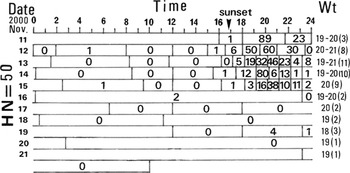
The observations were made in mid-November 2000 at Sakata, Tanabe Bay, Shirahama, Wakayama Prefecture, Japan. Medusa release of Eugymnanthea japonica was studied using 50 specimens of Mytilus galloprovincialis, sized 27–43 mm, using the same method as described in Kubota (Reference Kubota1996, Reference Kubota and Den Hartog1997). Collections of medusae were made 43 times at different times of the day from 11–15 November, but only 13 times from 16–22 November since medusa release nearly ceased after 16 November. Concomitantly with most collection events, the sea surface water temperature was measured. The number of measurements is shown in parentheses in Figure 1.
Temporal change in the number of medusae of Eugymnanthea japonica released from Mytilus galloprovincialis from Tanabe Bay (Wakayama Prefecture, Japan) at the end of the breeding season (November). Wt, range of the surface seawater temperature per day in °C (in parentheses the number of measurements); HN, number of host specimens used.

Similar observations for E. inquilina were carried out in the laboratory successively for two separate periods under slightly different conditions from those of E. japonica. On two occasions, 77 specimens of cultivated Mytilus galloprovincialis, ranging from 31 to 45 mm and 42–48 mm in anterio-posterior axes length, respectively, were bought at a seafood market on 17 and 27 October 2002 in Taranto, south-western Italy. After carrying these mussels to the Biological Laboratory of the University of Salento, Lecce, on the next day all the macro-organisms such as barnacles and polychaetes attached to the shell were removed with a knife and the shells washed quickly with tap and seawater. Then they were kept in aerated natural seawater taken from the sea coast near Porto Cesareo, Ionian Sea at room temperature and near-natural brightness. They were reared in a flat, shallow, plastic tray placed beside a glass window, avoiding direct sunlight to prevent warming up.
At various intervals, with a minimal interval of one hour, the released medusae were counted under a stereomicroscope immediately after collection and filtering the seawater with a 100 μm mesh. The mussels and the tray were rinsed with seawater at least three times, this in order to collect all released medusae. At the same time, the number of detached hydroids was counted, and the presence of pseudofaeces and other organisms released from the bivalves were checked to ascertain the health condition of hosts and hydroids. Many hydroids detached from the host due to stress during transportation (~300 in number on 18 October), but within two days after the beginning of the observations, this number decreased (2–42 per day until 23 October).
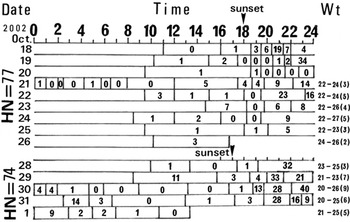
The water temperature was measured with an electronic thermometer on most occasions of the observation intervals; the number of measurements is shown in parentheses in Figure 2. The seawater was changed daily, but sometimes a small quantity of seawater was added at some intervals. No food was given to the hydroids and mussels during the observation period. During these two observation periods, only four mussels died, and the healthy condition of the mussels is reflected by the small number of hydroids that detached from the host. Note that on 27 October 2002, clocks were set back one hour as day light saving time ended.
Temporal change in the number of released medusae of Eugymnanthea inquilina from Taranto (south-western Italy) in the laboratory reared animals. Observations over two time periods. Wt, range of the surface seawater temperature per day in °C (in parentheses the number of measurements); HN, number of host specimens Mytilus galloprovincialis used.

RESULTS
In autumn at Shirahama, Japan, from 11 to 15 November a total of 594 medusae of Eugymnanthea japonica, (82–148 individuals/day), were released (a total of 43 intervals observed, maximally 11 intervals per day). In contrast to the release pattern observed in summer at the same place (Kubota, Reference Kubota1996), most of these medusae were not released at around sunset at 1700, but from 1800 to 2300 h with a peak between ~1900 and 2100 (Figure 1).
From 16 November the release of medusae nearly stopped and only a total of seven individuals was released until 22 November (Figure 1). The surface seawater temperature was 19–21°C for the period from 11–15 November during which the weather was fine or cloudy, while it was 18–20°C from 16–21 November during which the weather was rainy, cloudy, or fine. Detachment of hydroids from the host bivalve was very low, only 0–5 per day.
The medusae of Eugymnanthea inquilina from Taranto, Italy were also released at night-time during each of two sampling periods and not at around sunset that was at 1800 and 1648, respectively. However, not many medusae were released during the first observation period, only 207 medusae in all were counted (a total of 53 observation intervals, maximally 12 per day). During the second observation period, a total of 285 medusae were released (33 observation intervals, maximally 10 per day). Release was rare at midnight, in the morning, and during daytime (Figure 2). These observations were made in the laboratory and the water temperature fluctuated between 21°C and 24°C, with a maximum range of 20–27°C. Cercaria of trematodes and/or symbiotic Platyhelminthes were sometimes also released, the former being more frequent than the latter. Pseudofaeces were found during every observation interval which indicates that the mussels opened their shells every time. The shell opening was also ascertained repeatedly by direct observations. Neither hydroids nor medusae were trapped in the pseudofaeces.
DISCUSSION
In autumn, when water temperatures have already decreased significantly at Shirahama, Japan, the peak time of medusa release of Eugymnanthea japonica, is not much different from the one previously observed during summer time (Kubota, Reference Kubota1996, Reference Kubota and Den Hartog1997). However, sunset is about two hours later in autumn. This means that the release of medusa of E. japonica is not affected by the sudden decrease of light intensity after sunset, but rather appears to have a constant diurnal periodicity irrespective of the season. Because the circadian timing of medusa release of E. japonica does not change with the season, a kind of rigid, internal regulation process for the development of medusa buds and gonad maturation can be postulated. It can be expected that the release time of E. japonica would not change if the sunset time is artificially delayed or advanced through artificial lighting. This is in contrast to results obtained by Genzano & Kubota (Reference Genzano and Kubota2003) for another hydroid, Halocordyle disticha. Although our observation periods do not cover the whole reproductive season (June–November; see Kubota, Reference Kubota1994), it can be assumed that the release time remains constant.
The time of medusa release of E. inquilina was also during night-time as for E. japonica in autumn (Figure 2). We assume that the observed timing of medusa release in the laboratory comes close to the timing under natural conditions. Therefore, we could not find a significant difference of the timing of medusa release in the two Eugymnanthea species, this despite their differences in morphology as well as various other biological aspects (Kubota, Reference Kubota1989; Govindarajan et al., 2005).
The regular release time, which does not change with the seasonal changes of the sunset, does not promote cross-fertilization of Eugymnanthea species since the medusae do not release gametes at night. In contrast, other hydrozoans such as Halocordyle disticha (Goldfuss) and Millepora species begin to release their short-lived, mature medusae at about sunset and the release is continued for several hours thereafter. The release is immediately followed by spawning in order to maximize fertilization success (Song & Cho, Reference Song and Cho1998; Genzano & Kubota, Reference Genzano and Kubota2003). Eugymnanthea species spawn in the morning hours (Kubota, Reference Kubota2004; Govindarajan et al., 2005), therefore the release of medusa is not synchronized with the time of spawning of the gametes.
ACKNOWLEDGEMENTS
I sincerely thank Professor Ferdinando Boero, Dr Stefano Piraino, Dr Cinzia Gravili, Dr Jurgen Schmich, Mr Francesco Denito, Mr Catarodo Pieri, and Dr Annette Govindarajan for their kind help in various ways, particularly in collecting the material, and use of the facilities in the biological laboratory of the University of Salento, Lecce. Thanks are due to anonymous referees and editors of JMBA for critically reading the manuscript.