Older Canadians are highly dependent on the automobile as their primary means of transportation (Turcotte, Reference Turcotte2012). Having a valid license, together with access to a personal vehicle, increases the probability of seniors leaving their home on a given day and facilitates social connectedness. As drivers aged 80 and older are the fastest growing segment of the driving population in North America (National Highway Traffic Safety Administration [NHTSA], 2008; Turcotte, Reference Turcotte2012), understanding older adults’ purchase patterns may have an indirect impact on their safety. For example, a U.S. study found that approximately 37,000 seniors are injured annually getting into and out of a car, with 40 per cent of these injuries caused by falls (Dellinger, Boyd, & Haileyesus, Reference Dellinger, Boyd and Haileyesus2008). In Canada, falls and vehicular collisions together account for approximately 91 per cent of injury-related hospital admissions among seniors (Butler-Jones, Reference Butler-Jones2010). Given the importance of mobility to health and well-being in later life, preventing automotive-related injuries from happening in the first place requires consideration of not only age and health-related factors, but also elements of the driving environment, including vehicle design.
Models of injury prevention, including the most widely cited, the Haddon matrix (Haddon, Reference Haddon1972), recognize such incidents as multi-factorial events and emphasize the need for a systems approach for identifying potential risk factors. The vehicle and its corresponding features figure prominently in terms of their interface with other aspects of the model when it comes to preventing the “event” in question (e.g., fall). Applying a human factors approach to examine driving-related issues in older adulthood emphasizes aging as a dynamic, transactional process through which the biology of the individual, the conditions of the environment, and the requirements of the task interrelate to influence performance. This approach can be used not only to dissect the “event” in question, but also to proactively identify and resolve problems by considering the impact of aging and health in concert with the driving environment on performance.
Understanding driver-vehicle interactions in terms of safety can reduce and prevent serious injuries and fatalities in this age group when older drivers are using their automobile. In their recent review of literature, Eby and Molnar (Reference Eby and Molnar2012) emphasized the need for the automotive industry to consider this population in their design process. Individuals aged 65 and older are set to become the largest group of potential car buyers. Recent findings from studies of vehicle design specific to older drivers, although limited in number and scope, have highlighted certain features, such as ingress and egress, visibility of the external environment, storage, and dashboard controls, as being particularly important to this growing segment of automobile users (Eby & Molnar, Reference Eby and Molnar2012).
In a survey of over a thousand older drivers (aged 60 to 79) in Great Britain, Herriotts (Reference Herriotts2005) found that vehicle entry (33%) and exit (27%) is the most significant challenge in terms of vehicle design followed by visibility, particularly with regard to seeing out the rear window when reversing the vehicle. Problems with vehicle accessibility as well as visibility and adjustability have also been identified in a series of focus group studies with older drivers (Shaw, Polgar, Vrkljan, & Jacobson, Reference Shaw, Polgar, Vrkljan and Jacobson2010; Vrkljan et al., Reference Vrkljan, Cranney, Worswick, O’Donnell, Li and Gélinas2010), including a more recent investigation that examined factors that influenced their vehicle purchase (Zhan, Porter, Polgar, & Vrkljan, Reference Zhan, Porter, Polgar and Vrkljan2013). Older drivers report that ingress and egress difficulties are associated with declining strength and balance, as well as design of the vehicle itself such as the size of the door opening, low seats, raised sills, and the lack of handles to support safe entry and exit from their respective vehicle (Shaw et al., Reference Shaw, Polgar, Vrkljan and Jacobson2010). Similarly, Vrkljan et al. (Reference Vrkljan, Cranney, Worswick, O’Donnell, Li and Gélinas2010) found that drivers with arthritis experienced difficulties with being able to operate their vehicle, including operating secondary controls (e.g., turning knobs, using the gear shift), which also impacted their ability to access mobility aids or other items stored in the trunk.
An assortment of vehicle makes and models are currently available to consumers. Choo and Mokhtarian (Reference Choo and Mokhtarian2004) noted that car choice is ultimately based on both preferences and needs. To date, no studies to our knowledge have examined demographic factors and a driver’s functional abilities as they relate to the types of vehicles that are driven by older adults. This information would fill a gap in knowledge that is currently missing from the vehicle design literature that can influence the safety of this segment of the driving population.
Using baseline data from the Canadian Driving Research Initiative for Vehicular Safety in the Elderly (Candrive II), a multi-site, longitudinal project funded by the Canadian Institutes for Health Research (CIHR) tracking the health and driving patterns of drivers aged 70 and older, the primary purpose of the present study was to explore the influence of various driver characteristics on the type of vehicle driven. As part of the Candrive research team, a sub-project was undertaken involving focus groups that examined the older driver-vehicle design relationship (e.g., advanced vehicle technologies), with a specific focus on the car buying process (Zhan et al., Reference Zhan, Porter, Polgar and Vrkljan2013). Participants described how their mobility and other functional impairments influenced their vehicle purchase decisions. Hence, the aim of the current study was to use longitudinal project data from the Candrive study to examine whether functional performance, as measured by a standardized battery of clinical assessment measures of strength, balance, and joint mobility are related to the type of vehicle driven. Our hypotheses were that there would be differences across the sample on the basis of age, gender, and functional performance that would then be linked to certain types of vehicles. Although the Candrive study was not conducted for the purpose of examining vehicle design, the current analyses provide a unique opportunity to profile the types of vehicles driven by a representative sample of aging drivers in Canada (Marshall et al., Reference Marshall, Gagnon, Kadulina, Stinchcombe, Hickey and Man-Son-Hing2012).
Methods
Participants
Participants (n = 928) were recruited across seven cities and four provinces (Ontario, Quebec, Manitoba, Victoria) as part of the Candrive study (see Marshall et al., Reference Marshall, Man-Son-Hing, Bedard, Charlton, Gagnon and Gelinas2013). Data collection began in 2009, and participants were eligible if they were age 70 or older, drove at least four times per week, and held a valid driver’s license. Participants were excluded if there were any medical contraindications to safe driving (Canadian Medical Association [CMA], 2012). The research ethics boards at all institutions approved this study. Informed written consent was obtained from each participant.
Clinical Assessment Measures
Demographics (e.g., age, gender, height, weight) of participants as well as information on driving habits, as well as their health and functional abilities were collected (e.g., perceived balance problems, history of falls). Using height and weight, a body mass index (BMI) score was created for each participant (height divided by weight). Participants with a BMI less than 18.5 are considered underweight; 18.5 to 24.99 are normal; 25 to 29.99 are overweight; and greater than 30 are obese (Health Canada, 2014). Additionally, motor speed, balance, and strength were assessed using the following standardized clinical measures: the Rapid Pace Walk (RPW) test, the Timed Up and Go (TUG), and the One-Legged Stance test. Left and right One-Legged Stance test times were combined to produce an average score. Participants also completed four (of 24) items of the Western Ontario and McMaster Universities Arthritis Index (WOMAC), which is used to measure pain, stiffness, and physical function. Responses from the four WOMAC items were summed to produce a score ranging from 0 to 16; higher scores indicate more pain, stiffness, and functional limitations (Bellamy et al., Reference Bellamy1988).
Vehicle Purchase Information
Data on the vehicles driven by participants were collected at baseline, including the make (e.g., General Motors [GM], Ford, Honda, Toyota), model, and year. For inclusion in the Candrive study, vehicles had to be 1996 models or newer due to the requirements of the global positioning system (GPS) that was used to track driving patterns (Marshall et al., Reference Marshall, Man-Son-Hing, Bedard, Charlton, Gagnon and Gelinas2013). For the purpose of this study, the type of vehicle was categorized according to major groupings of the Insurance Institute for Highway Safety (IIHS) (http://www.iihs.org/iihs/ratings). The IIHS was highlighted as a key resource with respect to vehicle engineering in a seminal document published by Transport Canada (2011). For the purpose of the current analysis, these groupings were further collapsed to small, medium, large, sport utility vehicle (SUV), minivan/pickup truck, and sport cars. Cars were categorized this way based on the size of the door aperture. Minivans and pickup trucks were grouped together based on the driver seat to ground height with respect to vehicle entry and exit.
Data Analysis
Demographics of the participants (e.g., age, gender, height, weight, education) are presented as descriptives (mean ± SD) or frequencies (%). The χ2 analysis examined proportionate differences between categorical variables (i.e., gender and car models) and analysis of variance (ANOVA) was used to compare demographics of the participants and clinical measures (RPW, TUG, One-Legged Stance, WOMAC) with the types of vehicles driven. The Bonferroni multiple comparisons test was additionally conducted for the variables that had statistical differences among vehicle groups (based on the ANOVA) to identify which categories are significantly different from other categories. Data were analyzed in IBM’s SPSS version 22.0. The significance level was p < 0.05.
Results
Sample Characteristics
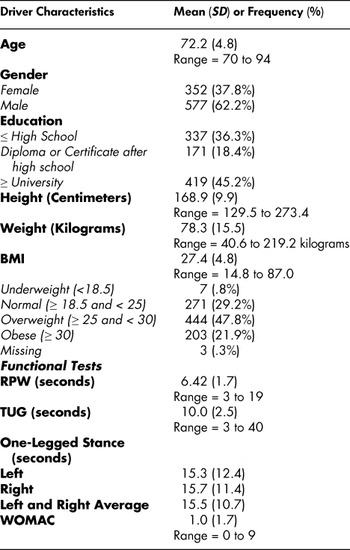
As shown in Table 1, the participants ranged in age from 70 to 94; 62 per cent were men; 64 per cent had completed some post-secondary education. Approximately one quarter of the sample (24.6%) reported problems with their balance of which 7 per cent had fallen in the past 4 months. Nearly 10 per cent of the sample reported using a cane; 2 per cent used a walker; and 1 per cent, a motorized scooter or wheelchair when needed. The medical diagnosis most often reported by participants were osteo/rheumatoid arthritis (48%), osteoporosis (19%), obesity (19%), irregular heart rhythm (18%), angina (14%), Type 1 or Type 2 diabetes (12.5%), followed by a heart attack (8%) and a transient ischemic attack (TIA) (6.5%). Scores on the RPW, TUG, One-Legged Stance test, and WOMAC are also shown in Table 1.
Sample demographics and functional scores (n = 928)

BMI = body mass index; RPW = Rapid Pace Walk; TUG = Timed Up and Go; WOMAC = Western Ontario and McMaster Universities Arthritis Index consisted of 4 items (range 0 to 16).
Vehicle Types, Demographics, and Functional Scores
Drivers in the sample reported purchasing their vehicles between 1996 and 2010 (M = 10.0; SD = 3.6, range 4 to 18 years ago). Men were significantly more likely than women to drive large cars, SUVs, or minivans/pickup trucks than small vehicles (χ2 = 77.27, p > 0.001). As shown in Table 2, there were significant differences in the type of vehicle driven with respect to mean age (F = 3.58, p = 0.003), height, (F = 13.32, p < 0.001), weight (F = 14.31, p < 0.001), and BMI (F = 4.40, p = 0.001). Drivers with large vehicles were significantly older than those driving small cars (p = 0.047), SUV (p = 0.026) or minivans/pickup trucks (p = 0.012). Drivers who drove small cars were significantly shorter than those driving mid-size (p < 0.001) and large sedans (p < 0.001), as well as SUVs, (p < 0.001) and minivans/pickup trucks (p < 0.001). Additionally, those driving mid-size sedans were also significantly shorter than those driving minivans/pickup trucks (p = 0.003). With respect to weight, those driving small and mid-size cars weighed significantly less than those driving large cars (p < 0.001) and minivans/pickup trucks (p < 0.001) respectively. Drivers with small and mid-size cars had a significantly lower BMI than those driving large cars (p = 0.036 and p = 0.023 respectively) or minivans/pickup trucks (p = 0.049 and p = 0.033 respectively). Those categorized as obese were more likely to drive large cars, SUVs, and minivans/pickup trucks than small cars (27.5% versus 18%, χ2 = 21.66, p = 0.017).
Type of vehicle driven and driver characteristics (n = 928)

Analysis performed was an ANOVA; post-hoc: Bonferroni correction. BMI = body mass index
There were no differences in terms of the type of vehicle driven and performance on clinical assessment measures of RPW, TUG, One-Legged Stance testing, or WOMAC scores. However, drivers with mild or moderate osteoporosis were significantly more likely to drive small cars compared all other models, including mid-size vehicles (χ2 = 21.23, p = 0.020). Similarly, those diagnosed with mild to moderate osteo/rheumatoid arthritis were significantly more likely to drive small and mid-size cars (χ2 = 21.23, p = 0.020). Although approximately 60 per cent of participants with balance problems drove small or mid-size cars, there were no differences with respect to car size in drivers who reported balance problems or who used an assistive device (e.g., cane or walker), as compared to other drivers in the sample.
Discussion
The findings show an age and gender effect on car model purchased. Larger sedans, SUVs, and minivans/pickup trucks were more likely to be driven by older male drivers and those of larger stature and girth (i.e., BMI). These analyses indicated the smaller the older driver (i.e., height, weight, BMI), the smaller their respective vehicle and vice versa. Although these findings are consistent with those from the survey conducted by Choo and Mokhtarian (Reference Choo and Mokhtarian2004), where they found that older males were more likely to drive large automobiles, the results from the current study suggest more subtle differences in terms of the type of vehicle driven based on a driver’s age, gender, anthropometrics, and underlying medical conditions.
Those in our sample who drove the smallest cars tended to be women and to be smaller in terms of height, weight, and BMI. From focus group studies with older drivers, Shaw et al. (Reference Shaw, Polgar, Vrkljan and Jacobson2010) found that perceptions of what constituted a safe vehicle were based on its size, with some participants indicating a smaller vehicle was safer because of its maneuverability whereas others observed that larger vehicles offered more protection; as one driver explained, “you feel like you are not going to be crunched in a larger car if you are in an accident” (p. 220). However, because of their study design, no linkages could be made with respect to the gender or health of the drivers per se. Although our findings indicated that level of functional performance in terms of strength, coordination, and balance did not influence the type of vehicle driven, older drivers who reported balance problems, or who had either osteoporosis or osteo/rheumatoid arthritis, were more likely to have smaller cars. In Canada, both health conditions affect a higher number of older women than men (Osteoporosis Canada, 2014; Arthritis Society of Canada, 2014). As well, these conditions have been linked to higher rates of physical fragility and declines in mobility, including a higher risk of injury resulting from a fall. As such, these underlying factors might have influenced our finding that smaller vehicles are in fact more likely to be driven by women and by those of shorter stature and girth.
As Haddon (Reference Haddon1972) noted in his model of injury prevention, the design of the vehicle and its associated features is one of many factors (i.e., multi-factorial) that can influence occupant safety. With age, the fit between the driver and vehicle design is particularly important (Eby & Molnar, Reference Eby and Molnar2012). Our findings demonstrated a relationship between anthropometrics of older drivers and the type of vehicle driven. Previous surveys and focus groups with older adults have reported problems with vehicle design. Shaw et al. (Reference Shaw, Polgar, Vrkljan and Jacobson2010) reported that older drivers in their focus groups feared a loss of balance when reaching out to close the door after entering a vehicle. Although larger sedans typically have a wider door aperture and, in turn, may seem more accessible, they actually have heavier doors. Problems in this age group with entering and exiting a vehicle have been linked to serious injuries and falls (Dellinger et al., Reference Dellinger, Boyd and Haileyesus2008). Hence, older drivers with certain anthropometrics and health conditions should consider the design of the vehicle at the time of its purchase.
To date, most research with older drivers in terms of vehicle choice has come from studies of their buying patterns. Koppel, Clark, Hoareau, Charlton, and Newstead (Reference Koppel, Clark, Hoareau, Charlton and Newstead2013) found that price was identified as most important (43%) among consumers aged 65 and older, yet half of those surveyed still ranked a safety-related feature (e.g., antilock brakes) in the top spot from a predefined list of features. This result is similar to findings from focus groups conducted with older drivers (aged 70 to 90) where participants emphasized the importance of certain safety features (i.e., seat belts, air bags, braking) but downplayed its impact on their vehicle purchase (Zhan et al., Reference Zhan, Porter, Polgar and Vrkljan2013). Most participants in the focus groups admitted they were unfamiliar with their car’s safety rating at the time of purchase. Further probing revealed features associated with accessibility, visibility, and adjustability that accommodated for age and health-related changes (e.g., physical limitations) were a key influence on the car they ultimately purchased. However, due to study design (i.e., self-report), direct linkages could not be made with respect to their health and choice of vehicle. Results from the current study fill this gap by examining the relationship between the types of vehicles driven and specific driver characteristics, including gender, anthropometrics, and certain medical conditions.
Limitations
This study should be considered in light of a few limitations. At the time the Candrive cohort study was initiated, participants were required to meet certain criteria in terms of their health, the year of their vehicle (1996 or older), as well as how often they drove their car. These stipulations likely account for why we did not find a relationship between the type of vehicle and scores on the clinical battery in terms of strength, balance, and mobility. However, these findings provide a baseline from which further analyses going forward can be conducted given that it is expected that the health and functional ability of the sample will decline over time. The results also suggested a relationship between the type of vehicle and certain musculoskeletal conditions. The presence of such conditions was based on self-report measures. As such, verification of their health status by the participants’ physician could yield different results, although medications are cross-checked by site coordinators where possible as per the Candrive protocol. Another potential limitation is the way in which the vehicle information was collected and then categorized. Although this approach enabled us to analyze the influence of demographics as well as other factors on the types of vehicles driven, we were not able to link specific features, such as safety rating, by collapsing the data in this way.
Conclusion
Findings from the current study provide a snapshot of the types of vehicles driven by a representative sample of older drivers in Canada. The next step will be to develop a database that will track the vehicles purchased by participants over the course of the Candrive study, including their corresponding safety ratings. In 2011, the National Highway Traffic Safety Administration (NHTSA) released an enhanced version of its five-star safety rating that provides an overall score (http://www.safercar.gov/), which makes it possible to compare newer vehicles. There has been tremendous advancement in vehicle design, particularly safety-related features (Zhan et al., Reference Zhan, Porter, Polgar and Vrkljan2013). Using the Candrive database, we will be able to extend our examination in the present study to track the safety and corresponding design features of the vehicles purchased in relation to age and health-related changes over time. We are also interested in examining if and how driving patterns might change as well as behind-the-wheel behaviors (e.g., braking, speeding) when a new vehicle is purchased. With adults aged 65 and older set to become the largest market share of potential buyers of automobiles, this type of data can be used by policymakers (NHTSA, Transport Canada) for ensuring safety-related regulations consider the needs of this consumer group given their vulnerability to crash, injury, and fatality. As well, information-related materials can be developed that target older consumers so they are better informed about the person-vehicle fit at the time of purchase.