Full-fat linseed and linseed oil, which are sources of α-linolenic acid (cis-9, cis-12, cis-15 18:3), have been investigated for their effects on lactation (Petit, Reference Petit2010) and reproductive (Petit et al. Reference Petit, Dewhurst, Scollan, Proulx, Khalid, Haresign, Twagiramungu and Mann2002) performance, FA profile and physical properties of milk fat (Hurtaud et al. Reference Hurtaud, Faucon, Couvreur and Peyraud2010), and enteric methane emission (Martin et al. Reference Martin, Rouel, Jouany, Doreau and Chilliard2008) in dairy cows. When cows receive full-fat linseed or linseed oil, the ruminal biohydrogenation of cis-9, cis-12, cis-15 18:3 produces a large number of FA isomers (Loor et al. Reference Loor, Ueda, Ferlay, Chilliard and Doreau2004; Flachowsky et al. Reference Flachowsky, Erdmann, Hüther, Jahreis, Möckel and Lebzien2006). These biohydrogenation intermediates can be absorbed and incorporated in milk fat of lactating animals, either directly, or following their metabolic transformation in body tissues (e.g. desaturation and elongation).
Dietary factors affecting ruminal biohydrogenation of linoleic acid (cis-9, cis-12 18:2) have been extensively evaluated (Bauman & Griinari, Reference Bauman and Griinari2001). More specifically, increased production of trans-10 18:1 is observed when feeding high doses of unsaturated FA with low-fibre diets. However, less is known about the effects of diet on different pathways of ruminal biohydrogenation of cis-9, cis-12, cis-15 18:3.
The predominant pathway in the biohydrogenation of cis-9, cis-12, cis-15 18:3 involves an initial isomerisation where the cis-12 bond is converted to a trans-11 bond to produce cis-9, trans-11, cis-15 18:3 (Harfoot, Reference Harfoot and Christie1981). The second and third steps consist of the hydrogenation of cis-9 and cis-15 bonds to produce trans-11, cis-15 18:2 and trans-11 18:1, respectively. After absorption, trans-11 18:1 can be desaturated to cis-9, trans-11 18:2 by the action of the Δ9 desaturase (Griinari et al. Reference Griinari, Corl, Lacy, Chouinard, Nurmela and Bauman2000). Destaillats et al. (Reference Destaillats, Trottier, Galvez and Angers2005) proposed an alternative pathway in the biohydrogenation of cis-9, cis-12, cis-15 18:3 involving an initial isomerisation where the cis-12 bond is converted to a trans-13 bond, leading to the sequential production of cis-9, trans-13, cis-15 18:3, cis-9, trans-13 18:2 or trans-13, cis-15 18:2, and trans-13 18:1. As for several octadecenoic acids, trans-13 18:1 could be desaturated after absorption to produce cis-9, trans-13 18:2 (Destaillats et al. Reference Destaillats, Trottier, Galvez and Angers2005). In support of the pathway proposed by Destaillats et al. (Reference Destaillats, Trottier, Galvez and Angers2005), few experiments have shown the presence of trace amounts of cis-9, trans-13, cis-15 18:3 in meat and milk fat from ruminants (Plourde et al. Reference Plourde, Destaillats, Chouinard and Angers2007; Rego et al. Reference Rego, Alves, Antunes, Rosa, Alfaia, Prates, Cabrita, Fonseca and Bessa2009). As opposed to cis-9, cis-12 18:2, the effects of diet on the different biohydrogenation pathways of cis-9, cis-12, cis-15 18:3 are not well documented.
The objective of this experiment was therefore to evaluate the effect of feeding linseed oil in diets differing in forage to concentrate ratio (F:C) on milk yield and composition, and on milk FA profile. It was hypothesised that supplying linseed oil in different basal diets affects the relative importance of different pathways involved in ruminal biohydrogenation of cis-9, cis-12, cis-15 18:3, resulting in varying concentrations of specific FA intermediates in milk fat.
Materials and methods
Animals and diets
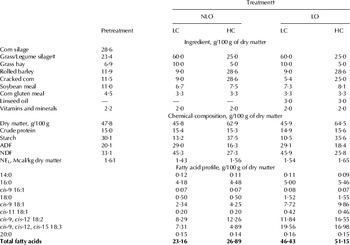
The experiment was conducted at the Centre de Recherche en Sciences Animales de Deschambault (Deschambault, QC, Canada). All procedures involving dairy cows followed the regulations of the Canadian Council on Animal Care (Reference Offert, Cross and McWilliam1993), and were approved by the Université Laval animal care committee. Twenty-four lactating Holstein cows (637±68 kg body weight; 168±53 d in milk; 9 primiparous and 15 multiparous) housed in a tie-stall barn were fed a pretreatment total mixed ration based on grass/legume silage and corn silage (Table 1). Cows were then assigned to a randomised complete block design based on days in milk with a 2×2 factorial arrangement of treatments. Within each block, cows were fed one of four experimental diets containing 30% concentrate (LC) or 70% concentrate (HC), without linseed oil (NLO) or with linseed oil (LO) supplemented at 3% of dietary dry matter (Table 1). The treatment period lasted 4 weeks. Throughout the experiment, diets were offered to the cows once daily as a total mixed ration, and the amount of feed offered was adjusted to ensure 10% refusals. Free access to water was provided at all time.
Ingredients and chemical composition of experimental diets (g 100/g dry matter)

† NLO=no linseed oil; LO=with linseed oil, LC=low concentrate; HC=high concentrate
‡ Grass/legume silage was constituted of 11% ladino clover, 34% timothy, and 55% bromegrass
Sampling, measurements and analyses
A first sampling and measurement phase was conducted during the last week of the pretreatment period (week 0), and a second during the last week of the treatment period (week 4). At each of those phases, cows were weighed for 3 consecutive days following the a.m. milking. Dry matter intake was recorded and feed samples were collected for 3 consecutive days and pooled by treatment. A first subsample was dried at 55 °C for 3 days to determine dry matter intake. All rations were analysed by wet chemistry (Dairy One Laboratory, Ithaca, NY, USA) according to the following methods: dry matter (method 2.2.1.1; National Forage Testing Association; Undersander et al. Reference Undersander, Mertens and Thiex1993), residual moisture (method 991.01; AOAC International, 2012), ADF (ANKOM Technology method 5: ADF in feeds – filter bag technique for A200; solutions as in method 973.18; AOAC International, 2012), NDF (ANKOM Technology method 6: NDF in feeds – filter bag technique for A200; solutions as in Van Soest et al. Reference Van Soest, Robertson and Lewis1991), and starch (application note number 319; YSI Inc. Life Sciences, Yellow Springs, Ohio).
After freeze drying and grinding through a 1-mm screen, FA profile of total mixed rations was determined. Fatty acids were directly transesterified, and FA methyl esters were extracted following the method described by Sukhija & Palmquist (Reference Sukhija and Palmquist1988) with modifications. In the modified procedure, benzene was replaced by toluene and incubation in 3 ml HCl 5% (v/v) was performed at 50 °C for 30 min and followed a prior incubation in 3 ml sodium methoxide (0·5 M in methanol) at 70 °C for 60 min.
Cows were milked at 0700 and 1700 h. Milk was sampled, and milk yield was recorded for 3 consecutive days. Daily milk composites were made from p.m. and a.m. milk samples proportionally to milk yield. A first subsample was preserved with bronopol and kept at 4 °C before analyses of fat, protein, and lactose using a Foss Milkoscan 4000 (Foss Electric, Hillerød, Denmark) combined with a Bentley 2000 (Bentley Instruments, Chaska, MN) at Valacta (Dairy Production Centre of Expertise, Ste-Anne-de-Bellevue, Québec, Canada). A second subsample was stored at −20 °C without preservative for FA analysis.
Before lipid extraction for FA analysis, milk samples were thawed in water at 36 °C for 30 min. Milk fat was then extracted and FA were methylated according to Chouinard et al. (Reference Chouinard, Lévesque, Girard and Brisson1997). Milk FA profile was determined using a gas chromatograph (Agilent 7890A; Agilent Technologies, Santa Clara, CA, USA) equipped with a 100-m CP-Sil-88 capillary column (0·25 μm i.d., 0·20 μm film thickness; Agilent Technologies Canada Inc., Mississauga, Canada), and a flame ionisation detector. In order to screen milk FA composition, a first temperature programme was used where, at the time of injection, the column temperature was 80 °C for 1 min., then ramped at 2 °C/min. to 215 °C and maintained for 21·5 min. Two additional isothermal temperature programmes (150 and 175 °C; Kramer et al. Reference Kramer, Hernandez, Cruz-Hernandez, Kraft and Dugan2008) were used to separate isomers that were co-eluting in the first programme. For the separation and quantification of cis-9, trans-11, cis-15 18:3 and cis-9, trans-13, cis-15 18:3, a fourth temperature programme was used where at the time of sample injection, the column temperature was 120 °C for 180 min., then increased at 10 °C/min. to 220 °C and maintained isothermal for 20 min. (Plourde et al. Reference Plourde, Destaillats, Chouinard and Angers2007). For the separation and quantification of trans-13 18:1 and trans-14 18:1, trans FA methyl esters were first isolated using silver ion-thin layer chromatography followed by a GC analysis of this fraction with a fifth programme at a low isothermal temperature of 120 °C (Kramer et al. Reference Kramer, Hernandez, Cruz-Hernandez, Kraft and Dugan2008).
Most FA peaks were identified and quantified using either a quantitative mixture or pure methyl ester standards (Larodan Fine Chemicals, Malmö, Sweden; Sigma-Aldrich Canada Ltd, Oakville, Ontario, Canada; Matreya LLC, Pleasant Gap, PA, USA; Nu Chek Prep, Elysian, MN, USA; Naturia, Sherbrooke, QC, Canada). Standards for isomers that were not available commercially were identified by order of elution according to Precht et al. (Reference Precht, Molkentin, McGuire, McGuire and Jensen2001) and Kramer et al. (Reference Kramer, Hernandez, Cruz-Hernandez, Kraft and Dugan2008).
Statistical analysis
Data were analysed using the MIXED procedure of SAS (SAS Institute Inc., Cary, NC) with two models depending on type of data collected. The first model was used for body weight, dry matter intake, milk yield, and milk composition. This model included data collected during the last week of the pre-trial period as covariates, and also level of concentrate, oil supplementation, and their interaction as fixed effects. Block was included as a random effect. Because data on milk FA profile from the pre-trial period were not available, a second model was used to determine treatment effects on milk FA composition which included the fixed effects of level of concentrate, oil supplementation, and their interaction, and block as a random effect. Results are reported as least square means and standard errors of the means. Differences between treatments were declared at P⩽0·05, and tendencies from P>0·05 to P<0·10.
Results
Dietary concentrations of crude protein were similar between treatments (Table 1). Both HC diets (NLO and LO) contained about 40% more dry matter, three times more starch, and 40% less ADF and NDF than both LC diets (NLO and LO). The HC diets which contained higher concentration of cracked corn and rolled barley had 40% more cis-9 18:1 and cis-9, cis-12 18:2, and 19% less cis-9, cis-12, cis-15 18:3 compared with LC diets. The addition of LO doubled the concentration of total FA in the diet compared with NLO treatments. Moreover, adding LO to diets increased the proportions of 18:0, cis-9 18:1, and cis-9, cis-12, cis-15 18:3 by about 3-fold as compared with NLO.
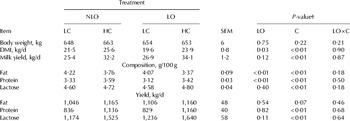
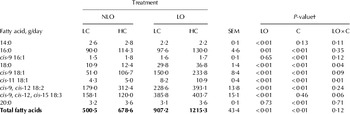
No interaction of oil by concentrate has been observed for animal performance and concentration of major milk constituents (Table 2). Final body weight after the 4-wk experimental period was similar among treatments. Feeding HC diets increased dry matter intake, milk yield, as well as protein and lactose content and yield (P<0·01). Adding LO decreased dry matter intake and milk protein content, but increased intake of cis-9, cis-12 18:2 and cis-9, cis-12, cis-15 18:3 (Table 3). Fat content decreased with LO supplementation, as well as with high concentrate diets (P<0·01), while fat yield tended to be higher with HC compared with LC (P=0·07).
Body weight, dry matter intake (DMI), milk yield, and milk composition in cows fed high (HC) or low (LC) concentrate diets without supplemental oil (NLO), or supplemented at 3% of dry matter with linseed oil (LO)

† P-value for the effects of linseed oil (LO), concentrate (C), and the interaction of linseed oil by concentrate (LO×C)
Fatty acid intake in cows fed high (HC) or low (LC) concentrate diets without supplemental oil (NLO), or supplemented at 3% of dry matter with linseed oil (LO)

† P-value for the effects of linseed oil (LO), concentrate (C), and the interaction of linseed oil by concentrate (LO×C)
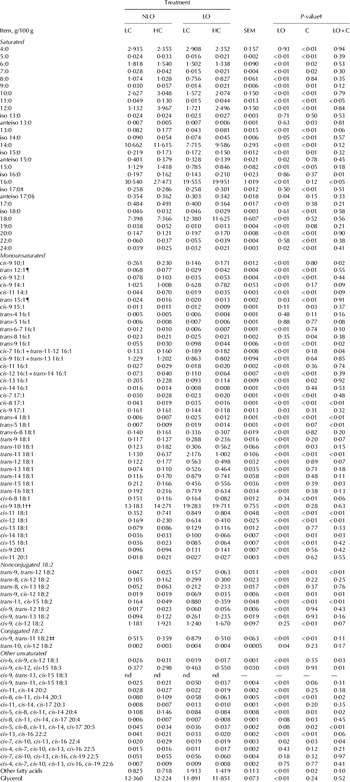
Feeding LO increased the concentration of cis-9, cis-12, cis-15 18:3 in milk fat (Table 4), and this increase was of a higher magnitude when LO was added in HC as compared with LC diet (interaction of LO by concentrate P<0·01). The concentration of cis-9, cis-12 18:2 was not affected by LO, but was increased when feeding HC as compared with LC diets.
Milk fat composition in cows fed high (HC) or low (LC) concentrate diets without supplemental oil (NLO), or supplemented at 3% of dry matter with linseed oil (LO)

† P- value for the effects of linseed oil (LO), concentrate (C), and the interaction of linseed oil by concentrate (LO×C)
‡ Coelution with minor concentration of trans-10 16:1
§ Coelution with minor concentration of cis-10 16:1
¶ Position of the double bound was not confirmed
†† Coelution with minor concentration of cis-10 18:1
‡‡ Coelution with trans-7, cis-9 18:2
A treatment interaction was observed for the level of trans-11 18:1 which was increased by feeding LO, but for which the increase was more pronounced with the LC as compared with HC diets. Milk fat concentrations of trans-15 18:1 and trans-11, cis-15 18:2 were also higher in milk of cows fed LO, but the increase was of a lower magnitude when LO was added in LC compared with HC diets.
Feeding LO increased milk fat content of trans-13 18:1 and cis-9, trans-13 18:2, while their concentrations were not affected by dietary concentrates (Table 4). The isomer cis-9, trans-13, cis-15 18:3 has not been detected in any of the milk samples.
The concentrations of cis-15 18:1, cis-9, trans-11 18:2 and cis-9, trans-11, cis-15 18:3 were higher in milk of cows fed LO, but feeding HC diets decreased milk fat content of these three FA without interaction between dietary treatments. Dietary LO increased the concentrations of trans-10 18:1 and trans-10, cis-12 18:2 in milk fat; and the proportion of trans-10 18:1 was further increased by feeding HC as compared with LC. Finally, the level of milk 18:0 was increased by feeding LO, but was not affected by dietary concentrates.
Discussion
Feeding LO, and supplying more concentrate, increased the dietary proportions of FA and starch, and therefore improved the energy density of the diets (Table 1). As observed in the current trial, Sterk et al. (Reference Sterk, Johansson, Taweel, Murphy, van Vuuren, Hendriks and Dijkstra2011) also reported that shifting from a high forage (65:35 F:C) to a high concentrate (35:65 F:C) diet increased dry matter intake and milk yield in dairy cows. The higher dry matter intake with HC diets is in agreement with a lower dietary NDF content as suggested by Allen (Reference Allen2000). The observed increase in milk yield with HC could then be explained by a greater intake of dry matter, with a higher nutrient density.
Supplementing dairy diets with LO, at similar or lower concentrations than the 3% level used in the current trial, has been shown to have no effect on dry matter intake (Loor et al. Reference Loor, Ferlay, Ollier, Doreau and Chilliard2005; Flachowsky et al. Reference Flachowsky, Erdmann, Hüther, Jahreis, Möckel and Lebzien2006; Benchaar et al. Reference Benchaar, Romero-Pérez, Chouinard, Hassanat, Eugene, Petit and Côrtes2012). However, Chilliard et al. (Reference Chilliard, Martin, Rouel and Doreau2009) reported a lower dry matter intake with higher levels of LO supplementation (5·7% of dry matter) using corn silage based diets.
Feeding HC diets, with higher starch content, increased milk protein concentration and yield. Sterk et al. (Reference Sterk, Johansson, Taweel, Murphy, van Vuuren, Hendriks and Dijkstra2011) observed similar results when supplying a greater amount of starch, a glucogenic precursor which has been shown by these authors to be correlated with milk protein synthesis. Also, in a review by Emery (Reference Emery1978), a positive correlation was established between milk protein concentration and energy intake when concentrate was substituted for forage.
The effects observed in the current trial on milk composition are consistent with previously published results showing lower milk fat content when feeding high concentrate diets (Griinari et al. Reference Griinari, Dwyer, McGuire, Bauman, Palmquist and Nurmela1998; Sterk et al. Reference Sterk, Johansson, Taweel, Murphy, van Vuuren, Hendriks and Dijkstra2011). However, the decrease in milk fat content was more than compensated by an increase in milk production, so that a tendency for a higher fat yield was observed with HC diets in the present experiment.
Dietary addition of LO increased the intake of cis-9, cis-12, cis-15 18:3, and this increase tended to be of a higher magnitude with HC as compared with LC (P=0·06). These variations were reflected in milk fat, where concentrations of cis-9, cis-12, cis-15 18:3 were increased when cows received LO diets with the highest concentration being observed with HCLO. Similarly, feeding HC diets increased the intake of cis-9, cis-12 18:2 which explained the higher concentration of this essential FA in milk fat as compared with LC diets.
Among the intermediates of ruminal biohydrogenation, the treatment interaction observed on the level of trans-11, cis-15 18:2, that was increased by feeding LO, but for which the increase was more pronounced with the HC as compared with LC, is consistent with a similar interaction observed in the supply of its precursor e.g., dietary cis-9, cis-12, cis-15 18:3. An inverse interaction was observed on the concentration of trans-11 18:1 for which the increase obtained with LO was of a lower magnitude with HC as compared with LC. This FA is an intermediate in the biohydrogenation process of both cis-9, cis-12 18:2 and cis-9, cis-12, cis-15 18:3. A shift from the trans-11 to the trans-10 pathway of biohydrogenation has been observed with the HC in the current trial as well as in previous experiments (Griinari & Bauman, Reference Griinari, Bauman, Yurawecz, Mossoba, Kramer, Pariza and Nelson1999). The production of FA intermediates of the trans-10 pathway has also been reported during the biohydrogenation of cis-9, cis-12, cis-15 18:3 (Lee & Jenkins, Reference Lee and Jenkins2011).
Destaillats et al. (Reference Destaillats, Trottier, Galvez and Angers2005) proposed a putative biohydrogenation pathway for cis-9, cis-12, cis-15 18:3 in which the hydrogenation process begins with a cis-12/trans-13 isomerisation. In the current study, despite chromatographic conditions that allowed identification of this specific isomer, cis-9, trans-13, cis-15 18:3 was not detected in milk fat. Consistent with the present study, Zened et al. (Reference Zened, Troegeler-Meynadier, Nicot, Combes, Cauquil, Farizon and Enjalbert2011) showed no detectable concentration of cis-9, trans-13, cis-15 18:3 in ruminal content incubated in vitro with cis-9, cis-12, cis-15 18:3 supplement. However, these conclusions are in contradiction with previous reports showing the presence of cis-9, trans-13, cis-15 18:3 in ruminant meat (Plourde et al. Reference Plourde, Destaillats, Chouinard and Angers2007) and milk (Rego et al. Reference Rego, Alves, Antunes, Rosa, Alfaia, Prates, Cabrita, Fonseca and Bessa2009). Discrepancies between studies remain to be elucidated and could potentially be related to experimental models, interactions with basal diets, and methodological and/or chromatographic conditions.
Nevertheless, the presence of trans-13 18:1 and cis-9, trans-13 18:2, which both increased following LO supplementation, confirm the existence of a trans-13 pathway of hydrogenation. Also, cis-9, trans-13 18:2 might have been produced endogenously in tissues by the Δ9-desaturation of trans-13 18:1 (Bichi et al. Reference Bichi, Toral, Hervás, Gómez-Córtes, Juárez and de la Fuente2012). Other isomers of 18:2 with a trans-13 double bond are increased when cis-9, cis-12, cis-15 18:3 is provided in the diet. Lerch et al. (Reference Lerch, Shingfield, Ferlay, Vanhatalo and Chilliard2012) observed higher concentrations of cis-11, trans-13 18:2 and trans-11, trans-13 18:2 in milk fat when feeding lactating dairy cows with extruded linseed. The isomer trans-13, cis-15 18:2 is another potential intermediate in a trans-13 pathway of biohydrogenation (Destaillats et al. Reference Destaillats, Trottier, Galvez and Angers2005). However, this conjugated 18:2 isomer remains to be identified in milk fat.
Among other 18:3 isomers, which could be intermediate in a trans-13 pathway, Lerch et al. (Reference Lerch, Shingfield, Ferlay, Vanhatalo and Chilliard2012) identified cis-9, trans-11, trans-13 18:3 in bovine milk fat. However, the hydrogenation of this fully conjugated 18:3 isomer is more likely to produce trans-11, trans-13 18:2 which has been reported in ruminal content (Loor et al. Reference Loor, Ueda, Ferlay, Chilliard and Doreau2004) and milk (Lerch et al. Reference Lerch, Shingfield, Ferlay, Vanhatalo and Chilliard2012) in dairy cows.
The level of trans-14 18:1 in milk fat was about 60% higher than the level of trans-13 18:1, and the ratio of these two FA was affected neither by LO supplementation nor by level of concentrate (P>0·10; data not shown). Unlike the ratio of trans-11 18:1 to trans-10 18:1, which was significantly reduced when changing from LC to HC diets (P<0·01; data not shown), the ratio of trans-13 to trans-14 does not appear to be modified by the conditions of ruminal environment.
Shingfield et al. (Reference Shingfield, Bernard, Leroux and Chilliard2010) integrated the data available in the literature on the biohydrogenation of cis-9, cis-12, cis-15 18:3, and suggested cis-12, trans-14 18:2 and trans-12, trans-14 18:2 as putative intermediates in the production of trans-14 18:1. In particular, results from other studies have shown an increase in trans-12, trans-14 18:2 (Gómes-Cortés et al. Reference Gómez-Cortés, Tyburczy, Brenna, Juárez and de la Fuente2009; Lerch et al. Reference Lerch, Shingfield, Ferlay, Vanhatalo and Chilliard2012), cis-9, trans-14 18:2, and cis-12, trans-14 18:2 (Lerch et al. Reference Lerch, Shingfield, Ferlay, Vanhatalo and Chilliard2012) when diets of lactating ruminants were supplemented with extruded linseed. In the current trial, the high concentration of trans-14 18:1 observed when feeding LO (7·5 fold increase compared with NLO with the LC diets) also supports the existence of a trans-14 pathway of biohydrogenation of cis-9, cis-12, cis-15 18:3.
The increase in milk fat content of trans-10, cis-12 18:2 and trans-10 18:1 when feeding LO in diets with a similar level of concentrate (LC or HC), or the higher trans-10 18:1 when increasing level of concentrate in diets with similar LO supplementation (NLO or LO) is in line with the lower milk fat content observed with these two treatments as reported previously under similar situations (Shingfield et al. Reference Shingfield, Bernard, Leroux and Chilliard2010). However, higher milk yield compensated for the lower fat concentration so that total fat yield was not affected by LO, and even tended to be higher with HC diets. Lack of effect of LO on milk fat yield has been observed previously with similar levels of supplementation (Loor et al. Reference Loor, Ferlay, Ollier, Doreau and Chilliard2005; Benchaar et al. Reference Benchaar, Romero-Pérez, Chouinard, Hassanat, Eugene, Petit and Côrtes2012), but a decrease in milk fat content and yield has been observed with higher dietary supplies of linseed oil (Chilliard et al. Reference Chilliard, Martin, Rouel and Doreau2009), and raw or extruded linseed (Akraim et al. Reference Akraim, Nicot, Juaneda and Enjalbert2007).
In conclusion, results of the current experiment confirmed that biohydrogenation of cis-9, cis-12, cis-15 18:3 is dominated by the trans-11 pathway; for which the highest concentrations of intermediates have been found in milk fat (i.e. cis-9, trans-11, cis-15 18:3, trans-11, cis-15 18:2, cis-15 18:1, and trans-11 18:1). Moreover, the extent of production of these intermediates has been affected by the levels of concentrate in the diet, as shown by the interactions observed between treatments for milk fat content of trans-11, cis-15 18:2 and trans-11 18:1.
The identification and quantification of trans-13 18:1 and cis-9, trans-13 18:2 still offers some support to a trans-13 pathway of ruminal biohydrogenation. However, adding linseed oil, high levels of concentrate, or both did not result in a shift toward a trans-13 biohydrogenation pathway. Finally, cis-9, trans-13, cis-15 18:3 has not been identified in our milk samples, which suggests that this specific biohydrogenation pathway is not initiated by a cis-12 to trans-13 isomerisation.
This experiment was funded through Industrial Research Chair programme of Natural Sciences and Engineering Research Council of Canada (Ottawa, ON, Canada), with industry contributions from Dairy Farmers of Canada (Ottawa, ON, Canada), Novalait Inc. (Québec, QC, Canada), Valacta (Ste-Anne-de-Bellevue, QC, Canada), Fédération des Producteurs de Lait du Québec (Longueuil, QC, Canada), and Ministère de l'Agriculture, des Pêcheries et de l'Alimentation du Québec (Québec, QC, Canada).
The authors thank André Perreault and Philippe Cantin as well as the administrative staff of the Centre de Recherche en Sciences Animales de Deschambault (Québec, Canada) for the care provided to cows during the trial. The authors are also grateful to Gabrielle St-Pierre and Micheline Gingras from the Département des Sciences Animales, Université Laval for their assistance in samplings and laboratory analyses.