Myocardial injury is a rare occurrence in previously healthy children.Reference Selbst, Ruddy, Clark, Henretig and Santulli 1 In addition, unlike the adult population in which acute coronary syndrome is the most common aetiology,Reference Ohman, Armstrong and Christenson 2 the differential diagnosis includes myocarditis, myopericarditis, pericarditis, anomalous coronary artery origins, Prinzmetal's angina, pulmonary embolism, and myocardial injury from substance abuse.Reference Kane, Fulton, Saleeb, Zhou, Lock and Geggel 3 – Reference Basnet, Mander and Nicolas 5 Although the incidence is low, given the increased awareness and potentially severe impact of cardiac disease, measurement of troponin levels to evaluate for myocardial injury is increasingly becoming part of the standard evaluation of cardiorespiratory symptoms in the emergency department.Reference Friedman, Kane and Rathod 6 In a recent study on children, a Troponin I level >2 ng/ml was suggestive of cardiac involvement.Reference Brown, Hirsh and Mahle 7 However, further work-up after confirmation of cardiac involvement has not been well defined. In this study, we review our experience with previously healthy children admitted to the Pediatric Cardiology Service with elevated troponin levels and evaluate the specific contribution of electrocardiography, cardiac catheterisation, echocardiography, cardiac magnetic resonance imaging, and other ancillary tests to the final diagnosis and clinical management. In addition, we assessed troponin levels within each diagnostic category to determine whether characteristic patterns could be indicative of the final diagnosis.
Materials and methods
A retrospective chart review of patients admitted to Children's Medical Center of Dallas Cardiology inpatient service between 2000 and 2010 was carried out. Patients with documented elevated troponin levels at the time of hospital admission were included. Patients with a previous history of congenital or acquired cardiac or pulmonary disease, sepsis, collagen vascular disease, or trauma were excluded. The study was approved by the Institutional Review Boards for Human Research at the University of Texas Southwestern Medical Center and at the Children's Medical Center.
The medical records of the patients were reviewed for age, gender, symptoms at presentation, initial diagnosis on presentation, final discharge diagnosis, and family history of sudden death or early atherosclerosis. Cardiorespiratory symptoms and signs at the time of presentation included the following: recent onset of chest pain and/or syncope – within two weeks of presentation; signs and symptoms of congestive cardiac failure; and arrhythmias with haemodynamic compromise. Laboratory data collected included cardiac enzyme (Troponin I) levels and drug screen tests. The results of the cardiac diagnostic studies including electrocardiography, echocardiography, cardiac catheterisation, and cardiac magnetic resonance imaging and their contribution towards the final diagnosis were reviewed.
The laboratory assay used for the measurement of Troponin I was the Siemens ExL Loci Module Troponin I assay (Siemens Healthcare Diagnostics, Tarrytown, NY, USA), which is a homogeneous sandwich chemiluminescent assay. The cut-off value for myocardial injury was >0.1 ng/ml.
Final diagnoses were based on the clinical impression of the attending cardiologist as documented in the medical record. The clinical diagnosis of myocarditis was based on cardiorespiratory symptoms along with electrocardiographic abnormalities and/or ventricular dysfunction as seen on the echocardiogram. The diagnosis of myocarditis was confirmed in some patients by the presence of delayed myocardial enhancement as seen on performing magnetic resonance imaging, as described previously.Reference Childs and Friedrich 8 Only one patient underwent a myocardial biopsy, as biopsies are not routinely performed at our institution.
Myopericarditis was diagnosed in the presence of elevated troponin levels and at least two of the following criteria: pericarditic chest pain, pericardial friction rub, diffuse ST segment elevation or PR depressions on electrocardiography, and/or pericardial effusion.Reference Imazio and Trinchero 9
Decreased left ventricular systolic function as seen on an echocardiogram was defined as a shortening fraction of 20–28% for mild dysfunction and <20% for moderate-to-severe systolic dysfunction.
Anomalous origin of the left coronary artery from the right cusp was identified on the basis of transthoracic echocardiograms. In our cohort, a cardiac catheterisation was performed mainly for the evaluation of coronary artery origins when not defined on echocardiography; haemodynamic assessment was not consistently performed.
Results
A total of 32 patients were identified. The mean age at presentation was 14 years (range 7–20 years). The majority (90%) were males. The average duration of symptoms before presentation was 3 days (range 1–14 days). There was no family history of sudden death in our cohort. There was one patient who had a previous cardiac history of Wolff–Parkinson–White Syndrome, for which he had undergone a successful ablation 5 years before this encounter.
The aetiology of myocardial injury in these patients was: myocarditis in 16 patients (50%), myocardial injury/infarction secondary to coronary vasospasm in seven (22%), myopericarditis in six (19%), anomalous coronary arteries in two (6%), and Prinzmetal's angina in one (3%) patient.
Myocarditis
Of the 16 patients with a final diagnosis of myocarditis, 11 had chest pain and 14 had prodromal respiratory or gastrointestinal symptoms at presentation – including fever, cough, respiratory distress, vomiting, diarrhoea, or abdominal pain – and evidence of cardiac failure, which prompted cardiac evaluation. Of these patients, three were also diagnosed with pancreatitis. The two patients who did not have a prodrome presented with syncope and arrhythmias, and one required an implantable cardioverter-defibrillator placement. Of the 16 patients in this subgroup, electrocardiographic abnormalities were present in 13: ST segment changes in the inferior and lateral leads were present in nine patients, three patients presented with ventricular tachycardia, and one had a complete heart block requiring urgent pacing and placement of an epicardial pacemaker. All patients underwent an echocardiographic evaluation: five had normal systolic function, eight presented with mild systolic dysfunction, and three patients had moderate-to-severe systolic dysfunction at presentation; all patients presenting with systolic dysfunction have subsequently had normal echocardiograms during the outpatient evaluation, with the exception of one patient. A total of 12 patients underwent urine drug screens, all of which were negative. A cardiac catheterisation was undertaken in seven patients because of the concern for coronary artery involvement. No abnormalities in coronary origin or vessel stenosis were detected. Of the seven patients who underwent a cardiac catheterisation, four had an elevated left ventricular end diastolic pressure (>15 mmHg). Haemodynamic data were not consistently performed during the cardiac catheterisation. Only one adolescent underwent right ventricular biopsy at the time of catheterisation to rule out myocarditis, and the results showed no evidence of inflammation. This patient had clinical characteristics of myocarditis, including chest pain, prodromal symptoms, electrocardiographic changes, mild left ventricular systolic dysfunction, and an elevated left ventricular end-diastolic pressure (20 mmHg). In all, three patients underwent cardiac magnetic resonance imaging, which revealed delayed gadolinium enhancement in the left ventricular wall; this was suggestive of myocarditis in two patients. The third patient had normal cardiac magnetic resonance imaging. Coronary artery origins were normal in all three patients. Of the two patients with myocarditis, one required extracorporeal membrane oxygenation support, with subsequent recovery of the cardiac function.
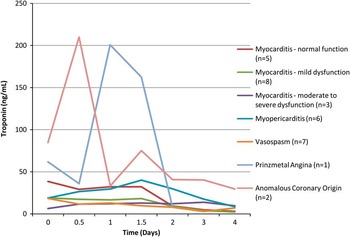
The median troponin level in patients with myocarditis with normal function was 15.4 ng/ml on presentation (range of 13.5–111.8), with a peak of 26.5 ng/ml (13.5–111.8) during the hospital stay. At the time of discharge, the median level was 2.2 ng/ml (range 0.8–45). The median troponin level in patients with mildly decreased function at admission was 19.6 ng/ml (range 9.1–31.7). The median peak troponin level was 20.5 ng/ml (range 9.1–40.2). The median troponin level at discharge was 2.25 ng/ml (range 0.5–11.6). The median troponin level in patients with moderate-to-severe dysfunction at admission was 5.7 ng/ml (range 4.1–8.8). The median peak troponin level was 17.8 ng/ml (range 6.4–21.1). The median troponin level at discharge was 0.4 ng/ml (range of 0.3–0.5).
Myopericarditis
A total of six patients were diagnosed with myopericarditis. Of them, five presented with chest pain and four had a prodrome. The electrocardiographs revealed an ST segment elevation in the inferolateral leads in all patients. All patients underwent an echocardiographic evaluation; four patients had transient mild left ventricular systolic dysfunction, including one patient with a dyskinetic apical septal segment. Of these four patients, three had a pericardial effusion, with two patients requiring drainage. The remaining two patients had normal left ventricular systolic function. In all, four patients underwent urine drug screens, which were negative. Of these patients, two underwent cardiac catheterisation to further delineate the coronary artery anatomy, which was normal as seen on angiograms. Cardiac magnetic resonance imaging was performed in one patient, which showed no evidence of delayed enhancement and normal coronary artery origins and course.
The median troponin level on admission was 9 ng/ml (range 2.4–69.5), which peaked at 32 ng/ml (range 2.4–132.4), and was 1.7 ng/ml (range 0.3–6.8) at the time of discharge.
Coronary vasospasm due to drug use
A total of seven patients were diagnosed with myocardial injury related to drug use. All patients presented with chest pain and four patients had prodromal symptoms. Urine drug screens were performed in seven patients: the results showed that five patients tested positive for cannabis and were negative in two patients. One patient who tested positive for cannabis had cocaine detected in his urine test. Both patients with a negative drug screen admitted to using K2, which is a cannabis derivative. Of the patients in this subgroup, six demonstrated ST elevation in the anterior, inferior, and lateral leads as seen on the electrocardiographs. All patients underwent an echocardiographic evaluation, demonstrating normal left ventricular systolic function, except for the one patient who tested positive for cocaine and cannabis who had apical septal segmental wall dyskinesia. Cardiac catheterisation in this patient revealed diminished blood flow through the distal left anterior descending coronary artery that improved after the administration of nitroglycerine, which is consistent with coronary vasospasm. There was one patient using cannabis who had distal mid-segmental narrowing of his left anterior descending coronary artery, consistent with a myocardial bridge. A total of three patients had normal coronaries as seen on angiograms and two patients did not undergo cardiac catheterisation.
The median troponin level in this subgroup was 17.2 ng/ml (range 8.6–33.7) on presentation, with a peak median of 22.5 ng/ml (range of 11.6–33.7) during the hospital stay and a median of 3.7 ng/ml (range of 0.3–8.2) at the time of discharge.
Anomalous coronary artery origin
In all, two adolescents were found to have an anomalous left coronary artery arising from the right cusp with an intramural course. Both patients presented with exertional syncope; one patient underwent a urine drug screen, which was negative. The electrocardiographs in both patients showed ST segment changes consistent with anterolateral infarcts. Of the two patients, one developed rapid clinical deterioration with cardiac arrest within a few hours of presentation requiring extracorporeal membrane oxygenation support. An anomalous coronary was detected on echocardiographic evaluation and confirmed by a computed tomography scan. Secondary to the severe neurological injury from the cardiac arrest, the patient did not survive. The second patient had incessant ventricular arrhythmias and also required extracorporeal membrane oxygenation support. The diagnosis was made using transthoracic echocardiography and confirmed using transoesophageal echocardiography. He underwent surgical repair and was clinically doing well on a subsequent 6-month follow-up.
The median troponin levels were as follows: at presentation 84.6 ng/ml (range 22.2–147), peak 209.9 ng/ml (range 47.7–372), and at discharge/death 8.7 ng/ml (range 4.9–12.4, mean 8.7).
Prinzmetal's angina
There was one patient who presented with chest pain in the setting of a strong family history of early coronary artery disease. His total cholesterol level was mildly elevated. The electrocardiograph, echocardiogram, and cardiac catheterisation were normal, and the urine drug screen was negative. He was diagnosed with Prinzmetal's angina with symptomatic relief on administration of a calcium channel blocker. His troponin level was 61.8 ng/ml on admission, peaked at 200.8 ng/ml, and was 8.3 ng/ml at the time of hospital discharge.
Discussion
The creation of a standardised work-up on elevated troponin levels in previously healthy children is complicated by the low incidence of underlying cardiac pathology of chest pain, which is estimated at 0.6–1.2%.Reference Friedman, Kane and Rathod 6 , Reference Hirsch, Landt and Porter 10 A thorough history remains the primary basic screening tool for a cardiac aetiology as it is helpful in the diagnosis of drug use and abnormal coronary origin. However, prodromal symptoms are not specific for myocarditis or myopericarditis. Measurement of serum troponin levels has been used with increasing frequency to evaluate for the presence of cardiac pathology.Reference Kane, Fulton, Saleeb, Zhou, Lock and Geggel 3 , Reference Brown, Hirsh and Mahle 7 Abnormal troponin levels are reflective of myocardial injury, and a recent paediatric studyReference Brown, Hirsh and Mahle 7 suggested that a troponin level >2 ng/ml decreases the likelihood of a non-cardiac diagnosis. Our results agree with this finding, as in our cohort with cardiac pathology the lowest troponin level on presentation was 2.4 ng/ml. The analysis of troponin values within each subgroup suggests that the absolute value and progression are not helpful in distinguishing between different cardiac aetiologies (Fig 1). Although marked troponin elevation (levels >100 ng/ml) has been previously reportedReference Kobayashi, Aggarwal, Kheiwa and Shah 11 in patients with myocarditis and myopericarditis, in our cohort higher levels (>200 ng/ml) were found in two patients – one with an anomalous coronary origin and one with Prinzmetal's angina. Owing to the small number of patients with these anomalies, the absolute troponin levels may not be useful in delineating the aetiology of myocardial injury. However, the level and trend of troponin values in these groups may warrant further assessment for the prognosis and outcome, although it does not predict the outcome in patients with myocarditis.Reference Kobayashi, Aggarwal, Kheiwa and Shah 11
Troponin values in children with myocardial injury.

Once myocardial involvement is suspected, a specific diagnosis has to be established expeditiously, as some diseases such as anomalous origin of coronary arteries are potentially lethal. In agreement with prior reports, the most common aetiology in our cohort was myocarditis. The diagnosis of myocarditis remains primarily clinical given the low yield and high risk of performing an endomyocardial biopsy in children. This was the case in one patient who met the clinical criteria for myocarditis but had a negative biopsy. Recently, magnetic resonance imaging with delayed gadolinium enhancement has proven helpful in identifying myocardial inflammation, which may be seen along with myocarditis.Reference Childs and Friedrich 8 , Reference Mahrholdt, Goedecke and Wagner 12 A study comparing magnetic resonance imaging with endomyocardial biopsy reported a sensitivity of 100% and a specificity of 90% for diagnosing myocarditis.Reference Gagliardi, Polletta and Di Renzi 13 Although abnormal left ventricular systolic function as seen on echocardiography has been used as a criteria for the diagnosis of myocarditis, there is a subset of patients with this disease that does not demonstrate ventricular dysfunction or segmental wall abnormalities.Reference Camastra and Cacciotti 14 Of interest, troponin levels were not useful in differentiating between patients with preserved versus depressed left ventricular systolic function.
Drug use in our cohort accounted for a larger proportion of patients admitted with elevated troponin levels when compared with prior studies.Reference Friedman, Kane and Rathod 6 , Reference Brown, Hirsh and Mahle 7 Coronary vasospasm caused by cannabis and its derivatives such as K2 and Spice has likely been underestimated as a cause of troponin elevation.Reference Mir, Obafemi, Young and Kane 4 In this retrospective chart review, an abnormal drug screen and/or history of substance abuse was identified in seven patients. In this subset of patients, diagnostic imaging, including coronary angiography, did not add to the management, again highlighting the importance of a thorough history. The urine toxicology screens were positive for five of these seven patients, and we recommend that they should be incorporated into the evaluation of every patient with chest pain and elevated troponin levels. Synthetic derivatives of cannabis such as K2 and Spice may not be detected on a routine drug screen; specific blood and urine tests have become available and can be used to confirm the presence of these synthetic derivatives.Reference Mir, Obafemi, Young and Kane 4 The predominant drug was cannabis, which has been reported to cause coronary vasospasms and myocardial infarction.Reference Basnet, Mander and Nicolas 5 , Reference Mittleman, Lewis and Maclure 15 , Reference Aryana and Williams 16 Interestingly, cannabis and its derivatives, K2 and Spice, have also been identified as causes of myocardial infarction.Reference Mir, Obafemi, Young and Kane 4 , Reference Mittleman, Lewis and Maclure 15
Anatomic abnormalities of the coronary arteries are rare but potentially life threatening and thereby warrant prompt identification upon initial presentation. The two patients with these abnormalities in our cohort developed rapid and precipitous clinical deterioration requiring extracorporeal membrane oxygenation support within a few hours of admission. Exertional syncope is commonly reported in this subgroupReference Kane, Fulton, Saleeb, Zhou, Lock and Geggel 3 and always warrants further evaluation. Although electrocardiographic changes are usually present, they are not always helpful in distinguishing between ischaemia and inflammation. Using comprehensive echocardiographic techniques,Reference Thankavel, Brown, Carron and Ramaciotti 17 the anomalous course of the coronary can be visualised. When an optimal echocardiographic study cannot be obtained, magnetic resonance imaging should strongly be considered to differentiate between an anomalous coronary artery and myocarditis.
In our study, the ancillary cardiac tests were not obtained in a systematic manner. However, on the basis of our results, general guidelines can be garnered. A drug screen should be mandatory for every patient as it identified the aetiology in 16% of our patients. If the clinical history is taken into account, drug use accounted for troponin elevation in 22% of patients in our cohort, which is a higher incidence than that previously reported; a review of the published literature estimates that drug-induced coronary vasospasms account for 0.08% of acute myocardial infarctions in young adults.Reference El Manyar 18 Among the drugs reported, cocaine was the most common. Our experience suggests that the role of cannabis in coronary vasospasm may be underappreciated.
An electrocardiograph should be obtained for all patients to evaluate the baseline cardiac rhythm, although an abnormal tracing is not specific in delineating the aetiology; furthermore, a normal tracing is sometimes encountered. Although cardiac magnetic resonance imaging is becoming widely used in the diagnosis of myocarditis, it may not be readily available in all centres.
The echocardiographic evaluation guided the clinical management as it is the primary tool to determine cardiac function and evaluate for a pericardial effusion. With new techniques, the sensitivity and specificity of echocardiography in diagnosing abnormal origins of the coronary arteries has improved,Reference Aryana and Williams 16 and cardiac catheterisation and/or magnetic resonance imaging for coronary origin evaluation should be reserved for patients with inadequate acoustic windows. In our cohort, both patients with an anomalous, intramural left coronary artery were diagnosed using echocardiography. Of note, the degree of initial ventricular dysfunction as seen on echocardiography does not appear to change overall prognosis in those diagnosed with myocarditis.
Unlike for the adult population, angiography of the coronary arteries in the cardiac catheterisation laboratory was not particularly helpful, with abnormal results only observed in two patients. In these two patients, the diagnosis was confirmed by an abnormal drug screen, and the catheterisation findings did not alter management. Normal coronary angiography is common in suspected vasospasm when provocative testing is not used.Reference El Manyar 18 There was one patient who had a myocardial bridge, which has been reported as a cause of myocardial injury.Reference Nallusamy 19 – Reference Xiang, Gong, He, Ruan and Xie 22 The same patient tested positive for cannabis; the myocardial bridge may have been an incidental finding, or possibly myocardial ischaemia may have been exacerbated by drug use.Reference Mittleman, Lewis and Maclure 15
Magnetic resonance imaging was diagnostic of myocardial inflammation and demonstrated the origin and course of the coronary arteries. Although not seen in our series, recent studies have reported that magnetic resonance imaging can differentiate between myocardial injuries resulting from coronary vasospasms and inflammatory changes of myocarditis.Reference Laissy, Hyafil and Feldman 23
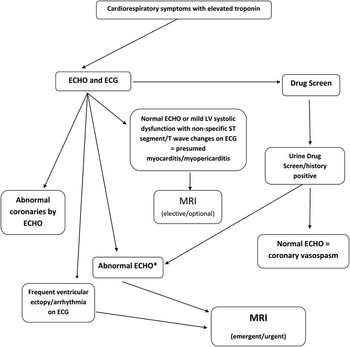
Poor prognostic indicators of overall outcome as suggested by our study were anomalous coronaries, congestive cardiac failure, and/or malignant arrhythmias. On the basis of our experience, an algorithm has been proposed (Fig 2).
The proposed algorithm in the work-up of aetiology of myocardial injury. *Segmental wall abnormality or moderate–severe LV systolic dysfunction with normal coronary orogins, or inadequate visualisation of coronaries. ECG = electrocardiography; ECHO = echocardiography; LV = left ventricle; MRI = magnetic resonance imaging.

Our study is limited by its retrospective nature, and we were restricted to the information present in the hospital records. There is uncertainty on the diagnosis of myocarditis as it is based on clinical findings, in the absence of definite diagnostic criteria. Viral aetiologies for myocarditis were not identified in majority of our patients because of the absence of tissue sampling and low yield of blood polymerase chain reactions. The diagnosis of myocardial damage by measurement of troponin serum levels has greatly enhanced the diagnosis and management of adults and children with cardiac disease. However, owing to its relative rarity in paediatrics, no uniform approach to the diagnostic work-up has been delineated. The present series is a reflection of this heterogeneous approach, which is a limitation of our study; however, we believe that our analysis is an attempt to initiate a more objective approach.
Clinical management of the patients was not based on a protocol; therefore, not all patients underwent all available examinations such as a magnetic resonance imaging. The validity of troponin levels as another tool to diagnose the aetiology of myocardial injury could not be tested using statistical analysis because of the low number of patients in each category. In addition, a long-term follow-up of these patients was not available to identify whether a subset of these patients progressed to dilated cardiomyopathy.
In conclusion, a thorough history remains the primary screening step. A urine drug screen, electrocardiography, and echocardiography should be obtained for all patients with elevated troponin levels. Initial troponin levels and progression do not appear to help in determining the aetiology of myocardial injury, and the degree of troponin elevation does not necessarily indicate poor prognosis among children. When the diagnosis is still unclear, cardiac magnetic resonance imaging may be the most helpful modality to reach a definitive diagnosis. In contrast to the adult population, cardiac catheterisation is of limited value in children.