INTRODUCTION
Caregiving in the context of a serious illness represents a great demand on family members. In addition to the stresses and strain that stem from the role of caregiver, family members are exposed to a patient's deterioration and to multiple other losses (Bevans & Sterberg, Reference Bevans and Sternberg2012; Li et al., Reference Li, Mak and Loke2013; Adelman et al., Reference Adelman, Tmanova and Delgado2014; Revenson et al., Reference Revenson, Griva, Luszczynska and Revenson2016). Family caregivers (FCs) experience personal losses due to restrictions of autonomy and suppression of their own needs, as well as relational losses, including deprivation of intimacy and reciprocity with the patient, causing intense feelings of grief while the relative is still physically present (Coelho & Barbosa, Reference Coelho and Barbosa2016). Grief during caregiving has been operationalized as “anticipatory grief” (Aldrich, Reference Aldrich and Schoenberg1974; Lindemann, Reference Lindemann1944; Rando, Reference Rando and Rando1986; Reference Rando1988), but recent research predominantly utilizes the terms “predeath” or “preloss grief,” because it merely indicates the presence of grief symptoms before a patient's death (Nielsen et al., Reference Nielsen, Neergaard and Jensen2016).
Researchers studying caregivers' grief have employed the PGD–12 as a valid screening tool for assessing predeath grief. It is basically an adaptation of the Prolonged Grief Disorder Questionnaire (PG–13) created to assess grief experiences associated with illness, rather than just to the death of a person (Prigerson et al., Reference Prigerson, Vanderwerker, Maciejewski and Stroebe2008). The PGD–12 is an instrument employed to diagnose prolonged grief disorder (PGD), which requires the following criteria: (1) the event—the respondent is experiencing the severe illness or the loss of a significant other; (2) separation distress—characterized by manifestations of longing and yearning; (3) emotional, cognitive, and behavioural symptoms—including avoidance of reminders, diminished sense of self, feeling stunned or shocked by the patient's illness, having trouble accepting it, and experiencing bitterness, numbness, and a sense of meaningless; and (4) impaired social and occupational functioning. With the PG–13, there is an additional temporal criterion that requires six months of persistent grief symptoms after the loss of the family member (Prigerson et al., Reference Prigerson, Horowitz and Jacobs2009).
The symptomatology associated with PGD is distinguishable from manifestations of normal grief (Boelen & van den Bout, Reference Boelen and van den Bout2008; Dillen et al., Reference Dillen, Fontaine and Verhofstadt-Denève2008), and only the former is associated with significant impairment (Latham & Prigerson, Reference Latham and Prigerson2004; Simon et al., Reference Simon, Shear and Thompson2007; Marques et al., Reference Marques, Bui and LeBlanc.2013). The trajectory and risk factors of PGD symptoms differ from those of other psychiatric conditions, for both the bereaved (Ogrodniczuk et al., Reference Ogrodniczuk, Piper and Joyce2003; Boelen & van den Bout, Reference Boelen and van den Bout2008) and their caregivers (Kiely et al., Reference Kiely, Prigerson and Mitchell2008; Chiambretto et al., Reference Chiambretto, Moroni and Guarnerio2010; Guarnerio et al., Reference Guarnerio, Prunas and Della Fontana2012).
Most studies that have employed the PG–12 to investigate predeath grief have been carried out in populations of FCs whose patients are in a vegetative state. Guarnerio et al. (Reference Guarnerio, Prunas and Della Fontana2012) assessed 40 caregivers of patients in a vegetative state or who were minimally conscious, and observed that, although significant correlations emerged among the symptom domains of PGD, depression, and posttraumatic stress disorder, from a categorical perspective, no relevant association was found, so that they should be considered as independent nosological entities. Chiambretto et al. (Reference Chiambretto, Moroni and Guarnerio2010) also distinguished caregivers' grief from depression: in a sample of 45 family members of patients in a vegetative state, 20% met the criteria for PGD only and total prevalence was 35.5%. In a similar sample, the prevalence of PGD reached 38.5%, and it did not change over time, suggesting that this is a stable condition, unlike other caregiver distress indicators (Bastianelli et al., Reference Bastianelli, Gius and Cipolletta2014).
The data concerning FCs of patients in a vegetative state suggest that young age family members and patients is associated with a higher risk of PGD (Chiambretto et al., Reference Chiambretto, Moroni and Guarnerio2010). Other studies using the PG–12 assessed caregivers' coping strategies associated with preloss grief in a sample of caregivers of patients with disorders of consciousness, and found that acceptance is highly protective of PGD, while denial and self-blame are associated with an increased incidence of PGD (de la Morena & Cruzado, Reference de la Morena and Cruzado2013). Cipolletta et al. (Reference Cipolletta, Gius and Bastianelli2014) found that highly stressed caregivers, including those with PGD, more often employ avoidance strategies.
Kiely et al. (Reference Kiely, Prigerson and Mitchell2008) evaluated 315 healthcare proxies of nursing home residents with advanced dementia. Their results corroborated the fact that predeath grief symptoms are associated with, but distinct from, those of depression. Separation distress was the most frequently cited grief symptom. Higher levels of predeath grief were registered in individuals whose primary language was not English, who lived with the resident before institutionalization, had more depressive symptoms, were less satisfied with their care, and were older than their resident relative.
A comparative study between the PG–12 and the Marwit–Meuser Caregiver Grief Inventory–Short Form (MM–CGI; Marwit & Meuser, Reference Marwit and Meuser2005), another self-report measure of predeath grief, one designed specifically for use with dementia caregivers, verified that both of these measures can be utilized reliably with such caregivers. The study also verified the convergent validity of each measure. A significantly smaller proportion of caregivers met the diagnostic criteria for PGD: 7% with the PG–12 compared to 27% with the MM–CGI, which has less rigorous scoring criteria (Mulligan, Reference Mulligan2011).
In the palliative care context, the PG–12 was administered to 301 FCs, 15% of whom met the criteria for PGD. Caregivers who had a probable anxiety and/or depressive disorder also reported higher levels of preloss grief than caregivers without signs of these disorders. Lack of family support, greater dependency, and greater impact of caregiving on health were found to be related to preloss grief (Hudson et al., Reference Hudson, Thomas and Trauer2011). Prospective data ascertained that PG symptoms at predeath constituted a strong predictor of PGD symptoms at both 6 and 13 months postdeath, which demonstrates the predictive value of the PG–12 in terms of bereavement outcomes, in accordance with the findings of Thomas et al. (Reference Thomas, Hudson and Trauer2014).
Previous studies have provided evidence supporting the discriminant validity of the PG–12. It has also demonstrated good internal consistency, with values of Cronbach's α of 0.88 in a sample of 45 FCs of patients in a vegetative state (Chiambretto et al., Reference Chiambretto, Moroni and Guarnerio2008), 0.87 in a sample of 202 dementia FCs (Mulligan, Reference Mulligan2011), and 0.78 in a sample of 39 cancer FCs (Prigerson & Maciejewski, Reference Prigerson and Maciejewski2008). Studies have also consistently shown the scale to be monofactorial in nature (Chiambretto et al., Reference Chiambretto, Moroni and Guarnerio2008; Mulligan, Reference Mulligan2011). Other versions of the instrument varying in length from 4 to 19 items have been used in different samples of caregivers (Tomarken et al., Reference Tomarken, Holland and Schachter2008; Prigerson et al., Reference Prigerson, Cherlin and Chen2003; van Doorn et al., Reference van Doorn, Kasl and Beery1998; Beery et al., Reference Beery, Prigerson and Bierhals1997) and patients (Jacobsen et al., Reference Jacobsen, Zhang and Block2010).
Early detection of PGD avoids pathologization of normal manifestations of predeath grief and promotes recognition of those caregivers who might present greater vulnerability when adjusting to loss. The aims of our study were as follows: (1) to translate, adapt, and contribute to the Portuguese version of the PG–12, examining its confirmatory factor validation, reliability, and discriminant and predictive validity; (2) to determine the prevalence of PGD in a population of family caregivers for oncological patients in palliative care; and (3) to identify the psychosocial factors that contribute to predeath PGD (e.g., sociodemographic characteristics, perception of illness, intensity of care, coping, and caregiver burden).
METHODS
Participants
The sample, selected by convenience, was composed of FCs for cancer patients followed on the palliative care unit of the Santa Maria Hospital in Lisbon, Portugal. We considered “family caregivers” to include family members, friends, and others with a significant nonprofessional or unpaid relationships with the patient. Those who were excluded from the study were: (1) under the age of 18 years; (2) had cognitive impairment or a physical/mental disorder that hampered their ability to respond to the instruments; and (3) did not speak Portuguese. Participants were informed about the purpose of the study, and an informed consent was obtained from each.
Instruments
The PG–12 is a 12-item self-report questionnaire for the diagnosis of preloss PGD. Respondents are asked to rate on a 5-point Likert-type scale (1 = almost never, 5 = always) how often they have experienced distressing grief symptoms. A diagnosis of PGD requires the following: (1) a score of 4 or 5 on either item 1 or 2, indicating that separation distress is present at least daily; (2) a score of 4 or 5 on at least five of items 3–11, indicating that cognitive, emotional, and behavioural symptoms are present daily, quite often, or overwhelmingly so. The last item is dichotomous. Respondents must answer “yes” to meet the impairment criterion. Examples of items include: “In the past month, how often have you had intense feelings of emotional pain, sorrow, or pangs of grief related to [the patient's] illness?” and “Do you feel that life is unfulfilling, empty, or meaningless since [the patient's] illness?”
The PG–13 is a 13-item self-report questionnaire used to diagnose postloss PGD. It is equivalent to the PG–12, but it includes an additional item, also dichotomous, in which respondents have to answer “yes” to meet the timeframe criteria. This instrument was validated for a Portuguese population by Delalibera and colleagues (Reference Delalibera, Coelho and Barbosa2011), and its internal consistency was considered to be very good (α = 0.932).
Symptoms of depression and anxiety were evaluated by the depression (six items) and anxiety (six items) subscales of the Brief Psychopathological Symptom Inventory (BSI; Derogatis & Melisaratos, Reference Derogatis and Melisaratos1983), validated for a Portuguese population by Canavarro (Reference Canavarro and Simões1999). Items were rated on a 5-point Likert-type scale (0 = almost never, 4 = always). According to Portuguese normative values, the cutoff point for the depression subscale was set at 0.89 and for the anxiety subscale at 0.94.
Caregiver burden was assessed by the Zarit Burden Interview, which was validated for a Portuguese population by Ferreira et al. (Reference Ferreira, Pinto. and Laranjeira2010). It contains 22 items, with scores ranging from 0 (never) to 4 (always). According to Portuguese normative values, its cutoff point was set at 17.
Coping mechanisms were evaluated by the Brief COPE (Carver, Reference Carver1997), which was adapted for Portuguese by Ribeiro and Rodrigues (Reference Ribeiro and Rodrigues2004). It includes 28 items, ranging from “I have not been doing this at all” to “I have been doing this a lot,” and it is scored from 1 to 4. Scores are averaged in pairs to produce 14 coping dimensions.
A questionnaire was employed to gather a sociodemographic characterization of the participants. Data concerning perception of illness and intensity of care (length and amount of hours of daily caregiving) were evaluated through structured questions on a 5-point Likert-type scale, for example: “Were you expecting this diagnosis?” (1 = not at all, 5 = totally); “How much time do you daily spend caring for your relative?” (1 = less than 2 hours, 5 = more than 16 hours).
Procedure
The process of translation, adaptation, and validation of the PG–12 in a Portuguese population occurred according to the phases stipulated by Beaton and coworkers (Reference Beaton, Bombardier and Guillemin2000). We first asked the author for permission to perform the study. Two independent translations of the scale into Portuguese were then made by bilingual translators. The translations were based on the validated version of the PG–13. A consensual synthesis of these versions was then constructed. This was back-translated into the original language by an independent translator to make sure that the translated version reflected the same item content as the original. A committee of psychologists reviewed all the translations and reached a consensus, so as to guarantee semantic, idiomatic, experiential, and conceptual equivalence. The final version was then subjected to a pretest with 10 FCs to verify the comprehensibility of its items and to search for difficulties related to interpretation of questions. Some adjustments were made based on respondents' comments, and this resulted in the final version of the PG–12.
Family caregivers who had assisted with palliative care from March of 2104 to June of 2016 were contacted and invited to participate in our study. Those who agreed to participate responded to the PG–12, to the depression and anxiety subscales, and to a demographics questionnaire. They could choose to fill out the questionnaires on paper (immediately in the office, on the phone, take it home and return it by hand or mail) or electronically (via an online questionnaire). A second round of assessments was conducted in order to verify the predictive validity of the PG–12. We contacted the participants at least six months after the patient's death to administer the PG–13, as well as the depression, anxiety, and somatization subscales. Those who agreed to participate answered the questionnaires by phone, by mail, or electronically. Individuals who manifested a need for psychological support were referred for bereavement consultation.
Our study was approved by the ethics committee of the Santa Maria Hospital (reference No. 344/14).
Data Analysis
Descriptive data were analyzed using SPSS statistical software (v. 22.0), and the factorial validity of the PG–12 was evaluated by confirmatory factor analysis (CFA) with AMOS (Analysis of Moment Structures) software.
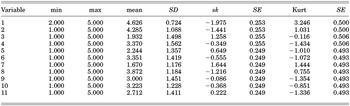
Descriptive statistics (frequency and percentages) were utilized for sociodemographic characterization of the sample. Means and standard deviations were calculated for each item. The psychometric sensitivity of the PG–12 was evaluated through the measures of central tendency and form, and the normality of variables through the asymmetry coefficients (sk), kurtosis (Kurt), and the respective standard error (SE). The values of sk are considered suitable when <3 and those of Kurt when <7 (Maroco, Reference Maroco2010). Item 12 was excluded from this analysis since it is variable.
Several fit indices were selected in order to test which CFA model best represented the present dataset: root-mean-squared error of approximation (RMSEA), which is a measure of the average of the residual variance and covariance; the comparative fit index (CFI), chi-square (χ2), and change in chi-square (Δχ2 df), given the change in degrees of freedom between models. According to Maroco (Reference Maroco2010), the adequacy of a model ratio is considered satisfactory when RMSEA < 0.10, Δχ2 df < 3, and CFI > 0.90. CFA was also employed to test divergent validity between the PG–12 and the BSI depression and anxiety subscales. We also assessed the influence of the PG–12 on BSI items using regression analysis.
Internal consistency was assessed via Cronbach's α. This index was employed to measure the internal consistency of a scale or to establish whether the magnitude of the items of an apparatus were correlated with each other. Values of alpha between 0.80 and 0.90 are generally preferred (Streiner, Reference Streiner2003).
Predictive validity was tested with correlations and simple linear regressions between the PG–12 and the follow-up variables: the PG–13, and the BSI depression, anxiety, and somatization subscales.
RESULTS
Descriptive Analysis
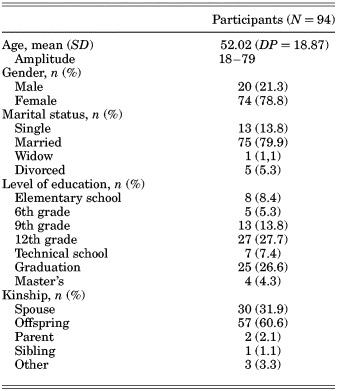
Our sample included 94 FCs of oncological patients. As shown in Table 1, most were female (78.8%), the daughter (61.3%) of the patient, and married (79.9%), with a mean age of 52.02 (SD = 12.87), who had completed high school (57.9%).
Sociodemographic characterization

Some 33% of participants met the criteria for predeath PGD. The mean values for the PG–12 were considered moderate (M = 34.35, SD = 9.53, amplitude = 13–56). According to the instrument's cutoff points, levels of caregiver burden were significant in 85.9%, depression symptomatology was present in 67.4%, and anxiety in 62%.
Confirmatory Factor Validation and Internal Consistency Reliability
The normality of the sample was confirmed by the values of asymmetry (sk) and kurtosis (Kurt). The highest mean values were obtained on the first two items, corresponding to daily frequency of the symptoms of separation distress (Table 2).
Amplitude, mean, and interpretability of PG–12 items

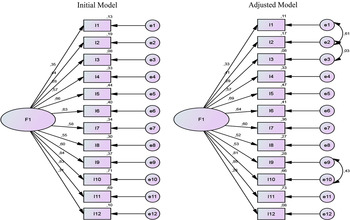
A unidimensional model of the PG–12 was then tested. Goodness of fit revealed poor quality of the original model for most indices, except for Δχ2 df. As depicted in Figure 1, the model was modified by correlating the error of items 1 and 2, 2 and 4, and 9 and 10, and this adjusted model had significantly improved fit indices (χ2(3) = 51.726, p < 0.05) (Table 3).
Confirmatory factor validity of the PG–12.

Fit indices of models

MECVI = modified expected cross-validation index.
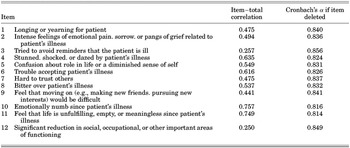
The items of the PG–12 demonstrated high internal consistency (α = 0.846), and none of the items negatively affected the consistency of the entire scale (Table 4).
Reliability of the PG-12

Divergent Validity
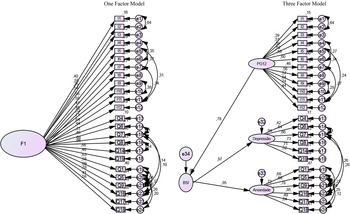
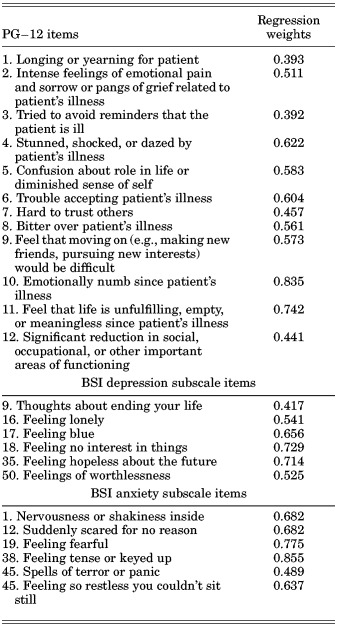
A confirmatory factor validation was conducted to evaluate whether the PG–12 is conceptually distinct from the depression and anxiety subscales. As shown in Figure 2, a one-factor model was first tested, but it did not fit the data (χ2 = 1.80, TLI = 0.746, CFI = 0.800, RMSEA = 0.092, parsimonious comparative fit index [pCFI] = 0.629). A three-factor model yielded satisfactory indices (Δχ2 df = 1.545, TLI = 0.822, CFI = 0.919, RMSEA = 0.77, pCFI = 0.674), confirming that these constructs are indeed distinct (Figure 2). We also tested the influence of the PG–12 on the BSI depression and anxiety subscales using standardized regression weights, and our results indicated that predeath grief is predictive of depression and anxiety (Table 5).
Divergent validity.

Regression weights of the PG–12 and the BSI subscales

Predictive Validity
To verify the predictive validity of the PG–13, PG–12 data were correlated with the results obtained with the PG–13 and the BSI depression and anxiety subscales in a subsample of family caregivers (n = 32), evaluated at least six months after the patient's death. The obtained values were positive and moderate, and the correlations with the PG–13 (R = 0.62), depression (R = 0.559), and anxiety (R = 0.45) were statistically significant.
A simple linear regression was also calculated to evaluate the explained variance of the PG–12 related to the variables assessed at follow-up. The explained variance was 36.3% (adjusted R 2 [aR 2] = 0.363) for postdeath prolonged grief, 30% (aR 2 = 0.300) for depression, and 17.9% (aR 2 = 0.179) for anxiety.
Correlates of the PG–12
The intensity of manifestations of grief did not vary much according to sociodemographic characteristics, with the exception of gender: females presented significantly higher values than males (t(80) = 1.941, p = 0.05). The PG–12 was positively and moderately associated with caregiver burden (r = 0.442, p < 0.01). Using a simple linear regression, the PG–12 explained 18.5% (aR 2 = 0.185) of the burden variance, as evaluated by the Zarit Scale.
Acceptance and positive reinterpretation coping mechanisms were found to be negatively associated with the PG–12 (r = –0.427, p < 0.05; r = –0.421, p < 0.05, respectively), while denial was positively associated (r = 0.402, p < 0.05). Concerning the circumstances of the illness, those family caregivers who assessed the physical condition of the patient as bad or very bad exhibited a higher intensity of predeath grief (t(77) = –0.199, p = 0.05), as well as those who were not expecting the diagnosis (t(78) = –2.15, p = 0.03). Denial was negatively correlated with the degree to which the disease was expected by the caregiver (r = –448). The length of caring did not affect manifestations of grief (t(78) = 0.556, p = n.s.), but the amount of hours of daily care was associated with higher-intensity grief manifestations (t(78) = 3.12, p = 0.003).
DISCUSSION
This Portuguese validation study of the PG–12, carried out with FCs of oncological patients undergoing palliative care, confirmed the high internal consistency of this instrument (α = 0.846), as has been accomplished in other populations (Chiambretto et al., Reference Chiambretto, Moroni and Guarnerio2008; Prigerson & Maciejewski, Reference Prigerson and Maciejewski2008; Mulligan, Reference Mulligan2011). It was not necessary to remove any items to improve the scale's consistency.
According to previous studies (Chiambretto et al., Reference Chiambretto, Moroni and Guarnerio2008; Mulligan, Reference Mulligan2011), CFA evidenced its monofactorial structure. Since the initial model did not yield satisfactory indices, it was necessary to readjust the model. The covariance between items 1 and 2 may reflect the fact that both items are correlated with separation distress. Items 2 and 4 include multiple feelings, which may induce confusion in respondents. Items 9 and 10 refer to numbness and a lack of interest, so they may be correlated.
As evidenced by other authors (e.g., Guarnerio et al., Reference Guarnerio, Prunas and Della Fontana2012; Chiambretto et al., Reference Chiambretto, Moroni and Guarnerio2010), predeath grief proved to be distinct from depression, as well as anxiety, though it may influence these symptoms. Another independent but correlated construct is “caregiver burden”). This result is consistent with a previous study among caregivers of patients with dementia (Holley & Mast, Reference Holley and Mast2009). Although the prevalence of prolonged grief disorder (33%) is much less common than caregiver burden (85.9%), depression symptomatology (67,4%), and anxiety (62%), the PG–12 proved to be predictive of postdeath prolonged grief, depression, and anxiety, making it a reliable and sensitive assessment tool for early identification of family caregivers at risk for maladjustment to loss.
The prevalence rate of predeath PGD is higher than in other palliative family caregivers, and close to the percentage verified in FCs of patients in a vegetative state (38.5% in Bastianelli et al., Reference Bastianelli, Gius and Cipolletta2014). This result may be explained by the patients' advanced state of disease, their late referral to palliative care, and by the convenience nature of the sample, which means that those who agreed to participate in the study were probably those who felt more affected by the experience of their relative's terminal illness.
Among the manifestations of grief, separation distress reached the highest intensity levels. This symptom has been identified as highly prevalent among patients with complicated grief and to be associated with greater symptom severity postdeath (Gesi et al., Reference Gesi, Carmassi and Shear2016). Another qualitative study (Saldinger & Cain, Reference Saldinger and Cain2005) drew attention to its centrality in predeath grief. Taking account of the imminent physical separation and the relational losses that characterize this experience, separation anxiety can be considered a pivotal dimension of predeath grief, but proving this hypothesis will necessitate further research.
Coping mechanisms were shown to be predictive of predeath PGD, in line with previous studies (de la Morena & Cruzado, Reference de la Morena and Cruzado2013; Cipolletta et al., Reference Cipolletta, Gius and Bastianelli2014). Acceptance and positive reinterpretation were demonstrated to be protective of predeath grief. As Carver et al. (Reference Carver, Scheier and Weintraub1989) noted, these mechanisms are most adaptive in situations where the stressor is unchangeable, requiring accommodation. Although this concept is controversial, denial was defined as “the refusal to believe that the stressor exists or of trying to act as though the stressor is not real” (Carver et al., Reference Carver, Scheier and Weintraub1989, pp. 270). According to the results of the Yale Bereavement Study—a longitudinal cohort study (Maciejewski et al., Reference Maciejewski, Zhang and Block2007)—a high degree of acceptance is the norm in the case of natural death, in contrast to deaths that are traumatic in nature, where higher levels of disbelief and lower levels of acceptance are observed. In our family caregiver population, denial was associated with more intense manifestations of grief. In fact, denial was associated with the perception of not having expected the diagnosis, and those caregivers who did not expect it scored higher on the PG–12. At the same time, a perception of the patient's poor physical condition and greater FC involvement in care also contributed to more intense manifestations of predeath grief. These results may contribute to a better understanding of the traumatic experience of family caregivers. As suggested by Sanderson et al. (Reference Sanderson, Lobb and Mowll2013), recurrent exposure to the distressing sights related to a significant other's vulnerability and dying process is likely to trigger some degree of traumatization.
Our study has limitations related to its small sample size and its convenience nature, which requires some caution when generalizing our results, particularly with respect to its predictive validity, which was calculated in a subsample. Our findings primarily involve middle-aged daughters, so that other family caregivers and contrasts with widows and widowers should be examined. Further research should also investigate the underlying mechanisms of predeath grief in order to address the specific intervention needs for better adjustment during caregiving and bereavement.
CONCLUSIONS
This study provides psychometric testing of the PG–12, a predeath grief scale that evaluates the criteria for PGD, involving pre- and postloss assessments, with a sample of family caregivers for oncological patients in palliative care. The PG–12 has been shown to be reliable, to have a high level of internal consistency, to have a monofactorial structure, and to be predictive of postdeath PGD, depression, and anxiety. The instrument is easy to apply and has been shown to be a useful screening tool for early identification of family caregivers who are at risk for maladjustment to loss.
CONFLICTS OF INTEREST
The authors hereby state that they have no conflicts of interest to declare.