During the sixteenth and seventeenth centuries, savants and literati with mixed mathematical inclinations were keenly interested in simplifying and automating calculation. This goal was something that unified the interests of two very different groups: mathematicians or astronomers engaged in the social-credit business of the commercium literarium on the one hand, and shopkeepers, apothecaries and accountants preoccupied with the real-money business of burgeoning global capitalism on the other. In this context, calculating systems such as Napier's rabdology or Samuel Morland's cyclology emerged as paper- and wood-based solutions to these rather pesky problems of mathematical knowledge.Footnote 1 Morland's and Napier's instruments, however, were not fully automatic calculating systems. Even though effective, they were merely aids to speeding up the execution of mathematical operations. They also required specialized knowledge and some training. It is only with the calculatrice of Blaise Pascal that moving metal cogs were made to bear the brunt of simple mathematics. The so-called Pascaline promised the complete black-boxing of basic arithmetic; the only knowledge required being that of the numbers to be inputted. This machine ultimately worked only for addition and subtraction, but it greatly enhanced Pascal's status and caused ripples in the European correspondence networks of the time.Footnote 2
The young and patronless Gottfried Wilhelm Leibniz, living in the 1670s in Mainz, was at the receiving end of these ripples.Footnote 3 He saw in Pascal's calculatrice an excellent reason to solidify his correspondence with Louis XIV's librarian, Pierre de Carcavy. Carcavy had access to one of the models of the machine and was also well connected with Colbert, the Sun King's powerful finance minster. In June 1671, Leibniz wrote to Carcavy to inquire how the Pascaline worked, suggesting that he was able to build an even better instrument, for all four mathematical operations. Seeing how much this project enhanced Pascal's standing, he was sure Colbert would extend to him the same honours: a patent and maybe even a position at the Académie royale des sciences.Footnote 4 Barely arrived in Paris in 1672, Leibniz saw the Pascaline, understood the way it worked, quickly copied its design and set out to the artisan quarters to produce a new machine which could also multiply and subtract.Footnote 5 This project to build a new machine – the Leibnizian Überpascaline – and, specifically, its transmission history is the topic of this paper.Footnote 6
The focus on scientific instruments in the history of science of the early modern period has helped demolish stiff, artificial distinctions between the intellectual and the mechanic, the scholar and the craftsman.Footnote 7 Consequently, the separate professional roles of curator and historian of science have been brought closer together, as much as have collections of scientific instruments and departments of the history of science. Scientific instruments from the past are now routinely deployed to project more interesting, materially grounded stories about historical contexts. Without contesting this approach, in this paper I want to propose that the history of transmission of scientific instruments can also be a legitimate object of study, perhaps as much as the already established history of the transmission and circulation of books as material objects is one: just as books are not mere naked conveyors of textual meaning, scientific instruments also are not just stand-ins for the scientific past they are made to convey. Artefacts themselves, as artefacts, have a history of how they got to our present. Consequently, the past that artefacts represent is not always a reflection of their historical origins. It can be a by-product of their transmission.
What I seek to describe here has been noted before by historians of science in connection with the so-called ‘stories of discovery’. As both Simon Schaffer and Hans-Jörg Rheinberger have pointed out, scientific discoveries and technological inventions do not have a single moment of genesis and do not align in linear histories.Footnote 8 Paradoxically, however, such linear narratives identifying scientific and technological heroes and dramatic moments of discovery are being generated unrelentingly. In lack of a better explanation, Rheinberger proposes that this might be intrinsic to the way science works: research systems constantly produce the future in a way that is disconnected from the past, and, as the future gets produced, because it is unexpected and radically different, the past is rewritten from its point of view. ‘Stories of discovery’ have, in this sense, according to Rheinberger, the function and effect of making the present ‘the future of a past that never happened’.Footnote 9 In this paper, my goal is to show that there is more than meets the eye to these rewritings of the past: the creation of ‘a past that never happened’ only seems discrete; we can actually study empirically how it gets produced and trace its consequences. In a more general way, I also hope to show that we can produce meaningful answers to questions about how we came to believe what we believe about historical figures such as Leibniz and the materially grounded stories we share publicly about them. In what follows, I will narrate the transmission history of the calculator, tracing its travels in space and in time from the seventeenth century to the twenty-first.
Design and development
As Leibniz came out through the door of Louis XIV's library after seeing the Pascaline, he left behind all of his previous ideas of what a new type of calculator could look like, but not his goals.Footnote 10 He had begun thinking about building a machine since at least 1670, two years before he came to Paris, and the challenge was clear: if mortal man had the power to transpose in ‘yellow brass’ the faculty of mathematical reasoning, there could be no doubt that God had been able to house a ‘more general spirit’ into the body of animals, giving them life.Footnote 11 The calculator could thus serve, at the very least, as another type of argument for the existence of God. But such lofty philosophical and theological ideals could not be reached unless all mathematical operations were successfully put to metal.
Pascal's machine afforded, as Leibniz quickly realized, half of the solution. It could perform additions and subtractions correctly and also carry digits upward, for example from 9 to 10 or from 99 to 100, when adding 1 in each case. What was needed was to attach a mechanism for multiplication and division. Multiplication was, after all, an iterated addition in that the same number had to be added to itself as many times as the multiplier required, and division was the reverse of this process. But how to find a way to store the number to be repeated in the addition/subtraction mechanism, how to count the number of repetitions and how to input easily any desired number? These were the concrete technical questions on which the German savant wasted ink and paper over the next few years.
Drawing from Machina arithmetica, LH XLII, 5, p. 1v. GWLB Hannover.

In 1672 Leibniz drew and described the concept of a mechanism with transmission cords.Footnote 12 The top row is supposed to be the Pascaline and the bottom the multiplication machine. The drawing does not intuitively suggest a feasible instrument, but it summarizes the core idea to be implemented. The paradigm is simple: the machine was meant to imitate the order in which mathematical operations are done on paper. Take the case of multiplication. For the example 365×124, which Figure 1 illustrates, one would need to first multiply 365 by 4. The disc of larger diameter labeled here 4 would make all the middle ‘multiplicandae’ wheels spin 4 times, thus adding 365 to itself just as many times, which results in 1,460. After this, the bottom two rows of the machine would need to be shifted to the left in order to execute the operation 365×20, resulting in 7,300. This would be automatically added over the previous result, obtaining 8,760. Next, another leftward shift would enable the result of 365×100, which again would be added to the previous product, to obtain 45,260, the final result.
Example of multiplication meant to serve as paradigm for the calculator. LH XLII, 5, p. 4r. GWLB Hannover.
In order to embody the concept presented here into ‘yellow brass’, Leibniz first conceived a wheel with variably extractable teeth – the roue a dents mobiles. This component would have been able to load into the Pascaline any number immediately. If, for example, the number 3 was needed, three teeth had to be pulled out. In this way it would have moved the Pascaline component 3 positions, displaying the number 3. This is the technology illustrated in the manuscript ‘Projet de la machine arithmetique’, most probably from 1673.Footnote 13
Sketch of the wheel with mobile teeth related to the 1673 project of the machine. LH XLII, 5, p. 29. GWLB Hannover.
Drawing related to the 1673 project of the machine. LH XLII, 5, p. 23. GWLB Hannover.
Sketch of the transport and the wheel with unequal teeth from 1674 (drawn in Hanover in 1695). LH XLII, 5, p. 12r. GWLB Hannover.
Between 1673 and 1674, in the context of Leibniz's collaboration with Parisian artisans, the wheel with extractable teeth – roue a dents mobiles – transformed into what Leibniz called a roue a dents inégales. The mechanism was fairly straightforward: by pushing and pulling these components into the addition machine they could repeat additions based on the different lengths of the teeth exposed. It is unclear whether this refers to a mechanism similar to the one in Figure 4 with the label dentes variabiles, which had a progressively increasing number of teeth along the length of a cylinder, or whether this was already something looking like the component Leibniz drew in 1695 to represent the machine he had built in Paris twenty-one years earlier in 1674.Footnote 14 The lack of contemporary detail about how, when and where the roue a dents inégales was developed can be interpreted as negative evidence of the uncredited tacit input that Parisian artisans might have had in the design process.
In any case, by 1673, Leibniz had a concept of the calculator, sketched out some design possibilities and began working on a model with the unnamed Parisian craftsmen.Footnote 15 But this was only the beginning of a lifelong tortuous development journey. After 1675, the clockmaker Olivier was supposed to continue the work under the supervision of Adolf Hansen, one of Leibniz's confidantes. But Olivier was in a precarious financial situation and could not dedicate himself fully to the project: he thought it did not pay enough to be worth his time. Close to financial ruin in 1679 he dismantled the newer model of the machine that he was supposed to develop and used the pieces for the clocks he was building for his Parisian clients.Footnote 16
Who exactly did work on the machine after 1679 is unclear, but we know that Leibniz was trying to improve the carrying of decimals – the so-called problem of transports, which threatened to undermine the whole project.Footnote 17 Only beginning in 1693 does the picture become clearer. The artisan Georg Heinrich Kölbing was employed. He and the butler Balthasar Ernst Reimers were busying themselves with the machine as Leibniz wanted to present the invention to his patron, Ernst August von Hannover, which he finally managed to do in 1695.Footnote 18
This, however, did not mark the end of the project. The mechanism for carrying tens in the addition component, which Leibniz never managed to fix, would have prevented the reliable display of correct results.Footnote 19 From 1696 onward the clockmaker Adam Scherp had been employed in Hanover to perfect the machine, but in the year 1700, both Scherp and the butler Kölbing having passed away, the decision was made to move it to Helmstedt.Footnote 20 Here Christian Wagner, professor at the local university and one of Leibniz's protégés, took up the responsibility to see it completed. Wagner hired the brothers Georg and Levin Warnecke for the job. They were supposed to finally finish the calculator for twelve number places and also start on a third, even bigger, model.
In 1706 the former twelve-place model was taken back to Hanover. Leibniz wanted to present it to Lord Halifax, who came over to negotiate the succession of Georg von Hannover to the throne of England. Apparently the presentation did not go well or did not happen at all. Leibniz soon complained to Wagner about the fact that the instrument did not work as it should. Meanwhile, Levin Warnecke continued work on the larger machine until 1708, when he quit. Wagner then hired the itinerant English clockmaker Keyling. But this employment was short-lived. Keyling soon fled Helmstedt without having payed his loans. He also took with him the all the tools used in Wagner's workshop. In March 1710 the clockmaker Blumenfels was hired, but he too needed to flee Helmstedt. The authorities sought to imprison him because it was thought he was bigamous.Footnote 21
After 1710, Leibniz took back to Hanover the almost finished, but still not quite working, second machine and the finished pieces of the newly commissioned third machine. In 1712 he entrusted the further development of this third machine to Buchta, councilor at the court of Moritz Wilhelm von Sachsen-Zeiz, and to the court preacher Gottfried Teuber.Footnote 22 Leibniz died in 1716 and the project of building the third model of the calculator was never completed. The pieces of the machine remained in Teuber's possession in Zeiz. The second machine for numbers up to twelve places, however, was in Hanover at the time of Leibniz's death, and remained there until 1775, when it travelled yet again, to Göttingen.
Rhetorical devices
Leibniz continued developing his machine until the end of his life and, judging by the many artisans he employed, it must have cost a small fortune. In spite of this, none of the models of the calculator developed during this time worked reliably for other than perhaps very short periods of time on a few set examples.Footnote 23 Consistent with the contemporary gentlemanly attitude towards artisans described by Steven Shapin, Leibniz constantly blamed the craftsmen he employed for the failure to ‘well execute what was so well conceived’.Footnote 24 But he never made his travails known to anyone, except the people he needed for building the machine. In the correspondences with other savants or nobility and in his published account about the calculator from 1710 a radically different picture was presented. Leibniz created for his public a complete rhetorical package centered on the idea of utility. He was promising that his machine would outshine any other invention in the arts and sciences, delivering humanity from the ‘servile effort of calculation’, cutting in half the difficulty of practising mathematics and making calculation child's play and the work of a student.Footnote 25
The futuristic discourse about the machine played an important role in Leibniz's political ambitions. In 1671 he was trying to convince Johann Friedrich von Hannover to finance his stay in Paris so that he could persuade Louis XIV to invade the Middle East in order to prevent French forces from attacking other European countries and provoking in this way a ‘universal war’. The project of the calculating machine would be used, Leibniz argued, to get access to Colbert, who could give him access to the king.Footnote 26 But the German savant did not limit himself to futurespeak. There are many instances where he claimed he had already completed such a wondrous device as he advertised. One example is his letter from March 1673 to Johann Friedrich von Hannover, in which he wrote that his calculator was considered both in Paris and in London as ‘one of the greatest inventions of the time’ and that ‘the greatness of its utility can be easily considered to reach so far as that of Arithmetic itself’.Footnote 27 Hungry for a position at the Hanover court, he seems to have stretched the truth to hyperbole. In London, for example, things didn't actually go that well: Robert Hooke gave a scathing evaluation of the first model of the machine in the context of Leibniz's presentation at the Royal Society, writing that what he saw was too complicated to ever be of ‘great use, especially common use’.Footnote 28 In July 1674 Leibniz again used the present tense to write to Oldenburg, the secretary of the society, that he is relieved to have finished the machine, its effects now universally admired.Footnote 29 Oldenburg, in disbelief, rudely called the calculator a ‘machinula’ in his reply, angrily reminding Leibniz to make good on his promise in front of the society to send over a model, which Leibniz never did.Footnote 30
There are also other instances when people in the know refused to fully accept Leibniz's rhetoric of wondrous utility. The Dutch savant Christiaan Huygens was deferential towards Leibniz and appreciated his efforts to make calculation easier, but in 1675 he let loose, writing about both the calculator and a new machine for extracting the roots of numbers that Leibniz advertised: ‘these things are not meant for demonstrating utility, they are more for demonstrating the force of the human mental capacities’.Footnote 31
Leibniz's exchange with Johann Sebastian Haes provides another telling example. Leibniz tried to convince Haes, a councilor for the Landgrave of Cassel, to have his patron buy the calculator. In a letter from January 1695 he wrote to Haes that he had a machine for calculating numbers up to twelve digits. This was based on the model he presented to great acclaim to the Royal Societies of London and Paris. No one had yet seen it, he added, but people from France were already lining up to buy it. Haes wrote back asking for more details, his patron being, of course, also interested. Leibniz, thrilled, quickly sent a response. He wrote, upping the ante, that the machine could multiply 654,321 and 99,999 with only five turns of the wheel; that ‘the greatest mathematicians of the time admired it after they could see its effects’; and that ‘even a child could do everything without knowing any calculation and almost without any concentration of the spirit, speaking and thinking of another thing’. The Jesuit Grimaldi wanted to show it to the ‘monarch of China’, he added, but unfortunately Leibniz was unable deliver one in time.Footnote 32
Haes stalled until May 1695. He finally wrote back, saying that using Samuel Morland's book on cyclology he had managed all by himself to build a calculating instrument. His new apparatus could operate numbers of more than a hundred million using only one wheel. He conceded abstractly that Leibniz's machine might be superior to those invented by Morland and others, but was not curious to inquire further than its form and size, leaving the offer to buy it completely in the air.Footnote 33
Leibniz did not give an inch publicly to any expressions of doubt. He continued to broadcast his rhetoric about the calculator far and wide. In 1710 he finally took to print, publishing ‘Brevis descriptio machinae arithmeticae’ in the first issue of the Miscellanea Berolinensia.Footnote 34 This publication would be the main source of information about the calculator until 1879, when the second model was rediscovered. The ‘Brevis descriptio’, however, was not exactly informative. Just like the letter to Johann Friedrich, it was a self-promotional account. Leibniz's goal was to get as much recognition as possible while divulging as little as he could about the state of the machine he was actually building. This was meant to discourage both unauthorized copies and unsolicited criticism. As before, the Royal Society; the Académie; and renowned savants such as Huygens, Arnauld and Tschirnhaus were paraded to sustain the wondrous functionality of the calculator ‘which even a child could use’. The Pascaline was now completely forgotten as inspiration source – the machine was just a me adolescente inventa – invented by Leibniz as a young man. In terms of description of the actual mechanism, things were left vague. Structurally, the calculator is described as consisting of a ‘mobile part’, an ‘immobile part’ and ‘large and small wheels’, and while the operation of multiplication is described adequately as being executed by the addition of the intermediary sums after each multiplication, no details of the internals are disclosed. The engraved image accompanying the text is equally unelucidating: it depicts a closed black box.
The Leibniz calculator described in the ‘Brevis descriptio machinae aritmeticae’, Miscelanea Berolinensia (1710) 1. Harvard University Libraries.
The ‘Brevis descriptio’ was republished in 1727, soon after Leibniz's death, in the Theatrum Artithmetico-Geometricum by Jacob Leupold. Leupold was diligent enough to include also the testimonial of Gottfried Teuber, the last man who had worked for Leibniz on this project.Footnote 35 Teuber knew very well that Leibniz never produced a fully working machine. He wrote about it in a journal from Leipzig, making note of the fact that because of the high accuracy needed, the second model did not work properly and a third was never finished. In the Theatrum, Leupold copied the image from the ‘Brevis descriptio’ and appended a few drawings that would represent the internal mechanism. These drawings were, however, completely unrelated to the calculator; they actually depict Leupold's own calculating machine.Footnote 36
Depiction of the Leibniz machine in Jacob Leupold, Theatrum Arithmetico-Geometricum, Leipzig: Gleditsch, 1726. Harvard University Libraries.
The second model of Leibniz's machine remained in Hanover until 1775. In this year it was given on loan to the Göttingen mathematician Abraham Gothelf Kästner. Kästner analysed the mechanism and was very disappointed. In the year 1800 he wrote back to Hanover, saying that the machine was a mere relic and he did not believe that it could be of any use.Footnote 37 Later, he took his evaluation to print, in the Fortsetzung der Rechenkunst of 1801, leaving a clue of where the calculator was located.Footnote 38 A few years later, Johann Paul Bischoff, a mechanically interested courtly administrator from Ansbach, also preoccupied himself with the Leibniz machine. In 1804 he wrote, but never published, a history of mechanical calculating machines. Bischoff was well aware of the distance between Leibniz's rhetoric and the actual machine and did not mince his words:
It may well be that there were some failures in the work on the machine, but I think that it was rather the arrangement of the parts, not the execution, that was responsible, and that the machine could not deliver what Leibniz promised it would do.Footnote 39
Bischoff was also familiar with the calculating machine of Philip Hahn, the first working calculator, which also used a wheel with unequal teeth. But Bischoff never thought that there was any connection between Hahn's machine and Leibniz's.Footnote 40 It thus seems that until 1879, at the earliest, nobody knew what the Leibniz calculator actually looked like and what made it work, and those like Kästner who had a clue never described it publicly. Moreover, while the Leibniz machine was recognized as a contribution to the history of mechanical calculation because of the ‘Brevis descriptio’, there was scepticism about its performance and value. Meanwhile, during the eighteenth and nineteenth centuries, Hahn (1774) and Thomas de Colmar (1820) independently invented mechanical calculating machines, which could function. Both used a wheel with unequal teeth, now called the stepped wheel, as a component. But as Friedrich Kistermann, who researched the influence of the Leibniz machine on later systems, argued, ‘it is evident from all we know today that Hahn and de Colmar each invented his own stepped wheel, independent from Leibniz’.Footnote 41 Matthew L. Jones has interestingly shown that in spite of the lack of material continuity between Leibniz and later inventors there was still a nexus at the level of discourse, in cases such as Leupold and Hahn: these inventors complemented nescience by suggestions that their projects were emulations of Leibniz's attempt.Footnote 42 Beginning in 1879, however, a completely different narrative began to emerge, one focused on material continuity.
Reinventing the Leibniz machine
From 1775, when it entered Kästner's possession, the Leibniz calculator never left Göttingen. In 1879 it was allegedly found in the attic of one of the buildings on the campus of the university, when the roof was being replaced.Footnote 43 The rediscovery thrilled beyond imagination the members of the Deutscher Geometerverein – the German Association of Surveyors. Rudolf Gerke, a senior member of the Verein and professor at the Technical University in Hanover, took it upon himself to assess the machine's significance. He reported swiftly to his peers in 1880, his contribution later published in the Verein's journal – the Zeitschrift für Vermessungswesen.Footnote 44
Gerke's report has two parts: one historical and one analytical. For the historical part he relied on a certain Dr Mohrmann, a teacher at the Gymnasium in Hanover. Mohrman had researched, so he claimed, the relevant documents left by Leibniz and published a history of the machine in two articles appearing in the Hannoverschen Courier and the Weserzeitung. Gerke was largely in agreement with Mohrmann's findings, appreciating his contribution as a valuable enterprise to be lastingly preserved for ‘correcting the widespread errors about that work of art’, which, for him, was the Leibniz calculator.
However, as it appears from Gerke's summary of the articles, Mohrmann actually drafted his revisionist account relying only on Leibniz's public presentation of the machine. In fact, he not only repeated the rhetoric, but also added some embellishments: on the relationship between the calculators of Leibniz and Pascal, Pascals's was of a ‘primitive kind’, besides which, Leibniz had come up with the idea long before he saw the Pascaline. Even more, the Leibniz machine was so good that everybody was ‘filled with amazement’, the most important mathematicians of the time ‘brought Leibniz their homage’ and ‘even the friends and relatives of Pascal had to admit the originality of the discovery’.Footnote 45
Building on Mohrmann's inspiring history, Gerke used the second part of his report to propose that Thomas's arithmometer, already very familiar to his readers, was in fact based on the Leibniz machine, being most probably an improvement of the former. Gerke did not exactly have concrete evidence showing when and how Thomas might have learned about the calculator; instead he argued that the structural similarity between the two machines would be enough to sustain his thesis. In order to prove his point, Gerke set, side by side, two images – one of the arithmometer and the other of the calculator. The image of the Leibnizian machine is based on the representation accompanying the 1710 ‘Brevis descriptio’. The comparative logic also follows this publication. Yes, admits Gerke, ‘Thomas had replaced, relative to Leibniz's machine, the “mobile part” with the “immobile” and the round wheels with vertical openings’, but these ‘small improvements’ could easily be implemented. The similarities between the two machines are ‘too obvious’ and imply that Thomas must have known about the calculator, the latter being ‘the originator of all later mechanical calculators using the stepped-drum principle’.Footnote 46
For the members of the Geometerverein, Gerke's thesis was too good not to be true, especially since, at the time, German manufacturers, such as Arthur Burkhardt, were producing clones of the commercially successful Thomas machine for the German and international markets. In this context, it was better to think of the arithmometer as something originally German, finally returned home after a trip to France, than entertain the notion that the Germans were selling imitations of a French invention, which was politically problematic in the wake of the Franco-Prussian war of 1870. Nobody, therefore, had an interest in scrutinizing Gerke's report. The celebrated Hanover geodesist Wilhelm Jordan further bolstered his account, repeating the analogy thesis in his own publications about the machine and also in his authoritative Handbuch der Vermessungskunde (Handbook of Surveying), which became the standard work in the field well into the twentieth century. Here, in the chapter dedicated to calculating technology, he writes, ‘The calculating machine, which is essentially an invention of the philosopher Leibniz, was built in the form it is used today by Thomas in Colmar and is now produced industrially in Germany by Arthur Burkhardt in Glashütte, Saxony.’Footnote 47 Like Gerke he also uses elements from the ‘Brevis descriptio’ to make analogies with the arithmometer:
The small round wheels on the mobile part [in Leibniz's machine] correspond to the vertical openings with the buttons you can push up and down. The openings on the immobile part correspond to the openings on the mobile part of Burkhardt's machine. The reciprocal mobility goes for Leibniz in the reverse direction in comparison with Burkhardt, which is unessential, because it concerns only the relative movement.Footnote 48
Burkhardt's clone of the arithmometer. From Wilhelm Jordan, Handbuch der Vermessungskunde, Stuttgart: Metzler, 1895, p. 162. Harvard University Libraries.
Jordan was so convinced that the Leibniz calculator used to be a working arithmometer that he advised Eduard Bodemann, who was in charge of the Royal Library in Hanover, to send it to Burkhardt, who, he believed, was uniquely positioned to restore it to its former glory; he was, after all, manufacturing the German version of Thomas's machine. Burkhardt's refurbishing job was deemed important as a way to secure Germany's priority over France with respect to calculating technology. As Jordan clearly stated, the goal was the ‘safeguarding of the principle of the stepped-wheel calculating machine as an invention of the German philosopher from the end of the seventeenth century, after, for a long time, a non-German invention at the beginning of this century was given credit’.Footnote 49
Burkhardt's restoration
Arthur Burkhardt premised his restoration of the calculator on the account in the ‘Brevis descriptio’, made popular again by Mohrman and Gerke. He was naturally expecting to see the childproof machine of which so many had sung the praises. But the instrument he found strongly refuted his expectations: ‘all the gears and discs fell toward me – they were merely stored in the box and in the frame’. Initially placing the blame on wear and tear, he tried to reconstruct the mechanism, as he believed it should have been. Heavy modifications are thus documented in his report. For example, gears that he found to have been only cast, never adjusted, as they were probably never used, were newly ground down by 2.5 millimetres to fit better. The original metal axes, considered of a ‘dubious nature’, were straightened, and he installed ‘round rings which I made so that they remain fixed, as if united with the axes, and I fitted them in their place with the help of small screws’. The frame was taken apart, being found crooked, and dealt a series of hammer blows:
It had to take a lot of blows with the hammer, a couple of holes were drilled into it, then polished, and again closed, drilled again, polished and so on. Its surface is a testament to an entire history of the person who, so to speak, understands its language and learned how to understand its language.Footnote 50
In spite of all these efforts, when put together, the machine still did not seem to live up to Leibniz's rhetoric. It simply didn't do anything. At this point, in need of something less dramatic, Burkhardt fell back on the arithmometer theory. In an arithmometer the angle distance between the teeth of the stepped drum is a measurement of the execution of an intermediary operation – this is called a tempus. In this framework, the Leibniz machine appears to have insufficient tempi: 360 degrees are necessary, but it only has 315 degrees (14×22.5 for each drum.) In order to work properly, the machine would have needed, according to Burkhardt, to compensate for the difference. To reach this goal, new adjustments and alterations were necessary. But even after this painstaking effort the calculator still did not seem to function properly. Finally he threw in the towel:
From these considerations we must reach the conclusion that Leibniz's calculating machine present here is, in what concerns its elements, ingeniously constructed and executed. But that in his time Leibniz must have been living with the belief that just by arranging together such elements any machine would provide results. Only in this way one can explain the way it is put together at present. From this, we must follow, that the present machine could never have been working.Footnote 51
But Burkhardt was not intending to rob Leibniz of his newly fashioned computing greatness. He quickly found some mitigating circumstances: the instrument, with which even a child could easily do mathematical operations, ‘must have been another one, of another construction’. Besides, even this non-functioning device, he writes, ‘confirms the belief that Leibniz was the constructor and initiator of the first calculator and with this he set the foundation for all calculating machines’.Footnote 52
Burkhardt's reconstruction was an earnest effort to mechanically embody the new interpretative context that the calculator was cast in after 1879. The mechanical ensemble found in Göttingen was remade to bring back to life the Leibnizian machine described in the ‘Brevis descriptio’, a machine now believed to be an earlier version of Thomas's arithmometer as per Gerke's and Jordan's reading. Burkhardt's report is ultimately a compelling document. It shows that the rewriting of history is not just limited to text; it can be embodied in metal and wood, becoming material rewriting.
It works after all: replicas of the calculator
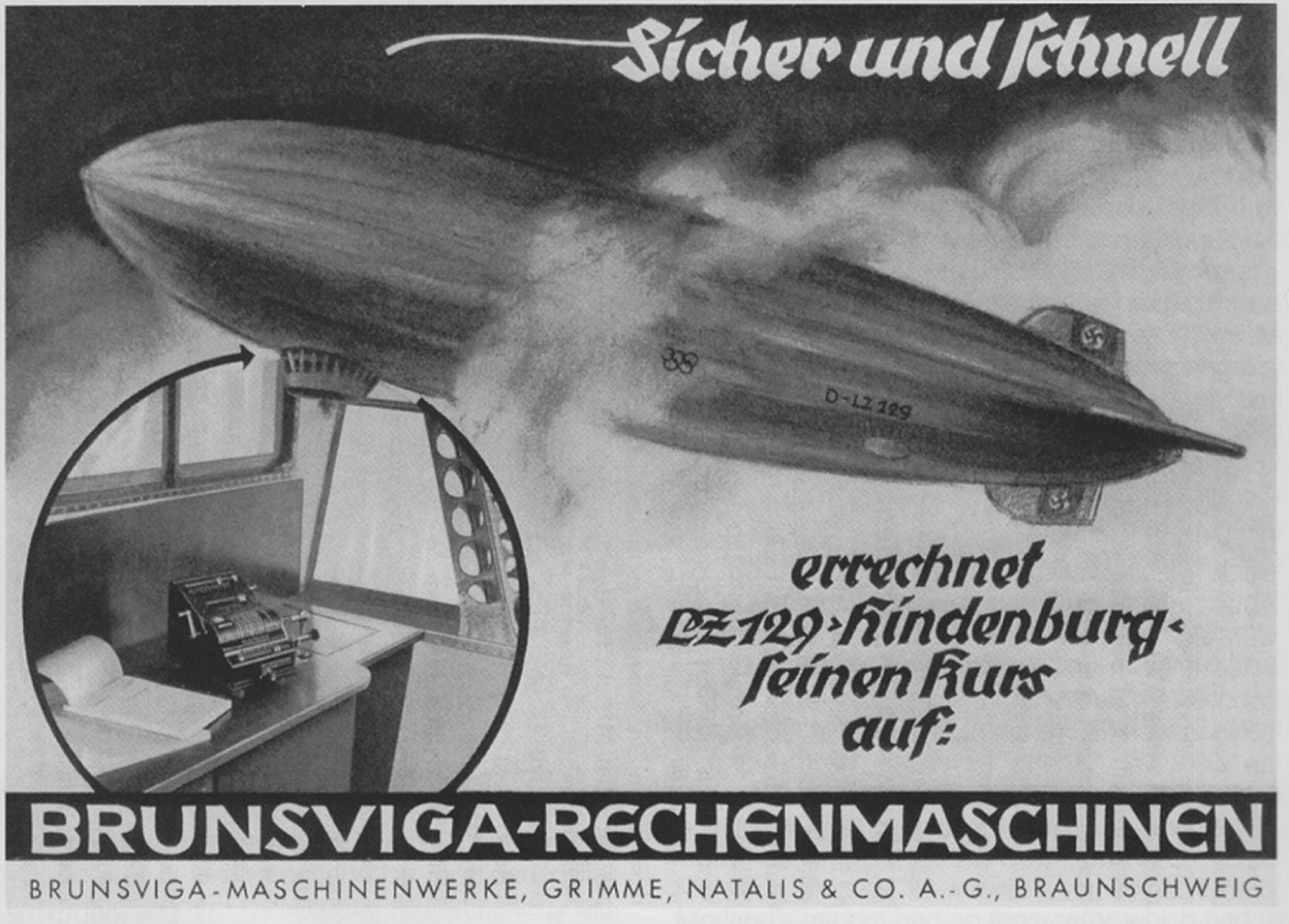
Burkhardt's material rewriting of history was, however, only the first in a series. The restored artefact, the newly made hybrid machine, was returned to Hanover. Because of its fragility and, perhaps, its underwhelming performance, it was kept under lock and key. But at the beginning of the twentieth century, because of the ballooning public interest in calculation, the making of copies was allowed. Some of these replicas, like the 1925 models built by the computing company Brunsviga, were meant not only to enhance the post-mortem status of Leibniz, but also to project back a tradition. The company IBM purchased one of these models and incorporated it in a permanent exhibit about the evolution of the computer. The catalogue entry informs us that while the Leibniz machine was not developed for commercial production, ‘the stepped drum principle survived for 300 years and was used in many later calculating systems’.Footnote 53
Brunsviga advertisement from 1936. Harvard University Libraries.
Animated by such exhortations, later projects to replicate the calculator went even further. The competing projects of the mathematician Nikolaus Lehmann from 1989 and the engineer Klaus Badur from 2004 are relevant here.Footnote 54 Their ambition was to prove that the calculator was not merely a source of computing ideas, which was by now widely accepted, but an actually functioning instrument. These projects added yet another layer of the rewriting of history to the saga of the calculator.
Take Lehmann's account, for instance. His project's aim was explicitly ‘to finally resolve all the contradictory statements about the functionality of the calculator’.Footnote 55 If he showed that the machine worked we would know it could have always worked. Lehmann's foil in this sense is none other than Burkhardt. Burkhardt, according to Lehmann, had used a ‘false theory’ to reconstruct the machine. A true theory would be one that produced an actually working machine.Footnote 56 Only this kind of machine could be considered ‘true to the original’, and it only would completely correspond to ‘Leibniz's intentions’.Footnote 57 These intentions, now realized in Lehmann's own replica, demonstrate that Leibniz ‘practically discovered already in that time all the solutions that were later implemented with success in the 250-year history of calculating technology’.Footnote 58 There is no escape from this logic: a non-working machine would simply be rejected as being below Leibniz's dignity.
The Badur replica. GWLB Hannover.
Klaus Badur's 2004 replication project, in collaboration with the engineer Wolfgang Rottstedt, is premised on the same argumentative structure.Footnote 59 Interestingly, however, this time Lehmann, not Burkhardt, is accused of being the falsifier and his effort dismissed as inauthentic: Lehmann had changed things such as the dimensions of the machine and even individual components, doing everything possible to have the ensemble function correctly.Footnote 60 While he, Badur, was also interested in showing that the machine worked, only a real ‘true-to-the-original’ copy would be compelling enough to make a historical statement about functionality. The crux of Badur's authenticity argument lies in the fact that he copied the machine according to the ‘original dimensions’, taking as his model the artefact from Hanover, understood as the product of Leibniz's own hand.Footnote 61 Care for authenticity is given airing at every step of the way, but there are occasional slips: the materials used were modern alloys, and they applied modern finishing techniques to ensure a precision of one-hundredth of a millimetre in making the difficult mechanism for carrying tens. The use of this kind precision, as Badur argues, is not a bug, but a feature of the project: while it does perhaps show that the calculator might not have worked in the past, this is taken to mean that ‘Leibniz was ahead of his time, relative to the implementation possibilities’.Footnote 62 It follows that if he had had those possibilities then he would surely have made something like the functioning replica. The machine, Badur concludes, indeed functions after all – ‘Und sie rechnet doch richtig!’
Looking underneath these claims, we find that just as for experimental replication we also have here a case of what Harry Collins called the experimenter's regress:Footnote 63 the outcome of replication changes the very criteria by which we assess truth and falsehood, in this situation historical truth and historical falsehood. The ‘replication’ of a working calculator casts a shadow of doubt over any other non-working one; the one true to the original seems to completely substitute any other original, even one that Leibniz actually built. In this way we come full circle: Lehmann and Badur finally managed to write for the Leibniz calculator ‘a future of a past that never happened’. Leibniz consequently finally managed to build in the twenty-first century the machine he had boasted about in the seventeenth.
Conclusion: when ghost ships get into museum bottles
On 30 September 2009, the office for public relations of the Gottfried Wilhelm Leibniz Library in Hanover released a statement to the press with the title ‘Leibniz in Washington’. It begins with the following words: ‘Gottfried Wilhelm Leibniz will also be present in Washington at the reception for 3,000 guests organized by the government of Lower Saxony and the German embassy on 2 October 2009’. The return of the living dead? No, the text is quick to reassure, the statue of Leibniz will be there, not the real person, as will, most importantly, it is poignantly emphasized, the original true copy of the calculating machine. The statement closes with a quote from the MP for Lower Saxony:
I am happy that, in this way, Leibniz will be present there as an ambassador of a science which is innovative and friendly towards human beings and as an ambassador of Lower Saxony. He is one of the greatest geniuses that lived and worked on the territory of today's Lower Saxony.Footnote 64
As the mixing of past and present in the pronouncement of the MP suggests, in our global cultural–political imagination, Leibniz thus appears to be less than ever the Leibniz of the calculus controversy with Newton, the Leibniz of the philosophy of possible worlds or the Leibniz of the Theodicy. The essence of everything Leibniz accomplished, and that which makes him one of the ‘greatest geniuses’, is condensed in this single ambassadorial invention – the calculating machine. This seems to be now our emblem for Leibniz, just as the telescope is the emblem for Galileo, Boyle's law for Robert Boyle, gravity for Isaac Newton and e = mc 2 for Albert Einstein.
The goal of this paper has been to open up this problem of emblems. How did we get to believe what we believe about the figures from the past in terms of the stories of discovery we tell about them? This is the question I tried to address here and I focused particularly on the role of artefacts. I showed how the Leibniz machine, now commonly seen as a major breakthrough, was reinvented as such only beginning in 1879, in a context where, out of a nationalistic impulse, the members of the German Society of Surveyors tried to secure the priority of Leibniz over the Frenchman Thomas de Colmar as the inventor of the stepped-drum calculator. Subsequently, as I have shown, this narrative was piled on and deepened in the twentieth century by computing companies such as Brunsviga and IBM and by replication projects aimed at showing that it actually worked ‘after all’.
There are two further aspects that merit discussion in view of this narrative of reinvention. First, the status of the claim repeated ad nauseam in current standard histories of computing that Leibniz was the discoverer of ‘the principle of the stepped-drum calculating machine’. This notion, as I hope to have shown here, is a way of thinking about the calculator that appeared only after 1879. Leibniz never saw himself as the discoverer of any principle of calculation. The roue a dents inégales was a development arising most probably from a context of collaboration with Parisian clockmakers and mechanics. More research is needed on this topic, but it is not unlikely that similarly shaped components were parts of clocks, music boxes or other mechanical devices of the time, something present in an already existing pool of technological knowledge that a skilled artisan would have quickly grasped.Footnote 65 Moreover, the phrase ‘stepped drum’, Staffelwalzen in German, was only coined after Thomas's arithmometer was invented and became popular. This word is a way of summarizing neatly in English and German what French commentators described longwindedly as having ‘the appearance of a staircase with short steps surrounding a column’.Footnote 66 Based on contemporary accounts of the arithmometer, Thomas invented the component by trial and error, just like the other aspects of his machine.Footnote 67 Initially it was not even considered an important development, being overshadowed by Thomas's successful mechanism for carrying tens (one of the points where Leibniz had failed), which made his machine functional and commercially viable.Footnote 68 It is in fact very likely that it was only after the German surveyors pushed the narrative of Leibniz's priority that the stepped wheel became important as an identifier of the Thomas machine in the first place. The Leibniz calculator is even occasionally called ‘the stepped reckoner’ to further emphasize the importance of this item. The narrative of the stepped drum's centrality has become so successful that accounts of the arithmometer now often contain the fact that it is based on a technology invented by Leibniz.Footnote 69 In a ‘back-to-the-future’ kind of way, this idea is now being used to enhance the status of the arithmometer, putting the engineer Thomas in the league of philosopher–polymaths such as Leibniz.
Beyond this, the case of the reinvention of the Leibniz machine also raises interesting questions about the way we talk about the past. The genius narratives long suspected and critiqued by historians and academics at large are alive and well. They are very much a tool of public memory and remembrance, being constantly used to reawaken interest in the figures of old. But is this tool achieving its goal? In an age of widespread use of parody and irony, can stiff, monumental stories still inspire and entice? Isn't the public ready, perhaps readier than ever, to stomach the messiness and complexity of the past and live out the realization that the canonical figures of ages long gone were actually people of their time? These are questions that merit deeper consideration and analysis by historians of science and others.