Implications
The present work shows a positive effect of controlled atmosphere stunning (CAS) on the quality of carcass and meat in ducks and geese. However, investigations on the effects of stunning techniques on fatty liver quality are necessary before any recommendation on the use of CAS under commercial conditions can be given (see associated paper).
Introduction
During the past decade, the French production of ‘foie gras’ has strongly increased from about 15 000 in 2000 to 20 000 t nowadays. Most of this production is represented by duck livers, geese livers accounting for only 500 t. France is the first producer and consumer of ‘foie gras’ in the world. French ‘foie gras’ is a high-quality standard product with strong added value. Its commercial value as a raw material is dependent upon two main quality traits: the overall aspect (absence of appearance defects leading to downgrading) and the ability to retain fat during the cooking process.
In poultry species, it has long been reported that the stunning operation is one of the main factors of variations in the incidence of carcass and meat appearance defects (see for instance Raj (Reference Raj1995), for a review). Specific works on force-fed ducks and geese are scarce. Hungarian scientists have compared electrical v. controlled atmosphere stunning (CAS) for their effects on the incidence of haemorrhages in meat and liver of geese (Turcsán et al., Reference Turcsán, Szigeti, Varga, Farkas, Birkás and Turcsán2001). They confirmed previous data obtained in other poultry species and showed a beneficial effect of CAS on the incidence of appearance defects in meat (haemorrhages), but they failed to show any difference between the effects of two techniques on the visual quality of goose liver. The same team compared various combinations of voltage and frequency during electrical water-bath stunning in geese. They demonstrated an increase in the visual quality of the liver with the use of current frequency above the usual 50 Hz AC (350 Hz) (Turcsán et al., Reference Turcsán, Varga, Szigeti, Turcsán, Csurák and Szalai2003). However, these data were obtained with individual currents ranging from 65 to 90 mA, which are far below the European recommendation of 130 mA per bird for an efficient stun of geese and ducks in a water bath (European Food Safety Authority (EFSA), 2004). In our laboratory, we have studied the effects of current intensity, stunning duration and current frequency during the water-bath stunning of overfed geese, on blood loss and fatty liver downgrading (Fernandez et al., Reference Fernandez, Leprettre, Dubois, Auvergne and Babilé2003). We showed an overall detrimental effect of electrical stunning in a water bath on the quality of the liver but this effect was slightly attenuated with high frequency AC current (1200 Hz). Here again, the currents used did not reach the recommended values since previous works had shown detrimental effects of high currents (>100 mA) on the quality of goose liver (S. Leprettre, unpublished observations).
The available data on the impact of stunning methods on the quality of liver from force-fed waterfowls concern only geese and most of these works use electrical stunning in a water bath with currents lower than the recommended value. There is, therefore, a strong need for reference data on the effects of the stunning methods on the quality of carcass and liver from ducks, the latter being the main source of ‘foie gras’ in France, and geese, and using stunning methods commonly recognized as acceptable on welfare grounds.
The present study compared electrical (water-bath or head-only) stunning, controlled atmosphere stunning and mechanical stunning for their effects on the quality of carcass, meat and fatty liver in ducks and geese. This paper reports the results obtained for the quality of carcass and meat.
Material and methods
Animals, breeding and force feeding
The male mule ducks (Cairina moschata × Anas platyrhynchos) used in this study (n = 150) were reared collectively in a poultry house under natural conditions of light and temperature, under the facilities of the Agricultural College of Périgueux (24, France). They were reared, until the age of 12 weeks according to standardized practices (Molee et al., Reference Molee, Bouillier-Oudot, Auvergne and Babilé2005). They were then force-fed in collective cages (four animals per cage) during 12 days, by the distribution of a soaked-corn mixture (grain-flour, 42% to 58%) twice daily.
Male geese (n = 160) from the French Landes grey breed were used in this experiment. The animals were raised at the Station of Goose Breeding (Coulaures, 24, France) until the age of 13 weeks, following standardized practices (Leprettre et al., Reference Leprettre, Babilé, Auvergne, Dubois, Manse and Verdier1997). They were then force-fed in collective pens (eight animals per pen; pen size 3 × 1 m) during 18 days. Force-feeding was achieved by the distribution of a soaked-corn mixture (grain-flour; 42% to 58%) in four meals per day, using a hydraulic machine, as previously described (Fernandez et al., Reference Fernandez, Leprettre, Dubois, Auvergne and Babilé2003).
Stunning and slaughter
Ducks and geese were slaughtered in the experimental slaughterhouse of the Agricultural College of Périgueux (France) on two different days (one day – one species). Since the ducks were reared and force-fed on the same site, they were slaughtered 8 h after the last meal but without being road-transported, whereas the geese were transported for approximately 30 min between the experimental farm and the slaughterhouse, and were slaughtered 10 h after the last meal. The rate of slaughtering was 30 animals/h and the overall process lasted for about 5 h. Slaughter rank was recorded but the stunning treatments were alternated in order to avoid confusion between stunning treatment and slaughter rank.
The following stunning techniques were applied after the birds have been weighed:
• Water-bath: The animals were suspended individually from a shackle with their head downwards and the contact between the shackle and the legs was wetted. The head and upper neck were plunged into a water bath and an isolated constant current (130 mA; 50 Hz AC) was applied for 4 s between the water and the shackle. For this purpose, a constant current generator designed by the Silsoe Research Institute (Silsoe, UK) was used.
• Head-only: The animals were suspended individually from a shackle with their head downwards. The feathers on the head were wetted to improve the current flow through the skull. A 600 mA, 50 Hz AC was applied during 4 s via two 2-cm diameter spiked electrodes fixed on a scissors-type tong. The generator was designed and constructed by DLC Instrumentation (Naintré, 86, France). Previous work in our laboratory, based on electroencephalogram analysis, has shown that this intensity of 600 mA is required to ensure a satisfactory stun, on welfare grounds, in force-fed mule ducks (Beyssen et al., Reference Beyssen, Babilé and Fernandez2004). In geese, however, we have been unable to achieve an acceptable stun with current intensities reaching up to 1 A (X. Fernandez, unpublished results). Therefore, in the present study, this technique was used only for ducks.
• CAS: Controlled atmosphere stunning was carried out on individual birds using a two-phase system. They were first plunged for 2 min in a mixture of CO2 (40%)–O2 (30%)–N2 (30%) and then immediately exposed to an atmosphere containing more than 85% CO2 in air (less than 2% O2) for 2 min. In previous works, we have demonstrated that this technique was suitable for the stunning of force-fed ducks and geese from the point of view of bird welfare (Fernandez et al., Reference Fernandez, Auvergne, Santacruz, Seidlinger, Leprettre, Dubois and Babilé2006). The CAS experimental equipment was designed and constructed in our laboratory.
• Mechanical: The animals were suspended individually from a shackle with their head downwards. They were stunned using a spring-handled penetrative bolt (6 mm diameter). The bolt was placed on the medium line of the skull, 1 cm back from the line joining the eyes (this position corresponds to the top of the skull). The shot profoundly damages the brain and creates an immediate and irreversible state of unconsciousness (Lambooij and Pieterse, Reference Lambooij and Pieterse1997).
All birds were slaughtered by a ventral cut of neck blood vessels within 10 s after the end of the stun. The carcasses were weighed after 5 min bleeding to estimate the bleeding rate (calculated by the difference between this weight and the weight immediately before stunning, expressed as % of initial weight).
Behavioural observations during bleeding
At the time of neck cutting, the birds were noted as apparently dead or alive. They were considered as apparently dead when there were no visible reactions and a general flaccidity of the body indicated by a relaxed neck and drooping wings (Mouchonière et al., Reference Mouchonière, Le Pottier and Fernandez1999). During the first 5 min of bleeding, the presence of the following behaviours was noted: head lift up, convulsions (recognized as unsynchronized reactions due to spinal chord reflexes) and convulsive wing flapping. Some wing flapping may be present during convulsions but the behaviour ‘convulsive wing flapping’ was distinguished from ‘convulsions’, because in the first case, the intensity of the reactions was much higher.
Sampling and measurements on the slaughter line
After scalding and plucking, the carcasses were eviscerated at 20 min post mortem. At this point, a 5 to 10 g sample of pectoralis superficialis (PS) muscle was taken from the front part of the muscle, dissected from all visible fat and connective tissue and cut into two pieces: a 2 g sample was homogenized in 18 ml iodoacetate (5 mM) for the measurement of pH (pH20), according to Jeacocke (Reference Jeacocke1977). A second sample of 1 to 2 g was immediately frozen in liquid nitrogen and stored at −80°C until the analysis of metabolites. The carcasses were chilled and stored at +4°C until the day after.
Sampling and measurements at 24 h post mortem
The pectoralis muscle that had been sampled the day before was cut off and the skin was removed. Colour was measured on a fresh cut (perpendicular to the main axis) of the muscle using the trichromatic CIE Lab coordinates system (L*, a*, b*), thanks to a CR 300 Minolta chromameter. A 2 g sample was used for the determination of pH (pHu) as described above. The rest of the muscle was trimmed, weighed, vacuum-packed in polypropylene bags and stored at +4°C until 6 days post mortem. At this time, it was weighed again and the fluid loss during storage was calculated and expressed as percentage of initial weight. The transversal cut was refreshed and trichromatic coordinates were measured. The rest of the muscle sample was weighed, vacuum-packed and frozen by immersion in −18°C ethanol for 2 h and stored at −20°C until used for texture analysis.
The contra lateral muscles were removed from the carcass at 24 h post mortem, vacuum-packed and immediately transported to the ADIV (63, Clermont-Ferrand, France) in a chilled vehicle and stored until 4 days post mortem where sensory analysis took place. Previous unpublished observations in our laboratory have shown that post-mortem ageing of pectoralis muscle in force-fed ducks (the so-called ‘magret’ meat) was completed at 4 days post mortem.
Analyses of metabolites
About 200 mg of freeze-dried muscle tissue were homogenized in 10 ml of 0.5 M perchloric acid, and 0.5 ml aliquots of the homogenate were taken for the enzymatic determination of glycogen and glucose-6-phosphate after glycogen hydrolysis with amyloglycosidase (Dalrymple and Hamm, Reference Dalrymple and Hamm1973). The rest of the homogenate was centrifuged (20 min at 2500 × g) and the supernatant was used for glucose, glucose-6-phosphate and lactic acid (Bergmeyer, Reference Bergmeyer1974) determination. The content of glycogen was calculated as the difference between the results of the two sets. The results were expressed in μmol/g of fresh meat, assuming a dry matter content of 25% in fresh muscle.
Glycolytic potential (GP) was calculated according to Monin and Sellier (Reference Monin and Sellier1985) as follows:
GP = 2([glycogen] + [glucose] + [glucose-6-phosphate]) + [lactate], expressed as μmol lactate equivalent/g of fresh meat.
Glycolytic potential takes into account the main products of post-mortem glycogenolysis. Consequently, the calculation of GP at 24 h post mortem is a good approximation of glycogen level at slaughter (Monin and Sellier, Reference Monin and Sellier1985).
Texture analysis
Texture analysis was carried out on a sample of 48 (ducks) and 36 (geese) animals, randomly chosen in each treatment group (12 per stunning method). The frozen vacuum-packed samples were thawed in water at +10°C. They were wiped and weighed for the determination of thawing loss (expressed as percentage of frozen weight). Half of the sample was used for measurements on raw meat. The rest was weighed, vacuum-packed and cooked in a water bath for 15 min at 80°C. Cooling was achieved by immersion in 20°C water. Immediately after cooling, the samples were unpacked, wiped and weighed for the determination of cooking loss (expressed as percentage of pre-cooking weight). In addition, overall loss (thawing + cooking losses) was calculated and expressed as percentage of weight before freezing.
Rheological measurements of meat texture were performed at temperature-controlled room (+20°C), using a universal testing machine, MTS® Synergie 200:
• The strength of raw and cooked meat was determined as described by Lepetit et al. (Reference Lepetit, Salé and Ouali1986). Meat samples (5 × 1 × 1 cm) were prepared with the longest dimension parallel to the fibre axis. They were submitted to a sinusoidal compression cycle (0.1 s period) perpendicularly to the fibre axis in a cell equipped with lateral walls so that the free deformation of the samples was maintained parallel to the fibre axis. Raw and cooked meat samples were compressed up to compression ratios of 0.2 (20%) and 0.8 (80%) of initial depth, respectively. The maximum stress during such tests was shown to give information on the mechanical strength of the myofibres (Lepetit et al., Reference Lepetit, Salé and Ouali1986; Kamoun and Culioli, Reference Kamoun and Culioli1989). The maximum stress obtained at each compression rate (K20 and K80) was expressed as N/cm2.
• Warner–Bratzler shear force of cooked muscle (single blade placed on a universal testing machine, MTS® Synergie 200) was measured in five replicates of 1 cm2 cross section and 5 cm length, with fibres’ direction parallel to the longest dimension of the strip and perpendicular to the direction of the blade (Honikel, Reference Honikel1998). Maximum shear force and shear force mechanical workload were retained.
Sensory analysis
The sensory analysis of meat was carried out by the ADIV (63, Clermont-Ferrand, France) at 4 days post mortem. The analyses were made on the same samples as those chosen for the measurements of texture (n = 48 and n = 36 for ducks and geese, respectively).
Raw ‘magrets’ (the ‘magret’ is constituted by the pectoralis muscle covered on its ventral side by skin and subcutaneous fat) were evaluated individually by a trained panel of 12 members. The order of presentation followed a factorial design in order to take into account the effect of rank. Colour (intensity and homogeneity), smell intensity, apparent blood and fat were evaluated on raw samples. The ‘magrets’ were then cooked on a grill (13 min each side at 145°C, starting by the side with the skin and fat) and cut into three pieces. The cooked pieces (always coming from the same part of the ‘magret’ for each panellist) were presented in a plate at a core temperature of 55 ± 5°C. Sensory attributes were scored on a 7-point discrete scale from 1 = very low to 7 = very high intensity.
Statistical analysis
Analyses of variance were performed using the GLM procedure of SAS (SAS, 1989). The model included the main effect of stunning technique. Slaughter rank was used as a covariate. Where appropriated, differences between means were tested using Duncan’s multiple range test. The test of χ 2 was used to analyse the effect of stunning treatment on the distribution of scores for appearance defects.
Data from sensory analyses were treated through the SAS system, using non-parametric methods of variance analysis and mean comparisons (Kruskall Wallis and Wilcoxon tests).
Results and discussion
Animal characteristics and weight response to force-feeding
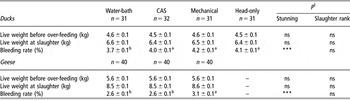
Immediately before the force-feeding period, the animals were allocated in view to obtain similar mean live weight between the treatments (Table 1). At slaughter, the live weight did not differ significantly between the treatment groups in either ducks or geese (Table 1), indicating similar weight gain during the force-feeding treatment between the experimental groups: +1.93 ± 0.22 (mean ± s.d.) and +2.89 ± 0.25 kg, for ducks and geese, respectively.
Differences between stunning treatments for birds’ live weights before force-feeding and at slaughter and for bleeding rate (expressed as % of live weight at slaughter)

1Level of significance of the effects of stunning method or slaughter rank: ***, P < 0.001; ns, P > 0.10.
a,bWithin a row, different letters indicate significant differences at level P = 0.05.
Data are shown as mean ± s.e.
Behaviour on the slaughter line and bleeding efficiency
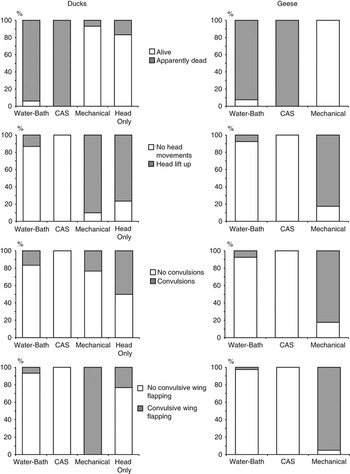
The incidence of all the behavioural traits recorded on the slaughter line was significantly affected by the stunning procedure (Figure 1). In both species, all animals appeared to be dead after CAS and therefore, they did not express any life sign on the slaughter line. Water-bath stunning in our experimental conditions killed more than 90% of the birds. For this technique, less than 10% of the birds exhibited convulsive wing flapping, thus showing that approximately all the animals that were not killed by the stun showed convulsive wing flapping during bleeding. In geese, there was a correspondence between the number of animals apparently dead at the time of neck cutting and the number of animals showing head movements or convulsions (Figure 1). In ducks, however, the percentage of animals showing head lift-up (12%) or convulsions (15%) during bleeding was higher than the percentage of birds apparently dead at the time of neck cutting (8%), thus suggesting that the diagnostic of death at the time of neck cutting was perfectible.
Effect of the stunning methods on the proportion of alive or apparently dead birds at time of neck cutting, and on the occurrence of various behaviours on the slaughter line during the first 5 min after severing neck vessels of force-fed ducks (n = 31 birds per method) and geese (n = 40 birds per method).

In ducks, as well as in geese, the stunning techniques that do not kill the animals were associated with a high incidence of head movements (mechanical and electrical head-only stunning) or convulsive wing flapping (mechanical stunning) during bleeding of both ducks and geese. In ducks, the incidence of wing flapping was higher after mechanical than head-only stunning. To our knowledge, the behaviour during bleeding after various stunning procedures, including CAS, electrical and mechanical stunning, has never been studied in birds. Our results show a clear distinction between the techniques that kill or do not kill the animals before bleeding. In broiler chicken, Hillebrand et al. (Reference Hillebrand, Lambooy and Veerkamp1996) reported higher post-stun convulsions in birds mechanically stunned with a captive bolt, compared to head-only and whole-body electrical stunning. Lambooij and Pieterse (Reference Lambooij and Pieterse1997) stated the lack of means to prevent the strong convulsions that occur after mechanical stunning in poultry was probably the reason why this technique has been negated.
The extent of bleeding differed significantly according to the stunning technique in both species (Table 1). In ducks, the animals stunned in the water bath showed the lowest bleeding efficiency, compared to the three other procedures (3.7% v. 4.0%, 4.2% and 4.1% for CAS, mechanical and head-only stunning, respectively). In geese, the mechanical stunning allowed the highest recovery of blood (3.1%) compared to the CAS and the water-bath methods (2.6%). The results obtained in geese would suggest that the techniques that kill the bird (CAS and water-bath) lower the extent of bleeding compared to a technique that does not kill the bird (mechanical stunning). Similar conclusion could be drawn from results obtained in broiler chicken by Raj and Johnson (Reference Raj and Johnson1997) who compared various CAS procedures and water-bath stunning at 50 Hz (killing the birds) or 1500 Hz (not killing the birds), and found a significantly higher extent of bleeding after 5 min in the latter technique, compared to the former ones. Our present results in ducks, however, do not support this view. Indeed, the extent of bleeding was significantly higher in CAS than in water-bath, while both techniques kill the animals. As already suggested for broiler chickens (Kotula and Helbacka, Reference Kotula and Helbacka1966), the effect of the stunning procedures on the extent of bleeding could be explained by differences in blood distribution in the body rather than by a direct effect on heart activity at time of neck cutting. Further works are currently carried out in our laboratory to confirm this hypothesis in ducks and geese.
Post mortem changes in breast muscle
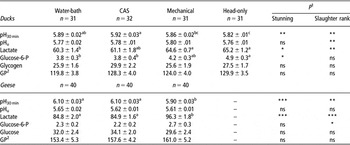
In ducks, as shown in Table 2, ultimate pH was not influenced by the stunning treatment. The rate of post-mortem pH fall, illustrated by the early measure of pH (at 30 min post mortem), depended significantly upon the stunning technique. The lowest rate of pH fall (pH30 = 5.92) was obtained after CAS, whereas the highest rate (pH30 = 5.82) was obtained after head-only electrical stunning. The other techniques gave intermediate values. Consequently, lactate contents at 30 min post mortem were significantly affected by the treatments: the highest concentrations were obtained after mechanical and head-only stunning, whereas the lowest was obtained after CAS (Table 2). A significant effect of the stunning method on glucose-6-phosphate (G-6-P) concentrations was also found in that the highest concentration was recorded in birds stunned by the head-only technique. CAS and water-bath stunning were associated with the lowest concentrations of G-6-P, mechanical stunning giving intermediate values. The stunning treatment did not affect either glucose content or the GP (an estimation of resting level of muscle glycogen) in ducks (Table 2).
Values of post-mortem pH and of breast muscle metabolites at 30 min post mortem according to stunning method and slaughter rank

1Level of significance of the effects of stunning method or slaughter rank: ***, P < 0.001; **, P < 0.01; *, P < 0.05; ns, P > 0.10.
2GP, glycolytic potential, is calculated as 2 × ([glycogen] + [glucose] + [glucose-6-phosphate]) + [lactate] and expressed as μmol lactate/g fresh muscle. Concentrations of metabolites are given as μmol/g fresh muscle.
a,b,cWithin a row, different letters indicate significant differences at level P = 0.05.
Data are shown as mean ± s.e.
In geese, the two techniques that kill the birds (CAS and water-bath stunning) were associated with significantly slower rates of post-mortem pH fall than the mechanical stunning (pH30 = 6.10 v. 5.90, respectively; Table 2). Consequently, the concentration of lactate was significantly higher in geese stunned mechanically than by water bath or CAS.
Post-mortem changes in muscle pH are due to the accumulation of protons coming from ATP hydrolysis, and of lactic acid coming from anaerobic glycolysis from endogenous reserves (glycogen) (Bendall, Reference Bendall1973). This explains why pH values at 30 min post mortem and lactate concentrations were significantly correlated in our study (r = −0.52, P < 0.001 and r = −0.63, P < 0.001, for ducks and geese, respectively). The effects of the stunning technique on post mortem changes in muscles are to be related with the corresponding behavioural responses of the birds during the bleeding phase. For instance, all birds stunned by the CAS were killed before neck cutting and did not show any movements or any muscular activity, during the bleeding phase. As a result, they showed the lowest rate of post-mortem pH fall, i.e. the lowest metabolic activity of muscle. In turkeys, Santé et al. (Reference Santé, Le Pottier, Astruc, Mouchonière and Fernandez2000) found a difference of 0.2 to 0.3 pH unit in breast muscle at 20 min post mortem between birds that did or did not express wing flapping during bleeding.
Our study showed that ultimate pH did not depend upon stunning treatment. Similar conclusions have been reported in broiler chickens and pigs (Raj et al., Reference Raj, Grey, Audsely and Gregory1990; Hillebrand et al., Reference Hillebrand, Lambooy and Veerkamp1996; Channon et al., Reference Channon, Payne and Warner2003). Ante mortem treatments occurring very early before slaughter usually do not affect ultimate pH because they have no significant effect on the level of muscle glycogen (Bendall, Reference Bendall1973). Our results support this view, since we did not record any effect of the stunning treatment on muscle glycogen level (GP) and/or ultimate pH.
The slaughter rank significantly affected several traits of the pectoralis muscle in both ducks and geese (see Table 2). In ducks, the slaughter rank was significantly, though slightly, correlated with the pH30 (r = −0.22; P < 0.01), the pHu (r = −0.23; P < 0.01) and with the concentration of lactate (r = 0.23; P < 0.01). In geese, pH30 (r = 0.18; P < 0.05), lactate (r = −0.23; P < 0.01) and G-6-P (r = −0.18; P < 0.05) contents were significantly affected by slaughter rank. In geese, the correlation obtained between slaughter rank and pH30 was in accordance with previous results obtained in pigs and showing that after a short transport (<2 h), the increase in waiting time at the slaughterhouse was associated with a decrease in the rate of post-mortem pH fall (Warriss, Reference Warriss1987), indicating the positive effect of resting after transport on the level of metabolic activity. In the present experiment, the geese have been transported by road to the slaughter plant (30 min trip) and slaughter rank could therefore be assimilated to the resting time before slaughter. In ducks, however, this was not the case since the animals were kept at the proximity of the slaughterhouse and gradually transported by groups of four, in cages, to the slaughter line, along the slaughter process. The negative correlation between the slaughter rank and pH30 is difficult to interpret.
Meat quality indicators
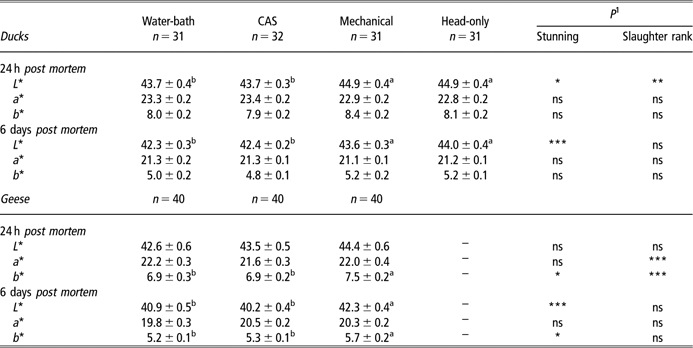
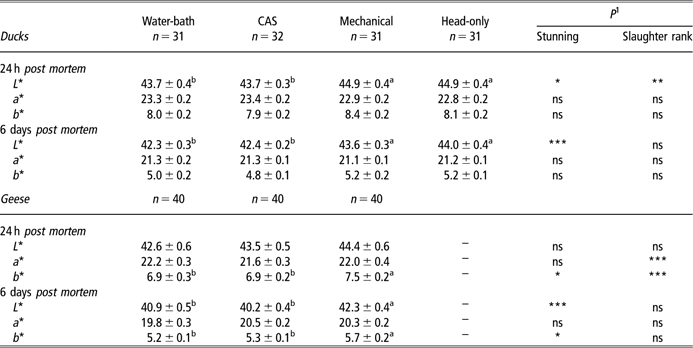
The chromaticity of duck breast muscle (a* and b* indexes in the CIELAB system) was not significantly affected by the treatment, regardless of post mortem time (24 h v. 6 days) (Table 3). The lightness, however, depended significantly upon the stunning techniques: the birds killed by the stunning technique (water-bath and CAS) showed significantly lower L* values than those stunned by the two other techniques. In geese, a similar result was observed but the effect was significant only after 6 days of storage (Table 3). In this species, however, stunning affected significantly the b* index: the animals stunned with the mechanical method showed higher yellowness than those stunned with the two other techniques.
Breast muscle colour at 24 h and 6 days post mortem according to stunning method and slaughter rank
1Level of significance of the effects of stunning method or slaughter rank: ***, P < 0.001; **, P < 0.01; *, P < 0.05; ns, P > 0.10.
a,bWithin a row, different letters indicate significant differences at level P = 0.05.
Data are shown as mean ± s.e.
Slaughter rank significantly affected the lightness of breast muscle in ducks (r = +0.22; P < 0.01), and redness (r = −0.49; P < 0.001) and yellowness (r = −0.30; P < 0.001) in geese at 24 h post mortem. In ducks, slaughter rank was found to be negatively correlated with ultimate pH and this could explain the positive correlation found with lightness.
The observed effects of the stunning techniques on breast muscle lightness are in accordance with previous observations in pigs where gas stunning was found to reduce lightness of meat (Channon et al., Reference Channon, Payne and Warner2002). In lean ducks, however, Raj et al. (Reference Raj, Richardson, Wilkins and Wotton1998) did not find any difference in meat colour between water-bath and gas stunning.
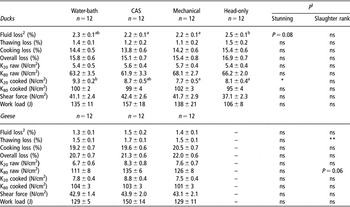
The fluid loss of breast muscle in ducks tended (P = 0.08) to vary according to the stunning technique, but the differences were of low magnitude (2.2% to 2.5%) and probably not of significance from a practical point of view (Table 4). The mechanical constraint at 20% compression of cooked meat was the only texture parameter, which was significantly affected by the stunning technique (Table 4). The animals stunned in the water bath showed significantly higher value than those stunned with the mechanical and head-only techniques, CAS showing intermediate values. In geese, the stunning techniques did not affect texture parameters. In lean ducks, Raj et al. (Reference Raj, Richardson, Wilkins and Wotton1998) showed that CAS gave a significantly more tender meat than water-bath stunning. However, stunning techniques were found to have no effect on meat tenderness in pork (Channon et al., Reference Channon, Payne and Warner2003) or broiler chickens (Poole and Fletcher, Reference Poole and Fletcher1998).
Loss of fluid during the various steps of processing and results from texture analysis, according to the stunning method and slaughter rank

1Level of significance of the effects of stunning method or slaughter rank: **, P < 0.01; *, P < 0.05; ns, P > 0.10.
2Fluid loss during 5 days of storage of vacuum-packed muscle.
a,bWithin a row, different letters indicate significant differences at level P = 0.05.
Data are shown as mean ± s.e.
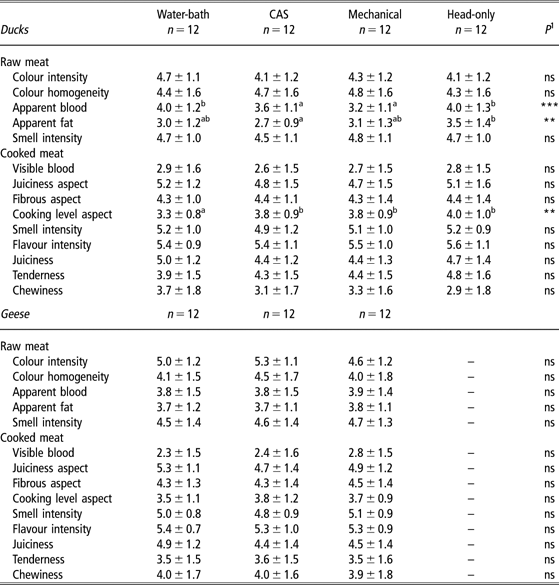
Sensory traits of breast meat
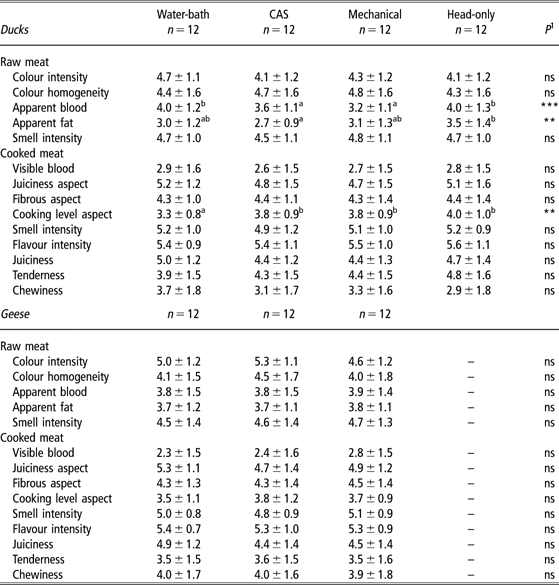
In ducks, the major sensory traits of cooked meat, such as flavour, juiciness and tenderness, were not affected by the stunning technique (Table 5). Few traits related to the aspect of meat varied according to treatment: apparent fat and blood of raw meat and apparent level of cooking of cooked meat. The score of apparent blood was significantly lower in birds stunned with CAS or mechanical technique compared to the two other techniques. The score of apparent fat was significantly lower in CAS ducks, compared to head-only stunned ducks, the two other techniques being intermediate.
Sensory characteristics of raw and cooked breast muscle according to stunning method
1Level of significance of the effects of stunning method or slaughter rank: ***, P < 0.001; **, P < 0.01; ns, P > 0.10.
a,bWithin a row, different letters indicate significant differences at level P = 0.05.
Data are shown as mean ± s.e.
In geese, none of the sensory traits were significantly affected by the stunning technique (Table 5).
Overall, the stunning techniques had slight, if any, effect on the sensory characteristics of meat in ducks and geese.
Carcass downgrading
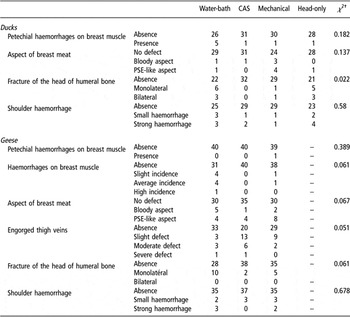
In ducks, the stunning treatment significantly affected the incidence of fractures of the head of humeral bone (Table 6). This defect was totally absent in ducks stunned in controlled atmosphere. The frequency was low (two out of 31 birds) after mechanical stunning, whereas the highest incidences were observed in ducks electrically stunned (in water-bath and head-only). It is also in these categories that several cases of bilateral fracture were recorded (Table 6).
Incidences and subjective scores for several traits related to carcass downgrading, according to stunning technique

†Probability of χ 2 test.
In geese, several appearance defects tended (P < 0.10) to be affected by the stunning treatment (Table 6). The incidence of breast muscles showing haemorrhage was higher in geese stunned by the water-bath system. The incidence of meat showing a ‘bloody’ appearance was the highest in birds stunned in the water bath whereas geese stunned with the mechanical system showed the highest rate of meat with a pale, soft and exudative (PSE)-like aspect, in accordance with the highest rate of post-mortem pH fall, and therefore a higher risk of developing PSE defects, reported above. As was the case in ducks, the water-bath stunning gave the highest rate of fractures of the head of humeral bone in geese. As already mentioned, the birds were killed before neck cut in the CAS system. Thus, they did not express any behavioural reactions during bleeding. Furthermore, the present CAS technique allows an induction of unconsciousness without any strong behavioural responses (such as convulsions or wing flapping; Fernandez et al., Reference Fernandez, Auvergne, Santacruz, Seidlinger, Leprettre, Dubois and Babilé2006). At last, the CAS permits to avoid the behavioural responses during shackling of live birds. All these reasons probably explain why this stunning technique is associated with the lowest rate of defects such as fractures and haemorrhages. The positive effect of gas stunning on the incidence of carcass and meat downgrading has already been reported in pig (Channon et al., Reference Channon, Payne and Warner2002), broiler chicken (Raj et al., Reference Raj, Grey, Audsely and Gregory1990), geese (Turcsán et al., Reference Turcsán, Szigeti, Varga, Farkas, Birkás and Turcsán2001) and broiler ducks (Raj et al., Reference Raj, Richardson, Wilkins and Wotton1998).
CAS was associated with the highest rate of thighs showing engorged veins (from slightly to highly engorged). This effect is probably not due to a difference in residual blood in the carcass since the quantity of blood recovered during bleeding was the same after CAS and water-bath stunning, for instance. A difference between the stunning techniques in the distribution of residual blood in the carcass might have played a role in the observed effects (more engorged thigh veins after CAS, more meat with bloody appearance after water-bath stunning).
Conclusions
The present work is the first report of the effects of various stunning methods on the quality of carcass and meat in ducks and geese force-fed for the production of French ‘foie gras’. The methods associated with a high incidence of post-stun convulsions (head-only stunning in ducks and mechanical stunning in ducks and geese) lead to an acceleration of post-mortem pH fall associated with paler meat. Overall, these results show the positive effects of CAS on the appearance defects of carcass and meat of ducks and geese, and, on the contrary, they confirm the detrimental effects of water-bath stunning on these criteria. However, the incidences on the sensory qualities of meat were scarce.
Acknowledgements
The authors wish to thank Mrs H. Manse for the practical organization of the experiment, Mrs C. Pautot for the measurements of texture and Mr S. Seidlinger for expert assistance with the handling of the CAS equipment. Ducks and geese were slaughtered and processed under the facilities of the Lycée Agricole de Périgueux (LEGTA, 24, France). The authors are indebted to François Hérault (LEGTA) for technical supervision of the slaughter process. The sensory analysis was carried out at the ADIV (63, Clermont-Ferrand, France). We thank Mrs Sylvie Gilbert (ADIV) for expert assistance in this field. The financial supports of INRA, CIFOG, Office de l’Elevage and French Ministry of Agriculture enabled the implementation of this program.