The ability of milks to withstand heat-induced coagulation during heat treatment is an important pre-requisite for heat processing of dairy products. The heat-induced changes occurring in milk depend on the heating conditions, protein composition and compositional factors such as milk pH, ionic strength and mineral composition (de Wit & Klarenbeek, Reference de Wit and Klarenbeek1984; Van Boekel et al. Reference Van Boekel, Nieuwenhuijse and Walstra1989; O'Connell & Fox, 2003). Caseins are heat stable but whey proteins are prone to denaturation. Changing the total protein concentration or the concentration of whey protein and casein in milk alters the rates of denaturation of the whey proteins (Law & Leaver, Reference Law and Leaver1997; Anema et al. Reference Anema, Lee and Klostermeyer2006). Increasing whey protein concentration increases the rate of whey proteins denaturation (Law & Leaver, Reference Law and Leaver1997; Guyomarc'h et al. Reference Guyomarc'h, Queguiner, Law, Horne and Dalgleish2003; Yüksel & Erdem, Reference Yüksel and Erdem2005).
The effects of varying casein to whey protein ratios on heat stability were examined in model milks obtained by blending various sources of casein, whey and ultrafiltered permeate (Patocka et al. Reference Patocka, Jelen and Kalab1993; Rattray & Jelen, Reference Rattray and Jelen1997; Beaulieu et al. Reference Beaulieu, Pouliot and Pouliot1999). However, the effects of the mineral composition of the milks have not been separated from that of varying casein to whey protein ratio. This is despite the known influence of the mineral composition on heat stability (Dalgleish et al. Reference Dalgleish, Pouliot and Paquin1987). Heat stability is sensitive to the initial pH of milk, the total mineral in the milk as well as the serum mineral composition of milk (Augustin & Clarke, Reference Augustin and Clarke1990; McKinnon et al. Reference McKinnon, Yap, Augustin and Hemar2009; de Kort et al. Reference de Kort, Minor, Snoeren, van Hooijdonk and van der Linden2012).
This study focusses on the heat-induced changes (pH, Ca activity, viscosity) of modified skim milks with varying casein : whey protein ratios and similar serum mineral composition as a function of initial pH at 25 °C. In this work, we firstly prepared casein-rich and casein depleted powders using a two-stage membrane filtration of skim milk, followed by freeze drying. We then prepared modified skim milk powders with varying casein to whey protein ratio but with the same serum mineral composition upon reconstitution. This was achieved by dialysing milks reconstituted from casein-rich and whey protein-rich powders or mixtures of these powders against skim milk. The susceptibility of the milks to thickening on heating, as assessed by measurement of viscosity at 25 °C after heating at 90 °C for 10 min, was examined as a function of initial starting pH (6·2–7·2) at 25 °C. The changes in pH in situ were determined as a function of the initial pH at 25 °C.
Materials and methods
Materials
Skim milk powder and fresh milk were obtained from a commercial source (Tatura Milk Industries, Tatura, Victoria, Australia). The preheat treatment given to the milk was 72 °C for 15 s. All chemicals used were analytical grade from BDH Chemicals (Kilsyth, Victoria, Australia) or Sigma Aldrich Pty Ltd (Castle Hill, NSW, Australia).
Compositional analysis
The moisture content of the powders was determined using the IDF method (1964). The total nitrogen, non-protein nitrogen, and non-casein nitrogen contents of the original skim milk powder were analysed by the Kjeldhal method (Standards Association of Australia, 1991). A factor of 6·38 was used in the calculations to convert the nitrogen concentration to the protein concentration (IDF, 1993). The total nitrogen content of the reconstituted freeze-dried modified milk solutions and the corresponding supernatants at natural pH were determined using a LECO FP-2000 Nitrogen Analyser (LECO Australia Pty Ltd, Castle Hill, NSW, Australia). Samples were ashed (Standards Association of Australia, 1988) and then used for total phosphorus analysis (IDF, 1990). The Standards Association of Australia method (1994) was used for estimating lactose content of the original skim milk powder. The lactose content of the freeze dried modified milks obtained after dialysis was determined by a commercial laboratory (Dairy Technical Services Ltd, Kensington, Victoria, Australia).
Analyses of calcium in milks were carried out on trichloroacetic acid (TCA) filtrates obtained after precipitating proteins in 12% (w/w) TCA. Calcium was determined by atomic absorption spectroscopy (Model AA 3110, Atomic Absorption Spectrophotometer; Perkin Elmer, Scoresby, Victoria, Australia) using an air acetylene flame and wavelength of 422·7 nm with LaCl3 as suppressant (Udabage et al. Reference Udabage, McKinnon and Augustin2001).
Preparation of casein-rich and casein-depleted powders using membrane filtration
Casein-rich and whey protein-rich powders were manufactured on a pilot scale plant at CSIRO, Werribee using ultrafiltration and microfiltration membrane processes. The skim milk was either reconstituted from skim milk powder or fresh skim milk. The reconstituted skim milk solutions (9% total solids (TS), w/w) were stirred for 1 h at 25 °C, left overnight at 4 °C and equilibrated to 25 °C for 1 h on the next day.
The skim milk was microfiltered using a 1 μm membrane (Stage 1) to remove microorganisms. Permeate from Stage 1 was microfiltered using a 100 nm membrane (Stage 2) to produce a casein-rich retentate. Permeate from Stage 2 was ultrafiltered using a 10 kDa membrane to obtain the whey protein-rich fraction. The casein-rich and whey protein-rich fractions were freeze dried at a commercial facility in Melbourne. The protein compositions of the powders were determined using methods described above. The moisture content, true protein, casein and whey protein contents of the powders obtained are given in Table 1.
Moisture and protein composition (g/100 g powder) of casein-rich and whey protein-rich powders

Mean values and sd of (n = 3) analyses; Batch 1 was made from reconstituted skim milk powder whereas Batch 2 was made from fresh milk.
Production of modified skim milks with a similar serum mineral composition
Modified skim milks with different casein to whey protein ratios (0·03, 1·74, 5·27 and 7·25) having a similar mineral serum composition to skim milk were prepared by mixing casein-rich and whey protein-rich powders. Table 2 shows the amounts of the casein-rich and whey protein-rich powders used for reconstitution to obtain milks with total protein of 3·3–3·4% w/w, which were dialysed against reconstituted skim milk (9% TS, w/w) reconstituted from skim milk powder. Control skim milk (9% TS w/w, casein : whey protein 3·97) was dialysed against itself so that all milks were subject to the same dialysis treatment and subsequent freeze-drying. Then all milks in dialysis bags (10 kDa molecular weight cut-off) were placed in 10X the volume of reconstituted skim milk (9% TS, w/w) for 24 h at 4 °C. The dialysed samples were freeze-dried. The composition of the powders were analysed using the methods described above and given in Table 3.
Formulation of reconstituted milks with varying casein : whey protein ratios for dialysis against reconstituted skim milk (9% TS, w/w)
Skim milk powder and casein-rich powder (Batch 1) were used for preparation of milk with casein : whey protein ratio of 3·97 and 7·25 respectively. For all other milks, casein-rich powder and whey protein-rich powder from Batch 2 were used. All %'s are on a w/w basis.
Composition of powders made from milks with varying casein : whey protein ratios dialysed against reconstituted skim milk (9% TS, w/w)
Mean values and sd of (n = 3) analyses; The moisture contents for powders with varying casein : whey protein ratios of 0·03, 1·74, 3·97, 5·27 and 7·25 were 3·5, 3·9, 2·4, 2·6 and 11·3% respectively.
Preparation of milks from freeze-dried powders
For the preparation of modified milks (9% TS, w/w) at their natural pH, the powders were dispersed in MilliQ water at 25 °C and stirred for 1 h prior to storage overnight at 4 °C, except for the casein-rich powder which was stirred at 50 °C for 1 h to aid dispersion prior to storage overnight at 4 °C. The pH-adjusted milks (9% TS, w/w) were prepared in the same way except that milks (18% TS, w/w) were made up from the freeze-dried powders, pH-adjusted with 1 m NaOH or 1 m HCl and then diluted to obtain 9% TS, w/w milks. All milks were re-equilibrated at 25 °C for 1 h prior to the start of experiments.
Preparation of serum phase
Milk solutions (9% TS, w/w) were ultracentrifuged at 33 000 g at 25 °C for 60 min using a Beckman L8 80 m ultracentrifuge with a type 80 rotor (Beckman Instruments Australia Pty. Ltd., Gladesville, NSW, Australia). After ultracentrifugation, a supernatant layer, an opalescent liquid layer and a pellet was obtained in addition to a thin layer of residual fat at the top of the tube. To obtain serum samples for compositional analyses, the thin fat layer was carefully removed after which the serum was collected without the opalescent layer. The mass of the combined clear serum and the opalescent layer were measured and taken as the total mass of the serum phase. The composition of the serum was determined.
pH and calcium activity
Aliquots (50 g) of milk in stainless steel tubes were heated in a water bath at 90 °C. The time to reach 90 °C was 8 min. The milk solutions were held for a further 10 min at 90 °C. After the heat treatment, the samples were cooled in a water bath held at 25 °C and then stored overnight at 4 °C. The next day, the milk solution was equilibrated at 25 °C for 1 h prior to measurements.
The pH of the reconstituted milks was measured using an InPro 2000 liquid electrolyte combined pH electrode with an integrated temperature sensor capable of withstanding temperatures of up to 140 °C (Mettler Toledo, Australia) connected to a pH meter (Metrohm, AG CH-9101, Hensau, Switzerland) (Chandrapala et al. Reference Chandrapala, McKinnon, Augustin and Udabage2010). Ca2+ activity was measured at 25 °C before heat treatment, after treatment (by flash cooling the heated milk samples in cold water) and after storing the milks samples overnight at 4 °C and re-equilibration at 25 °C for 1 h using a Calcium Ion Selective electrode (Chandrapala et al. Reference Chandrapala, McKinnon, Augustin and Udabage2010).
Viscosity
The viscosity of milk was measured with the Paar Physica modular compact MCR 300 rheometer (Anton Paar GmbH, Anton-Paar-Strabe 20, 8054 Graz, Austria) using the cup and bob set up at a constant shear rate of 46·1 s−1. The temperature was raised from 25–90 °C, then held at 90 °C before cooling down to 25 °C. Measurements were recorded every 30 s. The analysis was done in duplicate.
Results
The composition of powders made from milks with varying casein : whey protein ratios dialysed against reconstituted skim milk (9% TS, w/w) are given in Table 3. The pH and Ca2+ activity upon reconstitution of milks to 9% TS, w/w were 6·67–6·73 and 0·55–0·64. All milks at pH 6·7 had similar total serum Ca content (Table 3) and Ca2+ activity (0·59 ± 0·04), suggesting that similar serum mineral composition had been achieved for all milks.
pH
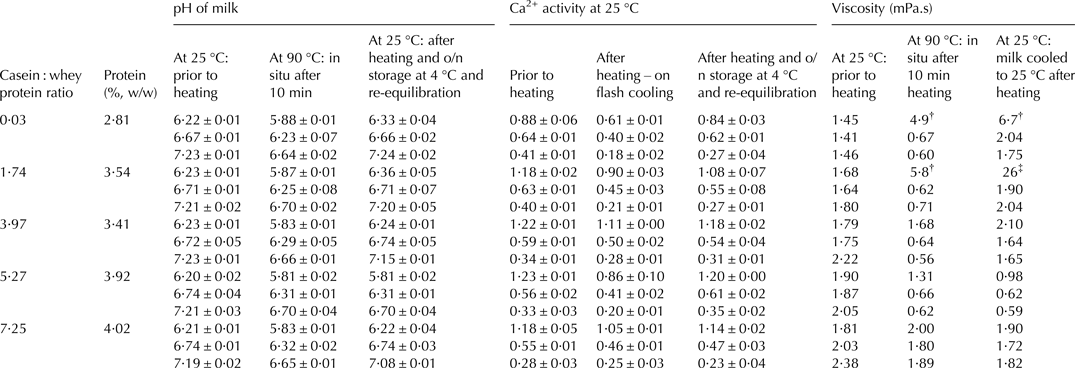
The pH of all skim milks decreased on heating and the pH change (difference between the pH at 25 °C before heating and the pH at 90 °C) increased with increasing pH (Table 4). The decrease in pH on heating at 90 °C was rapid, reaching the final pH value at the first time point (10 min) of the measurement and not changing for the duration of the heating (data not shown).
Changes in pH, Ca2+ activity and viscosity of modified skim milks on heating
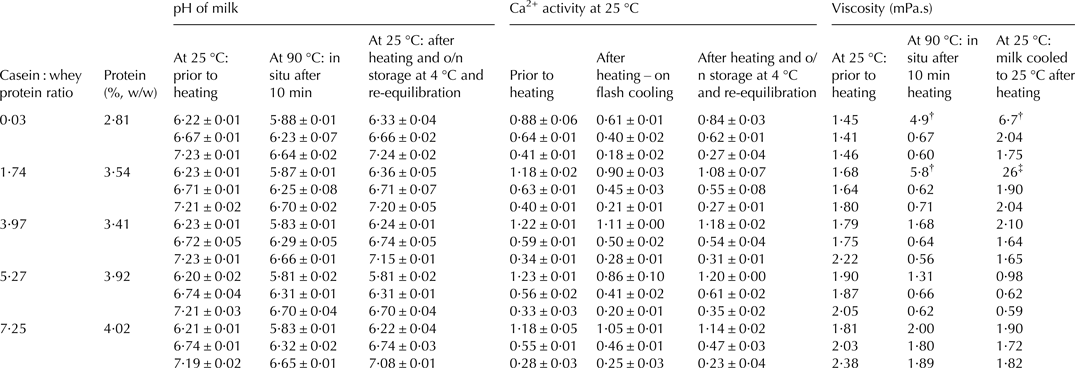
Protein content calculated from data in Table 3; pH and Ca2+ activity are the average of duplicate experiments; sd for Ca2+ measurements are ± 0·05; Viscosity data are expressed as the average of duplicate analysis with a pooled sd of ± 0·05 except for data followed by superscripts † and ‡ in where ± 3·0 and ± 10·0 respectively.
The Ca2+ activity results are based on a standard concentration C0 = 1mm.
The decrease in pH on heating to 90 °C was similar for all the modified skim milks with the same starting pH, irrespective of the differences in protein concentration (2·8–4·0%, w/w) and ratio of casein : whey protein in the milk (Table 4). The pH at 25 °C was largely restored after cooling except for modified skim milks with starting pH 6·2 with casein : whey protein ratio of 0·03 and 1·74, where pH on cooling and re-equilibration to 25 °C was higher than that prior to heating (Table 4).
Ca2+ activity
The Ca2+ activity increased as the pH decreased from 7·2 to 6·2 for all unheated modified skim milks (Table 4). The changes in Ca2+ activity with pH adjustment for milks were similar except that the magnitude of increase in Ca2+ activity on pH adjustment from the natural pH 6·7 to pH 6·2 was significantly lower for modified skim milk with the lowest casein : whey protein ratio compared to all other pH 6·2 modified skim milks. As pH is increased from pH 6·7 to pH 7·2, the magnitude of decrease in Ca2+ activity is similar for all modified skim milks (Table 4). After heating the milk samples and flash cooling, a decrease in Ca2+ activity was observed for all modified skim milks but the Ca2+ activities of the milks were largely restored on cooling after 24 h of storage (4 °C) and re-equilibration to 25 °C (Table 4).
Viscosity
Altering the casein to whey protein ratios and pH clearly had a significant influence on the viscosity (Table 4). Generally milks at low pH and with lower casein to whey protein ratios were more susceptible to thickening after heating. Although the total protein compositions of the modified skim milks were different, the effect of casein : whey protein ratio was dominant.
The viscosity of the modified skim milks (pH 6·7) at 25 °C prior to heating increased with increasing casein : whey protein ratio (Table 4). This is expected as caseins have a higher viscosity than whey proteins (Boulet et al. Reference Boulet, Britten and Lamarche1998). There was a slight increase in viscosity with increasing initial pH from pH 6·7 to pH 7·2 for all the unheated modified skim milks except milk with the lowest casein : whey protein ratio. This is due to the swelling of the casein micelles that occurs at the higher pH as the negative charge of the caseins is increased. Decreasing pH from 6·7 and 6·2 did not change the viscosity.
A decrease in viscosity is expected in situ (90 °C) when there is no aggregation of proteins as the viscosity of the aqueous phase is decreased as temperature is increased. The significant increase in viscosity of pH 6·2 milks with casein : whey protein ratio of 0·03 and 1·74 is evidence of protein aggregation.
Visual observation of the heated milks with low casein : whey protein ratios (0·03 and 1·74) on cooling showed that gelation had occurred. Modified skim milks (pH 6·7 and pH 7·2) with low casein to whey protein ratios (0·03 and 1·74) had slightly higher viscosity on cooling. The opposite was true for modified skim milks with higher casein to whey protein ratio (3·97, 5·27 and 7·25) at 25 °C after cooling for all pH 6·7 and pH 7·2 modified skim milks (Table 4) where there were very slight decreases in viscosity. This shows that the over-riding factor for increase in viscosity at pH 6·7 and pH 7·2 is the presence of whey protein.
Discussion
Composition of powders
Although a similar protein composition (37–38 g protein/100 g powder) was targeted in the formulation of the modified skim milks with varying casein : whey protein ratios (Table 3), there were significant differences in the milks prepared from the casein-rich and whey protein-rich powders (Table 2). Lactose is able to diffuse across the 10 kDa cut-off membrane. However, the lactose content of the powders was not the same for all powders, showing that the transfer of lactose was inhibited across the membrane. Higher proportions of lactose were obtained in the dialysed milk with increased proportion of whey protein-rich powders. The higher content of lactose in whey protein-rich powders compared with casein-rich powders meant that the lactose concentration was highest for the modified milk (casein : whey protein ratio of 0·03). A higher amount of lactose in the dialysis bag at the start of the dialysis experiment increases the osmotic pressure of the milk within the dialysis bag, resulting in a transfer of water from the external environment into the dialysis bag. This resulted in differences in the total protein and lactose in the powders prepared. Despite these limitations of unequal concentrations of protein and lactose concentrations, these milks were used for our studies as modified skim milks have the similar serum mineral composition.
Change in pH on heating
The pH changes on heating occur primarily due to the changes in the calcium phosphate equilibrium in milk (Chaplin & Lyster, Reference Chaplin and Lyster1988; Pouliot et al. Reference Pouliot, Boulet and Paquin1989a; Singh, 2004). The fact that that the decrease in pH of all modified skim milks with the same starting pH on heating to 90 °C and during the 10 min hold at 90 °C (Table 4) was largely independent of the different protein concentrations in the modified skim milks (2·8–4·0%) and the casein : whey protein ratio with the similar serum mineral composition (Table 3) confirms that the primary influence on the pH change was dictated by shifts in the serum mineral composition of the milk. The observed pH changes on heating to 90 °C are similar between all the modified skim milks in spite of the different levels of total calcium and phosphate (Table 3). Van Boekel et al. (Reference Van Boekel, Nieuwenhuijse and Walstra1989) showed that the whey proteins present in the serum phase did not contribute to the change in pH on heating.
The observed decrease in pH on heating to 90 °C and the increased magnitude of change with increased pH are similar to that previously reported (Chaplin & Lyster, Reference Chaplin and Lyster1988; McKinnon et al. Reference McKinnon, Yap, Augustin and Hemar2009; Chandrapala et al. Reference Chandrapala, McKinnon, Augustin and Udabage2010). On heating, the precipitation of calcium phosphate (CaHPO4) occurs, causing a reduction in mono-hydrogen phosphate (HPO42−) in the serum. To counter the decrease in mono-hydrogen phosphate, the deprotonation of dihydrogen phosphate occurs until equilibrium is established resulting in an increase in hydrogen ions and the pH decrease on heating.
The heat-induced pH changes are reversible or irreversible, depending on the heat treatment (Fox & McSweeney, Reference Fox and McSweeney1998; Le Ray et al. Reference Le Ray, Maubois, Gaucheron, Brule, Pronnier and Garnier1998; Ma & Barbano, Reference Ma and Barbano2003). Pouliot et al. (Reference Pouliot, Boulet and Paquin1989b) reported a 90–95% recovery of Ca and Pi in milks heated to 85 °C for 40 min on cooling for 24 h. In most cases, expect for the pH 6·2 milks with casein : whey protein ratio of 0·03 and 1·74, the heat-induced pH changes were reversible after overnight storage (4 °C) and re-equilibration to 25 °C (Table 4). The slight increase in the pH on cooling gelled milks (pH 6·2 milks with casein : whey protein ratio of 0·03 and 1·74) are due to irreversible heat-induced changes to the proteins and changes in conformation, with subsequent changes in pKa of the amino acid residues due to the changed immediate environment of the amino acids.
Ca2+ activity
The increase in Ca2+ activity with decreasing pH is expected due to the solubilisation of calcium phosphate. Conversely increasing pH results in the precipitation of calcium phosphate which decreases ionic calcium (Anema, 2009). The precipitated calcium phosphate may become part of micellar calcium phosphate or bind to phosphoseryl residues not involved in nanoclusters formation (Vaia et al. Reference Vaia, Smiddy, Kelly and Huppertz2006).
The lower Ca2+ activity of pH 6·2 milk with the lowest ratio of casein to whey protein compared with all other pH 6·2 milks is due to the near absence of casein micelles. In the absence of colloidal calcium phosphate in casein micelles, the increase in Ca2+ activity at lower pH is due to the solubilisation of various calcium complexes present in the serum. The serum phase contains soluble calcium present as a calcium citrate complex and to a lesser degree as a complex with inorganic phosphate and with chloride (Gaucheron, Reference Gaucheron2005). When casein micelles are present at higher concentrations, they participate in the binding of calcium and hence the higher total calcium in milk with increasing casein : whey protein ratio with the same serum mineral composition. On decreasing pH of milk with higher casein : whey protein ratio from 6·7 to 6·2, there is a contribution of increased Ca2+ activity due to dissolution of micellar colloidal calcium phosphate. However as pH is increased from pH 6·7 to 7·2, the magnitude of decrease in Ca2+ activity is similar to the other milks. The effects of the absence of the casein micelles are less obvious when pH is raised as precipitation of the ionic calcium from the serum is occurring, which reduces the Ca2+ activity.
After heating the milk samples and flash cooling, a decrease in calcium activity was seen, in accordance with others (Geerts et al. Reference Geerts, Bekhof and Scherjon1983). At low pH, the solubility of calcium phosphate increases in unheated milks, however, at high temperature this is accompanied and counteracted by a decrease in calcium phosphate solubility and a decrease in soluble calcium (On-Nom et al. Reference On-nom, Grandison and Lewis2010). Studies by Pouliot et al. (Reference Pouliot, Boulet and Paquin1989a, Reference Pouliot, Boulet and Paquinb) on the mineral partitioning at high temperatures showed that soluble calcium decreased with increasing temperatures of between 20–90 °C. There are also shifts in calcium citrate complexation contribute to altered Ca2+ activity on heating. Apart from calcium phosphate, calcium citrate is found on the casein micelles (Gaucheron, Reference Gaucheron2005).
The recovery of Ca2+ activity on cooling of heated milk has been observed previously (Augustin & Clarke, 1991). However, the incomplete reversibility of Ca2+ activity for pH 7·2 milks with low casein : whey protein ratios (0·30 and 1·74) and improved reversibility of other pH 7·2 milks with higher levels of casein suggest that the presence of casein micelles improved the solubility of the precipitated calcium phosphate complex after heating and cooling.
Susceptibility of milks to thickening after heating
When whey proteins are heated in the absence of the caseins, they precipitate or gel (Dalgleish, Reference Dalgleish1990; Law & Leaver, Reference Law and Leaver1997; De La Fuente et al. Reference De La Fuente, Olano and Juarez2002; Donato et al. Reference Donato, Guyomarc'h, Amiot and Dalgleish2007). In isolation, heated whey proteins form gels but gelation is inhibited in milk due to casein micelles (Dalgleish, Reference Dalgleish1990; Dickinson & Parkinson, Reference Dickinson and Parkinson2004). The onset of gelation as evidenced by the temperature at which viscosity in situ increased during heating (data not shown) for milk with casein to whey protein ratios of 0·03 (80 °C) and 1·74 (90 °C) at pH 6·2, suggesting that the higher the proportion of whey proteins in the total protein composition, the lower the gelation temperature and the more susceptible the milk is to thickening. Although heating of pH 6·7 and 7·2 milks with casein : whey protein ratios of 0·03 and 1·74 did not gel, there were measurable increases in viscosity on cooling, suggesting that there were soluble aggregates of whey proteins formed on heating.
The slight decreases in viscosity of milk with higher casein to whey protein ratio (3·97, 5·27 and 7·25) at 25 °C for all pH 6·7 and 7·2 milks on cooling may be attributed to the denaturation of whey proteins and their aggregation with the casein micelle. Anema & Li (Reference Anema and Li2003) reported that increasing pH from 6·5 to 6·7 decreased whey protein association with the casein micelles. At pH 7·2 the decrease in viscosity of these milks after heating is greater and is possibly due to the decrease in casein micelle size as a result of the dissociation of κ-casein from the casein micelle at high pH (Anema & Klostermeyer, Reference Anema and Klostermeyer1997; Anema et al. Reference Anema, Lowe and Li2004). The level of association of the denatured whey proteins with the casein micelle decreases as the initial pH of the milk prior to heating is increased (Singh & Creamer, Reference Singh and Creamer1991; Vasbinder & de Kruif, Reference Vasbinder and de Kruif2003). At pH 7·2, most of the aggregated whey proteins are soluble aggregates (Chandrapala et al. Reference Chandrapala, Augustin, McKinnon and Udabage2011). The decrease in the viscosity of the heated pH 7·2 milks suggests that the increased serum phase heat-induced soluble aggregates that form at pH 7·2 do not contribute significantly to viscosity.
Despite increasing concentration of total protein, which would have contributed to an increased rate of aggregation, it is clear that when the serum mineral composition is the same, the main contributor to thickening of milks after heating at low pH (6·2) is the variation in the ratio of casein to whey protein in milk, rather than the total protein concentration when protein is in the range of 2·8–4·0% w/w.
This work was supported by Dairy Innovation Australia Limited and the Australian Research Council (ARC). Mandeep Jeswan Singh would like to thank ARC for a PhD scholarship.