According to United Nations Office for Disaster Risk Reduction (UNISDR), the United Nations Environment Program (UNEP), and the Red Cross as well as others, the number of disasters, including earthquakes, floods, cyclones, tsunamis, and droughts have been steadily increasing since the early 1900s. Although this increase in natural disasters cannot be denied, often times, government agencies continue efforts to solve these problems alone or with little outside aids. It seems that with the number of disasters that are occurring, it is impossible for any single organization or government to serve sufficiently for relief, rehabilitation, and development. Reference Rose1 Different approaches in disasters management have been developed and implemented in different countries, among which a community-based approach can be mentioned. At the highest level, the Federal Emergency Management Agency (FEMA) and Centers for Disease Control and Prevention (CDC) accentuates on communicating and collaborating with local community-based organizations (CBOs) before the disasters.
Community-based participation in disasters risk management is a process in which all groups and members of the community participate in decision-making and practical action to solve community issues. Reference Cheema, Scheyvens and Glavovic2 The goal is to enhance the knowledge, awareness, and ability of local inhabitant to respond to disasters in an appropriate, impressive and economical way. Among CBOs, religious institutions have a great potential to contribute in disasters management. They have quick access to disaster areas and recognize the strengths and weaknesses of local areas in dealing with disasters. Reference Feldbush3
FEMA, with philosophy of “whole community,” has expressed the importance of the collaboration and communication of government agencies with community-based institutions such as religious organizations. This philosophy emphasizes the values of cooperation, empowering local people and the response of the collective community to disasters. CBOs are trustworthy in the communities that they help, in comparison to government agencies. Religious organizations are one of the most important components of community that in addition to community trust, have resources or access to resources such as volunteers, popular donations and other facilities that are highly valuable and critical to help government agencies to manage disasters successfully.
Also, the role of faith-based organizations (FBOs) has been largely undocumented and underestimated in the disaster studies literature. Reference Stajura, Glik and Eisenman4,Reference Cheema5 In 2013, Mohit et al., through a review study, had explored the role of mosques in disaster management in various Asian countries and had developed a model of the contribution of the mosques in disasters management in the Muslim countries. Reference Mohit, Zahari and Eusuf6 There are many studies about the role of religious institutions in disasters management, Reference Cheema5 but, based on our knowledge, there is no published systematic review research evaluating the articles on the participation of FBOs in disasters. The aim of this study is to evaluate the current knowledge about disaster management based on the role of religious institutions; to understand the ways that religious institutions, such as mosques, churches, and temples effect on response of communities; and to find out the role of these institutions in relation to main actors from the governments, communities, and nonprofit organizations during different phases of disasters.
METHODS
Design
In this study, data were collected using a clear and explicit process. To create transparency, the protocol of this systematic review was registered at the research gate site on June 17, 2018. Because of variations in methodologies and heterogeneity of the articles with the same methodology, implementation of quantitative analysis was not possible; therefore, content analysis was done to obtain descriptive information.
Inclusion Criteria
This systematic review includes papers from a broad range of disciplines focusing on or related to “religious institutions” and disasters and their equivalent words published since August 2018, without time limitation for beginning of search time period. Other resources, gray literature (including theses, conference papers, and research reports), expert’s opinions, as well as key journals were searched for additional studies. In addition, the retrospective method (ie, collecting literature according to the reference lists of the included paper) and searches in Google Scholar were used as supplementary methods.
Exclusion Criteria
For the purpose of this study, those articles that focus on response to disaster based on religious beliefs and religion rather than participation of religious institutions or FBOs in disaster risk management were excluded. Research articles in languages other than English were excluded due to inaccessibility, but the search strategy did not impose any language limitations.
Search Strategy
A search of electronic databases was conducted to identify relevant studies. The primary databases used for search of literature were Scopus, PubMed/Medline, Web of Science (WOS), Proquest, and Embase. Keywords included the “religious institutions” and “disasters management” and their equivalents were obtained from Mesh, Emtree, or extracted from related articles. Other resources, gray literature, reference lists of relevant primary studies, as well as key journals were searched for additional studies. The articles that were published since August 2018, without time limitation for beginning of search time period, were included. The study syntax was formed from 2 components. The first component, including disaster, earthquake, tsunami, hurricane, calamity, crisis, emergency, hazard, catastrophe, “natural disaster,”, “disaster planning,” “disaster management,” “disaster risk,” “disaster preparedness,” “risk management,” “disaster prevention,” “disaster mitigation,” mitigation, “disaster risk reduction,” and “relief planning.” The second component included church, mosque, masjid, temple, synagogue, “religious institution,” religion, and “religious beliefs.” The search syntax is shown in the online Supplemental Appendix 1.
Data Extraction (Selection and Coding)
First, a thorough literature search was performed using the key terms in databases include PubMed (including Medline), Web of Science, Scopus, Proquest, Embase, and Google Scholar (K.J., G.H.G.H., and R.S.H.). Second, the title and abstract of the found articles was evaluated to exclude the unrelated ones (K.J., G.H.G.H., and R.S.H.). Then, according to the inclusion and exclusion criteria, the eligibility of the full texts of the remaining articles were assessed by 2 reviewers. Any disagreement was resolved by consensus between the 2 authors (H.S., R.S.H.).
Quality Assessment
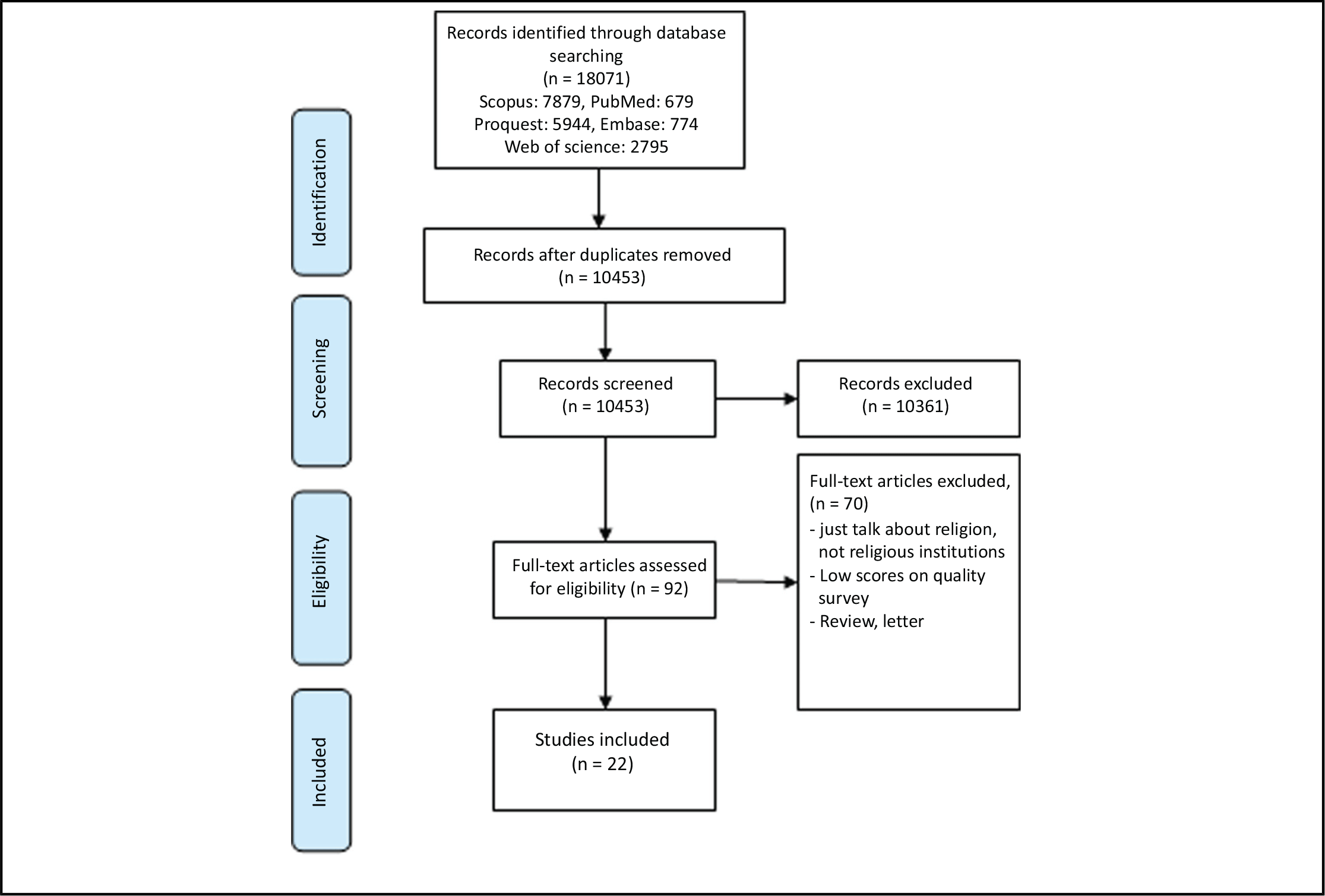
The full texts of the articles were read and checked by 2 authors independently for quality of the included studies by using the Critical Appraisal Skill Program (CASP), assessment tool for qualitative research (include 10 items), and the Strengthening the Reporting of Observational Studies in Epidemiology (STROBE), evaluation tool for cross-sectional studies (include 22 items). In this review, the studies with quality score equal to or higher than 70% of a possible score of 100% were included. It was not possible to implement meta-analysis due to variations in methodologies and heterogeneity of the included articles with the same methodology (Figure 1).
Systematic Review Flow Diagram

RESULTS
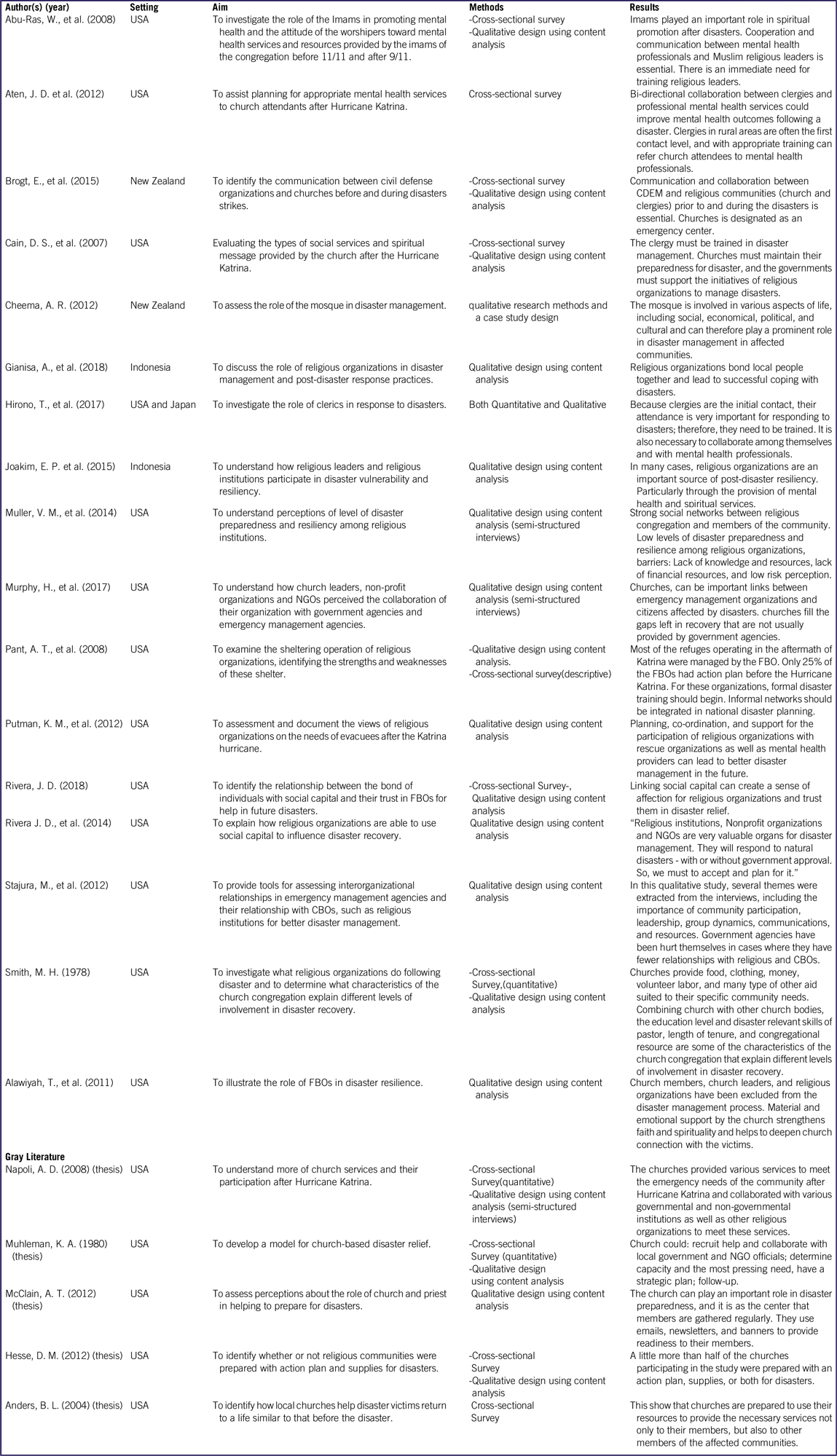
From the 18,071 records have been identified through database searching in the early stage, 22 articles were selected for this review followed by analysis of the characteristics and content analysis of the included studies to answer the study questions. Of the 22 selected studies in the final round, 18 studies were done in the United States, 2 studies in New Zealand, and 2 studies in Indonesia. Ten studies had qualitative design, 10 studies had mix-method design, and 2 articles were cross-sectional study (Table 1).
Characteristics of the Included Studies

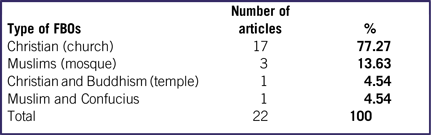
Of the included papers, 3 articles (13.63%) were about mosques’ (religious institutions of Muslims communities) participation in disaster management. An article (4.54%) was about the participation of religious institutions of Buddhism (temples) and Christian communities (churches) in disaster management. An article (4.54%) was about the participation of religious institutions of Muslim and Confucius communities in disaster management, and 17 articles (77.27%) were about churches’ participation in disaster management (Table 2).
Number of Included Articles by Type of FBO

Certainly, the primary role of the FBO is spiritual; despite this, the findings of researches show that the FBOs play essential roles in the nonspiritual aspects of life of people. From a cultural and social aspect, the FBOs are an entry door to facilitate and coordinate access of communities to governmental and NGOs during response to disasters. Reference Gianisa and Le De7 In this systematic review of study overall, 11 themes were identified from content-analysis that demonstrate the function of FBOs and their relationships with local government agencies and local health departments in the context of disaster management. The following sections demonstrate each of these themes from the authors’ viewpoint.
FBOs Potential for Disaster Management
The CDC workbook introduces “mosques, churches, synagogues, temples, charitable institutions related to religion and other services such as churches supported schools” as FBOs. Reference Stajura, Glik and Eisenman4 In addition to a place for worship, FBOs have potential for disaster management, such as the following.
-
a) FBOs as a Place for Training
Many people go to the mosques, churches, and other religious institutions to pray and listen to sermons. The leaders of religious organizations usually are trusted by their followers, and the messages the followers receive from them are better accepted and have a greater chance of success and sustainability. Thus, the FBOs can serve as a place for training on how to perceive disasters and how to deal with trauma and grief after disasters.
-
b) Providing Social and Health Services
Providing shelter, food, clothing, water, and counseling, and supporting communities in every possible way are some of the other activities of FBOs during the time of disasters. After a disaster, they are one of the first places that many victims seek assistance and services. The religious institutions are key factors in supporting people in need until they receive governmental assistance. Reference Feldbush3,Reference Pant, Kirsch and Subbarao8
In some countries, such as Japan, Baptist groups immediately turn their religious centers into shelters and school spaces during natural disasters. These groups also quickly establish centers for responding to the needs of the affected people and mobilize volunteers, donations, and other facilities needed by victims in disaster areas. In Japan, Christian groups also support large-scale reconstruction projects, engage volunteers, raise funds, meet and support children’s needs, and provide housing for them. Reference Brogt, Grimshaw and Baird9
The religious institutions are social and health support centers, especially for vulnerable groups, such as the elderly, women, children, people with low literacy, the economically deprived groups, persons with disability, persons with certain medical issues, and people isolated socially. The clergies can give people a sense of calm and security. They can also facilitate access of needed items to local community members by communicating with government agencies. Reference Brogt, Grimshaw and Baird9,Reference Muller, Burke and Berg10
-
c) Creating Social Cohesion
The FBOs congregation creates social cohesion and enhances the sense of cooperation and assistance to communities in times of grief and sadness. Reference Cheema5,Reference Hesse11 Creating social solidarity and social networks to overcome mental health problems and promote recovery and longer-term resilience are more important parts of their role. Reference Cheema5,Reference Brogt, Grimshaw and Baird9,Reference Joakim and White12
-
d) Knowing the Local Area
The presence of enough religious institution centers and individuals with facilities to adequately cover an area when a disaster strikes is another advantage. Reference Anders13 Religious groups and institutions have a great potential for managing the disaster’s risk in their neighborhood. Reference Cheema5,Reference Joakim and White12 They can go to places that the civil authorities cannot or not as easily and have volunteers who completely know the areas and their people. Therefore, they have this ability to go into disaster areas without an agenda and ask the condition of inhabitants. Because of using existing networks, the religious institutions often seemed to implement it easier than other participants and, because they are nongovernment agencies, affected people trust them more and are more willing to tell them about their problems. Reference Pant, Kirsch and Subbarao8,Reference Brogt, Grimshaw and Baird9
The governmental agencies cannot always reach the affected areas easily, but local organizations are there to start the assessment of needs. These organizations have resources that extend outside of government agencies. They have an abundance of volunteers, donations, and a network with local and out-of-state organizations. Reference Hesse11,Reference Joakim and White12,Reference Hirono and Blake14
-
e) FBOs as Warning Systems
In Muslim communities, the mosque loudspeakers can be used as a warning system immediately before disasters, and also can serve as a channel for communicating with the population after disasters to organize relief, rescue, and recovery phases, because some big mosques have generators and can use their the loudspeakers system even if a power outage occurs. Reference Cheema5,Reference Joakim and White12
-
f) FBOs as Contact Point
After disasters, every religious organization, such as the church or mosque, becomes the first contact point for rescue and relief operations. Reference Pant, Kirsch and Subbarao8,Reference Joakim and White12 In Muslim communities, many local government agencies, such as emergency service providers, use religious organizations to inform their presence and make initial communication with communities. The mosques are a place for dialogue, communication, and interaction between all disaster management actors, such as people, government agencies, private organizations, and nonprofit organizations. Reference Cheema5,Reference Pant, Kirsch and Subbarao8 These meetings lead to more organized consultations regarding problems caused by disasters, such as introducing business opportunities in other places.
People gather in the mosques to pray, to inform each other, to sympathize with each other, to support each other, and to make decisions for the livelihood of those in need. The mosques bring all stakeholders under 1 roof, providing opportunities for people, especially poor and illiterate persons, to express their needs to representatives of state and private institutions. Reference Joakim and White12
-
g) FBOs as Place of Recruiting Committed and Skilled People
Among the volunteers may be many highly skilled people whose skills can be used in emergencies, with proper planning. Reference Brogt, Grimshaw and Baird9 Religious leaders encourage people to join relief and rescue teams to respond to disasters. These institutions are a good place to recruit committed and compassionate people. Reference Cheema5,Reference Pant, Kirsch and Subbarao8
-
h) Religious Organizations as an Emergency Centre
Governmental emergency management offices think that schools have complied with building codes, and for this reason, often schools are designated as community emergency focus centers. But religious organizations, such as the churches, have important resources, such as volunteers, that make support actions and relief efforts easier than schools, which do not have volunteers network to recall. Therefore, people go to religious centers when disasters or emergencies occur. Religious institutions and center for disaster and emergency medicine (CDEM) can establish emergency center protocols, in which the religious institutions are designated as an emergency center in the community, and set out programs for supplying and distributing water, food, and other relief supplies. Even the CDEM can determine a key church or mosque in each area as a storage center for facilities, such as water and dry goods. Reference Pant, Kirsch and Subbarao8,Reference Brogt, Grimshaw and Baird9
Preparedness of FBOs for Disasters
According to studies conducted so far, FBOs often contribute in response and recovery phases of FEMA’s comprehensive emergency management cycle. Although these services are valuable, the great potential of these groups should also be recruited to participate in preparedness and mitigation efforts as parts of the disaster cycle. Reference Rose1,Reference Hesse11,Reference Muhleman15 Provide an operational plan, design training activities, and collect required supplies are examples of activities of religious groups in the preparedness phase. Reference Hesse11,Reference Smith16
-
a) Disaster Plan
Like other important tasks, disaster management should be seen as a vital part of FBOs’ program schedules. Therefore, a strategic plan with specific practical actions should be laid out by the leaders and delegated for the team members to begin. Reference Rose1
To avoid responding too hastily or excessively prolonging operations of FBOs when a disaster occurs, pro-active thinking should be done before disasters occur. Even small FBOs can have a small amount of planning and forecasting that can have a significant impact on disaster response. They have many needed resources readily available; thus, they can meet the significant needs of disaster victims. Reference Rose1,Reference Cheema5
Also, it is advised that leaders of local FBOs should meet regularly to discuss preparedness and develop relationships. Of course, this kind of relationship must occur before natural disasters happen; otherwise, it’s indeed difficult afterward. Reference Rose1,Reference Brogt, Grimshaw and Baird9
Creating a task force within an FBO by appointing members, identifying the needs of the community, making an action plan, creating a volunteer management structure, and assigning specific roles of each member is essential. Also emphasizing communication by inviting subject matter experts to evaluate whether or not the FBO is seeing the real needs of community is vital. They must determine the service gaps within the community and the ways to fill those gaps. Communication and cooperation with other institutions include religious or nonreligious and governmental or nongovernmental is a vital part of an operation plan. Religious groups should inform their members about where they can access help during a disaster and also how they can serve others. To see what they offer in terms of training, they should contact other agencies, such as the Red Cross and local emergency management services. Reference Rose1,Reference Cheema, Scheyvens and Glavovic2 The buildings of religious institutions that manage disasters should include large open spaces with access to proper washing facilities and kitchens. Reference Rose1,Reference Hesse11
Having phone numbers of FBO leaders, developing lists of names and telephone numbers for resources within and between congregations, identifying volunteers, doing vulnerability assessments in their own area, and knowing how to call in emergency situations are other parts of disaster planning. A religious leader or clergy may feel overwhelmed at this point because of many tasks that he or she has and having limited personnel. If a volunteer structure created, they can manage the preparedness and prevent overwhelming the leader. Reference Rose1,Reference Muhleman15,Reference Smith16
It should be noted that immediate response items, such as flashlights, cots, air mattresses, water, and food for a minimum of 1 day must be ready on-site. Reference Cain and Barthelemy17 Also planning to provide an appropriate packing list and having a generator if possible, are some basic requirements of these networks for effective response. Reference Rose1,Reference Gianisa and Le De7
-
b) Education and Training
The religious institutions should make aware that they need to learn about disaster response and make space for it in their outreach. They should encourage members to commit to 1 or 2 of the ways in which they will contribute or serve. Reference Pant, Kirsch and Subbarao8 It is recommended that religious organizations sponsor disaster education classes and invite subject matter experts, such as the Red Cross or Red Crescent, to speak for the FBO members about topics, such as what things could be done to prepare, what agencies are available to assist, what to expect emotionally after a disaster, what items should the religious institutions keep on hand to be ready for such a response, and what emergency numbers may be needed. The FBO leaders should understand how they can assist during a disaster by working with local governments and voluntary agencies. In addition, special educating programs for potential victims should be considered before a disaster strikes, such as elderly care program or child care program. Reference Rose1,Reference Abu-Ras, Gheith and Cournos18
The FBOs should designate a page on their websites, and their team members should know to go to that page for information and updates. It will be useful and this plan should reassess and be updated regularly. Reference Rose1,Reference Hirono and Blake14 They can design and publish a manual for disaster management, including first responders, disaster response volunteers, and disaster planners to inform, encourage, and acknowledge them. And, in this manual, they can focus on online resources that would help the FBOs during disasters. Reference Rose1,Reference Cain and Barthelemy17
There is a great need for local FBOs to use various agencies whose duty is to train leaders in disaster relief efforts. The humanitarian disaster institutions have entire missions set up to equip FBOs for disasters; therefore, the FBOs should use the information in the best way. Reference Gianisa and Le De7,Reference Cain and Barthelemy17
FBOs also can introduce many online resources to help train the local religious organizations in special needs areas. Reference Rose1 It is very important to keep FBO leaders and their members from being overwhelmed in disaster management-related training. The training steps should be simple, and a simple guideline should be established and followed. Reference Abu-Ras, Gheith and Cournos18 Faith-based providers should be trained to avoid disseminating false information in communities where they serve. Reference Pant, Kirsch and Subbarao8
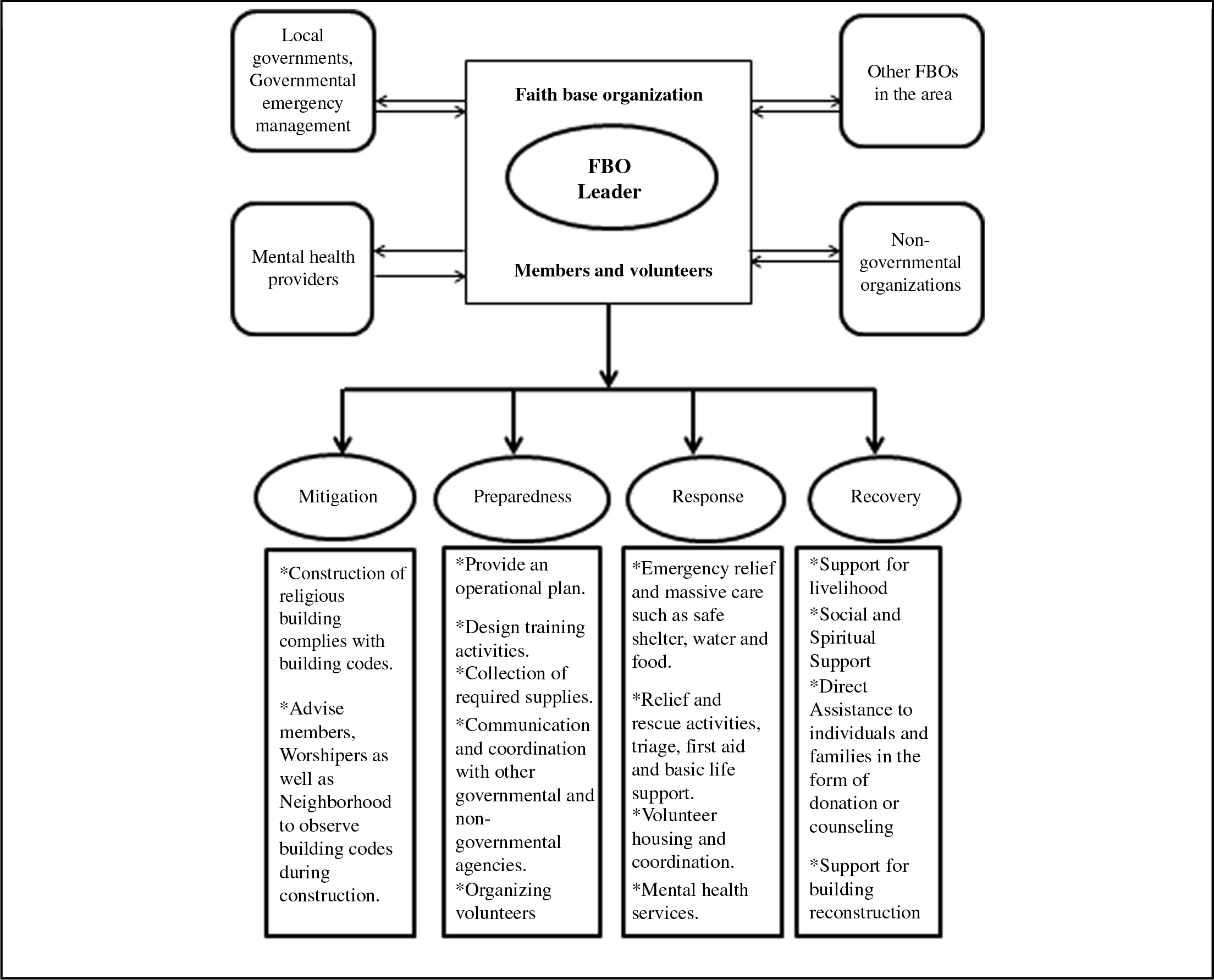
To cover great spiritual needs that will be prevalent undoubtedly, a predesigned team should be trained and equipped to help the victims in any possible way. (This issue is described in the section of FBOs leaders and psychological support.) Reference Rose1,Reference Alawiyah, Bell and Pyles19 The FBOs can play a vital role in disaster preparedness by sponsoring workshops or hands-on training. Also, they can send short disaster preparedness points monthly with emails, newsletters, or flyers to their members. They can also encourage the health ministry to dissiminate disaster preparedness information in addition to other health initiatives, such as diabetes, hypertension, breast cancer, HIV/AIDS, and other mental health and physical activities (Figure 2).Reference McClain20
Relations With Other Organizations and Actions at Different Stages of Disasters. Reference Rose1,Reference Cheema, Scheyvens and Glavovic2,Reference Muhleman15,Reference Abu-Ras, Gheith and Cournos18

Governmental agencies also can send specialists from universities to educate and train clergies and leaders of religious groups in different areas that are prone to disasters. This is a good approach, because many people go to mosques and churches to pray and listen to sermons. Reference Rose1,Reference McClain20
It should be note that, for training the members in small areas, the FBO’s leader can start with a preselected team training for a small event, such as a power outage that lasts several days. In this team should be a point person, someone who interacts with the people, someone who is the contact person, someone who communicates with other agencies, and a person who handles the logistics of the response. If this set-up occurs, the FBOs can respond quickly and effectively when disaster strikes. Reference Rose1,Reference Muhleman15,Reference Rivera and Nickels21
Response
Activities in the response phase include immediate disaster relief and mass care, such as providing food, water, safe shelter, and spiritual counseling. The FBOs have the resources, personnel, volunteers, and longevity to continue extended relief, rehabilitation, and development. Although, if they pass necessary training, they can contribute to lifesaving activities, such as search and rescue, triage, and basic life support. It is very important that the FBOs must recognize the most immediate needs of the community and, if possible, meet those needs according to their capacity. They should not plan for perfect responses while people are suffering or even is dying. Reference Joakim and White12
Recovery
The recovery phase is the longest stage, and religious organizations can have different effects at this phase. Reference Rose1,Reference Cheema5 Direct donations to individuals and families, assistance in referral services and house rebuilding, and counseling are services that religious organizations perform at this stage. Government agencies often do not have the staff or expertise required to provide these services, therefore, they contract with nongovernmental agencies (NGOs) and FBOs and delegate responsibility to them. Reference Stajura, Glik and Eisenman4 Also, NGOs and other agencies contributing to disaster management may travel to another country affected by another disaster; therefore, the greatest strength of religious institutions is follow-up, and they can go into the rebuilding stages of disaster relief. Reference Rose1,Reference Anders13
Social Capital
According to Putman, Reference Putman, Blair and Roberts22 “social capital refers to the social networks and norms of reciprocity and trustworthiness that develop alongside these networks or as a result of them.” The cultural values and norms that bring people together for cooperation, sympathy, trust, and understanding with one another are the concept of social capital. In the context of disasters, it is the potential of social capital that causes people to come together after a disaster and increase community resiliency against disasters. Reference Rivera and Nickels21 Also, social capital will develop within and among FBOs and their members, which can enhance alliances among members during times of disasters and let them access resources among each another to help in disaster resiliency. Reference Rivera23
Religious actions are a part of culture that enhance communication in the communities and can connect local communities together. Mass prayers in the mosques and churches can increase the sense of belonging to each other in communities and affect the behavior of communities and enhance coping with disasters. Reference Gianisa and Le De7,24
People would be better off when they have family or social structure around them. They know that they are included, and they are not forgotten. When they are in need, they have a place of stability and they know where they can go for help. In addition, they know where they can go to serve other people. In this network, they are not just victims, but they are also as a part of the solution. Therefore, the response is larger than a physical aspect, and increasing the social network in the community will be more effective in disaster response. Reference Rose1
Social capital contributes to improve the community’s resilience to disasters through various methods, such as facilitating the dissemination of information, promoting social organizations, and motivating the community to contribute to reconstruction efforts.
Therefore, most religious organizations need to link themselves with social capital to gain access to resources, mainly information, and funding opportunities that will help them provide social services. Reference Rivera and Nickels21,Reference Rivera23 Social capital with provide access to more resources of information, improving the quality, relevance, and timeliness of the information. This ability enables FBOs to disseminate information about vulnerability, response efforts, and evacuation in the often poor and marginalized regions, where government information is not accessible. Reference Rivera and Nickels21
Although the solidarity that has been formed through closed community networks may be somewhat detrimental and create a problem for new immigrant populations and prevent them from benefitting, and may even cause unethical behaviors in larger communities, but the effects of social capital in disaster management cannot be overestimated in any way. Reference Smith16,Reference Rivera and Nickels21,Reference Rivera23
FBOs Partnership With All Stakeholders
FBOs, local governments, and nongovernmental organizations have recommended dealing with disaster management among the whole community approach and coordination of all stakeholders. Reference Gianisa and Le De7 As a center for community support, the FBOs often act separately from local governments, but collaboration with government and private sector agencies is also very important in addition to collaborating with the community. Reference Brogt, Grimshaw and Baird9 Governmental emergency management agencies usually do not have a representative person among the communities to understand the needs and changing needs of the communities. Also, information from these organizations does not reach the communities in a timely manner. Reference Brogt, Grimshaw and Baird9,Reference Joakim and White12 The FBOs work at the community level with people, and they can provide valuable information for emergency agencies at the local level, as they themselves need to obtain information from government sources; therefore, one of the basic principles of religious organizations should be communication and collaboration with other stakeholders. Reference Hirono and Blake14,Reference Rivera23
It is important that FBOs realize they cannot work for disaster management alone. So, they need to recruit help and declare in their congregation for anyone who wants to serve in disasters relief. Then they should elect a point person who aid in collaboration with other agencies and disseminate information. Collaboration with NGO officials and local government agencies is essential. They should know about other local FBOs, their capacities, and their needs. Reference Rose1,Reference Cain and Barthelemy17
A basic relationship should be created between local government agencies and the FBOs that enable wider localized community oversight and network. It would be advantageous for local emergency offices to have a list of all leaders of FBOs in their region. It is also appropriate to have a printed list so that people can access them even when telecommunication is disconnected. Reference Brogt, Grimshaw and Baird9 FBOs partnership with the governments can include information sharing, facility use, receiving funds to service efforts, and connectivity through mutual partners. It is frequently suggested that FBOs and government agencies should create opportunities for greater communication. In this way, more cooperative meetings for communicating service needs would be useful. Reference Napoli25
Working with other agencies is beneficial and can reduce duplication of services and, therefore, reduce expenditures and allow religious organization to focus on the best service they can provide. Reference Pant, Kirsch and Subbarao8,Reference Hesse11 Also, partnership with mental health providers can develop positive perception in people and will increase coping capacity, restore safety, build social support, and increase hope in community. Reference Pant, Kirsch and Subbarao8
The FBOs can partner with members of their own congregation, community volunteers, denominational headquarters, and religious affiliates to meet emergency needs. Reference Pant, Kirsch and Subbarao8,Reference Napoli25
A network of religious organizations, nonprofit organizations, private sectors, and government agencies would be able to provide critical information and resources for people affected at different stages of the disasters. Reference Pant, Kirsch and Subbarao8,Reference McClain20 This collaboration also helps FBOs to work with government health agencies and evaluate health activities, to focus more on practical interventions and to pay more attention to different ethnical and racial groups. Reference Muller, Burke and Berg10,Reference McClain20 Lack of coordination with other participants in disasters management is one of the most important limitations of religious organizations. Reference Hesse11 Also, low level of trust and relationships with other government and nongovernmental organizations may prevent the development of strong networks of religious organizations to deal with disasters. Reference Muller, Burke and Berg10 Of course, effective collaboration often depends on prior relationships and established lines of communication. Reference Rose1,Reference Murphy and Pudlo26
FBOs Leaders and Psychological Support After Disasters
The leaders of religious organizations usually know customs, culture, and the needs of communities and also are trusted by their followers. Therefore, their participation in disaster management can increase community participation. Reference Gianisa and Le De7 And, because of providing emotional and psychological support for disaster recovery, they can provide a form of resiliency to the community. Reference Joakim and White12 Religious leaders as the initial contact can play a significant role in addressing and preventing mental health issues in communities, because they are a trusted listener and a voice of hope for their communities. This theme is discussed in 4 sub themes, as follows.
-
a) Leader Training
Religious group leaders often are asked issues other than spiritual and religious matters and can have significant impact on knowledge, attitude, belief, and behavior of their followers and their communities. Reference Muller, Burke and Berg10 But often, especially in Muslim societies, they have no scientific knowledge about disaster management. Some do not go to religious schools for training and become religious leaders only because of their family heritage. They are respected for their knowledge of religious issues among the community. Therefore, training FBO leaders is necessary to maintain and improve positive mental health and create hope in the community. Reference Abu-Ras, Gheith and Cournos18
Because religious institutions are among the first-responders following disasters, FBO leaders need to be trained about signs and symptoms of serious mental health problems, so they can work effectively and skillfully and refer survivors to appropriate professionals. Reference Hirono and Blake14,Reference Cain and Barthelemy17 Also, they need to be trained to take nonjudgmental and compassionate viewpoints in relation to the families of natural disaster victims. Reference Hirono and Blake14,Reference Abu-Ras, Gheith and Cournos18
In addition, mental health professionals should consider specific training programs for the religious leaders and other community’s leaders and explain the type of services available to their congregation members. They can also enhance the leader’s role as a mental health “gatekeeper” by conducting special training in mental health issues, greater familiarity with guidelines for psychological triage, and by providing printed content about referral procedures in the language of religious leaders, which facilitate the referral process.
There is an urgent need to educate religious leaders to be able to refer their followers for use of mental health services in the community, while followers are still using their leadership services. Reference Rose1,Reference Abu-Ras, Gheith and Cournos18,Reference Aten, Gonzalez and Boan27 Religious leaders can invite mental health professionals to their congregation to provide psycho-educational training and the signs and symptoms of mental illness and the process of referring patients to mental health centers before disasters occur. Reference Aten, Gonzalez and Boan27
-
b) Leader Characteristics
The knowledge level of religious leaders can have a significant impact on the vulnerability of their followers due to the power and control they exert. Reference Joakim and White12 The personality of a religious leader and his perception about his role in community, other than a worship leader (imam) has great influence on his participation in various stages of disaster management. It is the personality of a leader that largely defines the social role of the religious institution and its capacity to carry out nonworship activities, such as contributions in disaster risk management. Reference Cheema, Scheyvens and Glavovic2
-
c) Ways of Sympathy
The clergies use different ways to express their sympathy to people who lost their family members or their loved ones. But the common ways used to reduce grief and improve mental health include praying, not focusing on negative issues, listening to people’s when they talk, give hope, keeping alive the memory of their family member who was lost, and helping them in any possible way. For example; more American Christian clerics focus more on “comfort,” “relieve pain,” and hope, while Japanese clerics focus more on listening and praying when they talk with the person who lost their family members. Reference Rose1,Reference Cheema5,Reference Hirono and Blake14
-
d) Collaboration Between Mental Health Professionals and Religious Organizations Leaders
The collaboration and communication between mental health providers and religious institution leaders can improve the referral process and access to appropriate cultural-related mental health services. Reference Abu-Ras, Gheith and Cournos18
Previous studies have shown that, during the initial stages of disasters and the recovery phase, the focus of disaster victims is placed more on the physical reconstruction of houses and the improvement of resources, such as water, food, and shelter. Therefore, usually in the early stages, attention is not paid to mental health issues. Reference Aten, Gonzalez and Boan27 But in those early phases, survivors are exposed to the highest levels of negative mental health consequences and are prone to serious psychological problems. Therefore, to increase prompt access to post-disaster mental health services, mental health providers should have a close relationship with local sources, including religious group leaders. Reference Rose1,Reference Hirono and Blake14,Reference Muhleman15,Reference Aten, Gonzalez and Boan27
Bidirectional cooperation is essential. Therefore, mental health professionals should seek opportunities to work with FBOs to raise awareness among their congregation on disaster mental health issues so that their congregation members can better identify emotional problems and refer families or friends for help. Reference Aten, Gonzalez and Boan27 Also, it is necessary that mental health providers consider postdisaster collaboration so that they reach a consensus point with FBO leaders. Reference Aten, Gonzalez and Boan27
If there is an established reciprocal relationship between the leaders of the FBOs and mental health professionals, mental health professionals can provide clinical services and outreach services for FBOs, conduct trauma assessment in disasters and concise screenings to FBOs, offer consultation services to FBOs, and refer clients for spiritual support and resources to FBOs. Reference Napoli25,Reference Aten, Gonzalez and Boan27
Unity of Information and Message
The leaders of religious organizations have a sense of responsibility for creating positive mental health and motivation of the people in their community after disasters. They are one of the sources of strength in the community and are known as a reliable source. The information that is disseminated through them is more confident, and when they say something, the people accept it and follow easier; thus, they can be a significant source for disseminating knowledge about safety and security in future disasters and publishing knowledge about preparation for and coping with disasters. Reference Joakim and White12
Religious leaders are often more trusted than local authorities, and the messages that are received from them are better accepted and have a greater chance of success and sustainability. Reference Cheema, Scheyvens and Glavovic2,Reference Joakim and White12,Reference Abu-Ras, Gheith and Cournos18 Therefore, religious institutions can publish disaster preparedness information, but it is acknowledged that messages should be coordinated and united. Reference Cheema5,Reference Joakim and White12
Coordination between government agencies, nonprofit organizations, and religious institution will allow the community to receive the same messages from multiple sources. This will help with unity and confidence and will prevent unnecessary anxiety and fear in the community. Reference Cheema5,Reference Hesse11,Reference Joakim and White12
FBO Shelters
The FBOs can provide shelter in mosques, churches, and other buildings with religious affiliation and disseminate information received from the governmental agencies and distribute needed items. Reference Gianisa and Le De7,Reference Pant, Kirsch and Subbarao8
FBOs provide significant assistance to evacuees, such as food, clothing, emergency financial assistance, reconnecting families, and continued provision of services. Religious groups pay for services with congregation donations and through private sources. The most difficult aspect of evacuee care is finding adequate shelter and housing. Reference Pant, Kirsch and Subbarao8,Reference Cain and Barthelemy17
-
a) Strengths of FBO Shelters
The World Health Organization (WHO) view is that services provided by FBO networks are often useful, reliable, and inexpensive. Religious organizations are near to the affected area or even are part of the affected community. Reference Pant, Kirsch and Subbarao8 Their volunteers are often from the affected community. They are persons who are committed, compassionate, reliable, and responsible to help the evacuees. It may take 48 to 72 h for comprehensive government assistance to reach the affected areas. At this delay time, FBOs have the ability to provide emergency relief services needed by the community during the response phase of disasters. Because of the proximity to the disaster area, most religious organizations are able to recognize the needs of evacuees immediately and inform these needs to local and national responsible organizations and, through communication with other organizations, facilitate the fast, targeted, and sustainable transport of relief items to disaster area. Reference Pant, Kirsch and Subbarao8,Reference Rivera and Nickels21
In the shelter of FBOs, decisions are made very quickly and flexibly because they act with less bureaucracy. These shelters are usually managed by 1 leader or a small executive board, therefore, decision-making and adaptation to changing needs of the victims take place very quickly. Because volunteers are part of the religious organizations, managing and recruiting them is much easier. The FBOs facilitate access to medical treatment, or there is on-site medical care in shelters. They also help victims fill forms of relief agencies by providing telephone, Internet, or other communication channels. Reference Pant, Kirsch and Subbarao8,Reference Alawiyah, Bell and Pyles19,Reference Napoli25
Although religious organizations play an important role in sheltering and providing services to evacuees, for the sustainability of the provision of these services, it is necessary to incorporate and integrate formal and governmental networks. These networks must be act in such a way that they have the best efficiency and do not worsen their bureaucracy. Providing standardized guidelines for provide services and training members can improve utility of FBO shelters. Reference Gianisa and Le De7,Reference Pant, Kirsch and Subbarao8,24
-
b) Weaknesses of FBO Shelter
Religious organization shelters are not a section of formal response networks; therefore, their access to routine means of communication, supply lines, and affected areas will be limited. Often there is no predisaster plan, education, disaster training, evacuation plan, and drills for volunteers in shelter, and these lead to low quality of services or even lead to harmful practices. Another weakness in some FBOs shelters is lack of programs for children and elderly victims. Reference Pant, Kirsch and Subbarao8,Reference Joakim and White12,Reference Napoli25
Dealing With Disaster in Old and New Approaches
There are 2 approaches in dealing with disaster management: care-oriented management and mitigation-oriented management. Care-oriented management often involves providing disaster relief activity and victim care after a disaster in 2 phases: response and recovery. But the mitigation-oriented management involves reducing the disaster’s effects all over the cycle of a disaster, such as the phases of prevention, mitigation, preparedness, response, and recovery. The new approach is, from now on, for FBOs to support mitigation-oriented management and to supplement care-oriented management with the mitigation-oriented management. Reference Rose1,Reference Gianisa and Le De7
Barriers and Challenges
A community’s contribution to disaster management is faced with many problems because of the lack of a safety culture, sustainable coordination, and other factors. Reference Pant, Kirsch and Subbarao8 There is no doubt that the FBOs have great potential for effective disaster management, but the problem within the religious organizations today is that, when a disaster occurs, there is no organization, preparation, and cooperation to face it. Reference Rose1,Reference Muhleman15,Reference Murphy and Pudlo26 The main problem is that the local FBOs tend to have no plan. In the majority of cases, they are not ready, they have not trained their members or their congregations, and there is no an action plan and communication with other agencies. As well as they have most likely not thought that what types of help they can and cannot suggest, and not thought through the diversity between preparedness, relief, rehabilitation, reconstruction, and development. This disorganization can show itself as great turmoil in relief efforts and add trauma to the volunteers, to other relief workers, and to rescuers. The reason for this is often due to the fact that enthusiastic groups that self-deploy inexperienced individuals into disaster areas are without forethought and planning and sufficient backup resources and they rapidly join the original victims of the disasters and disrupt the recovery system. Reference Rose1,Reference Gianisa and Le De7,Reference Hesse11
Lack of planning, coordination, and resources are the most important limitations of FBOs partnership with each other; also, a low level of confidence and communication with communities other than themselves may prevent the development of strong disaster networks for these groups. FBOs are not formally recognized as an existing system with special resources that can be used before, during, and after disasters. Reference Hesse11
The major obstacles identified in various studies for disaster preparedness include cultural and economic barriers, low prevalence of disasters, hesitancy about how people should respond to an incident, complacency, lack of understanding about the severity of an incident, and being reactive instead of proactive. In another survey, lack of communication between governmental and nongovernmental agencies, managing supplies, and time commitment were identified as major preparedness barriers. Reference McClain20
Because disasters are a rare occurrences, possibly leading to them not even being considered, preparing for them is not enough of a priority in religious institutions. Reference Pant, Kirsch and Subbarao8,Reference McClain20 According to some studies, the members of religious institutions are not prepared for disasters, and few religious organizations participate in educational and training programs designed by governmental emergency agencies, and they do not have official programs for disasters. Reference Muller, Burke and Berg10 Low risk perception, lack of knowledge, lack of financial resources, lack of space to store resources, lack of agreement with other organizations such as the Red Cross and local disaster organizations, and small congregation size are other barriers to religious institutions preparedness for disaster management. Reference Pant, Kirsch and Subbarao8,Reference Muller, Burke and Berg10,Reference Joakim and White12
Despite the difficulties of people to meet daily needs after disasters, religious organizations may exert pressure on their followers to fulfill their obligations and perceive disaster-related activities as a chance to perform their own plan; therefore, the involvement of religious groups in disaster management and disaster risk reduction should be done cautiously to avoid giving excessive authority to religious institutions. These aspects should be taken into account when religious groups intervene in disaster management. Reference Gianisa and Le De7 Thus, the contribution of FBOs leadership and institutional networks may be somewhat heterogeneous. Believing in fate or fatalism among religious groups may increase vulnerability in some cases when they contribute in disaster management, while in other cases, religious support contributes to vulnerability reduction. Reference Joakim and White12
Many clergies or religious institution leaders believe that a disaster response is their moment to step forward, and they have to prove their worth and they should try to be all and everything; this is wrong. Instead, they should recognize that they are not alone and that they are a member of a supportive network of organizations that are there to help. They should realize that they are not a disaster man or disaster response expert and the only thing they have to do is facilitate a meeting with subject matter experts. Reference Rose1,Reference Muhleman15
Because community-based groups usually do not study enough about the facts, they sometimes have a noninformed opinion, they are usually irresponsible and make suggestions that have great public request but that are often not possible to implement, and are often against the view of governments. Reference Rose1,Reference Smith16
Limitation of the Study
Although this study was intended to provide foundational knowledge without language restriction and while in the searches that were done, there was only 1 article in the Chinese language, the authors could not find that author’s e-mail; therefore, compulsory language restriction applied.
CONCLUSIONS
Today, NGOs and informal organizations play a vital role in disaster management, and compared with governmental agencies, communities usually have more trust in them. Reference Cheema, Scheyvens and Glavovic2,Reference Pant, Kirsch and Subbarao8,Reference Muller, Burke and Berg10 FBOs are 1 of these organizations that have access to critical resources for disaster management and, therefore, have an increasing and significant role in this area. Reference Joakim and White12
FBOs are more involved in the response and recovery phases of the disaster cycle, whereas international organizations, such as FEMA, emphasize those CBOs involved in disaster management should contribute in all phases of the disaster cycle, including mitigation and preparedness. Reference Rose1 Although participation in the response and recovery phases is very valuable, the great potential and resources that religious institutions possess can be effective in the entire disaster management cycle. Two approaches, used simultaneously, are proposed to deal with disasters: a care-oriented approach and a mitigation-oriented approach. Reference Gianisa and Le De7
To further influence, there is a need for bilateral and multilateral communication and cooperation between all stakeholders that are involved in disaster management. FEMA’s whole-community approach reflects the value of collaboration of all institutions involved in disaster management and, in particular, emphasizes the strengthening of local NGOs, such as FBOs. Reference Joakim and White12
Government agencies are strongly encouraged to communicate and collaborate with CBOs, such as religious organizations proactively to increase the communities’ capacity and resiliency against disasters, because it would be hard to create such cooperation in times of disasters. Also, proactive collaboration with religious organizations to manage community health in disasters is one of the priorities of the WHO. Reference Joakim and White12,Reference Anders13
This systematic review shows that FBOs can play an important role in providing the material, emotional, and spiritual needs of their communities when disasters occur. Access to essential resources, such as volunteers and popular donations, high flexibility, lower bureaucracy, and community trust are the most important characteristics of religious organizations, which makes it possible to have a high potential for effective disaster management. Reference Joakim and White12,Reference Anders13
Take actions, such as preparing a standard program and a proper guideline on how to provide services to victims, can help improve the quality of their work. Also, if any religious organization is allowed to operate in a specific service, such as providing food, shelter, mental and emotional support, or childcare, it will prevent duplication of services and costs will be reduced. Reference Cheema5,Reference Pant, Kirsch and Subbarao8,Reference Hesse11
Some believe that policy-makers should look for ways to integrate these religious organizations into formal networks of disaster management and make more use of their potential. About this issue, there are a few points to consider: Will the integration of these organizations into official networks weaken their bureaucracy? How is the efficacy of these organizations maintained when integrated into formal organizations? Another important point is that the help of religious organizations in disaster management must be carried out in a manner that does not discriminate between victims with different cultures and religions. Reference Pant, Kirsch and Subbarao8,Reference Alawiyah, Bell and Pyles19
Acknowledgments
This study is a part of Ph.D. dissertation that supported, funded, and sponsored by Iran University of Medical Sciences (Grant number: IUMS/SHMIS-97-01-136-33034). The authors thank all reviewers who helped improve the manuscript.
Conflict of interest
The authors declare that they have no conflict of interest.
Supplementary material
To view supplementary material for this article, please visit https://doi.org/10.1017/dmp.2019.145