I Cultural Politics
Between February and April of 1899, Camille Saint-Saëns, at the age of 64, composed his first of two string quartets. Following the public premiere on 21 December of that year, the respected critic Pierre Lalo devoted most of his column in Le Temps to an extensive and wide-ranging review.Footnote 1 This document, probably the richest in the quartet's early reception history, intimates an important cultural-political context and some key aesthetic issues emerging from it, threads this essay will weave together to highlight this little-known work's importance to Saint-Saëns's evolving aesthetic outlook and its relevance to the historiography of turn-of-the-century French music. The critic began by speculating about why audiences had waited so long for a work in the most prestigious chamber genre from this musician, an obvious question given Saint-Saëns's international fame and his prior contributions to France's thriving chamber-music culture (two piano trios, a cello sonata, a piano quartet, two violin sonatas and a piano quintet among them), and one which had also occurred to Otto Neitzel, who concluded his important 1899 life-and-works volume with the hope Saint-Saëns would soon produce ‘ein schönes Streichquartett’.Footnote 2 Availing himself of anecdote, Lalo related an exchange which had supposedly taken place ‘some years earlier’, wherein Saint-Saëns had replied to an unnamed interlocutor: ‘you can only write a quartet when you're twenty, when you've got the rashness and ignorance of youth, or when you are sixty, when you possess consummate experience and your art no longer lacks anything. I'm not there yet’.Footnote 3 As context, the critic characterized the string quartet as a composer's stiffest test, a common view in fin-de-siècle France, and he acknowledged the anxieties attendant upon the genre in a musical culture in which Beethoven loomed as the marquee name of a canon-centric chamber repertory. He could also have noted the natural predilection of the nation's leading keyboard virtuoso – and a musician to whom fame came earlier as a performer than as a composer – for chamber music with piano.Footnote 4
Whatever the episode's original circumstances, Lalo probably quoted the exchange, attributing to the composer a defensive tenor, to suggest subtly that recent successes in the genre by followers of Franck – himself the author of a much-admired quartet (1890) – especially Vincent d'Indy (1890 and 1897) and Guy Ropartz (1893), could have unsettled Saint-Saëns, the senior of the former by 16 years and the latter by 29. Saint-Saëns had probably also learned that Ernest Chausson, one of Franck's most successful students, had begun a quartet in 1897 and had nearly completed it by his untimely death in 1899. The composer privately expressed anxiety to his publisher Auguste Durand in an irony-drenched letter:
Had I not written this quartet, the aestheticians [d'Indy and his allies] would have drawn a heap of conclusions. They would have discovered in my nature why I didn't write one and why I was incapable of doing so. Have no doubt, I know them!Footnote 5
If Saint-Saëns sensed that the so-called franckistes were beginning to colonize the string quartet, he had reason: in the early years of the new century, a run of quartets ensued, by Ropartz, Georges Martin Witkowsky, Gustave Samazeuilh and Albéric Magnard (sometimes considered part of Franck's circle). Although present-day historiography tends to lionize the quartets of Debussy and Ravel, as Jean Gallois reminds us, the franckistes effectively dominated the genre on the ground as it existed between 1890 and 1914.Footnote 6
Saint-Saëns's evolving relationship with Franck and his legacy is familiar, but aspects of it bear brief recapitulation here.Footnote 7 A degree of camaraderie had prevailed through the 1870s, by which time Saint-Saëns had established a reputation as one of France's leading composers. His relationship with the circle, however, deteriorated precipitously in the 1880s on account of intertwined aesthetic disputes and personal grievances, which unfolded in the ensuing years against the backdrop of a fundamental shift in the composer's position in the nation's musical culture, from one of progressive leadership to the role of rigid traditionalist. Serious cracks developed over the importance d'Indy, Chausson, Ropartz, Duparc and other franckistes attached to Wagner, whose influence in France they helped bring to its apogee during the decade after 1883. Though he admired much in Wagner's music and enthusiastically embraced a measure of its influence, in a series of polemics appearing in the 1880s Saint-Saëns reductively decried wagnérisme as a monolithic cult which in his estimation dogmatically sought to foreclose on all but the most doctrinaire stylistic orientations. This development, he feared, would not only marginalize his own music but also predispose the nation's musical culture to Germanic grandiloquence, prolixity and lourdeur, while sapping it of the aristocratic qualities of refinement and sensibility that he considered the core of its traditions.Footnote 8 Folding civic virtue into aesthetics, he even worried that an excess of wagnérisme could cost listeners a diminished sense of their Frenchness.Footnote 9 These missives did not mention names, but they appeared as d'Indy and some of his allies seized administrative control of the Société nationale de musique and narrowed the aesthetic outlook of this composers’ league and concertizing organization, which Saint-Saëns had cofounded in 1871 and which had become a vitally important platform for French chamber and orchestral music. Finding himself in an untenable position, Saint-Saëns resigned in 1886, ostensibly over an amendment to the society's statutes permitting the inclusion of foreign music on its hitherto French-only programmes; he remained bitter for years.Footnote 10
Saint-Saëns moreover came to recognize that Franck and the coterie that formed around him were collectively usurping his position at the vanguard of French music. Important premieres in the 1880s ensconced d'Indy in the front rank; continued success as a composer along with his activities as a pedagogue, administrator and performer would by the century's end arguably make him the nation's most influential musician. Proudly waving their mentor's banner, some of Franck's other students, Chausson, Duparc and Ropartz among them, developed significant public profiles, and it bears emphasis that Franck himself composed the majority of his most influential works in the decade before his death in 1890. Saint-Saëns held a measure of respect for his erstwhile colleague's music but hardly considered it worthy of the public stature and the following among composers it quickly accrued. To cite one important development, in 1897 d'Indy inaugurated the historically informed composition programme at the Schola cantorum, the influential Parisian music academy he had helped found three years earlier; the curriculum positioned Franck as the only French member of a trinity of key models rounded out by Beethoven and Wagner. Still fractious in 1919, when reviewing the publication of these lectures as the Cours de composition musicale, Saint-Saëns jealously ridiculed the ‘inordinate height of the pedestal’ upon which d'Indy had placed his mentor and dismissed Franck as ‘more of a musician than an artist’.Footnote 11
Although he maintained civilized professional relationships with his franckiste colleagues, and although he would later recognize common ground with d'Indy in the face of the emerging avant-garde, Saint-Saëns remained locked in a mentality of besiegement and rivalry in the years leading up to his First Quartet's composition. Such was his hostility in 1898 that that he petulantly refused to join a committee, led by d'Indy, overseeing a monument to Franck; he rebuffed public calls for reconciliation in a blunt letter to Le Monde musical declaring that the intended dedicatee ‘did not exert a happy influence on the French school’, adding ‘a statue of Rameau, Méhul or Hérold would seem much more appropriate than the one in question’.Footnote 12
II ‘Un petit quatuor’
Whatever hope Saint-Saëns pinned on the new quartet to bolster his reputation, and the aesthetic values he championed, would remain largely unrewarded. He took satisfaction from enthusiastic audience responses to the first performances, but early press verdicts surely pleased him less.Footnote 13 The work commanded respect, but little deep admiration. Hugues Imbert, the editor of Le Guide musicale and an accomplished violinist, judged it a worthy pendant to the composer's chamber oeuvre on account of its craft and the rarefied charm he discerned, especially in the adagio movement's seraphic main theme and its conclusion in pianissimo harmonics.Footnote 14 The critic did not, however, place the quartet among the canonical masterworks of the genre. In the review cited earlier, Lalo similarly discerned clarity and solidity of form, sober elegance and scintillating grace, but candidly declared that he did not sense a work of ‘major significance’ destined for a place in the composer's output comparable to Samson et Dalila and the ‘Organ’ Symphony.
This prognosis proved correct. As one would expect given Saint-Saëns's stature, the quartet attracted attention from performers. During the three years after Jacques Thibaud, Stanley Mosès, Henri Casadesus and Francis Thibaud gave the public premiere in December 1899, at least seven performances followed in Paris by leading ensembles, including the Quatuor Marteau and the Quatuor Parent, and at important venues, among them Edouard Colonne's high-profile Nouveau-théâtre concerts, the chamber-music society La Trompette and the Société nationale.Footnote 15 The quartet led by the brilliant violin virtuoso Eugène Ysaÿe brought the work to Brussels (April 1900) and London's St James's Hall (January 1901), and the Marteau ensemble introduced it to audiences in Rotterdam (December 1901) and Geneva (January 1905); according to dispatches in Le Guide musicale, performances took place in St Petersburg (November 1901) and at the Argentine Conservatory in Buenos Aires.Footnote 16 Sabina Teller Ratner has catalogued half a dozen additional performances in Paris and Cairo between 1905 and the outbreak of the First World War.Footnote 17 Nonetheless, the work never established a position in the repertoire comparable to Franck's Quartet, a major item that appeared on dozens of programmes during the same period, or those of d'Indy, which quickly became recital-hall staples and remained so throughout the composer's lifetime. Subsequent criticism has largely mirrored concert culture's tepid reception. Like Imbert, Emile Baumann, a reliable early twentieth-century champion of Saint-Saëns, perceived some supreme delicacy of expression, above all in the pianissimo reprise of the scherzo, which ‘touches the limits of the intangible. It is impossible to take further … the crepuscular charm of shadowy visions [visions ténues] slipping away and vanishing’.Footnote 18 Nonetheless, in the prevailing view, the composer's typical mastery of form and impeccably polished style succumb to a dryness owing to an excess of artifice and a lack of the compelling emotional depth found in his most famous works.Footnote 19
In his early review, Lalo speculated that canonical status would elude the quartet for other reasons. Perhaps flinching at the spectre of tradition, the composer had shied away from the grandiosity and seriousness of purpose the critic considered vital to the genre's nineteenth-century masterworks. Saint-Saëns had instead produced ‘un petit quatuor’ (emphasis in original), resembling in scale and ambition Mozart rather than Beethoven, and in these areas falling short of the recent French quartets of Franck, d'Indy and Edourad Lalo (the critic's father). ‘I hope that someday’, concluded Lalo, ‘M. Saint-Saëns, more ambitious and reassured, … will compose a quartet in which he dares to employ the full resources of his art in all their richness’.
Lalo was writing impressionistically. In its simple duration, typically between 30 and 34 minutes, the work sits on a par with Beethoven's ‘Rasumovsky’ Quartets; while significantly shorter than Beethoven's op. 131 and slightly less so than op. 127, it is longer than Opp. 135 and 95 (‘Serioso’). It certainly exceeds all of Mozart's quartets, and in Haydn's oeuvre it is approached only by the ‘Emperor’ and ‘Razor’ Quartets (if repeats are observed). Measured against its French antecedents, it is indeed cut more slightly than Franck's quartet and both of d'Indy's, but it significantly outlasts Edouard Lalo's 25-minute quartet.
Perceptions of scope, weight and ambition, of course, do not rest solely on duration. Taken qualitatively, Lalo's observation alights upon one of the work's touchstone characteristics and rubs up against the tenebrous evanescence Baumann signalled as its most attractive attribute. Saint-Saëns would rankle at the pejorative countenance of ‘un petit quatuor’ – and still more at unfavourable comparison to his rivals – but the characterization would otherwise have pleased him, not least for how, in highlighting these qualities, it pithily captures key and fundamental differences between his quartet and those of Franck and d'Indy while emphasizing musical values Saint-Saëns feared were broadly succumbing to the Wagnerian tide. As we shall see in the following pages, Saint-Saëns's quartet offers a pointed critique of what d'Indy called the ‘monumental character’ he considered essential to the didactic purposes he ascribed to art. It does so by misreading, in Harold Bloom's well-known sense of that term, the cyclic formal strategies d'Indy advocated to this end, strategies that stood – and still stand – as compositional signatures of Franck and his circle, and which ostentatiously factored in the two pillars of the franckiste quartet repertoire as it existed in 1899: d'Indy's Second and the quartet of Franck himself.Footnote 20 That is, Saint-Saëns confronts the cyclic procedures these works exemplify, engaging them but purposefully conscripting them to altogether divergent ends which accord with his own aesthetic agenda. The following section of this article shows that Saint-Saëns employs tiny motivic particles where Franck and d'Indy employ robust cyclic themes and motives. Drawing on theory from the fields of psychology and memory studies, I argue that liminal relationships among these materials may engender in listeners a bewildering mixture of recognition and elusiveness resembling déjà vu. Subsequent sections contextualize this effect with close readings of Saint-Saëns's writings, and argue that it instantiates what the composer sometimes called ‘charm’: a beguiling sense of enchantment, unmediated by reason and experienced in the unfolding time of hearing the music, an attribute which (in the composer's estimation) remained untethered to the political and moral spheres d'Indy sought to serve with music. Observing the quartet's critique of franckiste cyclic procedures, and the broader values informing them, adds nuance to our grasp of how Saint-Saëns's music evolved over the course of his long career. Doing so, moreover, serves to underscore how deeply seated differences with d'Indy persisted during a time when the two composers appeared to come together in the face of the successive avant-gardes that emerged in the early years of the twentieth century.
III Cyclic Form
Among the compositional ‘resources’ he judged attenuated in the quartet, Lalo might well have counted cyclic form: the practice of reintroducing or developing themes or motives from earlier movements in later ones and thereby establishing large-scale, inter-movement formal relationships. Many of the procedures this broad category encompasses do much to foster perceptions of the monumental quality the critic found lacking.Footnote 21 Saint-Saëns, moreover, had from the beginning of his career frequently and fruitfully employed cyclic form; early examples include the A-minor Piano Quintet (1855), the first two violin concertos (1858 and 1859) and the Second Symphony (1859). He followed these up with a long string of other cyclic works in the next three decades, including the Second, Third and Fourth Piano Concertos (1868, 1869 and 1875), the First Violin Sonata (1885) and, most famously, the Third (‘Organ’) Symphony (1886), all among his most respected and frequently performed compositions, and the last his magnum opus in the eyes of many contemporaries.
These cyclic works typically telescope, to varying degrees, the formal functions of a single-movement sonata design across their three- or four-movement spans. At its most straightforward, this involves a cyclic thematic return in the finale to complete formal business left unfinished in the opening movement's sonata form. In the D-Minor Violin Sonata, for example, the first movement's subordinate theme returns off tonic in the recapitulation, which segues seamlessly into the adagio second movement without securing the home key, leaving the theme unresolved and the form fragmentary. This theme returns as a grand, tonic-key apotheosis in the finale, belatedly realizing its home-key recapitulation and tying up the loose formal thread.Footnote 22 Many of Saint-Saëns's other cyclic forms are more complex. In the Third (‘Organ’) Symphony in C Minor, the allegro, adagio and scherzo function simultaneously as independent movements and as the exposition and development sections of a higher-order sonata form, with transformations of the principal theme appearing in each (a strategy the composer derived from the oeuvre of Franz Liszt, notably the B-Minor Sonata and some of the symphonic poems). In the finale, the cyclic theme returns as a grand C-major chorale to act as a recapitulation to the overarching form. In each case, the cyclic return of a theme serves to further or complete a teleological formal process that spans the entire work.Footnote 23
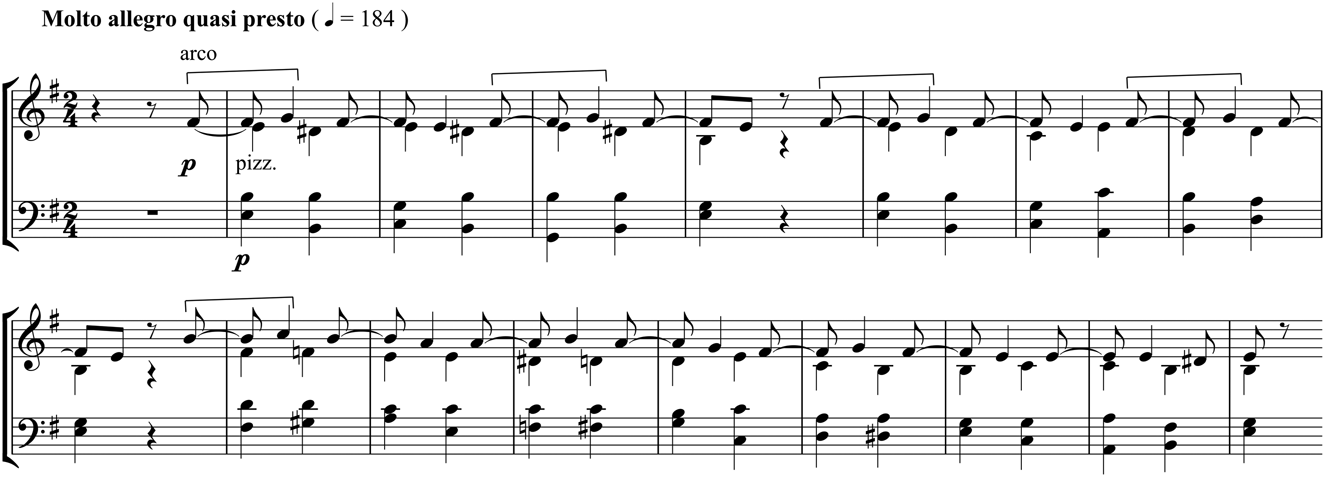
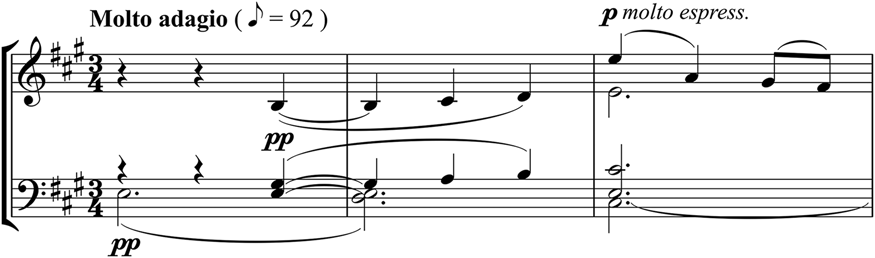
Things are otherwise in the E-Minor Quartet. The only instance of thematic recall resembling what one encounters in the symphony or the violin sonata involves the citation near the finale's conclusion of two brief fragments from the first movement's slow introduction (see Exx. 2a and 2b, below). Upon their return, these quickly vanish; neither had served a properly thematic role in the first movement, and it seems difficult to attribute their recurrence in the finale to the formal rationale motivating cyclic return in the composer's earlier works. In light of the composer's habitual practice, one can readily imagine how perceptive listeners could have been left with the impression that Saint-Saëns had withheld the ‘full resources of his art’.
What contemporary observers could not have known was that after the turn of the century Saint-Saëns would forever abandon the cyclic strategies that had underpinned some of his most successful music. The factional politics outlined above weighed heavily here: much of Franck's fame owed to patently cyclic works, including the Piano Quintet (1879), Prélude, choral, et fugue (1884); the Violin Sonata (1886); Prélude, aria, et final (1887); the Symphony (1888); and the String Quartet. With his highly successful Symphonie sur un chant montagnard français of 1886, d'Indy initiated a long series of ostentatiously cyclic compositions, which by the century's end would notably include a piano trio and the two quartets. Some of Franck's other students also habitually employed cyclic procedures in the century's final years, including Chausson (a symphony, a piano quartet and the Concert), Ropartz (two symphonies, a quartet and others) and the talented but short-lived Guillaume Lekeu (a piano trio and a violin sonata).
D'Indy and some of his acolytes moreover actively encouraged perceptions of cyclic form as a compositional signature of Franck's school. D'Indy's composition lectures taught that Franck had inherited cyclic form directly from the venerable Beethoven, developed it further, and bequeathed it to the next generation as a historically determined canon, one which bestowed legitimacy on those who followed Franck's example. This narrative received additional dissemination in the musical press and in public lectures, and whatever contemporaries might have thought of its obvious and serious flaws – especially d'Indy's specious, ad hoc dismissals of cyclic works by Berlioz, Schumann, Mendelssohn and Liszt – enough proved sufficiently receptive for its basic point to stick.Footnote 24 So strong became the association of cyclic form with franckisme that it appears to have even made an impact on one of the period's most creative and independent musicians. As Marianne Wheeldon has observed, the youthful Debussy emulated the cyclic design of Franck's String Quartet in his own Quartet, possibly with an eye to securing a performance at the Société nationale. But in later works, weary of ‘a musical heritage that began with Beethoven and culminated with d'Indy and his students at the Schola cantorum’, Debussy engaged cyclic procedures with altogether more reserve.Footnote 25
IV Misreading Franck and d'Indy
Given his cultural-political positions, Saint-Saëns would have little choice but similarly to reassess the place of cyclic form in his compositional toolkit; but when he wrote his First Quartet at the brink of the century, this dust was still settling. Let us now turn to the work and to how it misreads two key franckiste cyclic practices, the first involving genetic relationships between a work's successive themes, and the second involving how these recur strategically in a finale to produce an apotheosis.
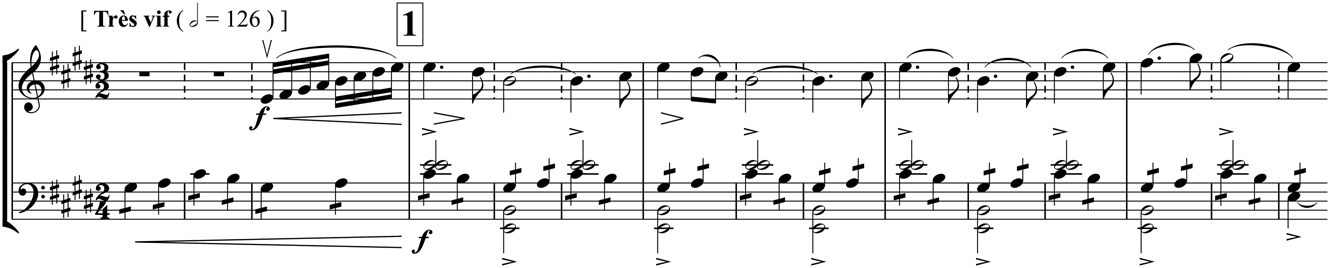
Contrary to Saint-Saëns's habitual procedure of employing thematic return to craft closed, teleological forms, d'Indy conceived cyclic form as being akin to variation procedure and the iterative, open-ended forms it yields. The heart of the technique, as he theorized and practised it, lay in the derivation, by way of rhythmic, melodic and/or harmonic variation, of most or all of a work's themes from one or two first-movement sources.Footnote 26 He upheld as the ‘first and purest model’ of this procedure in the post-Beethoven era Franck's Violin Sonata, ‘a true musical monument’, in which the three-note cell initiating the violin's first melody, ‘the germ of the entire work’ (‘la … generatrice de toute l'oeuvre’), suffuses themes in all four movements.Footnote 27 In d'Indy's own Symphonie sur un chant montagnard français (1886), one of his first public successes, variations of a folksong stated in the introduction furnish the main themes of each movement.Footnote 28 In his Second Quartet in E Major, virtually all materials descend from a four-note motto, shown as an incipit at the head of the score (a feature the composer likened to ‘certain canons’ by J.S. Bach but which was surely meant to evoke Beethoven's Quartet in F, op. 135).Footnote 29 The incipit suggests abundant potential: the two ‘C’ clefs indicate that the basic shape may assume various scale degrees, and the cryptic, upside-down bass clef insinuates its inverted and retrograde forms. As Example 1 shows, the motto, or some obvious development of it, initiates the main themes of all four movements (as well as other themes not shown in the example). It tends to infuse themes’ interiors (see Exx. 1c and 1e), and it sometimes factors in the bass (Ex. 1d) or the inner voices (Ex. 1e); occasionally (as in Ex. 1c) it returns at cadences.
D'Indy, Second String Quartet (1898), Incipit

I, Main Theme, Rehearsal 2 + 12ff

II, Main Theme, bars 1–5

III, Main Theme, bars 1–7

IV, Main Theme, Rehearsal 1−3 to 1 + 11

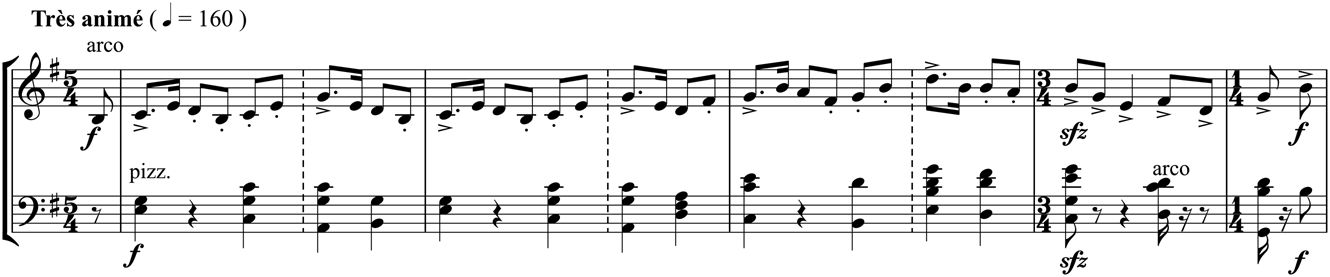
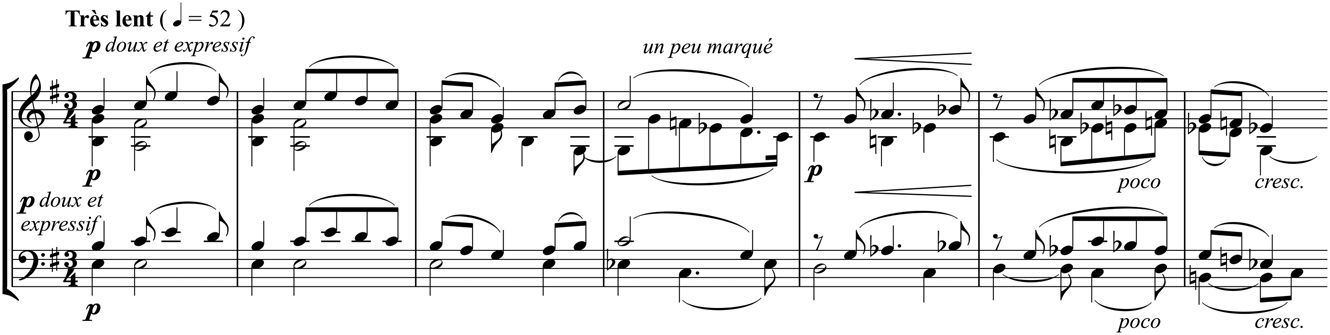
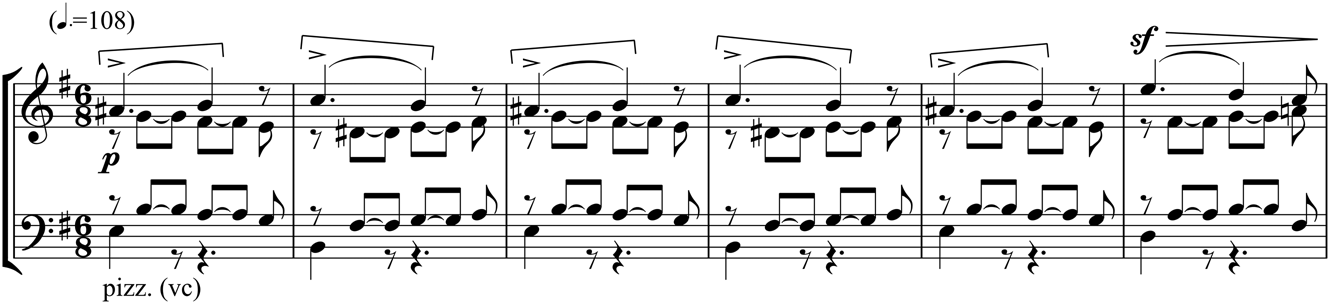
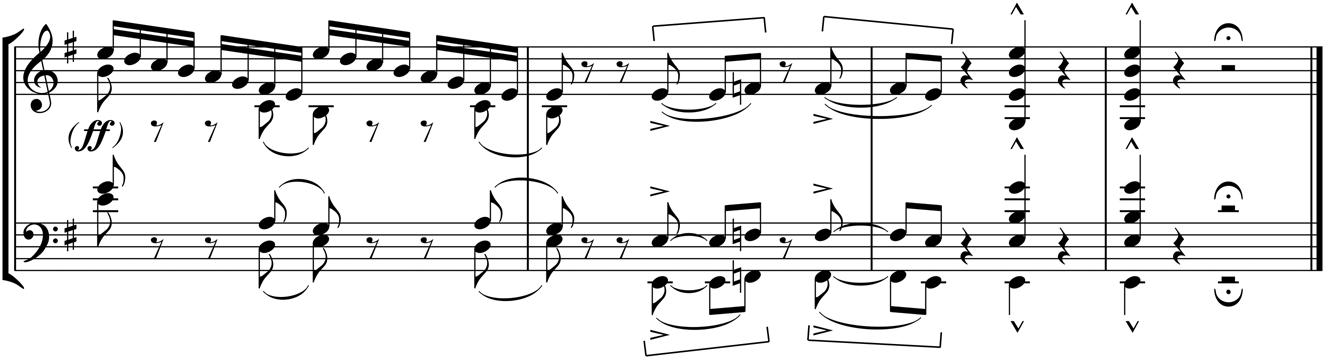
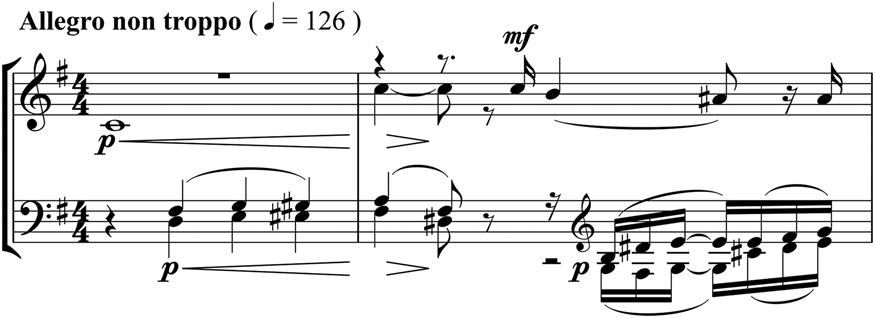
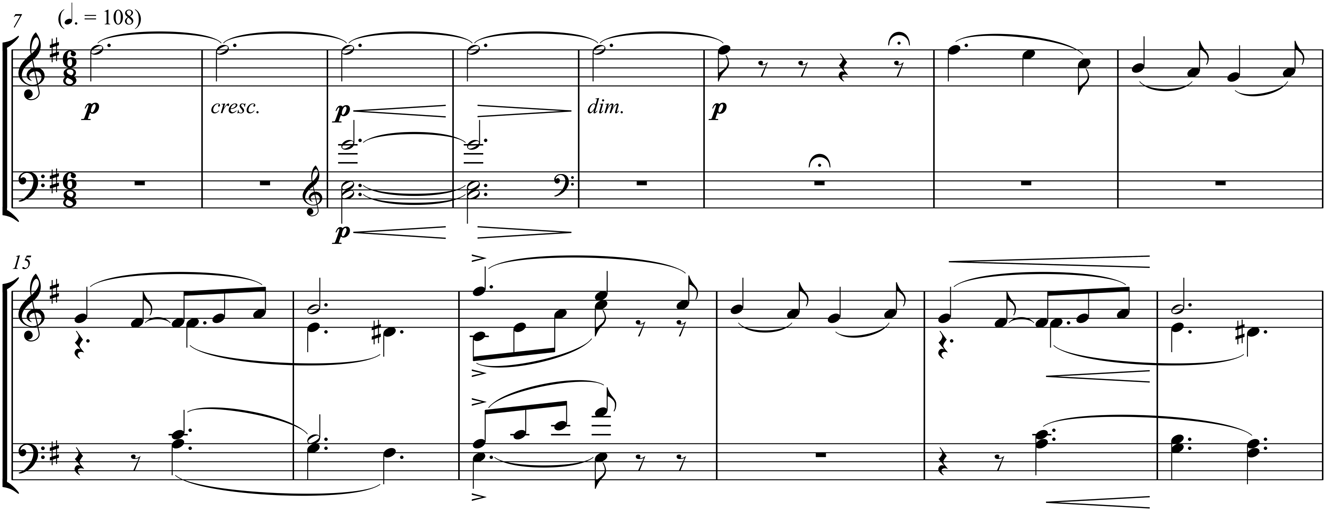
In his own E-Minor Quartet, Saint-Saëns shadows this procedure by adopting as an analogue to d'Indy's distinctive motto the smallest imaginable pitch configuration: a melodic semitone. As Example 2 shows, Saint-Saëns employs this ‘motive’ (indicated by brackets) in all of the same ways. We first encounter it in two important fragments in the slow introduction (Exx. 2a and 2b). These both return in the development (rehearsal 10 + 6ff), in the recapitulation (reh. 13 + 18) and (as noted above) in the finale (reh. 48). The first movement's main theme (Ex. 2c) is initiated by a thrice-iterated half step, with many others sounding in the inner voices and in the bass; this interval also articulates the half cadence in the theme's fourth bar. Semitones saturate a fugue theme in the first-movement development section (Ex. 2d), the first one underscored by the augmented second that follows. Half steps also initiate and suffuse the main themes of the second-movement scherzo (Ex. 2f) and the finale (Ex. 2g).
Saint-Saëns, First String Quartet, I, Slow Introduction, Rehearsal 1 to 1 + 5

I, Slow Introduction, Reh. 2−4 to 2−1

I, Main Theme, Reh. 3 to 3 + 7

I, Fugue Theme in Development, Reh. 9 + 5 to 9 + 8

I, Final 4 bars

II, Main Theme, bars 1–17

IV, Main Theme, bars 1–6

Such miniscule relationships pose an obvious conundrum for analysts and critics. Naively or opportunistically, d'Indy viewed the quartet as a failed attempt at the type of cyclic design he advocated. His analysis identifies the melodic half step in Example 2a as ‘the cyclic bond for the entire work’, but disparages this cell, ‘certainly less characteristic and less recognizable than that of Franck's quartet’, for making ‘an insufficiently distinct and lasting impression on the listener’.Footnote 30 Georges Servières, perhaps taking his cue from d'Indy, drew similar conclusions.Footnote 31 Most commentators, however, make no mention of motivic connections between themes, presumably because they do not perceive any or do not know what to make of them if they do. After all, it seems hard to argue with d'Indy: in a large-scale work, written in a late nineteenth-century chromatic idiom, the half-step, even deployed copiously and in conspicuous and consistent formal positions (such as the beginnings of themes) hardly seems substantial or differentiated enough to suggest even the latent, ‘submotivic’ formations Carl Dahlhaus finds in certain of Beethoven's middle- and late-period works, let alone to establish the kinds of clear genetic bonds d'Indy obtains with his pellucid four-note cell, or for that matter the kinds of inter-thematic relationships one finds in countless nineteenth-century works by Liszt, Schumann, Mendelssohn and Berlioz, to say nothing of Saint-Saëns's own oeuvre.Footnote 32
Put differently, the ‘motive’ seems problematic because it does not contain enough of the necessary kinds of information for it to register as such in a listener's memory. Benedict Taylor and Michael Puri have recently drawn cyclic form into fruitful dialogue with memory studies.Footnote 33 Both writers employ a hermeneutic approach, which effectively treats a musical work as a remembering subject, its formal processes mimicking the modes in which writers – Proust, T.S. Eliot, Bergson, Lévi-Strauss and others – have aestheticized or theorized memory. Taylor and Puri thereby insightfully align music by Mendelssohn and Ravel with romantic and decadent strains of subjectivity. Such methods seem promisingly applicable to a broader range of repertoire, but in the present instance it might prove more productive to proceed from the phenomenal experience of hearing Saint-Saëns's semitones – from how listeners may perceive relationships between them in the immediacy of a performance – than from an intertextual-hermeneutic posture. For if this interval does not make for familiar kinds of motivic links between the quartet's themes, it nonetheless does make an effect, as d'Indy's analysis acknowledges.
Let us consider what happens when we encounter the first-movement main theme (Ex. 2c). Backing up from this point, the semitone receives considerable emphasis in the slow introduction by way of the fragments shown in Examples 2a and 2b. These appear back to back, and both passages repeat, making for 22 bars of semitone-saturated music. Before the tempo change, however, we hear some 30 bars, lasting around 40 seconds at a typical tempo, of material containing almost no half steps at all. As a result, when the main theme arrives, the ‘status’ of the accented half step seems ambiguous: it registers in a liminal zone, somewhere between sounding like a salient motive and an unmarked, stylistically conventional pitch shape.
The sense of connection between the main theme and the slow-introduction fragments in Examples 2a and 2b consequently seems quasi-tangible and delicately poised on the threshold of salience. In its contradictory mixture of recognition and certainty on the one hand and elusiveness and ambiguity on the other, the experience of hearing the main theme at this juncture shares important characteristics of déjà-vu: ‘the clash between two simultaneous and opposing mental evaluations: an objective assessment of unfamiliarity juxtaposed with a subjective evaluation of familiarity’, as broadly defined by cognitive psychologist Alan S. Brown, or, as explained by Evelyne Ender:
a moment of confusion around a mental representation of a moment: on very rare occasions, for an infinitesimal fraction of time, we cannot be sure whether an impression refers to the present or the past, making us wonder … whether we have been there, seen that, or done this before.Footnote 34
D'Indy, who recognized importance in the semitone embedded in the slow-introduction fragments (Exx. 2a and 2b) but doubted its capacity to register upon the listener's memory in such a way as to guarantee recognition upon its recurrence in other themes, might have experienced the elusiveness of the present moment's connection to the past that forms the backbone of Sigmund Freud's definition of déjà vu:
we must include in the category of the miraculous and the uncanny the peculiar feeling … of having once before been in the same place, though our efforts never succeed in clearly remembering the previous occasion that announces itself in this way.Footnote 35
(Writers on this subject have increasingly emphasized the range of experiences, involving various senses, the phenomenon traverses; the term ‘déjà vu experience’ frequently appears as rubric drawing together a number of subtypes, among them déjà arrivé, déjà connu, déjà gouté, déjà senti, déjà parlé and – most relevantly – déjà entendu.Footnote 36)
Some of the many explanations of how déjà vu arises – which range from the neurological to the psychopathological to the paranormal – likewise seem relevant to the musical situation at hand. The leading mnestic model, most recently endorsed and refined by Herman Sno and Don Linszen, holds that the experience results from an over-generalized familiarity brought about by a memory of a small detail in a new and changed context.Footnote 37 George Humphrey offers a classic example:
Suppose … that after I have visited the picture gallery I go to the next city where there is another gallery. Perhaps in some corner of a room there is some insignificant detail, such as a gilded cornice, that is the same as in the last gallery. This will be seen and recognized, but the feeling of recognition, instead of being confined to the one detail, may be spread over the whole room. In that case, I may not consciously understand just what brings the feeling of recognition, but feel that I am recognizing the whole.Footnote 38
Returning now to the quartet, this effect seems cultivated and purposeful, and because Saint-Saëns continues to strike a deft balance between defining the half step as a salient motive and allowing it to recede into the ambit of the stylistically conventional, listeners may experience the other themes shown in Example 2 the same way. Turning again to Example 2f, the main theme of the scherzo (the second movement) may serve as an additional example. Again momentarily backing up, the first-movement's recapitulation and coda place relatively little emphasis on the semitone-saturated materials. We get only a tiny, five-bar fragment of the main theme, and then brief citations of the above-mentioned slow introduction fragments. The bulk of the recapitulation and almost the entire coda treat instead the subordinate theme and other materials from the slow introduction, in which the half step does not factor at all conspicuously. Indeed, after the development section the semitone here receives so little emphasis that by the opening movement's end it might seem entirely divested of the limited motivic markedness it had accrued – were it not for the very final bars, shown in Example 2e. Here the half step returns, and it returns configured in an off-beat rhythm that suggestively prefigures the following scherzo's main theme (Ex. 2f). This synoptic gesture at the opening movement's conclusion does just enough for listeners to perceive again a liminal relationship, a quasi-tangible connection between the scherzo's main theme and first-movement materials.
In the nineteenth-century repertoire, cyclic returns occur especially frequently in finales, where they typically intensify teleology and thereby contribute weight to a work's conclusion. Saint-Saëns's Quartet misreads a characteristically franckiste variant of this procedure, of which Franck's quartet stands as the locus classicus. Franck's finale opens with brief but unmistakable citations of the main themes from each movement, much as in Beethoven's Ninth Symphony. In the final coda, Franck famously juxtaposes and contrapuntally combines themes from all movements to craft a magnificent, climactic apotheosis, a technique his followers frequently adopted.Footnote 39
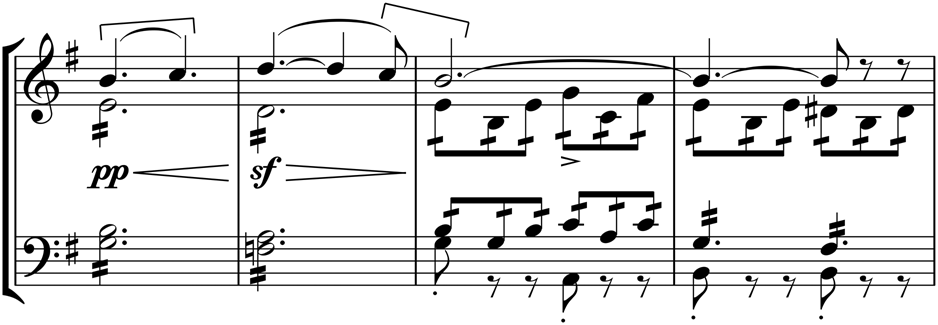
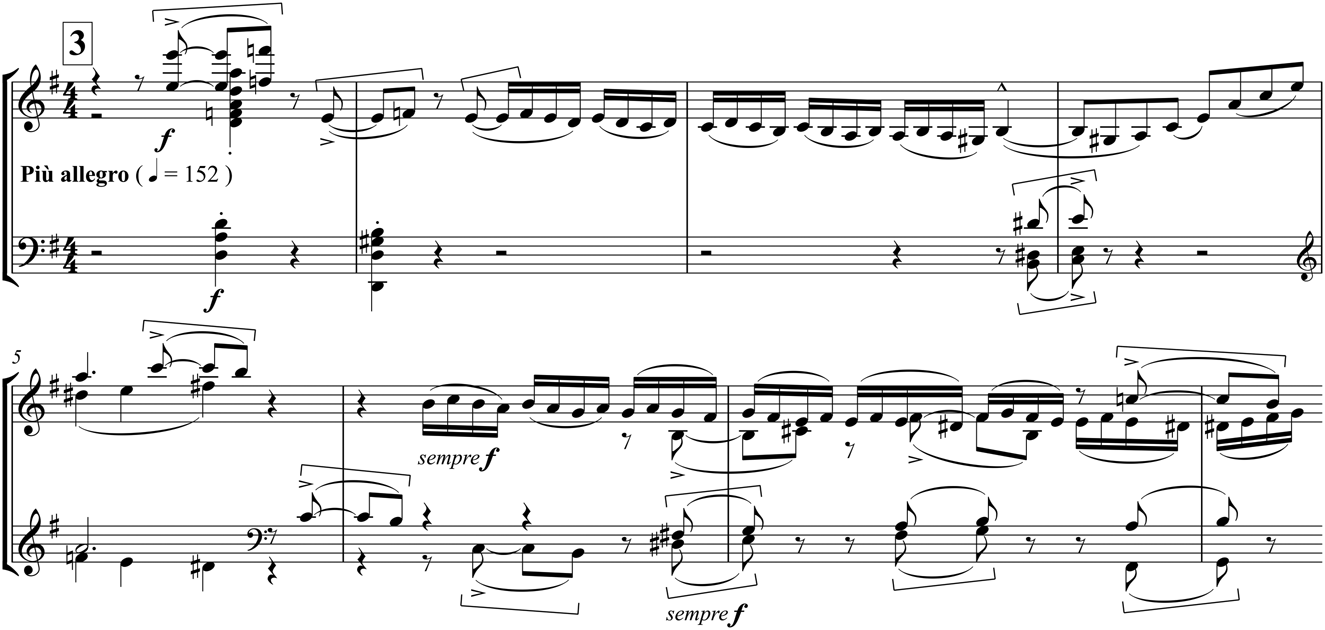
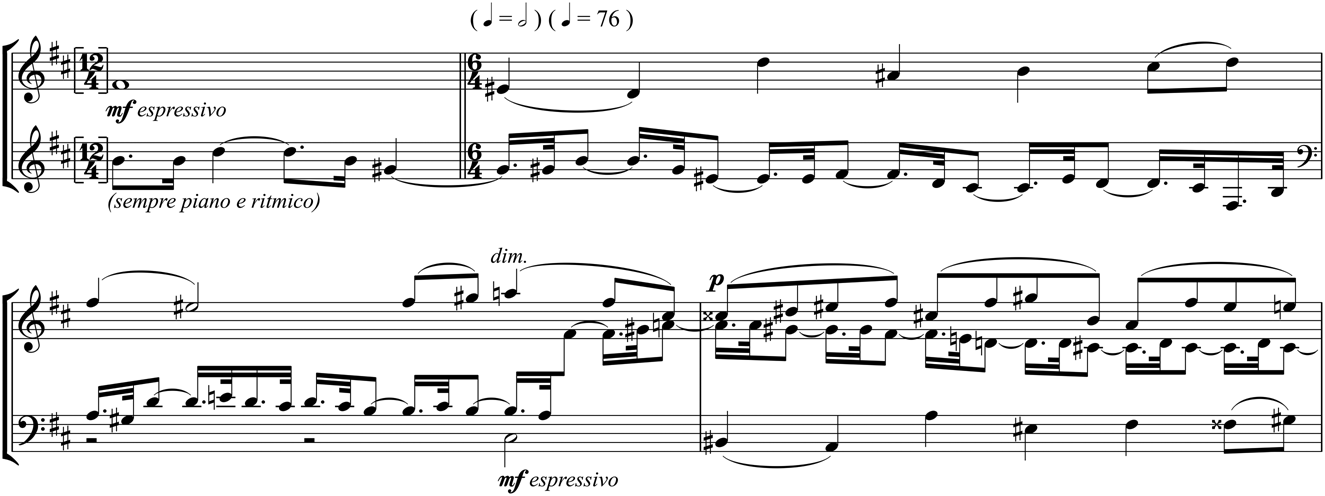
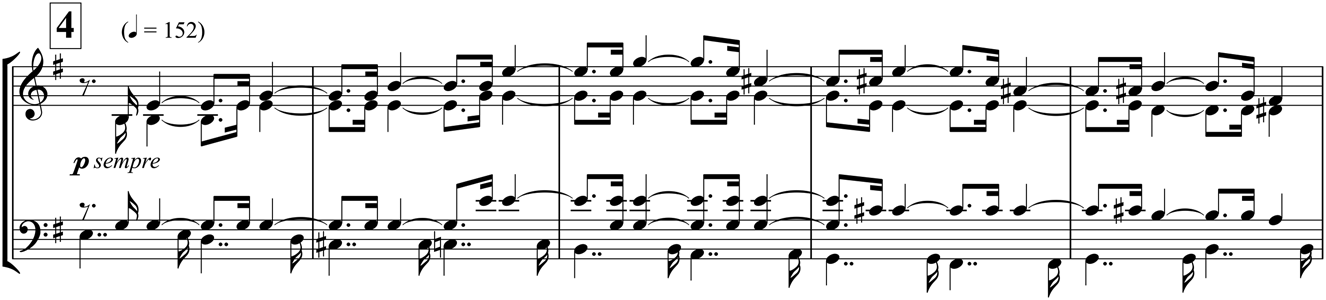
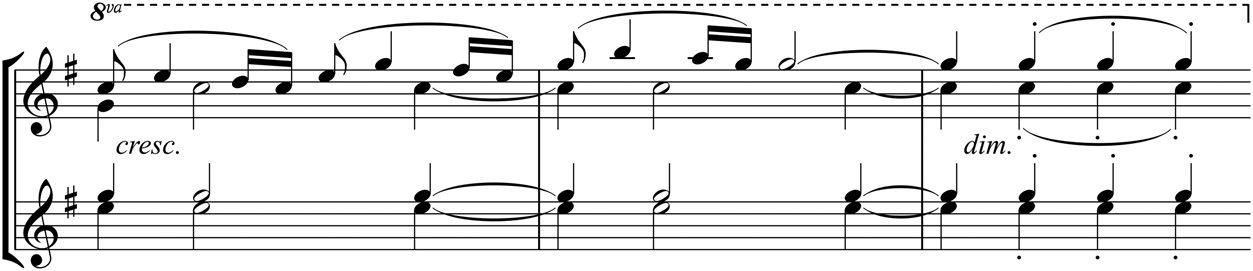
The beginning of Saint-Saëns's finale likewise makes references to past movements. As shown in Example 3, the first two bars offer an echo of the third movement's opening: in both passages, a lone piano pedal is joined by rising crotchet lines in two other instruments to express dominant harmony; the first violin then joins with the main theme when the tonic arrives. As Example 4 shows, the Finale's main theme assumes the distinctive double-dotted rhythm of the opening movement's second main theme. The principal thematic kernel of the rondo form's first episode, the form's next element, which repeats after the first return of the main theme, derives from a codetta at the tail end of the first movement's exposition, (see Ex. 5).
IV, bars 1–2

III, bars 1–3

IV, Main Theme, bars 2–6 (1st violin only)

I, Main Theme 2, Reh. 4 to 4 + 4

IV, First Episode, Reh. 38 to 38 + 3

IV, First Episode, Reh. 38 to 38 + 3

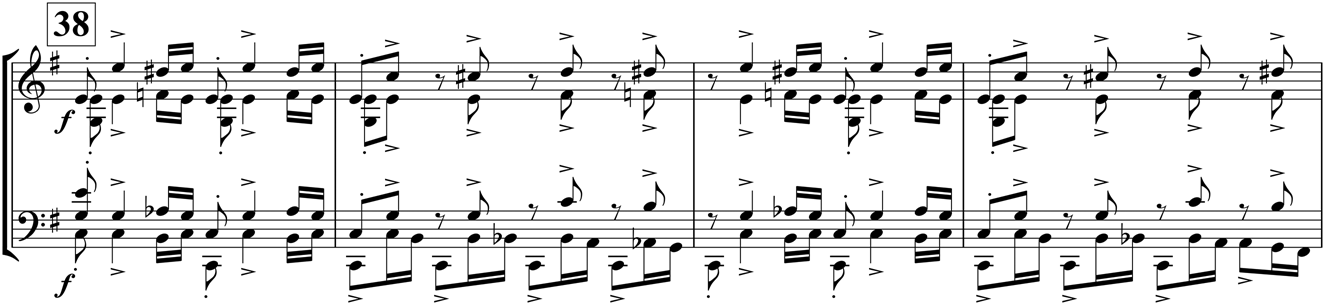
Where the citations of past movements at the outset of Franck's finale are hard to miss, Saint-Saëns's equivalents are about as oblique as they can be. The finale's main theme (Ex. 4a) and the first-movement theme (Ex. 4b) share a distinctive double-dotted rhythm, which does not occur anywhere else in the quartet and which persists, uninterrupted, for each theme's entire duration (13 bars of four-four time in both cases). Nonetheless, the pitch contours differ significantly, as do the bass and inner voices, and, by the time the finale comes around, a listener's memory of the first movement could well have grown hazy (the scherzo and adagio together typically last between 13 and 15 minutes). Examples 5a and 5b match more closely in melodic and especially rhythmic profiles, and both passages express C major. But here the reference in the finale is fleetingly brief, and the first-movement referent lies in a codetta rounding out the exposition, an obscure part of the form, and although this codetta recurs at the analogous place in the recapitulation, it does not factor anywhere else in the movement. For different reasons, then, listeners likely will not make explicit connections between the pairings shown in Examples 3, 4 and 5. But when they encounter the finale's opening bars, main theme and first couplet, they could very well experience an uncanny feeling of familiarity, a contradictory mixture of recognition and elusiveness. Put differently, listeners may well experience here again déjà entendu.
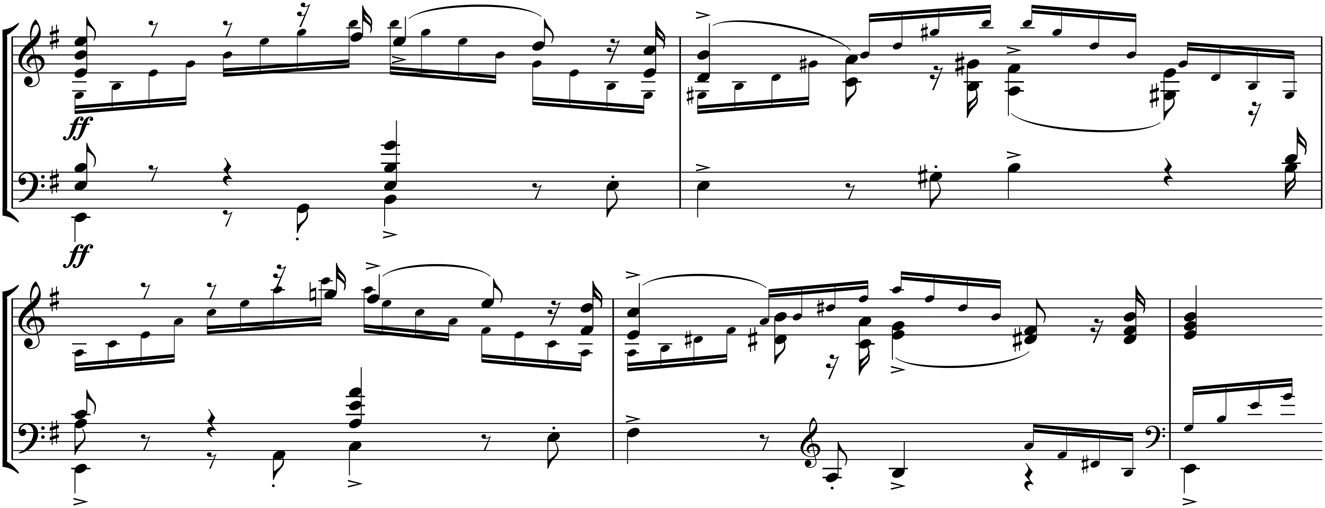
The finale's conclusion seems to begin building an apotheosis in the manner of Franck's quartet. After the recapitulation of the main theme, as Example 6 shows, a quotation of the slow-introduction fragment shown in Example 2a appears, and Example 2b soon joins it. These citations are literal and readily recognizable, the first of their kind anywhere in the work, and they prime listeners for more, especially those familiar with franckiste convention.
IV, Coda, Reh. 48 to 48 + 6

Manuscripts and correspondence reveal that the composer hesitated over what was to come next until the final second. Indeed, he virtually had to ask Durand, his publisher, to stop the presses in order to add the ending as we know it. Having commenced the quartet in late February of 1899, Saint-Saëns mailed what he called the ‘definitive manuscript’ to Durand on 16 April.Footnote 40 Like the fair copy apparently completed some days earlier, this manuscript ended with a fortissimo, quaver tonic chord on the downbeat of what, in the published score, is rehearsal 49, and it lacked altogether the final molto allegro gambit with which the work as we know it draws to a close.Footnote 41 The composer posted these final 35 bars two days later in a separate package, with a short letter explaining to Durand: ‘No sooner had I dispatched my quartet than I realized it needed a little tail, something like a final crisis [une crise finale]’.Footnote 42 At face value, these documents might imply that the coda came as an afterthought, but it seems difficult to accept that Saint-Saëns – a master of balance, proportion and pace – had seriously entertained the idea of ending the work at rehearsal 49, which comes across as a structural anacrusis even with the tonic chord. He might have sent off the score before committing to a conclusion in order to placate Durand, who felt rushed to issue the work before the beginning of the fall concert season and who may have been applying pressure to the composer to deliver it promptly.Footnote 43 One might draw a similar inference from some of the composer's letters to the publisher.Footnote 44
Whatever the case, following closely from the aforementioned literal quotations of slow-introduction materials, and proceeding from the expectation of a thematic apotheosis those quotations arouse, the ‘final crisis’ the composer belatedly committed to paper involves some real musical subterfuge. The beginning of the allegro molto gambit, shown in Example 7a, suggests the texture of the scherzo's main theme (Ex. 7b). In both passages, steady crotchet pizzicatos in the second violin, viola and cello accompany an agile, bowed first-violin part, all piano or pianissimo. The melodic line in the finale, however, does not come from the scherzo or from any earlier movement. It is, in fact, simply an embellished and rhythmically disguised variation of the finale's main theme. Listeners might hear in what comes next (Ex. 8a) a flash of the work's very first theme, shown in Example 8b, probably the most distinctive element in the slow introduction. Example 8a probably causes the listener's memory to spark, but it does not bear enough similarity to Example 8b to clinch the association with the work's opening. The coda fills in the introduction theme's gaps, straightens out its melodic curve and effaces its drawn-out half-diminished seventh sonority. To summarize: where Franck robustly juxtaposes and combines themes from his quartet's various movements to realize a full-blooded, climactic apotheosis, Saint-Saëns feints at the same but follows through with crepuscular shadows (as Baumann might have had it), an anti-apotheosis consisting only of a phantom of the scherzo and a ghostly trace of the quartet's initial bars. As with the work's other ‘cyclic’ elements, in Examples 7a and 8a, details from previous movements return, but in significantly changed contexts; like Humphrey's gilded cornices, these carry traces of the past that may trigger a listener's memory but which become overwhelmed by the present moment, resulting in the uncanny feeling Freud attributed to the déjà-vu experience.
IV, Final Presto, Reh. 49 + 1 to 49 + 5

II, Scherzo, Main Theme

IV, Coda, Reh. 50 + 4 to 50 + 8

I, Slow Introduction, bars 7–20

V Monumentality, Messages and Charm
Saint-Saëns's misreadings in the E-Minor Quartet of canonical franckiste cyclic procedures reflect broad aesthetic conflicts with d'Indy, the tendrils of which extend all the way to divergent suppositions about art's essential purposes. D'Indy ascribed to art a fundamentally didactic role. As he stated at the outset of the Cours de composition (and echoed frequently in its four volumes and elsewhere), it existed to teach and better humankind by ‘nourishing humanity's soul and fostering its progress’.Footnote 45 By this the aristocratic, monarchist and staunchly Catholic composer-pedagogue tasked music with promulgating the eminently conservative social and political values he himself espoused. Typifying the French right, he considered doctrines of individualism, social equality, secularism and other post-revolutionary ideals of the Third Republic toxic to ‘humanity's soul’; the convalescence he envisioned entailed a palliative reengagement with the primordial truths and the immutable traditions of the Ancien regime: social determinism, collective national consciousness, monarchical rule and, above all, the Catholic Faith.
Musical works could offer such ambitious enseignement in manifold ways. They could, for instance, exemplify clear continuity between stylistic innovation and received generic, formal and syntactic traditions.Footnote 46 Cyclic form served d'Indy's didactic objectives in two principal ways. First, he likened cyclic themes to Wagnerian leitmotifs. Concepts could attach to them through topic, style, or musical context; their development and interaction could produce meaning by way of musical narrative, much as in contemporary accounts (including d'Indy's own) of motivic argument in Wagner's operas.Footnote 47 As Brian Hart has emphasized, there existed a vibrant tradition within d'Indy's circle of receiving cyclic instrumental works as moralizing ‘messages’.Footnote 48 The composer's acolyte René de Castéra, to cite one important example, published a lengthy analysis of d'Indy's Second Symphony highlighting confrontation between its two cyclic themes, one (according to the critic) representing ‘the negative influence of the modern element’ and the other the ‘good influence’ of ‘tradition’.Footnote 49
In d'Indy's estimation, the most didactically effective works would evince a ‘monumental character’, a metaphor which folded together commanding mass and solidity of structure on the one hand and value and durability on the other. In the Cours de composition, he famously elaborated a hierarchy of genres. In the sphere of ‘musique pure’ (non-programmatic instrumental music), the symphony occupied the top spot, ahead of chamber genres based on the same four-movement pattern; beneath these he placed smaller forms.Footnote 50 Scale and scope clearly mattered. The composer-pedagogue, however, did not emphasize these attributes alone. A true monumental character could only result from a synthetic ‘unity’ among a composition's various movements, and herein also lay the importance of cyclic thematic procedures to d'Indy's aesthetics.Footnote 51 ‘Just as any three canvases do not necessarily make a triptych, and as a succession of tragedies … do not necessarily make a trilogy’, so it is with the movements of a musical composition, which can only achieve the requisite coherence by way of a ‘common link, a unity of thought, of form, of tonality and above all of themes’.Footnote 52 A large-scale work ‘constructed’ – d'Indy employed this term frequently – upon a sturdy frame of cyclic themes could assume the ‘perfection’ and imposing eminence of a grand ‘cathedral in sound’, the supreme form of architecture in the deeply religious composer's view.Footnote 53
Put differently, d'Indy's teachings conflate music-stylistic aspects of the nineteenth-century sublime – the overwhelming awe and wonder evoked by massiveness of scale, far-reaching thematic development, climactic apotheoses and so on – with moral utility and therefore with greatness and canonical permanence. He appears to have comprehended very well a special property, to which Alexander Rehding has recently drawn attention, of the outsized forms, glittering thematic returns and (in the case of orchestral music) awe-inspiring displays of sonic force that proliferated in the late nineteenth-century. Such attributes seem to invest music with a potent – and potentially coercive – sense of moral authority, one which, it scarcely needs to be emphasized, accorded very well with d'Indy's didactic objectives.Footnote 54 Put reductively, listeners cowed by transcendental sublimity could prove receptive to a work's moralizing message.
Earlier in his career, Saint-Saëns, like many of his contemporaries (French and otherwise) had clearly shared something of d'Indy's predilection for monumentality. One could fairly state that the Fourth Piano Concerto and the ‘Organ’ Symphony – a monumental work if ever there were one – arrive at synthetic ‘unities’, as distinct as their cyclic procedures are from d'Indy's. In the D-Minor Violin Sonata, the return of the first-movement subordinate theme in the finale makes for as grandiose an apotheosis as in Franck's quartet. Although always suspicious of extravagant claims on behalf of music, Saint-Saëns also appears to have shared something of d'Indy's views on art's social utility, if not his younger colleague's religious or political convictions. Jann Pasler, for instance, has argued that the symphonic poem Le Rouet d'Omphale (1871), which takes as its subject (as the programme has it) ‘feminine seduction’, and the triumph of the title character's ‘weakness’ over the brute strength of Hercules, could galvanize the French nation in the face of its military defeat to the virile Germans by allegorizing its ethics and virtues as the nascent Third Republic regime defined them.Footnote 55 Nonetheless, starting in the mid-1880s – when the rift with d'Indy and Franck's legacy developed – Saint-Saëns's writings evince an increasingly oppositional posture against both strands of his younger adversary's aesthetics, an important context for certain contemporaneous developments in his compositional oeuvre, among them his intensifying scepticism toward cyclic form and, ultimately, his misreadings in the E-Minor Quartet of canonical franckiste cyclic procedures.
Saint-Saëns offered his most sustained and direct critique of d'Indy's aesthetics in a 40-page review of the Cours de composition’s first two volumes that appeared in 1919 (the third volume of the Cours would not go to press until 1950). He opened by confronting d'Indy's teaching that art had emerged from the Christian religion, asserting instead Enlightenment notions of universal humanity:
Art came into being on the day that man, instead of being solely concerned with the utility of an object he had made, preoccupied himself with its form … and decided that this form should satisfy a need peculiar to human nature, a mysterious need to which the name of ‘aesthetic sense’ has been given.
Ornament, the principal means of enriching form in this imagined, mythical past, ‘serve[d] no other need than to satisfy this aesthetic sense’.Footnote 56 Here, the question of art's origins merely serves as a polite cover for the altogether more consequential issue of its purposes: to d'Indy's cherished precepts of art's fundamentally didactic role and its moral utility, Saint-Saëns counters with a diametrically opposed posture of aesthetic autonomy. In an article of 1912 – titled ‘L'Art pour l'art’ – he iterated a similar position: ‘the whole principle of art’ lies in making abstractions which turn nature ‘into something that responds to a special and inexplicable need of the human spirit’.Footnote 57 The main thrust of this text disavowed d'Indy's entwinement of music and the moral sphere. ‘Art accommodates itself wonderfully to morality and passion’, Saint-Saëns acknowledged, but these, he insisted, ‘are incidental to it … Just as morality has no call to be artistic, art has no call to be moral’.Footnote 58 Art, he admonished, ‘remains sufficient unto itself, and it is then that it is at its greatest;’ it bore a responsibility only to satisfy a universally human need (so he claimed) for aesthetic experience. This carried the implication that music was at its best when it remained within its own element and did not gravitate toward the forms or content of other modes of expression.Footnote 59
A comprehensive account of how Saint-Saëns believed music could stimulate the aesthetic sense lies beyond the scope of this essay, but one element relevant to the E-Minor String Quartet, and to the question of how music could best inhabit its own element, is ‘charm’. Like many of his contemporaries, he sometimes used this term indiscriminately and even dismissively, but with it he also denoted some aesthetic sine qua non. Most generally, he applied the term, also like many of his contemporaries, to music exemplifying understatement, restraint, refinement, elegance and so on. Pithy passages dotting Saint-Saëns's writings testify to the value he placed on these traits. If he did not begrudge ‘those geniuses who grasp music with both hands and employ its resources to the utmost’, in an article of 1897 extolling Gounod's merits, he underscored his ‘preference … for sobriety of means, so long as it does not entail poverty in the results’.Footnote 60 In a synoptic assessment of current musical trends, also penned in 1897, he expressed his preference for ‘delicate delights’ over the ‘violent emotions and nervous shocks’ that certain unnamed contemporaries ‘wrongly interpret as progress’.Footnote 61 In Mozart's operas he marvelled at ‘the intimate union of word and note, the absolute accord of the smallest stylistic details with the most delicate nuances of feeling;’ he lingered on Gounod's ability to ‘bring off striking effects with a single dissonant chord’.Footnote 62
Subtlety, restraint and economy of means seem relevant to the pseudo-cyclic aspects of the E-Minor Quartet. The composer's treatment of the semitone perhaps registers as an analogue to the potent effects Gounod could so efficiently achieve, and the foregoing analysis highlights how the work makes an agenda of producing ‘delicate nuances of feeling’ by means of ‘the smallest stylistic details’. The refinement and delicacy that captivated Baumann and Imbert prevails over the ‘monumental character’ d'Indy pursued (and which Lalo, in his early review, found lacking in the Quartet). Charm did not amount simply to an umbrella category under which could be grouped the classicizing traits that have long been recognized as Saint-Saëns's aesthetic spine or, more broadly, the ensemble of values to which French writers often pointed to contrast the stylistic virtues of their nation's music with Germanic ponderousness, lourdeur and severity. As Jann Pasler has observed, the term in fin-de-siècle France also held a more specifically affective meaning appealing to its connotations of enchantment and magic. The result of an attractive, immediately appealing stylistic surface, often sensuous and often involving refined, delicate or novel sonorities, charming music could exert a seductive power. In Pasler's view, charm mattered for this very reason: it could function like a hook, drawing listeners into a work and into whatever ideology it might seek to expound and thereby ‘serve a political purpose’.Footnote 63 Saint-Saëns, at least in the second half of his career, would greet this last claim with scepticism, but he too ascribed a persuasive capacity to music eliciting ‘pleasure’, which he regarded as ‘the attraction by which it seduces its audience’.Footnote 64 Charm was therefore not only a stylistic attribute, but also an operation; it involved acting upon listeners.
Saint-Saëns would have been more receptive to the less directly political conception of charm theorized by the French philosopher-critic Vladimir Jankélévitch, whose writings on some of the composer's early twentieth-century colleagues – notably his protégée Gabriel Fauré – have recently gained currency in Anglophone musicology. Suspicious of Teutonic grandiloquence and an advocate of the ‘lessons in reticence and sobriety’ offered by ‘the arid and sparing concision of a Ravel, the austerity of a Falla, the heroic held-back quality of a Debussy’, Jankélévitch characterized charm as this music's ‘mystical transaction’.Footnote 65 Listeners surrendering themselves to these qualities may experience an intoxicating, spontaneous state of grace within a realm of intuition and communion with the absolute knowledge and the continuous process of becoming which Jankélévitch, drawing upon Henri Bergson, considered attendant upon the lived experience of time.
Although Saint-Saëns remained circumspect on the question of what, exactly, music might arouse in listeners, what he did write intimates something like the ‘ineffable’ richness of meaning Jankélévitch ascribed to music's charm. By ‘setting the aesthetic sense in vibration’, music could ‘awaken noble and pure feelings in the hearts of mankind;’ elsewhere Saint-Saëns maintained that worthy music could ‘expand the heart, … elevate the soul, … and awaken the imagination by opening up for it the horizons of an unknown and superior world’.Footnote 66 He denied Franck a place among ‘the great masters of music’ because ‘in his works we do not find that latent warmth, that irresistible charm which makes us forget everything and transports us into unknown and supernal realms’.Footnote 67
Saint-Saëns gave his most revealing account of music's affective action in the introduction to a collection of essays titled Harmonie et melodie, the 1885 text cited earlier in which the composer mounted his most impassioned defence of his aesthetic values in the face of French Wagnerism (d'Indy's monumentality among its facets):
Music is not an instrument of physical pleasure. Music is one of the most delicate products of the human spirit. … Behind the sense of hearing, with its marvellous capacity to analyse sounds, to distinguish the differences in their intensities, timbres, and qualities, there lies, inside the complexities of the brain, a mysterious [i.e. the aesthetic] sense that responds to something quite different. You know [Beethoven's] Pastoral Symphony. You've heard the Peasants’ Round Dance [the scherzo], which gradually gains pace to the point of giddiness, of madness. At the climactic point everything suddenly stops and, without a transition of any kind, the double basses play pianissimo a note outside the prevailing key [the D flat that initiates the ‘Storm’ movement]. This note, almost inaudible, is like the sudden spreading of a black veil; it is the shadow of implacable fate appearing in the midst of the festivities, an indescribable anguish that no one can escape. From the point of view of the ear and its physical pleasure, or even of cold reason, this note is absurd because it destroys the tonality and logical development of the movement. And yet is it sublime. It appeals therefore neither to the ear that wishes to be caressed, nor to a short-sighted reason … . There must, then, be something in the art of sound that passes through the ear like a porch and through reason like an entrance hall, and that goes on further. All music that lacks this something is to be despised.Footnote 68
As one might expect, while ‘pleasure’ in this account plays a role in the musical experience, neither the impact nor the value of music (at least music the author considered worthy) reduce to sensation. More strikingly, Saint-Saëns – the committed classicist – does not explicate the activation of the aesthetic sense with an example exhibiting formal perfection, clarity, balance and the like. Rupture, ambiguity and discontinuity could accord supremely with his aesthetic programme, provided these derived from ‘sobriety of means’ and resulted in ‘delicate delights’ and not ‘nervous shocks’. Perhaps more strikingly still for a figure so committed to science – Saint-Saëns's writings range to astronomy, optics and (of course) zoology – the account grants no mediating role to reason. Engaging with the passage from this posture does not involve making sense of Beethoven's pianissimo D-flat by way of analysis or hermeneutic interpretation, but experiencing, spontaneously and in the unfolding time of hearing the music, the ‘sublime’ feeling paraphrased by the composer's intensely evocative prose. The aesthetic sense is charmed – the word's connotations of enchantment and magic here come to the fore – by an exquisite musical moment.
These musings on the beginning of the Storm Movement bring into sharper focus the aesthetic import of the E-Minor String Quartet's misreadings of canonical franckiste cyclic procedures. D'Indy advocated cyclic form as a means to make of a musical work an awe-inspiring mountain; by cognitively overloading listeners with a vast web of motivic interconnections (as in his own Second Quartet) or by densely layering at some key moment materials from throughout (as in the apotheosis of Franck's Quartet), a work could project an aura of authority and greatness that could render listeners overwhelmed and figuratively prostrate. Saint-Saëns's deformations of these very procedures, on the other hand, trade on a surfeit of subtlety and on cognitive deficit. The effects of déjà entendu to which they give rise engender an altogether different type of transaction with listeners, one which seems broadly similar to what the composer experienced upon hearing Beethoven's solitary, pianissimo D-flat. Saint-Saëns might have taken recourse to the same language he adopted in the programme to Le Rouet d'Omphale and characterized the effects’ comparably disruptive and mysterious affective force as ‘feminine seduction’. More broadly, he might have cast the difference between the cyclic strategies he pursued in the E-Minor Quartet and those employed by d'Indy and Franck as the ‘triumph of weakness over force’. Where d'Indy's cyclicism seeks to overwhelm listeners with mass, Saint-Saëns's charms them with mysteriously beguiling understatement.
By casting the artwork as an oracle, d'Indy – who likened cyclic themes to leitmotifs – implicitly assigns listeners the hermeneutic task of deciphering the truths dispensed by it. Saint-Saëns's misreadings in the E-Minor Quartet of franckiste techniques, on the other hand, give rise to effects that are fundamentally immediate and temporal. If the pseudo-cyclic connections in the E-Minor Quartet trade on the mnestic workings of the déjà vu experience as theorized by Sno and Linszen – that is, if (say) the main theme of the finale embeds a detail of the first-movement subordinate theme (the double-dotted rhythm) in otherwise entirely new musical surroundings, triggering a sense of recognition that eludes attachment to memory of a specific past moment – this occurs within what Jankélévitch calls the ‘drastic’ register, the singularity of time one experiences while listening to a performance of the work. The effect's force does not derive from recognition of musical topic, from following motivic narrative, from contemplating what musical form might allegorize, or from any other ‘gnostic’ interpretive posture. As Saint-Saëns might have it, the effects bypass reason. Yet they hardly reduce to sensuous pleasure. Their affective quality seems closer to the sublime feeling aroused by the intensely concentrated effect of Beethoven's D-flat: the miraculous and uncanny characteristics Freud attached to the déjà-vu experience seem of the same order as the awe and dark wonder Saint-Saëns experienced at the onset of the Pastoral Symphony's Storm movement.
The arguments developed in this essay, and the attention it draws to the importance of charm as an aesthetic priority of Saint-Saëns, may serve to add nuance to our grasp of the richly contoured musical landscape of early twentieth-century France. Present-day historiography tends to cast the post-1900 figures of Saint-Saëns and d'Indy together as traditionalists who stood firm against the avant-garde movements headed by Debussy, Richard Strauss and Stravinsky.Footnote 69 To be sure, the two composers did come to share much: both resisted the idea that fundamental cultural values inevitably shift with history; both posited tradition as an authority dictating normative and stable values in aesthetics. Both remained committed to a syntax projecting a single tonic within a chromatically embellished major–minor tonal system; both saw continuing relevance in classical genres and in the forms they involved.
Yet to the same measure that historiography recognizes in Saint-Saëns and d'Indy like minds facing common foes, it would do well to take account of the divisions between these traditionalists that persisted and even intensified, especially because both remained highly visible musicians and productive composers through the First World War and beyond. As Leon Botstein has observed, Saint-Saëns came to see his work as ‘an explicit act of defiance against the evisceration … of [the] normative aesthetic standards’ he espoused.Footnote 70 Botstein had in mind the composer's reaction to Pelléas et Mélisande, Salomé and Le Sacre du printemps, but Saint-Saëns assumed this stance in the first instance in response to d'Indy and to Franck's legacy. Saint-Saëns's First String Quartet offers a touchstone not only for matters of musical style but also for how these intersect with fundamentally conflicting assumptions about art's goals and social purposes. D'Indy's tasked art with moral enseignement; cyclic form served this ambition on the one hand as a means to load works with meaning by way of motivic discourses to be interpreted by listeners, and on the other hand as a means to an imposing monumentality that could fill listeners with awe and reverence. The claims of autonomy and universality Saint-Saëns pinned to the gratification of the ‘aesthetic sense’, in his view music's only obligation, were, of course, equally contingent upon ideology. Indeed, these seem to reframe, in response to d'Indy, the composer's earlier calls for music to take as its highest duty ‘the cause of giving the public a taste for elevated enjoyment’, by which he meant the democratization of aristocratic tastes for refinement and sensibility, a programme that accorded squarely with the Republican political values he espoused.Footnote 71 Nonetheless, Saint-Saëns's ‘petit quatuor’, and its treatment of canonical franckiste cyclic procedures, thrusts to the foreground the issues that formed the core of his conflict with d'Indy and Franck's other followers. Saint-Saëns substitutes understatement, subtlety and the evanescence Baumann admired for the solid ‘construction’ that undergirds the monumental designs his counterparts advocated. The work, moreover, enlists cyclic procedures in order to foster musical effects that are essentially temporal and apprehended by intuition rather than by reason, whereas d'Indy's usage of these procedures encourages listeners to assume a hermeneutic posture. Put most reductively, where d'Indy deploys cyclic form to discipline listeners, Saint-Saëns's quartet does so to charm them.