INTRODUCTION
The shrimps from the Penaeidae Rafinesque, 1815 family are one of the main fishery resources in tropical coastal regions (Albertoni et al., Reference Albertoni, Palma-Silva and Esteves2003; Costa et al., Reference Costa, Fransozo, Freire and Castilho2007; Eutrópio et al., Reference Eutrópio, Mariante, Ferreira Junior and Krohling2013). Among these species, Xiphopenaeus kroyeri (Heller, 1862), popularly known as the seabob shrimp, is highlighted as the major fishery resource in Brazil (Albertoni et al., Reference Albertoni, Palma-Silva and Esteves2003; Costa et al., Reference Costa, Fransozo, Freire and Castilho2007; Campos et al., Reference Campos, Branco and D'Incao2011; Eutrópio et al., Reference Eutrópio, Mariante, Ferreira Junior and Krohling2013). This species shows wide distribution along the Western Atlantic, from Virginia (USA) to Rio Grande do Sul (Brazil) (D'Incao et al., Reference D'Incao, Valentini and Rodrigues2002; Costa et al., Reference Costa, Fransozo, Melo and Freire2003), is more abundant in areas with less than 30 m depth and is particularly associated with sandy and muddy bottoms (Branco et al., Reference Branco, Lunardon-Branco, Souto and Guerra1999).
Nowadays, X. kroyeri is considered overexploited in the south and south-east of Brazil (Brasil, 2004), and as moderately exploited in the north-east (Vasconcellos et al., Reference Vasconcellos, Diegues, Salles and Costa2007). The impact generated by shrimp fishing practices causes significant loss in biomass and biodiversity of the continental shelf (Pauly & Christensen, Reference Pauly and Christensen1995; Pauly et al., Reference Pauly, Christensen, Guénette, Pitcher, Sumaila, Walters, Watson and Zeller2002), since they exhibit relevant importance in benthic communities and food chains (Souza et al., Reference Souza, Costa, Martins and Fransozo2008; Lopes et al., Reference Lopes, Frédou and Peixoto2013; Heckler et al., Reference Heckler, Costa, Fransozo, Rosso and Shimizu2014), and also in substrate bioturbation (Smith et al., Reference Smith, Jumars and De Master1986). For better suitability of management plans for this marine resource, it is necessary to understand its life cycle; this can be achieved through estimating mortality, which can be obtained through growth studies and size relations (García & Le Reste, Reference García and Le Reste1981; Gulland & Rothschild, Reference Gulland and Rothschild1981; King, Reference King1997).
Usually growth is fast in Penaeidae shrimp (Neiva & Wise, Reference Neiva and Wise1964; Gulland & Rothschild, Reference Gulland and Rothschild1981), with males being smaller than females due to differential growth between sexes (Campos et al., Reference Campos, Branco and D'Incao2011; Fernandes et al., Reference Fernandes, Silva, Jardim, Keunecke and Di Beneditto2011; Grabowski et al., Reference Grabowski, Simões and Castilho2014). The growth process in these shrimps occurs discontinuously, being frequently interrupted by successive moults (ecdyses), with the duration of moulting cycles depending on the species, size, sex, life stage, environmental factors, such as water temperature and salinity (proximal factors), and availability and quality of food (ultimate factors) (Hartnoll, Reference Hartnoll and Abele1982; Bauer, Reference Bauer1992; Clarke, Reference Clarke1993; Boschi, Reference Boschi1997; Castilho et al., Reference Castilho, Costa, Fransozo and Boschi2007a, Reference Castilho, Gavio, Costa, Boschi, Raymond and Fransozob; Costa et al., Reference Costa, Branco, Machado, Campos and Avila2010).
Due to this growth discontinuity and the absence of corporal structures that can provide data about growth (Petriella & Boschi, Reference Petriella and Boschi1997; Branco, Reference Branco2005; Vogt, Reference Vogt2012), the mathematical equation of von Bertalanffy (Reference von Bertalanffy1938) is well suited to the biological process of these crustaceans (García, Reference García and Gulland1988; D'Incao & Fonseca, Reference D'Incao, Fonseca, Klein and Schram1999). The evaluation of body size in crustaceans, using growth curves, remains of fundamental importance to population studies which can determine the relationship between size and age (Branco et al., Reference Branco, Lunardon-Branco and De Fenis1994), since the determination of longevity in these organisms can be obtained through this relationship (García & Le Reste, Reference García and Le Reste1981; Gulland & Rothschild, Reference Gulland and Rothschild1981; King, Reference King1997).
The studies of growth in crustaceans can also help in the understanding of the biological meanings in the observed sex ratio, in relation to the expected Mendelian equivalence 1:1 (Wenner, Reference Wenner1972). This relationship normally occurs since the different mortality and growth rates and migration mechanisms, frequently associated with feeding processes, defence and reproduction, that are distinct between sexes can influence the shaping of sex ratio deviation (Wilson & Pianka, Reference Wilson and Pianka1963; Wenner, Reference Wenner1972; Haley, Reference Haley1979; Trott, Reference Trott1998).
The studies focusing on population structure, growth and longevity in marine crustaceans have also been used for a better understanding of ecological paradigms, e.g. the latitudinal paradigm (Castilho et al., Reference Castilho, Gavio, Costa, Boschi, Raymond and Fransozo2007b; Grabowski et al., Reference Grabowski, Simões and Castilho2014). This phenomenon affects the population structure according to the latitudinal location, and it has been evidenced in Penaeoideans (Bauer, Reference Bauer1992; Bauer & Rivera Vega, Reference Bauer and Rivera Vega1992; Costa & Fransozo, Reference Costa and Fransozo2004; Aragón-Noriega & Alcántara-Razo, Reference Aragón-Noriega and Alcántara-Razo2005; Castilho et al., Reference Castilho, Gavio, Costa, Boschi, Raymond and Fransozo2007b). Furthermore, the differences in temperature along the latitudinal gradient can directly affect the maximum body sizes of individuals, which tend to reach larger sizes at higher latitudes and smaller sizes at lower latitudes, following Bergmann's rule (Blackburn et al., Reference Blackburn, Gaston and Loder1999).
We can check the latitudinal paradigm using morphological parameters of specimens, and considering the relationship between size at onset of sexual maturity and growth (Fernandes et al., Reference Fernandes, Silva, Jardim, Keunecke and Di Beneditto2011; Almeida et al., Reference Almeida, Baeza, Fransozo, Castilho and Fransozo2012; Onaga et al., Reference Onaga, Fiedler and Baeza2012). These features can vary both in space and time as a function of intrinsic factors (genetic) or extrinsic factors (environmental variations) (Dall et al., Reference Dall, Hill, Rothlisberg, Sharples, Blaxter and Southward1990; Fernandes et al., Reference Fernandes, Silva, Jardim, Keunecke and Di Beneditto2011). Moreover, growth parameters can also help studies that aim to understand the presence of latitudinal patterns. Different local environmental factors (mainly temperature and photoperiod, in addition to salinity, sediment type and biotic interactions) may vary along a geographic scale. Most of these factors can influence marine crustaceans, in that they can regulate growth, size at onset of sexual maturity and reproduction (Jones & Simons, Reference Jones and Simons1983; Wägele, Reference Wägele1987; Hines, Reference Hines1989; Dall et al., Reference Dall, Hill, Rothlisberg, Sharples, Blaxter and Southward1990; Crocos et al., Reference Crocos, Parck, Die, Warbuton and Manson2001; Bauer, Reference Bauer2002; Baldwin & Bauer, Reference Baldwin and Bauer2003; Costa et al., Reference Costa, Castilho and Freire2005; Castilho et al., Reference Castilho, Gavio, Costa, Boschi, Raymond and Fransozo2007b).
Variations in populations of X. kroyeri are expected to occur along the Brazilian coast, caused by differences in abiotic factors (sediment type, temperature, salinity, hydrodynamics) and biotic interactions (competition, predation) (Lenihan & Micheli, Reference Lenihan, Micheli, Bertness, Gaines and Hay2001; Castilho et al., Reference Castilho, Gavio, Costa, Boschi, Raymond and Fransozo2007b; Grabowski et al., Reference Grabowski, Simões and Castilho2014). However, information on the growth and longevity of penaeideans in Brazil is scarce, despite their economic and ecological importance. There is little information on the growth of X. kroyeri on the north-east Brazilian coast, except for the study accomplished by Santos & Ivo (Reference Santos and Ivo2000), in the State of Bahia and Lopes et al. (Reference Lopes, Peixoto, Frédou and Silva2014) in the State of Pernambuco, which used similar procedures to the present study.
The aim of this investigation was to evaluate the population structure, focusing on temporal, spatial and by size class sex ratio, sexual maturity, growth and longevity of X. kroyeri in the coastal region of the State of Sergipe, Brazil. Additionally, this study evaluates the latitudinal paradigm in relation to sexual maturity, body size and growth parameters of this species; and tests the null hypothesis that populations of X. kroyeri on the Brazilian coast follow Bergmann's rule.
MATERIALS AND METHODS
Study area
One of the shorter continental shelves of Brazil (Pereira et al., Reference Pereira, Torres and Gestinari2014) is the portion that corresponds to the continental shelf of the State of Sergipe. It is characterized by shallow water and with reduced width, ranging from 12 to 34.90 km, and with a gentle slope. Its coastal zone is 163 km long (Carvalho & Fontes, Reference Carvalho and Fontes2007), being considered an oligotrophic region, i.e. with low nutrient availability (Medeiros et al., Reference Medeiros, Macedo, Feitosa and Koening1999; Macedo et al., Reference Macedo, Muniz, Montes, Esquinazi-Leça, Neumann-Leitão and Costa2004).
Samplings
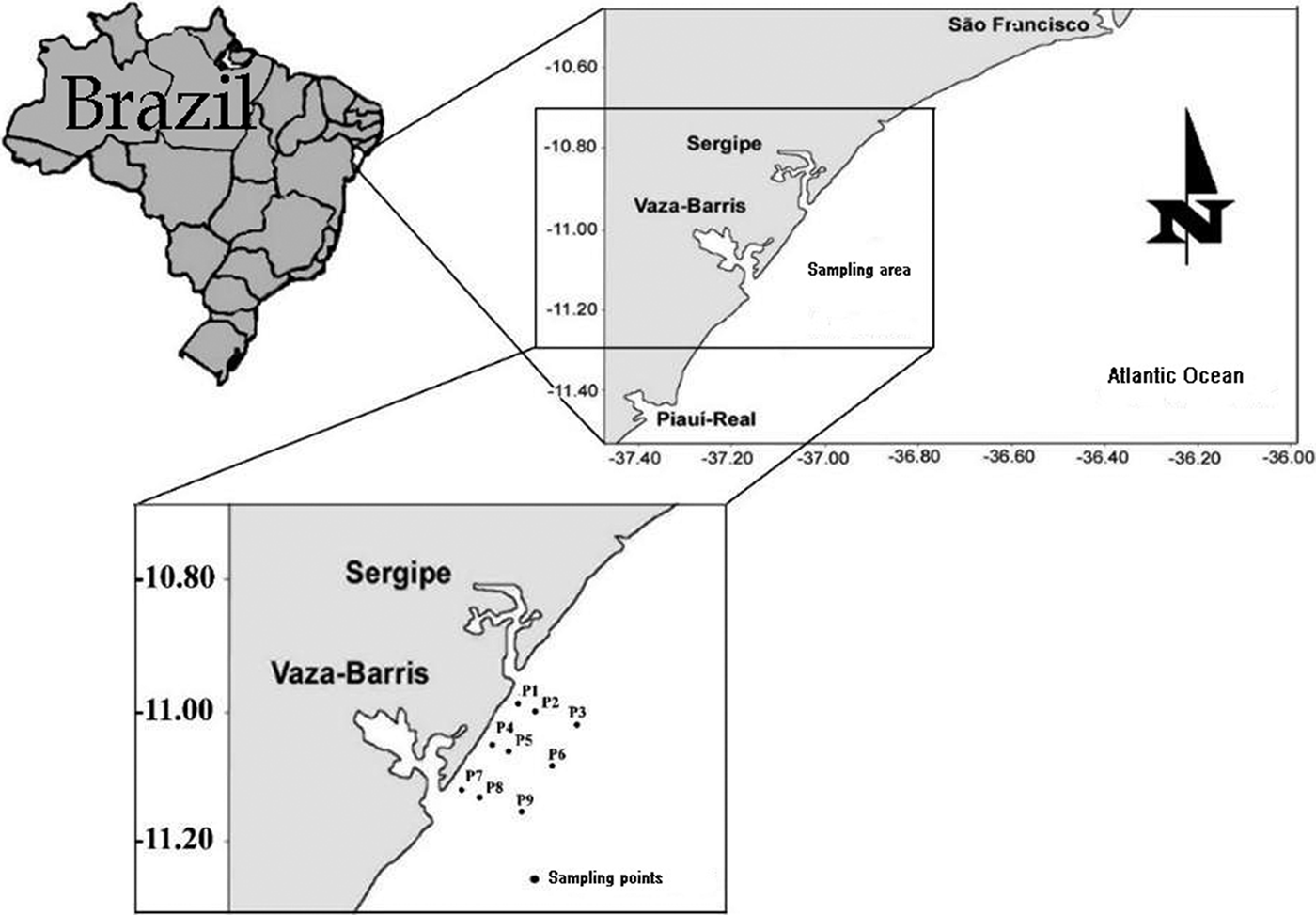
The shrimp X. kroyeri was collected monthly from September 2013 to August 2014 on the continental shelf of Sergipe in an area located between the mouth of the Sergipe and Vaza-Barris Rivers (Figure 1). At the study area, three transects were performed at three stations each. The depths of transects were 5, 15 and 30 m.
Map of the marine area of the continental shelf of Sergipe, located between the mouth of the Sergipe and Vaza-Barris Rivers, Sergipe State, Brazil. Points on the map indicate sampling stations.

During the sampling survey, we used a shrimp fishery boat equipped with a double rig net, with the following measurements: 4 m mouth width, 10 m long, 20 mm mesh size for the internode distance at sleeves and the body network, and 18 mm in the cod end. At each station, a sampling effort of 15 min/trawl was conducted. All sample material was stored in plastic bags inside thermal boxes with ice and transported to the laboratory.
In the laboratory, the shrimps were identified according to Costa et al. (Reference Costa, Fransozo, Melo and Freire2003). They were then weighed (total biomass in grams) for each station. A subsample of 300 g was taken randomly for each station, if the amount of specimens exceeded 300 g weight. For the samples with less than 300 g, all individuals were analysed. The shrimps were examined for sex determination. After that, the carapace length (CL mm), i.e. the linear distance from the postero-orbital margin to the median notch of the posterior margin of the carapace, was measured with a digital calliper (0.01 mm).
The reproductive condition of females was determined by macroscopic observation of the gonads, with the ovaries classified in respect with colour and size as previously indicated by several authors (Bauer & Lin, Reference Bauer and Lin1994; Nakagaki & Negreiros-Fransozo, Reference Nakagaki and Negreiros-Fransozo1998; Costa & Fransozo, Reference Costa and Fransozo2004; Castilho et al., Reference Castilho, Costa, Fransozo and Boschi2007a; Campos et al., Reference Campos, Dumont, D'Incao and Branco2009; Lopes et al., Reference Lopes, Frédou, Silva, Calazans and Peixoto2017). Females were classified into four development stages, according to their ovary development level: female with immature gonads (Stage I), with fine, transparent and small ovaries; females with spent gonads (Stage II), with transparent ovaries, but carapace length longer than the smallest Stage IV female; females with developing gonads (Stage III), with light green ovaries; females with developed gonads (Stage IV), with dark green, easily visible and voluminous ovaries.
For males, classification was conducted as proposed by Boschi & Scelzo (Reference Boschi and Scelzo1977). In this technique, male classification was based on the fusion of the petasma (endopod of the first abdominal appendage). The individuals were classified as juveniles (Stage I) when the endopod of the first pleopod pair was not jointed, and as adults when the petasma was totally formed, united by means of very small hooks, known as cincinnuli, which are found on the medial face of each endopod (Fransozo et al., Reference Fransozo, Santos, Lopez-Greco and Bolla2011). We classified Adult males as spent (Stage II) when they presented empty terminal ampoules and as developed (Stage III) when the terminal ampoule was full of spermatophores (Nakagaki & Negreiros-Fransozo, Reference Nakagaki and Negreiros-Fransozo1998).
Sex ratio
The sex ratios were analysed by month, by depth and by size class using the Chi-square test (χ2) (α = 0.05) (Sokal & Rohlf, Reference Sokal and Rohlf1995). For statistical reasons, the Chi-square test was only utilized in samples with more than 20 individuals (Vieira, Reference Vieira1991).
Population structure
The data used for the carapace length were tested for normality using the Shapiro–Wilk test (α = 0.05) and for homoscedasticity using the Levene test (α = 0.05). The test results showed that these data do not meet the assumptions of a parametric test, thus the data were log-transformed (log (x + 1)). Even after the data transformation, they remained non-normal and non-homoscedastic. Then, we compared the body size between males and females using the non-parametric Wilcoxon test (α = 0.05). The determination of sexual maturity was estimated separately for each sex, using a size class interval with 1.00 mm CL. For males, due to the existence of a transitory interval between juveniles and adult individuals, the size at onset maturity was estimated at which 50% of the individuals are in the adult condition (CL50%). For females, the same procedure was carried out; however, the size at onset maturity was based on the reproductive condition of the gonad, when 50% of females were between stages I and III of ovarian development. This value was obtained by the logistic function interpolation y = a/(1 + b*exp(-cx)) adjusted to the data. The values of ‘b’ and ‘c’ were estimated using a linearized model.
Growth and longevity
Growth and longevity were analysed separately for each sex (Boschi, Reference Boschi1969), based on von Bertalanffy's growth model (von Bertalanffy, Reference von Bertalanffy1938). The modal values were determined based on the frequency distribution of carapace length using the software PEAKFIT, with a size class interval of 1.0 mm. The models were plotted on a scatter chart against age to analyse the growth rhythm of cohorts. Growth parameters (CL ∞: asymptotic size of carapace; k: growth coefficient (day−1); t 0: theoretical age when size equals zero) were determined using the SOLVER add-in for Microsoft Office 2007, which applies von Bertalanffy's growth model: CLt = CL∞(1-exp−k(t−t0)) (CL t: carapace length at age t). Cohort data were grouped and the growth parameters were estimated. The estimated growth curves for males and females were compared using the F test (P = 0.05) (Cerrato, Reference Cerrato1990). The longevity was calculated using the inverse equation of von Bertalanffy's model with adequacy as suggested by D'Incao & Fonseca (Reference D'Incao, Fonseca, Klein and Schram1999), considering t 0 = 0 and CLt/CL∞ = 0.99.
RESULTS
Sex ratio
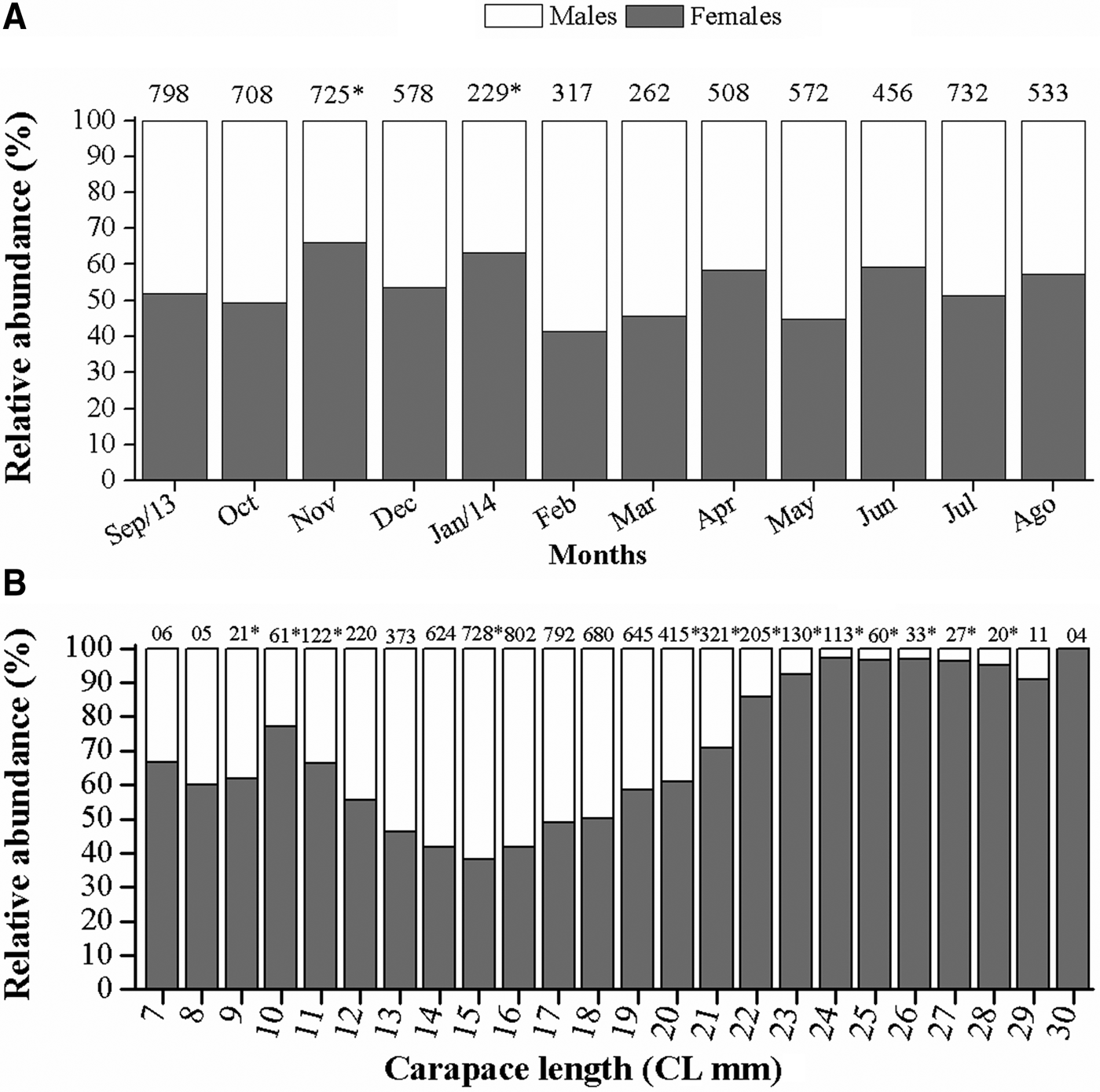
In total, 6418 individuals of X. kroyeri were obtained, of which 3457 were females and 2961 were males. The total sex ratio (female = 53.90%, male = 46.10%) did not differ significantly from 1:1 (χ2 = 0.59, P > 0.05). However, there was a higher proportion of females in November 2013 (χ2 = 10.50, P < 0.05) and January 2014 (χ2 = 7.09, P < 0.05) (Figure 2A). Regarding the spatial analyses, no significant difference was found for the sex ratio by depth: 5 m (females = 1526, males = 1252, χ2 = 0.97, P > 0.05), 15 m (females = 1324, males = 1173, χ2 = 0.36, P > 0.05) and 30 m (females = 607, males = 536, χ2 = 0.38, P > 0.05).
Xiphopenaeus kroyeri (Heller, 1862). (A) sex ratio by sampled month; (B) sex ratio by carapace length (CL mm). The numbers above the bars represent the quantity of individuals. * = significant differences (α = 0.05).

The sex ratio analysis by size class showed significant differences, in which at sizes ≥20.00 mm females occurred in higher proportions than males, while in the smaller class (≤19.00 mm), the sex ratio was variable, with sex ratios tending to females at class sizes from 9.00 to 11.00 mm, and for males at 15.00 mm. For the remaining classes smaller than 19 mm, the sex ratio was 1:1; except for the classes of 7.00 and 8.00 mm, for which analysis were not possible due to the small number of specimens (Figure 2B).
Population structure
The carapace length varied from 7.00 to 30.40 mm for females (average size 18.20 ± 3.70), and from 7.50 to 29.10 mm for males (average size 16.70 ± 2.50). Females were significantly larger than males (Wilcoxon test: P < 0.05).
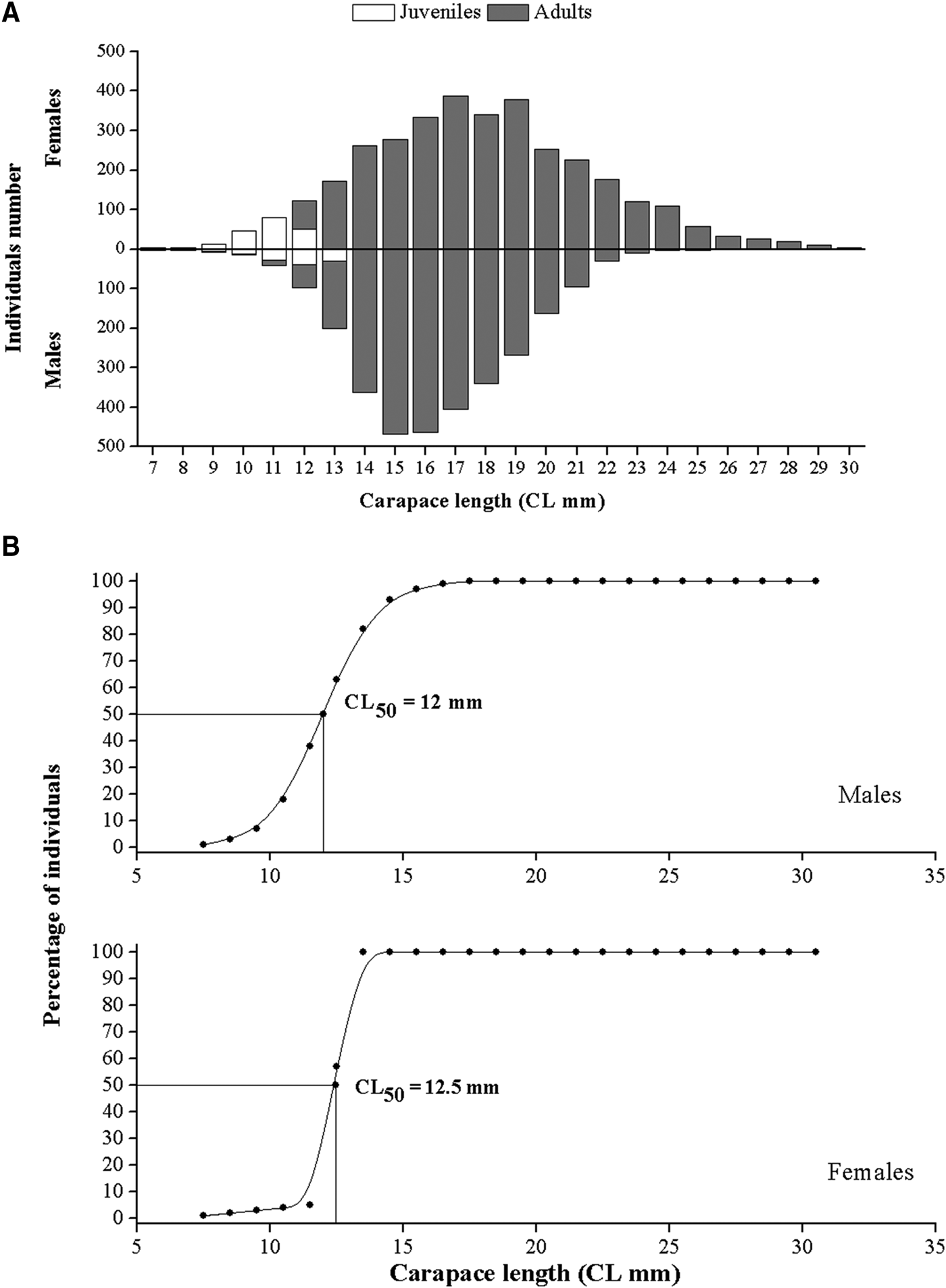
Juvenile females were present in a class from 7.00 to 12.00 mm CL, while adult females were from 12.00 to 30.00 mm CL. For males, the juveniles were found from 7.00 to 14.00 mm CL and adults, from 9.00 to 29.00 mm CL (Figure 3A). The estimation of size at onset of maturity, where 50% of individuals are mature (CL50) was 12.00 mm CL for males and 12.50 mm CL for females (Figure 3B), corresponding to ages of 67 and 87 days, respectively, calculated by von Bertalanffy's inverse formula.
Xiphopenaeus kroyeri (Heller, 1862). (A) Frequency distribution of carapace length of males, juveniles and adult females; (B) Logistic curve and interpolation where 50% of males and females reach the first maturity (CL50).

Growth and longevity
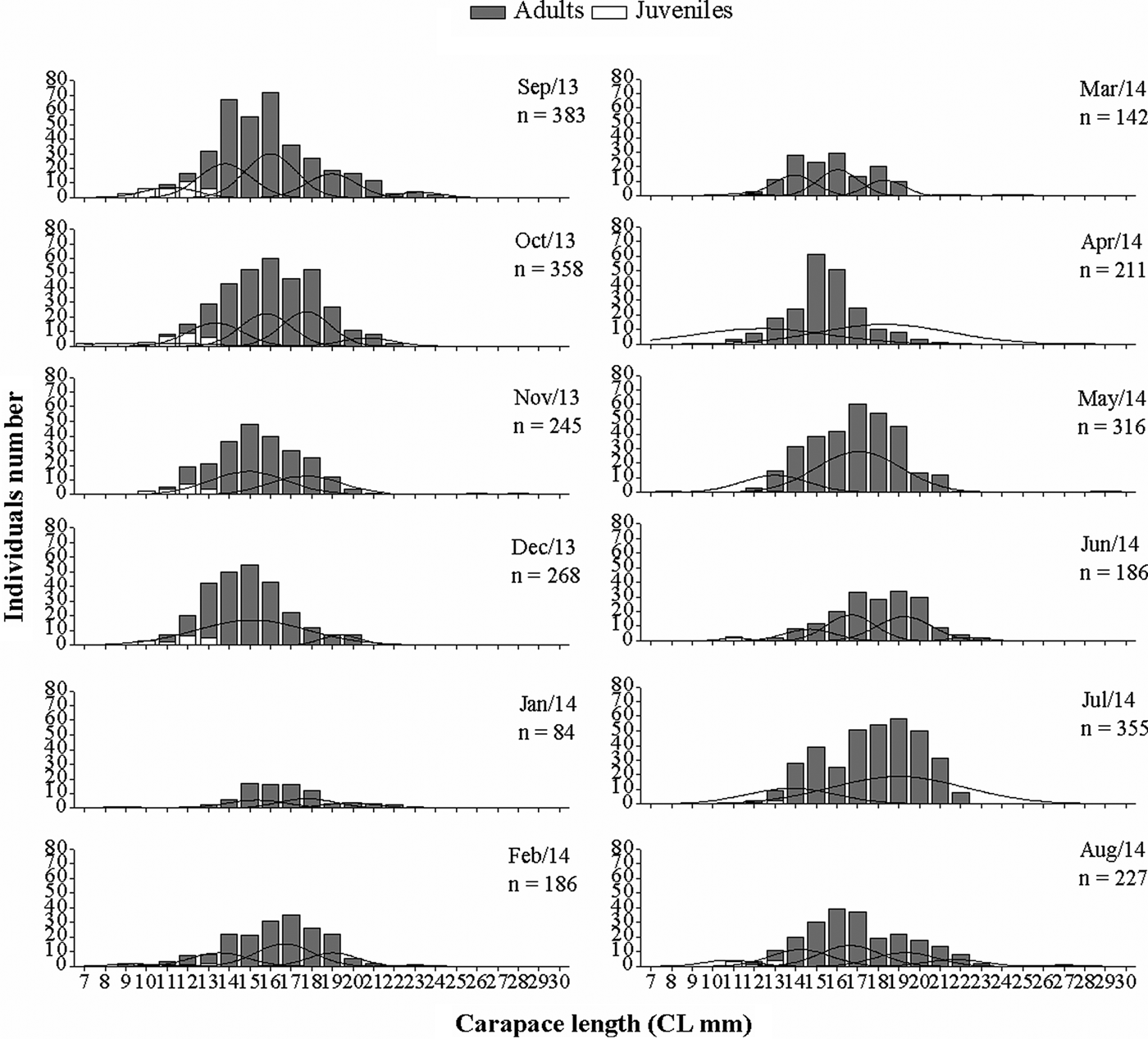
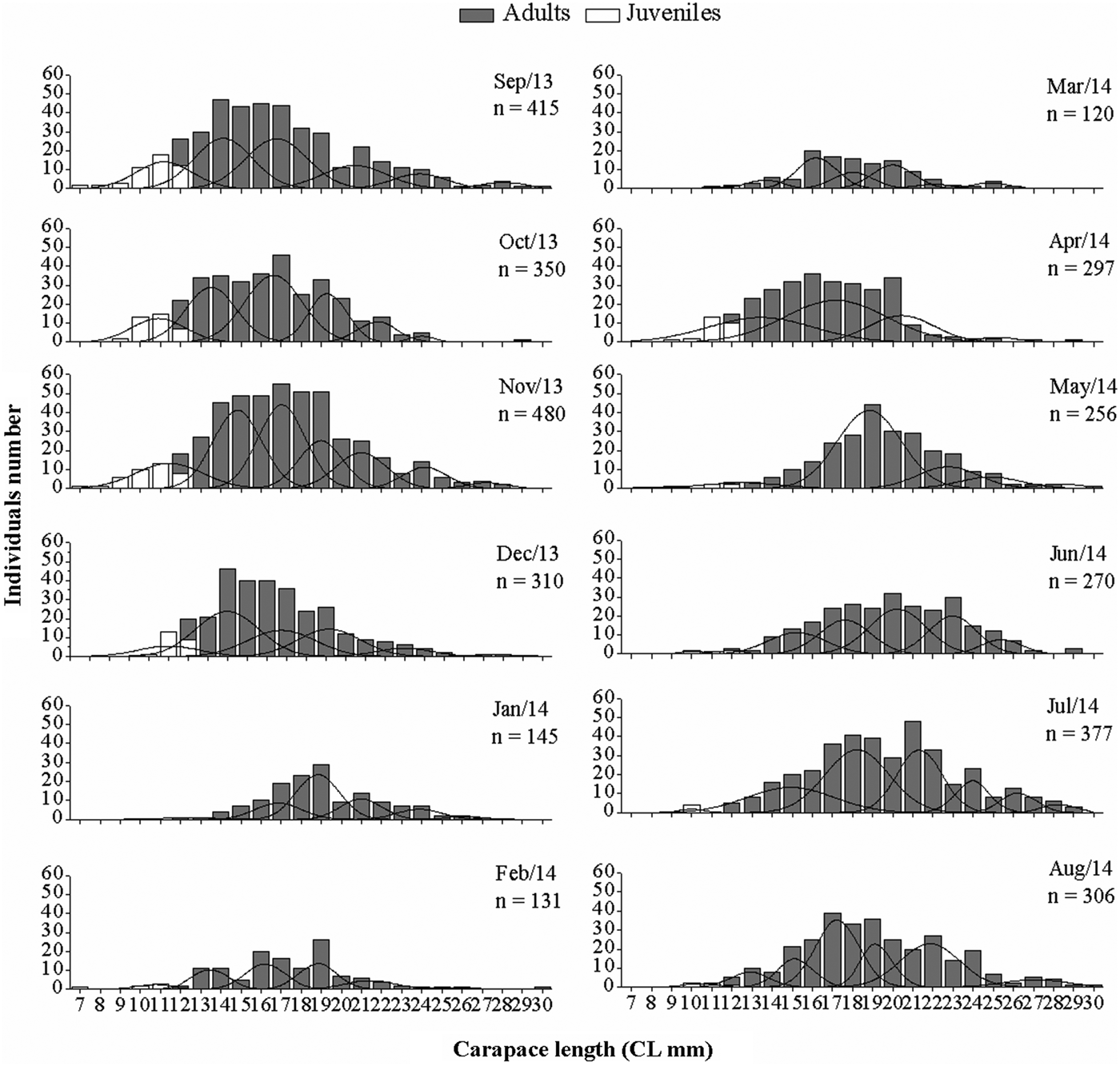
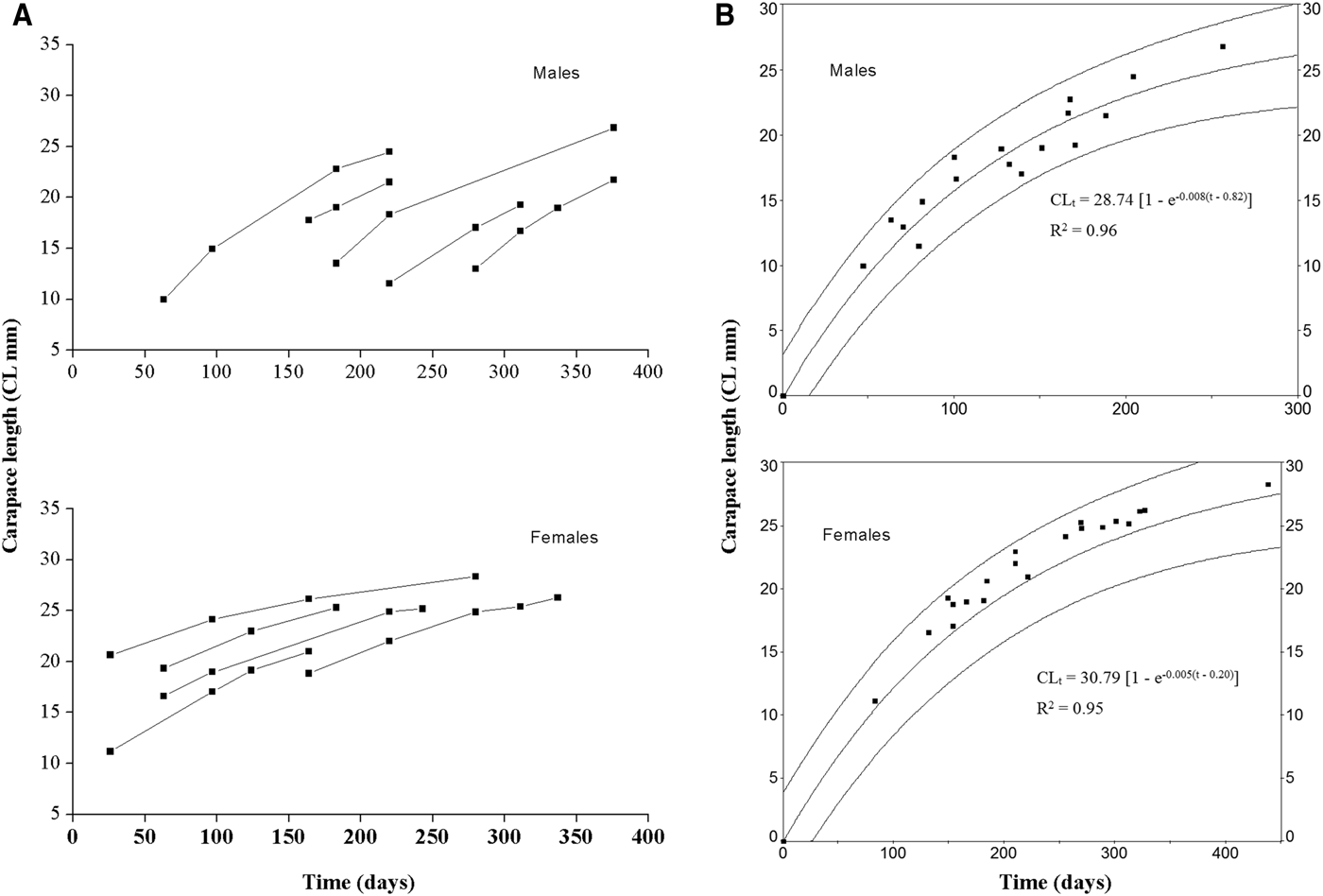
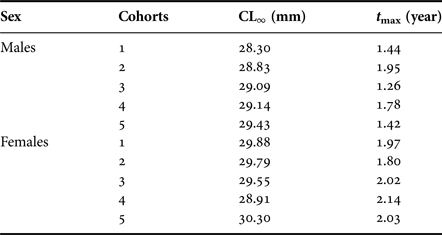
The frequency distribution showed an alternation in modal distribution pattern that was sometimes bimodal or polymodal, along months for males and females (Figures 4 and 5). Based on modal values, five cohorts for both males and females were identified (Figure 6A). We built the general growth curve by cohort grouping, obtained for males and females separately, using the von Bertalanffy equation (Table 1). According to these curves, the general growth model for each sex was determined, with estimated results as follows: CL∞ = 28.74 mm, k = 0.0081 days (2.96/year) and t 0 = −0.82 for males and CL∞ = 30.79 mm, k = 0.0058 days (2.12/year) and t 0 = 0.20 for females. Males presented smaller asymptotic sizes than females. Nevertheless, males had a higher growth coefficient.
Xiphopenaeus kroyeri (Heller, 1862). Distribution of carapace length (mm) of males, throughout the samplings (from September 2013 to August 2014). n, number of individuals. Lines, modal distribution.

Xiphopenaeus kroyeri (Heller, 1862). Distribution of carapace length (mm) of females, throughout the samplings (from September 2013 to August 2014). n, number of individuals. Lines, modal distribution.

Xiphopenaeus kroyeri (Heller, 1862). (A) Cohorts identified during samplings describing the growth of each sex; (B) Growth curves and von Bertalanffy's equation parameters estimated for males and females. The central line = mean; external lines = prediction intervals (95%).

Xiphopenaeus kroyeri (Heller, 1862). Growth parameters and longevity.

Growth parameters: CL∞, asymptotic size of carapace length. t max (year), longevity of cohorts selected to construct male and female growth curves.
The longevity was estimated in 565 days (or 1.55 years) for males and 786 days (or 2.15 years) for females. The growth curves for males and females showed significant differences (F calculated = 9.02 > F critical = 2.83; P = 0.00).
DISCUSSION
The overall sex ratio of the seabob shrimp X. kroyeri found in this study did not differ from (1:1). Similar results were observed in other Brazilian localities: in the studies by Branco (Reference Branco2005) in the State of Santa Catarina; Fernandes et al. (Reference Fernandes, Silva, Jardim, Keunecke and Di Beneditto2011) in the State of Rio de Janeiro; Eutrópio et al. (Reference Eutrópio, Mariante, Ferreira Junior and Krohling2013) in the State of Espírito Santo; Heckler et al. (Reference Heckler, Simões, Lopes, Zara and Costa2013a) and Castilho et al. (Reference Castilho, Bauer, Freire, Fransozo, Costa, Grabowski and Fransozo2015) in the State of São Paulo. This pattern agreed with the theory of sexual allocation described by Fisher (Reference Fisher1930), who assumed that for gonochoric species, the expected sex ratio is 1:1.
Nevertheless, monthly deviation occurred in favour of females for the sex ratio. Usually, spatial and temporal variation in the sex ratio can be determined by differential migration between sexes, due to intrinsic behaviour, in which reproductive females migrate to different depths (Fernandes-Góes et al., Reference Fernandes-Góes, Fransozo and Góes2005; Keunecke et al., Reference Keunecke, Silva Junior, Vianna, Verani and D'Incao2009; Costa et al., Reference Costa, Branco, Machado, Campos and Avila2010; Heckler et al., Reference Heckler, Costa, Fransozo, Rosso and Shimizu2014). However, there was no difference in spatial sex ratio in the present study.
Probably, the absence of spatial deviation is related to the fact that the population of X. kroyeri does not show stratification of their demographic categories, presenting higher abundance concentrated at 5 and 15 m depth on the continental shelf of Sergipe (Santos et al., Reference Santos, Silva, Costa, Davanso and Hirose2017), suggesting that reproductive females do not present a migration behaviour to deeper waters. Thus, other factors may influence this monthly sex ratio deviation, such as behavioural factors, since during the gonad maturation period the females may spend more time feeding due to the high metabolic rates, making them more vulnerable to sampling (Kevrekidis & Thessalou-Legaki, Reference Kevrekidis and Thessalou-Legaki2006). The deviation found in the size class sex ratio favouring females in the bigger size classes can probably be attributed to the differential growth between sexes observed in the present study, since the different mortality and growth rates can influence the sex ratio (Wilson & Pianka, Reference Wilson and Pianka1963; Wenner, Reference Wenner1972; Haley, Reference Haley1979; Trott, Reference Trott1998).
The sexual dimorphism found for X. kroyeri, in terms of the larger size of females compared with males, seems to be a typical feature of penaeidean shrimps (Boschi, Reference Boschi1969). The larger size of females occurs due to their reproductive strategy, since larger sizes result in more space for oocyte production and, consequently, fecundity is increased (Gab-Alla et al., Reference Gab-Alla, Hartnoll, Ghobashy and Mohammed1990; Yamada et al., Reference Yamada, Kodama, Yamakawa, Horiguchi and Aoki2007; Bissaro et al., Reference Bissaro, Gomes and Di Beneditto2013). The same dimorphic sexual pattern was verified in previous studies on X. kroyeri by Castro et al. (Reference Castro, Costa, Fransozo and Mantelatto2005), Grabowski et al. (Reference Grabowski, Simões and Castilho2014) and Castilho et al. (Reference Castilho, Bauer, Freire, Fransozo, Costa, Grabowski and Fransozo2015) with this shrimp species from the south-eastern coast of Brazil.
Considering the size at onset of sexual maturity, males attained sexual maturity at smaller sizes in comparison with females. These differences found between sexes of the same species are regulated, mainly, by intrinsic factors (Gab-Alla et al., Reference Gab-Alla, Hartnoll, Ghobashy and Mohammed1990; Yamada et al., Reference Yamada, Kodama, Yamakawa, Horiguchi and Aoki2007; Bissaro et al., Reference Bissaro, Gomes and Di Beneditto2013), resulting in this differential growth between sexes, which could also be related to higher growth coefficients found in male penaeidean shrimps in relation to females (García & Le Reste, Reference García and Le Reste1981; Fernandes et al., Reference Fernandes, Silva, Jardim, Keunecke and Di Beneditto2011; Bissaro et al., Reference Bissaro, Gomes and Di Beneditto2013). This pattern was found in other populations of X. kroyeri in the study of Castilho et al. (Reference Castilho, Bauer, Freire, Fransozo, Costa, Grabowski and Fransozo2015) and other Penaeoidea, Pleoticus muelleri (Spence Bate, 1888) analysed by Castilho et al. (Reference Castilho, Costa, Fransozo and Negreiros-Fransozo2008). Usually in Decapod crustaceans, males with smaller sizes than females at onset of sexual maturity have their opportunities to mate increased (Powell et al., Reference Powell, James and Hurd1974; Jivoff, Reference Jivoff2003; Almeida et al., Reference Almeida, Hiyodo, Cobo, Bertini, Fransozo and Teixeira2013).
The frequency distribution of X. kroyeri by size class shows alternation among unimodal, bimodal and polymodal distribution patterns along months for both sexes. At higher latitudes, changes in the size frequency distributions are common along months, from unimodal to bimodal and vice versa (Díaz & Conde, Reference Díaz and Conde1989). However, the unimodal, bimodal and polymodal distributions are not uncommon for crustaceans which live in tropical regions, with unimodality reflecting continuous recruitment with a constant mortality rate, but without class interruptions, and bimodality or polymodality reflecting pulses of recruitment, differential or catastrophic mortality, or behavioural differences (Díaz & Conde, Reference Díaz and Conde1989).
The occurrence of recruitment and reproduction pulses in the natural populations reflects bimodal and polymodal distributions (Castilho et al., Reference Castilho, Gavio, Costa, Boschi, Raymond and Fransozo2007b; Almeida et al., Reference Almeida, Fransozo, Teixeira, Furlan, Hiroki and Fransozo2011), as found in the present results. Previous studies have shown similar results: for X. kroyeri by Castro et al. (Reference Castro, Costa, Fransozo and Mantelatto2005), Fernandes et al. (Reference Fernandes, Silva, Jardim, Keunecke and Di Beneditto2011) and Heckler et al. (Reference Heckler, Simões, Santos, Fransozo and Costa2013b); and for another penaeid, Artemesia longinaris Spence Bate, 1888 by Castilho et al. (Reference Castilho, Gavio, Costa, Boschi, Raymond and Fransozo2007b). In the caridean shrimp Nematopalaemon schmitti (Holthuis, 1950), such features were observed by Almeida et al. (Reference Almeida, Fransozo, Teixeira, Furlan, Hiroki and Fransozo2011).
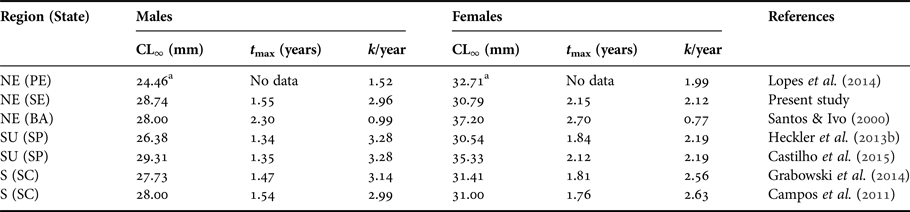
In penaeidean shrimps, males usually present elevated growth coefficients and smaller asymptotic sizes in relation to females (García & Le Reste, Reference García and Le Reste1981). In the present study X. kroyeri showed the same growth pattern, with males presenting higher growth coefficients (k) and smaller asymptotic sizes (CL∞) than females, whereas females exhibited smaller growth coefficients and higher asymptotic sizes. Studies of X. kroyeri along the Brazilian coast agreed with this pattern (Table 2). These differences between sexes can be explained by differential energy allocation (i.e. growth vs gamete production) (Pinheiro & Hattori, Reference Pinheiro and Hattori2006; Keunecke et al., Reference Keunecke, D'Incao and Fonseca2007) since there is a positive correlation between size and oocyte production, as highlighted by many authors (Gab-Alla et al., Reference Gab-Alla, Hartnoll, Ghobashy and Mohammed1990; Yamada et al., Reference Yamada, Kodama, Yamakawa, Horiguchi and Aoki2007; Bissaro et al., Reference Bissaro, Gomes and Di Beneditto2013).
Xiphopenaeus kroyeri (Heller, 1862). Comparison of growth and longevity along the Brazilian coast.

CL∞, asymptotic size of carapace; k, growth constant; t max, longevity; NE, north-east; SU, south-east; S, south; PE, Pernambuco; SE, Sergipe; BA, Bahia; SP, São Paulo; SC, Santa Catarina.
a Total length values were converted to carapace length according to equations provided by Lopes et al. (Reference Lopes, Peixoto, Frédou and Silva2014) and Silva et al. (2015).
The growth coefficient and longevity estimated for X. kroyeri (Table 2) occurred within the range of values expected for penaeid shrimp life history, proposed by D'Incao & Fonseca (Reference D'Incao, Fonseca, Klein and Schram1999), with longevity values of 1.50–2.50 years and growth coefficients of 1.80–3.60/year suggested by García & Le Reste (Reference García and Le Reste1981). Moreover, the asymptotic sizes found for this species are consistent with the maximum size observed in X. kroyeri: (females: estimate = 30.79 mm, field sample = 30.41 mm; males: estimate = 28.74 mm, field sample = 29.07 mm).
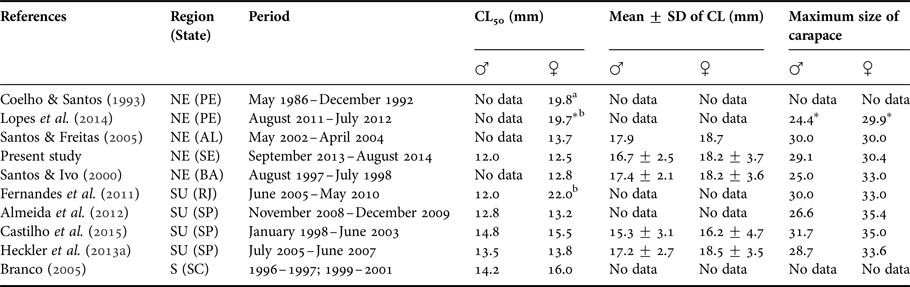
Comparing the asymptotic size and the growth coefficient for populations of X. kroyeri at different latitudes on the Brazilian coast, no latitudinal pattern was observed (Table 2). The same was found when comparing the maximum body size and the size at onset of sexual maturity of X. kroyeri at different geographic regions of Brazil, with no evident latitudinal pattern (Table 3). Although X. kroyeri is a species distributed along the Western Atlantic coast, in regions with occurrence of cold and warm water masses (Costa et al., Reference Costa, Fransozo, Melo and Freire2003; Heckler et al., Reference Heckler, Costa, Fransozo, Rosso and Shimizu2014), this species is usually found in higher abundance in shallow water, with no population stratification (Fransozo et al., Reference Fransozo, Costa, Mantelatto, Pinheiro, Santos, Escobar-Briones and Alvarez2002; Costa et al., Reference Costa, Fransozo, Melo and Freire2003, Reference Costa, Fransozo, Freire and Castilho2007; Voloch & Solé-Cava, Reference Voloch and Solé-Cava2005). This absence of a latitudinal pattern may occur because the distinct populations of X. kroyeri which are distributed along the Brazilian coast occur in areas where the water temperature is similar.
Xiphopenaeus kroyeri (Heller, 1862). Size at onset of maturity (CL50) for males (♂) and females (♀) in different regions of the Brazilian coast.

NE, north-east; SU, south-east; S, south; PE, Pernambuco; AL, Alagoas; SE, Sergipe; BA, Bahia; RJ, Rio de Janeiro; SP, São Paulo; SC, Santa Catarina.
a Rudimentary adult female classified as juveniles.
b Juveniles deleted from analysis.
* Total lengths were converted to carapace length according to the equation provided by Lopes et al. (Reference Lopes, Peixoto, Frédou and Silva2014) and Silva et al. (Reference Silva, Calazans, Nolé, Viana, Soares, Peixoto and Frédou2015).
In addition, the distribution limit of X. kroyeri ranging from tropical to subtropical (Costa et al., Reference Costa, Fransozo, Melo and Freire2003) could decrease the latitudinal effect of temperature. Thus, the morphometric data presented are consistent with this information, since in previous studies on growth of X. kroyeri, the authors found no captures at depths greater than 30 m (Santos & Ivo, Reference Santos and Ivo2000; Campos et al., Reference Campos, Branco and D'Incao2011; Heckler et al., Reference Heckler, Simões, Santos, Fransozo and Costa2013b; Grabowski et al., Reference Grabowski, Simões and Castilho2014; Lopes et al., Reference Lopes, Peixoto, Frédou and Silva2014; Castilho et al., Reference Castilho, Bauer, Freire, Fransozo, Costa, Grabowski and Fransozo2015), limiting the distribution of X. kroyeri on the continental shelves in areas with warm waters.
Higher abundances of X. kroyeri in the study area occurred in shallow waters (<15 m) (Santos et al., Reference Santos, Silva, Costa, Davanso and Hirose2017). A similar result was found in the study by Castilho et al. (Reference Castilho, Bauer, Freire, Fransozo, Costa, Grabowski and Fransozo2015) in the south-east of Brazil, who recorded higher abundance of X. kroyeri in shallow areas, decreasing the abundance at deeper regions, where the temperature is less than 22°C. This information agrees with Costa et al. (Reference Costa, Fransozo, Freire and Castilho2007), who assumed that X. kroyeri migrate to the northernmost (warmer) region of south-eastern Brazil upon the arrival of cold-water masses, in periods or areas with temperatures below 21°C.
Other factors that can influence this absence of latitudinal pattern are the different research procedures adopted, as described by Grabowski et al. (Reference Grabowski, Negreiros-Fransozo and Castilho2015). In addition, different techniques for somatic growth analysis and the non-standardization of biometric measurements make comparisons of growth parameters difficult, mainly among populations of the same species at different latitudes. Nevertheless, when we compare our results on X. kroyeri with those found on the south-eastern and southern Brazilian coasts, there was no evidence of latitudinal pattern; even when the procedures were the same for all of these regions, the growth coefficients remain lower for both sexes when compared. Furthermore, the data of mean and maximum size of carapace were accomplished with the same procedure, and they did not show any latitudinal pattern, as highlighted before.
Additionally, the absence of a latitudinal pattern in body size, maturity and growth pattern among populations of X. kroyeri from the north-east, south-east and south of Brazil, could be a consequence of the high exploitation of species from the south-east and south of Brazil (García & Le Reste, Reference García and Le Reste1981; Conover & Munch, Reference Conover and Munch2002; D'Incao et al., Reference D'Incao, Valentini and Rodrigues2002; Branco, Reference Branco2005; Vasconcellos et al., Reference Vasconcellos, Diegues, Salles and Costa2007), considering that fisheries can affect the population pattern (Grabowski et al., Reference Grabowski, Simões and Castilho2014). Our findings on the X. kroyeri population from the continental shelf of Sergipe are in accordance with population structures previously analysed for this species along the Brazilian coast. Moreover, our results contribute to the knowledge of the biology of this species in the Sergipe State and clarify hypotheses presented in relation to the latitudinal paradigm along the Brazilian coast.
ACKNOWLEDGEMENTS
We thank S. P. Barros-Alves, PhD and D. F. R. Alves, PhD for their expertise in growth analysis. We also thank IBAMA (‘Instituto Brasileiro de Meio Ambiente e dos Recursos Naturais Renováveis’) for the sample/transportation liberation of wild fauna in situ for scientific purposes Proc# n° 02070.001067/2013-96, according to the State and Federal regulatory rules Sisbio (‘Sistema de Autorização e Informação em Biodiversidade’).
FINANCIAL SUPPORT
This study was financed by the ‘Conselho Nacional de Desenvolvimento Científico e Tecnológico’ (CNPq) through the research proposal ‘Population ecology of penaeid shrimps (Decapoda: Dendrobranchiata) from the coastal region of Sergipe: Biological subsidies for adjustment of the management plan’ (Universal – MCTI/CNPQ 14/2012 proc. #482802/2012-0 to G.L.H.) and CNPq (Research Scholarship no. 305919/2014-8 to R.C.C.), and by ‘Coordenação de Aperfeiçoamento de Pessoal de Nível Superior’ (CAPES) with a scholarship grant to R.C.S. and S.L.S.R.