A series of fatal respiratory disease outbreaks during the past decade have emerged as an imminent threat to human life—severe acute respiratory syndrome (SARS) in 2002 to 2003, avian flu in 2004, and swine flu in April 2009. In March 2009, a new influenza virus called swine flu first appeared in Mexico. By April 15, the first case in the United States was confirmed by the Centers for Disease Control and Prevention (CDC). The virus was originally referred to as swine flu because laboratory testing showed that many of the genes in the virus were very similar to the influenza viruses that normally occurred in pigs. 1 On April 26, a public health emergency was declared by the US government. Then on June 11, the World Health Organization (WHO) raised the worldwide pandemic alert level to 6—its highest level—due to a global pandemic of this influenza. By June 19, all US states had reported cases of the 2009 H1N1 infection. These events highlighted the rapid development and seriousness of this pandemic influenza.
To mitigate the impact of influenza pandemics, advanced planning and pandemic preparedness have become priorities by public health agencies at all levels.Reference Das, Savachkin and Zhu 2 , Reference Ferguson, Cummings and Cauchemez 3 The prerequisites for effective emergency preparedness and response are to comprehensively understand how individuals perceive the associated risks before and during the emergency and to develop risk communication strategies that may promote appropriate public preventive behaviors.Reference Gladwin, Lazo and Morrow 4 – Reference Trainor and McNeil 6 This approach is particularly important in the case of pandemics, because in the period between the identification of the start of a pandemic and the development of mitigation strategies, the only available course to prepare for and deal with the emergency situation is through preventive behaviors and actions.Reference Ferguson, Cummings, Fraser, Cajka, Cooley and Burke 7 , Reference Low 8
Much research has investigated the public’s risk perceptions regarding novel influenza viruses and how this risk perception correlates with preventive behaviors.Reference de Zwart, Veldhuijzen and Elam 9 – Reference Liao, Cowling, Lam and Fielding 11 However, most of these studies were conducted after an influenza outbreak or used a hypothetical anticipated pandemic. Very few studies have examined the public’s risk perceptions and then their preventive behaviors during an influenza outbreak.Reference Jones and Salathé 12 The timeline is important, as individual perceptions of risk are not static and may change as the pandemic evolves.Reference Ibuka, Chapman, Meyers, Li and Galvani 10 Furthermore, as noted, perceptions of risk and the associated preventive behaviors may be most important early in the pandemic, before other control measures are available.Reference Raude and Setbon 13
Even without the element of time, the relationship between risk perception and preventative behaviors is complex. While association between the 2 is generally accepted,Reference Jiang, Elam and Yuen 14 , Reference Rubin, Amlôt, Page and Wessely 15 risk perception is a multidimensional variable that is not directly observable, which makes it difficult to accurately measure. Leppin and Aro report on a 2-dimensional model to investigate the risk perceptions of emerging infectious diseases, such as SARS and avian influenza, and describe the individual risk perception as being cognitive elements (eg, the perceived likelihood or vulnerability to contracting a specific novel influenza virus) and/or emotional (eg, the level of concern, fear, or worry of contracting influenza).Reference Leppin and Aro 16 This conceptualization and measurement of the risk perceived by the public have been reported in the studies of the 2009 H1N1 influenza,Reference Eastwood, Durrheim, Jones and Butler 17 – Reference Liao, Cowling, Lam, Ng and Fielding 19 as well as in studies of hypothetical anticipated pandemic influenza scenarios.Reference Jacobs, Taylor, Agho, Stevens, Barr and Raphael 20 – Reference Taylor, Raphael, Barr, Agho, Stevens and Jorm 22
Adding to the complexity of measuring the risk perception, both the cognitive and emotional elements of the Leppin-Aro model may be influenced by a variety of factors. Factual knowledge, for example, is often used in risk communication strategies, and it may affect the cognitive and emotional interpretations of risk perception. The relationship between factual knowledge about influenza and individual risk perception is mixed, but they appear to have a positive relationship.Reference Yap, Lee, Yau, Ng and Tor 23 , Reference Rubin, Potts and Michie 24 It is important that this relationship may change over time. Observed environmental cues that signal the beginning of an outbreak can influence how the public perceives the risk of contracting the 2009 H1N1 flu.Reference Ibuka, Chapman, Meyers, Li and Galvani 10 , Reference Liao, Cowling, Lam and Fielding 11 , Reference Yap, Lee, Yau, Ng and Tor 23
Due to the rapidly evolving situation, reliable and accurate pandemic information is not always evenly diffused to the population at the same speed, which leads to conflicting information about the disease, its risk factors, and its possible outcomes. In fact, it has been consistently reported that during the 2009 H1N1 pandemic, the public did not have sufficient knowledge about the previous strains of this novel flu. 25 – Reference Jehn, Kim, Bradley and Lant 27
Demographic characteristics also influence each individual’s risk perception. Previous studies have suggested that substantial socioeconomic differences are correlated with individual risk perceptions of the threat of, or fear of, pandemic influenza.Reference Raude and Setbon 13 Women are more concerned than men about contracting the SARS virus or about someone in their families contracting the virus.Reference Ibuka, Chapman, Meyers, Li and Galvani 10 Individuals with a lower education also tend to perceive a higher level of fear about a pandemic influenza than those who completed an intermediate or higher education.Reference Raude and Setbon 13 , Reference Brug, Aro, Oenema, de Zwart, Richardus and Bishop 28 Also, people with children in the household appear to perceive this risk differently than those without children,Reference Brewer and Hallman 29 and people who have not experienced any negative life events may perceive themselves as being less vulnerable.Reference Donner 30 , Reference Perloff and Fetzer 31
It is important to note that traditional risk perception studies have demonstrated a tendency for people to be unrealistically optimistic or downgrade their own risk when comparing themselves (ie, personal risk) to others or “average people” (ie, general risk).Reference Weinstein 32 While previous studies have focused exclusively on emerging infectious diseases and appear to follow this convention in terms of specifying the targets of risk as personal or general, some have attempted to assess risk perceptions regarding their close friends or loved ones (eg, family risk).Reference Leppin and Aro 16
While exceedingly complex, a thorough understanding of each of the components associated with a risk perception is essential if risk communicators are to successfully target and tailor messages that elicit a desirable response or change in behavior among the public. To modify messages for the maximum public health impact, the risk communicators must understand the relationship between individual risk perception and preventive behaviors. They must also understand the causal relationships between factual information/knowledge and individual risk perception for a wide variety of demographic populations.
This study aimed to examine the cognitive and emotional constructs of risk perceptions and their correlation with preventive behaviors during the peak of the 2009 H1N1 pandemic, while taking into account the demographic factors and flu knowledge/information at that time. The study has provided a somewhat novel contribution to the literature, in that its data were collected during the 2009 H1N1 pandemic, so the individual perceptions of risk were collected in real-time rather than retrospectively. We hypothesized that higher perceptions of risk are positively associated with preventive behaviors during this pandemic outbreak.
Methods
Research Context
In Arizona, the first wave of the 2009 H1N1 influenza outbreak began in late April 2009.Reference Chowell, Ayala, Berisha, Viboud and Schumaker 33 The state confirmed its first case of infection on April 29, 2009, and identified the first death associated with this influenza virus on May 14, 2009.Reference Chowell, Ayala, Berisha, Viboud and Schumaker 33 , Reference Shanks 34 The second wave of the outbreak in the state started in early September 2009, peaked in October 2009, and continued through the normal 2009 to 2010 influenza season. Based on the weekly report from the Arizona Department of Health Services, 2243 people were infected and 30 people died from influenza in Arizona by early October 2009. By the end of the normal influenza season, the total number of people in the state who had been infected and those who had died from influenza were 5620 and 122, respectively.
The Survey
A representative sample of the general public in Arizona was obtained through a random-digit-dial household telephone survey. The survey was designed to elicit responses from the adult in the household who was the primary health-related decision maker. The survey was conducted by trained interviewers using a structured questionnaire. Interviews were performed between 8:00 am and 9:00 pm on weekdays and weekends, from October 1 through 30, 2009. A translated survey questionnaire was used for respondents who spoke only Spanish. The study was approved by the institutional review board at the study institution on September 16, 2009. Verbal consent and adult confirmation were obtained from the participants before the individual surveys were conducted.
A total of 945 available telephone numbers in Arizona were identified for potential interviews, with 727 households completing the survey, for a 77% final survey sample response rate. This rate was obtained by calling the selected household phone numbers repeatedly until the interviewers reached the primary health-related decision maker in the household within the month of the survey. Sampling was designed around a 95% confidence interval, and the response rate resulted in a ±3.64% margin of error. The survey contained 53 questions and related sub-questions about the respondents’ 2009 H1N1 flu-related knowledge, risk perceptions, information-seeking behaviors, preparation plans and behaviors, and demographics.
Measures
Public perceptions of risk related to the 2009 H1N1 influenza were examined through a series of risk perception questions on a 4-point Likert scale that ranged from strongly agree (rated 1 in the original survey) to strongly disagree (rated 4). For an easier interpretation, we reversely recoded the risk perception measurements from the original coding in the present analysis; that is, the higher the risk perception score, the more likely the respondent is to agree on the risk of 2009 H1N1. At the time of the survey, the terminology of 2009 H1N1 influenza varied (ie, H1N1, swine flu, and H1N1/A). We used the term novel H1N1 in all survey questions based on consultations with public health professionals and survey design experts.
The first risk perception question was phrased as follows: How likely do you think it is that you or someone in your household will get sick with novel H1N1 in the next 12 months? This question concerned the cognitive aspect of risk perception. The second question asked, How concerned are you about the health risks of someone in your household getting sick with novel H1N1? While limited, this second question concerned the emotional aspect of risk perception. Although we specified a person and family as targets of risk for the first question, we targeted only family members for the second question.
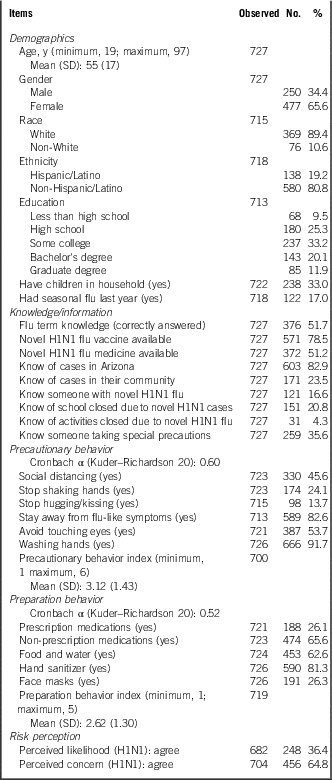
Flu-related knowledge/information was captured by 3 sets of questions: (1) the ability to distinguish between different flu terms; (2) the information on the availability of 2009 H1N1 flu vaccine or medicine; and (3) the awareness of the situation through environmental cues. The first set of questions was designed to determine if the respondents understood the differences between the terms of seasonal, swine, and novel H1N1 flu. The second set of questions asked about their knowledge of the availability of a 2009 H1N1 vaccine and medicine in October 2009. To elicit the awareness of the environmental cues, separate questions were asked that related to whether the respondents were aware of current 2009 H1N1 infectious cases in various settings (Table 1).
Descriptive Statistics

Based on previous studies, 2 sets of questions were asked to collect information on preventive behaviors. Six questions were asked to capture people’s precautionary behaviors (Table 1, Cronbach α=0.60). For preparation behaviors, 5 questions were asked about whether the respondents’ households prepared for the outbreak (Table 1, Cronbach α=0.52). Therefore, the precautionary behavior index ranged from 0 (minimum) to 6 (maximum) and the preparation behavior index ranged from 0 (minimum) to 5 (maximum).
The survey also collected the basic demographics of respondents in the past year, such as age, race, Hispanic ethnicity, education level, children in household, and history of seasonal flu.
Results
Descriptive Statistics
Of the 727 respondents, 11% were 19 to 34 years old, 59% were 35 to 64 years old, and 30% were 65 years or older. The mean age of the respondents was 55 years, and 66% were women. The majority of the respondents (89%) were white, and 19% were Hispanic. Approximately 10% had less than a high school education. For the remainder, 25% had a high school education, 33% had some college, 20% had a bachelor’s degree, and 12% had a graduate or post-college degree. Approximately 33% had at least 1 child younger than 18 years old in the household, and 17% reported that someone in their household had seasonal flu during the previous flu season.
Most respondents correctly recognized the difference between seasonal and swine flu (80% correct) and seasonal and 2009 H1N1 flu (75% correct). However, only 66% were aware that the terms of swine flu and 2009 H1N1 flu referred to the same virus. In answering all flu terminology questions, 52% of the respondents answered correctly. About 79% stated that a 2009 H1N1 vaccine existed during the survey period, but only 51% were aware of any medications for the flu.
In addition, among the respondents, 83% were aware of at least one 2009 H1N1 infection case in Arizona. Approximately 24% knew of a case in their community, and 17% personally knew at least 1 person with the flu. About 36% personally knew someone who was taking precautionary actions, and 21% knew of a school closure due to the flu. Only 4% knew of any other functions or activities that were canceled due to the flu.
Regarding the precautionary behaviors, 46% stayed away from places where large groups of people gathered; 24% stopped shaking hands; 14% stopped hugging and kissing close relatives; 83% stayed away from people with flu-like symptoms; 54% avoided touching their eyes, nose, and mouth; and 92% washed their hands more frequently. The average precautionary index score was 3.12 (±1.43). For preparation behaviors, about 26% of the respondents had an extra supply of prescription medications on hand, 66% were prepared with an extra supply of nonprescription or over-the-counter medications on hand, 63% were prepared with extra food and water, 81% purchased hand sanitizers, and 26% purchased face masks. The average preparation index score was 2.62 (±1.30).
Two Dimensions of Risk Perceptions
For perceived likelihood, only 36% of the respondents believed that they or someone in their household might get sick with the 2009 H1N1 flu in the next 12 months. In terms of perceived concern, however, 65% were concerned about someone in their household getting sick with the flu. Therefore, more people were worried about the outbreak situation, but few thought that they or someone in their household might get sick with the flu. That is, the public perceived different levels of risk regarding the likelihood and concern of contracting 2009 H1N1 flu.
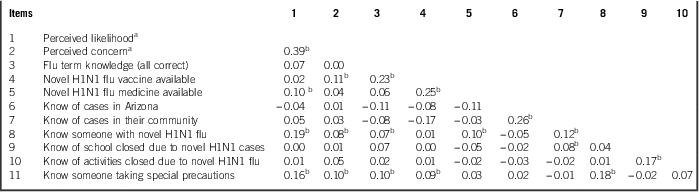
On the other hand, as seen in Table 2, the correlation between perceived likelihood and perceived concern was statistically significant (r=.39, P<.01). Perceived likelihood was highly correlated with a concern about the possibility that the respondents’ family members might become infected with the 2009 H1N1 flu. Therefore, while the public perceived different levels of risk regarding the flu, the cognitive and emotional dimensions of risk perception were strongly correlated.
Correlations Between 2009 H1N1 Influenza Risk Perceptions and Flu Knowledge/Information Follow-up

a Based on a scale of 1 (lowest rate) to 4 (highest rate) after the reversed coding of the original scale.
b P value<.05.
Risk Perceptions and Knowledge/Information
We first examined how the 2 risk perception measures were associated with the respondents’ flu-related knowledge and information (Table 2). The binary variable for flu knowledge (whether the respondent correctly answered all 3 questions related to flu terminology) was not significantly related with any of the risk perception measures we examined. It was interesting that those who answered (incorrectly) that a 2009 H1N1 flu vaccine existed at the time of the survey showed higher risk perceptions in terms of the perceived concern of their family members (r=.11, P<.01) but not for perceived likelihood. Those who correctly indicated that medicine was available for 2009 H1N1 flu showed higher risk perceptions in terms of perceived likelihood (r=.10, P<.01), but not for perceived concern. Moreover, knowing a specific person with the flu was positively correlated with perceived likelihood (r=.19, P<.01) and perceived concern (r=.08, P<.05). Also, knowing someone who was taking special precautionary actions was correlated with higher perceived likelihood (r=.16, P<.01) and higher perceived concern (r=.10, P<.01).
This analysis shows 2 findings: (1) public risk perception is more likely to be associated with knowledge/information about treatments rather than general knowledge of the flu such as flu terminology, and (2) knowing someone who has been directly affected by the flu (physically or behaviorally) results in a higher perceived risk than more general environmental cues such as school closures or awareness of cases in the larger community.
Risk Perceptions and Social Contexts
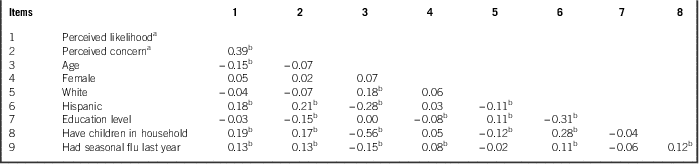
Table 3 presents the correlations between risk perception measures and demographic variables that capture the varying social contexts of respondents. The perceived likelihood of contracting 2009 H1N1 flu was correlated with 4 variables: age, ethnicity, having children younger than 18 years old in the household, and experience with seasonal flu in the last year. An increase in age was negatively correlated with a perceived likelihood of contracting 2009 H1N1 flu (r=−.15, P<.01). Hispanic respondents perceived a higher likelihood of getting the flu than non-Hispanic respondents (r=.18, P<.01). Those with children younger than 18 years old at home perceived a higher likelihood of getting the flu than those without children at home (r=.19, P<.01). Those who had seasonal flu in the past year also perceived a higher likelihood of getting 2009 H1N1 flu than those who did not experience seasonal flu in the past year (r=.13, P<.01). No significant difference was found in perceived likelihood by gender or education level.
Correlations Between 2009 H1N1 Influenza Risk Perceptions and Social Contexts

a Based on a scale of 1 (lowest rate) to 4 (highest rate) after the reversed coding of the original scale.
b P value<.05.
Perceived concern was correlated with ethnicity, education level, having children in the household, and a seasonal flu experience in the past year. The Hispanic respondents reported a higher level of perceived concern than the non-Hispanic respondents (r=.21, P<.01). An increase in level of education was inversely correlated with perceived concern (r=−.15, P<.01). Being Hispanic was also negatively associated with an increase in level of education (r=−.31, P<.01). Those with children younger than 18 years old in the household perceived a higher concern of getting 2009 H1N1 flu than those without children at home (r=.17, P<.01). Those who had seasonal flu in the past year also perceived a higher concern than those who did not experience seasonal flu in the past year (r=.13, P<.01).
These findings indicated that the public’s risk perceptions of 2009 H1N1 flu were significantly correlated with Hispanic ethnicity, having children in the household, and recent seasonal flu experience for both constructs of risk perception. No association was observed between risk perception and gender.
Risk Perceptions and Preventive Behaviors
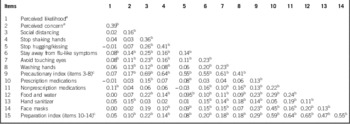
The correlations between risk perception measures and preventive behaviors are shown in Table 4. We examined individual behavioral outcomes separately and as 2 overall indexes. Among the 6 precautionary behavioral measures, the perceived likelihood of getting 2009 H1N1 flu was significantly related to staying away from people with flu-like symptoms (r=.08, P<.03) and avoiding touching one’s eyes (r=.08, P<.04). Among the 5 preparatory behavioral measures, the perceived likelihood of getting the flu was correlated only with having an extra supply of nonprescription or over-the-counter medications (r=.11, P<.01). Overall, the perceived likelihood of contracting 2009 H1N1 flu was not statistically associated with either the precautionary or the preparatory behavioral index at P<.05.
Correlations Between 2009 H1N1 Influenza Risk Perceptions and Preventive Behaviors

a Based on the scale of 1 (lowest rating) to 4 (highest rating) after the reversed coding of the original scale.
b P value<.05.
c An additive sum of behavior measures that were coded yes or no for items 3 to 8 or items 10 to 14.
On the other hand, perceived concern was correlated with 3 precautionary behavioral measures. Respondents who reported worrying more about getting 2009 H1N1 flu were also more likely to report staying away from people with flu-like symptoms (r=.14, P<.01), avoiding touching their eyes (r=.11, P<.01), and washing their hands more frequently (r=.13, P<.01). Perceived concern was also correlated with preparing for the outbreak by having hand sanitizers available (r=.15, P<.01). Overall, the perceived concern of contracting the 2009 H1N1 flu was significantly correlated with the precautionary behavioral index (r=.17, P<.01) and the preparation behavioral index (r=.10, P<.01). The higher the perceived concern of getting 2009 H1N1 flu, the more likely the public was prepared and took precautions.
Finally, we examined the association between the risk perception (cognition and emotion) and precautionary behavioral measures after controlling for the indicated sociodemographic variables examined. We used the behavioral measure indexes as dependent variables. Because Cronbach α (ie, Kuder and Richardson 20 in this case) for the preparation behavioral index was relatively low (0.52) and the model was not significant, we excluded the analysis results from the preparation behavioral index from this study.
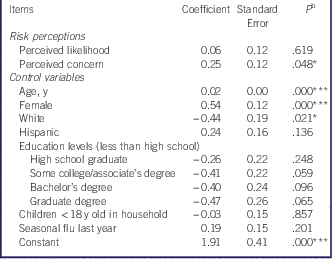
Table 5 shows the standardized coefficients of the risk perception variables for the precautionary behavioral index. After controlling for age, gender, ethnicity, and education, only perceived concern remained positively and statistically significantly associated with the precautionary behavioral index. Precautionary behavioral index scores were higher among those who worried about someone in their household contracting 2009 H1N1 flu than among those who did not worry about such a risk (P<.05). That is, people took more precautionary behaviors when they were concerned about getting this flu. The perceived likelihood of contracting the flu was not significantly associated with the precautionary behavioral index score (P<.62). Three demographic variables were significantly associated with the precautionary behavioral index score: older, female, and non-white respondents were more likely to engage in more precautionary behaviors (P<.01).
Precautionary Behaviors and Risk Perceptions, Standardized CoefficientsFootnote a

a N=620; adjusted R2=0.08. Dependent variable is precautionary behavior index (minimum score =1, maximum score =6).
For the risk perception variables, binary variables were created by combining respondents who answered “strongly agree” and “agree” into 1 group (coded 1) and those who answered “strongly disagree” and “disagree” into another group (coded 0).
b *P<.05; **P<.01; ***P<.001.
Discussion
Our survey was conducted at the peak of the second wave of the 2009 H1N1 flu pandemic. At that time, the public in Arizona had already experienced the first wave of the pandemic, and the flu season of that year was starting. Timing the research that way distinguished our study from many previous ones that had been conducted after an outbreak or had used a hypothetical scenario. Answers about how perceptions of the risk of a novel influenza change at various stages of the pandemic have driven policy decisions about risk communication messaging before, during, and after an event.
The findings of this study were consistent with those previously reported; also, a few novel observations were uncovered. First, the 2 constructs of risk perception—cognitive and emotional—were not equally associated with the preventive behaviors. The perceived likelihood of getting sick (cognitive element) was not strongly associated with preventive behaviors, whereas perceived concern (emotional element) was significantly associated with precautionary and preparatory behaviors. This correlation persisted even after controlling for other potentially associated factors. Thus, the concern about someone in the household contracting H1N1 flu appeared to be a more motivating factor than the perceived likelihood of getting sick when engaging in preventive behavior. This finding suggested that people do not necessarily need to believe they have a high probability of getting sick. Instead, to induce them to engage in preventive behavior, it is more important for them to worry about the health status of someone else in their household. In other words, even if the likelihood of disease transmission is low, people may still engage in preventive behavior if the perceived severity or risk of poor health outcomes is high for themselves or a family member who contracted the disease.
Second, risk perception is not necessarily influenced by factual knowledge about the terminology and flu. Consistent with similar studies of the risk perceptions of respiratory illnesses,Reference Brug, Aro, Oenema, de Zwart, Richardus and Bishop 28 the data show no association between an increased understanding of terms and concern for the health of household members or perceived likelihood of contracting the flu. Instead, a correlation was observed between the risk perceptions and information related to flu prevention and treatment measures.
At the time of the survey, antiviral medicine was widely available, but the 2009 H1N1 vaccine had not yet arrived in Arizona. Nevertheless, the correlation was positive between the perceived concern about contracting the 2009 H1N1 flu and the erroneous belief that the vaccine was available at the time of the survey. In other words, those who (incorrectly) thought a vaccine was available did not think the likelihood of getting sick was high, but they were still concerned about the health of someone in their home. This finding intuitively makes sense, as a vaccination should reduce an individual’s likelihood of getting the flu, but the flu may still be risky for those who have compromised immune systems, such as the very old, the very young, pregnant women, and others.
Similarly, those who believed that medicine was available for treatment thought the likelihood of illness was high, but they were not likely to be concerned about the health effects of the disease on someone in their household. Again, this was a somewhat intuitive relationship. If people think a treatment is available, they may still think they will contract the flu but will be less worried about its effects. These findings showed that information about vaccination and the availability of medicine may actually lessen the perceptions of risk and therefore reduce preventive behaviors.
Our study also adds to the existing body of evidence that risk perception is amplified when individuals personally know someone who either has the disease or is taking specific precautionary actions against the disease. The visibility of hazards and geographical proximity to the risk can also influence the public’s perceptions about the event occurring.Reference Fischhoff 35 People are more likely to perceive the situation to be risky or urgent if the threat is immediate and proximate to individuals and loved ones.Reference Donner 30 A recent empirical study has reported that when people knew that their friends and families had a greater risk of getting swine flu, they were more likely to worry about themselves and their families contracting the flu as well.Reference Prati, Pietrantoni and Zani 36
Previous research on the fear of an infectious threat has suggested that women tend to report higher risk perception scores, and highly educated individuals tend to report lower risk perception scores.Reference Raude and Setbon 13 , Reference Brug, Aro, Oenema, de Zwart, Richardus and Bishop 28 In our study, being female was not correlated with the perceived likelihood or concern of contracting 2009 HIN1 flu (individually or for family members in the household). Education level was also not significantly associated with this perceived likelihood, but it was correlated with perceived concern, which is consistent with Balkhy et al.Reference Balkhy, Abolfotouh, Al-Hathlool and Al-Jumah 37 That is, the respondents with higher education levels tended to report a lower concern about contracting the 2009 H1N1 influenza during the peak of the outbreak.
When we controlled for the 2 risk perception measures, older respondents, women, and whites tended to report engaging in more precautionary behaviors. The article by Rubin et al addressed similar topics: public perceptions, personal variables, and recommended behaviors (eg, clean or disinfect door knobs or hard surfaces) and avoidance behaviors (eg, social distancing) in relation to the swine flu outbreak using a cross-sectional telephone study.Reference Rubin, Amlôt, Page and Wessely 15 Our findings on the relationship between precautionary behaviors and gender, age, and race differed from those of Rubin et al, although the avoidance behavioral items examined in their survey were slightly different from the precautionary behavioral items in our study.Reference Rubin, Amlôt, Page and Wessely 15
One consistent finding between their study and ours was that the educational level was not statistically significantly associated with risk avoidance behavior (precautionary behavior in our case). Also, their study described a difference between respondents with no educational attainment and those who attained a higher degree. Other studies, however, have reported that educational level was positively and significantly associated with precaution measures.Reference Balkhy, Abolfotouh, Al-Hathlool and Al-Jumah 37 Given the inconsistency, it was difficult to discern whether these findings were the result of variability in the research design or if the correlation between risk perception and gender and educational level may have been influenced by the presence of unmeasured confounding variables. We have speculated that the difference may have resulted from the fact that the studies by Rubin et al and Balkhy et al did not control for risk perception when examining the association between personal variables and preventive behaviors.Reference Rubin, Amlôt, Page and Wessely 15 , Reference Balkhy, Abolfotouh, Al-Hathlool and Al-Jumah 37
Rubin et al also reported a significant association between the perceived likelihood and severity of contracting swine flu and the recommended behavioral measures after adjusting for personal variables.Reference Rubin, Amlôt, Page and Wessely 15 Although their study and ours examined each construct differently, some consensus was noted on the association between the concern about pandemic influenza and behavioral outcomes. Throughout the study, the emotional dimension of risk perception appeared to be associated with engaging in appropriate behaviors during an emergency situation. On the other hand, Prati et al reported that an affective response was a mediator for the relationship between cognitive dimension, sociocontextual variables, and following recommended behaviors.Reference Prati, Pietrantoni and Zani 36 We did not test whether the emotional dimension of risk perception was mediating the relationship between those constructs in this study, but it certainly deserves further examination in future research.
Limitations
Several limitations were observed in our survey. Previous studies have examined the role of trust of governmental authorities in predicting preventive behaviors and have found that trust plays an important role in influencing risk perceptions.Reference Rubin, Amlôt, Page and Wessely 15 , Reference Prati, Pietrantoni and Zani 38 Although the survey asked questions about the importance of the different sources of information, such as individual media, friends, family, employer, physician, and government authorities, the answers could not be used to examine the role of trust in the government and the impact of trust in influencing risk perception in this study.
Also many limitations were inherently associated with a research design using a cross-sectional telephone survey. The survey was conducted in households with landline telephones in Arizona; therefore, people using only cellular phones were not contacted. This gap inherently resulted in a selection bias. The early release of the 2008 National Health Interview Survey indicated that the percentage of US households with only a wireless telephone continues to grow and has reached about 20%.Reference Blumberg and Luke 39 A state-level estimate for Arizona during the time of the survey was approximately 19%.Reference Blumberg, Luke, Davidson, Davern, Yu and Soderberg 40
Our survey intentionally focused on interviewing the household decision makers for health-related issues because they tend to drive health-seeking behaviors of the family, and the ultimate goal of our survey was to better understand the potential impact of the flu on the surge in the capacity of the health care system. By interviewing the decision makers, this research’s design skewed the survey respondents toward those who tended to be older and female. The mean age of the respondents was 55 years old, which is higher than that of the overall Arizona population (35 years in the 2000 US Census). In addition, the survey overrepresented women (50% in Arizona) and whites (76% in Arizona) and underrepresented the Hispanic population (29% in Arizona).
For Hispanic respondents, the survey questions were translated into Spanish; however, the implementation of the translation had 2 practical limitations. First, some flu terms have no direct Spanish translation. Second, the translated survey questionnaire was implemented after mid-October 2009, due to the difficulty in finding available translators. Although these factors possibly resulted in measurement errors, the number of surveys completed in Spanish constituted a small percentage of the total respondents and most likely resulted in nondifferential misclassification of the survey results.
Conclusions
This study leveraged the timing of the peak of the second wave of a pandemic influenza outbreak in 2009 in Arizona to address an important gap in the literature. In spite of the cited limitations, our findings have several important implications regarding public risk perceptions during a public health crisis. The public responded differently to the different dimensions of risk perception. The relationship between the emotional dimension of risk perception and precautionary behavior was more plausible than that between the cognitive dimension of risk perception and precautionary behavior. Having a greater concern about contracting influenza may have induced slightly more precautionary behaviors than having a lower risk perception or no risk perception at all. In addition, our findings were consistent with previous research emphasizing the influence of significant others in forming individual risk perceptions of swine flu.Reference Liao, Cowling, Lam and Fielding 11 , Reference Prati, Pietrantoni and Zani 36 They also suggested that in future studies risk perceptions of respiratory infectious diseases should specify environmental cues that have a specific relationship to the respondent rather than by simply asking questions on general cases or areas.
Finally, previous studies and experience have consistently shown that it is important to partner with the recipients of risk communication messages to increase the effectiveness of these messages.Reference Fischhoff 35 Given the variation in risk perception and its role in inducing precautionary behaviors, risk communication and other strategies for pandemic preparedness and response need to appropriately reflect these differences among different subgroups and conditions.
Funding and Support
This study was funded by the Arizona Department of Health Services through a Health and Human Services preparedness grant, Arizona State University College of Public Program’s research seed grant, and the National Research Foundation of Korea Grant (NRF-2013S1A3A2053959).