Introduction
For many years medical science has overemphasized the psychopathological aspects of mental disorders, particularly in the case of schizophrenic and affective psychoses. Yet, for a complete understanding and successful therapy of severe mental disorders, we need to consider the patients' subjective experiences in addition to salutogenetic aspects in the course of the disorder (Strauss, Reference Strauss2011).
In recent years, the interest in clinical research of subjective determinants of recovery and health in both physical and mental disorders has increased. These subjective determinants have been examined extensively with regard to how they promote health, quality of life and autonomy by focusing on resources of patients, even in chronic courses. Examples are salutogenesis (Eriksson & Lindström, Reference Eriksson and Lindström2006, Reference Eriksson and Lindström2007), post-traumatic growth (Calhoun & Tedeschi, Reference Calhoun and Tedeschi2006), recovery (Bonney & Stickley, Reference Bonney and Stickley2008), optimism (Rasmussen et al. Reference Rasmussen, Scheier and Greenhouse2009), spirituality (Koenig, Reference Koenig2009) and subjective beliefs and meaning (Roessler et al. Reference Roessler, Salize, Cucchiaro, Reinhard and Kernig1999; Park, Reference Park2010).
Recovery from psychotic crises according to individual case histories and field reports (Boydell et al. Reference Boydell, Stasiulis, Volpe and Gladstone2010) seems to be largely influenced by patients' ability to find some sense or meaning in their disorder. These interesting findings can be explained with the human need for meaning, which is the focus of this article. Thus, the need for meaning can be seen as a universal principle to adjust to stressful life events or to maintain health in general (Frankl, Reference Frankl1988, Reference Frankl2006). The question ‘Why does this happen to me?’ is familiar to anyone facing an adverse life situation and it might be followed by the questions ‘What does it mean for my life? and What is it good for?’, reflecting causal aspects and consequences. The experience of meaningfulness in life was captured in the salutogenetic ‘sense of coherence’ scale (Antonovsky, Reference Antonovsky1979, Reference Antonovsky1993). Hardly surprising, the positive contribution of this concept to mental health and quality of life found substantial empirical support (Eriksson & Lindström, Reference Eriksson and Lindström2006, Reference Eriksson and Lindström2007).
A theoretical framework helping to understand the complex process of meaning making in the search for adjustment to a stressful life event is described in Park's recent model (2010). She defines the meaning-making process as the effort to achieve congruence between general life orientations (‘global meaning’) and the meaning of a given situation of distress (‘appraised event meaning’). In the case of discrepancy between the two, the process of meaning making begins and may result in a found meaning (‘meanings made’). Although a comprehensive assessment of Park's meaning making model has not yet been undertaken, it has been shown that the found meanings of a stressor are connoted positively or go along with positive psychological outcomes (e.g. Davis et al. Reference Davis, Nolen-Hoeksema and Larson1998: acceptance, causal understanding; Calhoun & Tedeshi, Reference Calhoun and Tedeschi2006: perceptions of personal growth or positive life changes).
With regard to our particular interest in how coping with severe mental disorders such as psychoses can be supported in clinical practice, we discovered that, to our knowledge, no quantitative empirical studies on meaning making in psychotic disorders exist. This might be explained by the severity of psychotic disorders assumed to impede the experience of positive psychological changes in the aftermath. However, research on the concept of post-traumatic growth suggests that this is not the explanation: numerous surveys provide evidence that people surviving stressful life events and existential medical conditions may report beneficial outcomes as well (Zoellner & Maercker, Reference Zoellner and Maercker2008; Barskova & Oesterreich, Reference Barskova and Oesterreich2009). The long tradition of deficit orientation in psychiatric research might be responsible for the lack of scientific interest in meaning-based coping strategies in psychoses, and an adequate instrument to assess such phenomena is still missing. Reviews of meaning-related instruments (e.g. White, Reference White2004; Fjelland et al. Reference Fjelland, Barron and Foxall2008; Park, Reference Park2010) do not list any self-report measures to capture meaning making in psychoses.
Thus, we aimed to develop and validate a new self-report instrument to assess patients' subjective experiences and meanings of their psychoses (abbreviated as SUSE, referring to subjective sense). Our aim was to assess the construct of meaning making as a coping strategy applied in psychoses, beyond case histories and qualitative studies. A variety of attitudes and opinions regarding the issue of subjective meaning was considered, ranging between the following extreme positions that can be found in the clinical field (e.g. Buck-Zerchin, Reference Buck-Zerchin2007):
(1) Psychoses are completely meaningless and random processes. The brain metabolism becomes disorganized without any reference to experience.
(2) Psychotic experiences provide an unfamiliar and overwhelming access to unconscious experiences and conflicts; their reappraisal is necessary to reach a lasting stabilization.
The new instrument paves the way for empirical exploration of the positive contribution of meaning making on outcomes and prognosis of psychoses. Therefore, we aimed to develop an economic instrument following the guidelines of classical test theory. An important objective was to display accurately the heterogeneity of individual experiences found in the field.
Method
Our questionnaire, SUSE, to assess subjective experience and meaning of psychoses was developed and evaluated in three steps.
Step 1: Item collection and construction of the first version
The development of the questionnaire was based on multiple stages of item collection and evaluation. First, items were collected by our research unit aiming to identify a broad range of possible opinions and answers to the question ‘Which subjective experiences and meanings are related to psychoses?’ An initial pool of 44 items resulted. Second, narrative interviews, focus groups and the ‘Psychosis Seminar’ (Bock & Priebe, Reference Bock and Priebe2005) in Hamburg were used to discuss the issue of subjective meaning with patients, family caregivers and professionals to refine our assumptions about an ideal item pool. Psychosis seminars are forums for the above-named groups to discuss individual perspectives (Bock & Priebe, Reference Bock and Priebe2005). The contribution of patients and family caregivers in the process of development of the instrument guarantees a high face validity of the instrument. We assorted the gained items using two criteria to cover a broad range of perspectives toward psychoses:
(1) Items were sorted by their temporal perspective in the course of the disorder: items referred to the past and the emergence of the disorder, focused on the present experience of acute symptoms of psychosis or were related to the future by looking at potential consequences.
(2) Within the three temporal categories, the items differed also in their valence: about half of the items described a positive meaning of psychoses whereas the other half focused on a negative meaning.
According to these two criteria, items were related to one of six dimensions: (1) coherent emergence of the psychosis (positive valence) versus (2) incomprehensible emergence of psychosis (negative valence), (3) positive experience of symptoms versus (4) negative experience of symptoms and (5) long-term positive effects versus (6) long-term negative effects. The resulting instrument contained 60 items that were rated on a four-point Likert scale. Additionally, open questions to each of the three temporal perspectives gave patients an opportunity to express individual aspects.
Step 2: Pre-test
Data collection for the pre-test was carried out in a cross-sectional design in two northern German hospitals. Besides completing the questionnaire, participants were asked to provide basic sociodemographic and clinical information. For details concerning the pre-test, see Bock et al. (Reference Bock, Bryzinski, Klapheck, Bening, Lenz and Naber2010) .
Participants
Inclusion criteria were a diagnosis of schizophrenia, schizotypal or a delusional disorder (ICD-10, section F2; WHO, 2009), sufficient German language skills and a minimum age of 18 years. Exclusion criteria were acute psychotic states or suicidal tendency. The questionnaire was completed by 90 patients [mean (s.d.) age 40 (9.1) years (range 21–62 years); 53% male (n=47) and 47% female (n=42); one specification missing]; 30% were in-patients (n=27), 45% out-patients (n=40) and 25% participants of the Psychosis Seminar in Hamburg (n=22).
Statistical analyses
We examined the factor structure of the questionnaire using principal component analysis (PCA) with Varimax rotation. To optimize internal consistency, items displaying ambiguous factor loadings and items showing insufficient discriminatory power (r it<0.30) were removed.
Results of the pre-test
As expected, the items could be summarized on two factors for each of the three temporal perspectives (past/present/future) by principal component factor analyses. This result supported our approach to measuring six different aspects of subjective experience and meaning of psychoses. To shorten the new questionnaire, seven out of 60 items were excluded because of insufficient factor loadings or discriminatory power. The subscales of this modified version of SUSE consisted of six to 12 items each. All subscales showed good internal consistency with Cronbach's α>0.80, apart from the subscale coherent emergence of the psychosis (six items), for which α was equal to 0.69.
For descriptive analyses the answers ‘agree’ and ‘rather agree’ were summarized to the category of agreement, ‘rather disagree’ and ‘disagree’ to the category of disagreement. For each subscale, the mean portions of agreement and disagreement to the associated items were calculated. The majority of participants (62–91%) agreed with four of the six subscales (coherent emergence of the psychosis, incomprehensible emergence of psychosis, negative experience of symptoms and positive effects) and disagreed with the other two (positive experience of symptoms and negative effects). In detail, participants agreed most strongly with the subscale that assumes a relationship between the individual biography and the emergence of psychosis (91%) and they disagreed most with long-term negative effects of the psychosis (28%).
Step 3: Main study
The main study was carried out as a cross-sectional multicentre study in 16 German and Austrian centres comprising psychiatric out-patient treatment, psychosocial community care services and out-patient day-care units of psychiatric hospitals, in addition to in-patient treatment. This broad range of treatment settings provides a high representativeness of the sample. Ethical approval was granted by the local ethics committee in Hamburg.
Participants
Inclusion and exclusion criteria were as in the pre-test, with 423 patients participating. Because of substantial data loss of more than 30% in 23 cases, data sets of only 400 patients were considered for further analyses. The mean (s.d.) age of the sample was 39 (11.2) years (range 19–73 years), 51% of participants were male and 49% female (n m=205, n f=194; one specification missing), 20% were in-patients and 66% out-patients (n i=81, n o=262; 57 specifications missing).
Instruments
SUSE (second version, consisting of 53 items and six open questions) was presented to the participants, who were again asked to provide basic sociodemographic and clinical information. In addition, professional health-care workers who had treated the participants were asked to rate symptoms and severity of the disorder using two well-established clinical instruments: (1) the Positive and Negative Syndrome Scale (PANSS; Kay et al. Reference Kay, Fiszbein and Opler1987) and (2) the Clinical Global Impression – Schizophrenia Scale (CGI-SCH; Haro et al. Reference Haro, Kamath, Ochoa, Novick, Rele and Fargas2003).
To examine the convergent construct validity, a widely used and well-validated German questionnaire to assess coping with illness was presented, the Freiburg Questionnaire of Coping with Illness [Fragebogen zur Krankheitsverarbeitung (FKV); Muthny, Reference Muthny1989]. The FKV comprises five different coping strategies: (1) depressive coping, (2) active problem-focused coping, (3) distraction and self-encouragement, (4) religious faith and search for meaning, and (5) extenuation and wishful thinking. In this context, the fourth strategy was of particular interest to prove convergent validity.
Statistical analyses
First, we analysed missing data and extreme values. Items that were rated at the end-points of the scale (1=agree or 4=disagree) by ⩾80% of the participants and thus displayed extreme item difficulty were excluded to obtain a suitable difficult instrument.
Second, taking into account that our sample consisted of individuals treated in 16 different institutions with varying treatment conditions, we also controlled for systematic data bias, that is response effects due to the different clinical context conditions, using multilevel analysis. More technically speaking, we aimed to identify the level of variance in the patients' responses that resulted from their specific treatment contexts. A level of explained variance >10% can usually be seen as an index of context relevance (Papaioannou et al. Reference Papaioannou, Marsh and Theodorakis2004, p. 102) and implies that our instrument cannot be seen as context stable. Therefore, we conducted two-level analyses. In a first step, we modelled the patients' answers on each of the six scales on level 1 as dependent variables. On level 2, we modelled the patients' medical centre (analysis 1) with respect to the in- or out-patient treatment condition of each patient (analysis 2). To estimate the degree of explained variance by the patients' context, that is their response dependence due to their specific medical centre (analysis 1) or specific treatment condition (analysis 2), in a second step we conducted so-called empty models (unconditioned models) and computed intra-class correlations (ICCs; Raudenbush & Bryk, Reference Raudenbush and Bryk2002), a common index of context effects.
According to the pre-test, the questionnaire consists of six definable subscales. To test the factorial validity of the second version of SUSE, we first assessed unidimensionality of each of these subscales through first-order confirmatory factor analyses (CFAs) and modified the subscales to decrease the item number. To obtain an overall model of the questionnaire with an optimal fit between model and data, we then compared four models of increasing complexity using a CFA. Internal consistency was assessed to identify the reliability of each subscale.
Finally, we conducted a variety of statistics (t test and Pearson's product-moment correlations) to obtain a greater understanding of the construct validity and answer effects related to the basic demographic properties. We explored the construct validity by correlating the scores on the SUSE subscales with the scores on the FKV subscales. All analyses were conducted using the common statistical software packages of SPSS 18 (IBM SPSS Statistics, USA), AMOS 18 (IBM AMOS, USA) and Mplus 6 (Muthén & Muthén, Reference Muthén and Muthén2010).
Results
Pre-analysis
For the pre-analysis, the proportion and patterns of missing values were examined. Negligible 2% average missing values (range 1–5%) resulted for the 53 items concerning the subjective meaning of psychoses. Detailed inspection showed that participants' responses were missing on the two subscales concerning the experience of symptoms due to the response option ‘symptom not experienced’. On average, 4% of participants did not experience specific enriching, positive symptoms and 5% of participants ignored the negative experience of specific symptoms.
Item analysis revealed that all item responses were spread over the full range of possible answers and maximally 65% of participants answered at an end-point of the scale (1=disagree, 4=agree), so that the difficulty of this SUSE version can be seen as adequate.
In addition, ICCs revealed no effect of the specific institutional context nor an effect of the treatment condition (in- or out-patients): the results in both analysis steps indicated only small context effects below the cut-off of 10% explained variance, implying that participants' scores on SUSE are due to individual estimations and do not simply reflect where and how their treatment took place. The found effects ranged from zero to 4%. Thus, SUSE can be seen as context stable and the data structure has not been taken into account in further analyses.
Coherence of SUSE subscales
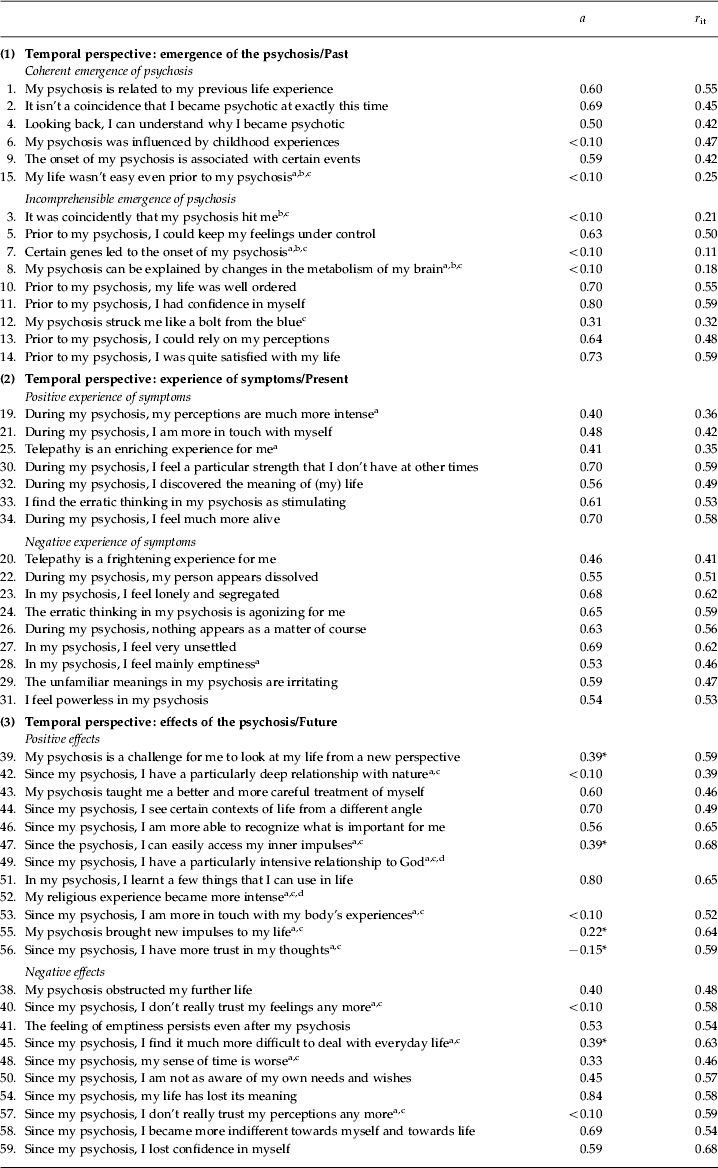
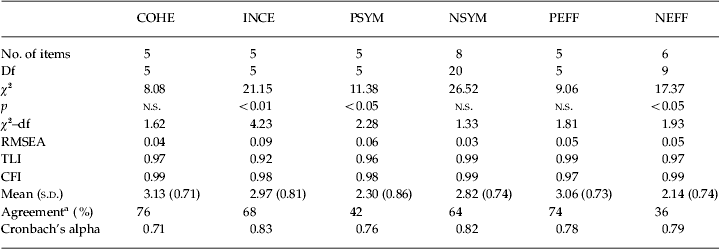
As we aimed to reduce the number of items for a more economic instrument, we first applied three criteria to delete items with inferior properties from each subscale: (1) for content reasons, (2) due to poor discriminatory power and (3) due to poor factor loadings. Therefore, factor loadings were calculated in exploratory factor analyses (EFAs) with a maximum likelihood estimator and Promax rotation procedure beforehand (see Table 1). Two items belonging to the subscale positive effects (items 49 and 52) were strongly referring to religious changes effected by the psychosis. As religious experiences are an important and complex issue in schizophrenia (Mohr et al. Reference Mohr, Gillieron, Borras, Brandt and Huguelet2007; Koenig, Reference Koenig2009), in-depth examination should follow with specific instruments to a later point and therefore both items were excluded from our analyses. To prove whether the remaining items of each of the six hypothesized SUSE subscales reflect a common underlying construct, the unidimensionality of each subscale was evaluated by first-order CFA (for model details see Byrne, Reference Byrne2001, p. 98). A schematic representation of one of these models is presented in Fig. 1. We hypothesized a priori that error terms associated with each item were uncorrelated. Table 2 shows the final item numbers of the subscales (range 5–8 items) and the calculated fit indices for the confirmatory model tests. In interpreting these we relied on common interpretation of indices, whereby a χ2–df ratio between 2 and 3 is generally regarded as satisfactory, a maximum root mean square error of approximation (RMSEA) of 0.08 is described as adequate fit (Brown & Cudeck, Reference Brown, Cudeck, Bollen and Long1993) and a minimum Comparative Fit Index (CFI) and a Tucker–Lewis Index (TLI) of 0.95 as acceptable (Hu & Bentler, Reference Hu and Bentler1999).
Subscale ‘coherent emergence of psychosis’ (COHE): test for unidimensionality (schematic representation). e, Error term.

Items of SUSE subscales with factor loadings and discriminatory power in the main study (English translation)

SUSE, Subjective Sense in Psychosis Questionnaire; a, factor loadings; r it, discriminatory power (corrected item-total correlation).
Maximum likelihood factor analysis with Promax rotation (κ=4) and Eigenvalue criterion as the extraction method.
a Item exclusion with regard to content.
b Item exclusion due to poor discriminatory power r it<0.30.
c Item exclusion due to poor factor loading a<0.40.
d Items concerning religious aspects were excluded prior to exploratory factor analyses (EFAs).
* Ambiguous loading, 328<n<398 due to missing values.
To present SUSE in a non-German sample, thorough adaptation of item wordings in a translated version will be necessary.
Unidimensionality of SUSE subscales: CFA data fit and further subscale characteristics (n=400)

SUSE, Subjective Sense in Psychosis Questionnaire; CFA, confirmatory factor analysis; COHE, coherent emergence of psychosis; INCE, incomprehensible emergence of psychosis; PSYM, positive experience of symptoms; NSYM, negative experience of symptoms; PEFF, positive effects; NEFF, negative effects; df, degrees of freedom; n.s., not significant; RMSEA, root mean square error of approximation; TLI, Tucker–Lewis Index; CFI, Comparative Fit Index; s.d., standard deviation.
a Mean portion of agreement to the associated items (answers ‘agree’ and ‘rather agree’ were summarized).
The results of the CFAs indicated predominantly acceptable goodness of fit for all of the six subscales, with the χ2–df ratio in the range 1.33–4.23, an RMSEA of 0.03–0.09, a CFI between 0.97 and 0.99 and a TLI between 0.92 and 0.99. The subscale incomprehensible emergence of psychosis showed slightly unsatisfactory indices, but taking the exploratory nature of our study into account, we considered the goodness-of-fit statistics as satisfactory. Under this solution, the internal consistency of the subscales was acceptable, with Cronbach's α between 0.71 and 0.83 (see Table 1).
Confirmation of overall factor structure of the questionnaire
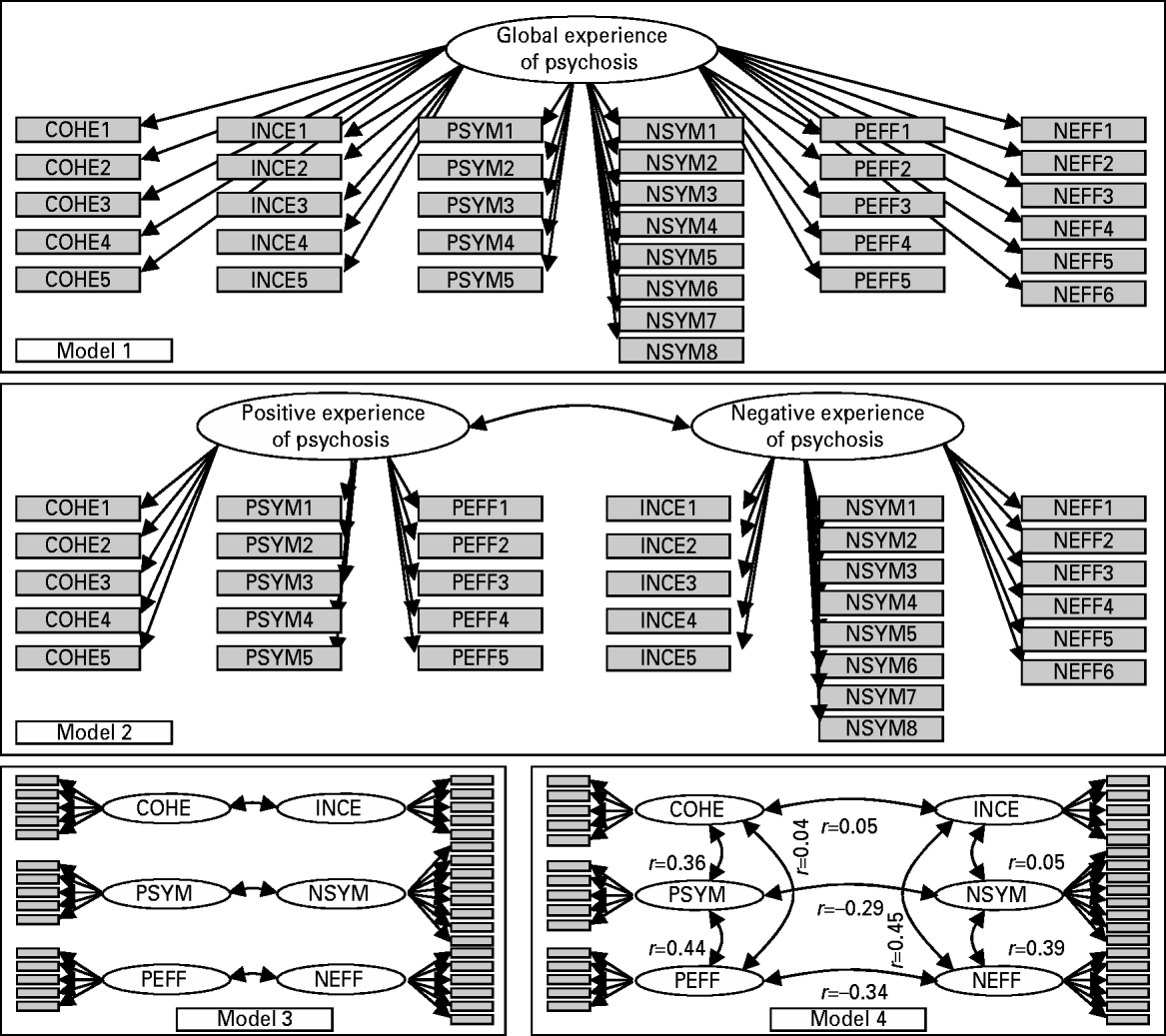
To prove the hypothesized overall structure of the questionnaire, we again used CFA. For this purpose, four different models with increasing complexity were specified to approximate our assumptions concerning meaning in psychoses described in the Introduction of this article (schematic model representations are presented in Fig. 2). Model 1 assumes a first-order model with one latent general factor ‘global experience of psychosis’, which explains all 34 items. In model 2, all items loaded on two latent factors referring to their valence of positive or negative experience/meaning of psychoses, which are correlated. Besides the valence or meaning of the experience, model 3 also accounts for the temporal perspective; accordingly, six latent factors were constructed in which every latent factor equates to one of the six subscales. In this case, three correlations were specified linking the factors that relate to the same three temporal perspectives (past emergence of psychosis, present acute symptoms and future long-term effects). Finally, model 4 provides the most complex pattern of correlations. Thus, both latent factors of the same temporal perspective and factors of the same valence (positive or negative) were linked by correlations.
Confirmatory factor analysis (CFA) models: schematic representation. Error terms are not shown for clarity. COHE, Coherent emergence of psychosis; INCE, incomprehensible emergence of psychosis; PSYM, positive experience of symptoms; NSYM, negative experience of symptoms; PEFF, positive effects; NEFF, negative effects.

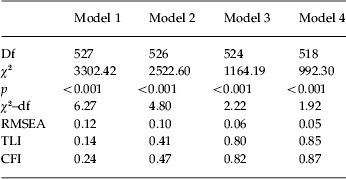
The model tests show that goodness-of-fit indices changed for the better with increasing model complexity, with model 4 as the best-fitting one (see Table 2). The χ2–df ratio decreased from 6.27 (model 1) to 1.92 (model 4) and the RMSEA from 0.12 to 0.05; both indices can be thus seen as being in a satisfactory range in model 4. The CFI ranged from 0.24 in model 1 up to 0.87 in model 4 and the TLI from 0.14 to 0.85, hence these goodness-of-fit indices remained slightly below the cut-off for an acceptable fit. Because of the restricted sample size, further model specifications including superordinate second-order factors could not be estimated.
In model 4, significant correlations exist among the subscales (Fig. 2) with a range of 0.29⩽r⩽0.45, thus on a low up to a moderate level. The strongest but still moderate correlations link a coherent emergence of psychosis to positive effects (r=0.45) and a positive experience of symptoms to positive effects (r=0.44), in addition to a negative experience of symptoms to negative effects (r=0.39). A coherent emergence of psychosis is also associated with a positive experience of symptoms (r=0.36). For two of the three temporal perspectives, positive and negative scales were negatively correlated, with r=−0.29 for the experience of symptoms and r=−0.34 for the effects of the psychosis. The subscale incomprehensible emergence of psychosis lacks any significant correlations to the other subscales.
Overall factor structure of SUSE: CFA data fit (n=400)

SUSE, Subjective Sense in Psychosis Questionnaire; CFA, confirmatory factor analysis; df, degrees of freedom; RMSEA, root mean square error of approximation; TLI, Tucker–Lewis Index; CFI, Comparative Fit Index.
Construct validity
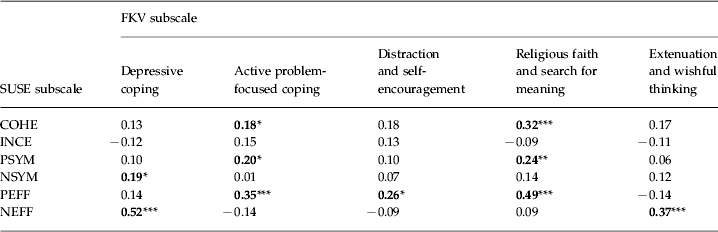
To prove the convergent construct validity of SUSE, we calculated product-moment correlations between SUSE subscales and different coping strategies assessed by the FKV (see Table 4). For this we calculated mean scores of each SUSE subscale by summarizing the scores on the related items. As the general severity of the disorder is likely to interfere with the probability of using certain coping strategies, we conducted a partial product-moment correlation controlling for the general severity of the disorder using the professional health carers' ratings on the CGI-SCH.
Correlations among SUSE subscales and coping strategies

SUSE, Subjective Sense in Psychosis Questionnaire; FKV, Freiburg Questionnaire of Coping with Illness; COHE, coherent emergence of psychosis; INCE, incomprehensible emergence of psychosis; PSYM, positive experience of symptoms; NSYM, negative experience of symptoms; PEFF, positive effects; NEFF, negative effects.
Partial correlations under control of severity of illness; bold correlations are significant with
* p<0.05, ** p<0.01 and *** p<0.001; n=114.
The results indicate that, independently from the severity of the disorder, a coping strategy of religious faith and search for meaning was significantly related to stronger agreement on the three SUSE subscales of positive meaning: coherent emergence of the psychosis (r=0.32), positive experience of symptoms (r=0.24) and positive effects of the psychosis (r=0.49). By contrast, depressive coping was related to a fairly negative experience of symptoms and negative effects of the psychosis, with r=0.19 and r=0.52 respectively.
Subscale scores
The pattern of agreement with the subscales resembled the pattern found in the pre-test: as can be seen in Table 2, the majority of participants (64–76%) agreed with the same four of the six subscales: (1) coherent emergence of the psychosis, characteristic item: ‘My psychosis is related to my previous life experience’, (2) incomprehensible emergence of psychosis, characteristic item: ‘Prior to my psychosis, I had confidence in myself’, (3) negative experience of symptoms, characteristic item: ‘In my psychosis I felt very unsettled’ and (4) positive effects of psychosis, characteristic item: ‘In my psychosis I learnt a few things that I can use in life’. Again, participants agreed most strongly with the items that assume a relationship between the individual biography and the emergence of psychosis (76%) and they agreed least with long-term negative effects (36%, characteristic item: ‘Since my psychosis, I became more indifferent towards myself and towards life’).
Regarding the basic sociodemographic parameters age and sex, the mean scores of SUSE subscales did not differ significantly for participants' subgroups. For analyses of relationships to illness characteristics such as psychopathology and symptom severity, see Nordmeyer et al. (unpublished observations).
Discussion
This article describes the development and psychometric properties of the questionnaire SUSE, an instrument to measure subjective experience and meaning of psychoses, applied for the first time in a German sample. With its good psychometric properties, the questionnaire facilitates the measurement of subjective experience and coping with psychoses beyond case histories and qualitative studies. Face validity is given by the contribution of patients who had previously experienced psychosis, and also by professionals in all steps of the construction process. The six subscales show predominantly satisfactory internal consistency and acceptable fit indices in tests for unidimensionality. The factor structure as a whole, which was derived from our clinical experience and found empirical support in the pre-test, could be replicated and further validated using CFAs. The stepwise examination of different models led to an appropriate model with the best fit between the hypothesized models and data, albeit further optimization might be helpful. Correlations with different strategies to cope with the illness confirmed the convergent construct validity of SUSE.
For a better understanding of successful coping through meaning making in psychoses, the associations between the six subscales, which differ in valence and temporal perspective, are crucial. In our view, the most interesting result is that patients who are able to see the emergence of a shattering psychosis as coherent, because they are aware of a biographical association, are more likely to judge the experience of symptoms as positive and enriching. In addition, the long-term effects of the disorder seem to be more beneficial to them. According to Park (Reference Park2010), a successful meaning-making process in the face of a situation of distress may result in a found meaning, which can be defined as causal understanding as one possibility. Another, ‘meaning made’, may be the perception of growth or positive life changes, which is subsumed in the SUSE subscale ‘positive effects of psychosis’. Although the constructive relationship between the biographical understanding and appraisals of symptoms and effects of a psychosis should not be misunderstood as causal, the results might indicate the necessity to dispute the patient's subjective perspective on the etymology of their psychosis. Hence, our findings have potential practical applications for psychotherapists, inviting them to start reflection on the psychotic experience and meaning finding with their patients.
The results of the descriptive analyses provide evidence that psychotic patients do have a strong need to give a subjective meaning to their psychosis, with almost 80% of agreement. This result supports the central theses of Frankl's meaning-based logotherapy (1988) and also Antonovsky's salutogenetic model of a sense of coherence (1993). Thus, we understand our finding as the desire to gain a distinctive self-image, coherence and inner accordance. The portion of patients who give not only a negative (>40%) but also a positive (>70%) meaning to symptoms and effects of their psychosis is substantial. In particular, the patients' report of positive consequences of the psychosis (e.g. having learnt something they can use in further life) emphasizes the validity of the concept of (post-traumatic) personal growth (Calhoun & Tedeshi, Reference Calhoun and Tedeschi2006) for persons concerned with psychoses.
There are some limitations to this study. First, we have to assume that the sample used for scale construction and validation was necessarily selective, given that patients took part voluntarily in the research project. Patients who suffer under an extreme severity of the disorder and who have the most difficulties to give meaning to their shattering experience of psychosis are less likely to participate in such research, and consequently SUSE might not adequately assess the experiences of that group.
Second, our research design of a cross-sectional study fails to capture the meaning making in psychoses over time, that is the process-related aspect of meaning making. By this, our study fails to identify cause-and-effect relationships between different aspects in this process and the possible impact on long-term outcomes of the disorder. In a further longitudinal study, the different stages of experience of and coping with the psychosis should be assessed in addition to its prognostic properties. For this purpose, it would be necessary to test the new questionnaire's responsiveness to change in the first place.
Third, the subscale incomprehensible emergence of psychosis shows inferior psychometric properties compared with all other subscales. It should integrate items that underline the shattering randomness and incoherence of the emergence of psychoses, unexplainable by biography. Furthermore, the lack of any correlations with other subscales is counterintuitive to the theoretical framework and needs clarification. Further subscale modification is necessary for optimization.
Finally, it remains unexplained whether structural aspects of experience and meaning of psychoses assessed with the SUSE subscales are most adequately represented by the factorial structure postulated in the final first-order model in this study. A further synthesis of the subscales of positive valence to a second-order factor ‘meaning making’ in opposition to another second-order factor consisting of subscales with negative valence may be advantageous.
In sum, the construction and validation of SUSE can be regarded as successful: the 34-item questionnaire measures six distinct aspects of the experience and meaning of psychoses. The instrument can easily be applied because of its brevity and many participants have given us feedback that they found it stimulating to answer. Hence, the questionnaire can be used in clinical practice and psychotherapy to facilitate discussions about subjective meaning making. In clinical research, it may function to assess meaning making as an outcome of successful coping with psychotic disorders and recovery through different therapeutic interventions.
Acknowledgements
We thank all the participants and the staff of the participating institutions, clinics and psychiatric surgeries: Sächsisches Krankenhaus für Psychiatrie und Neurologie Arnsdorf, Praxis für Neurologie, Psychiatrie, Psychotherapie Asperg, Charité Universitätsmedizin Berlin, Klinik für Psychiatrie und Psychotherapie, Evangelisches Krankenhaus Königin Elisabeth Herzberge Berlin, Abteilung Psychiatrie, Psychotherapie und Psychosomatik, Psychiatrische Tagesklinik Bünde, Rheinische Kliniken Essen Heidhausen, Klinik für Psychiatrie und Psychotherapie, Evangelisches Krankenhaus Bethanien Greifswald, Abteilung Psychotherapie, Tagesklinik und Psychiatrische Institutsambulanz, Bethesda Allgemeines Krankenhaus Hamburg Bergedorf, Klinik für Psychiatrie und Psychotherapie, Nussknacker e.V./VIA Hamburg-Altona, Soziale und medizinische Dienste Exit Sozial Linz, Psychosoziale Dienste, Isar-Amper-Klinikum München-Ost, Allgemeinpsychiatrie, Soteriastation, Psychiatrischer Rehabilitationsverbund Oldenburg (PRO) and Karl-Jaspers-Klinik Bad Zwischenahn, Zentrum für Psychiatrie Reichenau, Bruderhaus Diakonie Reutlingen, Sozialpsychiatrie.
Declaration of Interest
None.