Introduction
In recent decades, the proportion of persons exposed to psychotropic drugs has increased dramatically in developed countries (Pincus et al., Reference Pincus1998). This growing number of psychotropic prescriptions is being observed in all age groups, including the elderly. Among psychotropic medications, antidepressants are often prescribed in older persons mainly for the treatment of depression and anxiety, and less frequently for neuropathic pain and other psychiatric conditions such as obsessive-compulsive disorder and panic attacks. The prevalence of depression in older persons varies largely across studies, from 8% to 23% in the community and up to 50% in hospitalized older persons (Alexopoulos et al., Reference Alexopoulos, Buckwalter, Olin, Martinez, Wainscott and Krishnan2002). On the other hand, the few available studies showed the prevalence of anxiety to range from 3.2% to 14.2% in community-dwelling elderly people (Wolitzky-Taylor et al., Reference Wolitzky-Taylor, Castriotta, Lenze, Stanley and Craske2010). Many studies have shown that depression and anxiety, if not treated adequately, are associated with several adverse outcomes in older age groups, such as increased risk of disability, poor quality of life, and mortality (Koenig and George, Reference Koenig and George1998; Covinsky et al., Reference Covinsky, Kahana, Chin, Palmer, Fortinsky and Landefeld1999).
Antidepressants are effective in the treatment of depression and anxiety in elderly people, but these are not free of side effects depending on the class of drugs (Dolder et al., Reference Dolder, Nelson and Stump2010). Elderly persons are usually affected by multimorbidity as they are prescribed with polypharmacy and are at high risk of adverse drug reactions (Simonson and Feinberg, Reference Simonson and Feinberg2005) of greater severity than younger people. Moreover, older patients dispensed with antidepressants are per se at high risk of being prescribed with potentially conflicting medications thereby increasing the risk of adverse events (Caughey et al., Reference Caughey, Roughead, Shakib, McDermott, Vitry and Gilbert2010). Thus, it is of great importance that all medications are appropriately prescribed according to definite diagnoses. In the case of antidepressants, a particular concern is that these are often prescribed in combination with other psychotropic medications such as anxiolytics and hypnotics. Recently, Caughey and colleagues (Reference Caughey, Roughead, Shakib, McDermott, Vitry and Gilbert2010) showed that one-third of older persons dispensed with antidepressants were concomitantly prescribed benzodiazepine, which highly increased the risk of adverse drug reactions.
The aims of the study were to evaluate the prevalence of antidepressant drug prescriptions at hospital admission and discharge in elderly Italian inpatients; to analyze sociodemographic and clinical characteristics of the patients associated with antidepressant prescription; and to evaluate the consistency between prescription of antidepressants and specific diagnoses requiring this treatment.
Methods
Data collection
The present study was undertaken between January and December 2008 in 38 hospitals located in different regions of Italy, all participating in the Registro Politerapie SIMI (REPOSI) study, a collaborative effort between the Italian Society of Internal Medicine (SIMI) and the Mario Negri Institute of Pharmacological Research (see the Appendix for a list of participating units and co-authors). The REPOSI study was designed with the purpose of creating network of internal medicine and geriatric wards in order to evaluate patients affected by multiple diseases and prescribed with polypharmacy. Participation in the network was voluntary, but in selecting the participating centers attention was given to their homogeneous composition in terms of geographic distribution, size, and consecutive admission from the wards or the emergency room. The specific aims of the REPOSI study were to describe the prevalence of co-occurring multiple somatic and psychiatric diseases and treatments in hospitalized elderly patients; to correlate patients’ clinical characteristics with type and number of diseases and treatments; and to evaluate the main clinical outcomes at hospital discharge. The study included two phases: phase one was designed to create the network of internal medicine and geriatric wards, and phase two was intended to activate a registry of patients included in the study. All the patients admitted to the wards participating in the study were consecutively recruited if they were 65 years old or more. All the patients signed an informed consent. Data collection was in full compliance with the Italian law on personal data protection. Samples comprised at least 40 patients consecutively admitted to each participating center during a period of four weeks, three months apart from each other (in February, June, September, and December 2008). A standardized web-based Case Report Form was filled in by the attending physicians, including sociodemographic factors, clinical parameters, diagnoses, and treatment at the time of hospital admission and discharge, clinical events during hospitalization, and outcome. All the data recorded were collected and cleaned by a central monitor institution (the Mario Negri Institute for Pharmacological Research, Milan). In Italy, under the applicable legal principles on patients registries, the study did not require the approval of Ethical Committees; nonetheless, the Ethical Committee of one of the participating centers approved the study.
The initial study sample included 1,332 individuals; of these, patients who were not discharged home (n = 111) or who died (n = 66) during the hospital stay were excluded from analyses. Among the 111 patients not discharged home, six were terminally ill at hospital admission and transferred to end-of-life care, 44 to rehabilitation units or long-term facilities, and 61 to other hospital units due to onset of acute medical or surgical acute diseases during hospitalization. The most common causes of death were: respiratory failure (35%), cardiovascular diseases (27%), infectious diseases (14%), malignancy (8%), cerebrovascular diseases (5%), and renal failure (5%). Thus, 1,155 patients were included in the analyses at both hospital admission and discharge.
Assessment of diseases
Diseases examined in this study were collected at hospital admission and confirmed by clinical examination, clinical history, and laboratory and instrumental data collected by the attending physicians. Diagnoses were made using standardized criteria. The International Classification of Diseases – Ninth Revision (ICD-9) (World Health Organization, 1987) was used for classifying all the diseases. The following ICD-9 codes were employed (corresponding diseases are listed in alphabetical order): 280–285 (anemia); 300 (anxiety); 715 (arthritis); 427 (atrial fibrillation, AF); 430–438 (cerebrovascular diseases, CVD); 410–414 (coronary heart disease, CHD); 490–496 (chronic obstructive pulmonary disease, COPD); 585 (chronic renal failure, CRF); 290 and 331 (dementia); 296, 298, and 311 (depression); 250 (diabetes mellitus); 272 (dyslipidemia); 530–536 (gastric diseases); 428 (heart failure, HF); 401–405 (hypertension); 560–569 (intestinal diseases); 571 (liver cirrhosis); 140–165, 170–175, and 179–208 (malignancy); 600 (prostate hypertrophy); and 240–246 (thyroid diseases).
The Charlson Index was employed to evaluate the coexistence and severity of multiple diseases (Charlson et al., Reference Charlson, Pompei, Ales and MacKenzie1987). Each condition was assigned a score of 1, 2, 3, or 6 depending on the risk of dying associated with this condition. Then, the scores were summed and given a total score, which predicted mortality (Charlson et al., Reference Charlson, Pompei, Ales and MacKenzie1987).
Drug prescription
All the drugs taken at the time of hospital admission and all medications recommended at discharge were recorded and encoded according to the Anatomical Therapeutic Chemical classification system (ATC) (World Health Organization, 1990). This classification system divides drugs into different groups according to the organ or system on which they act and/or their therapeutic and chemical characteristics. Each bottom-level ATC code stands for a pharmaceutically used substance in a single indication (or use). The prescription of antidepressant drugs (ATC classification code N06A) was assessed retrospectively taking into account the pathological conditions requiring their use according to the indications approved by the Agenzia Italiana del Farmaco (AIFA, the Italian Drug Agency). The pathological conditions in which we assessed the use of N06A drug were classified on the basis of the diagnosis at hospital admission and discharge with the specific ICD-9 codes (296, 298, 311 for depression and 300 for anxiety). No patient had other diagnoses requiring the prescription of antidepressants, such as pain control or other psychiatric conditions (i.e. panic attacks or obsessive-compulsive disorders).
Statistical analysis
Prevalence per 100 antidepressant drug prescriptions at hospital admission and discharge was calculated. Categorical variables were expressed by frequency and percentages, while continuous variables were characterized as means and discrete variables as medians. Logistic regression models were run to analyze the association between characteristics of the patients and the prescription of antidepressants, and 95% confidence intervals (CI) were calculated and adjusted for participating centers. All the statistical calculations were performed with STATA software, version 9 (College Station, TX, USA).
Results
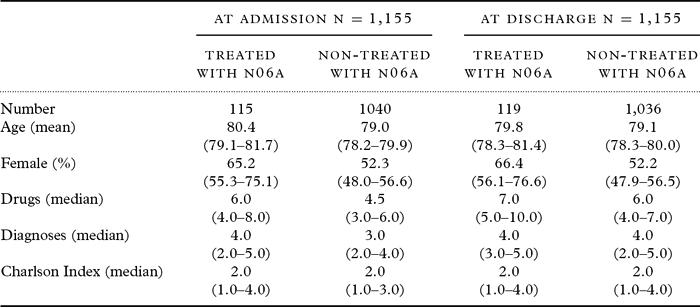
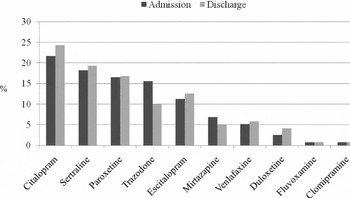
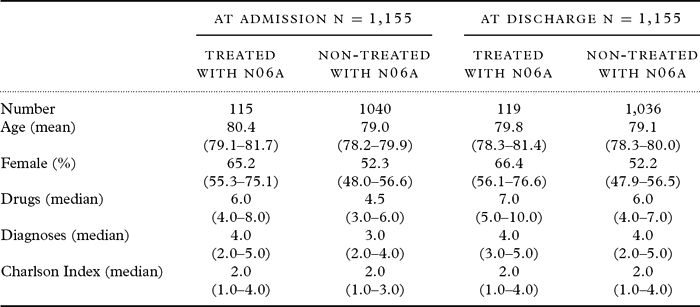
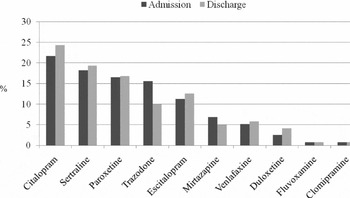
Of the 1,155 patients included in the analyses carried out at admission, 53.6% (95% CI = 49.4–57.8) were females. The mean age of the patients was 79.2 years (78.7–79.6), and the mean length of hospital stay was 11 days (10.6–11.6). The average number of prescribed drugs at hospital admission was 4.9 (4.7–5.1) and at discharge 6.0 (5.8–6.2). The most frequent diagnoses at hospital admission were hypertension (58.8%), diabetes mellitus (24.3%), CHD (22.9%), AF (20.2%), CVD (20.0%), and COPD (19.2%). The prevalence of diagnosis for depression was 2.2% at admission and 1.9% at discharge, and the prevalence of diagnosis for anxiety was 7.8% at admission and 8.5% at discharge. The number of patients treated with antidepressants during hospital stay was 115 (9.9%; 95% CI = 7.9–12.1) and at discharge 119 (10.3%; 95% CI = 7.7–12.8). Two patients at admission and six at discharge received a second antidepressant drug and one at discharge received three antidepressants. Patients treated with antidepressants were more likely to be female, receiving a higher number of drugs, affected by a higher number of diseases, and having a higher Charlson Index score (Table 1). Among all the diseases other than depression and anxiety, patients affected by dementia were more likely than those without such diagnosis to be prescribed with antidepressants at both admission and discharge (33.8% vs. 8.2%, and 28.3% vs. 8.5%, p < 0.001). Among other psychotropic medications, patients prescribed with antidepressants were more likely to be prescribed with antipsychotics (N05A) (8.7% vs. 2.9%, p < 0.001 and 8.4% vs. 4.8%, p = 0.09), anxiolytics (N05B) (22.6% vs. 9.6% and 31.9% vs. 9.6%, p < 0.001), and hypnotics (N05C) (9.6% vs. 2.5%, p < 0.001 and 5.8% vs. 2.7%, p < 0.05), respectively, at admission and discharge. The first choice active principles included in the N06A classification code are shown in Figure 1; selective serotonin reuptake inhibitors (SSRI), such as citalopram, sertraline, and paroxetine, were the most frequently prescribed drugs at both admission and discharge, followed by trazodone (Figure 1).
Characteristics of the sample according to antidepressants prescription at hospital admission and discharge. Data are presented as mean, median (first and third quartile) or percentages (95% confidence intervals) adjusted for participating centers
Prevalence per 100 (P) of active principles included in N06A category (antidepressants) at hospital admission and discharge.
Among patients taking antidepressants, only 66 (57.4%) at admission and 76 (66.1%) at discharge had a diagnosis of either depression or anxiety. Hospitalization did not significantly improve the consistency between antidepressant prescription and a related diagnosis. When only newly treated patients with antidepressants at discharge were considered (n = 22), seven of them did not have a specific discharge diagnosis.
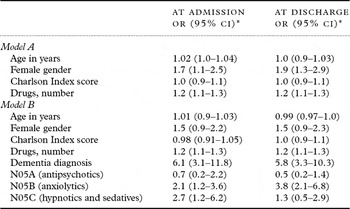
Table 2 shows the association between age, female gender, the Charlson Index, number of drugs, and use of antidepressants in Model A, whereas, in Model B, diagnosis for dementia and prescription of other psychotropic drugs were also included. A higher number of drugs, diagnosis of dementia, and prescription of anxiolytics and hypnotics were factors independently associated with the use of antidepressants in Model B at admission. At discharge, the association between hypnotics and antidepressants was not significant whether the odds ratio for anxiolytics increased or not. In fact, the absolute number of patients treated with the combination of antidepressants and anxiolytics at discharge was higher than that at admission (38 patients vs. 26, p < 0.001).
Odds ratios (OR) and 95% confidence intervals (CI) for being treated with antidepressants at both hospital admission and discharge
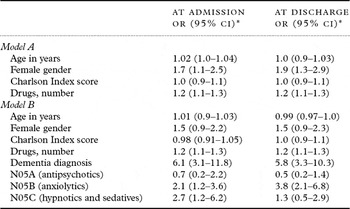
* 95% CI adjusted for participating centers.
Only 12 patients at admission and 13 at discharge were prescribed with acetylcholinesterase inhibitors. Although they were significantly associated with antidepressant prescription, the inclusion of this class of drugs in the multivariate analysis did not improve the model (data not shown).
Discussion
The main findings of this study are that antidepressants are frequently prescribed in hospitalized elderly patients and that a higher number of drugs, other psychotropic medications, and having a diagnosis of dementia are factors associated with use of antidepressants. About half of the patients treated with antidepressants do not have a specific diagnosis requiring these medications either at admission or at discharge. Hospitalization does not significantly change the inconsistency between antidepressant prescription and a related diagnosis.
In the fully adjusted model, a higher number of drugs was associated with the use of antidepressants; when the number of drugs was excluded from the analysis, a higher number of diseases emerged as significantly related to the use of antidepressants (data not shown). In the older population, depression is commonly coexistent with several chronic medical conditions requiring prescriptions of other drugs and this association can be interactive. On one hand, chronic diseases increase the risk of depression, with the prevalence of depression being up to five times higher in persons with chronic medical conditions (Moussavi et al., Reference Moussavi, Chatterji, Verdes, Tandon, Patel and Ustun2007). This strong association can be explained by the presence of disability, pain, and polypharmacy in the elderly affected by multiple diseases. On the other hand, depression can delay the diagnosis of other diseases and negatively affects medication adherence and healthy behaviors to prevent other clinical conditions (Prince et al., Reference Prince2007).
Among specific diseases besides depression and anxiety, dementia was the only diagnosis significantly associated with the prescription of antidepressants, even after multiple adjustments. The combination of dementia and depressive symptoms doubles every 5 years after the age of 70, reaching a prevalence of about 25% in persons aged 85 years or more (Arve et al., Reference Arve, Tilvis, Lehtonen, Valvanne and Sairanen1999). The efficacy of antidepressant drugs in patients affected by dementia is still debated. In fact, although several dementia patients present depressive symptoms requiring pharmacological treatment, most clinical trials have been negative, probably due to the difficulty in assessing depressive symptoms in dementia patients, instability of the symptoms, and insensitivity to antidepressant effects (Meyers, Reference Meyers1998; Rosenberg et al., Reference Rosenberg2010). The high number of patients with dementia treated with antidepressants in our population may be due to their prescription to treat depression and anxiety considered as behavioral disturbances and not reported as specific diagnoses along with dementia, or to treat other behavioral symptoms, such as apathy. Indeed, a recent review of the literature has concluded that antidepressants can be effective in the treatment of behavioral disturbances and are generally well tolerated in elderly patients affected by dementia (Henry et al., Reference Henry, Williamson and Tampi2011).
In agreement with previous studies (Caughey et al., Reference Caughey, Roughead, Shakib, McDermott, Vitry and Gilbert2010), patients prescribed with antidepressants were also more likely to receive prescriptions of other psychotropic medications, such as anxiolytics and hypnotics. Moreover, the association between anxiolytics (benzodiazepines) increased at hospital discharge. These medications are associated with sedation, increased risk of cognitive impairment, and falls in the elderly population. The risks of these adverse effects are increased with concurrent use of antidepressant drugs (Ray et al., Reference Ray, Tharpa and Gideon2000). Anxiolytics and hypnotics are often associated with antidepressant drugs for the treatment of depression or anxiety, but their use is most helpful at the beginning of the therapy. We do not have data on the length of treatment with these drugs in our sample of patients; however, in order to avoid extended periods of unnecessary combinations of antidepressants and other psychotropic drugs, and for prescriptions to remain appropriate, the elderly should periodically undergo medication review, particularly because of increased risk or presence of multimorbidity.
A large majority of patients in this study were treated with SSRIs. The most frequently prescribed active principle was citalopram regardless of the fact that a recent systematic review of the literature has shown that the small number of studies available come to no conclusion about the relative efficacy and tolerability of citalopram compared with other antidepressants (Seitz et al., Reference Seitz, Gill and Conn2010). Both first- and second-generation antidepressants are effective in the treatment of depression in elderly people although side effect profiles tend to favor SSRIs over tertiary amine tricyclics (Meyers and Jeste, Reference Meyers and Jeste2010). Less is known about the efficacy and safety of antidepressants in the oldest old and whether efficacy and safety are reduced by age-related factors such as multimorbidity and polypharmacy (Meyers and Jeste, Reference Meyers and Jeste2010). Hence, for the reasons mentioned above, it is extremely important that the prescription of antidepressants is appropriate. In this study, six patients received two antidepressants and one patient received as many as three antidepressants at hospital discharge, whereas it has been shown that adding a second or third antidepressant in elderly people is harmful and not useful (Schweitzer and Tuckwell, Reference Schweitzer and Tuckwell1998). Moreover, nearly half of the patients were prescribed these medications without specific diagnosis both at admission and discharge. Hospitalization did not significantly change the inconsistency between antidepressant prescription and related diagnosis. The hospitalization period should represent a chance for revising not only the overall pharmacological treatment of the patients (Stitt et al., Reference Stitt, Elliott and Thompson2011) but also the presence of diagnoses such as depression and anxiety, especially in elderly people already prescribed with polypharmacy. This under-reporting of diagnosis in medical records and in the administrative database (Parabiaghi et al., Reference Parabiaghi2011) may lead to underestimation of consequences and costs of specific diseases, or biases in research studies using such databases as a source of medical information.
Two major strengths of the REPOSI study are the multicenter design that involved 38 internal medicine and geriatric wards throughout Italy, resulting in a sample representative of the elderly hospitalized population of the country; and the inclusion of patients during a period of 4 weeks (one per season) in order to balance the common effect of seasons on acute diseases leading to hospitalization. However, a few limitations must also be mentioned. First, several problems can arise from using hospital data for research because hospital records are not designed for research purposes but rather for patient care, and the diagnostic quality of records may vary depending on different hospitals, physicians, and clinical units. Moreover, hospital admissions are often selective on the basis of ward characteristics, severity of disease, associated medical conditions, and admission policies that may vary from hospital to hospital. Second, information about drug prescriptions at admission was obtained directly from patients or relatives, so real drug use may be underestimated compared with information at discharge, which was collected directly by the study investigators. Third, cognitive impairment and dementia in medical inpatients can be missed by physicians, so the association of dementia with use of antidepressants could have been underestimated in our study. Finally, we did not collect follow-up data after discharge to evaluate continuity of treatment and possible drug-related adverse events.
Conclusions
Antidepressants are commonly prescribed in geriatric patients, especially in those receiving multiple drugs, other psychotropic drugs, and those affected by dementia. There is great inconsistency between prescription of antidepressants and a specific diagnosis, although hospitalization improves this slightly. Hospitalization in internal medicine and geriatric wards should represent a chance for revising the overall diagnoses and pharmacological treatment of elderly patients often affected by multimorbidity and prescribed with polypharmacy.
Conflict of interest
None.
Description of authors’ roles
A. Marengoni and G. Bianchi designed the study, analyzed data, and wrote the paper. A. Nobili, M. Tettamanti, and L. Pasina supervised the data collection and assisted with writing the paper. S. Corrao supervised statistical analysis; F. Salerno, A. Iorio, M. Marcucci, and P. M. Mannucci critically reviewed the paper.
Appendix
REPOSI collaborators and participating units
The following hospitals and investigators have contributed to this study: Pier Mannuccio Mannucci, Alberto Tedeschi, Raffaella Rossio (Medicina Interna 2, Fondazione IRCCS Ospedale Maggiore, Milano); Guido Moreo, Barbara Ferrari (Medicina Interna 3, Fondazione IRCCS Ospedale Maggiore, Milano); Cesare Masala, Antonio Mammarella, Valeria Raparelli (Medicina Interna, Università La Sapienza, Roma); Carulli Nicola, Stefania Rondinella, Iolanda Giannico (Medicina Metabolica, Università di Modena e Reggio Emilia); Leonardo Rasciti, Silvia Gualandi (Medicina Interna, Policlinico S. Orsola Malpighi, Bologna); Valter Monzani, Valeria Savojardo (Medicina d'Urgenza, IRCCS Fondazione Ospedale Maggiore, Milano); Cappellini Maria Domenica, Giovanna Fabio, Flavio Cantoni (Medicina Interna 1A, Fondazione IRCCS Ospedale Maggiore, Milano); Dallegri Franco, Luciano Ottonello, Alessandra Quercioli, Alessandra Barreca (Medicina Interna 1, Università di Genova); Riccardo Utili, Emanuele Durante-Mangoni, Daniela Pinto (Medicina Interna, Seconda Università di Napoli); Roberto Manfredini, Elena Incasa, Emanuela Rizzioli (Medicina Interna, Azienda USL, Ferrara); Massimo Vanoli, Gianluca Casella (Medicina Interna, Ospedale di Lecco, Merate); Giuseppe Musca, Olga Cuccurullo (Medicina Interna, P.O. Cetraro, ASP Cosenza); Laura Gasbarrone, Giuseppe Famularo, Maria Rosaria Sajeva (Medicina Interna, Ospedale San Camillo Forlanini, Roma); Antonio Picardi, Dritan Hila (Medicina Clinica-Epatologia, Università Campus Bio-Medico, Roma); Renzo Rozzini, Alessandro Giordano (Fondazione Poliambulanza, Brescia); Andrea Sacco, Antonio Bonelli, Gaetano Dentamaro (Medicina, Ospedale Madonna delle Grazie, Matera); Francesco Salerno, Valentina Monti, Massimo Cazzaniga (Medicina Interna, IRCCS Policlinico San Donato, Università di Milano); Ingrid Nielsen, Piergiorgio Gaudenzi, Lisa Giusto (Medicina ad Alta Rotazione, Azienda Ospedaliera Universitaria, Ferrara); Enrico Agabiti Rosei, Damiano Rizzoni, Luana Castoldi (Clinica Medica, Università di Brescia); Daniela Mari, Giuliana Micale (Medicina Generale ad indirizzo Geriatrico, IRCCS Istituto Auxologico Italiano, Milano); Emanuele Altomare, Gaetano Serviddio, Santina Salvatore (Medicina Interna, Università di Foggia); Carlo Longhini, Cristian Molino (Clinica Medica, Azienda Mista Ospedaliera Universitaria Sant'Anna, Ferrara); Giuseppe Delitalia, Silvia Deidda, Luciana Maria Cuccuru (Clinica Medica, Azienda Mista Ospedaliera Universitaria, Sassari); Giampiero Benetti, Michela Quagliolo, Giuseppe Riccardo Centenaro (Medicina 1, Ospedale di Melegnano, Vizzolo Predabissi, Milano); Alberto Auteri, Anna Laura Pasqui, Luca Puccetti (Medicina Interna, Azienda Ospedaliera Universitaria Le Scotte, Siena); Carlo Balduini, Giampiera Bertolino, Piergiorgio Cavallo (Dipartimento di Medicina Interna, Fondazione IRCCS Policlinico San Matteo, Università degli Studi di Pavia); Ronchi Esio, Daniele Bertolini, Nicola Lucio Liberato (Medicina Interna, Ospedale Carlo Mira, Casorate Primo, Pavia); Antonio Perciccante, Alessia Coralli (Medicina, Ospedale San Giovanni-Decollato-Andisilla, Civita Castellana); Luigi Anastasio, Leonardo Bertucci (Medicina Generale, Ospedale Civile Serra San Bruno); Giancarlo Agnelli, Ana Macura, Alfonso Iorio, Maura Marcucci (Medicina Interna e Cardiovascolare, Ospedale Santa Maria della Misericordia, Università di Perugia); Cosimo Morabito, Roberto Fava (Medicina, Ospedale Scillesi d'America, Scilla); Giuseppe Licata, Antonino Tuttolomondo, Riccardo Di Sciacca (Medicina Interna e Cardioangiologia, Università degli Studi di Palermo); Luisa Macchini, Anna Realdi (Clinica Medica 4, Università di Padova); Luigi Cricco, Alessandra Fiorentini, Cristina Tofi (Geriatria, Ospedale di Montefiascone); Carlo Cagnoni, Antonio Manucra (UO Medicina e Primo Soccorso, Ospedale di Bobbio, Azienda USL di Piacenza); Giuseppe Romanelli, Alessandra Marengoni, Bonometti Francesca (UO Geriatria, Spedali Civili di Brescia); Michele Cortellaro, Maria Rachele Meroni, Magenta Marina (Medicina 3, Ospedale Luigi Sacco, Università di Milano); Carlo Vergani, Dionigi Paolo Rossi (Geriatria, Fondazione IRCCS Ospedale Maggiore e Università di Milano).
Clinical data monitoring and revision: Valentina Spirito, Damia Noce, Jacopo Bonazzi, Rossana Lombardo, Luigi De Vittorio (Istituto di Ricerche Farmacologiche “Mario Negri”, Milano).