

1 Introduction
Capturing the meaning of text is key to text understanding and reasoning. These tasks could potentially improve the performance of several natural language processing applications and help tools requiring inferences, e.g. recognizing textual entailment. Even though philosophers and linguists have proposed several theories and models to represent the meaning of text, the state of the art is far from doing so automatically.
Negation is present in all human languages and it is always the case that statements are affirmative by default. Negation is marked and typically signals something unusual or an exception. It may be present in several units of language, e.g. words (incredible) and clauses (He doesn't have friends). Negation and its correlates (truth values, lying, irony, false or contradictory statements) are exclusive characteristics of humans (Horn, Reference Horn1989; Horn and Kato, Reference Horn and Kato2000).
Negation is well understood in grammars (Quirk et al. Reference Quirk, Greenbaum, Leech and Svartvik1985; Huddleston, Rodney and Pullum Reference Huddleston and Pullum2002) and the valid ways to express a negation are extensively documented. However, within computational linguistics, there has not been much work on detecting it, and more importantly, on representing its meaning. Semantic role labelers, e.g. systems trained over PropBank (Palmer, Gildea and Kingsbury, Reference Palmer, Gildea and Kingsbury2005) or FrameNet (Baker et al., Reference Baker, Fillmore and Lowe1998), and participants in the SemEval tasks regarding relation detection, e.g. Hendrick et al. (Reference Hendrickx, Kim, Kozareva, Nakov, O'Seaghdha, Padó, Pennacchiotti, Romano and Szpakowicz2009), ignore the semantics of negation. Scope detectors are a step forward, but they are far from fully representing the meaning of negation.
At first glance, one would think that interpreting negation could be reduced to finding negative keywords, detecting their scope using syntactic analysis and reversing the polarity. Actually, it is far more problematic. Negation plays a crucial role in text understanding and poses considerable challenges.
Detecting the scope of negation in itself is challenging: All vegetarians do not eat meat means that vegetarians do not eat meat, and yet All that glitters is not gold means that it is not the case that all that glitters is gold (so out of all things that glitter, some are gold and some are not). In the former example, the quantifier all has scope over the negation; in the latter, the negation has scope over all.
In classical logic, two negatives always cancel each other out. On the other hand, in language this is not always the case: she is notunhappy does not mean that she is happy; it means that she is not fully unhappy, but she is not happy either.
Some negated statements carry implicit positive meaning. For example, cows do not eat meat implicitly states that cows eat something other than meat. Otherwise, the speaker would have stated cows do not eat. A clearer example is the correct and yet puzzling statement tables do not eat meat. This sentence sounds unnatural because of the underlying positive meaning tables eat something other than meat.
Negation can express less than or in between when used in a scalar context. For example, John does not have three children probably means that he has either one or two children (as opposed to no children at all). Contrasts may use negation to disagree about a statement and not to negate it, e.g. That place is not big, it is massive defines the place as massive, and therefore, big.
This paper introduces a model that thoroughly interprets negation by surfacing implicit positive meaning. The rationale behind this relies on detecting the focus of negation. The main contributions are: (a) interpretation of negation using focus detection; incorporation of negation to (b) semantic relations and (c) composition of semantic relations (CSR) and (d) focus of negation annotation over all PropBank verbal negations. We also report experimental results on focus detection and composing semantic relations when negation is present. The work presented here builds on our first proposal to semantically represent negation (Blanco and Moldovan, Reference Blanco and Moldovan2011b).
1.1 Negation in natural language
Unlike affirmative statements, negation is marked by words (e.g. not, no, never) or affixes (e.g. -n't, un-, dis-). Negation interacts with other words in special ways. For example, negated clauses use different connective adjuncts than positive clauses do: neither, nor instead of either, or. The so-called negatively oriented polarity-sensitive items (Huddleston and Pullum, Reference Huddleston and Pullum2002) include, among many others, words starting with any- (anybody, anyone, anywhere etc.), the modal auxiliaries dare and need and the grammatical units at all, much and till. Negation in verbs usually requires an auxiliary; if none is present, the auxiliary do is inserted (I read the paper vs. I didn't read the paper).
Huddleston and Pullum (Reference Huddleston and Pullum2002) distinguish four contrasts for negation. The first two have to do with the expression of negation, while the second two have to do with meaning or interpretation:
Verbal if the marker of negation is grammatically associated with the verb (e.g. I did not see anything at all); nonverbal if it is associated with a dependent of the verb (e.g. I saw nothing at all).
Analytic if the sole function of the negated mark is to mark negation (e.g. Bill did not go); synthetic if it has some other function as well (e.g. [Nobody]agent went to the meeting).
Clausal if the negation yields a negative clause (e.g. She didn't have a large income); subclausal otherwise (e.g. She had a not inconsiderable income).
Ordinary if it indicates that something is not the case, e.g. (a) She didn't have lunch with my old man: he couldn't make it; metalinguistic if it does not dispute the truth but rather reformulates a statement, e.g. (b) She didn't have lunch with your ‘old man’: she had lunch with your father. Note that in (a) the lunch never took place, whereas in (b) a lunch did take place.
In this paper we focus on verbal, analytic, clausal and both metalinguistic and ordinary negation.
2 Previous work
Negation has been widely studied outside of computational linguistics. In traditional logic, it is usually the simplest unary operator and reverses the truth value. The seminal work on negation by Horn (Reference Horn1989) presents the main thoughts in philosophy and psychology. We follow him in the next two paragraphs.
Two of the most basic philosophical laws put forth by Aristotle are the Law of Contradiction (LC, it is impossible to be and not be at the same time) and the Law of Excluded Middle (LEM, in every case we must either affirm or deny). The Law of Excluded Middle is not always applicable to statements involving negation (e.g. one can deny being cold and not being cold). Philosophers realized that a negative statement can have latent positive meaning, e.g. Socrates is not well presupposes that Socrates is alive. They differentiate between contradictory and contrary statements: two statements are contradictories if one or the other must be true, but both cannot be true or false at the same time; they are contraries if only one can be true, but both can be false at the same time. For example, The plant is alive and The plant is dead are contradictories; The flower is white and The flower is blue are contraries.
Psychology researchers have studied the constructs, usage and cognitive processing of negation. They note that negated statements are not on equal footing with positive statements; they are a different and subordinate kind of statements. Interestingly, evidence suggests that children learn first to communicate using positive statements and acquire negation later (Horn, Reference Horn1989). Psychology also confirms the intuitive thought that humans normally communicate in positive terms and reserve negation to describe unusual or unexpected situations (Boucher and Osgood, Reference Boucher and Osgood1969).
2.1 Linguistics
Linguists have found negation a highly complex phenomenon. The Cambridge Grammar of the English Language (Huddleston and Pullum, Reference Huddleston and Pullum2002) dedicates over sixty pages to negation, covering scope and focus, verbal and non-verbal negation, polarity items (e.g. already, any) and multiple negation. This paper borrows from them the descriptions of negation types, definitions of scope and focus and several examples. Huddleston and Pullum (p. 798) also point out that the choice of focus reveals positive implicatures.
A Comprehensive Grammar of the English Language (Quirk et al., Reference Quirk, Greenbaum, Leech and Svartvik1985) covers negation in different sections of the book. Negative forms, scope and focus are covered in Sections 2.54–2.56, 10.64 and 10.65. Although very briefly, Quirk et al. (p. 86) provide an example of focus and implicated meaning: I don't drink instant coffee (focus is instant) should be interpreted as I drink some coffee, but not instant. Negative pronouns are also detailed (Section 6.62), e.g. None of the students have failed, Neither accusation is true, as well as words negative in form and meaning (e.g. not, no), words negative in meaning but not in form (e.g. seldom, little), local and double negation and negative intensification (Sections 10.54–10.70).
Rooth (Reference Rooth1985) presented a theory of focus in his dissertation, Association with Focus and posterior publications, e.g. Rooth (Reference Rooth1992). He proposes an alternative semantics (i.e. semantics of alternatives) and studies not only the focus of negated statements but also the focus of affirmative ones and questions. His alternative semantics (e.g. they didn't order the right parts implies that some alternative of the form they ordered X is true) was an inspiration for this work. In this paper we follow the insights on scope and focus of negation by Huddleston and Pullum (Reference Huddleston and Pullum2002) rather than Quirk et al. (Reference Quirk, Greenbaum, Leech and Svartvik1985) and Rooth (Reference Rooth1985).
Among others, negation interacts with quantifiers and anaphora (Hintikka, Reference Hintikka2002). For example, the reference to They is easier to solve in (a) than in (b): (a) Some of the students passed the exam. They must have studied hard; (b) Not all the students failed the examination. They must have studied hard. Negation also influences reasoning (Sánchez Valencia, Reference Sánchez Valencia1991; Dowty, Reference Dowty1994). In the simplest scenarios (Dowty, Reference Dowty1994), one can perform upward (but not downward) monotone inference with positive statements (e.g. She has a bulldog, bulldog is a dog; therefore she has a dog), and downward (but not upward) monotone inference with negative statements (e.g. She didn't give him a flower; a rose is a flower; therefore, she didn't give him a rose).
Ladusaw (Reference Ladusaw and Lappin1996) analyzes natural language negation (intra-domain and inter-domain negation, strengths of negation etc.), focusing on clausal negation, polarity items and negative concord (i.e. multiple negation). Zeijlstra (Reference Zeijlstra2007) investigates the way different languages position and form negative elements (basically negative verbs for clausal negation or negative particles for sentential negation), as well as the interpretation of negative concord. Sandu (Reference Sandu1994) extends first-order logic to represent negation, allowing for strong or dual and weak or contradictory negation. Löbner (Reference Löbner2000) studies the nature of polarity in natural languages. He formally defines the concept of falsity (p. 224) and differentiates between syntactic (when a lexically negative element is added to the sentence or is substituted for a positive element) and semantic negation (i.e. polarity counterparts, A and B are polarity counterparts of each other iff: A is true iff B is false).
2.2 Computational linguistics
Within natural language processing, negation has drawn attention mainly in the biomedical domain and sentiment analysis. Recently, two events have dealt directly with negation, specifically scope detection. Most contributions to the Negation and Speculation in Natural Language Processing workshop (Morante and Sporleder, Reference Morante and Sporleder2010) focused in the aforementioned subfields. The CoNLL-2010 Shared Task (Farkas et al., Reference Farkas, Vincze, Móra, Csirik and Szarvas2010) aimed at the detection of hedges and their scope.
There have been several proposals to detect the scope of negation, most of them are within the biomedical domain and use the BioScope corpus. The first approach to model the problem as a classification task was made by Morante, Liekens and Daelemans (Reference Morante, Liekens and Daelemans2008). They present a supervised scope detector in two phases: hedge cue identification, and scope finding. They use standard machine learning algorithms and a very specialized feature set for scope detection. Özgür and Radev (Reference Özgür and Radev2009) present a similar two-phase approach. They use more sophisticated features for detecting keywords, but decide scopes based upon manually defined syntactic rules. Øvrelid, Velldal and Oepen (Reference Øvrelid, Velldal and Oepen2010) propose another two-step scope detector for uncertainty: first, they use a maximum entropy classifier for identifying cue words; second, they define hand-crafted rules over dependency representations to decide their scope. Councill, McDonald and Velikovich (Reference Councill, McDonald and Velikovich2010) present a supervised scope detector using their own corpus. They manually annotated the scope of negations contained in product reviews and apply their scope detector to sentiment classification. Li et al. (Reference Li, Zhou, Wang and Zhu2010) approach scope detection from a novel perspective. Using ideas from traditional semantic role labeling, they treat negation clues as predicates and their scopes as predicate arguments. Their models outperform scope detectors based on chunking techniques.
Negation has been incorporated in systems performing sentiment and opinion analysis. The main goal of these efforts is to improve sentiment classification and related tasks by introducing some basic treatment of negation. They do not consider focus or implicit positive meaning, and their approaches to scope resolution use heuristics. Wiegand et al. (Reference Wiegand, Balahur, Roth, Klakow and Montoyo2010) survey the role of negation in sentiment analysis. Pang, Lee and Vaithyanathan (Reference Pang, Lee and Vaithyanathan2002) mark as negated all words between a negation word (not, isn't, didn't etc.) and the first punctuation mark following that word. Hu and Liu (Reference Hu and Liu2004) flip the opinion orientation of words within a five-word window of a negation word. Jia, Yu and Meng (Reference Jia, Yu and Meng2009) propose several heuristics and exceptions to determine scope of negation for sentiment analysis.
Some natural language processing applications deal indirectly with negation, e.g. machine translation (van Munster, Reference van Munster1988) and text classification (Rose et al., Reference Rose, Roque, Bhembe and Vanlehn2003). These applications only treat negation to improve the performance of a particular application and do not offer a model to semantically represent it. Boxer (Reference Bos, Bos and Delmonte2008), an off-the-shelf semantic parser, accounts for negation and detects its scope, but disregards focus.
A phenomenon related to negation is factuality, that is, the quality of being actual or based on a fact. Computational approaches to event factuality aim at recognizing whether events are presented as corresponding to real situations in the world, situations that have not happened or situations of uncertain status (Saurí and Pustejovsky, Reference Saurí and Pustejovsky2008). Determining the factuality of events has been used for recognizing textual entailment (Saurí and Pustejovsky, Reference Saurf and Pustejovsky2007).
Regarding corpora, the BioScope corpus (Szarvas et al., Reference Szarvas, Vincze, Farkas and Csirik2008) annotates negation marks and linguistic scopes exclusively on biomedical texts. BioScope does not annotate focus of negation and purposely ignores negations such as the reactions in NK3.3 cells are not always identical (Szarvas et al., Reference Szarvas, Vincze, Farkas and Csirik2008), which carry the kind of positive meaning this work aims at extracting (the reactions in NK3.3 cells are sometimes identical). Morante (Reference Morante2010) depicts twenty-nine common negation clues found in BioScope and discusses their ambiguity.
Even though scope detectors trained using BioScope achieve a relatively high performance, it remains unknown how well they will perform in other domains. There is an ongoing effort that will allow the community to answer this question soon enough. Scope of negation is being annotated over the novel The Hound of the Baskervilles by Conan Doyle (Reference Morante, Schrauwen and Daelemans2011). Authors point out several interesting phenomena that greatly influence negation and are not found in BioScope due to its limited domain. For example, ‘negation words in exclamative particles do not have a negation function, e.g. Don't tell that it is our friend Sir Henry!’.
PropBank (Palmer et al. Reference Palmer, Gildea and Kingsbury2005) adds a layer of predicate-argument information, or semantic role labels, to the syntactic structures of the Penn Treebank. When it comes to negation, the only information provided for a negation mark is the verb it attaches to, labeled with mneg. Predicting this label is rather simple, the best performing system (Koomen et al., Reference Koomen, Punyakanok, Roth and Yih2005) participating in CoNLL-2005 Shared Task (Carreras and Màrquez, Reference Carreras and Màrquez2005) achieved an f-measure of 97.61. mneg, though, does not help much capturing the meaning of verbal negation (Section 3.1).
FrameNet (Baker et al., Reference Baker, Fillmore and Lowe1998) is based on frame semantics (Fillmore, Reference Fillmore1976). It provides a set of frames, their participants (frame elements using their jargon) and tokens that can instantiate the frame. The resource has been widely used and proven useful to encode the meaning of text, but it ignores negation.
FactBank (Saurí and Pustejovsky, Reference Saurí and Pustejovsky2009) annotates degrees of factuality for event mentions. It considers several factuality values: certainly, probably or possibly positive, and certainly, probably or possibly negative. In addition, an event can be labeled underspecified (Saurí and Pustejovsky, Reference Saurí and Pustejovsky2008).
None of the above references aim at detecting or annotating the focus of negation in natural language. Neither do they aim at carefully representing the meaning of negated statements nor extracting implicit positive meaning from them. To the best of our knowledge, the work described in this paper is the first attempt to automatically tackle these problems within computational linguistics.
3 The semantics of negation
Simply put, negation is a process that turns part of a statement into its opposite. However, pinpointing what is negated and what is implicitly positive is challenging.
3.1 Negation and implicit positive meaning
State-of-the-art semantic role labelers, e.g. the ones trained over PropBank (Kingsbury, Palmer and Marcus, Reference Kingsbury, Palmer and Marcus2002) or NomBank (Meyers et al., Reference Meyers, Reeves, Macleod, Szekely, Zielinska, Young and Grishman2004), do not accurately represent the meaning of negated statements. Given John didn't build a house to impress Mary, they encode agent(John, build) & theme(a house, build) & purpose(to impress Mary, build) & negation(n't, build). This representation corresponds to the interpretation it is not the case that John built a house to impress Mary, ignoring that it is implicitly stated that John built a house, but not to impress Mary. Another option to interpret the above representation is (a) it is not the case that John built, (b) it is not the case that a house was built and (c) it is not the case that a building took place to impress Mary. Note that both options are not logically equivalent and none detect any positive meaning.
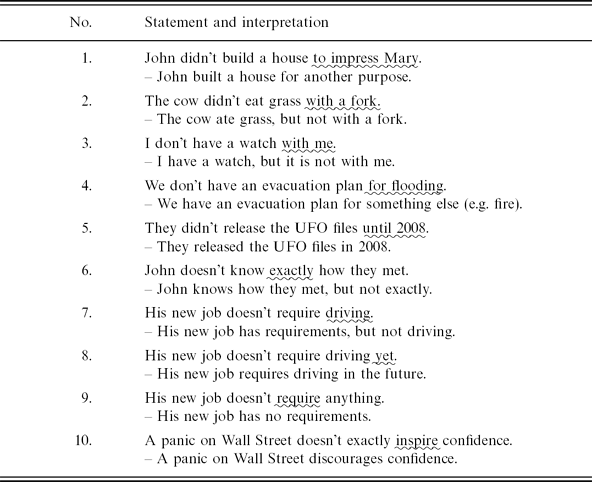
Several examples of negated statements carrying implicit positive meaning are shown in Table 1. For all statements s, role labelers would only encode it is not the case thats. However, the negations in examples (1–8) carry positive meaning underneath the direct meaning:
• Examples (1–4) are simple, in both cases humans would skip the last prepositional phrase unless they intend to convey the proposed positive meaning.
• Regarding (5), encoding that the UFO files were released in 2008 is crucial to fully interpret the statement.
• Statements (7–9) show that different verb arguments modify the interpretation and even signal the existence of positive meaning.
• Examples (6 and 10) further illustrate the difficulty of the task; they are very similar (both have agent, theme and manner) and their interpretation is altogether different.
Examples of negated statements and their interpretation considering underlying positive meaning. Wavy underlines indicate the focus of negation (Section 3.2); the negations in examples (9 and 10) do not carry any positive meaning

Note that the negations in statements (9 and 10) do not carry any positive meaning, but the statements as a whole do, e.g. statement (9) implies he has a new job. Even though the interpretations of statements (9 and 10) do not contain a verbal negation, the meaning remains negative. Some examples could be interpreted differently depending on the context (Section 5.1). For example, if the next sentence to example (1) from Table 1 were He built a castle, we would have John didn't build a house to impress Mary (i.e. John built something to impress Mary, but not a house); if it were He acquired a mansion, we would have John didn't build a house to impress Mary (i.e. a building did not take place).
3.2 Scope and focus of negation
Negation has both scope and focus and these are extremely important to capture its semantics. Scope is the part of the meaning that is negated. Focus is that part of the scope that is most prominently or explicitly negated (Huddleston and Pullum, Reference Huddleston and Pullum2002).
The two concepts are interconnected. Scope refers to all elements whose individual falsity would make the negated statement strictly true. Focus is the element of the scope that is intended to be interpreted as false to make the overall negative true. Huddleston and Pullum (Reference Huddleston and Pullum2002) provide the following description for focus:
In all but the most trivial negative clauses there are several different conditions whose failure to hold would cause the clause to be strictly true. Which condition is intended can be indicated by a speaker through the device of stressing the most closely associated word. A constituent marked by stress as being crucial to the way in which an instance of negation should be understood is called the focus of that negation.
Consider statement (1) and its positive counterpart (2):
1 Cows don't eat meat.
2 Cows eat meat.
The truth conditions of statement (2) are: (a) somebody eats something; (b) cows are the ones who eat; and (c) meat is what is eaten. In order for statement (2) to be true, conditions (a–c) have to be true.
On the other hand, the falsity of any of the conditions (a–c) is sufficient to make statement (1) true. In other words, statement (1) would be true if nobody eats, cows don't eat or meat is not eaten. Therefore, all three conditions (a–c) are inside the scope of statement (1).
The focus is usually more difficult to identify, especially without knowing stress or intonation. Text understanding is often needed and context plays a key role. The most probable focus for statement (1) is meat, which corresponds to the interpretation cows eat something else than meat. Another possible but not likely focus is cows, which yields someone eats meat, but not cows.
Both scope and focus are primarily semantic, highly ambiguous and context-dependent. More examples can be found in Tables 1 and 5, and Huddleston and Pullum (Reference Huddleston and Pullum2002). In this paper, a wavy underline indicates the focus of negation.
4 Semantic representation of negation
Negation does not stand on its own. To be useful, it should be added as part of another existing semantic representation. In this section we present a model to incorporate negation into semantic relations (Section 4.1). We also extend a framework to compose semantic relations with negation (Section 4.2).
4.1 A model to incorporate negation into semantic relations
Semantic relations capture connections between concepts and label them according to their nature. We denote a semantic relation r holding between two concepts x and y as r(x, y). r(x, y) could be read ‘x is rof y’. For example, agent(John, bought) encodes John is the agentof bought. The semantic representation of text via relations and a specific set of relations were presented in Blanco and Moldovan (Reference Blanco and Moldovan2011c), but our treatment of negation is not tied to any relation inventory.
Our model to incorporate negation into semantic relations has the following characteristics:
• It aims at detecting implicit positive meaning from negated statements.
• It aims at selecting the smallest number of negative concepts in order to retrieve the largest amount of implicit positive meaning.
• It encodes the meaning of negated statements in context. The goal is to obtain the meaning of text taking into account negation, not to obtain a detailed representation of negated statements in isolation.
• It is inspired by theoretical works on negation, but does not strictly follow any of them.
We propose to incorporate the symbol ‘∼’ to indicate an argument of a relation that must be negated. r(∼x, y) is interpreted [not x] is rof y, and r(x, ∼y) is interpreted x is rof [not y]. This way, the semantic representation for a negated statement explicitly states which concepts are positive and which are negative.
We found that applying ‘∼’ to the first or second argument of a relation is enough for representing verbal, analytical and clausal negation:
• r(∼x, ∼y) would encode [not x] is rof [not y]. This is rather useless since knowing that a relation r exists between two concepts and that those concepts are not x and y is vague. For example, agent(∼Mary, ∼run) would encode someone (but not Mary) is the agentof something (but not run).
• ∼r(x, y) would encode x is [not r] of y, i.e. there is a semantic relation between x and y, and that relation is not r. Consider, for example, Bob did not steal the bicycle. In a usual first-order logic, this sentence may be represented as ∼steal(Bob, bicycle). However, our representation is agent(Bob, ∼steal) & theme(bicycle, ∼steal), which falls under the negated argument case.
• ∼r(∼x, y) and ∼r(x, ∼y). These two cases are also not possible in our representation, they fall under the negated argument case.
Given statement (1) The cow didn't eat grass with a fork, the state of the art encodes agent(the cow, eat) & theme(grass, eat) & instrument(with a fork, eat) & negation(n't, eat). This representation fails to detect implicit positive meaning and only differs on the last relation from the positive counterpart. Its interpretation is it is not the case that the cow ate grass with a fork.
Several options arise to thoroughly represent statement (1). First, we find it useful to consider the semantic representation of the affirmative counterpart, (1’) The cow ate grass with a fork: (1’a) agent(the cow, ate) & (1’b) theme(grass, ate) & (1’c) instrument(with a fork, ate).
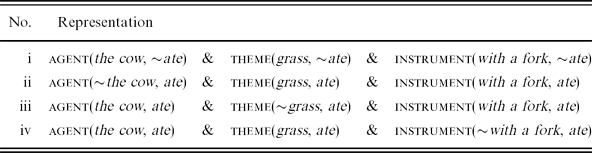
Table 2 depicts four semantic representations for statement (1). Option (i) negates the verb, and it corresponds to the interpretation the cow is the agentof [not eat], grass is the themeof [not eat] and a fork is the instrumentof [not eat]. This option, like typical semantic roles, does not detect positive meaning and does not encode that an eating event took place. Options (ii–iv) negate the first argument of a single relation and their interpretations surface implicit positive meaning. Henceforth, ‘negates the r’ must be read negates the first argument of r( x , y ):
• Option (ii) negates the agent, it encodes grass was eaten with a fork, but not by a cow.
• Option (iii) negates the theme, it corresponds to the cow ate with a fork, but not grass.
• Option (iv) negates the instrument, encoding the cow ate grass, but not with a fork.
Possible semantic representations for statement (1), The cow didn't eat grass with a fork. Options (ii–iv) reveal implicit positive meaning within the verbal negation
Option (iv) is preferred since it captures the best implicit positive meaning. It corresponds to the semantic representation of the affirmative counterpart (1’a–c) after negating the argument corresponding to the focus of the negation (i.e. with a fork). This fact and the examples in Tables 1 and 5 justify and motivate the importance of considering the focus of negation.
Consider statement (2), A panic in Wall Street doesn't exactly inspire confidence. The proposed representation is (2a) agent(A panic in Wall Street, ∼inspire) & (2b) manner(exactly, ∼inspire) & (2c) theme(confidence, ∼inspire). This example does not contain implicit positive meaning, (2a–c) simply negate the verb.
4.1.1 Wide focus and multiple foci
It is out of the scope of this paper to review the extensive literature in linguistics about focus-sensitive phenomena, but we provide examples to show that our model can cope with wide focus and multiple foci (Rooth, Reference Rooth1985). Simply put, our proposal selects an argument of one semantic relation for representing verbal, analytical and clausal negation. Similar examples are discussed by Jackendoff (Reference Jackendoff1972).
Example 1. Consider the following sentences:
1 John didn't build a house to impress Mary.
2 He bought a mansion.
Recall that our model aims at extracting the meaning of text taking into account negation, not to represent negated statements in isolation. Therefore, we aim at obtaining a representation encoding what a human would understand after reading (1, 2), i.e. John bought a mansion with the purpose of impressing Mary. Note that the meaning of a negated statement in isolation is ambiguous in general and can only be determined when context is taken into account (see examples 2 and 3).
Following our proposal, we select as focus of (1) build and obtain the following representations:
• (1a) agent(John, ∼build) & (1b) theme(a house, ∼build) & (1c) purpose(to impress Mary, ∼build)
• (2a) agent(He, bought) & (2b) theme(a mansion, bought)
Relations (1a–c) encode that no building took place. After resolving that He in (2) refers to John in (1) relations (2a–b) encode that John bought a mansion. We believe that detecting that the purpose of buying the mansion was to impress Mary can be done by ellipsis resolution, i.e. detecting that to impress Mary was omitted in (2) simply to avoid unnecessary repetition. How to detect this kind of ellipsis is beyond the scope of this paper; the problem has been approached before (Nielsen, Reference Nielsen2004) and annotation is available (Bos and Spenader, Reference Bos and Spenader2011).
Another option to represent the meaning of (1) is grounded on selecting a wider focus, John didn't build a house to impress Mary. This option is legitimate and cannot be encoded with our proposal because the focus maps to two relation arguments (build and a house). However, we hypothesize that our proposal combined with ellipsis resolution should extract the same meaning while simplifying the task of focus detection since we restrict focus to a single argument.
Example 2. Let us consider the following statements and proposed representations:
1 John didn't build a house to impress Mary.
(1a) agent(John, build1) & (1b) theme(∼a house, build1) & (1c) purpose(to impress Mary, build1)
2 He built a castle.
(2a) agent(He, built2) & (2b) theme(a castle, built2)
The interpretation for (1, 2) is John built a castle to impress Mary. Relations (1a–c) encode that John built1 something to impress Mary, but not a house; relations (2a–b) encode that John built2 a castle. Note that neither build1 nor built2 are negated, and an event coreference system should detect that both of them actually refer to the same building: build1 indicates the purpose, built2 the theme and both indicate the agent. We believe that detecting that build1 did occur even though it is negated by n't should help resolving the event coreference.
Example 3. A simple, theoretical example of multiple foci is the following:
1 John didn't cheat1 on Mary.
2 Mary cheated2 on John.
Sentences (1, 2) are interpreted as Mary cheated on John and further imply that John would never do such a thing by preceding (2) with (1) (detecting the implicature is outside the scope of this paper). One can rightfully consider multiple foci and select as focus for (1) John didn't cheat on Mary. However, we argue that our proposal, without allowing multiple foci, captures the right meaning of (1, 2) as well:
• (1a) agent(John, ∼cheat1) & (1b) theme(Mary, ∼cheat1)
• (2a) agent(Mary, cheated2) & (2b) theme(John, cheated2)
The representation in (1a–b, 2a–b) successfully encodes that cheat1 did not occur and cheat2 occurred with Mary as agent and John as theme. In this example, both instances of cheated cannot refer to the same event since the first one did not occur and the second did.
Note that the sentence following (1) is key to determining the meaning of (1, 2):
• (2′) John cheated 2′on Sue.
Both cheated are positive, (1, 2′) provide the agent and (2′) the theme.
• (2′′) Bill cheated 2′′on Mary.
Both cheated are positive, (1, 2′′) provide the theme and (2′′) the agent.
• (2′′′) Bill cheated 2′′′on Sue.
Only cheated 2′′′ occurred, all positive meaning is encoded by (2′′′).
4.1.2 Interpreting ‘∼’
Rewriting a negated argument into its positive counterpart is not always easy. Sometimes, however, the task can be solved by checking a dictionary of antonyms. Consider again the statement, A panic in Wall Street doesn't exactly inspire confidence and its proposed representation agent(A panic in Wall Street, ∼inspire) & manner(exactly, ∼inspire) & theme(confidence, ∼inspire). One can easily realize that ∼inspire is semantically equivalent to discourage.
Consider now example (6, Table 1), John doesn't know exactly how they met. The suggested representation is (3a) agent(John, know) & (3b) manner(∼exactly, know) & (3c) theme(how they met, know). In this case it is easy to rewrite (3b) as manner(incompletely, know).
However, negating an argument is often not straightforward. Take the statement (3, Table 1), I don't have a watch with me. The proposed representation is: (4a) agent(I, have) & (4b) theme(a watch, have) & (4c) location(∼with me, have). Rewriting (4c) without including the symbol ‘∼’ is difficult, even if we took into account the full context and meanings associated with its concepts. The watch might be at home, in the car, with my son or in many other places. Unless context states the actual location or gives a hint, the location probably cannot be specified. Relation (4c) does state that a possible location is not with me, but it does not specify any precise area. Note, though, that unlike typical semantic roles, (4a–c) do encode that I have a watch, i.e. positive meaning carried by the verbal negation.
Similarly, the proposed representation for example (2, Table 1) The cow didn't eat grass with a fork is (1a) agent(The cow, ate) & (1b) theme(grass, ate) & (1c) instrument(∼with a fork, ate) (Table 2, Option iv). Commonsense knowledge tells us that the cow (probably) used its mouth, i.e. instrument(its mouth, ate). However, how to determine that this relation is the positive counterpart of (1c) is not simple.
To complicate things further, rewriting a negated argument into its positive equivalent requires deep understanding of text and world knowledge. Decisions must be made based on the full meaning of the current sentence, and potentially a larger context and external knowledge. For illustration purposes, take the following examples:
• The kids didn't eat soup with a fork; instrument(∼with a fork, ate) could be rewritten as instrument(with a spoon, ate).
• The kids didn't eat sandwiches with a fork; instrument(∼with a fork, ate) could be interpreted as instrument(with their hands, ate).
We believe that even without fully specifying the meaning of a negated argument, the model described here is a significant improvement on semantic representation of negation. The main advantage is to recognize implicit positive meaning, a task currently ignored by the state of the art.
4.2 Incorporating negation into composition of semantic relations
So far we have looked at incorporating negation into semantic relations. In this section we study the impact of negation when composing relations. First, we summarize a model to compose semantic relations (Blanco and Moldovan Reference Blanco and Moldovan2011a, Reference Blanco and Moldovan2011c), then we enhance the model to compose relations when an argument is negated.
4.2.1 Composition of semantic relations
Composition of semantic relations is a framework that aims at extracting relations currently ignored by semantic parsers. It is not coupled to a particular relation set and automatically obtains inference axioms to compose relations. In CSR, a semantic relation r is defined using an extended definition including (a) Domain(r) and Range(r), i.e. semantic restrictions on the sorts of concepts that can be the first and second argument; and (b) P r, an array corresponding to the values for a set of semantic primitives. CSR was inspired by previous work within knowledge bases (Cohen and Loiselle, Reference Cohen and Loiselle1988; Huhns and Stephens, Reference Huhns and Stephens1989).
Primitives capture elemental semantic properties of relations. Each relation takes a value for each primitive from the set V = {−, 0, +}, indicating if the primitive does not hold, does not apply or holds. For example, the primitive temporal indicates if the first argument must precede the second. We have P causetemporal = + (a cause must precede its effect) and P mannertemporal = 0 (there is no temporal precedence between an event and the manner in which it occurs). Using primitives to define relations has an advantage: key semantic properties are explicit, allowing for automatic reasoning.
Axioms are denoted r1(x, y) ○ r2(y, z) → r3(x, z), where r1 and r2 are the premises, ‘○’ is the composition operator and r3 is the conclusion. Given the premises, an axiom infers the conclusion, adding a new link between the ends of the chain formed by the premises. In order to chain two relations r1(x, y) and r2(y, z), they must have an argument in common, y. We define the inverse of a relation to facilitate chaining relations, and denote the inverse of r as r−1. Given r1(x, y), r1−1(y, x) always holds. Consider sentence [They]x [came]y to [talk]z about the issue, where agent(They, came) and purpose(talk, came) are extracted by an existing semantic parser. Instantiating axiom agent(x, y) ○ purpose−1(y, z) → agent(x, z) with these two relations, we obtain agent(They, talk), a relation probably ignored by some semantic parsers: agent(They, came) ○ purpose−1(came, talk) → agent(They, talk).
Composition of semantic relations automatically obtains axioms using the extended definition and a manually defined algebra for composing primitives. The algebra determines rules for composing primitives, e.g. the relation resulting from the composition of two relations that hold temporal also holds temporal. For each primitive, the algebra defines the result of composing the nine possible combinations of values of primitives (|V×V| = 9).
Obtaining inference axioms is reduced to two analytical tasks easy to automate: (a) Enforce domain and range compatibility to find pairs of premises to be used in composition, and (b) for each pair of possible premises, find a relation that fits as the conclusion using the algebra for composing primitives. The following pseudo code (henceforth CSR algorithm) loops over all unique combinations of relations and performs both tasks (Blanco and Moldovan, Reference Blanco and Moldovan2011c):
CSR algorithm(R)
Input:R, set of semantic relations defined using the extended definition
Output:inference_axioms, list of axioms using
 $\textsc {r_1}\in R$ and $\textsc {r_2}\in R$ as their premises
Repeat for
$(\textsc {r_1}{},\textsc {r_2}{}) \in R \times R$:Repeat for (ri, rj) ∈ [(r1, r2), (r1−1, r2), (r2, r1), (r2, r1−1)]:
1. Domain and range compatibility.
IfRange(ri) ∩ Domain(rj) = ∅, break
2. Conclusion match.
Using the algebra for composing primitives, calculate
$P_{\textsc {r\text{$_i$}}} \circ P_{\textsc {r\text{$_j$}}}$Repeat for
$\textsc {r_3}\in R$:
(a) IfDomain(r3) ∩ Domain(ri) = ∅ orRange(r3) ∩ Range(rj) = ∅, break
(b) If
$consistent(P_{\textsc {r_3}}, P_{\textsc {r\text{$_i$}}} \circ P_{\textsc {r\text{$_j$}}})$, $inference\_axioms.append(\textsc {\textsc {r\text{$_i$}}}(\textsl {x}, \textsl {y}) \circ {} \textsc {\textsc {r\text{$_j$}}}(\textsl {y}, \textsl {z}) \rightarrow \textsc {\textsc {r_3}}(\textsl {x}, \textsl {z}))$







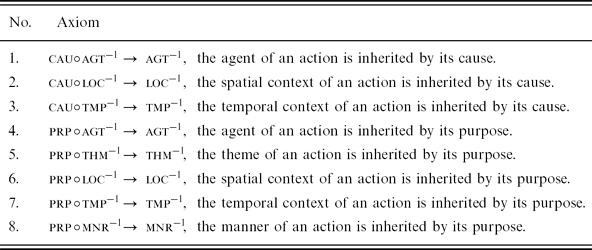
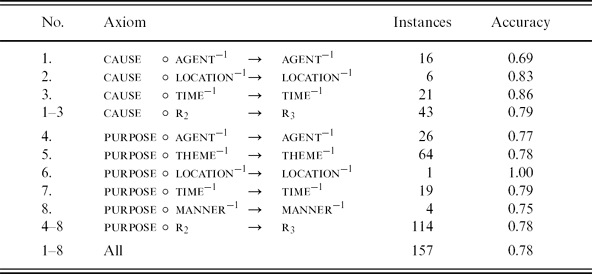
Composition of semantic relations is applicable to any relation inventory. Blanco and Moldovan (Reference Blanco and Moldovan2011a) applied it to PropBank and obtained eight inference axioms (Table 3). Instantiating these axioms improves the basic representation that PropBank provides by adding relations currently ignored. Consider the following sentence from PropBank (file wsj_0134, sentence 0):
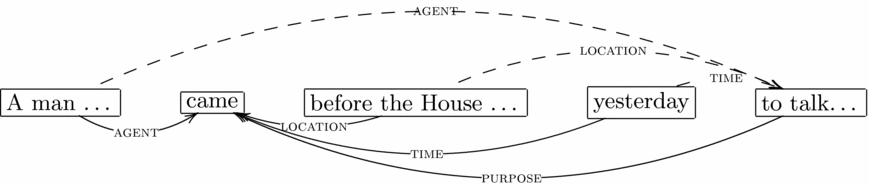
[A man from the Bush administration]  $_{z, \textsc {agent}}$[came] y,verb[before the House Agriculture Committee]
 $_{z^{\prime }, \textsc {location}}$[yesterday]
 $_{z^{\prime \prime }, \textsc {time}}$[to talk about the U.S.'s intention to send some $100 million in food aid to Poland, with more to come from the EC]
 $_{x, \textsc {purpose}}$.
Inference axioms obtained using CSR over PropBank semantic roles. cau stands for cause, prp for purpose, agt for agent, thm for theme, loc for location and tmp for time
Figure 1 shows PropBank annotation for the verb came with solid arrows. By instantiating axioms 4, 6 and 7 from Table 3 with this basic annotation, one can infer the three relations shown with discontinuous arrows.
Example of instantiation of inference axioms. Solid arrows indicate annotation in PropBank, discontinuous arrows inferred relations using axioms 4, 6 and 7 from Table 3.
4.2.2 Instantiating axioms with negated arguments
As illustrated in Figure 1, instantiating an axiom r1(x, y) ○ r2(y, z) → r3(x, z) over relations without a negated argument is reduced to finding a chain r1(x, y) ○ r2(y, z) and adding r3(x, z). However, when a premise has a negated argument, the conclusion may not have that same argument negated. In this section, we illustrate this phenomenon.
Consider statement (5) John didn't build a house to impress Mary. The proposed representation is: (5a) agent(John, build) & (5b) theme(a house, build) & (5c) purpose(∼to impress Mary, build). Instantiating purpose(x, y) ○ agent−1(y, z) → agent−1(x, z) over relations (5c, 5a), we must conclude agent−1(∼to impress Mary, John), i.e. John is the agent of [not to impress Mary]. In other words, John is the agent of some action, but not of impressing Mary. This example suggests that instantiating an inference axiom with a negated argument might be as simple as maintaining the negated mark in the conclusion: purpose(∼to impress Mary, build) ○ agent−1(build, John) → agent−1(∼to impress Mary, John).
Now consider sentence (6) In Frankfurt, stocks didn't open for the first 45 minutes because of order imbalances (wsj_0719, 18). Its meaning is In Frankfurt, stocks opened, but not for the first 45 minutes, because of order imbalances, and its representation is (6a) agent(stocks, open) & (6b) location(In Frankfurt, open) & (6c) time(∼for the first 45 minutes, open) & (6d) cause(because of order imbalances, open). Instantiating cause(x, y) ○ time−1(y, z) → time−1(x, z) over (6d, 6c), we must get time−1(because of order imbalances, for the first 45 minutes), i.e. the order imbalances happened during the first 45 minutes. Note that in this example a premise has a negated argument and yet the conclusion has all arguments positive: cause(because of order imbalances, open) ○ time−1(open, ∼for the first 45 minutes) → time−1(because of order imbalances, for the first 45 minutes).
4.2.3 Enhancing CSR to incorporate negation
As exemplified in the previous section, instantiating an axiom when considering negation is not straightforward. In this section, we enhance the general CSR framework presented in Section 4.2.1 to take into account negation, a scenario not studied before. Composing semantic relations is broken down into two steps: axiom extraction and axiom instantiation.
The extraction of inference axioms is done using the CSR algorithm exactly as before. Given any set of relations defined using the extended definition, this algorithm extracts inference axioms. The instantiation of an axiom r1(x, y) ○ r2(y, z) → r3(x, z), though, is more complicated than finding a chain of relations matching the premises, in order to determine if the conclusion has a negated argument, we must examine whether the premises have a negated argument as well as the semantics of the premises.
We introduce the primitive negation to incorporate negation into CSR. Negation indicates if the instance of a relation has any argument negated. ‘−’ indicates that the first argument is negated, ‘+’ indicates that the second argument is negated and ‘0’ indicates that neither argument is negated. Regarding the inverse relation, if r(∼x, y) (negation = −), then r−1(y, ∼x) (negation = +). For example, time(∼for the first 45 minutes, open) and agent(stocks, open) from sentence (6) In Frankfurt, stocks didn't open for the first 45 minutes because of order imbalances take ‘−’ and ‘0’ respectively; manner(exactly, ∼encourages) from (2) A panic in Wall street doesn't exactly encourage confidence takes ‘+’. Note that assigning a value to negation indicates whether the instance has an argument negated.
The algebra to compose primitives is extended with the negation primitive. Given the values two relation instances take for negation ( $P_\textsc {r_1}^{neg}$,
 $P_\textsc {r_2}^{neg}$), it can be observed that the following rules depict the values for their composition (
 $P_\textsc {r_1}^{neg} \circ P_\textsc {r_2}^{neg}$):
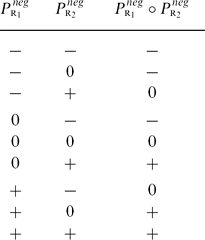
As the examples in Section 4.2.2 show, deciding if the conclusion of instantiating an axiom r1(x, y) ○ r2(y, z) → r3(x, z) must have an argument negated ( $P_{\textsc {r_3}}^{neg}$) depends not only on whether or not the premises have an argument negated (
 $P_{\textsc {r_1}}^{neg}$ and
 $P_{\textsc {r_2}}^{neg}$), but also on the semantics of r3. We found that the primitives separable and intrinsic are essential.
Separable is defined as x can be temporally or spatially separated from y, thus x can exist independently of y (Winston, Chaffin and Herrmann, Reference Winston, Chaffin and Herrmann1987). Actions and their purposes can exist independently of each other, therefore P purposeseparable = +. Intrinsic is defined as relation is an attribute of the essence/stufflike nature of x or y (Huhns and Stephens, Reference Huhns and Stephens1989). Consider cause(x, y), where the occurrence of y is due to x. The relation between x and y is an attribute of the essence of y (its existence), therefore P causeintrinsic = +. On the other hand, the relation between an action y and its purpose x is not in the essence of y (y may have multiple purposes with different motivations, each purpose may or may not happen in the future), so we have P purposeintrinsic = -.
If intrinsic holds for the first premise and separable does not apply to the second premise, then negation does not apply to the conclusion r3 ( $P_{\textsc {r_3}}^{neg} = 0$). Otherwise
 $P_{\textsc {r_3}}^{neg}$ is calculated according to the above rules for
 $P_\textsc {r_1}^{neg} \circ P_\textsc {r_2}^{neg}$.
The procedure for instantiating inference axioms considering negation is depicted in the Instantiate-Axiom algorithm. For each pair of relations (r1(x, y), r2(y, z) instantiating each axiom, a new relation r3(x, z) is inferred. Depending on the value assigned to  $P_{\textsc {r_3}}^{neg}$, which is calculated over
 $P_{\textsc {r_1}}^{neg}$,
 $P_{\textsc {r_2}}^{neg}$,
 $P_{\textsc {r_1}}^{intrinsic}$ and
 $P_{\textsc {r_2}}^{separable}$, the conclusion may or may not have an argument negated.
The following pseudo-code presents the Instantiate-Axiom algorithm:
An example. Consider axiom (4) purpose(x, y) ○ agent−1(y, z) → agent−1(x, z), automatically extracted using the CSR algorithm, and the following sentence (7) He ultimately became so well-known for cutting compensations, however, that clients didn't seek him out for anything else. A partial representation of (7) is (7a) agent(clients, seek) & (7b) theme(him, seek) & (7c) purpose(∼for anything else, seek), encoding clients sought him for the same (i.e. for cutting compensations).
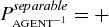
The above axiom (4) can be instantiated using as premises (7c, 7a): purpose(∼for anything else, seek) ○ agent−1(seek, clients). agent−1 holds the primitive separable (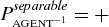 $P_\textsc {\textsc {agent}\text{$^{-1}$}}^{separable} = +$ (Blanco and Moldovan, Reference Blanco and Moldovan2011a), so we must follow case 2 of Instantiate-Axiom algorithm. Following the rules for composing negated, the conclusion takes ‘−’ for this primitive (‘−’ ○ ‘0’ = ‘−’). Thus, we infer agent−1(∼for anything else, clients). Paraphrasing, clients are the agents of cutting compensations.
Now consider the previous example (6) In Frankfurt, stocks didn't open for the first 45 minutes because of order imbalances. Axiom cause(x, y) ○ time−1(y, z) → time−1(x, z) can be instantiated with relations (6d, 6c): cause(because of order imbalances, open) ○ time−1(open, ∼for the first 45 minutes). Because the primitive separable does not apply to time−1 (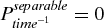 $P_{\textsc {time}^{-1}}^{separable} = 0$) and P causeintrinsic = + (Blanco and Moldovan, Reference Blanco and Moldovan2011a), we must follow case 1 of Instantiate-Axiom algorithm. The conclusion takes ‘0’ as value for negated, inferring time−1(for the first 45 minutes, because of order imbalances), i.e. the order imbalances happened during the first 45 minutes. Even though for the first 45 minutes appears negated in the first premise, the procedure correctly deletes the negated mark in the conclusion.
5 Annotating the focus of negation
Section 4 introduced a novel representation for negation grounded on focus detection. This representation requires automatic detection of focus of negation, a task never undertaken before. In this section, we describe our annotation effort for focus of negation (Blanco and Moldovan, Reference Blanco and Moldovan2011b) and in Section 6 we present experimental results. The annotations are publicly available at http://www.clips.ua.ac.be/sem2012-st-neg/ (pb-foc corpus) and were used in the *SEM 2012 Shared Task (Morante and Blanco, Reference Morante and Blanco2012).
Because of the lack of corpora containing annotation for focus of negation, new annotations are needed. An obvious option is to add it to any text collection. However, building on top of publicly available resources is a better approach: they are known by the community, they contain useful information for detecting the focus of negation and tools have already been developed to predict their annotations.
We decided to work over PropBank. Unlike other resources (e.g. FrameNet), gold syntactic trees are available. Compared to the BioScope corpus, PropBank provides semantic annotations and is not limited to the biomedical domain. The additional annotations can be readily used by any system working with PropBank, quickly incorporating interpretation of negation to them. On top of that, there has been active research on predicting PropBank roles for years, including systems participating in the CoNLL-2004 and CoNLL-2005 Shared Tasks (Carreras and Màrquez Reference Carreras, Màrquez, Ng and Riloff2004, Reference Carreras and Màrquez2005), the special issue on ‘Semantic Role Labeling’ of Computational Linguistics (Màrquez et al., Reference Màrquez, Carreras, Litkowski and Stevenson2008), and many workshop and conference papers, e.g. Dang and Palmer (Reference Dang and Palmer2005), Koomen et al. (Reference Koomen, Punyakanok, Roth and Yih2005), Zapirain, Agirre and Màrquez (Reference Zapirain, Agirre and Màrquez2008), Merlo and Van der Plas (Reference Merlo and Van der Plas2009) and Lang and Lapata (Reference Lang and Lapata2010).
5.1 Annotation guidelines
PropBank annotates exclusively semantic roles, i.e. semantic relations between a verb and its arguments. Each verb is annotated with up to six numeric core arguments (a0, a1, a2, a3, a4, a5) and argument modifiers (mtmp, mloc etc.). Numeric arguments do not have a uniform meaning across verbs, but a0 generally exhibits features of a prototypical agent, while a1 is a prototypical patient or theme (Palmer et al. Reference Palmer, Gildea and Kingsbury2005). Argument modifiers have a fixed meaning across verbs summarized in Table 4. For a discussion on the creation of the corpus and the semantics of each label, refer to Palmer et al. (Reference Palmer, Gildea and Kingsbury2005) and the annotation guidelines (http://verbs.colorado.edu/mpalmer/projects/ace/PBguidelines.pdf).
Argument modifiers in PropBank
We targeted verbal negations involving a verb v and having a semantic role of the form mneg(x, v). The focus is resolved as follows:
• If it cannot be inferred that an action v occurred (i.e. focus is v), mark as focus mneg.
• Otherwise, mark as focus the role that is most prominently negated.
All decisions are made considering the context of the previous and next sentence. The mark -not is used to indicate the focus. Consider the following statements (wsj_2282, sentences 15 and 16):
• Applied, then a closely held company, was stagnating under the management of its controlling family.
• [While profitable]
$_{\textsc {\textsc {madv\text{$_{1,2}$}}}}$, [it]$_{\textsc {\textsc {A}{\selectfont 1}\text{$_1$},\textsc {A}{\selectfont 0}\text{$_2$}}}$ ‘was[n't]$_{\textsc {\textsc {mneg}\text{$_1$}}}$ [growing]$_{\textsc {v\text{$_1$}}}$ and was[n't]$_{\textsc {\textsc {mneg}\text{$_2$}}}$ [providing]$_{\textsc {v\text{$_2$}}}$ [a satisfactory return on invested capital]$_{\textsc {\textsc {A}{\selectfont 1}\text{$_2$}}}$,’ he says.



Regarding the first verb (growing), one cannot infer that anything was growing, so focus is mneg. For the second verb (providing), it is implicitly stated that the company was providing a not satisfactory return on investment, therefore focus is a1. Figure 2 shows the new annotation.
Example of focus annotation (marked with not). The new representation explicitly states that it (the company) was not growing and was providing a not satisfactory return on invested capital.
The guidelines assume that the focus corresponds to a single role or the verb. In cases where more than one role could be selected, the most likely focus is chosen; context and text understanding help resolving ambiguities. We define the most likely focus as the one that yields the most meaningful implicit information.
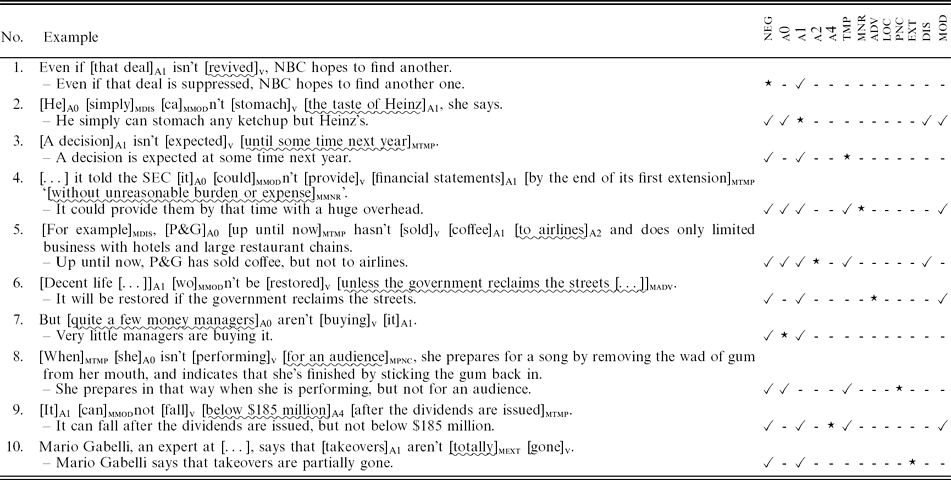
The task of selecting the focus is highly ambiguous. For illustration purposes, consider the following sentences (wsj_1856, sentences 27 and 28; also in Table 5):
1. Kathie Huff, a respondent in the Journal survey from Spokane, Wash., says her husband is adamant about eating only Hunt's ketchup.
2. [He (her husband)]
$_{\textsc {\textsc {A0}}}$ [simply]$_{\textsc {mmnr}}$ [ca]$_{\textsc {mmod}}$[n't]$_{\textsc {mneg}}$ [stomach]$_{\textsc {v}}$ [the taste of Heinz]$_{\textsc {\textsc {A1}}}$, she says.


Negated statements from PropBank and their interpretation considering implicit positive meaning. ‘✓’ indicates that the role is present and ‘⋆’ indicates that it corresponds to the focus. The verbal negation in example (1) does not carry positive meaning
Four options for the focus of the verbal negation in (2) are:
(a) [He]
$_{\textsc {\textsc {A0}}}$, encoding there are people who simply can stomach the taste of Heinz, but not he.(b) [simply]
$_{\textsc {mmnr}}$, encoding He can stomach the taste of Heinz, but with difficulties.(c) [stomach]
$_{\textsc {v}}$, encoding he simply can do a few things with the taste of Heinz, but not stomach it.(d) [the taste of Heinz]
$_{\textsc {\textsc {A1}}}$, encoding he simply can stomach any ketchup but Heinz.


Taking into account the context, the best option is a1, the taste of Heinz. Note that we are purposely limiting the choice of focus to all the words belonging to a labeled role from PropBank. This way we ease the task and make it compatible with the original PropBank. A possible finer grained focus is the word Heinz, but we select a1.
Several examples of annotated statements from PropBank are depicted in Table 5. The negation in example (1) does not carry any positive meaning, the focus is the verb. In examples (2–10) the verb must be interpreted as affirmative, as well as all roles except the one marked with ‘⋆’ (i.e. the focus). For each example, we provide PropBank annotation (top), the new annotation (i.e. the focus, bottom right) and its interpretation (bottom left). Some examples in Table 5 are ambiguous, e.g. in example (5) there is ambiguity between a0 and a2; and in example (9) between mtmp and a4.
Selecting a semantic role, as opposed to specific words, has the drawback of potentially selecting too coarse of a focus. For example, in the company wasn't providing a satisfactory return on investment, choosing satisfactory as focus would help determining the positive counterpart (i.e. an unsatisfactory return on investment). On the other hand, selecting a role has the advantage of simplifying the task of predicting the focus and allows existing role labelers to make this prediction without severe modifications: the only requirement is to retrain with the new labels.
5.1.1 Phenomena influencing focus of negation
Annotating the focus of negation is a semantic task influenced by many phenomena commonly found in text. Context plays an important role and deep understanding of text is critical. The following examples illustrate some interesting recurrent phenomena that we found during the annotation process.
Shorter clauses tend to have as their focus the verb, e.g. ‘[I] a0'm not[interested] v,’ said Dallas investor Harold Simmons. These statements typically contain a limited number or roles and they should often be interpreted by negating the verb.
Context is key for deciding the focus, especially the previous sentence. Consider the following example, describing the buying of Farmers (an American company) by Axa (a French company).
• Claude Bebear, chairman and chief executive officer, of Axa-Midi Assurances, pledged to retain employees and management of Farmers Group Inc., including Leo E. Denlea Jr., chairman and chief executive officer, if Axa succeeds in acquiring Farmers.
• Mr. Bebear added that [the French insurer]
$_{\textsc {A}{\selectfont 0}}$ would keep Farmers’ headquarters in Los Angeles and ‘[will]$_{\textsc {mmod}}$not [send]v [French people]$_{\textsc {A}{\selectfont 1}}$ [to run the company]$_{\textsc {mpnc}}$’.


Given the context, it is clear that no one will send anyone for any purpose (i.e. no sending event will take place); if Axa ends up buying Farmers, they will let current Farmers employees run that division of the company.
Some verbs are rarely the focus, e.g. seek, want, believe. These verbs usually signal that the focus is a1(x, y), corresponding to the interpretation that what is sought, wanted or believed is [not x].
• But he noted that [speculators]
$_{\textsc {A}{\selectfont 0}}$ [apparently]$_{\textsc {mmnr}}$ don't [believe]v [there is much more of a decline in store for cocoa]$_{\textsc {A}{\selectfont 1}}$.– He noted that they apparently believe there is little or not decline in store for cocoa.


Verb modifiers play a role, especially adverbs. For example, even typically signals a strong negative verb polarity. Thus, this adverb usually indicates that the negation does not carry positive meaning and the focus is the verb.
• [The company's conduct]
$_{\textsc {A}{\selectfont 0}}$‘does not[even] $_{\textsc {\textsc {madv}}}$[raise] v[a question of wrongful corporate intent, ratification or cover-up] $_{\textsc {A}{\selectfont 1}}$’, GE's brief asserts.– There are no issues with the company.


Conditionals attached to a verbal negation often carry implicit positive meaning. For example, the following statements are equivalent:
• The Los Angeles investor can't [buy]v UAL stock unless he makes a formal offer of $300 a share or UAL accepts an offer below $300.
– The Los Angeles investor can buy UAL stock if he makes a formal offer of $300 a share or UAL accepts an offer below $300.
Certain quantifiers in A0 usually signal that the focus is a0. This role corresponds to the prototypical agent (Palmer et al. Reference Palmer, Gildea and Kingsbury2005). Generally, if one says that some/most/part of x does not y, it is implicitly saying that others/few/another part of x does y. The following example illustrates this:
• But John LaWare, a Fed governor, told the subcommittee the evidence is mixed and that the Fed's believes [the vast majority of banks]
$_{\textsc {A}{\selectfont 0}}$ aren't [discriminating]v.– He told them that he believes that very few banks are discriminating.

Modifiers in A1 usually signal that the focus is a1. This role corresponds to the prototypical theme (Palmer et al. Reference Palmer, Gildea and Kingsbury2005). If it contains adjectives such as sufficient and necessary, the event they attach to actually occurs with a negated a1:
• ‘We would be the first to admit that [we]
$_{\textsc {A}{\selectfont 0}}$ have not [devoted]v [the necessary amount of emphasis]$_{\textsc {A}{\selectfont 1}}$ [over the past several years]$_{\textsc {mtmp}}$’ [to developing examinations for discrimination]$_{\textsc {mpnc}}$, said Jonathan Fiechter, a top official of the Office of Thrift Supervision.– ‘We would be the first to admit that we have devoted insufficient amount of emphasis over the past several years’ to developing examinations for discrimination said Jonathan Fiechter, a top official of the Office of Thrift Supervision.


Certain roles are more likely to be the focus. Particularly roles that do not occur frequently are often the focus when present. For example, mmnr is frequently the focus, but not always. Compare the following statements:
• Seeing all those millions in action, I was just so relieved that [Ms. Gruberova, gawky thing that she is]
$_{\textsc {A}{\selectfont 0}}$, didn't [accidentally]$_{\textsc {mmnr}}$ [smother]v [herself]$_{\textsc {A}{\selectfont 1}}$ [in a drape]$_{\textsc {A}{\selectfont 2}}$.– [...] I was just so relieved that nobody smothered himself.
• Some critics say [they]
$_{\textsc {A}{\selectfont 1}}$ [wo]$_{\textsc {mmod}}$n't be [quickly]$_{\textsc {mmnr}}$ [embraced]v [by consumers]$_{\textsc {A}{\selectfont 0}}$ [because of the high price]$_{\textsc {mcau}}$.– Some critics say that they will be embraced by consumers, but only in the future, because of the high price.


Temporal information signaled by until repeatedly indicates that the focus is mtmp, but not always. Compare the following statements:
• [The union]
$_{\textsc {A}{\selectfont 0}}$ [wo]$_{\textsc {mmod}}$n't [respond]v [to the USX statement]$_{\textsc {A}{\selectfont 1}}$ [until Mr. Williams has studied it]$_{\textsc {mtmp}}$, the spokesman said.– The union will respond to the USX statement after Mr. Williams has studied it, the spokesman said.
• We urge [our people]
$_{\textsc {A}{\selectfont 1}}$not to [wait]v [until they have to fight for their own nation]$_{\textsc {mtmp}}$.– We urge our people to [not wait] (i.e. our people should act now).


5.2 Normalization of -NOT
According to the proposed guidelines, not is attached to the role corresponding to the focus of negation or mneg if the focus is the verb. The guidelines were specifically designed to maintain the original PropBank format; for each instance only one label is changed. One can easily normalize this enhanced PropBank annotation to the model proposed in Section 4.1:
• If mneg-not(x, y), all roles r(x’, y) are normalized as r(x’, ∼y).
• If any other role r(x, y) is marked with not, that role is normalized as r(∼x, y) and all other roles remain as in the original PropBank.
After normalization, mneg (with or without not) can be ignored since it is overwritten by ‘∼’. For example, the normalized representation for the example in Figure 2 is madv(While profitable, ∼growing) & a1(it, ∼growing) & madv(while profitable, providing) & a0(it, providing) & a1(∼a satisfactory return on investment, providing).
5.3 Annotation process
We annotated 3,993 verbal negations signaled with mneg in PropBank, contained in 3,779 sentences. Before annotation began, all semantic information was removed by mapping all role labels to arg. This step is necessary to ensure that focus selection is not biased by the semantic labels provided by PropBank.
As an annotation tool, we use Jubilee (Choi, Bonial and Palmer, Reference Choi, Bonial and Palmer2010). This Java-based application required minimal modifications to configure files and proved very convenient for our focus annotation task. It provides multi-annotator capabilities and a simple methodology to resolve disagreements. For each instance (i.e. predicate from the original PropBank with mneg), annotators decide the focus given the parse tree, as well as the previous and next sentence. A post-processing step incorporates focus annotation to the original PropBank by adding not to the corresponding role.
In the first round, 50 percent of instances were annotated twice by two graduate students in computational linguistics. Inter-annotator agreement was 72 percent, calculated as the percentage of annotations that were a perfect match. After careful examination of the disagreements, they were resolved and annotators were given clearer instructions. Annotators often disagreed about whether the verb or a semantic role was the focus. The remaining instances were annotated once.
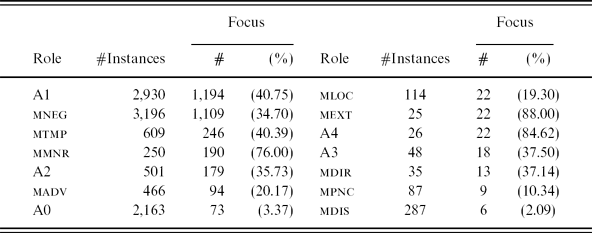
Table 6 depicts counts for each role over the training and held-out splits.
Roles, total instantiations and counts corresponding to focus over training and held-out instances
6 Experimental results
In this section we present experimental results on predicting the focus of negation (Section 6.1) and the methodology to incorporate negation into CSR (Section 6.2). All experiments were carried out using gold annotations, and therefore it is expected that using automatic annotations will lower the performance.
6.1 Focus detection
We have implemented four baselines and more complicated models to predict the focus of negation. These systems show that it is feasible to obtain the proposed representation for negated statements (Section 4.1) automatically.
Each of the 3,993 verbal negations annotated (Section 5.3) was divided into training (70 percent), held-out (10 percent) and test (20 percent). The held-out portion is used to tune the feature set and results are reported for the test split only, i.e. using unseen instances. Because PropBank adds semantic role annotation on top of the Penn Treebank (Marcus, Santorini and Marcinkiewicz, Reference Marcus, Santorini and Marcinkiewicz1994), we have available gold syntactic annotation and semantic role labels for all instances.
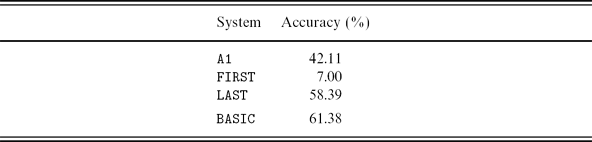
We implemented four baselines to measure the difficulty of the task:
• A1: Select the most likely focus to be the role, a1. If a1 is not present, then select mneg.
• FIRST: Select the first role, i.e. the one whose first content word starts the earliest within the sentence.
• LAST: Select the last role, i.e. the one whose first content word starts the latest within the sentence.
• BASIC: Same as FOC-DET (Section 6.1.1) but only using features last-role and flags indicating presence of roles (role-present).
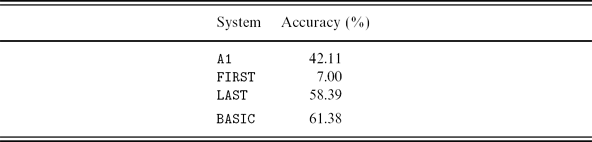
The accuracy for each baseline, ranging from 7.00 to 61.38, is depicted in Table 7. In Section 6.1.2 we provide detailed results.
Accuracies over test split for the four baselines
6.1.1 Selecting features
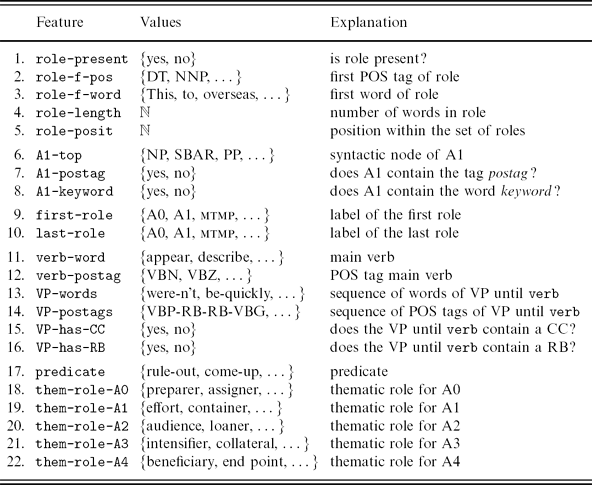
BASIC yields an accuracy of 61.38. We improved this baseline by considering an enhanced feature set (Table 8). All features are fairly simple and specifically target a1 and mneg, the roles that most frequently correspond to the focus of negation (Table 6).
Full set of features. Features (1–5) are extracted for all roles, and features (7, 8) for all POS tags and keywords considered
Features (1–5) are extracted for all roles present in PropBank, regardless of whether or not they correspond to the focus in our annotations. These features capture their presence, first word and part-of-speech (POS) tag, length and position within the roles present for that instance. Features (6–8) further characterize a1. A1-postag is extracted for the following POS tags: DT, JJ, PRP, CD, RB, VB and WP; A1-keyword for the following words: any, anybody, anymore, anyone, anything, anytime, anywhere, certain, enough, full, many, much, other, some, specifics, too and until. The above lists were extracted after manual examination of training examples and aim at signaling whether a1 corresponds to the focus.
Examples of A1 corresponding to the focus and including one of the POS tags or keywords are as follows:
• [Apparently]
$_{\textsc {madv}}$, [the respondents] A0don't think [that an economic slowdown would harm the major investment markets very RBmuch] $_{\textsc {A1}}$. (i.e. the responders think it would harm the investments little).• [The oil company]
$_{\textsc {A0}}$does n't anticipate [any keywordadditional charges] $_{\textsc {A1}}$ (i.e. the company anticipates no additional charges).• [Money managers and other bond buyers]
$_{\textsc {A0}}$haven't [shown] $_{\textsc {v}}$[much keywordinterest in the Refcorp bonds] $_{\textsc {A1}}$ (i.e. they have shown little interest in the bonds).• He concedes H&R Block is well-entrenched and a great company, but says ‘[it]
$_{\textsc {A1}}$doesn't [grow] $_{\textsc {v}}$[fast enough keywordfor us] $_{\textsc {A1}}$’ (i.e. it is growing too slow for us).• [We]A0 don't [see]
$_{\textsc {v}}$ [a domestic source for somekeyword of our HDTV requirements ]$_{\textsc {A1}}$, and that's a source of concern [...] (i.e. we see a domestic source for some other of our HDTV requirements).


Features (9, 10) indicate the first and last role respectively. Features (11–16) characterize the main verb. VP-postag (VP-words) corresponds to the full sequence of POS tags (words) from the beginning of the VP until the main verb. Features (15–16) check for POS tags as the presence of certain tags usually signal that the verb is not the focus of negation (e.g. [Thus]  $_{\textsc {mdis}}$, he asserts, [Lloyd's]
 $_{\textsc {A0}}$[[ca]
 $_{\textsc {mmod}}$n't [react] v[quickly RB]MMNR[to competition]
 $_{\textsc {A}{\selectfont 1}}$]VP).
Features (17–22) tackle the predicate, which includes the main verb and may include other words (typically prepositions). We consider the words in the predicate, as well as the specific thematic roles for each numbered argument. This is useful since PropBank uses the same numbered arguments for different thematic roles depending on the frame (e.g. a3 is used as purpose in authorize.01 and as instrument in avert.01).
The total number of features, taking into account that features (1–5) are extracted for eighteen roles, features (7, 8) for seven POS tags and seventeen keywords respectively, is 129. We created a system (FOC-DET) training with bagging over standard C4.5 decision trees and using the full set of features. We used the implementation in the Weka software pacakage (Hall et al., Reference Hall, Frank, Holmes, Pfahringer, Reutemann and Witten2009).
6.1.2 Detailed results
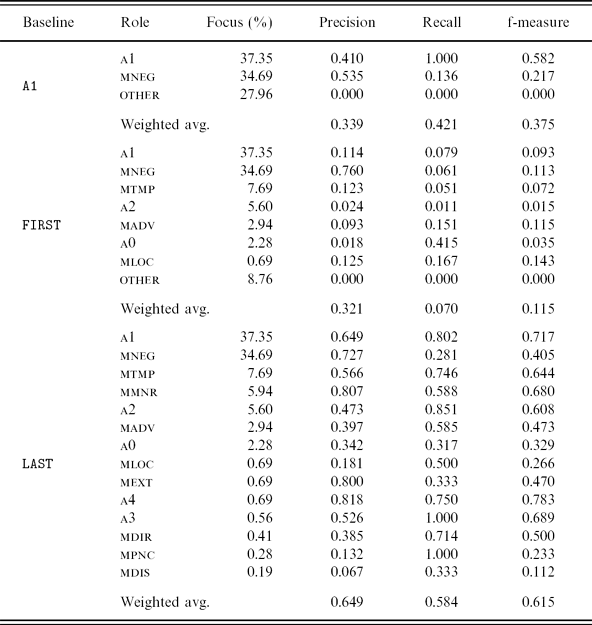
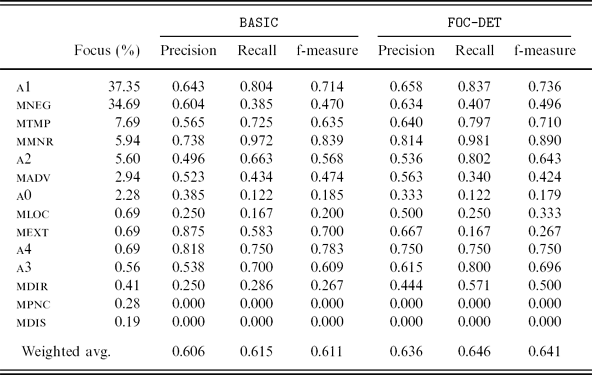
Table 9 provides per class precision, recall and f-measure using baselines A1, FIRST and LAST. A1 only predicts a1 or mneg as focus, and the overall performance is low (f-measure 0.375). FIRST is not a sound baseline (f-measure 0.115), and simply choosing the last role (LAST baseline) yields an f-measure of 0.615. LAST and BASIC obtain very similar performance (Table 10).
Per-class precision, recall and f-measure using baselines A1, FIRST and LAST. other stands for all roles that are never predicted by the baseline
Per-class precision, recall and f-measure using BASIC and FOC-DET
Table 10 provides per class precision, recall and f-measure using BASIC and FOC-DET. These systems obtain weighted f-measures of 0.611 and 0.641 respectively. mpnc and mext, the two less frequent roles corresponding to the focus (Table 6), are never predicted (together they only correspond to 0.47 percent of instances). On the other hand, FOC-DET successfully predicts a1, the most likely focus, with an f-measure of 0.736 (precision: 0.658, recall: 0.837). mneg, the second most likely role to correspond to the focus obtains an f-measure of 0.496 (precision: 0.634, recall: 0.407).
6.2 Incorporating negation into composition of semantic relations
In this section we evaluate the Instantiate-Axiom algorithm (Section 4.2.3). As a set of axioms A to be instantiated, we use the eight inference axioms automatically obtained by CSR algorithm over PropBank (Table 3). As relation instances rels, we use annotation present in PropBank for verbs y, which have a relation of the form mneg(x, y). In order to avoid inferring a relation that might already be present in the annotation provided by PropBank, we do not instantiate an axiom r1(x, y) ○ r2(y, z) → r3(x, z) if a relation of the form r3(x’, z) is already present.
Even in a vast corpus like PropBank (112,917 annotated predicates), the number of instantiations found is small. Out of the 3,993 predicates marked with mneg, only 103 contain purpose and 123 cause. Taking into account the above constraint, there are forty-three instantiations of axioms involving cause (axioms 1–3) and 114 of axioms involving purpose (axioms 4–8).
Accuracies for instantiating each axiom are depicted in Table 11. The remainder of this Section illustrates real inferences using the Instantiate-Axiom algorithm. For each example, we provide the sentence, partial representation and inferred relation:
• If you’re homeless, you don't sleep for fear of being robbed or murdered.
– agent−1(∼sleep, you) & cause(for fear of being robbed [...], ∼sleep)
Axiom
$\textsc {\textsc {cause}} \circ {} \textsc {\textsc {agent}\text{$^{-1}$}}$ → agent−1 yields agent−1(for fear of being robbed or murdered, you). [P causeintrinsic = + and P agent−1separable = +, so $P_{\textsc {r_3}}^{neg} = P_{\textsc {cause}{}}^{neg} \circ {} P_{\textsc {agent}^{-1}}^{neg} = 0$].• But such operations typically aren't performed because there is no sign right after an injury that surgery would be beneficial.
– time−1(performed, ∼typically) & cause(because there is no sign right after an injury that ..., performed)
Axiom
$\textsc {\textsc {cause}} \circ {} \textsc {\textsc {time}\text{$^{-1}$}}$ → time−1 yields time−1(because there is no sign right after ..., typically). [P causeintrinsic = + and P time−1separable = 0, so $P_{\textsc {r_3}} = 0$].• Workers, except for senior management, were asked not to report for work yesterday.
– purpose(for work, report) & time−1(report, ∼yesterday)
Axiom
$\textsc {\textsc {purpose}} \circ {} \textsc {\textsc {time}\text{$^{-1}$}}$ → time−1 yields time−1(for work, ∼yesterday). [P purposeintrinsic = − and P _time−1separable = 0, so $P_{\textsc {r_3}}^{neg} = P_{\textsc {purpose}{}}^{neg} \circ {} P_{\textsc {time}^{-1}}^{neg} = +$].






Evaluation of the Instantiate-Axiom algorithm (Section 4.2.3)
7 Discussion
In this paper we have presented a model to thoroughly represent the meaning of negation. This model surfaces implicit positive meaning from negated statements and is grounded on detecting the focus of negation, a problem not previously considered. Negation is incorporated into semantic relations using the symbol ‘∼’, indicating if an argument of a relation must be negated. We also devise a methodology to incorporate negation to a previous framework to compose semantic relations. This approach yields a richer representation of text combining negation with semantic relation composition in a unified manner.
The proposed model goes beyond the state of the art. Given The UFO files weren't released until 1998, semantic role labelers simply indicate that the verb released is negated by n't. Scope detectors are a step forward, but by no means encode the correct interpretation of the statement, i.e. The UFO files were released, but not until 1998. The proposed representation encodes this interpretation using ‘∼’: theme(The UFO files, released) & time(∼until 1998, released).
Using this novel representation is conceptually simple but requires detecting the focus of negation. Because of the lack of corpora, new annotation over PropBank is presented. This annotation can be readily used by any existing semantic role labeler trained over PropBank, quickly incorporating interpretation of negation.
Deciding the focus of negation is a highly ambiguous task. Our annotation guidelines were designed to maintain the original PropBank annotation and select a role as focus. Examples show that deep understanding of text is necessary. Several phenomena influencing this task, most notably context, are also exemplified.
Simple baselines and a more complex feature set to predict the focus of negation have been proposed, showing that the model is feasible. The Instantiate-Axiom algorithm provides a procedure to instantiate an inference axiom when a premise may have an argument negated. It is simple and obtains high accuracy.
One issue remains open: Rewriting a negated argument into its positive counterpart is often difficult. For example, statement s: [when] time[she] agent isn't [performing]v[for an audience] purpose, she prepares for a song by removing the wad of gum from her mouth, and [...] is interpreted as she prepares in that manner when she is performing, but not for an audience. purpose(∼for an audience, performing) could be rewritten as purpose(for herself, performing), but doing so automatically is not without its challenges. The proposed model explicitly encodes that kind of preparation happens when she is performing (but not for an audience), but stating the positive counterpart of not for an audience deserves more work.