For generations, scholars of seventeenth- and eighteenth-century Spanish drama have been attempting to define the parameters that characterize the comedia suelta, but to date no firm consensus about the form's textual or generic qualities has been reached. Broadly defined, the term comedia suelta embraces theatrical works written in a variety of styles, including farsas (short, humorous, carnivalesque texts); sainetes (short productions or distinct portions of larger works that are normally danced and sung); eglogas (brief pastoral works, often with sad or somber overtones); entremeses (concise comedic pieces emphasizing the burlesque and the grotesque); and autos (succinct allegorical religious productions frequently tied to the celebration of the Eucharist).Footnote 1 Other theatrical forms and subgenres current in Spanish drama of the period might also easily be classified as sueltas, depending on one's particular point of view.
Given the potential all-inclusiveness of the label comedias sueltas, some who have studied the form have attempted to demarcate its boundaries more stringently by focusing not on generic terms or thematic concerns but on more precise qualities of bibliographical stability and material fixity. In other words, they believe that comedias sueltas can best be defined not by the types or styles of theatrical work they represent but by the physical forms in which they are presented. Generally speaking, sueltas are cheap, single-volume pamphlets that contain separately issued plays intended to be sold as individual units (as opposed to single play texts printed as part of a larger collection of works bound and issued together within common covers). Although sueltas were actively printed from the early 1600s until about 1850, their main period of wide popularity spanned roughly 150 years, from the last quarter of the seventeenth century to the first quarter of the nineteenth. For most of this period, they almost always appeared in quarto format (comprising sheets of paper folded twice to create four leaves, yielding eight pages of text on each sheet), although sueltas in the smaller octavo format (sheets folded three times to produce eight leaves, or sixteen pages on each sheet) began to be produced more frequently by the mid-1800s. These short publications typically included twenty-four to sixty-four pages of two-column printed text; twenty-four to forty pages was most common.Footnote 2
Though this basic bibliographical definition of the suelta works well enough in allowing us to identify such works quickly and without too much confusion, it is important to remember that this broad, bibliographically defined field encompasses hundreds of separate authors and includes dramatic works extending from the secular to the sacred, from the comic to the tragic, and from the historical to the fantastical. Additionally, the extreme popularity of the form meant that sueltas were published on a staggering scale. For every title that may have been printed only once there is at least one—and likely many more—that was reprinted ten, twenty, or even thirty times over the years by a bewildering array of printers located across Spain. The combined textual, generic, and bibliographical diversity and complexity of sueltas has made it extremely challenging for those interested in the Spanish theatre to understand fully the complicated histories of these texts and their authors, publishers, and audiences. For scholars who hope to develop their appreciation for sueltas and the textual, commercial, intellectual, and performance cultures that depended on them, a simple fact becomes clear: without access to physical copies of primary documents—in this case the original sueltas—scholars will not be able to unravel the many problems that presently obscure a clear view of the field.
Original copies of comedias sueltas are not rare. In fact, as a result of the massive numbers of such plays printed during the 150 years of their main popularity, it is probably safe to say that original copies of various works can be found in most libraries that house even a smattering of early modern Spanish theatrical materials. Although the sheer number of sueltas that survive has engendered significant textual and bibliographical confusion, the very survival of so many of these texts has provided modern scholars with a unique opportunity to construct an accurate picture of theatrical publishing, reading, and performance in Spain during this period. Over the past several decades, many institutions across Europe and North America with sizable numbers of sueltas have helped lay the groundwork for more comprehensive scholarly work by preparing detailed descriptive catalogs of their holdings.Footnote 3 Some bibliographies list hundreds of volumes, whereas others document much larger collections, such as the more than fourteen thousand individual pieces currently being cataloged at the Harry Ransom Center at the University of Texas.Footnote 4 Such in-depth bibliographical efforts have proven extremely valuable in helping researchers identify previously unknown and unstudied texts, recognize variant editions of single plays, distinguish between the typographical work of anonymous and unspecified printers, and investigate complex questions about textual transmission and reception. These collections and the growing number of catalogs that expedite scholarly access to them offer tools of immeasurable value to anyone interested in learning more about the vibrant and diverse culture of the early modern Spanish stage. The Claude E. Anibal Collection of Spanish Drama of The Ohio State University Libraries (OSUL) perfectly embodies the value of such primary source collections.
Claude E. Anibal, professor of Spanish languages and literatures at The Ohio State University from 1924 to 1955, was an early advocate of the indispensability of primary sources for literary and textual analysis of comedias sueltas. Throughout his academic life, Prof. Anibal remained preoccupied with the Spanish stage, specifically in terms of problems of authorship, literary attribution, and textual editing, and over the years he amassed a significant private collection of original sueltas that he used for teaching and research until his sudden death in 1955.Footnote 5 In 1956, to honor her husband's memory and perpetuate his scholarly legacy, Prof. Anibal's widow generously donated his library and papers to OSUL.Footnote 6 Today the Claude E. Anibal Collection is administered and developed by two distinct units of OSUL's Special Collections. The Rare Books and Manuscripts Library (RBMS) oversees a sizable (and growing) group of well over five hundred individual sueltas as well as many other associated Spanish dramatic and literary works produced between 1600 and 1899. This core collection of original dramatic texts is supplemented further by the holdings of the Jerome Lawrence & Robert E. Lee Theatre Research Institute, which holds additional primary source materials, such as entremeses and other related works, as well as Prof. Anibal's unpublished manuscript studies of numerous plays written by Lope de Vega, Mira de Amescua, Monroy y Silva, and Juan Bautista de Villegas and his extensive notes on the vocabulary, historical context, style, versification, and sources of the many plays and authors he researched throughout his career.
Although the Anibal Collection is relatively small compared to other cataloged collections—though in many ways is typical of other holdings in its mixture of odd works by lesser-known playwrights, such as Guillén Pierres, and more substantial holdings of texts by famous dramatists, such as Calderón de la Barca, Luciano Francisco Comella, Lope de Vega, and Agustín Moreto y Cabaña—it stands out from its peers in one major respect: the large number of plays featuring manuscript markings.Footnote 7 These unique annotations imbue the Anibal collection with additional levels of historical, textual, and cultural authority, allowing us to see these plays not just as static works of dramatic literature but as valuable, living artifacts that testify to the dynamic and continuous histories of production, transmission, staging, reception, and interpretation of each text. For our purposes here, these annotated plays can be divided into three main groups, each of which suggests new ways for us to engage with the many complex questions underlying suelta research.
The first and most sizable cluster of annotated works comprises fifty-seven plays containing Prof. Anibal's explanatory notes and textual observations. Although they cannot tell us anything about early modern attitudes toward these plays, these notes nevertheless represent an extremely interesting and useful record of the scholarly questions and viewpoints that were prevalent during Anibal's day. Given the overall complexity of the bibliographical and textual histories of sueltas in general, the working comments of a trailblazing scholar such as Anibal also offer useful commentary, reminding us that literary texts do not exist in an interpretive vacuum but live and breathe in a continuum of constantly evolving reception and criticism. Anibal's annotations actively demonstrate this intellectual evolution in process, and alongside his surviving notes and manuscripts they provide helpful insights into specific scholarly approaches to analyzing and interpreting particular authors and plays.
A second, much smaller group of marked-up volumes includes plays that feature ownership inscriptions that provide valuable evidence of each text's early provenance. Over the past twenty years, provenance research has become a driving force in book history as scholars search for new ways to place historical literary texts within wider sociocultural contexts.Footnote 8 At first glance, these simple inscriptions might not seem to provide much in the way of concrete information, and they may only name individuals for whom it might be impossible to find further information. If we pay close attention to such markings of ownership in suelta collections around the world, however, the potential is there to discover a number of interesting things about the broader commercial, collecting, and reading milieus of early modern Spanish drama. Compiling lists of these inscribed names could allow us to reconstruct previously unknown collections of suelta materials and, perhaps, help us match these named collectors with recorded figures in a variety of contemporary demographic and documentary sources. By identifying individual collectors we might then be able to learn more about the distribution of sueltas, the types of audience they attracted, the economics of collecting, and the personal tastes of individual collectors and readers. These potential answers could then lead us to ask new questions about the social aspects of suelta reading and collecting and the wider influence of this literary form on Spanish popular culture in general.
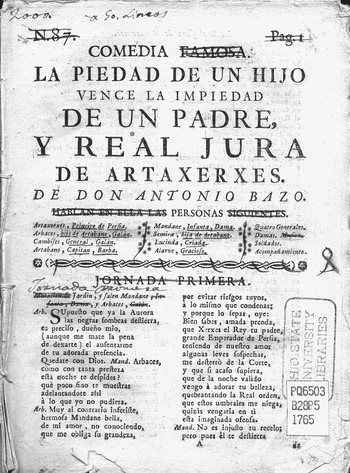
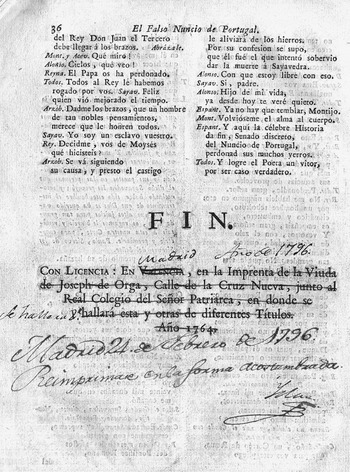
The third, and perhaps most unique, group of marked-up sueltas in the Anibal Collection comprises the ten plays featuring annotations that testify to the professional practices of a Madrid-based printer of dramatic texts named Quiroga (likely Manuel Quiroga and possibly later his widow, who apparently took over the business after his death).Footnote 9 It would appear that Quiroga acquired copies of each of these plays with the intention of revising their layout for his own press; moreover, in preparing his own editions, he marked his source texts in various ways, all of which now provide insight into the editorial and compositional practices of one eighteenth-century Spanish theatrical printer. A few examples of Quiroga's editing activities should suffice to point out the importance of these manuscript annotations. The number “2000” has been written on the front page of several of these plays, a significant addition that Víctor Arizpe has argued denotes the number of copies Quiroga intended to print.Footnote 10 If Arizpe's interpretation is correct, these notations offer concrete evidence of the size of a print run for a suelta during this period. Some of these source texts also contain instructions to the compositor about how many lines of text each page should include. For instance, Quiroga stipulates that his edition of Antonio Bazo's La piedad de un hijo vence la impiedad de un padre, y real jura de Artaxerxes [A Son's Mercy Conquers a Father's Cruelty, and the Royal Oath of Artaxerxes] should include fifty lines of text per column (Fig. 1). These editorially annotated texts also include markings indicating changes Quiroga wished to make to typographical elements, such as converting roman type to italic, alterations to the layout of act divisions and stage directions, and deletions of ornamental features such as columnar boundaries and decorative pieces of type for which his print shop likely had no direct analogues. Quiroga also altered his source texts' colophons by updating the date and place of publication and noting that his new edition would be reprinted according to well-known generic conventions (Fig. 2).
Antonio Bazo, La piedad de un hijo vence la impiedad de un padre, y real jura de Artaxerxes (Valencia: la Viuda de Joseph de Orga, 1765). At the top are Quiroga's notes designating the number of copies to print and the total number of lines to be set per page.

José de Cañizares, El falso nuncio de Portugal (Valencia: la Viuda de Joseph de Orga, 1764). Note Quiroga's addition of the new colophon in manuscript.

Quiroga's annotations can tell us much about the enduring popularity of particular authors and titles, his expectations of commercial success, and his own particular printer's aesthetic. These marked-up copies can also reveal details about the strategies printers used to produce texts as economically as possible. A close analysis of the markings in Tomás de Iriarte's El señorito mimado, ó La mala educacion [The Pampered Dandy; or, Bad Manners] illustrates the value of Quiroga's annotations—both to his bottom line as a printer and to modern scholars studying the economics of printed play production. At the top of the play's first page, Quiroga has noted that each appearance of the words “Don” and “Doña” demarcating the beginning of individual portions of dialogue throughout the text should be removed. Over the course of the forty pages of text, these deletions amount to a total excision of 2,621 total ems (individual pieces of type). The omission of these letters does not decrease considerably the amount of space necessary to print each line of text, but it does reduce the amount of type that the compositor would have had to set. Given that an average compositor of the time could set approximately 1,250–1,500 ems of type per hour, this simple editorial expedient would have trimmed approximately two hours' worth of composition labor, saving Quiroga additional wages for time spent assembling this text and allowing him to assign his compositor another piece of work.
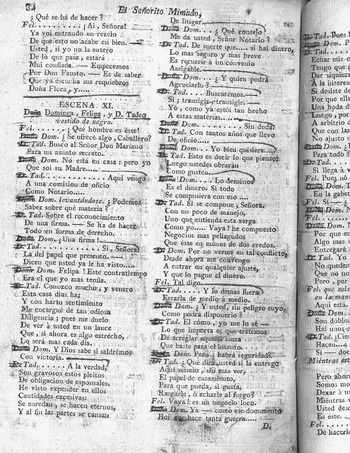
Other annotations by Quiroga reveal a more substantial way that he saved money on his printing of this play. Throughout the text he marked 257 places where he planned to collapse or combine lines, resulting in a substantial reduction of the total amount of space necessary to set the complete text (Fig. 3). Altogether, these 257 dropped lines amount to just over five columns' worth of set text in his model copy. Multiplied over an entire print run of two thousand copies, the total Quiroga apparently planned for many of his editions, this would be the equivalent of a reduction of 10,080 total columns of type. In a typical suelta quarto edition, sixteen columns of text were printed on each sheet. By dividing the total number of columns Quiroga's editing activities saved by the total number of columns printed per sheet, we arrive at a total savings of 630 sheets over the print run. Considering the fact that the cost of paper was a printer's heaviest financial burden during the hand press period, these savings would have been very welcome.
Tomás de IriaRte, El señorito mimado, ó la mala educacion (Barcelona: la Viuda Piferrer, ca. 1780), 34–5.

Additional examples of how Quiroga's editorial annotations would have impacted the production, packaging, and marketing of his texts abound throughout these ten marked-up texts. By paying close attention to such bibliographical and typographical evidence we can speculate more intelligently about the economic and commercial environment surrounding the production, distribution, and collecting of comedias sueltas and, in turn, think about how the practices of printing houses directly and indirectly influenced the public's buying choices and reading interests. These practices might also provide clues about the popularity of particular plays and about theatre practices of the time.
In sum, the Claude E. Anibal Collection of Spanish Drama at OSUL offers scholars a remarkable laboratory for the study of Spanish theatre from the seventeenth through the nineteenth centuries. What can be done there to learn more about the criticism, provenance, staging history, printing and publishing, distribution, reception, and interpretation of sueltas, however, can be done in the many other specialized collections of such materials located around the world. I hope that in the years to come scholars will work together to compile annotated data sets that will facilitate critical comparison of the holdings of these collections, thereby revealing in more full and vibrant detail the complex and exciting world of early modern Spanish drama.