1. Introduction
Structure–function mapping in cognitive neuroscience would be simplest if each brain region performed a single function. However, current research suggests that brain areas are often multifunctional—for example, the insula is associated with numerous functions, including gustation (taste), empathy, disgust, attention, pain, and working memory (Menon and Uddin Reference Menon and Uddin2010). In an influential meta-analysis, Michael Anderson (Reference Anderson2010) reports that cortical areas are redeployed on average across nine cognitive domains (vision, memory, numeric cognition, etc.). Thus, multifunctionality may be a global feature of the brain’s organization.
Multifunctionality raises challenges for structure–function mapping (Price and Friston Reference Price and Friston2005; Anderson Reference Anderson2010; Klein Reference Klein2012; Rathkopf Reference Rathkopf2013). Broca’s area is classically associated with speech production. However, recent studies implicate Broca’s area in action imitation—for example, Heiser et al. (Reference Heiser, Iacoboni, Maeda, Markus and Mazziotta2003) report that repetitive transcranial magnetic stimulation (rTMS) of Broca’s area impairs participants’ ability to imitate the finger movements of a videotaped hand whilepreserving basic finger mobility. How should neuroscientists interpret these findings? Does Broca’s area perform one function connected to both speed production and action imitation, or does it merely perform different functions in different contexts?
Cognitive scientists Cathy Price and Karl Friston (Reference Price and Friston2005) argue that brain regions perform many functions at one level of description and a single, previously uncharacterized function at another. Thus, neuroscientists need to revise their cognitive ontologies—that is, taxonomies of cognitive functions—to obtain systematic mappings. Philosopher Colin Klein (Reference Klein2012) draws a very different lesson from the same findings: since the functions of brain regions vary according to the functional networks in which they are embedded, neuroscientists should abandon systematic mappings for context-sensitive mappings.
In this article, I claim that neither strategy will succeed as a general treatment of multifunctionality in cognitive neuroscience. I argue that brain areas, like other biological parts (e.g., genes, tissues, organs), are multifunctional in different ways—I call this the “functional heterogeneity hypothesis.” Furthermore, I argue that different kinds of multifunctional parts call for different functional mapping strategies. Therefore, there is no one-size-fits-all solution to the puzzle of multifunctional brain regions. My account draws heavily on causal role theories of function in the philosophical literature (see Cummins Reference Cummins1975; Craver Reference Craver2001).
First, I discuss the problem of multifunctionality in greater detail (sec. 2). Then, I examine different strategies for treating multifunctionality (sec. 3). Next, I argue that the value of different mapping strategies depends on the mechanistic organization of the target system. Furthermore, I contend that brain areas, like genes or organs, are multifunctional in different ways (sec. 4). Finally, I highlight some implications for human brain mapping (sec. 5).
2. The Problem of Multifunctionality
In what sense are brain areas multifunctional, and why is this a problem for cognitive neuroscience? According to Robert Cummins’s (Reference Cummins1975) influential causal role account, functional analysis involves decomposing a capacity ψ of some containing system S into a set of constituent operations or roles Ф that collectively perform that capacity.Footnote 1 For example, the capacity of breathing (ψ) performed by the human respiratory system (S) consists of roles including inhalation (Ф1), exhalation (Ф2), gas exchange (Ф3), and the control of breathing rhythm (Ф4). In this framework, the function of a component X is the role that X plays in S’s ability to ψ—for example, the brain stem’s (X) role in breathing (ψ) is the maintenance of breathing rhythm (Ф4).Footnote 2
Causal role functions nicely capture how brain regions are multifunctional.Footnote 3 Cognitive neuroscientists typically study complex cognitive capacities by decomposing them into a set of component operations—for example, cognitive models of reading involve component operations such as attention, eye movement control, word form recognition, and semantic access. Then, neuroscientists use subtractive neuroimaging and other techniques to map these component operations onto the brain (Petersen and Fiez Reference Petersen and Fiez1993). Thus, structure–function mapping often involves specifying the role Ф a region plays in a target cognitive capacity ψ. For example, the visual word form area’s role Ф in reading ψ is processing the shape of written characters (Dehaene et al. Reference Dehaene, Cohen, Sigman and Vinckier2005). But just as some organs are recruited for multiple physiological capacities (e.g., the liver functions in fat digestion [ψ1] and blood sugar regulation [ψ2]), some brain areas are recruited for multiple cognitive capacities (e.g., the insula is involved in empathy [ψ1] and disgust [ψ2]; Menon and Uddin Reference Menon and Uddin2010). This finding raises interpretive problems in cognitive neuroscience.
Ideally, brain research would yield systematic mappings where structure and function predict one another (Price and Friston Reference Price and Friston2005). A brain mapping is systematic when (1) a region’s involvement in a task (e.g., activation measured by the blood-oxygen-level-dependent [BOLD] signal in functional magnetic resonance imaging [fMRI]) predicts the recruitment of some cognitive function and (2) that function predicts what tasks will recruit the region. Since systematic mappings hold across different contexts, they support inferences between structure and function. For example, if there is a systematic mapping between working memory and dorsolateral prefrontal cortex, researchers can infer that when dorsolateral prefrontal cortex is recruited for a task, the task involves working memory.Footnote 4
Multifunctional regions confound the search for systematic mappings. For instance, the posterior lateral fusiform gyrus (PLF), or “visual word form area,” is hypothesized to function in word form recognition, a stage of reading in which the visual system encodes the form of written characters (Dehaene et al. Reference Dehaene, Cohen, Sigman and Vinckier2005). However, neuroimaging experiments implicate PLF in many nonreading tasks—for example, categorizing pictures as animals or artifacts, recognizing objects by touch, and pairing gestures with visual cues (see Price and Friston Reference Price and Friston2005). Thus, word form recognition cannot give a systematic mapping for PLF—for example, it does not predict that categorizing pictures as animals will recruit PLF, or capture what PLF is doing when recruited for touch-based object recognition. This raises the concern that traditional psychological functions cannot provide systematic mappings for multifunctional regions. Therefore, neuroscientists need to adopt different strategies for functional mapping if they want to make inferences from structure to function and vice versa.
3. Strategies for Functional Mapping
Now I introduce different strategies for dealing with multifunctionality, focusing on a recent debate between Price and Friston (Reference Price and Friston2005) and Klein (Reference Klein2012). Each strategy seeks to interpret the finding that brain regions are often associated with many different cognitive capacities (ψ1, ψ2, ψ3, etc.). First, I briefly discuss a strategy that seeks to explain away the problem.
3.1. Subdivide and Conquer
One strategy for dealing with multifunctionality is to subdivide the region in question into multiple functionally specific areas—according to this “subdivide-and-conquer” strategy, brain areas appear multifunctional because current ways of delineating brain regions (e.g., BOLD dissociations or cytoarchitectural maps) lump functionally distinct neural populations together (see Grill-Spector, Sayres, and Ress Reference Grill-Spector, Sayres and Ress2006). Subdividing these composite regions may eliminate putative cases of multifunctionality—for example, Wager and Barrett (Reference Wager and Barrett2004) argue that the insula contains distinct subregions for core affect, motivation, and pain.
New techniques such as fMRI adaptation (e.g., Price and Friston Reference Price and Friston2005) and high-resolution fMRI (e.g., Grill-Spector et al. Reference Grill-Spector, Sayres and Ress2006) offer promising avenues for subdividing multifunctional regions. However, it is unlikely that this strategy will explain away every instance of multifunctionality. First, in practice, multifunctionality often resists subdivision—for example, the insular subregions identified by Wager and Barrett (Reference Wager and Barrett2004) still perform multiple functions. Second, multifunctionality is widely considered a basic feature of neural organization observed in both well-characterized invertebrate circuits (see Getting Reference Getting1989) and at small spatial scales in the primate brain (see Anderson Reference Anderson2014, chap. 2). Therefore, it is plausible that the human brain contains genuinely multifunctional components—that is, multifunctional regions that resist further subdivision. Assuming that some regions are genuinely multifunctional, how should brain mapping proceed?
3.2. Cognitive Ontology Revision: New Systematic Mappings
Price and Friston (Reference Price and Friston2005) offer an alternative strategy for analyzing multifunctional regions. According to Price and Friston, the common denominator among PLF’s diverse functions is that “a [characteristic] motor response (name or action) is retrieved from [appropriate] sensory cues” (Reference Price and Friston2005, 267). Therefore, Price and Friston argue that while at one level of description PLF performs many functions—word form recognition, cue-gesture pairing, and so on—at another level of description PLF performs the single function of sensorimotor integration in every context. Thus, unlike word form recognition, sensorimotor integration provides a systematic mapping for PLF.
Price and Friston stress that sensorimotor integration is a new kind of cognitive function (i.e., a new addition to one’s cognitive ontology) because it is not a component operation of reading, object categorization, or tactile object recognition hypothesized in cognitive psychology, but another function PLF performs when participants name objects as animals, perform the right gesture in response to visual cues, and so on. They draw a general lesson from this analysis, arguing that adhering to traditional psychological categories (e.g., word form recognition) encourages neuroscientists to emphasize the differences among a region’s hypothesized functions instead of searching for deeper functional similarities outside the boundaries of traditional categories. They claim that in addition to a region’s many diverse functions, each area has one function (e.g., sensorimotor integration) capturing its involvement in a broader range of task conditions. Therefore, neuroscientists need to revise their cognitive ontologies—that is, develop new categories of cognitive kinds—to obtain systematic mappings.
3.3. Networks and Context-Sensitive Mappings
Colin Klein (Reference Klein2012) offers a very different take on multifunctionality: neuroscientists must abandon systematic mappings in favor of context-sensitive ones. Klein argues that sensorimotor integration is an uninformative function. Many regions, such as the medial temporal area (MT) and parietal reach region, pair sensory cues to motor responses—in some sense, this is “what nearly all of cortex does” (Klein Reference Klein2012, 955). Thus, it is trivially true that the function of PLF is sensorimotor integration.
Klein elaborates that systematic, decontextualized functional mappings are often unilluminating. To illustrate, he draws an analogy between brain areas and diesel truck pistons. Certain diesel truck pistons perform one of two functions (F1 or F2) depending on the context of the system (C1 or C2). Under normal driving conditions (C1), the piston compresses a fuel-air mixture as it moves upward; this springs the piston down, which powers the engine (F1). When the engine brake is engaged (C2), exhaust valves release the compressed air before it springs the piston; the engine now drags the piston, which slows the truck down (F2). Klein argues that while both context-sensitive mappings (the piston performs F1 in C1 and F2 in C2) are useful, the piston’s only systematic mapping is a vacuous one, such as, “the job of the piston is either to speed the truck or to slow it down” (Reference Klein2012, 955).
Klein’s central lesson is that successful functional attribution often depends on the broader context of the containing system (e.g., the piston’s function depends on what the engine brake is doing). In this situation, researchers should not search for systematic functional mappings, but try to identify the relevant contexts for anchoring context-sensitive ones. According to Klein, brain regions perform different functions depending on the networks in which they participate; therefore, neuroscientists must reference this “neural context” when doing functional mapping. Whether a region R performs a particular function depends on its network context—that is, R performs F1 in C1, F2 in C2, and so on, where contexts are individuated by sets of co-activated brain regions (Klein Reference Klein2012, 952).Footnote 5
4. Different Parts, Different Strategies
Assuming that the brain contains genuinely multifunctional parts, which strategy—Price and Friston’s cognitive ontology revision, or Klein’s context-sensitive functional mapping—is more valuable for cognitive neuroscience? I now argue that neither strategy will succeed as a general treatment of multifunctionality. I claim that the value of different mapping strategies depends on the mechanistic organization of the target system (see Craver Reference Craver2001). In other words, different kinds of multifunctional parts call for different mapping strategies. Furthermore, I contend that the brain likely contains different kinds of multifunctional parts—I call this the “functional heterogeneity hypothesis.” Thus, while multifunctionality calls for both cognitive ontology revision and context-sensitive functional mapping, each strategy has limited value.
4.1. Mappings and Mechanistic Organization
Carl Craver (Reference Craver2001) argues that mapping functions to a component (in the causal role sense described in sec. 2) requires specifying how that component fits into the mechanistic organization of a containing system—that is, the system’s spatial, temporal, and constitutive organization. For example, the heart performs the role of pumping blood (Ф) in circulation (ψ) because it is connected in the right way to a system of veins and arteries, it contracts in time with the opening and closing of vein valves, and so on. In this spirit, I argue that mapping functions onto multifunctional components also depends on the mechanistic organization of the target system. To demonstrate, consider the subdivide-and-conquer strategy.
Human pancreatic tissue has many functions, including the production of hormones and digestive enzymes. However, distinct cell populations are involved in these different functions—cells in the islets of Langerhans perform the pancreas’s endocrine functions (e.g., insulin production), while acinar cells perform its exocrine functions (e.g., digestive enzyme production) (Fox Reference Fox2001, chap. 18). Therefore, the pancreas’s multifunctionality is largely the product of a division of labor among different cell types—this is a triumph of the subdivide-and-conquer strategy. Liver tissue also has many functions, including blood toxin removal, bile secretion, and glycogen synthesis. But remarkably, the liver is a largely homogenous mass of cells called “hepatocytes” that perform these diverse functions (Fox Reference Fox2001, chap. 18). Therefore, while the subdivide-and-conquer strategy works for composite components (e.g., pancreatic tissue), it fails to capture components with a homogeneous structural composition (e.g., liver tissue) that nevertheless perform different functions. Thus, the value of the subdivide-and-conquer strategy depends on how the target system is organized.
In sections 4.2 and 4.3 I argue that the value of cognitive ontology revision versus context-sensitive mapping in neuroscience similarly depends on the mechanistic organization of neural systems. I distinguish two kinds of multifunctional components in biology: components with conserved roles (i.e., parts that perform the same basic operation in multiple capacities) and components with variable roles (i.e., parts that perform different roles in different capacities). I argue that parts with conserved roles support systematic mappings of the kind Price and Friston envision (sec. 4.2), while components with variable roles do not (sec. 4.3). Furthermore, I argue that both kinds of multifunctional parts are likely found within the human brain.
4.2. Conserved Roles and Systematic Mappings
According to Price and Friston, cognitive ontology revision will yield systematic mappings because multifunctional regions perform a single function at some level of description. Klein counters that these systematic descriptions are bound to be uninformative. How should theorists interpret this talk of “levels?” Do multifunctional regions perform one function in any interesting sense?
Klein understands these levels in terms of abstraction, characterizing Price and Friston’s strategy as follows: “Perhaps brain regions only appear pluripotent because we have not specified their functions in suitably abstract terms. Make it abstract enough, and we will find that brain regions only do one thing after all” (Reference Klein2012, 954). According to this formulation, Price and Friston’s cognitive ontology revision involves developing “a set of suitably abstract functional labels” to yield systematic mappings. Just as walking and flying are examples of locomotion, word form recognition and tactile object recognition are both instances of sensorimotor integration (954).
Klein’s worry is that abstract mappings gain their generality at the expense of specificity and explanatory power. The hypothalamus has many functions—for example, regulating hunger, thirst, internal temperature, and sleep cycles. But the most abstract functional characterization of the hypothalamus (e.g., homeostasis) is not more predictive or explanatory than other concrete, context-sensitive, functions (e.g., the regulation of circadian rhythms). Why should neuroscientists prefer a strategy that sacrifices specificity for generality?
My take is that the relevant levels of functional description for Price and Friston are not levels of abstraction but levels in a mechanistic hierarchy (see Craver Reference Craver2001). Causal role approaches distinguish two levels of description for a component X: the broader capacity ψ to which X contributes, and the role Ф that X plays in that capacity—for example, the valves (X) in human veins contribute to circulation (ψ) by preventing the backflow of blood (Ф). This distinction between roles and capacities provides a way of characterizing different kinds of multifunctional parts. Many biological components are multifunctional in that the same structure X is recruited for different capacities ψs—for example, the brain stem regulates both blood pressure and breathing rhythm. Some multifunctional components have conserved roles—that is, they perform the same role or operation Ф in different capacities ψ1, ψ2, ψ3, and so on.Footnote 6
In some leeches, a single motor neuron circuit functions as a “central pattern generator” controlling the rhythm Ф of swimming (ψ1) and crawling (ψ2) motions that rely on distinct muscle groups (Briggman and Kristan Reference Briggman and Kristan2008). Conserved role multifunctionality is also observed in molecular genetics. Some genes exhibit “parsimonious pleiotropy,” a pattern in which “one gene is used for identical chemical purposes in multiple pathways” (Hodgkin Reference Hodgkin1998, 502).Footnote 7 For example, the E. coli gene ilvN plays the same role (encoding the enzyme AHASI) in synthesizing the amino acids valine and isoleucine (Dailey and Cronan Reference Dailey and Cronan1986; Hodgkin Reference Hodgkin1998). What makes a role “conserved” across different capacities varies in different systems. In a computer, a string of code might execute the same subroutine Ф in different programs (ψ1, ψ2, etc.). In a cell, an enzyme might catalyze a reaction Ф shared by different metabolic pathways (ψ1, ψ2, etc.).
Components with conserved roles permit systematic mappings of the kind Price and Friston envision. This formulation holds that brain areas typically perform the same basic role or operation Ф in different cognitive capacities ψ1, ψ2, ψ3, and so on. At the level of capacities (e.g., reading or arithmetic), brain areas have many functions; at the level of roles (e.g., sensorimotor integration), they perform a single function. Other authors have proposed similar theories about multifunctional regions—for example, Anderson (Reference Anderson2010) distinguishes between the diverse higher cognitive functions for which regions are recruited and the conserved local “workings” or computations the regions perform. Do brain areas typically perform the same role in different cognitive capacities?
Recent work suggests that the intraparietal sulcus (IPS), a region implicated in numeric cognition in humans and other mammals, performs the same basic operation in judgments of number and time. In humans, neuroimaging results suggest that IPS is recruited for judgments of quantity (e.g., does pile A or pile B contain more dots?), duration (e.g., did tone A or tone B sound for longer?), and size. A leading theory of these effects is that IPS implements a mechanism for representing analog magnitude (Ф) that is flexibly recruited for visual estimations of quantity (ψ1) and auditory estimations of duration (ψ2) (Pinel et al. Reference Pinel, Piazza, Bihan and Dehaene2004; Bueti and Walsh Reference Bueti and Walsh2009).
Many other regions are hypothesized to perform the same operation in different cognitive capacities. For example, dorsolateral prefrontal cortex is thought to implement a selection mechanism (Ф)—that is, a mechanism for choosing which stimuli will be rehearsed—for two distinct working memory networks: the visual sketchpad (ψ1) and the phonological loop (ψ2) (see Baddely Reference Baddely2003). Aminoff, Kverga, and Bar (Reference Aminoff, Kveraga and Bar2013) argue that the parahippocampal cortex (PHC) plays the same basic role in several different cognitive capacities. The PHC is involved in many functions, including spatial memory, visual scene processing, and even nonspatial forms of episodic memory (e.g., odor–odor associations). Aminoff and colleagues propose that the PHC performs a form of contextual processing (Ф)—that is, accessing associative links in long-term memory—for different capacities such as scene processing (ψ1) and nonspatial episodic memory (ψ2).
4.3. Variable Roles and Context-Sensitive Mappings
Does this mean that brain regions typically have informative, systematic mappings? Price and Friston’s strategy (achieving systematic mappings through the identification of novel cognitive kinds), construed in terms of abstraction, applies universally. Neuroscientists can always describe different functions as the same at some level of abstraction—for example, working memory and top-down attention are both controlled cognitive processes. However, as Klein notes, this approach risks generating trivial mappings. While conceiving Price and Friston’s strategy in terms of conserved roles mitigates this worry, the move comes at a cost: now the strategy only applies to components that perform the same operation in different capacities. However, there is no guarantee that multifunctional components in biological or neural systems are organized this way.
Klein’s case of diesel truck pistons illustrates why researchers should be skeptical that multifunctional regions necessarily perform the same basic operation at another level of description. If Klein’s analysis is right, the piston exhibits context sensitivity at both the level of capacities (in C1, it speeds the truck up [ψ1]; in C2, it slows the truck down [ψ2]) and the level of roles (in C1, it compresses a fuel-air mixture to denotation [Фa]; in C2, it acts as a weight that the engine drags [Фb]). Thus, some multifunctional components have variable roles—that is, they perform different roles or operations Фa, Фb, Фc, and so on, in different capacities ψ1, ψ2, ψ3, and so on.
Variable role multifunctionality or context sensitivity is found in many biological systems. Some regulatory genes can enhance or repress transcription depending on their biochemical context (Hodgkin Reference Hodgkin1998). For example, the gene Ultrabithorax modulates leg segment growth in some aquatic insects. However, owing to differential regulatory effects, Ultrabithorax expression shortens some developing segments while lengthening other developing segments (Khila, Abouheif, and Rowe Reference Khila, Abouheif and Rowe2014). Similarly, liver hepatocytes perform different roles in different capacities. When the pancreas produces insulin, hepatocytes absorb (Фa) glucose from the blood stream for glycogen synthesis, which lowers blood sugar (ψ1). On the other hand, hepatocytes secrete (Фb) bile, which contributes to fat digestion (ψ2).
Components with variable roles often lack systematic functional mappings—for example, liver cells do not “do the same thing” for fat digestion and blood sugar regulation, except in a very general sense (i.e., metabolism). Context-sensitive mappings are often more useful for such parts. According to this interpretation, Klein holds that brain regions typically (or at least often enough to trouble Price and Friston’s approach) perform different roles (Фa, Фb, Фc, etc.) in different capacities (ψ1, ψ2, ψ3, etc.). Is there evidence of variable role multifunctionality in the brain?
Recent work in cognitive neuroscience suggests that the same neural populations can implement different coding schemes for different channels of environmental information. The hippocampus is involved in both spatial navigation (ψ1) and episodic memory (ψ2). Leutgeub et al. (Reference Leutgeb, Leutgeb, Barnes, Moser, McNaughton and Moser2005) argue that a single population of hippocampal neurons (found in CA1–CA3) has distinct signaling patterns for these capacities. According to their model, what subset of the population is firing (Фa) signifies the rat’s spatial location (ψ1); these “place field configurations” correspond to location but not environmental features (e.g., colors, shapes). At the same time, the population’s rate function (Фb) reflects the presence of certain environmental features (ψ2) regardless of the active place configuration. Therefore, these neurons implement population coding for spatial memory and rate coding for episodic memory.
Other regions are thought to perform different roles in different cognitive capacities—for example, while the dorsal striatum is involved in reward learning (ψ1) and voluntary movement (ψ2), models of its contribution to these capacities involve distinct operations. The dorsal striatum’s role in reward learning involves temporal difference detection (Фa)—that is, detecting differences between anticipated and actual reward onset—while its role in initiating movements is modeled as a simple disinhibition or gating mechanism (Фb) (Suri and Schultz Reference Suri and Schultz2001; Liljeholm and O’Doherty Reference Liljeholm and O’Doherty2012). Likewise, primate neurophysiology studies suggest that certain inferotemporal cortex neurons exhibit one spiking pattern (Фa) for detecting global features of objects (ψ1) and another spiking pattern (Фb) corresponding to local features (ψ2) of the same stimuli (Wang, Tanifuji, and Tanaka Reference Wang, Tanifuji and Tanaka1998).
5. The Functional Heterogeneity Hypothesis
There is no canonical structure–functional relationship for multifunctional components in biology. Components with conserved roles perform the same role in different capacities, while components with variable roles perform different roles in different capacities. Given recent research in cognitive neuroscience, this insight appears to be equally true of genes, organs, and neural systems. This suggests a “functional heterogeneity hypothesis,” which holds that the brain contains different kinds of multifunctional parts. According to this hypothesis, the brain exhibits a heterogeneous functional organization in which different regions are multifunctional in different ways.
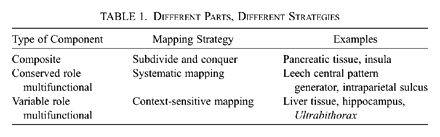
The value of mapping strategies is inextricably tied to the mechanistic organization of the target system (see table 1). For instance, composite components (e.g., the human insula) are amenable to the subdivide-and-conquer strategy, while other multifunctional components are not. Thus, the functional heterogeneity hypothesis entails that there is no general account of how structure–function mapping will proceed in light of multifunctionality. Price and Friston are right that where regions have conserved roles, characterizing these roles (e.g., analog magnitude representation or contextual processing) may yield novel systematic mappings highlighting similarities between seemingly different cognitive capacities. However, Klein is right that there is no guarantee that this strategy will work. To the extent that brain regions have variable roles (e.g., implementing different coding schemes for different stimuli), context-sensitive mapping will often prove more useful. Which strategy is preferable will depend on the target brain region.
Different Parts, Different Strategies

| Type of Component | Mapping Strategy | Examples |
|---|---|---|
| Composite | Subdivide and conquer | Pancreatic tissue, insula |
| Conserved role multifunctional | Systematic mapping | Leech central pattern generator, intraparietal sulcus |
| Variable role multifunctional | Context-sensitive mapping | Liver tissue, hippocampus, Ultrabithorax |
If my account is right, then the challenge for neuroscientists is not to provide a general strategy for mapping functions onto multifunctional regions but to provide strategies that work for particular kinds of areas and means of identifying what kinds of areas there are. Depending on factors such as the size of the region in question, one’s existing taxonomy of cognitive functions, and the mechanistic organization of brain systems, progress in structure–function mapping might require cognitive ontology revision, new methods of subdividing regions, or context-sensitive mapping. The trick is determining when each approach is needed.