Introduction
The genus Oocephalus (Benth.) Harley & J.F.B.Pastore was proposed by Harley & Pastore (Reference Harley and Pastore2012) in the most recent generic revision of subtribe Hyptidinae of the Lamiaceae, based on morphological evidence and the results of the first phylogenetic analysis of the subtribe (Pastore et al., Reference Pastore, Harley, Forest, Paton and van den Berg2011). The species of the genus Oocephalus were formerly included by Epling (Reference Epling1949) in different subsections of Hyptis sect. Polydesmia Benth. (subsects Glomeratae Benth. and Oocephalus Epling). Currently, Oocephalus comprises 18 species, 17 of which are endemic to the campos rupestres vegetation of the Serra do Espinhaço (a mountain range located in the Brazilian states of Bahia and Minas Gerais) and the Cerrado of central Brazil (Goiás state and the Federal District; Harley, Reference Harley2015). The only widely distributed species is Oocephalus oppositiflorus (Schrank) Harley & J.F.B.Pastore (= Hyptis glomerata Mart. ex Schrank), which extends the range of the genus to eastern Bolivia and Paraguay (Harley & Pastore, Reference Harley and Pastore2012).
Oocephalus can be recognised by the possession of an inflorescence of congested, pedunculate or sessile cymes, never hemispherical or globose but slightly ovoid in form, that are few to many flowered and often enveloped by an involucre of broad, ovate or lanceolate bracteoles, which are rarely narrower and not enveloping the cymes [in Oocephalus hagei (Harley) Harley & J.F.B.Pastore] (Harley, Reference Harley2014). Also, the flowers are sessile or subsessile, the corollas usually with an elongate tube and short lobes, the lips unmarked by lines or blotches (Harley, Reference Harley2015).
During extensive fieldwork and herbarium specimens analyses, we found an undescribed species from the region of the Chapada dos Veadeiros National Park (Goiás state, Brazil). This is described and illustrated here.
Species Description
Oocephalus pubescens A.Soares & Harley, sp. nov
Oocephalus pubescens is similar to O. foliosus (A.St.-Hil. ex Benth.) Harley & J.F.B.Pastore in the leaf shape, leaf apex and possession of an inflorescence with short peduncles, but differs in having stems, leaves and cymes covered with dense, short white hairs, sessile leaves that are congested on the distal parts of branches and caducous on the lower parts, and cymes with subsessile peduncles (up to 2.4 mm long versus 4 mm long in O. foliosus). – Type: Brazil, Goiás, Alto Paraíso de Goiás, Morro da Baleia, situado no Parque Nacional da Chapada dos Veadeiros. Campo rupestre com solo arenoso, 1332 m, 14°07′51.01′′S, 47°39′29.99′′W, 18 xi 2018, Soares, A.S. et al. 567 (holo UFRN; iso CEN, CTBS, HUEFS). Figs 1, 2.
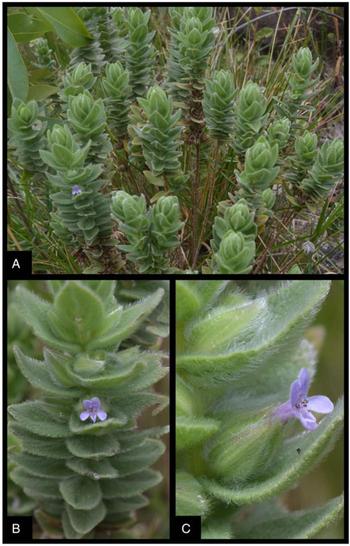
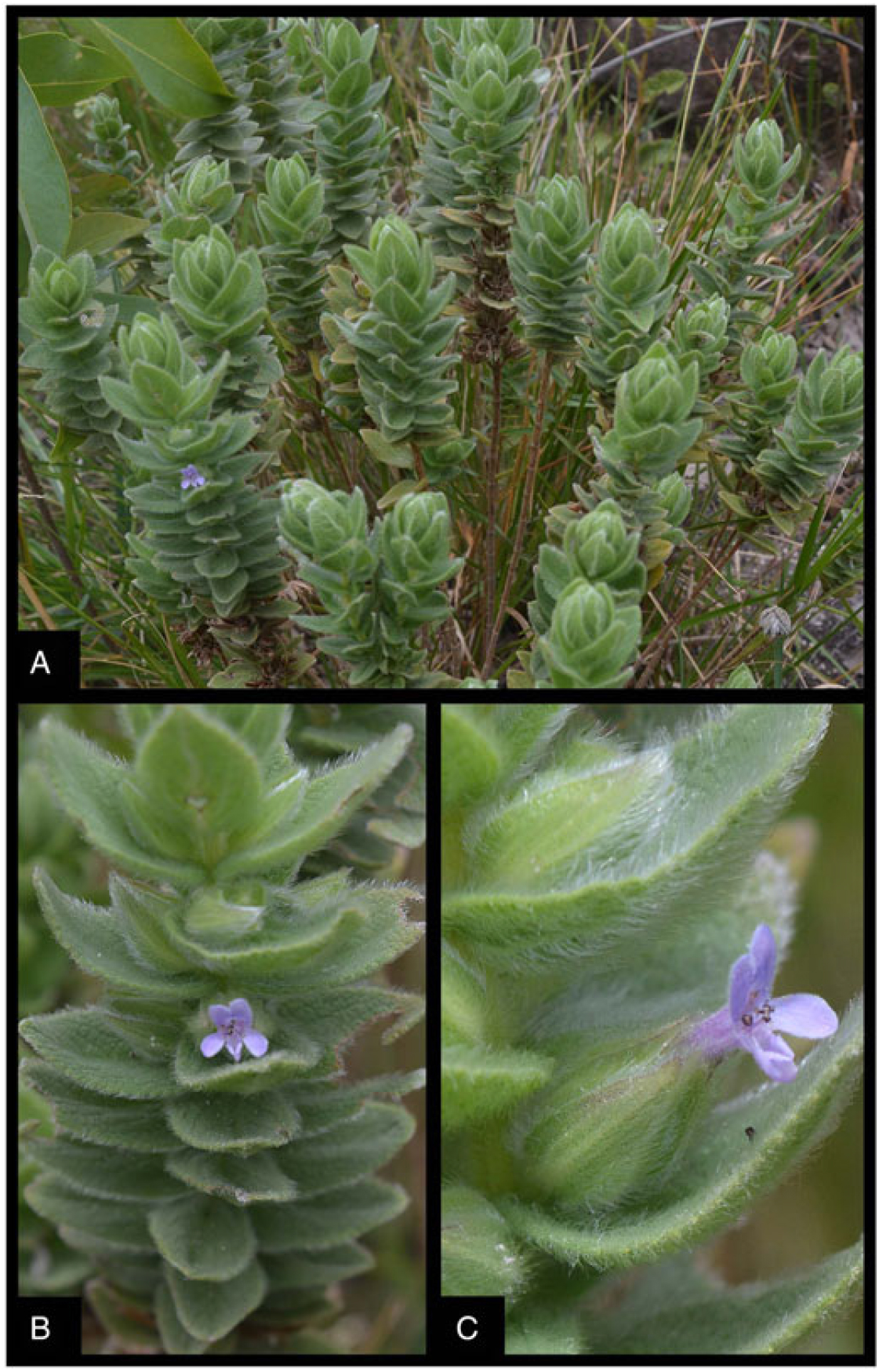
Oocephalus pubescens sp. nov. A, Habit; B, branch, cauline leaves and flower; C, flower detail. (Photographs: Arthur de Souza Soares.)
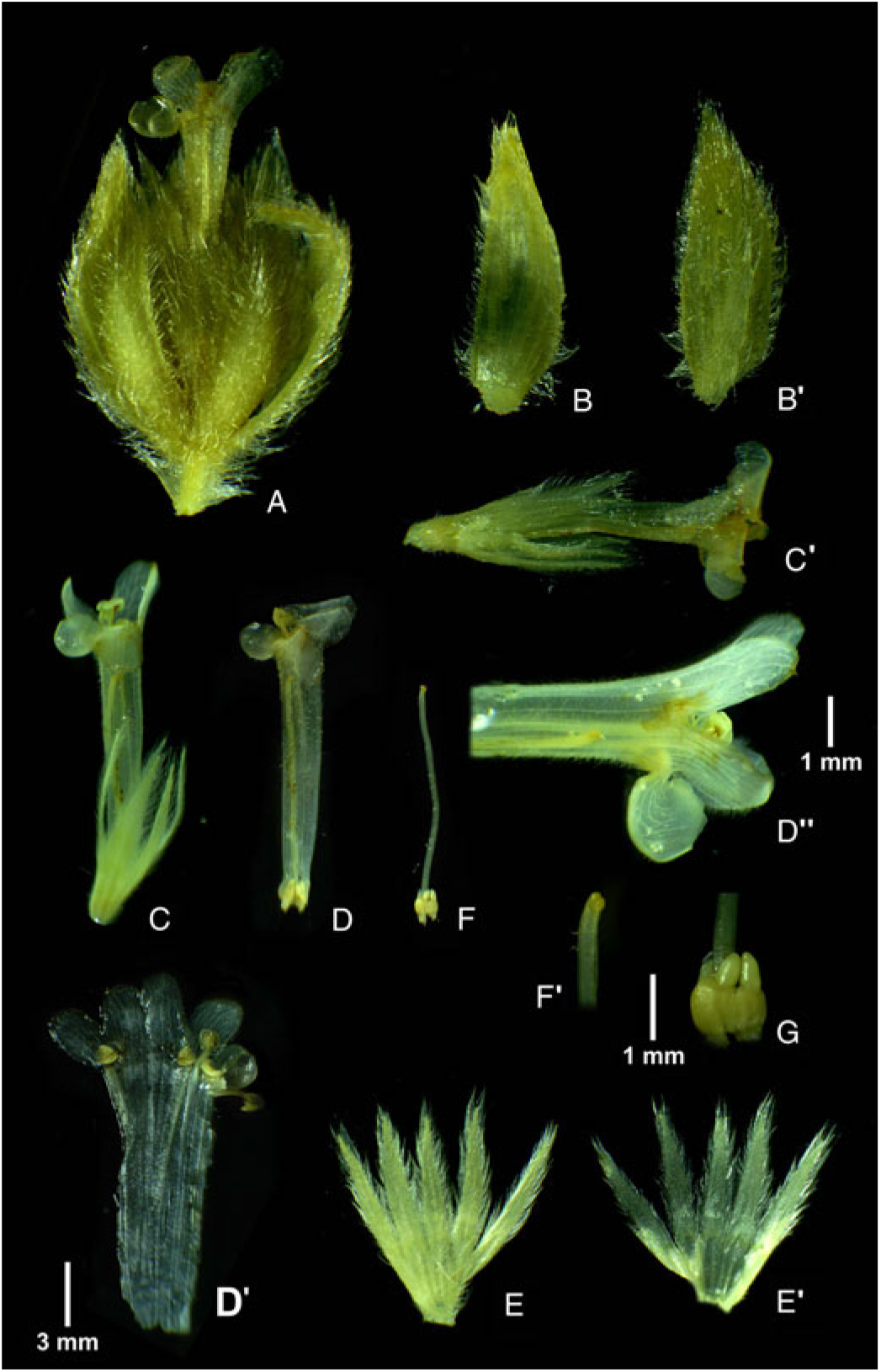
Reproductive parts of Oocephalus pubescens sp. nov. A, Cyme; B and B′, outer bracteole, ventral view and dorsal view, respectively; C and C′, flower; D, D′ and D′′, corolla, lobes and open corolla, respectively; E and E′, calyx at anthesis, inner and outer side, respectively; F and F′, gynoecium and stigma lobes, respectively; G, ovary lobes. (Photographs: José Floriano Barêa Pastore.)
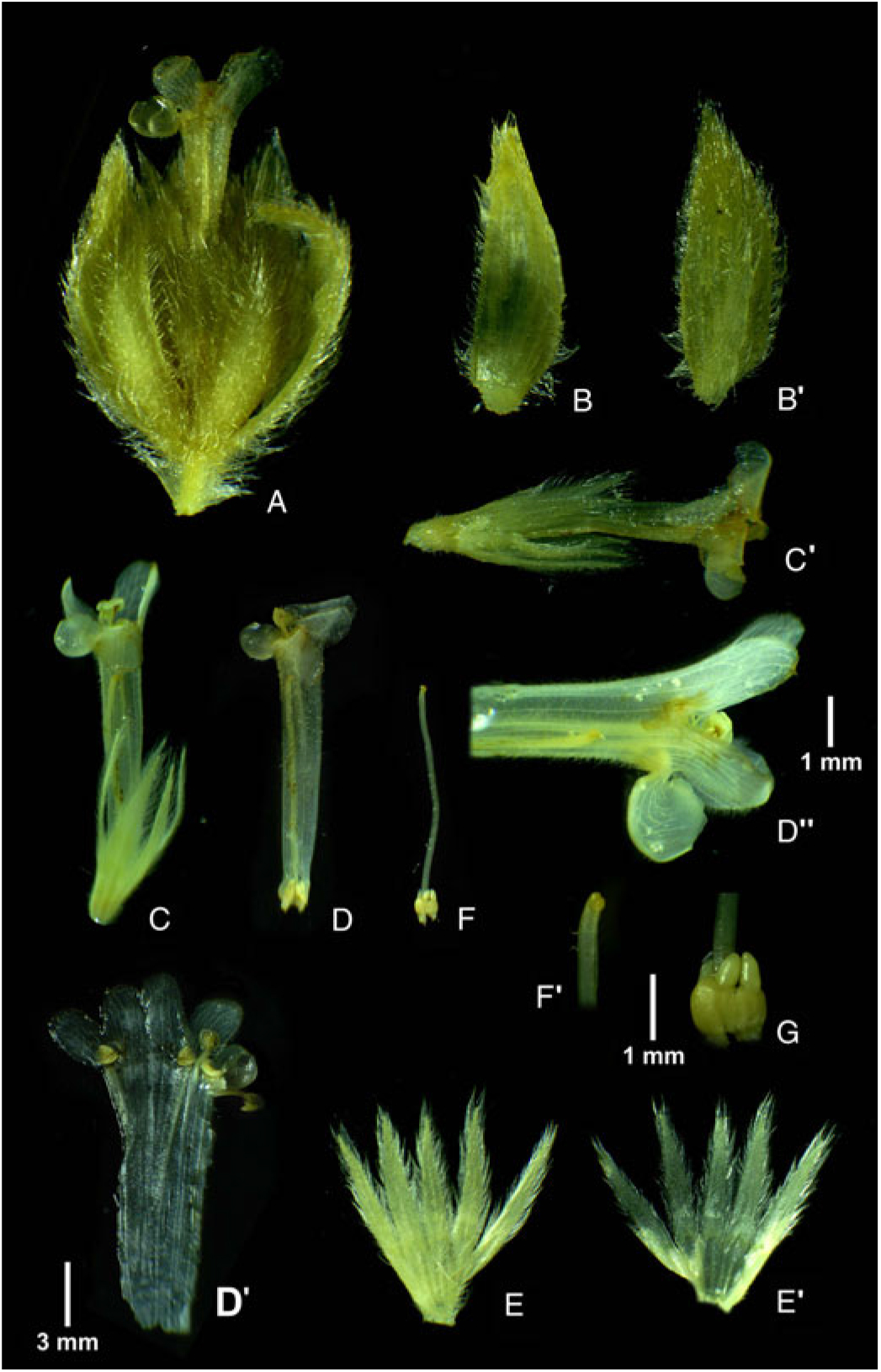
Erect shrub or subshrub, weakly aromatic, stems arising from well-developed wood rootstock (xylopodium), 0.8 m tall. Branches tomentose, densely covered with short white hairs and with scattered sessile glands. Leaves caducous below and congested on distal portions of branches, 0.9–2.5 × 0.6–1.3 mm, opposite decussate, sessile, ovate, cartaceous, with semicraspedodromous venation, margin crenate with slightly recurved lobes, adaxial surface green, covered with soft, short white hairs, abaxial surface paler, indument the same as on the adaxial surface but more concentrated between veins, apex rounded, base rounded to slightly cordate. Inflorescence a subsessile ovoid cyme in the axil of foliaceous bracts, cyme 1.3 × 2.1 cm, congested, peduncle up to 2.4 mm long, 5-flowered; bracteoles forming an involucre at the base of the cyme, outer bracteole green with the apex slightly purple, 1.4 cm long, ovate, densely covered with short white hairs on dorsal portion, ventral portion glabrous; inner bracteole 1.1 cm long, slightly lanceolate, less concave than the outer, covered with short white hairs. Flower sessile; calyx at anthesis 1.1 cm long, green, 0.4–0.5 mm long, campanulate, membranous, densely covered with short white hairs, glabrous within, lobes green, 0.7 mm long, ensiform, membranous, covered with short white hairs; calyx at fructification brown, 3–3.2 mm long, campanulate, cartaceous, covered with short white hairs, glabrous within, lobes 5 mm long, narrowly triangular, cartaceous; corolla pale purple, tube 1.2–1.4 cm long, 1.4 mm in diameter near the base, 2.5 mm in diameter near the throat, covered with short white hairs along the tube, lobes 2.6–3.4 mm long, apex rounded; stamens with filaments pilose, 3.5 mm long, anthers yellow, 0.8–1 mm long; gynoecium glabrous, style 1.7 mm long, stigma bilobed with short lobes. Nutlets not observed.
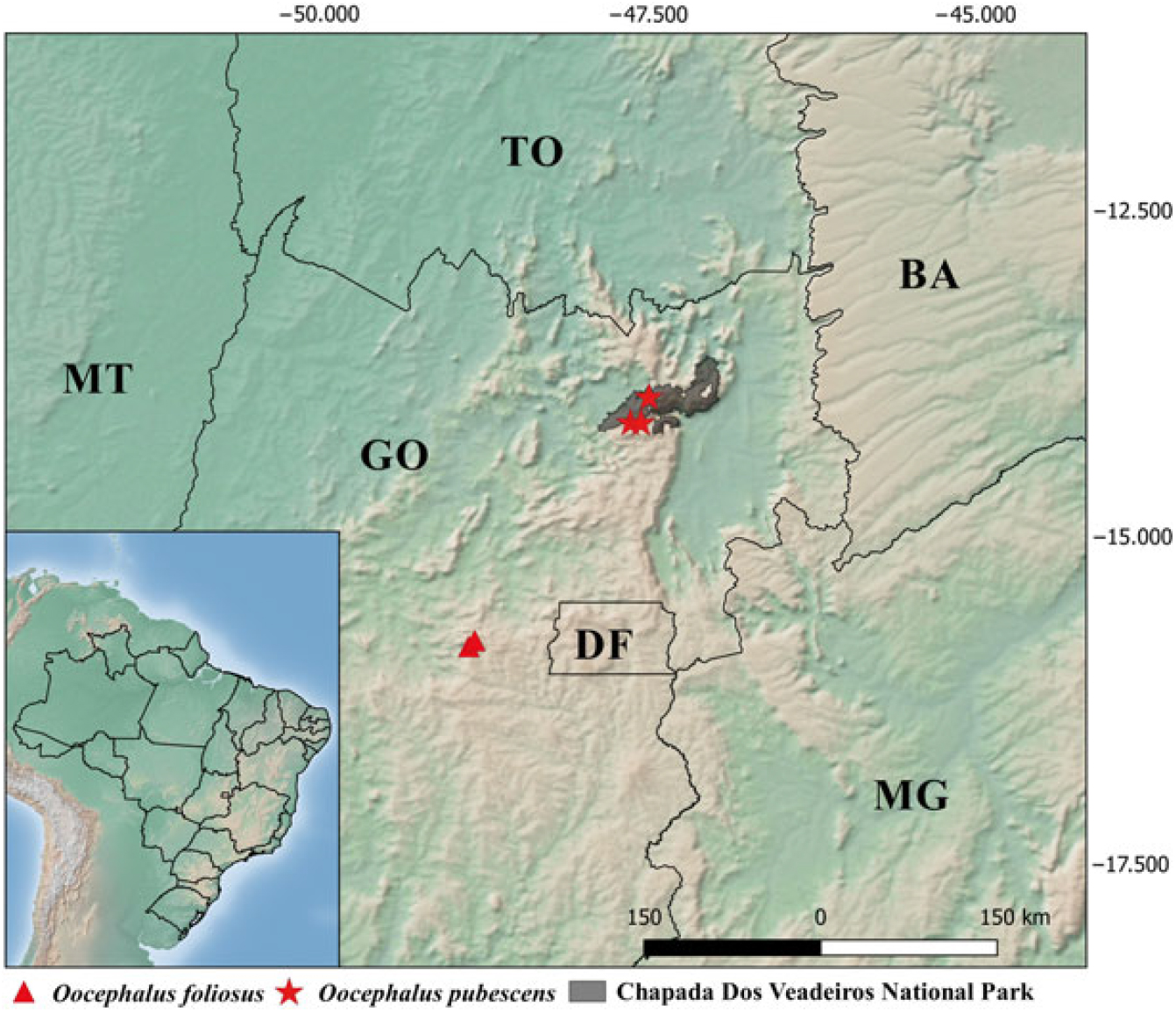
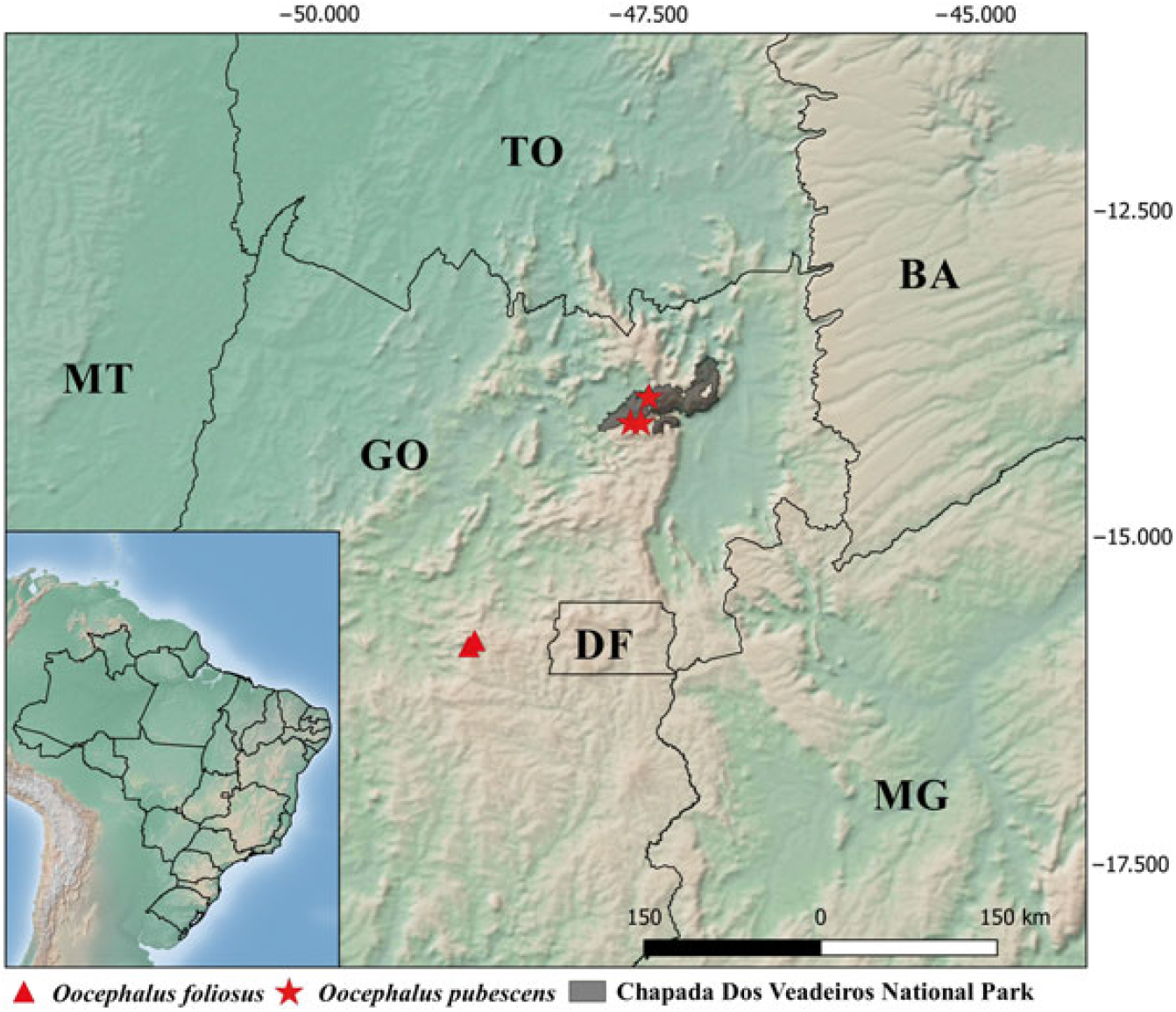
Distribution. Brazil, Goiás state: Chapada dos Veadeiros, near the town of Alto Paraíso de Goiás (Fig. 3).
Distribution map for Oocephalus pubescens sp. nov. BA, Bahia; DF, Federal District; GO, Goiás; MG, Minas Gerais; MT, Mato Grosso; TO, Tocantins.
Habitat and ecology. In campo rupestre, 1200 m, growing in sandy dry soil with rocks, on the southeastern slope of Morro da Baleia, near the road GO-239.
Flowering. The new species was collected with flowers in January, March and November.
Etymology. The specific epithet refers to the dense, short and soft indument of the species, which characterises it.
Provisional IUCN conservation assessment. Oocephalus pubescens is known only from the Chapada dos Veadeiros National Park region, a federal conservation unit with high levels of plant species richness and endemism (Harley, Reference Harley2013). The extent of occurrence and the area of occupancy were calculated as 198,245 km2 and 12 km2, respectively, using the online software GeoCat (Bachman, Reference Bachman, Moat, Hill, de La Torre, Scott, Scott and Peney2011). The type locality of the species is used for ecotourism by people visiting the town of Alto Paraíso de Goiás and is vulnerable to anthropic actions. Although hypothetically a risk assessment could be calculated using the GeoCat tool, little is known about the population in this area, and therefore it is not appropriate to evaluate its risk under criterion D (estimated population), which requires the number of individuals in the population to be assessed (IUCN Standards and Petitions Subcommittee, 2017). Therefore, we decided to classify the species as Data Deficient (DD), considering also the low number of records.
Additional specimens examined. Brazil. Goiás: Alto Paraíso de Goiás, Chapada dos Veadeiros, c.20 km N of Alto Paraíso, 21 iii 1971, Irwin, H.S. et al. 32887 (K, NY, P and UB, the first three seen by photograph); ibid., 5 km de Alto Paraíso de Goiás, 24 i 1979, Gates, B 7 (UB).
Discussion
Material of this species was first provisionally identified by Harley in 1973, before Oocephalus was separated from Hyptis (see Harley & Pastore, Reference Harley and Pastore2012). Harley made the first collection with Irwin in 1971. He believed, at that time, that it was almost certainly a new species related to ‘Hyptis foliosa A.St.-Hil. ex Benth.’, but because the material lacked corollas and possessed only old inflorescences, he was unable to reach a definitive conclusion. The recent collection with flowers at anthesis now allows a formal description to be made. Oocephalus pubescens can be distinguished by the white, dense and soft indument that covers branches, inflorescences and leaves, which are subsessile and caducous below and more congested on distal portions of stems (see Fig. 1), whereas O. foliosus is covered with much shorter and less densely distributed hairs, with leaves petioled and more loosely distributed. The cymes of Oocephalus pubescens are subsessile (see Fig. 2), whereas O. foliosus has a short pedunculate cyme (inflorescence peduncle c.4 mm long).
Although these species occur in the same state, Goiás, they are not sympatric. So far, Oocephalus pubescens has been collected only from the Chapada dos Veadeiros National Park, whereas O. foliosus is known only from its type locality, the Serra dos Pirineus (a mountain formation situated southwest of Chapada dos Veadeiros) and surrounding areas (R. M. Harley, personal observation). Restricted occurrence in the Chapada dos Veadeiros region is a common pattern of distribution in angiosperms, as noted by Simon & Proença (Reference Simon and Proença2000). In the subtribe Hyptidinae this pattern is frequent, with several species from different genera being endemic to the region, such as Cyanocephalus digitatus (Harley) Harley & J.F.B.Pastore, C. tagetifolius (Harley) Harley & J.F.B.Pastore, Hypenia paradisi (Harley) Harley and H. subrosea (Harley) Harley, as well as recently described species such as Gymneia chapadensis Harley (Harley, Reference Harley2013), Hyptidendron roseum Antar, Harley & J.F.B.Pastore (Antar et al., Reference Antar, Harley, Pastore and Sano2018) and Eriope paradise Schliewe, H.D.Ferreira, D.Graciano-Ribeiro & M.H.Rezende (Schliewe et al., Reference Schliewe, Ferreira, Rezende and Graciano-Ribeiro2017).
Acknowledgements
The first author (A.S.S.) wishes to thank the Coordenação de Aperfeiçoamento de Pessoal de Nível Superior (CAPES) for his Ph.D. scholarship, as well as the curator of the UB herbarium, Carolyn Proença, and other staff for their kindness in loaning material used in this work. The third author (J.F.B.P.) gratefully acknowledges Conselho Nacional de Desenvolvimento Científico e Tecnológico (CNPq) for support from a fellowship (302452/2017-6). The authors also thank the two anonymous reviewers and the editor-in-chief, Neil Bell, whose suggestions and comments improved the quality of the paper.