Most human beings are not migrating. More and more people want to migrate for various reasons. But most never do so because they encounter various obstacles. This book is about those obstacles. One set of obstacles comes in the form of social forces, whereas another set is in the form of government immigration policy. However, both sets are at their most powerful in preventing immigration when they interact with each other in three ways: denying potential immigrants legal entry, deterring others from even applying for a visa, and disenchanting former immigrants who give up after they start immigrating into a society – processes which in the three parts of this book I respectively refer to as denial, deterrence, and disenchantment.
Many people might have immigrated if such processes had not stopped them. Thus, the amount of international migration we observe is much less than it would be in a counterfactual world where governments and societies would not impose so many obstacles on individuals who desire to cross borders and immigrate. Many of those who do not immigrate are what you could think of as might-have-been immigrants or what for purposes of brevity in this book I call potential immigrants – individuals who counterfactually might already have immigrated if they had not confronted such obstacles. Although less frequently examined by scholars than immigrants, potential immigrants are especially important because of how they might have changed the composition of migrant-origin societies and migrant-destination societiesFootnote 1 in important ways if they had not confronted the obstacles mentioned earlier in this chapter.
Why write a book about what prevents people from immigrating? The geographical positionality of most scholars as inhabitants of migrant-destination societies makes us more attentive and knowledgeable about immigrants than those who aspired to immigrate but never did. This biases and limits our perspective on and understanding of immigration to a myopic range and the specific positionality of nonmigrant inhabitants in migrant-destination societies. For myself, while growing up in a multicultural and multiracial lower-middle class suburb of the San Francisco Bay Area in California, I had little awareness of how or why many of my childhood friends had come with their families from other far-away countries in the world. I only gained clues as to how they had come to my community when I heard my mother speculate out loud that Thao’s family might be refugees from Vietnam, or perhaps Enrique with his family had come across the border from Mexico. Like many inhabitants of migrant-destination societies with little knowledge of foreign countries, my understanding of international migration was limited only to what I could observe. What I could observe were the immigrants that my fellow Californians, during our state’s relatively more xenophobic era of 1980–2000, seemed to either wish to welcome for both altruistic and self-interested reasons or to resent for reasons of discomfort or aversion toward the unfamiliar. What most other inhabitants of migrant-destination societies and I could not observe were the arguably many more people who wanted to immigrate but never succeeded in doing so and all that they had been through to try to immigrate into our society only to fail. For most of us, such potential immigrants hardly existed, apart from some very rare coverage of their travails by the mass media.
While in high school and college, I learned much more about other societies and the astonishing international inequalities in the world. I came to appreciate better what the families of my immigrant friends from my childhood had gone through to become a part of another society. My life in the United States seemed idyllic when I learned about what these families had endured to immigrate. I increasingly sensed that people in migrant-destination societies had a crucial and large epistemological blind spot in understanding how immigrants had migrated. I also suspected that I could only confront that blind spot by traveling widely outside the US, avoiding hotels or hostels and staying, whenever possible, in local people’s homes to understand their culture and society better. I found that doing this helped me better understand how individuals outside of migrant-destination societies perceived international migration very differently from those inhabiting migrant-origin societies. Through chance encounters with potential immigrants, I hoped to understand better what international migration, mobility, and travel are than I could have from learning only from the immigrants I grew up with.
Many such potential immigrants I met outside the United States, include, for example, a kind young Albanian Catholic teenager who introduced himself to me at a bus station, invited me to stay with him both in his home and that of his brother when I traveled to Tirana, and then asked me if I could help him ask an officer at the US Embassy why it denied him a visa and how I could help him obtain one – for that question I could not even get a clear answer except, “You cannot help your friend.” As an example of potential immigrants who did not immigrate due to visa denial, I likely would never have met him if I had not traveled outside the US. Others, like the Cameroonian healthcare worker who hosted me and saved my life from a terrifying bout of malaria and dysentery, would cheerfully laugh when I naively told them they were always welcome to stay with my family in California. They would dismissively inform me that they would love to do so, but for them to apply for a visa would be a waste of their time, money, and energy, as the odds of their receiving one were too low. They were an example of a potential immigrant who did not immigrate due to deterrence. And lastly, I met potential immigrants who seemed like they would acculturate well into the United States and other societies abroad, so I often wondered why they had not immigrated. Yet these potential immigrants told me that they had no desire to do so, like the Jordanian manager I hitchhiked with who explained how he felt he could contribute much more to society and the world in his home country than in societies of immigration like the United States, where every day since 9/11, he and his wife had confronted Islamophobia that limited both their career prospects and therefore the benefit that the United States could have derived from their presence. All these cases illustrate how potential immigrants are a general phenomenon across the world, rather than unique to any specific society. This suggests potential immigrants are globally important. Quantitative data substantiates this. A Gallup poll longitudinally measured migration intention by asking people in 150 countries, “Ideally, if you had the opportunity, would you like to move permanently to another country, or would you prefer to continue living in this country?” The 2021 wave of this survey revealed that a global average of 16 percent of people – or 900 million people – in the world would like to migrate to live in another country, with the respondents ranging from 4 percent (the minimum, in East Asia) to 37 percent (the maximum, in both Latin America and sub-Saharan Africa). Moreover, between 2011 and 2021 the percentage of people wanting to emigrate from nearly all regions of the world has risen – in some countries by as much as 27 percent – and it has only declined in the European Union and East Asia (Pugliese and Ray 2023). Together, these quantitative figures suggest that a large proportion of the world’s population consists of potential immigrants. Of course, arguably only a minority of those who express an intention to migrate would do so, but even this at least suggests that many more people would migrate internationally if it were easier to do so. This also explains why governments ranging from the United States to the EU countries to Australia have had officials make diplomatic trips to migrant-origin societies or have spent money on campaigns to discourage and dissuade potential immigrants from immigrating.
After I decided that I would devote my PhD dissertation to producing more data, knowledge, and theory about potential immigrants, I learned that most scholars of international migration focused only on immigrants. I soon learned from a methodological text about research design that this tendency to focus only on instances of when something happens without comparing them to negative cases (Emigh Reference Emigh1997) of when they did not happen had a jargony name – “selecting on the dependent variable” (King, Keohane, and Verba Reference King, Keohane and Verba2021) and how this approach could lead to biased conclusions in empirical research about phenomena. Yet I also learned about how many social scientists discouraged studies like mine based on an entrenched belief that it is hard to falsify and prove such negative cases. At the same time, I also knew from my travels that there were a lot of people abroad and in destination societies who would migrate internationally more and benefit a lot from migration if government policies and their social circumstances did not make migration so difficult for them. For me, these potential immigrants haunted the field of international migration research and provoked perennial anxieties in migrant-destination societies and governments about immigration. Our ignorance about such populations of potential immigrants limits our understanding of migration.
Yet why should people care about potential immigrants if most social scientists or readers of this book will never encounter them? Consider this book as an effort to convince you, dear reader, that such potential immigrants are worthwhile subjects of study and can even help you better understand immigrants, immigration, and inequality on a more global scale than you could from many previous studies of international migration. This is the case not only because potential immigrants have broader implications for the differences in the types of individuals that can cross borders and those that cannot, the capability of governments to control migration, and the relationship between migration and inequality both within and between societies. The overarching goal of this book is not to normatively or empirically prove anything specific about potential immigrants, but instead to explore how studying the different mechanisms that prevent many from immigrating can supplement our abundant knowledge about positive instances of migration with respect to international migration, law, and social stratification. In sum, we can better answer many perennial questions about immigration by studying not only those who immigrated, but also those who might have migrated if governments and societies had made it easier to do so.
How has this epistemological blind spot about potential immigrants emerged? First, due to the national interests and funding priorities of the governments of migrant-destination societies, much of the research about international migration in the past 150 years has attempted to explain why people migrate or continue to migrate, whether that be through the theory of distance influence (Ravenstein Reference Ravenstein1889), the push-pull theory (Bogue Reference Bogue1957; Heberle Reference Heberle1938; Lee Reference Lee1966), macrolevel or microlevel neoclassical theory (Harris and Todaro Reference Harris and Todaro1970; Sjaastad 1962), segmented labor market theory (Piore Reference Piore1979), the new economics of labor migration theory (Stark and Bloom Reference Stark and Bloom1985), world systems theory of migration (Portes and Walton Reference Portes and Walton2013), institutional theory (Massey et al. 1993), migration network theory (Hugo 1981), cumulative causation theories (Massey et al. Reference Massey, Arango, Hugo, Kouaouci, Pellegrino and Taylor1993 for a summary), migration systems theory (Fawcett Reference Fawcett1989), or the renaissance of transnationalist theories about migration (Schiller, Basch, and Blanc-Szanton 1992). The question of why some people did not immigrate has consequently been a lower research priority.
At a macrohistorical level, I think we can trace the blind spot back to a combination of (1) how much social science about international migration has emerged during the time after the United States, from 1924 until 1965, had largely cut itself off from immigration due to that era’s highly restrictive immigration laws and (2) what the late political philosopher Iris Marion Young (2010) theorized as the “demands of immediacy.” Such demands of immediacy lead U.S.-based scholars to be most concerned with those subjects of any social phenomenon who are most socially entangled with our daily lives and with whom we are more likely to have homophilic relations, to have the least social distance from, and to share a linked fate with. Young’s theory would suggest that for the White middle-class American men who dominated social science research until roughly fifty years ago, the demands of immediacy would have made them most concerned about their own immigrant ancestors and the contemporaries of their own class, ethnicity, gender, race, and nationality. They would have been somewhat less interested in legal contemporary immigrants from non-White and female populations and immigrants who occupied a socioeconomic class very different from their own. They would have been even less interested in foreigners beyond the borders of their society who struggled to enter the country through authorized and unauthorized channels. And they would have been the least interested in potential immigrants living outside the researcher’s country of residence, who often only existed to the researcher through representations in the media and images in their own minds.
I recognize that research about migration has expanded and progressed remarkably over the past fifty years. When sociologists began to tire of studying first-generation immigrants, scholars then researched how the process of assimilation continues through the second generation. When scholars embraced most of the opportunities for research about the second generation, they began focusing on the 1.5 generation and undocumented immigrants, offering a further testament to how complex and rocky the intergenerational process of immigration is. Many social scientists have also recently focused on disaggregating the more nuanced differences between undocumented immigrants (Del Real Reference Del Real2019), unaccompanied minor immigrants (Galli Reference Galli2020), legal permanent residents (Jasso Reference Jasso2011), asylum seekers (FitzGerald Reference FitzGerald2019), and immigrants who adopt a more “liminal status” (Menjivar 2006) like those holding TPS or Deferred Action on Childhood Arrival (DACA) documents (Gonzalez 2016), which allow them to stay but not become full members of society. Certainly, scholars have periodically focused more on potential immigrants in migrant-origin societies (FitzGerald Reference FitzGerald2019; Lucht Reference Lucht2011; Carling 2004), but most of the focus has been on immigrants. All this research about different types of immigrants selectively manufactured by an interplay of immigration policy and social forces has greatly enriched our knowledge of immigrants and how they cope with a variety of social forces and distinct bureaucratic regulations.
However, I argue that our understanding of international migration as a general phenomenon and its various aspects is still limited due to a relative deficiency in knowledge about a possibly even larger population of individuals that counterfactually might have immigrated but in fact did not. To paraphrase Roger Waldinger (Reference Waldinger2013), migration scholars have long had their backs to the border, looking inward, examining less frequently the generational lines of emigrants and premigration processes that lead a minority of potential immigrants to emigrate and prevent most potential immigrants from doing so. Our relative ignorance of such antimobility processes is understandable both because of the demands of immediacy and the fact that those denied entry and deterred from applying never come to the migrant-destination societies where scholars of migration live, and that those who gave up on immigrating often leave such societies before the scholars can identify them as disenchanted ex-immigrants. Yet as the field of immigration in sociology has grown into the more encompassing field of international and transnational migration, the need to systematically collect social science data and knowledge about what prevented potential immigrants from immigrating becomes more pressing if we want to achieve a truly global understanding of migration rather than one that disproportionately values abundant knowledge about immigrants.
To reduce the chances of misunderstandings, I will now clarify what I mean by potential immigrants and immigrants because different languages, cultural worldviews, and discursive fields conceptualize both subjects differently. For example, in Chinese, the word “immigrate” (移民 or Yímín) literally means “to change one’s nationality/citizenship.” Therefore, an immigrant is someone who makes such a change. In this sense of the word, an individual can be an immigrant if they find a way to secure citizenship in and a passport from a migrant-destination society and then return to their migrant-origin society to live. Lawyers and government officials of the United States and many other migrant-destination countries define immigrants much more broadly as those who legally enter and settle into a society for a certain period of time and live amongst others.
Yet, beyond this strictly legal definition, social scientists have also come to view concepts of membership, citizenship, and immigration not in narrow legal terms but in a more social sense (Bloemraad Reference Bloemraad2006; Marshall and Bottomore Reference Marshall and Bottomore1992). This also seems to be in line with the emic understanding of immigration we see manifested in Western media and public opinion: A person is an immigrant and has immigrated to the extent that they have settled into and become a part of society. A person who lacks citizenship, a permanent residence permit, or even a temporary visa is still an immigrant if they have inhabited a society for longer than a typical tourist or visitor. In contrast, an individual is not an immigrant in the common sense of the term if they for most of their lives reside outside of the migrant-destination society but are citizens of a migrant-destination country because they happened to be born into the society, obtained a job there, or married someone there – even if politically and legally they are not immigrants. This distinction is important, as some scholars have described individuals as “immigrating” or “becoming immigrants” in the legal sense when most people would not consider them socially to be immigrants.
Governments typically define “nonimmigrants” as those who lack a legal right to settle permanently in the migrant-destination society but have permission to enter for a short period. Demographers will sometimes refer to everyone in a migrant-origin society as “nonimmigrants” to compare them to immigrants. Race and ethnicity scholars focused on relations between “immigrants” and the “native-born” will sometimes refer to the latter as “nonimmigrants.” In this book, I adopt the more precise term “potential immigrants” to refer to the fraction of the migrant-origin society that have not yet immigrated but might have done so if not for interactions between immigration policies and social forces that contribute to the denial, deterrence, and disenchantment of potential immigrants. They are distinct from the majority in populations of origin societies who have never considered migrating and those entering migrant-destination societies without authorization from the government, which this book excludes from its analysis.
1.1 Research Questions, Theoretical Frameworks, and Argument of the Book
1.1.1 Conceptualizing the Distinct Mechanisms that Reduce Migration
Observed migrant selectivity is a dialectical product of self-selection and state-selection. Put into the classically Hegelian thesis-antithesis-synthesis framework, the thesis comes from a subpopulation of the migrant-origin society that proclaims, “We want to immigrate!” revealing how those who want to move differ from those who do not (self-selection). This clashes with the antithesis, which is the governments and societies of migrant-destination jurisdictions who retort, “We don’t want you all to come!” and accordingly enact restrictive immigration policies to reduce the numbers that immigrate. This reveals how those individuals that a state allows to come are different from those it does not (state-selection). The resolution of this thesis and antithesis produces the synthesis of only immigrants who both want to come and whom the state wants to come, revealing how international mobility is in fact related to inequality (observed selectivity).
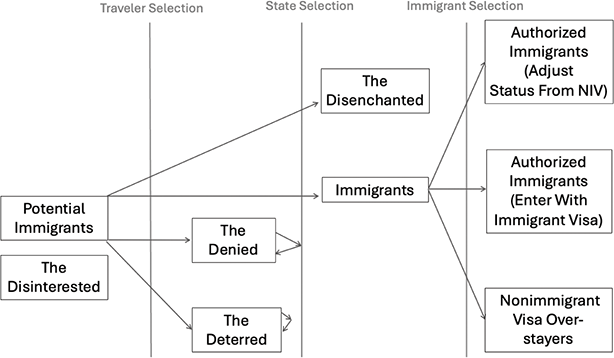
For analytical clarity, Figure 1.1 illustrates this heterogeneity of the potential immigrant population with respect to immigration policies and social forces by analytically distinguishing between self-selection and state-selection of who goes abroad, clarifying how such processes produce a variety of potential immigrants. Note how my analytical framework only includes individuals who obey immigration law and excludes those who enter territories without authorization and those who have no interest in migrating or going abroad. Migration policies and social forces interact to reduce legal migration.
Disentangling traveler, state, and immigrant-selection.
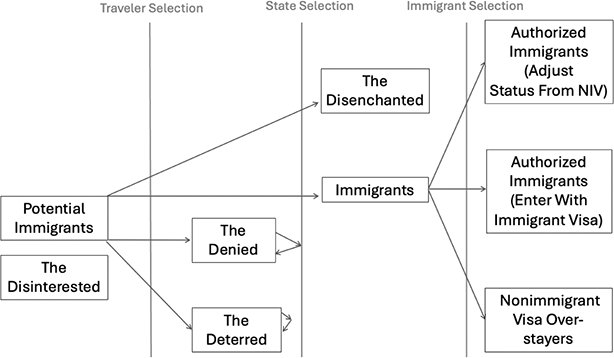
The arrows represent the journey that each type of potential immigrant takes, and whether they cross the different barriers of deciding whether they will cross a border (“self-selection”) in terms of travel and immigration and or whether the state legally authorizes them to cross that border (“state-selection”). At the left is the migrant-origin society, and at the right is the migrant-destination society. For a potential immigrant to reach the migrant-destination society, they must pass through both the barriers of traveler-selection (the first type of self-selection) and state-selection by traveling. These selection barriers subdivide potential immigrants into several types. They are all distinct from those who are disinterested in going outside their country of birth. First, many individuals self-select to migrate and request that the state select them to legally enter its territory. They are unable to enter because the government denies them a visa. Part I of the book provides empirical examples of these individuals. Those prevented from migrating due to deterrence would like to go abroad. However, they do not apply because they believe they are not qualified to obtain a visa. Therefore, they do not even reach the state-selection barrier. Part II of the book provides empirical examples of these people. Although a minority of those denied and deterred might then migrate without authorization, how effective the mere presence and enforcement of immigration law is at reducing immigration stems from the unappreciated fact that – contrary to popular perceptions – those denied visas and who obey immigration law and remain in the migrant-origin society are far more numerous than those who migrate without a visa.
Two groups pass through state selection. The first group confronts disenchantment after arrival. Instead of immigrating, due to either the challenge of legally immigrating or an independent preference for their country of birth, they choose to return to their society of origin as ex-immigrants and do not pass through immigrant selection (a second type of self-selection). Part III of this book analyzes empirical examples of these individuals. The second group is the immigrants who pass through immigrant selection. They either overstay their visa and become unauthorized by intentionally or accidentally overstaying their visa or transition to legal status (either immediately by becoming a citizen or only by obtaining a permanent residence permit). I only analyze empirical cases of immigrants as a contrast to my three potential immigrant subpopulations of interest. The immigration journey, therefore, consists of three stages, which are 1) applying for a visa (traveler selection), 2) having a state approve for entry (state selection), and 3) deciding whether to stay and immigrate (immigrant-selection).
1.1.2 Expanding the Push-Pull Model to a Push-Retain-Pull-Repel Model
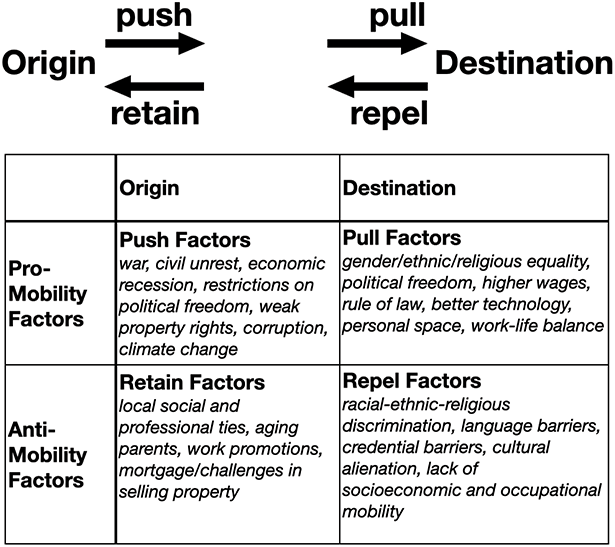
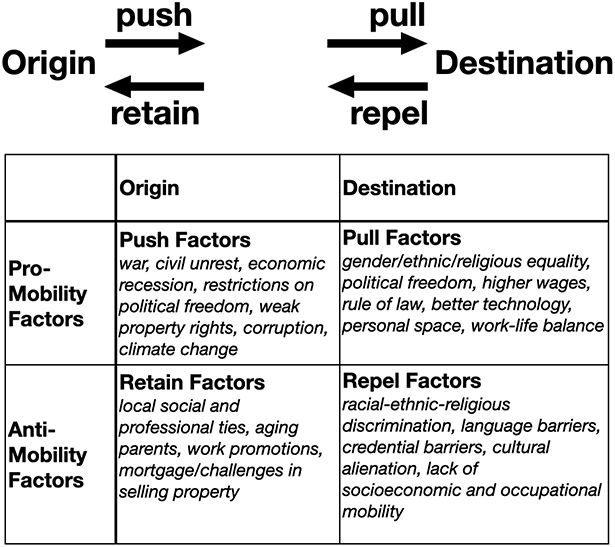
By collecting richer data about these three mechanisms, I further extend the elegant and simple push-pull model (Bogue Reference Bogue1957; Heberle Reference Heberle1938; Lee Reference Lee1966). In this model, “push factors” like war, civil unrest, restrictions on political freedom, economic recession, and climate change in the migrant-origin society motivate people to emigrate, whereas “pull factors” such as higher wages, better career opportunities, more civil liberties, political stability, personal space/work-life balance, and relatively more equality with regard to gender and sexuality attract immigrants to many destination societies.
The problem with this model is that it does not explain why so many people have not migrated although they say they want to do so – large populations of potential immigrants that you could designate as being ambivalently immobile. They are ambivalently immobile because two types of countervailing factors are just as, if not more, powerful than the push factors and pull factors and discourage people from migrating: (1) the retain factors that make the migrant-origin society attractive to stay in, such as promotions and raises at work, aging parents, mortgage/challenges in selling property, and benefits from retirement schemes that one has invested into; and (2) the repel factors in the society of destination that make a migrant-destination society unattractive, such as ethnic-racial-religious discrimination, credentialing barriers, cultural alienation, a language barrier, and a lack of occupational mobility. Figure 1.2 graphically depicts the structural form of the push-retain-pull-repel model. This book will demonstrate how the four-factor model offers us a fairer and even-handed way to also explain why many potential immigrants do not immigrate.
The push-retain-pull-repel model.
1.1.3 An (Im)mobility Paradox in How Migration Policy Interacts with Social Forces to Reduce Immigration
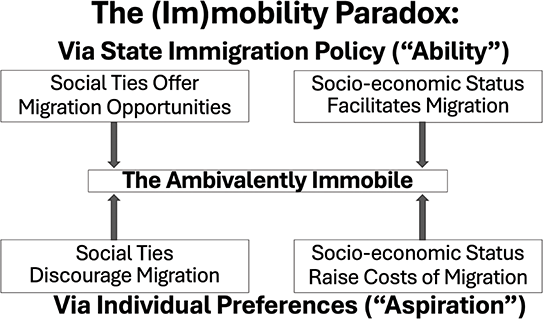
Despite many potential immigrants’ genuine interest in going abroad and immigrating, I argue that in each step of the migration process outlined in Figure 1.1, an additional tension emerges between the individuals’ desire for both mobility and stability within contexts of origin that stymies the aspiration to go abroad, given the way governments enforce immigration policy and how societal forces subtly discourage international migration and travel. This raises fundamental questions about what ties potential immigrants to both migrant-origin societies and migrant-destination societies and prevents them from moving between societies. Certainly, as much classical migration theory would posit, socioeconomic resources and social ties enable and facilitate an individual’s ability to migrate. Yet many people may also be reluctant to emigrate because of such socioeconomic status – for example, a lucrative job with opportunities for promotion in one’s migrant-origin society, formal education that is more valued in migrant-origin societies than in migrant-destination societies, a real estate property that is challenging to sell – as well as because of social ties – for example, being embedded in one’s current job after working there a long time, having a child in need of care, and ties to retired or aging parents in need of care. Both the design of visa policy and societal forces interact in both exploiting and exacerbating this tension by facilitating travel and visits only for those who have such resources that make a potential immigrant less likely to migrate. With regard to the process of denial, this is particularly the case within the context of the life course, as each type of potential immigrant must demonstrate that they are sufficiently established before they can legally move or immigrate. The same resources that would make many potential emigrants attractive to migrant-destination governments – abundant human capital in the form of education, technical skills, or language ability, strong familial and social connections, financial assets, and travel experience – also grant them greater opportunities in the country of origin and make emigrating more of a sacrifice for them. Such paradoxical resources constitute immobility-mobility capital, or what for brevity I term (im)mobility capital.
Fulfilling conventional life course processes like obtaining an education, a financially and psychologically satisfying job, a reliable partner, children, a home, and a community where one feels a sense of belonging is a challenge for potential immigrants who aspire to immigrate and settle into another society. Expectations that one should achieve such milestones in life make crossing borders often take priority over migration projects, which restrictive immigration policy and social forces make less feasible. The tension between individual and societal aspirations for the stability or immobility often necessary to achieve these milestones and a countervailing individual desire for geographic mobility explains more clearly than either only immigration policy or only individualistic conceptions of migration preferences why we do not have more international mobility and migration in today’s world. I diagram this tension in Figure 1.3, which further develops the trade-off between ability and aspiration (Carling Reference Carling2002).
The (im)mobility paradox.
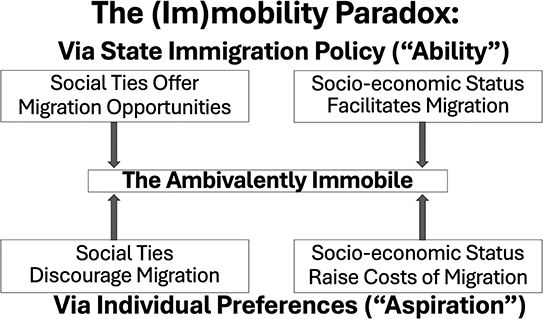
Those who can emigrate often have less aspiration and those who want to immigrate often are unable to do so. Therefore, only a minority who have both ability and aspiration migrate. The resources of socioeconomic status and social ties an immigrant possesses that increase potential immigrants’ opportunities to immigrate also tie them to their origin society, just as the inability to establish those resources makes immigration less likely. This tension between mobility and immobility with respect to the processes of denial, deterrence, and disenchantment I call the (im)mobility paradox throughout the book. This paradox produces many potential immigrants who never immigrate and whom we can also conceptualize as the ambivalently immobile. This also often, as I will show, motivates deterred emigrants to raise second-generation emigrant children.
The number of people deterred by migration policies is counterfactually difficult if not impossible to estimate, but the number is arguably substantially larger than those prevented from illegally entering due to border enforcement, those denied visas, or those who become disenchanted. Such deterrence massively compromises the development and flourishing of societies in ways we cannot fully appreciate because we cannot observe how the world would be different without such deterrence. Sociologists in the past have highlighted and seemingly celebrated the impressive optimism, energy, and determination that successful immigrants radiate in enduring obstacles that at times seem insufferable (Kao and Tienda 2012). As real and inspiring as that optimism may be, many potential immigrants certainly did not possess such intangible assets to persist and remain in the migrant-destination society, obtain a visa, or even apply for a visa in the face of intense xenophobic opposition to their presence. Such potential immigrants never overcome the (im)mobility paradox and therefore do not permanently immigrate.
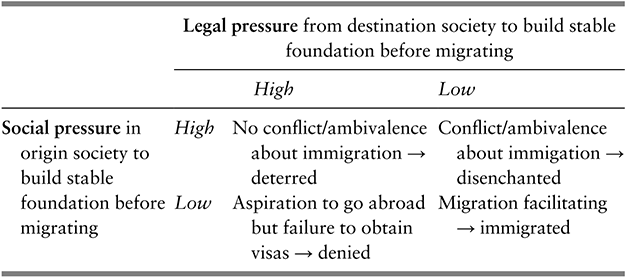
Analytically, different combinations of high and low antimobility pressures from this paradox can result in four different outcomes, as illustrated in Table 1.1. In the upper left-hand quadrant are individuals who face strong legal pressures from the government of a country of destination to prove they have strong ties to their country of residence, as well as strong social pressures from familial and social networks not to go abroad. Due to these pressures, they do not apply for visas and become deterred from going abroad even though they desire to do so. In the lower left-hand quadrant are the potential immigrants who face weak social pressures to apply for a visa but strong legal barriers from the government of the migrant-destination society, and therefore they do not apply for such a visa. If the government of a migrant-destination society believes a potential immigrant lacks strong ties to their society of origin, the potential immigrant is denied.

Table 1.1 Long description
This table illustrates how the pressures of the destination society’s government and social pressures from familial and friendship networks in the origin society lead to different non-migration outcomes. Those who confront strong pressures from both the destination society and social pressure in the origin society to build a stable foundation before migrating become deterred. Those who confront strong legal pressure from the destination society to build a stable foundation before migrating and weak social pressure in the origin society to build a stable foundation, have the destination country government deny them a visa. Those who confront weak legal pressure from the destination society to build a stable foundation before migrating and strong social pressure in the origin society to build a stable foundation before migrating obtain a visa, but later become disenchanted with immigrating. Those who confront weak legal pressure from the destination society to build a stable foundation before migrating, and weak social pressure in the origin society to build a stable foundation before migrating, will later immigrate.
In the upper right-hand quadrant are potential immigrants who face weak resistance from destination-country governments but strong social pressures not to remain abroad. They are likely to emigrate and settle in another country but later return to their country of origin and become disenchanted. These three types of nonimmigrants – those denied, deterred, and disenchanted – certainly can confront more than one force and move between one category and another over time. Previous scholars have studied all three alongside each other with respect to these critical mechanisms that reduce the amount of international migration in the world. Furthermore, we can compare those who do not immigrate because they fail to overcome one or more of these three obstacles to the immigrants who overcome all three, which most scholars of international migration have focused upon researching. They are in the lower right-hand quadrant.
1.1.4 Extending Theories of Stratification and Segmentation of Immigrants to Potential Immigrants
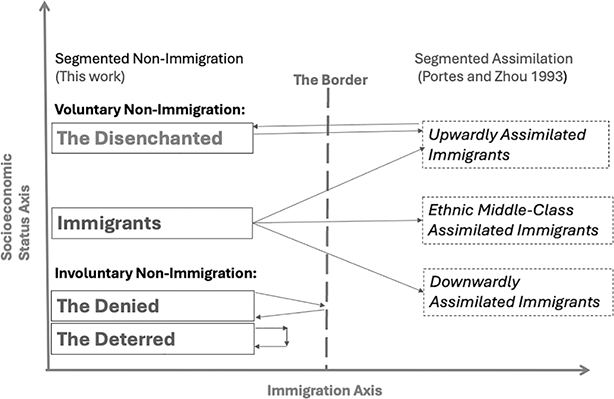
The way in which the processes of denial, deterrence, and disenchantment stratify the potential immigrant population complements previous voluminous research about the social stratification of immigrants. One of the most influential theories is that of segmented assimilation (Portes and Zhou 1993). This theory integrated discoveries from both qualitative and quantitative empirical research about diverse immigrant groups across the socioeconomic spectrum. In contrast to the classical assimilationist (Gordon Reference Gordon1964) and neo-assimilationist (Alba and Nee Reference Alba and Nee2009) theories of how “successful” immigrants across generations eventually assimilate into the mainstream ethnic-racial majority, the segmented assimilation theory posited that given the reality of extensive socioeconomic inequality, some immigrants will also not assimilate into the mainstream but instead integrate into middle-class ethnic enclaves and suburbs. A third group of immigrants will assimilate into the lifestyle of low socioeconomic classes in the migrant-destination society, characterized by dropping out of high school or not entering or completing college, joining gangs, committing crimes, going to prison, and/or being unable to maintain a stable job and remaining on the most exploitative margins of the labor market.
Yet, given that the level of inequality in societies of migrant-origin is just as substantial as the level of inequality in societies of migrant-destination, would not the population of potential immigrants be segmented as well? We could potentially think of the potential immigrants most impacted by one of the three mechanisms I analyzed in the process of emigration in a similar way. Economic historians have shown that immigrants tend to be those who originate from the professional, middle-class, and upwardly mobile strata of the population – precisely those individuals who benefit most from long-term migration and settlement due to greater opportunities in the country of destination (Hatton and Williamson Reference Hatton and Williamson2005).
In Figure 1.4, I show that just as the process of immigration/assimilation can be socioeconomically segmented (based on the vertical axis), so also may be the population of potential immigrants (running horizontally from the far left toward the border). Immigrants include individuals who are highly educated, ambitious, and hard-working from the middle classes in the migrant-origin country. As they are often not the most privileged people in the society, in many ways they gain the most from migrating. They are more likely to attain a materially and psychically more rewarding life in migrant-destination countries where they can more fully exploit their human capital due to various factors, such as superior education, technology, and infrastructure and relatively less corruption, nepotism, and gender, religious, and racial-ethnic discrimination. Those who immigrate into another country are, in fact, those who would be most likely to contribute to social mobility, innovation, and dynamism to the destination economy. They, therefore, are often those most determined to persist in immigrating.
Socioeconomic stratification and inequality of potential immigrants in the migrant-origin society.
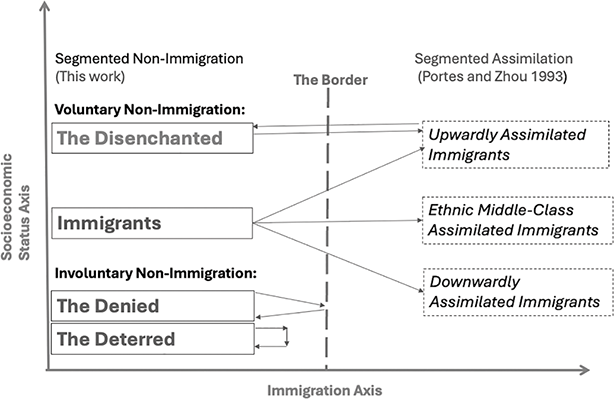
Yet, as I will show in the empirical chapters that follow, most people who once aspired to immigrate do not have such a celebratory and widely lauded journey at all. Most of these potential immigrants come from the upper and lower strata of the migrant-origin society. Lower-middle classes are denied visas and may never immigrate because the destination country government either believes they do not have enough ties to the origin country and therefore the government believes they are the most likely to immigrate. The most socioeconomically disadvantaged class of potential immigrants is simply deterred because they believe they lack resources to even apply for a visa, or even if they have the resources, they may believe that governments of most migrant-destination societies would not grant them a visa to enter even temporarily; therefore, they do not waste their time and money applying. Collectively, I consider groups impacted by these forces to be involuntarily immobile (Carling Reference Carling2004).
Finally, since individuals from the upper strata of many such developing economies are more likely to benefit from strong political and social connections in the migrant-origin society and already have a satisfactory standard of living, they are more likely, after visiting a migrant-destination society, not to be enchanted with the idea that immigration provides them with a pathway of upward social mobility. They often become disenchanted with the experience of immigrating and return to their country of origin as ex-immigrants, where many believe they can have a better life. However, they may also have sufficient education and language ability that the process could potentially be much easier than it is for less advantaged applicants. In sum, the comparable data of the type I collect enable me to show in Chapter 8 how these different populations of potential immigrants are socioeconomically stratified with respect to each other and immigrants as well, yielding a more global and transnational perspective on the relationship between inequality and migration than an analysis of only immigrants would allow.
1.1.5 What Have Previous Researchers Discovered about Denial, Deterrence, and Disenchantment?
Prior scholars of these mechanisms have focused on only one mechanism rather than integrating them all into a single theoretical framework. Although I review the literature on these mechanisms in general later in this introduction, these mechanisms likely operate somewhat differently across diverse cultural contexts. I pay special attention to research that reveals how these factors operate in mainland China,Footnote 2 as this is where I collected the sample I will empirically analyze in this book.
1.1.5.1 Denial
Concerning those denied visas, Points of Entry by Vic Satzewich and Schengen Visa Implementation and Transnational Policy Making by Federica Infantino examined state actors’ perspective on border regulation and control of international migration and nonmigrants in Canada and the European Union, respectively. Such bureaucrats typically repeat official discourse, have seemingly limited discretion, and conform to organizational institution/bureaucratic habitus, particularly in the politically sensitive department of immigration (Satzewich Reference Satzewich2015; Infantino Reference Infantino2019; Alpes and Spire Reference Alpes and Spire2014). Although these authors contributed a valuable insider perspective with first-hand ethnographic observations of and interviews with officials about how they decide to deny visas, only some of their results suggest any contradictions between what bureaucrats say they do and what they actually do. Methodologically, I will reveal such contradictions by instead examining the output of such processes in terms of who can enter and who cannot with large-N survey data collected directly from both applicants denied and granted visas based on applicants’ demographic traits and presentation of self and motivations. In contrast to these prior works, I assess in greater detail these critical interactions between the state and potential immigrants from the perspective of visa applicants, with regards to their individual traits and presentation of self.
Due to both a lack of data and theory about different types of potential immigrants under the shadow of a widespread “mobility bias” (Schewel Reference Schewel2020), social scientists have been limited in their ability to precisely answer three important long-standing questions in the demographic literature about international migration and inequality. The first question is about how those legally entitled to cross borders are different from those that do not – the selectivity question. Ethnographers, legal scholars, and practicing lawyers have confirmed from analyzing small samples of applicants that visa applicants who lack various conventional indicators of “ties” to their country of residence tend to be denied visas (Alpes and Spire Reference Alpes and Spire2014; Infantino 2017; Nafziger Reference Nafziger1991; Satzewich Reference Satzewich2015). These studies from migrant-destination countries as diverse as Belgium, Canada, France, Italy, and the US tend to conclude that officers are constrained by the bureaucratic habitus, organizational/structural factors, and functional norms of the consular institutions. These studies primarily rely on first-hand observation of officers processing cases and interviews with a sample of visa officers that explain in their own words how they decide to select immigrants, much as they already do in public relations videos on YouTube, like the “Visa Hour” produced by the US Department of State or in the abundant videos ex-visa officers produce to advise potential applicants.
Scholars of the selectivity question often crudely compare immigrants to entire populations of nonmigrants in the country of migrant-origin (Feliciano Reference Feliciano2005; Hatton and Williamson Reference Hatton and Williamson2005; Kapur Reference Kapur2010), rather than the typically smaller subpopulation of the nonmigrant population that takes action to go abroad. As already acknowledged in critical reviews of selectivity research (Feliciano Reference Feliciano2020), this approach to analyzing selectivity raises three serious methodological concerns from a causal inference standpoint: (1) potential immigrants are those of most interest to policy-makers in both migrant-destination and migrant-origin societies, and they are often different from those who do not emigrate due to self-selectivity, (2) immigrants have already changed in the process of migrating from when they left, so data collected from them after they leave is likely to be different (e.g., with respect to their education, or income) than data collected from them before they left, and (3) governments through their selective policies are themselves constructing that selectivity, confounding selectivity due to self-selection and selectivity due to state-selection. These studies tend to analyze the migrant selectivity by comparing (1) individuals who both decide to migrate (“self-selection” or “aspiration”) and whom governments allow to enter (“state-selection” or “ability”) (Carling and Schewel Reference Carling and Schewel2018) after they migrated and changed to (2) entire migrant origin populations, most of whom never considered migrating, within which potential emigrants are a minority. Consequently, they do not compare successful migrants and those who are self-selected but not state-selected before both populations migrated. This seems both to be an important theoretical distinction and to have practical importance to those denied visas and governments that desire to control migration.Footnote 3 Such selectivity research has found that immigrants – compared to nonimmigrants – are more likely to have more years of formal education, parents with relatively prestigious occupations, members of immediate family or friends overseas, a high SES rank, stable employment, a political perspective different from their migrant-origin government, and no children. Ethnographic and historical research suggest that migrants tend to come from specific regions known for unauthorized out-migration (Chu Reference Chu2010) and that they benefit from friends-and-relatives networks. However, poverty, immigration restrictions, lack of contact with migrant communities (Hatton and Williamson Reference Hatton and Williamson2005), and an opaque “migration infrastructure” (Xiang and Lindquist Reference Xiang and Lindquist2014) are all additional structural factors that constrain travel opportunities. Notably, most of this selectivity literature focuses on better understanding individuals who immigrate and settle in the territories of their migrant-destination rather than travel or visit for a short time, and so does not attend to the selectivity of legal international mobility in general or transnational migrants.
Cultural sociologists often suggest that a set of cultural dispositions (Lamont and Lareau Reference Lamont and Lareau1988) may enhance people’s upward socioeconomic mobility. They enable visa applicants to “culturally match” (Rivera Reference Rivera2012) the model image of a foreigner likely to return based upon how visa officers interpret signals from such applicants. Applicants, therefore, pragmatically draw upon and deploy a repertoire of cultural resources (Swidler Reference Swidler2013). Anthropologist Julie Chu (Reference Chu2010) and I have observed many Chinese applicants rehearsing or simulating their interview with visa agents or American friends to ensure their speech, accent, and body movements are sufficiently “American,” or even memorizing and practicing with scripted materials provided by agents outside the consulates. Such preparation may be in vain if the applicant does not have the proper profile, since senior US diplomats claim experienced consular officers can make “good” decisions about 90 percent of the time “as the applicant walks up to the window” (Kopp Reference Kopp2011). At their end, bureaucrats valorize and legitimate specific forms of cultural capital (Kim Reference Kim2018), becoming important agents in the cultural selectivity of international migration and travel opportunities. Race and ethnicity scholars have emphasized how “stereotype promise” (Lee and Zhou Reference Lee and Zhou2015) and “stereotype threat” (Steele and Aronson 1998) might privilege and disadvantage distinct groups of applicants depending on how “hyper-selective” or “hypo-selective” (Lee and Zhou Reference Lee and Zhou2015) officers (correctly or erroneously) perceive applicants to be and how knowledge of such stereotypes affects applicants’ behavior. Such psychological tendencies may distort the accuracy of an officer’s judgment of whom they perceive as a potential immigrant and induce further selectivity based on some composite of traits, as recent research has demonstrated how specific social characteristics may be conjointly associated with individuals perceiving others to be worthy of a specific immigrant legal status label (Flores and Schachter Reference Flores and Schachter2018). Such cultural perceptions and stereotypes about certain immigrants, like East Asians as “model minorities” or family-oriented, can potentially lead officers to misinterpret different types of evidence that an applicant is sufficiently tied to their society that they will return to it.
The second question related to denial is about why and how governments are limited in their ability to control migration. Here, research has focused mostly on immigrants entering without inspection (Hollifield, Martin, and Orrenius Reference Hollifield, Martin and Orrenius2014), concluding that the state lacks the “capacity” or capability to completely enforce its restrictive immigration laws. The case of managing nonimmigrant visa (NIV) applicants I consider here is different from this research in that it concerns the state’s capacity to process law-abiding potential immigrants. When under intense pressure from supervisors, time constraints, and confronted with complicated cases, officers may lack time to reflect upon cases fairly or thoughtfully. They may rely on an automatic or unconscious channel of thought, or what distinct dual processing models in psychology variably call the associative/impulsive/heuristic/central/intuitive process of thinking, in contrast to a rule-based/reflective/analytic/peripheral reasoning process. The latter requires more conscious effort, information, and attention that officers cannot afford to spend on most applicants (Lizardo et al. Reference Lizardo, Mowry, Sepulvado, Stoltz, Taylor, Van Ness and Wood2016). Particularly when feeling burdened or overwhelmed, officers may make decisions based on their “gut feeling” (Rivera Reference Rivera2015), either granting visas to foreigners who later overstay them (false positives) or erroneously denying visas to foreigners who would not (false negatives). When working under intense pressure, bureaucrats draw on mental heuristics, risk profiles, national stereotypes, and covert classificatory systems of perceived moral worth, national origins, and presumed social class (Alpes and Spire Reference Alpes and Spire2014; Gilboy Reference Gilboy1991; Heyman Reference Heyman1995) to “typify” potential immigrants and travelers in terms of whether they are a likely national security threat, not very employable, going to become dependent on government spending, or are committing a crime or are a victim of a crime (Bouchard Reference Bouchard2000; Infantino Reference Infantino2019; Satzewich Reference Satzewich2015; Vega 2017). Such standardized categories can “elicit routine responses,” which likely increase if “work overload” causes an organization to employ – in the words of one former Immigration and Naturalization Service (INS) agent-ethnographer – “assembly line methods” (Weissinger Reference Weissinger2017) to streamline and accelerate the processing of applicants. Some ethnographers even found that given excessive applicants and limited time, typifying applicants to “fight against fraud” and “migratory risk” makes highly repetitive visa-office work more efficient, less tedious, and more emotionally bearable or even satisfying for officers, making them feel more “professional” (Alpes and Spire Reference Alpes and Spire2014). Relying on such professional models of workflow and an self-level or group-level identity of a loyal and successful bureaucrat rationalize, justify, and perpetuate biases. These biases, in turn, only magnify error patterns, particularly in dealing with anomalous and difficult-to-typify cases. Officers have exercised more of such discretion when confronted with unfamiliar or atypical cases for which policy instructions are vague, ambiguous, or inconsistent (Bouchard Reference Bouchard2000). In such situations, officers tend to commit such errors due to more statistical discrimination than taste-based discrimination (Rissing and Castilla Reference Rissing and Castilla2014). Finally, perceived discordance between codified law and moral schemas also shapes frontline officials’ evaluation and exercise of discretion in making their decisions (Shiff Reference Shiff2021).
Those taking a more organizational perspective argue that consular officers – far from being an “unencumbered sovereign” – are structurally constrained by “socially constituted discretion” and a “bureaucratic habitus.” They struggle to consistently follow the law and balance “migratory risks” from fraud and granting “derogations” to preserve the diplomatic and economic interests of the governments they represent (Alpes and Spire Reference Alpes and Spire2014; Infantino Reference Infantino2019; Satzewich Reference Satzewich2015). Some suggest that bureaucrats’ decisions differ based on their sex or race (Chávez Reference Chávez2016), their personal biography and career history (Ramji-Nogales, Schoenholtz, and Schrag Reference Ramji-Nogales, Schoenholtz and Schrag2007), and their broader knowledge about inequalities and socioeconomic biases (Satzewich Reference Satzewich2015). In terms of career aspirations, professional biographies, and how satisfied they are with the visa officer position, foreign service officers generally consider visa work to be among the least desirable of posts (Satzewich Reference Satzewich2015). Such positions often lead officers to “take a too narrow or limited view of their functions and responsibilities” (Herz Reference Herz1983) and “satisfice” (Simon Reference Simon1965) in terms of the quality of their service. All this raises questions about how effectively visa officers implement immigration law and whether they may unintentionally contribute to undermining immigration law through the discretionary way they enforce it in denying visas.
The third research question relevant to denial pertains to how migration opportunities are related to intergenerational social mobility and inequality within and between migrant-origin and migrant-destination societies. Recent research on the relationship between inequality and migration has mostly focused on how legal immigration status and unequal access to documents stratify foreign noncitizens within migrant-destination countries with respect to immigrant visas and residence permits (Jasso Reference Jasso2011), citizenship (Hainmueller and Hangartner Reference Hainmueller and Hangartner2013), and labor certifications (Rissing and Castilla Reference Rissing and Castilla2016), showing how legal migration opportunities are strongly associated with nationality, gender, and average income per capita in their countries of origin. Yet many foreigners do not even have an opportunity to pursue these later, more frequently researched steps toward becoming a member of a society because the government of the migrant-destination society denies them the ability to enter the society and acquire many of the social, educational, and economic resources within the migrant-destination society that would substantially raise their chance of immigrating. This selective control over who can legally cross borders on the margins alters the level of inequality and composition of both migrant-origin and migrant-destination societies. With people increasingly living outside their country of birth, and international performances, educational programs, internships, employment, tours, and independent travel providing opportunities through contact with the migrant-destination society, access to visas can stratify life chances within not only migrant-destination societies but also within migrant-origin societies between those who can obtain such visas and those who do not. To complement this prior research, Chapters 2 and 3 provide a richer understanding of how the control of migration and travel through visa denials contributes to levels of inequality both within and between migrant-origin and migrant-destination societies.
1.1.5.2 Deterrence
Even fewer scholars have analyzed those deterred from applying for visas. Cosmologies of Credit, by cultural anthropologist Julie Chu, discusses how many aspirational emigrants in China believe they must train and cultivate the bodily habitus and generate a performative and duplicitous “paper self” before they can succeed in applying for a visa. Yet many may doubt whether they may ever attain such cultural habitus necessary even to make an expensive visa fee and a journey to a city with a consulate worthwhile. What Chu called “emplacement” deprives those deterred potential immigrants of international mobility. Trapped in society they cannot leave, they may become unhappy, feel out of place, and resent their society of residence that they are unable to leave – unlike the many who prefer not to go abroad and are quite content residing where they live. Furthermore, I show that the gendered and socioeconomic inequalities we observe among immigrants also emerge among potential immigrants and constrain them from even taking action to apply for a visa, as much as they desire to do so.
Past general theories of migration have primarily theorized migration as motivated by the role of individual economic interests that motivate migration or transnational community ties (social networks and cumulative causation). Others have enriched this research with theories of how curiosity and attachment to different cultures/lifestyles and a desire to be with friends or a romantic partner motivate many to migrate (Bloch et al. Reference Bloch, Sigona, Zetter, Sigona and Zetter2013). Many younger generations also understand their projects of transnational mobility as a way to free an authentic self from familial and collectivist ties in society, enabling them to form an individual identity and a lifestyle less constrained by the norms of their society (Huang Reference Huang2022).
Prior researchers found that many successful immigrants had to overcome both social opposition, socioeconomic constraints, and visa regulations. For example, both young adults and especially women who migrated earlier confronted and overcame earlier opposition from members of their families in diverse migrant-origin societies, including Bangladesh, Brazil, Indonesia, Malaysia, Mexico, Sri Lanka, Taiwan, and Vietnam (see Paul (Reference Paul2015) for a summary). Understandings of mobility and immobility are different for men and women (Angulo-Pasel Reference Angulo-Pasel2018) in terms of their physical survival (Brigden Reference Brigden2018), emancipatory life-changing opportunities, and the social expectations to maintain a respectable, gendered reputation in society (Galam Reference Galam2017). Even if some more independent-minded women selectively go abroad to escape patriarchal societies (Jackson 1984), demographic research also has shown that common traits of highly patriarchal societies—low educational levels, early marriage and childbearing, and a social stigma toward divorce—deter women more than men from going abroad (Kanaiaupuni 2000). Women more often express aspirations to go and stay abroad than men, due to presumed discrimination in the local labor market, and in some cultures, men tend to view the emigration of women more negatively than women view it (Agadjanian Reference Agadjanian2023) and may therefore oppose it. Past research has focused on young women who ultimately succeed by negotiating with family members to allow them to emigrate, often by performing or “doing gender” and framing their migration as a gendered duty of fulfilling their role as a mother, daughter, or wife (Paul Reference Paul2015). The ability of the potential immigrant to negotiate the option of migrating is arguably most constrained in cases of parents opposing the migration of their potential immigrant children who are materially dependent on their parents. The feasibility of migration also depends upon the important role of nonmigrants in the community, like grandparents left behind who provide care for grandchildren and others in the community, enabling others to go abroad (Yarris Reference Yarris2017). But aging parents may need in-person care from their children, so elders may play an often overlooked role in whether younger people migrate.
Both academic and policy-related research have mostly emphasized the role of visa and immigration policy of governments as the primary actor in deterring potential immigrants (Czaika and de Haas Reference Czaika and de Haas2017; Hatton and Williamson Reference Hatton and Williamson2005). Yet the very design of immigration law – which often requires most nonimmigrant visa applicants to demonstrate strong ties to their country of origin before they can even obtain a visa to legally travel to a migrant-destination society – implies that social ties like those of families may interact with stringent visa policies and exert an independent impact on reducing international migration as much as they facilitate it. Even within contexts that scholars have described as possessing a “culture of migration,” families maintain the continuity of many traditional norms and highly gendered cultural roles that discourage women from going abroad and stigmatizing men who do not (Chu Reference Chu2010). Often, the social ties of family members function as a form of “family capital” that consists of valuable resources like socioeconomic status, civic virtues, reciprocity, and trust (Prandini Reference Prandini2014) that are only valuable locally.
A potential young adult immigrant also would not be willing to give up such capital by going abroad if their family opposes them, especially if they are too embedded in norms like collectivism due to traditions like filial piety. Filial piety is a traditional obligation of youth to obey and care for their parents, and this plays an important mediating role in deterring migration. Although most frequently articulated in analyses of East Asian cultures due to the centrality and importance of filial piety there, I analyze its role in international migration here as theoretically applicable to most migrant-origin societies which also tend to be more traditional, collectivist, and family-oriented than many migrant-destination societies (Inglehart Reference Inglehart2006). This obligation remains prevalent (Hu and Scott Reference Hu and Scott2016) in such “neo-familial” societies (Yan 2010), even if parents with higher levels of education and living in more urbanized areas now may more likely renegotiate “filial expectations” (Croll Reference Croll2006; Shi Reference Shi2009; Wang Reference Wang and Ikels2004). One compelling example of filial piety is how young women – after learning an unmarried partner impregnated them and realizing their parents would refuse their desire to shotgun marry the biological father – clandestinely or with the approval of parents abort the fetus, reasoning that intergenerational ties are “more enduring and reliable than ties between intimate partners” (Lai and Choi Reference Lai and Choi2021, p. 1). Parents also strongly influence and cultivate a child’s career, education, residential, and marital choices (Choi and Luo Reference Choi and Luo2016). These two norms may strengthen parental decisions to deter their children from going abroad.
When young adults travel abroad, research suggests as individuals they “no longer need to play the role set up by others” and feel freer from such cultural constraints and norms (Huang Reference Huang2022, p. 340). Yet, for this reason, families concerned about children maintaining these roles might reasonably oppose their child going abroad, given evidence of persisting gendered beliefs about how much men and women attach to biological families. For example, Asian female immigrants in some societies like the United States are less likely to reside with their parents than male immigrants (Qian 2012). Chinese parents doubt their migrant daughters will continue to support them as much if they move abroad (Gruijters and Ermisch Reference Gruijters and Ermisch2019), despite evidence to the contrary (Xie and Zhu Reference Xie and Zhu2009). The odds are also higher that women who go abroad will immigrate through marriage than men because Asian women dislike the “traditional Asian male role” of adhering to less egalitarian values, whereas Asian men abroad find it more challenging to compete with nonmigrant men for potential partners (Kao, Balistreri, and Joyner Reference Kao, Balistreri and Joyner2018). In the United States, intersectional partnerships between Asian women and non-Asian men are more frequent than between Asian men and non-Asian women (Yang and Bohm-Jordan Reference Yang and Bohm-Jordan2018). They are also likelier to last longer (Bratter and King Reference Bratter and King2008). For adult children who do establish a family while they are abroad, women who go abroad are more likely to wish to immigrate than men because, in the process of starting a family, they purchase durable goods and furnishings that tie them more to their new country of residence (Grasmuck and Pessar Reference Grasmuck and Pessar1991). For these reasons, although Chinese parents would have grounds to be concerned about sons going abroad and not returning to support them, those with daughters may have relatively more heightened fears that if they allow their child to go abroad, they would devote more emotional and financial attention and resources to a distant “family of affiliation” into which they married than their ancestrally related “family of orientation” (Parsons Reference Parsons1943) in China. This could possibly result in loss of a parent’s only economic and emotional source of support as they age.
Furthermore, due to persisting female disadvantage in China’s labor markets and their potential higher gain in earnings abroad relative to men (Meng Reference Meng2012), parents may believe that overseas educational investment in their daughter will yield lower domestic economic returns than that in sons. Parents also may be more concerned about their daughters’ physical and sexual safety than their sons. They therefore desire more to protect their daughters if they perceive foreign societies as more threatening, particularly if the local media instills fears about how dangerous migration and the migrant-destination societies are (Gerard and Pickering Reference Gerard and Pickering2013).
Institutional-historical factors may further accentuate the abovementioned cultural dynamics. Decades of a one-child policy in China concentrated and intensified the educational, emotional, and financial resources parents devote to their singleton child – especially daughters (Lee Reference Lee2012) and the intergenerational reciprocal care the child repays to their parents in a society with weak welfare support for the retired elderly. China’s government institutionally contributed to the strength of this discourse by legally enforcing children’s responsibility to care for their parents and provide monetary support for the indigent elderly (Wu, Mao, and Xu Reference Wu, Mao and Xu2008) who often cannot afford to stay in high-quality (private) care homes (Zhan, Feng, and Luo Reference Zhan, Feng and Luo2008), with 90 percent of the elderly relying on familial care (Xiang Reference Xiang2012). The preceding findings hint at how Chinese family dynamics and outright opposition by parents operate as powerful retain factors that render many young adults – especially women – involuntarily immobile even though they harbor strong desires to go abroad.
Even if such parents have sufficient economic resources to support their children to go abroad, many may prioritize those resources for other purposes. Due to parents’ unilateral executive control over household finances and the resource dependence of the child upon the parent, parents often decide ahead of time that their child will not go abroad in their early adult life by how they invest in their education, purchase a home (Davis Reference Davis2010), or assist their children in obtaining a job (Lin Reference Lin and Grusky2018), giving parents leverage with which they can determine the international mobility of children (Choi and Luo Reference Choi and Luo2016). Prior research also shows how within a culturally collectivist society, parents confront societal pressure from their peers to have “respectable” and “successful” children who achieve certain objectives by a certain age, like graduating from college, securing a lucrative and stable job, purchasing a home with a mortgage, marrying, birthing, and raising children, and taking care of their elders (Tong, Persons, and Harris Reference Tong, Persons and Harris2019). A striking example of this is how parents of gay and lesbian children who know of their child’s sexual orientation will encourage them to performatively/nominally marry a queer opposite-sex friend and even bear and raise a child so the parents do not suffer stigma from other more socially conservative members in their community (Choi and Luo Reference Choi and Luo2016). If such concerns are sufficiently intense and prevalent, this can also result in stronger peer pressure for parents to oppose their only child from going abroad.
Although young adults may be deterred from migrating by their family or their socioeconomic circumstances, they also instead focus on cultivating and raising their own children to become second-generation emigrants: Such parents sometimes actively and intentionally raise their children in ways that prepare them for a life of studying and working abroad by transmitting social capital and norms that will facilitate opportunities to do so (Tong, Persons, and Harris 2020). Such parents often view opportunities for their child to study as a pathway for upward socioeconomic mobility for the whole family that would not be available to them if the student strives for success within the country. In Chapters 4 and 5, to further enrich our understanding of these retain factors, I will draw both on data from a region of China with historically the highest rate of out-migration (Liang and Morooka Reference Liang and Morooka2004) and also social media data throughout China to show how both opposition from family members and normative expectations and pressures by society to achieve certain milestones in life interact with the restricted eligibility criteria of governments to deter many from applying for visas and going abroad.
1.1.5.3 Disenchantment
In terms of disenchantment, books like The Skills of the Unskilled by Jacqueline Hagan Ruben Hernandez-Leon, and Jean-Luc Demonsant Diaspora, Development and Democracy by Devesh Kapur, Paradise Redefined by Vanessa Fong, Immigrant Japan by Gracia Liu-Farrer, and Education, Migration and Cultural Capital in the Chinese Diaspora by Johanna Waters have interpreted return migration from diverse source countries in an ex-post facto manner, often viewing it as a strategic way that individuals strategically acquire financial resources and human capital that they had always intended to bring back to their country of origin. However, we know considerably less about those return migrants who had genuinely aspired at some point to immigrate and might have done so if social and governmental forces and chance events had not worn down their will to do so – those who went through a process of disenchantment that led them to give up on their immigration project.
Notably, research about transnational migrants (Schiller, Basch, and Blanc-Szanton 1992) has pointed out that return migration is often not permanent – for example, Susan Ossman (Reference Ossman2013) writes in her book Moving Matters about serial migrants who move throughout their life from one country to the next and identify neither with immigrants nor cosmopolitan “nomads.” Elaine Ho and Fiona McConnell (Reference Ho and McConnell2019) discuss “diplomatic diasporas” who move back and forth between a society of residence and a society of origin. Susan Coutin (Reference Coutin2015) considers how return migrants deported from a country of destination often later remigrate to it. Russell King and Jill Ahrens (2023) have critiqued the prevalent conception of migration as a bipolar phenomenon that underestimates the possibility that migrants decide to onward migrate to a third country. However, all these works do not focus on the subset of return migrants who become so thoroughly disenchanted with life outside of their origin society that they decide to return to it. Often these decisions are heavy and momentous, since they often occur in contexts in which the return migrant may have a low probability of gaining another opportunity to legally and permanently immigrate abroad later. What leads such potential immigrants to decide not to immigrate surely is of interest to migrant-destination governments that – regardless of their immigration politics – typically desire to demonstrate their control over immigration to their citizens and spend enormous resources to attract and retain human capital from all over the world.
If immigrants become too disenchanted with the prospects of immigration, they will abandon their prior life project of immigrating into another society. Then a potential immigrant becomes an ex-immigrant. This is a case of the more general phenomenon of an individual’s subjective social identity changing. Like marriage, taking a new job, buying a house, or becoming a member of an important affiliative group or community, a project to immigrate is a major investment. Becoming disenchanted with immigration also entails associated changes in social identity that are often fraught with ambivalent emotions. For example, a popular and academic discourse respectively characterizes ex-immigrants from migrant-origin societies as “failures” and “negatively selective” (Borjas Reference Borjas1987, p. 476) simply in terms of their higher income-generating potential in their migrant-destination economy (relative to that of their migrant-origin economy) based on a neoclassical rational choice model of migration. This assumes that if a potential immigrant can earn a higher income by migrating than by returning to their country of origin (which is often the case), they will immigrate. Yet, as I will show, diverse social forces lead potential immigrants to give up immigrating even if immigrating is in their economic interest, making immigration a far less determined process than it is from the vantage point of scholars who primarily view migration decisions through a rational choice framework.
Past quantitative research about “return migrants” has focused on measuring how strongly the probability of return migration is associated with discrete migrant traits and aspects of a migrant-origin and a migrant-destination society. In recent decades, 20–50% of prospective migrants abandoned high-income per capita countries within 5 years of arrival. They generally left before their permits expired (OECD 2019). Generally, migrants are more likely to return if the context of migrant reception is more rural (Treacy Reference Treacy2010), xenophobic, and racist; keeps migrants more spread out and unable to form networks (Basok Reference Basok2000); and contains professional associations that reject immigrants’ educational credentials (Coniglio, De Arcangelis, and Serlenga Reference Coniglio, De Arcangelis and Serlenga2009; Thomas-Hope Reference Thomas-Hope1999; Venturini and Villosio Reference Venturini and Villosio2008). Migrants are also less likely to return if they can obtain a secure legal status in the destination society (Constant and Massey Reference Constant and Massey2002; Dustmann, Bentolila, and Faini Reference Dustmann, Bentolila and Faini1996). Human capital-rich (“high-skilled”) migrants often return due to a limited social network in the migrant destination society (Khoo, Hugo, and McDonald Reference Khoo, Hugo and McDonald2008). Scholars find that compared to immigrants, return migrants also tend to be married (Wang and Zweig Reference Wang and Zweig2010), older, have better information about the law and debt bondage (Liu-Farrer Reference Liu-Farrer2020), lack friends or a romantic partner in the immigration country (Bloch et al. Reference Bloch, Sigona, Zetter, Sigona and Zetter2013), have acquired a sufficient amount of retirement money or obtained pension rights, and feel they have not culturally adapted to their host society (Carling Reference Carling2004). Migrants are more likely to return if their country of origin is closer, more “balanced” in economic sectors, and not much poorer than their migrant-destination country (Basok Reference Basok2000). Finally, many migrant-origin country governments incentivize emigrants to return. For example, during World War II, Japan actively recruited Japanese–Americans to incorporate their expertise in agricultural development in Japan or Japanese settler colonies of Taiwan, Manchuria, Southeast Asia, and Pacific Islands and even later fight militarily against the US (Azuma Reference Azuma and Eiichiro2019; Jin Reference Jin2021). Although China has specific programs to attract migrant “talents” to return, like the Thousand and One Talent (Youth) Program or its “green card” policy (Hao et al. Reference Hao, Yan, Guo and Wang2017), researchers have noted that such programs only target a select group that is not representative of the whole population of return migrants, with around 91 percent consisting of male scholars and STEM scholars (Biao Reference Biao2011; Zweig, Fung, and Han Reference Zweig, Fung and Han2008). None of the ex-immigrant participants in this book claimed to have benefited from such programs. In other studies of Chinese human capital–rich return migrants, scholars have found that male student return migrants deciding whether to return tend to be more concerned about factors affecting their future career development, like their family socioeconomic status, human capital, and social networks. In contrast, female students are more concerned about social/family concerns like parental influence toward migration, belonging, and support (Lu, Zong, and Schissel Reference Lu, Zong and Schissel2009), suggesting that gender also mediates decisions to give up immigrating among middle-class migrants.
Notably, the longer migrants stay in a migrant-destination country, the less likely they are to return (King Reference King2015). Length of stay is an especially important variable to consider in any analysis. This is especially true if there is a large time-zone difference with the origin country (as is often the case for migrants from China) and their jobs reduce the free time to communicate with their origin country (Waldinger Reference Waldinger2015). Restrictive immigration policies and various social forces can become so frustrating that immigrants decide it is better to cut their losses and return.
Migrants’ choice to return can be as fraught with ambivalence as the initial decision to migrate because they already incurred “sunk costs” (Arkes and Blumer Reference Arkes and Blumer1985), many significant others expect them to immigrate, and the normative discourse of the immigrant’s dream that one can pursue a better life by immigrating into another society. Due to the preceding factors, when many ex-immigrants describe the process of giving up on immigrating in their narratives on social media platforms, they often adopt a confessional tone of discourse as they feel like they must explain their decision to audiences who would expect them to continue to immigrate. Previous scholars have emphasized that individuals give up immigrating due to a single social force – typically racial-ethnic discrimination (Jin Reference Jin2021; Waters Reference Waters2008) based on retrospective interviews. Yet this does not comprehensively account for many other factors at play that interact with racial discrimination. Potential immigrants must sacrifice so much emotionally, mentally, and physically in their journey, investing energy, time, and money. The decision to give up on immigrating frequently results from multiple interrelated and intersecting social forces that compound each other.
We can conceptualize social forces that may gradually disenchant a potential immigrant from immigrating as being of two different general types: adaptational challenges and macrostructural forces. In the early years of an immigrant’s arrival to the host society, the immigrant’s frustration is due to adaptational challenges like their disappointment that the society is not as they had imagined, the language barriers they confront, and cultural alienation. As immigrants become more fluent in the local language and culture and adjust to the reality of the migrant host society, they confront an “integration paradox” (Schaeffer and Kas Reference Schaeffer and Kas2023), in which they become more acutely sensitive to more macrostructural forces that are outside of their control. These include racial discrimination, the intersectional difficulties of navigating unfamiliar gender norms, the durable obstacles they confront to achieving upward socioeconomic and lateral career mobility, and the government’s visa restrictions.
With respect to the adaptational challenges older immigrants confront during the earlier stages of the immigration process, prior research suggests that even in culturally similar societies like Japan, Chinese immigrants often interact more with Chinese people than people from other ethnic backgrounds. Such homophily (McPherson, Smith-Lovin, and Cook Reference McPherson, Smith-Lovin and Cook2001) tends to reduce interactions with the other ethnic groups and the ethno-racial majority and a feeling of a “lack of belonging” (Liu-Farrer Reference Liu-Farrer2020, p. 50), even if they have the cognitive ability to master the language to pass the required standardized language exams. This prior research reveals how such a “lack of belonging” often leads many Chinese people to return to China since many immediately reacquire a sense of belonging with a society of coethnics upon returning.
Even after Chinese ex-immigrants adjust to the reality of their new society, acculturate, and become more conversant in the language, a different set of four macrostructural factors is likely to compel them to give up immigrating. Whereas before, they may have thought the barrier to feeling a part of their host society was related to their lack of culture, language, and adapting to the local lifestyle, even after they overcome such adaptational challenges, they still will suffer a sense of exclusion. First, immigrants are likely to more frequently attribute their exclusion to racial discrimination due to experiences of double-consciousness (DuBois 1965) and stereotype threat (Steele and Aronson Reference Steele and Aronson1998). They come to interpret this as a sign that they will always remain a cultural and ethnic “outsider,” no matter how hard they strive to become accepted by acquiring Western cultural and economic capital. They realize that in their country of origin they would have less reason to wonder if how people interact with them is related to their race.
This sense of exclusion can be particularly acute for those who face challenges navigating the system of gender relations in their host society and do not have a steady romantic partner (Liu-Farrer Reference Liu-Farrer2020, p. 50). Young Chinese adults, especially women, face stronger pressures from their parents to marry and bear children at earlier ages than their counterparts in Western society. Therefore, especially for those who reach an age where they feel biologically ready to find a partner, start a family, and bear children, and face social pressures to do so, many ex-immigrants see much better prospects for this in their country of origin, which also will incentivize them to return.
Many immigrants may respond to a racialized and gendered sense of exclusion by working harder to elevate their socioeconomic status. However, this may not lead them to achieve a sense of belongingness. Instead, ex-immigrants may continue to confront both limited upward socioeconomic and cross-career mobility due to how historically the labor markets in Western societies in the past 200 years have commodified East Asian immigrants as “alien capital” (Day Reference Day2016) that merely serves to increase the efficiency of the migrant-destination economy’s physical and digital infrastructure while simultaneously limiting immigrants’ capacity to contribute to the content and design of products. Immigrants’ cultural alienation and their higher propensity to interact with those in their ethnic in-group due to homophily will result in difficulties in bridging structural holes (Burt Reference Burt2018) to individuals and groups with traits different from theirs, limiting their ability to acquire satisfying jobs and other opportunities via “weak ties” (Granovetter Reference Granovetter1977). Even if they can “culturally match” the preferences of employers (Rivera Reference Rivera2012) or culturally embrace more “assertive” leadership styles that are more rewarded in many migrant-destination societies than in China (Lu, Nisbett, and Morris Reference Lu, Nisbett and Morris2020), employers in the labor market will prefer only to hire foreigners to pursue technical careers rather than the creative and human-based careers potential immigrants may prefer like advertising, product design, counseling, and the arts.
Due to the preceding factors, barriers to socioeconomic mobility are far more complex than simply a gap in career opportunities and earnings between migrant-origin and migrant-destination societies. Although many researchers of a more rational-choice orientation have assumed that the decision to return is symmetrically driven by the same economistic mechanisms as emigration decisions (Wiesbrock Reference Wiesbrock2008), the qualitatively different experience of what motivates migration and return migration raises questions about this assumption. However, such obstacles in upward sociological economic mobility call into question this framework if immigrants derive more psychic or social utility than pure monetary compensation from being in a particular profession.
Exacerbating all these society-based repel factors mentioned here is how the migrant-destination society’s government usually legally constrains employers’ ability to employ immigrants and limits immigrants’ choice of occupation. This results in an “unfree”, constrained, or indentured labor and forces ex-immigrants to continually spend energy, time, and money in filing immigration paperwork to maintain a legal status (Sarkar Reference Sarkar2017, p. 173). Immigrants also experience anxiety and depression because of how such restrictive visa policies increase their uncertainty about the future and increase the risk of making long-term investments that tie them to the migrant-destination society, like purchasing a car, a mortgage on a home, or starting a business and creating jobs for the migrant-host economy (Jasso Reference Jasso2011). In contrast, potential immigrants know that if they return to their origin society, at least they will not have to regularly file paperwork and pay fees for existing in that society. This may make life back in their origin society appear relatively less stressful and even more economically free. For many ex-immigrants, the probability of withstanding all the previously mentioned social forces makes immigration far less likely than most migration scholars have conceptualized it in the past.
1.1.6 Different Obstacles To Immigration, Distinct Sampling Strategies and Methods
As I knew of no other dataset that included data about those who did not immigrate because of denial, deterrence, and disenchantment, I decided to build a new dataset to test the preceding theories that I call the Potential Immigrant Survey (PIS). I began by conducting a pilot survey of potential immigrants constrained by processes in several societies with large populations of potential immigrants to the US, including China, the Dominican Republic, Haiti, India, Mexico, and the Philippines. China was, to my surprise, the most feasible society to conduct such a study, despite the high cultural and linguistic barriers. Although ideally the PIS would be a multisociety project, I chose to begin building the PIS by focusing on data collection only in mainland China, as senior scholars suggested it would be wisest to focus on collecting such novel data from a single society.
In quantitative terms, China is an important case of potential immigrants, as illustrated by the often-told apocryphal tale of Premier Deng Xiaoping, highlighted in 1979, after US President Jimmy Carter criticized him for not permitting more of China’s citizens the freedom to go abroad. Deng wittily retorted, “How many Chinese nationals do you want? Ten million? Twenty million? Thirty million?” (Borjas Reference Borjas2011 [1999], p. 3) leaving Carter in an uncomfortable silence as he considered the domestic political implications of so many Chinese people coming to the United States. Even the minority of China’s people who have gone abroad have already substantially changed the demographic composition of many migrant-destination societies, especially in meso-level institutions like private companies, universities, and particular neighborhoods.
Yet despite the huge numbers of Chinese migrants in the world, given the size of China’s population, in fact only a tiny fraction of its enormous population goes abroad. This is due to how Chinese migrants have historically confronted strong legislative obstacles and social opposition to their immigration to other societies. In societies with enormous populations like China and India and countries with close historical ties with the US, like Mexico and the Philippines, many potential immigrants must wait years for a US immigrant visa because immigration laws impose strict per-country quotas on the number of citizens from any country that can immigrate. This greatly lowers the probability that any one individual born in such a country will ever obtain an immigrant visa. Hence, they are likely to be motivated to enter migrant-destination countries through other channels, many of them either unauthorized or semi-legal channels. Second, considering the severe constraints on the free flow of information to the population within China, the lack of international migration limits nongovernmental cultural exchanges and understanding between the population of China and those of many migrant-destination societies.
In this book, to better understand the processes of (1) denial, (2) deterrence, and (3) disenchantment that limit international migration I respectively draw upon (1) a large-scale intercept survey of 2,397 nonimmigrant visa applicants exiting the US Consular Bureaus in Beijing and Chengdu and additional applicants’ social media accounts of their application experience in China at the consulates of other migrant-destination societies, (2) in-depth ethnographic observations of and interviews with 61 parents and adult children in a high-migration province about how social forces and government policies interact to deter them from going abroad, as well as comparable data from social media posts throughout China, and (3) oral histories and social media narratives from 121 socioeconomically privileged ex-immigrants within China who gave up immigrating into 16 different countries. For those fascinated with the more scholarly aspects of my research design, I discuss further details of this in Appendix A, where I elaborate further on the technical details of the study’s design, data, sampling approach, models, and methods I employ in each section. For reasons of efficiency, I strategically selected diverse field sites and employed a wide range of methods for sampling because analyzing the processes of denial, deterrence, and disenchanted requires different approaches to sampling hard-to-reach populations and choices of field sites for this study.
First, I chose to sample those denied legal entry by conducting a large-N intercept-survey of nonimmigrant visa (NIV) applicants exiting the US consulates in Beijing and Chengdu and comparing those denied visas to those granted visas. This approach enabled me to collect enormous amounts of data, which I weighted with a random probability sample of the entire NIV applicant population. This gave me sufficient statistical power over prior studies of the nonimmigrant visa application process that focused on ethnographically observing and interviewing officers cited earlier. I assess the generalizability about the process of denial in the case of US visas by also incorporating social media narratives of those who applied for nonimmigrant visas to legally enter other major migrant destination societies.
To research deterrence was far more challenging because OECD (2019) data suggest that China has one of the lowest emigration rates of any country in the world. Therefore, a nationally representative sample would be a too costly and inefficient way to survey those deterred from even applying for a visa. Instead, I ethnographically observed and interviewed people who once aspired to go abroad and their family members in only four contiguous counties that demographer Liang and Morooka (Reference Liang and Morooka2004) had previously found was the source of over 74 percent of migrants in Fujian province in 2000 and that I calculated from 2010 census data were the source of still around 65.2 percent of its emigrants. By 1995 and 2000, Fujianese accounted respectively for 28.05 percent and 17.6 percent of the 236,800 and 756,626 emigrants from China, with even Shanghai trailing it at 15.25 percent and 5.66 percent, respectively. Due to this, Fujian province constitutes one of the least likely cases one would expect to observe family deterring people from going abroad. I was therefore more confident that I would encounter individuals who were potential immigrants there due to the local “culture of migration” (Chu Reference Chu2010). To confirm the generalizability of my findings, I also collected twenty narratives of family opposition to migration in other provinces from diverse Chinese social media channels (e.g., Douban, Xiaohongshu, Hupu, Weibo, WeChat, and Zhihu) with historically lower out-migration like Hebei and Inner Mongolia and even major cities of China like Hangzhou, Beijing, and Shanghai. Since I found in my prior survey of visa applicants that most individuals cited family as the primary reason they would not emigrate abroad, I adopted a strategy of doing semistructured interviews with a range of age groups positioned differently within family networks of deterred applicants.
Finally, to gather data from ex-immigrants who had become disenchanted and abandoned their projects to immigrate, I utilized a variety of internet websites and online communities where I knew I had a high probability of discovering such a population, like digital networks of alumni who graduated from Western universities, communities of foreign nationals, and online language partner forums. Based on these core contacts I situated myself in first-tier cities like Beijing and Shanghai where return migrants tended to settle, and utilized respondent-driven sampling to recruit additional participants. This enabled me to conduct oral history interviews and social media narratives with a sample of Chinese ex-immigrants who had returned from twelve different migrant-destination societies, offering me a diverse cross-national sample of Chinese ex-immigrants. The oral life history methods were more effective than simple interview methods for tracing the development of ex-immigrants’ perceptions of and experiences with different foreign societies and international migration from their childhood until the time of the interview, enabling me to understand better how they changed. This yielded life-course data that also helped me to sequentially trace the social forces that both gradually and suddenly repelled potential immigrants from immigrating. I could thereby better understand how disenchantment emerged out of a tension between the desire for mobility and stability in life that repelled them from migrant-destination societies.
1.1.7 Outline of the Book
The empirical portion of this book consists of three parts, each of which has two complementary chapters that focus on a different mechanism that prevents many individuals from immigrating.
Part I, Denial, focuses on the process by which a migrant-destination government denies nonimmigrant visas and how they are different from those who receive visas in terms of demographic traits and attitudes toward mobility and migration. The chapters illuminate how the tension between immobility and mobility with regard to traits strongly associated with visa approval and how they present those traits.
Chapter 2, “What Ties Individuals to a Society? How (Im)mobility Capital Stratifies International Migration and Mobility”, compares those to whom the US government denies nonimmigrant visas to those it grants such visas. This chapter quantitatively shows how officers are more likely to deny visas to those who tell surveyors that they would not immigrate if they had the opportunity to do so, whereas they are more likely to grant visas to those who told surveyors they would immigrate if they had an opportunity. Officers are also more likely to grant visas to those who possess indicators of what I define as (im)mobility capital. Such (im)mobility capital consists of only a subset of many measures of socioeconomic status and social ties, such as high levels of formal education, extensive travel experience, attendance at a selective school, expertise in science, technology, engineering, or mathematics (STEM), and the number of years at their current job. Officers interpret these traits as a sign that the applicants are well established in their country of residence and that they are unlikely to remain in the US. I also show that visa officers commit many of these errors because some components that I identified to comprise (im)mobility capital are also associated with whether a (non)immigrant visa applicant would be willing to spend more than half of the rest of their life in the country of destination if they had the opportunity. This holds both for applicants of all visa types and only for rarely converted tourist visas, for citizens of China and foreigners, for working-age adults and nonworking adults, and in the culturally and socioeconomically distinct locales of both Beijing and Chengdu. By analyzing social media narratives of those who applied for nonimmigrant visas at the consulates of other OECD societies, I also offer evidence that like US visa officers, visa officers in consulates of other countries deny and grant visas according to how much (im)mobility capital an applicant possesses.
In Chapter 3, “How the Strategic Presentation of the Nonimmigrant Self Undermines the Nonimmigrant/Immigrant Binary,” I examine the way in which applicants for visas for tourism, business, and short-term visits present their motives to surveyors and officers in their visa interviews and how it differs from those that are applying for all other types of visas which are more frequently converted to immigrant visas. This is due to a provision in the immigration law statute – the dual intent doctrine. This provision encourages US visa officers to apply a strict standard of immigrant intent to low-conversion visa applicants while not denying high-conversion visa applicants even if they are likely to pursue permanent residency after they arrive in the US. In terms of how applicants answer questions and present their motivations to surveyors and visa officers, (im)mobility capital is not as important to demonstrate for those applying for high-conversion visas as for low-conversion visas due to the dual intent doctrine.
In Part II, Deterrence, I venture far away from migrant-destination societies and their consulates to examine how immigration policies, social pressures, and personal preferences interact to deter many from even applying for a visa throughout their life course and in the cultural context of their society. This chapter, therefore, focuses on many of the retain factors in the push-retain-pull-repel model that are often far more powerful than the push and pull factors for those potential immigrants who are even more socioeconomically disadvantaged than potential immigrants who are denied visas.
In Chapter 4, “The Gendered Way Familial Ties Reduce International Migration and Mobility,” I build upon a finding from my survey of nonimmigrant visa applicants that one of the most mentioned reasons that nonimmigrant visa holders say they would not immigrate is family. In a region of China that has historically had one of the highest levels of out-migration, I show how many young adults become deterred from migrating not merely from visa requirements, but also due to opposition and pressure from the family, which reinforces the visa requirements. Despite how most of China has a patrilocal kinship system and culture that more strongly sanctions men from marrying outside their bloodline, Chinese parents are much more likely to oppose women going abroad than men, even if this opposition decreases as their children age. Parents most often oppose their children migrating or traveling abroad due to concerns about their child’s physical safety, their child’s socioeconomic dependence, and societal peer pressure. Such concerns are particularly strong in the patriarchal context of China, as they are mediated by a traditional filial duty amongst the one-child-only generation toward their parents and the intense influence that parents exercise over the educational, career, and marital choices of their adult children.
Chapter 5, “Not Settled Enough to Be Internationally Mobile: How Deadlines in the Life Course Schedule Deter Potential Immigrants”, highlights how deterrence also operates through a belief among potential immigrants that they need time to build sufficient socioeconomic status and social ties in their country of origin with which they can prove to foreign governments, family, and others in the country of origin they will return to their country when applying for an NIV and therefore enhance the opportunities they have to travel abroad. Many individuals repeatedly defer migrating abroad to devote time to accumulating SES and social ties to meet several expectations of society, like the expectation that adult children complete a college education, obtain a “respectable” and stable job, purchase a home with a mortgage, marry, give birth to and raise children, work enough to afford paying for the mortgage and sending their child to university, and take care of their parents as they age – all of which effectively tie up and therefore ground many individuals from going abroad. With machine learning methods and the model I developed in Chapter 2 for who obtains a nonimmigrant visa, I show how most of those deterred from applying for a visa in the PIS would in fact not obtain one if they counterfactually applied for one. Although many such deterred adults never arrive at the visa application counter due to this tension, others later often become especially eager to intentionally provide their children with pre-immigration support to go abroad.
In Part III, Disenchantment, I examine the gradual and sudden processes by which many of those who earnestly aspired to immigrate eventually become so disenchanted with migrant-destination societies that they give up and decide they would have a better life as an ex-immigrant in their origin society. This final part of the book therefore illuminates distinct repel factors, which when more powerful than the push and pull factors will lead to what I found to be the most socioeconomically privileged potential immigrants’ decision not to immigrate.
Chapter 6, “Disenchanted with the Immigrant’s Dream: The Sociological Formation of Ex-immigrant Subjectivity”, demonstrates with data from 16 diverse migrant-destination societies how although many potential immigrants previously had an opportunity to go abroad to a society into which they had earlier aspired to immigrate, over time they become disenchanted with the prospect of immigrating and decide not to immigrate. Synthesizing their narratives illuminates how immigrants often are bored and disappointed with a host society being unlike what they had envisioned, then frustrated with the language barrier and sentiments of cultural alienation due to their unfamiliarity with cultural references, customs, and norms. Then, even after they culturally assimilate, potential immigrants encounter both racial discrimination that they perceive as hostile and local gender norms that make it difficult to find a stable relationship. After working for several years, they gradually become aware of how they are unable to advance their career within their job as an immigrant. Throughout their gradual disenchantment with their immigration project, restrictive immigration policies and greater opportunities in their country of origin can lead potential immigrants to cut their losses from their immigration project out of the belief that they will have a happier life as an ex-immigrant in their homeland than as “just an immigrant”.
Chapter 7, “‘I Wanted to Immigrate until_____’: What Type of Sudden Shocks End Immigration?” examines whether and how sudden and unexpected shocks at the microlevel, mesolevel, and macrolevel trigger disenchantment by depriving ex-immigrants of feeling sufficiently ontologically grounded, secure, and stable in their pursuit of mobility within host societies. Microlevel shocks like relationship break-ups or a friend or family member suddenly becoming seriously ill or dying often lead immigrants to give up immigrating. Macroshocks like the COVID-19 pandemic also induced so much suffering across the entire population. This substantially reduces an immigrant’s network of social support from anyone who could help them cope with a loss of a stable sense of self and home. Those traumatized by such a macrolevel shock were even less able to draw upon social support to recover a lost sense of ontological security that they can more rapidly recover by returning to their origin country. Finally, a mesolevel shock designed to drive away migrants – the spike of violent physical and verbal hate crimes against immigrants of East Asian origin in Western societies since 2020, accompanied by demands that they go back to their country of origin – paradoxically motivated them to remain and acculturate in many ways into a migrant-destination society more rapidly, rather than give up on immigrating.
Chapter 8 of the book, “What We Gain from More Knowledge about Denial, Deterrence, and Disenchantment and The Potential Immigrants Who Do Not Immigrate,” draws together the findings about these three types of processes that discourage immigration to discuss their implications for future research programs about migrant selectivity, state capability to control international migration and travel, and inequality both within and between migrant-destination and migrant-origin societies. I summarize ways in which my results about denial, deterrence, and disenchantment provide empirical support for how a push-retain-pull-repel model can help us better understand why many remain ambivalently (im)mobile and never immigrate. I also review how my findings about each mechanism demonstrate how socioeconomic resources and social ties both facilitate and increase the costs of migration due to an interaction of immigration policy and social forces in society that incentivize individuals to establish stable ties to their society rather than migrate. This (im)mobility paradox makes international migration a far more difficult decision and unlikely event than most in migrant-destination societies perceive it to be. Finally, I confirm with my quantitative data from the PIS that the interaction of immigration policy and social forces stratifies potential immigrants into an underclass, a lower class, and an upper class in the migrant-origin society, depending on whether they never immigrate primarily due to deterrence, denial, and disenchantment, respectively, thereby mirroring the stratification of immigrants through different pathways of assimilation in the migrant-destination society.
I finally propose ways future researchers can quantitatively scale up the PIS data to new national contexts and then analyze it alongside the already abundant data we have about immigrants to substantiate the global validity of my theoretical models. We can thereby develop more empirically compelling findings for such research questions than did prior studies that relied on lumping together diverse types of potential immigrants and those with no interest in immigrating as “nonmigrants”. I propose that by harmonizing and merging data from surveys about immigrants with more data from negative cases of potential immigrants confronting these three mechanisms within different national contexts, future research can employ multilevel models to discover more empirically robust findings about how migration flows are altering inequality both within and between migrant-origin and migrant-destination societies, how effective states are at controlling migrants, and how immigrants and the different types of potential immigrants are different from one other.
Acknowledging that the PIS dataset is as limited as all other datasets are, I conclude by encouraging scholars to incorporate further testing of my theories about these mechanisms and potential immigrants in other national contexts. For scholars who remain focused on only those who succeeded in immigrating, I believe this will also better illuminate what is distinctive and special about their research on positive cases of immigration. In this way, the PIS and the theories I developed from it can help us cultivate an even more profound ontological and epistemological appreciation of what international migration and mobility are and richer empirical knowledge and theories about why many potential immigrants did not immigrate.